The Asch paradigm was a series of conformity experiments by Solomon Asch designed to investigate how social pressure from a majority group could influence an individual to conform.
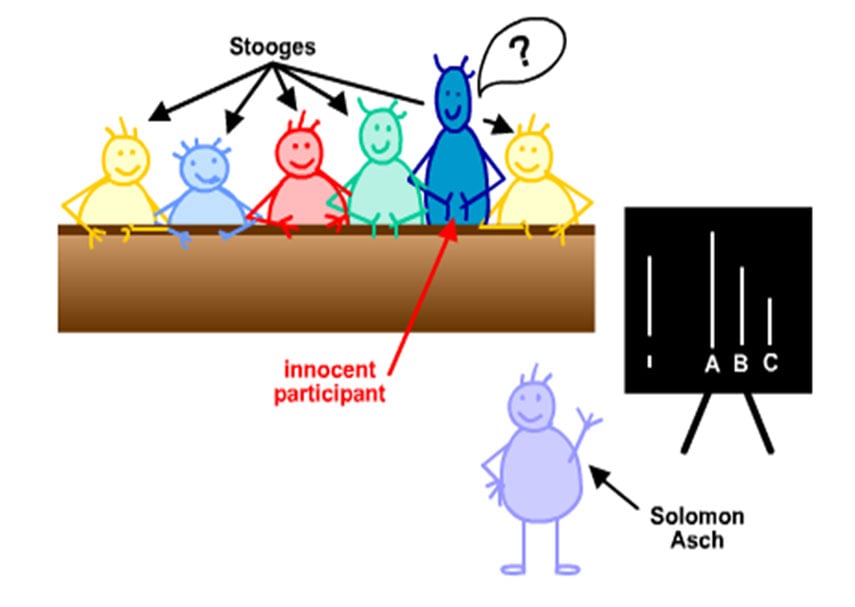
In the experiments, groups of participants were asked to match the length of lines on cards, a task with an obvious answer.
However, each group only included one real participant, with the rest being confederates instructed to give the incorrect answer.

Ethical Issues
It is important to remember that formal ethical guidelines for psychological research were not yet in place at the time Asch conducted his studies in the early 1950s.
Consequently, judging his methods by today’s criteria means we are applying rules and protections that did not exist during his era.
While this does not excuse the potential harm some participants experienced, it does help us understand why Milgram’s study unfolded with less participant protections than we would deem acceptable now.
1. Deception and Informed Consent:
Participants were deliberately misled about the true purpose of the experiment.
They believed they were in a vision perception test with other genuine participants, when in fact the others were acting according to a script.
Because of this deception, participants could not give fully informed consent to the real scenario (they consented to a “vision test,” not to being subjected to group pressure and deceit).
While deception was common in 1950s social psychology, it is ethically sensitive because it violates the principle of informed consent.
Asch defended the need for deception by arguing that revealing the true aim would cause participants to alter their behavior (invalidating the results).
In other words, some level of deception was deemed necessary to avoid demand characteristics and obtain genuine reactions.
2. Psychological Distress:
The procedure placed individuals in a stressful and uncomfortable position – repeatedly facing a group that unanimously disagreed with them on an obvious fact.
Many participants reported feeling tension, self-doubt, or anxiety when they found their perceptions in conflict with the group.
Those who tried to resist conformity could experience stress from standing out or risk embarrassment in front of others.
Protection from psychological harm is an ethical concern:
Asch did not anticipate extreme harm (indeed, no physical harm was done), but the emotional discomfort in some moments was real.
Fortunately, there were no reports of lasting harm, and the majority of participants said afterward that they were glad to have participated.
Nonetheless, today researchers must carefully consider participants’ well-being in such situations.
3. Right to Withdraw:
Asch did not explicitly report whether participants were reminded of their right to withdraw at any time.
In practice, participants could have withdrawn if they became extremely uncomfortable, but the social pressure and the cover story might have implicitly discouraged withdrawal (since they thought others were counting on them in a vision test).
Modern ethics would require making the right to withdraw clear.
4. Debriefing:
After the trials, Asch thoroughly debriefed his participants.
He informed them of the experiment’s true nature and discussed the results with them, which is how we know about their post-experimental explanations.
The debriefing was an ethical safeguard, allowing participants to understand the deception and to assure them that their feeling of conflict or any embarrassment was part of an important research inquiry.
Asch’s interviews served both ethical and scientific purposes.
Ethically, they helped alleviate any potential negative feelings (since participants learned others also struggled, and that their behavior was normal under the circumstances).
Scientifically, they provided insight into why people conformed or remained independent.
Factors Affecting Conformity
In further trials, Asch (1952, 1956) changed the procedure (i.e., independent variables) to investigate which situational factors influenced the level of conformity (dependent variable).
His results and conclusions are given below:
1. Group Size
Asch (1956) found that group size influenced whether subjects conformed.
The bigger the majority group (no of confederates), the more people conformed, but only up to a certain point.
With one other person (i.e., confederate) in the group conformity was 3%, with two others it increased to 13%, and with three or more it was 32% (or 1/3).
Optimum conformity effects (32%) were found with a majority of 3. Increasing the size of the majority beyond three did not increase the levels of conformity found.
Brown and Byrne (1997) suggest that people might suspect collusion if the majority rises beyond three or four.
According to Hogg & Vaughan (1995), the most robust finding is that conformity reaches its full extent with 3-5 person majority, with additional members having little effect.
2. Lack of Group Unanimity / Presence of an Ally
The study also found that when any one individual differed from the majority, the power of conformity significantly decreased.
This showed that even a small dissent can reduce the power of a larger group, providing an important insight into how individuals can resist social pressure.
As conformity drops off with five members or more, it may be that it’s the unanimity of the group (the confederates all agree with each other) which is more important than the size of the group.
In another variation of the original experiment, Asch broke up the unanimity (total agreement) of the group by introducing a dissenting confederate.
Asch (1956) found that even the presence of just one confederate that goes against the majority choice can reduce conformity by as much as 80%.
For example, in the original experiment, 32% of participants conformed on the critical trials, whereas when one confederate gave the correct answer on all the critical trials conformity dropped to 5%.
This was supported in a study by Allen and Levine (1968). In their version of the experiment, they introduced a dissenting (disagreeing) confederate wearing thick-rimmed glasses – thus suggesting he was slightly visually impaired.
Even with this seemingly incompetent dissenter, conformity dropped from 97% to 64%. Clearly, the presence of an ally decreases conformity.
The absence of group unanimity lowers overall conformity as participants feel less need for social approval of the group (re: normative conformity).
3. Difficulty of Task
When the (comparison) lines (e.g., A, B, C) were made more similar in length it was harder to judge the correct answer and conformity increased.
When we are uncertain, it seems we look to others for confirmation. The more difficult the task, the greater the conformity.
4. Answer in Private
When participants were allowed to answer in private (so the rest of the group does not know their response), conformity decreased.
This is because there are fewer group pressures and normative influence is not as powerful, as there is no fear of rejection from the group.
Frequently Asked Questions
How has the Asch conformity line experiment influenced our understanding of conformity?
The Asch conformity line experiment has shown that people are susceptible to conforming to group norms even when those norms are clearly incorrect.
This experiment has significantly impacted our understanding of social influence and conformity, highlighting the powerful influence of group pressure on individual behavior.
It has helped researchers to understand the importance of social norms and group dynamics in shaping our beliefs and behaviors and has had a significant impact on the study of social psychology.
What are some real-world examples of conformity?
Examples of conformity in everyday life include following fashion trends, conforming to workplace norms, and adopting the beliefs and values of a particular social group.
Other examples include conforming to peer pressure, following cultural traditions and customs, and conforming to societal expectations regarding gender roles and behavior.
Conformity can have both positive and negative effects on individuals and society, depending on the behavior’s context and consequences.
What are some of the negative effects of conformity?
Conformity can have negative effects on individuals and society. It can limit creativity and independent thinking, promote harmful social norms and practices, and prevent personal growth and self-expression.
Conforming to a group can also lead to “groupthink,” where the group prioritizes conformity over critical thinking and decision-making, which can result in poor choices.
Moreover, conformity can spread false information and harmful behavior within a group, as individuals may be afraid to challenge the group’s beliefs or actions.
How does conformity differ from obedience?
Conformity involves adjusting one’s behavior or beliefs to align with the norms of a group, even if those beliefs or behaviors are not consistent with one’s personal views.
Obedience, on the other hand, involves following the orders or commands of an authority figure, often without question or critical thinking.
While conformity and obedience involve social influence, obedience is usually a response to an explicit request or demand from an authority figure, whereas conformity is a response to implicit social pressure from a group.
What is the Asch effect?
The Asch Effect is a term coined from the Asch Conformity Experiments conducted by Solomon Asch.
It refers to the influence of a group majority on an individual’s judgment or behavior, such that the individual may conform to perceived group norms even when those norms are obviously incorrect or counter to the individual’s initial judgment.
This effect underscores the power of social pressure and the strong human tendency towards conformity in group settings.
What is Solomon Asch’s contribution to psychology?
Solomon Asch significantly contributed to psychology through his studies on social pressure and conformity.
His famous conformity experiments in the 1950s demonstrated how individuals often conform to the majority view, even when clearly incorrect.
His work has been fundamental to understanding social influence and group dynamics’ power in shaping individual behaviors and perceptions.
References
Allen, V. L., & Levine, J. M. (1968). Social support, dissent and conformity. Sociometry, 138-149.
Asch, S. E. (1951). Effects of group pressure upon the modification and distortion of judgment. In H. Guetzkow (ed.) Groups, leadership and men. Pittsburgh, PA: Carnegie Press.
Asch, S. E. (1952). Group forces in the modification and distortion of judgments.
Asch, S. E. (1956). Studies of independence and conformity: I. A minority of one against a unanimous majority. Psychological monographs: General and applied, 70(9), 1-70.
Back, K. W., Bogdonoff, M. D., Shaw, D. M., & Klein, R. F. (1963). An interpretation of experimental conformity through physiological measures. Behavioral Science, 8(1), 34.
Bond, R., & Smith, P. B. (1996). Culture and conformity: A meta-analysis of studies using Asch’s (1952b, 1956) line judgment task. Psychological bulletin, 119(1), 111.
Longman, W., Vaughan, G., & Hogg, M. (1995). Introduction to social psychology.
Perrin, S., & Spencer, C. (1980). The Asch effect: a child of its time? Bulletin of the British Psychological Society, 32, 405-406.
Sherif, M., & Sherif, C. W. (1953). Groups in harmony and tension. New York: Harper & Row.

