Simple random sampling is a technique in which each member of a population has an equal chance of being chosen through an unbiased selection method. Each subject in the sample is given a number, and then the sample is chosen randomly.
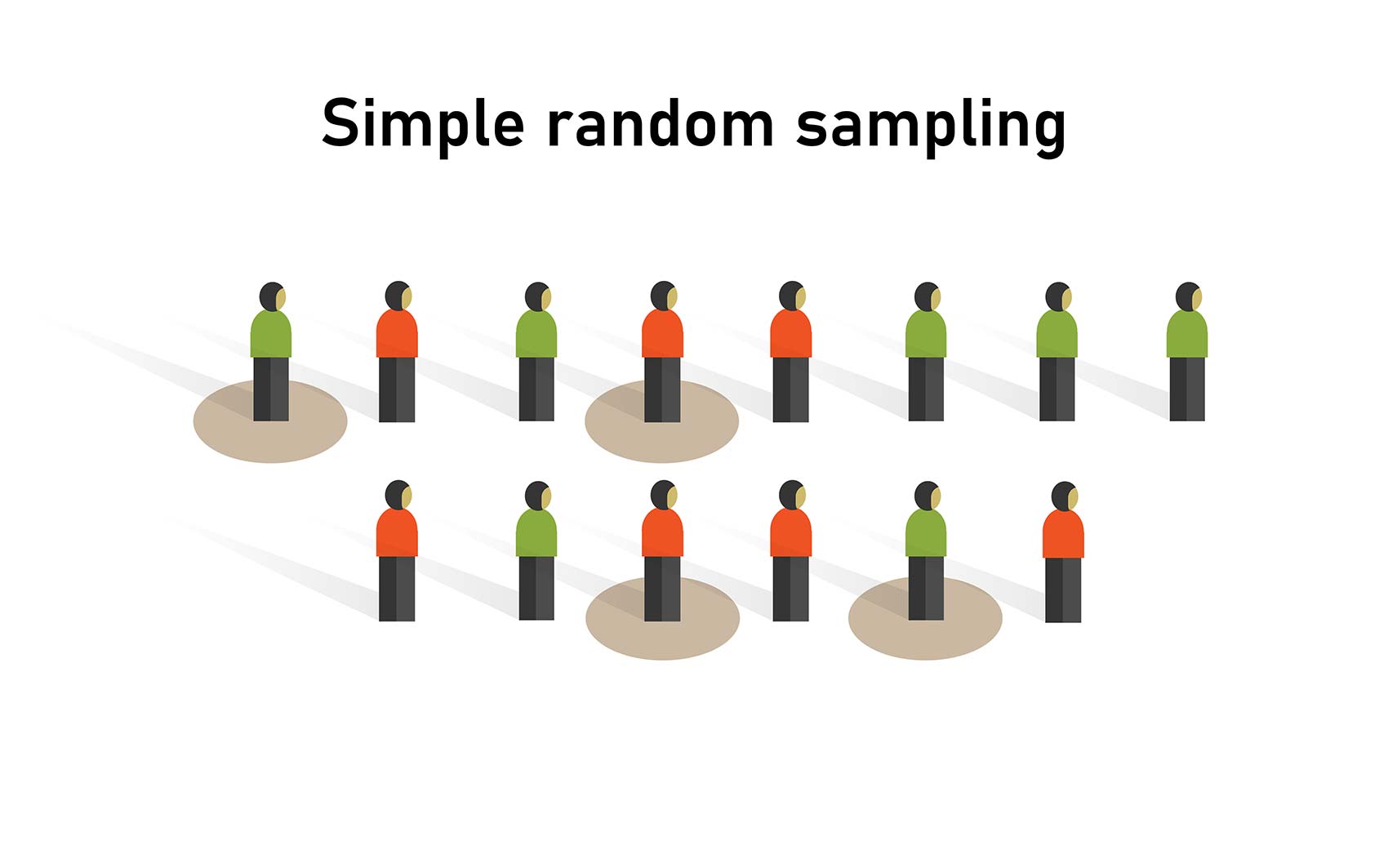
The random sampling method is one of the simplest and most common forms of collecting data, as it provides an unbiased representation of a group. The random subset of selected individuals represents an entire data set.
The goal of simple random sampling is to create a manageable, balanced subset of individuals that is representative of a larger group that would otherwise be too challenging to sample.
Example
For example, if you wanted to conduct a survey about food preferences in a school of 1000 students, and you wanted to sample 100 students.
You could use simple random sampling by assigning each student a number from 1 to 1000, then using a random number generator to pick 100 numbers.
The students assigned those numbers would be the ones you survey.
Method
- First, choose the target population you wish to study and your desired sample size; a smaller sample is less likely to generalize to the wider population.
- The sampling frame is the list of people from which the sample is drawn, such as the electoral register, a school roll, or a register of drug users.
- Then, assign a sequential number to each subject in the sampling frame.
- Next, individuals are selected using an unbiased selection method. Some examples of simple random sampling techniques include lotteries, random computer number generators, or random draws.
Advantages
Minimizes Bias
It is the least biased sampling method: every member of the target population has an equal chance of being chosen, free from researcher influence. Some error is still possible. The method itself is designed to stay unbiased.
Representativeness
Random sampling ensures that every member of the target population has an equal chance of being selected. This helps to ensure that the sample is representative of the population, making it more likely that the findings can be generalized to the entire population.
Limitations
Expensive and time-consuming
It is an expensive and time-consuming method. Getting the name of every member of a large or poorly defined population is difficult, so simple random sampling is rarely used in practice.
Random sampling remains the ideal for eliminating bias, but a fully random human sample is rarely achievable, so researchers often randomise as much as practically possible instead.
Access to respondents
This is hard to achieve, especially with a large population. Participants do not choose to take part, so researchers must actively track each person down and secure their agreement.
Even a perfectly random draw can be pulled back into bias here. If the people willing to take part differ from those who refuse, non-response quietly reintroduces the very bias random selection was meant to remove.
Sampling error
Sampling error is the normal, random gap between a sample’s result and the true population value; it exists simply because a sample is not the whole population.
Unlike sampling bias, this error is not systematic, and it shrinks as the sample size grows. A researcher cannot eliminate it entirely, but a larger, well-drawn random sample keeps it small.
Other techniques
There are four types of random sampling techniques (simple, stratified, cluster, and systematic random sampling).
Stratified Random Sampling
- In stratified random sampling, researchers divide a population into subgroups, or strata, and then randomly select participants from each in the same proportion as the population.
- This method is typically used when a population has distinct differences, such as demographics, level of education, or age, and can easily be broken into subgroups.
Cluster Random Sampling
- Similar to stratified random sampling, cluster random sampling begins by dividing a population into smaller groups.
- However, in cluster sampling, researchers use naturally formed groups to divide a large population up into clusters and then select randomly among the clusters to form the sample.
- Examples of these pre-existing groups could include school districts, city blocks, or households.
Systematic Random Sampling
- Systematic random sampling involves taking random samples at regular periodic intervals.
- For example, if you were conducting a survey in a cafeteria, you could give a survey to every sixth customer that comes into the cafeteria.
Key Terms
- Sample: the participants selected from a target population to represent it in a study. Because a whole population is too large to study directly, a smaller, representative group stands in for it.
- Representative: the extent to which a sample mirrors the target population’s characteristics, such as gender, ethnicity, or socioeconomic status. Sampling methods exist to minimise sampling bias, the over-representation of one group in the sample.
- Generalisability: the extent to which findings from a sample can be applied to the wider population it was drawn from.
Key Takeaways
- Definition: Simple random sampling selects each member of a population by giving everyone an equal, unbiased chance of being chosen, typically via a random number generator.
- Least Biased: It is considered the ideal method because a large, truly random sample should mirror the population on every variable, minimizing systematic bias.
- Sampling Frame: Researchers need a complete list of the population, the sampling frame, before drawing numbers; compiling one is expensive and time-consuming for large populations.
- Non-Response Bias: Even a perfectly random draw can end up biased if people who agree to take part differ from those who decline to join.
- Alternatives: Stratified, cluster, and systematic sampling offer more practical options when a complete population list is unavailable or too costly to compile.
References
Hayes, A. (2021). Simple Random Sample. Investopedia. Retrieved from https://www.investopedia.com/terms/s/simple-random-sample.asp
Simple random sample: Definition and examples. Statistics How To. (n.d.). Retrieved from https://www.statisticshowto.com/probability-and-statistics/statistics-definitions/simple-random-sample/
Simple random sampling: Definition, examples, and how to do it. Qualtrics. (2022). Retrieved from https://www.qualtrics.com/experience-management/research/simple-random-sampling/ nce-management/research/simple-random-sampling/


