Deutsch and Gerrard (1955) identified two reasons why people conform:
- Normative social influence prompts individuals to conform to group norms to fit in, gain acceptance, and feel good.
- Informational social influence leads people to conform, believing the group possesses competent and correct information, especially in ambiguous situations or tasks.
Normative Influence
Normative social influence is where a person conforms to fit in with the group because they don’t want to appear foolish or be left out.
The person conforms to group pressure because they are scared of being rejected by the group.
Normative social influence is usually associated with compliance, where a person changes their public behavior but not their private beliefs. This means any change of behavior is temporary.
The human need for affiliation and acceptance in social groups drives normative influence.
It can cause individuals to adopt behaviors, attitudes, or values that they might not personally hold to fit in or to avoid disapproval from the group.
This theory plays a fundamental role in understanding group dynamics and social behavior, illustrating how the fear of social rejection can significantly influence individual behaviors and decisions.
Examples
- Peer Pressure: A person may feel pressured to smoke because the rest of their friends are. They conform to the group behavior, not out of personal desire but to gain acceptance and avoid social exclusion. Normative social influence tends to lead to compliance because the person smokes just for show, but deep down, they wish not to smoke.
- Fashion Trends: When people follow fashion trends that they don’t necessarily like, it shows the desire to fit in with societal expectations and the fear of standing out or being viewed as different, key aspects of normative social influence.
- Social Media Likes: The trend of posting content on social media that aligns with popular sentiment, even if it doesn’t reflect one’s true opinion, demonstrates the power of normative social influence, as individuals modify their behavior to meet the expectations of the online community and gain social approval.
Asch Line Study
The most significant demonstration of this phenomenon is the 1950s line-judgment research conducted by Solomon Asch. This study proved that social pressure can override sensory evidence.
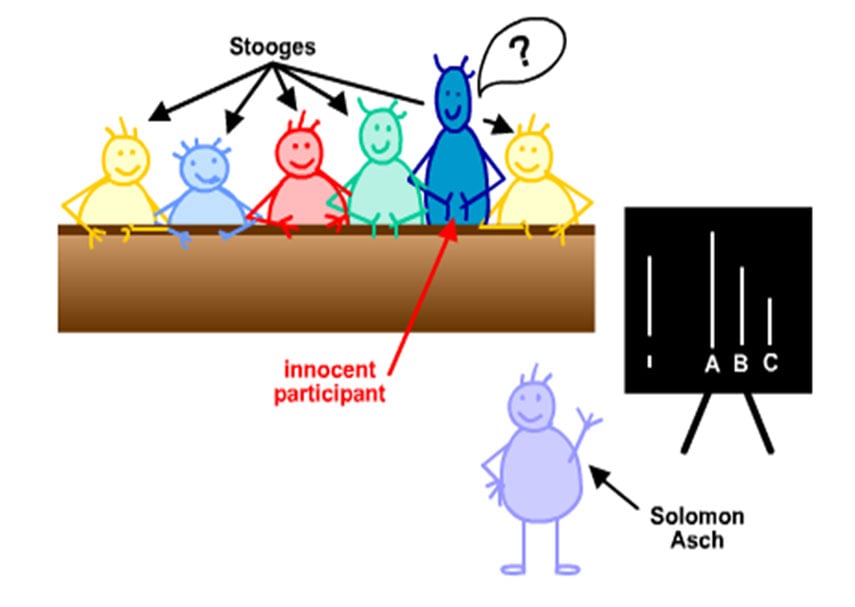
- Aim: To investigate the extent to which social pressure from a unanimous majority causes individuals to conform on an unambiguous task.
- Procedure: Participants were placed in a group with seven confederates: individuals secretly working for the researcher. Each person was shown a “standard line” and asked to match its length to one of three “comparison lines.” The confederates were instructed to give the same incorrect answer on 12 out of 18 trials.
- Findings: The real participants conformed to the incorrect majority on 32% of the critical trials. Seventy-six percent of participants conformed at least once during the experiment.
- Conclusions: People conform to group pressure even when the group is clearly wrong. Post-experimental interviews revealed that participants conformed to avoid social rejection or looking foolish.
When the participants were interviewed after the experiment, most said that they did not believe their conforming answers but had gone along with the group for fear of being ridiculed or thought “peculiar.
This study demonstrated the power of normative influence, as individuals were willing to contradict their senses to conform to the group.
Factors That Affect Normative Influence
According to Bibb Latané’s Social Impact Theory, the likelihood of a person conforming to normative social influence depends on three main variables regarding the group:
- Strength (Importance): How important the group is to the individual. We are much more likely to conform to normative pressures from friends and loved ones because the cost of losing their respect is high.
- Immediacy: How physically and temporally close the group is to the person during the influence attempt.
- Number (Group Size): As the size of the majority increases, so does the normative pressure. However, this effect levels off; going from three to four people has a much larger impact than going from 53 to 54.
Cultural Variations in Conformity
Culture dictates the value placed on group harmony versus individual autonomy. These values directly impact the prevalence of normative social influence.
Collectivist cultures prioritize the “we” over the “I.”
In these societies, conformity is viewed as a sign of maturity and social tact. Meta-analyses demonstrate that conformity rates are significantly higher in these regions.
Conversely, individualist cultures emphasize independence and personal uniqueness. In these environments, conformity is often stigmatized as a sign of weakness or submissiveness.
Consequences of Resisting Normative Influence
If an individual violates group norms and resists normative influence, the group typically reacts negatively.
Initially, group members may increase communication, teasing, or long discussions to bring the nonconformist “back into the fold”.
If the person continues to deviate, the group will likely become angry, say negative things, assign them unimportant tasks, and eventually reject or ostracize them.
However, individuals can earn idiosyncrasy credits.
If you conform to a group’s norms most of the time, you build up a tolerance or “credits” that allow you to occasionally deviate from the group without suffering severe social consequences.
Informational Influence
Informational social influence (ISI) refers to the tendency to conform to what others are doing or saying because we perceive them as a source of accurate information, particularly in ambiguous or uncertain situations.
Informational social influence is where a person conforms because they have the desire to be right and look to others who they believe may have more information.
People may experience an ambiguous (i.e., unclear) situation and socially compare their behavior with the group.
This type of conformity occurs when a person isunsure of a situation or lacks knowledge and is associated with internalization.
Individuals publicly change their behavior to fit in with the group while agreeing with them privately. An internal (private) and external (public) change of behavior.
This theory highlights how the desire to make correct or appropriate decisions can lead to social conformity.
This is the deepest level of conformity, where the group’s beliefs become part of the individual’s belief system.
Examples
- Ambiguous Situations: An example of this is if someone was to go to a posh restaurant for the first time, they might be confronted with several forks and not know which one to use, so they might look to a nearby person to see what fork to use first.
- Emergency Situations: In emergencies, people often look to others to determine how to respond. If everyone else is calm, a person is likely to conclude that the situation isn’t serious, whereas if people are panicking, the person will likely perceive the situation as serious.
- Public Health Crises: During public health crises, people often rely on information from health officials, government leaders, and peers to determine how to protect themselves, reflecting informational social influence.
- Asking for Directions: When lost, people usually ask locals for directions as they are assumed to have accurate information about the area.
- Learning a New Job: When starting a new job, people often look to coworkers for cues on how to behave, especially when unsure of the rules or expectations.
Sherif’s Autokinetic Effect Experiment
In this classic study, participants were shown a stationary pinpoint of light in a dark room and asked to estimate how far the light moved.
When individuals made estimates in a group, their estimates converged, illustrating informational social influence as they used others’ estimates as a guide in an ambiguous situation.
Jenness’ Bean Jar Experiment
Jenness conducted a study on conformity where participants were asked to estimate the number of beans in a jar. Initially, each participant made an individual estimate, and then, they estimated it as a group.
His findings indicated that when the task was performed within a social group, participants’ estimates converged to a similar value, despite their initial individual estimates varying significantly.
This study effectively demonstrated the influence of the majority, proving that a group can impact individuals’ behaviors and beliefs.
This is likely an instance of informational social influence, as participants would be unsure about the actual number of beans in the jar.
Real-World Consequences and Dangers
While relying on others is often a rational strategy, informational influence has profound and sometimes dangerous implications:
- Contagion and Mass Panic: Relying on others can backfire disastrously if the surrounding crowd is also misinformed. In confusing crises, inappropriate emotions and behaviors can spread rapidly through a crowd, an effect known as “contagion”. For example, during the 1938 War of the Worlds radio broadcast, listeners who tuned in late were confused about the fictional alien invasion. They looked to the worried faces of their family and friends, which validated their fears and escalated the situation into a very real mass panic.
- Bystander Effect: ISI plays a critical role in pluralistic ignorance during emergencies. If a person hears a scream but the situation is ambiguous, they will look to other bystanders. If everyone is trying to appear calm while secretly observing each other, the group’s collective inaction convinces each individual that the situation must not be an emergency, leading to a failure to help.
- Minority Influence: While a majority often gains public compliance through normative pressure, a consistent minority can change a majority’s view through informational influence. By introducing novel, unexpected information, the minority forces the majority to carefully examine the issue, which can lead to genuine private acceptance or “conversion”.
- Group Polarization: In group decision-making, ISI helps explain why a group’s collective stance often becomes more extreme than its members’ initial individual views. During discussion, members share supportive arguments and information that others had not previously considered, pulling the group further in the dominant direction.
Learning Check
Here are some real-life examples of conformity. For each one, identify the type of conformity that is happening. You should try to explain your answers.
- Sam has just started work in an office. On his second day there, his colleagues discussed asylum seekers coming to the UK. His colleagues thought that they received favorable treatment from the government and that this should stop. Sam doesn’t agree with this view, but when asked what he thought, he said his colleagues were right.
- Parvinder is a police officer. Her friends have remarked that when she is off duty, she is a relaxed and easygoing person, but when she is in uniform, she becomes much more serious and authoritative. It’s almost as if she was two different people.
- Emma is a student. When she first went to university, she made friends with a group of students who were passionate about animal rights. Emma didn’t have strong opinions on animal research then, but over the past few months, she has become very much against it. Now she has joined a campaign against animal research and has started attending public demonstrations with her friends.
- It is Jim’s first day of college, but he arrived late and missed the part where a lecturer told all the new students what they should do during induction. He sees a group of students filing off towards a corridor and decides to follow them.
- Jan and Norah have just finished their first year at university, living in a house with six other students. All the other students were very health conscious and ate only organic food. Jan had listened to their point of view, and now she also eats only organic food.
- Norah was happy to eat organic food while in the house, but when she went home for the holidays she ate whatever her mother cooked. Both girls conformed but for different reasons. Explain which type of conformity each girl was showing.


References
Asch, S. E. (1951). Effects of group pressure upon the modification and distortion of judgment. In H. Guetzkow (ed.) Groups, leadership and men. Pittsburgh, PA: Carnegie Press.
Deutsch, M., & Gerard, H. B. (1955). A study of normative and informational social influences upon individual judgment. The Journal of Abnormal and Social Psychology, 51(3), 629.
Jenness, A. (1932). The role of discussion in changing opinion regarding a matter of fact. The Journal of Abnormal and Social Psychology, 27, 279-296.
Sherif, M. (1935). A study of some social factors in perception. Archives of Psychology, 27(187).