The biomedical model is the Western medical view that health is the absence of disease. It holds that disease is a biological fault such as a germ, a gene or a chemical imbalance. It treats the body like a machine to be diagnosed and repaired. Critics argue it ignores the mind and social world.
Key Takeaways
- The Model: Health is the absence of disease, and disease is a physical fault that a doctor finds and repairs.
- Five Assumptions: Mind and body are separate, disease is explained in small parts, each disease has one cause, the body is a machine, and disease departs from a norm.
- Strengths: It made targeted treatment and objective diagnosis possible, and it remains correct for acute single-cause disease (Wade & Halligan, 2017).
- Engel’s Challenge: In 1977 Engel called the model a dogma that ignores the psychological and social levels of illness (Engel, 1977).
- The Evidence: Stress, social position and expectation are each linked to physical health, a link the model rules out (Cohen et al., 1991; Marmot et al., 1991; Kaptchuk et al., 2010).
- Criticisms: It sidelines the patient, rests on a mind-body split, fits long-term illness poorly and can over-medicalise.
- Integration: The biopsychosocial model adds psychological and social levels to the biological. Wade and Halligan (2017) argue for embedding biomedicine, not discarding it.
How Does the Biomedical Model Explain Illness and Treatment?
The Doctor and the Patient
The model gives each person a clear job. The doctor finds the fault and repairs it. The patient receives the treatment.
That follows from the machine picture. If the body is a machine, the doctor is the technician who diagnoses what has broken and fixes it. The fix is physical: a drug, an operation or radiation.
The patient’s part is smaller. As the psychiatrist George Engel pointed out in 1977, the model treats illness as a biological accident beyond a person’s control.
So people are not responsible for their illnesses. Responsibility for treatment rests with the medical profession (Engel, 1977).
The model also draws a sharp line between disease and illness.
Disease is a physical abnormality that tests can show. Illness is the patient’s own experience of being unwell: the pain, the worry, what it means for their life.
The model treats disease as the real problem. At most, illness is a result of it, not a contributor to it.
How the Model Explains an Illness, Step by Step
The model explains an illness in four steps.
- A symptom appears: Something feels wrong, such as a pain, a cough or a fever. The model reads it as a sign of a physical problem underneath.
- The doctor looks for a physical cause: It might be a germ, a faulty gene, a chemical imbalance or a damaged organ.
- Tests compare the body with a norm: Disease is a measurable departure from normal functioning, such as an abnormal blood pressure, a tumour or a germ where none should be.
- The doctor repairs the fault: A drug, an operation or radiation removes the physical problem. The model assumes that removing it restores health.
Notice what the chain leaves out. In its strongest form, the model holds that illness may have psychological consequences, but never psychological causes (Engel, 1977).
On this view, a worried mind is the result of the disease, not part of its cause.
The Five Assumptions Behind the Model
The model rests on five assumptions. They are rarely stated out loud, but they do most of the work.
- Mind-body dualism: Mind and body are separate. The mind cannot influence physical matter, so beliefs and emotions are irrelevant to how a disease develops.
- Reductionism: A disease is best understood by breaking it into smaller parts, from organ to cell to molecule to gene. Explanation is complete only at the smallest level.
- Specific aetiology: Aetiology means cause. The model assumes each disease has one specific physical cause, such as a germ or a gene, and that finding it points to the cure.
- The body as a machine: The body is a complex machine whose parts can fail and be repaired. The doctor is a technician who diagnoses the fault and fixes it.
- Disease as departure from a norm: Disease is a measurable departure from normal biological functioning. Health and disease are separate states, and the abnormality counts even if the person feels fine.
Together, these ideas form one coherent picture. That coherence makes it easy to mistake the model for reality itself. For more on the second idea, see reductionism.
Where the Assumptions Came From
The model took shape over several centuries, out of philosophy, new technology and a run of scientific discoveries. Three strands matter most.
The first is René Descartes, the seventeenth-century French philosopher. He separated the non-material mind from the material body. He also argued that the body is a machine, governed by the same physical principles as any other.
That split did real work. Calling the body a machine with no soul in its tissues helped frame it as something to study mechanically. This supported research in anatomy and physiology.
The second is Rudolf Virchow, in the mid-nineteenth century. He argued that disease is ultimately a disturbance of cells, a view called cellular pathology.
This replaced humoral theory, the older idea that illness comes from an imbalance of the body’s fluids. Disease became damage at a physical site, which strengthened both reductionism and the machine picture.
The third is germ theory. In the later nineteenth century, Louis Pasteur and Robert Koch showed that specific infectious diseases are caused by specific micro-organisms, or germs.
Koch’s criteria for linking a microbe to a disease gave medicine its template of one cause, one disease.
Microbes were identified for anthrax, tuberculosis and cholera. Vaccination and antibiotics followed.
The approach worked so well for infection that medicine applied it to all disease: find the specific cause, target it, remove it.
By the early twentieth century, these strands had fused into the mature biomedical model. It was built on the lessons of infectious disease. Whether those lessons suit every illness is what the rest of this article tests.
An Example: Two Patients, One Worrying Symptom
Take two invented patients who both see a doctor with the same worrying symptom. Follow what the model does with each.
Maya has a bacterial chest infection. A test finds the germ. The doctor prescribes an antibiotic, which targets it. One physical cause meets one physical remedy.
This is the model at its best. Its four steps fit Maya’s case closely: a symptom, a physical cause, a test, a repair.
Sam has long-standing heart disease. The doctor measures what can be measured and prescribes treatment for the fault. The prescription is correct.
But Sam’s case does not fit so neatly. There is no single germ to find.
His condition has built up over years, shaped by his genes, his habits, his surroundings and his circumstances. A correct prescription also helps only if he takes it.
Whether he does depends on what he believes about it, how well he understands it, and whether he trusts his doctor.
The same model, the same doctor, a different fit. For Maya, the model explains the problem and solves it. For Sam, it explains part of the problem and risks missing the rest.
Everyday Situations Read Two Ways
The table reads four situations through the model’s eyes. It shows what the model looks at and what it leaves out.
| Situation | What the model looks at | What it leaves out |
|---|---|---|
| A broken bone | The break, shown on an image, then set or repaired. | Very little. The cause is physical and local, so the model fits well. |
| A bacterial chest infection | The germ responsible, which a targeted treatment can remove. | Very little. One physical cause meets one physical remedy. |
| Long-standing heart disease | The damaged heart and the physical signs that tests can measure. | How genes, behaviour, surroundings and circumstances combined over the years. |
| A prescription not taken | The correct drug for the diagnosed fault. | Why the patient is not taking it: beliefs, understanding, trust and circumstances. |
In the first two rows, the model sees nearly everything that matters. In the last two, it sees the fault but not the whole situation.
The model is not wrong in any row. In the last two, it is incomplete.
What Does the Evidence Say About the Biomedical Model?
Engel’s challenge is only as strong as the evidence behind it. This section tests the model’s blind spots.
In principle, the model rules out psychological and social causes of physical illness. That makes it easy to test. If such causes exist, the model has a blind spot, and the studies below look for them.
Engel’s Challenge (1977)
George Engel was an American psychiatrist and internist, meaning a specialist in internal medicine.
In 1977 he published a paper in the journal Science called The need for a new medical model: A challenge for biomedicine (Engel, 1977). He called the biomedical model a dogma, meaning a belief held without question.
The paper is an argument, not an experiment. So the block below has an Argument and Claims where an experiment would have a Method and Results.
Engel saw nature as a hierarchy of levels, from molecules up to the person, the family and the community. He said the biomedical model stops at the organ or the cell.
- Aim: To show that the biomedical model had become a reductionist dogma, an unexamined “folk model” passing as science, and to propose a broader model that is still scientific.
- Argument: Engel named two founding commitments, reductionism and mind-body dualism. He said they had stopped being working hypotheses and become an article of faith. Data that biochemistry could not explain were ignored or forced to fit.
- Claims: Whether a biological abnormality produces illness depends on the person’s psychological state and social circumstances. Grief can disturb the body with no physical damage. Diabetes and schizophrenia involve biology, mind and society together.
- Conclusion: Medicine needs a model that is still scientific but not reductionist: the biopsychosocial model, in which biological, psychological and social levels interact. Engel argued it is more scientific, not less, because it refuses to ignore clinically relevant data.
Engel’s paper is an argument, so it shows what the model leaves out in principle. It cannot show that the gaps are real.
It grants the model its successes and questions only whether biology alone is enough. Engel later showed how a doctor might apply his model to a real case, reasoning across the biological, personal and social levels at once (Engel, 1980).
The studies below test whether the gaps exist.
Stress and the Common Cold (Cohen et al., 1991)
A strong form of the biomedical view says that a germ simply equals a disease. Cohen et al. (1991) tested whether the same virus affects everyone alike.
- Aim: To test whether people under more psychological stress are more likely to catch a cold when exposure to the virus is held constant.
- Method: 394 healthy adults first completed measures of stress, including stressful events and negative mood. In quarantine, they were then given nose drops containing one of five respiratory viruses. Researchers recorded who became infected and who developed a cold.
- Results: Infection and colds became more common as stress rose, for all five viruses. The link held after allowing for health habits, so stressed people’s poorer self-care could not explain it.
- Conclusion: Psychological stress raised the chance of infection. The same virus at the same dose made some people ill and not others, depending on their stress. A psychological factor changed a biological outcome.
Because the researchers controlled the dose of virus, differences in exposure cannot explain the result. Stress was measured before anyone was exposed, so the cold cannot have caused the stress.
There are limits. Stress was measured, not assigned, so other differences between people could still play a part, although the researchers allowed for many, including health habits.
The study also tested healthy adults and the common cold. It shows that stress can raise the chance of infection, not that it causes other diseases.
Our article on stress and the immune system explains how stress affects the body’s defences.
The Social Gradient in Health (Marmot et al., 1991)
The second strand moves from the laboratory to the workplace.
Marmot et al. (1991) studied British civil servants, the people who staff government offices. They asked whether health follows social position, even among people who are all in work.
A steady change in health from the top of the job ladder to the bottom is called a social gradient.
- Aim: To find out whether health varies across the whole range of job grades in the British civil service, from senior administrators to clerical staff, not just between the poor and everyone else.
- Method: Whitehall II recruited over 10,000 London civil servants aged 35 to 55. At the start, it measured their health and their risk factors, such as smoking and blood pressure, which raise the chance of disease.
- Results: The lower the grade, the worse the health and the more risk factors. Lower grades also reported less control at work and less social support. The gradient ran across all grades, not just the bottom.
- Conclusion: Health follows social position even among people who are all in work. That points to causes beyond the individual body, such as social position and the quality of working life.
Because the gradient ran across all the grades, poverty alone cannot explain it. The lower grades also carried more of the usual physical risk factors, which may account for part of the gap.
The study describes a pattern in one group at the start of a long study. It cannot show which feature of work or life matters.
Its sample was also London civil servants aged 35 to 55, so it cannot show that the same gradient holds elsewhere.
The Placebo Effect: What It Shows and What It Does Not
A placebo is an inert treatment, such as a sugar pill, with no active ingredient. The placebo effect is genuine improvement in a real symptom after one.
The biomedical model struggles to explain it. If only a physical treatment acting on a physical fault can change a physical symptom, an inert pill should do nothing.
Beecher (1955) reviewed clinical trials and drew attention to the “powerful placebo”. He estimated substantial average relief from dummy treatments. The Cochrane review below found a small pooled benefit.
Kaptchuk et al. (2010) tested a placebo that patients knew was a placebo.
Patients with irritable bowel syndrome, a gut condition with real physical symptoms, were assigned by chance to placebo pills or to no treatment. This design is a randomised controlled trial.
The patients given pills were told openly that the pills were inert, with no active medication. They still reported significantly greater improvement in symptoms than the no-treatment group. There was no deception and no active drug.
The effect is narrower than the popular story suggests.
A Cochrane review, a type of research summary, looked at 234 trials. Each had both a placebo group and a no-treatment group (Hróbjartsson & Gøtzsche, 2010). A no-treatment group shows what happens with nothing at all.
The review found a small benefit overall, larger when patients rated their own symptoms, such as pain, though small trials may have exaggerated it.
The authors concluded that placebos have no important clinical effect in general. But they can shift patient-reported symptoms, notably pain and nausea.
A trial in asthma shows the same split (Wechsler et al., 2011).
Each patient went through four conditions in turn: the real drug (albuterol), a placebo inhaler, sham (fake) acupuncture, and no treatment. Objective lung function improved much more with the real drug.
Patients’ own ratings of improvement were similar for the real drug, the placebo and the sham acupuncture. They were lower only for no treatment.
Both research teams caution that these ratings are hard to separate from biased reporting. Biased reporting means answers coloured by what patients expect.
So the placebo effect qualifies the model. It does not refute it. Expectation and the meaning of care can change how much better patients report feeling. Neither study suggests that a placebo replaces treating the underlying fault.
That is why the biopsychosocial view adds to biomedicine instead of replacing it.
Health Behaviour, Adherence and Long-Term Illness
Engel (1977) argued that some decisions sit outside biology.
One is whether a person seeks care. Another is whether they follow the treatment. He called these psychosocial, meaning psychological and social, not biological.
That matters because a correct treatment works only if the patient takes it.
Non-adherence means not taking treatment as directed. A model that treats the patient as a recipient has little to say about it.
Prevention raises the same problem. Preventing a disease that behaviour contributes to means changing what people believe and do before any fault appears. A model that looks only for physical faults has little to offer there.
Wade and Halligan (2017), reviewed next, add a modern point. They argue that chronic disease, meaning long-term illness, and multimorbidity, meaning several long-term conditions at once, now predominate in health care.
This change, from short-lived infections to long-term conditions, is called the epidemiological transition.
A Review Forty Years On (Wade and Halligan, 2017)
Wade and Halligan (2017) revisit Engel’s argument some forty years later. Their review is titled The biopsychosocial model of illness: A model whose time has come.
- Aim: To re-assess the biomedical and biopsychosocial models after four more decades of evidence, and to argue that the biopsychosocial model is now necessary and practical for health care.
- Method: A conceptual review, with no sample and no new data. The authors weighed the model’s shortcomings against modern practice, including chronic disease, multimorbidity and medically unexplained symptoms (symptoms doctors cannot explain).
- Argument: The biomedical model remains correct and essential for acute (short-lived) single-cause disease. But it fails to account for much of today’s illness burden, the authors argue, and a biopsychosocial model explains illness and organises care better.
- Conclusion: Health care should embed biomedicine within an integrated biopsychosocial model, not discard it. The authors expect better outcomes and, potentially, contained costs.
This is an argument by two authors, not a test of the model. It has no sample and no data of its own.
What it adds is a modern restatement of Engel’s case, with a practical focus on how health systems might use it.
Whether integration improves outcomes and contains costs is what the authors expect, not something the review demonstrates. Like Engel, they grant biomedicine its achievements. The evidence for the model’s blind spots rests on the studies above.
Strengths of the Biomedical Model
The model has four main strengths:
- Infectious Disease: Germ theory led to new vaccines and antibiotics, which gave doctors a way to prevent and treat infections that had long been major killers.
- Targeted Treatment: Treating disease as a specific physical fault made treatments aimed at that fault possible, such as insulin for diabetes and antibiotics for bacterial infection.
- Objective Diagnosis: Defining disease as a measurable departure from a norm gave medicine tests and scans that make disease visible and let treatments be checked against physical outcomes.
- Testable Science: The model replaced older fluid-based and mystical ideas with hypotheses that can be tested, refuted and refined.
These strengths are real. Engel (1977) granted them. He questioned only whether biology alone is enough.
Limitations of the Biomedical Model
Before working through each one, here is a one-line summary of the main criticisms:
- Patient Sidelined: By treating the body as a machine, the model leaves little room for the patient’s experience and active part in care.
- Mind-Body Split: Dualism rules out psychological causes before any evidence is gathered, and the evidence above points the other way.
- Single-Cause Thinking: The search for one physical cause suited infection but fits long-term, multi-causal illness poorly.
- Over-Medicalisation: Defining disease as a departure from a norm lets more of normal life be labelled as medical.
- Clinical Blind Spots: Grief, unexplained symptoms and prevention sit outside a model built on finding a physical fault.
The Patient’s Experience and Agency
Engel (1977) argued that the doctor-patient relationship itself affects outcomes.
The interview, the meaning the patient gives the illness and the trust between them all matter. A model that treats the patient as a broken machine cannot see any of this.
The cause lies in the assumptions. The model separates objective disease from the patient’s experience of illness, and treats the first as the real problem.
The patient’s fears, beliefs and priorities become, at most, a result of the disease. Yet the patient lives with the experience of illness. Engel also saw seeking care and following treatment as psychosocial processes.
This criticism concerns scope, not truth. Nobody has to deny that disease is real to say the person who has it also matters.
The Mind-Body Split
Engel (1977) argued that dualism had stopped being a working hypothesis and become an article of faith. The problem lies in how the assumption works.
If the mind cannot influence physical matter, psychological causes of physical illness are impossible by definition. Evidence could never show them. The question is closed before any data are gathered.
That is a poor way to treat a factual question. A scientific model should let evidence decide whether the mind affects the body.
Once the question is opened, the studies above point the other way (Cohen et al., 1991; Marmot et al., 1991; Kaptchuk et al., 2010). The split is hard to defend.
Dualism was not useless. As the history above showed, treating the body as a machine opened the way to anatomy and physiology. The criticism is that a useful starting point was treated as settled fact.
Single-Cause Thinking and Long-Term Illness
Germ theory taught medicine to look for one specific cause. When that worked for infection, the lesson was applied to every disease.
It fits long-term illness poorly.
Engel (1977) took diabetes and schizophrenia as his main examples. In both, biological vulnerability interacts with psychological and social factors in onset, course and management.
Wade and Halligan (2017) make the same point at the level of health care. They argue that the model fails to account for much of today’s illness burden, where chronic disease and multimorbidity predominate.
The cost is a narrow search. A model that keeps looking for one physical cause looks for the answer inside the body. It may overlook the behaviour and circumstances around it.
Sometimes a single physical cause does exist. In a bacterial infection, looking for one cause is exactly right. The criticism is that the approach was stretched beyond such cases.
Over-Medicalisation
The model defines disease as a departure from a measurable norm. That definition can stretch.
The criticism is medicalisation: treating normal variation, distress, ageing and social problems as medical conditions that need medical treatment.
The mechanism lies in the assumption about norms. An abnormality counts as disease whether or not the person feels or functions as ill. So more of life can be measured against a norm and labelled.
The concern is a technical fix for what are really problems of living or of society.
The debate is sharpest in mental health. There the same tendency raises questions about labelling and social control, which our article on the medical model of mental health covers.
The criticism here concerns the model’s reach, not its truth where a real physical fault exists.
Grief, Unexplained Symptoms and Prevention
Engel (1977) pointed to grief as a case the model cannot classify.
Grief is a normal response to loss. It can produce real bodily disturbance, and even death. There is no primary lesion, meaning no physical damage.
Wade and Halligan (2017) add the influence of context on outcomes. They also point to the prevalence of medically unexplained symptoms in modern practice.
In these cases the model may find little to point to, such as no germ and no primary lesion. It then has little to offer.
Prevention poses a similar problem, as the evidence section noted. It works before any fault exists. Taken together, these cases show how much of health care a model built on finding a fault can miss.
Where Is the Biomedical Model Still Used?
The criticisms ask whether the model is enough, not whether it is useful. Three areas show where it is still the right tool.
Acute, Single-Cause and Surgical Problems
Some problems have one clear physical cause. A broken bone, an inflamed appendix, a bacterial pneumonia and a bleeding artery are examples. So is a diabetic’s need for insulin.
Here the machine picture fits. In an emergency, the right move is to locate the fault and fix it, fast.
Wade and Halligan (2017) agree. They argue that the biomedical model remains correct and essential for acute single-cause disease. The question is not whether the model works here. It is whether it is enough everywhere else.
Diagnostics and Imaging
Imaging, laboratory tests, microbiology and genetic testing all rest on the same idea: disease can be measured against a physical norm. They make disease visible and let doctors track it over time.
These tools do not belong to the biomedical model alone. Engel’s biopsychosocial model keeps the biological level and adds to it (Engel, 1977). So the tools that examine the body stay useful in both models.
Drugs and Biotechnology
Drug treatment follows the model’s repair logic. Find the physical mechanism, then target it.
Molecular biology, genomics (the study of genes) and immunotherapy (treatment that works through the immune system) follow the same logic. They explain illness at ever smaller scales, from the organ to the cell to the gene.
They are direct descendants of germ theory and cellular pathology, described above. The model is still a living research programme.
How Does the Biomedical Model Compare with Other Models?
Biomedical vs. Biopsychosocial Model
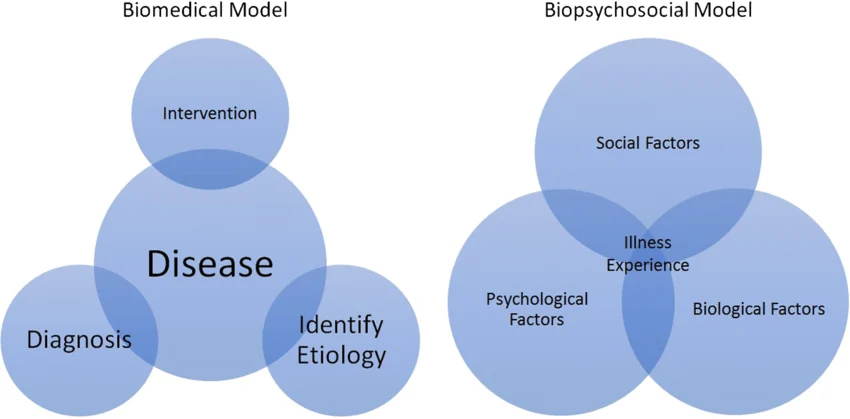
The biopsychosocial model is Engel’s alternative. He proposed it as a broader model that keeps biology and adds to it. The table sets out the contrast on four points, using Engel’s account (Engel, 1977, 1980).
| Dimension | Biomedical model | Biopsychosocial model |
|---|---|---|
| What causes illness | A physical fault in the body, such as a germ, a gene or a chemical imbalance. | Biological, psychological and social levels interact, from molecules up to the person, family and community. |
| What counts as relevant | What can be measured against a biological norm. Mind and social life are set aside. | The biology, plus the person’s psychological state and social circumstances. |
| The patient’s role | A recipient of treatment, not responsible for the illness. | The patient’s experience, beliefs and choices, such as seeking care and following treatment, are part of the picture. |
| The doctor’s role | A technician who finds the fault and repairs it. | Reasons across biological, personal and social levels. The doctor-patient relationship itself affects outcomes. |
Engel argued that this makes his model more scientific, not less, because it refuses to ignore clinically relevant data. His point concerns scope, not whether biology matters. The question is whether biology alone is enough.
The two are better seen as a narrower and a broader framing of health than as rival theories. Wade and Halligan (2017) likewise argue for embedding biomedicine, not discarding it.
Biomedical Model vs. the Medical Model of Mental Disorder
The biomedical model is not the same as the medical model of mental disorder. They are cousins.
The biomedical model covers health and physical illness across the whole of medicine. The medical model of mental disorder applies a similar biological approach to abnormal behaviour, treating it as mental illness.
Both share an ancestor in nineteenth-century biological medicine. But the mental-health version raises its own debates, about labelling, social control and whether psychiatric categories are real. For that model, see our article on the medical model.
Biomedical vs. Holistic: Parts or Whole?
The biomedical model is reductionist: it explains illness by breaking it into parts, from organ to cell to gene.
Holism takes the opposite view. It treats the whole person as the unit that matters, not only the parts. Our article on holism explains the idea.
Engel’s systems view gives holism a medical form.
Every level, from cell to person to family and community, is a whole in its own right and part of the level above. Each has properties that cannot be fully predicted from the level below (Engel, 1977).
Where does the social world fit? In Engel’s model it sits in the upper levels: the family, the community and the culture. The evidence above shows it in the Whitehall II findings.
Reductionism can be used as a research strategy, breaking a problem into parts to study it.
The criticism targets reductionism as a doctrine: the claim that nothing beyond the smallest level adds anything. The wider debate is covered in our article on reductionism.
References
Beecher, H. K. (1955). The powerful placebo. Journal of the American Medical Association, 159(17), 1602-1606. https://doi.org/10.1001/jama.1955.02960340022006
Cohen, S., Tyrrell, D. A. J., & Smith, A. P. (1991). Psychological stress and susceptibility to the common cold. New England Journal of Medicine, 325(9), 606-612. https://doi.org/10.1056/NEJM199108293250903
Engel, G. L. (1977). The need for a new medical model: A challenge for biomedicine. Science, 196(4286), 129-136. https://doi.org/10.1126/science.847460
Engel, G. L. (1980). The clinical application of the biopsychosocial model. American Journal of Psychiatry, 137(5), 535-544. https://doi.org/10.1176/ajp.137.5.535
Hróbjartsson, A., & Gøtzsche, P. C. (2010). Placebo interventions for all clinical conditions. Cochrane Database of Systematic Reviews, 2010(1), Article CD003974. https://doi.org/10.1002/14651858.CD003974.pub3
Kaptchuk, T. J., Friedlander, E., Kelley, J. M., Sanchez, M. N., Kokkotou, E., Singer, J. P., Kowalczykowski, M., Miller, F. G., Kirsch, I., & Lembo, A. J. (2010). Placebos without deception: A randomized controlled trial in irritable bowel syndrome. PLoS ONE, 5(12), e15591. https://doi.org/10.1371/journal.pone.0015591
Marmot, M. G., Stansfeld, S., Patel, C., North, F., Head, J., White, I., Brunner, E., Feeney, A., & Davey Smith, G. (1991). Health inequalities among British civil servants: The Whitehall II study. The Lancet, 337(8754), 1387-1393. https://doi.org/10.1016/0140-6736(91)93068-K
Wade, D. T., & Halligan, P. W. (2017). The biopsychosocial model of illness: A model whose time has come. Clinical Rehabilitation, 31(8), 995-1004. https://doi.org/10.1177/0269215517709890
Wechsler, M. E., Kelley, J. M., Boyd, I. O. E., Dutile, S., Marigowda, G., Kirsch, I., Israel, E., & Kaptchuk, T. J. (2011). Active albuterol or placebo, sham acupuncture, or no intervention in asthma. New England Journal of Medicine, 365(2), 119-126. https://doi.org/10.1056/NEJMoa1103319