Correlation means association – more precisely, it measures the extent to which two variables are related. There are three possible results of a correlational study: a positive correlation, a negative correlation, and no correlation.
Types
- Positive Correlation: relationship between two variables in which both variables move in the same direction. Therefore, one variable increases as the other variable increases, or one variable decreases while the other decreases. An example of a positive correlation would be height and weight. Taller people tend to be heavier.
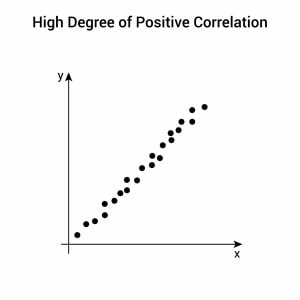
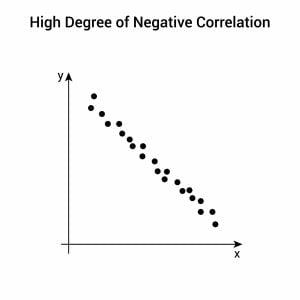
- Negative Correlation: relationship between two variables in which an increase in one variable is associated with a decrease in the other. An example of a negative correlation would be the height above sea level and temperature. As you climb the mountain (increase in height), it gets colder (decrease in temperature).
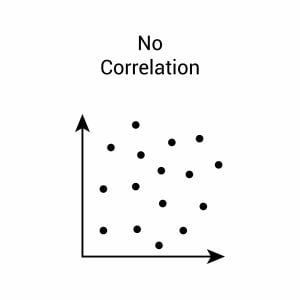
- Zero Correlation: exists when there is no relationship between two variables. For example, there is no relationship between the amount of tea drunk and the level of intelligence.
Scatter Plots
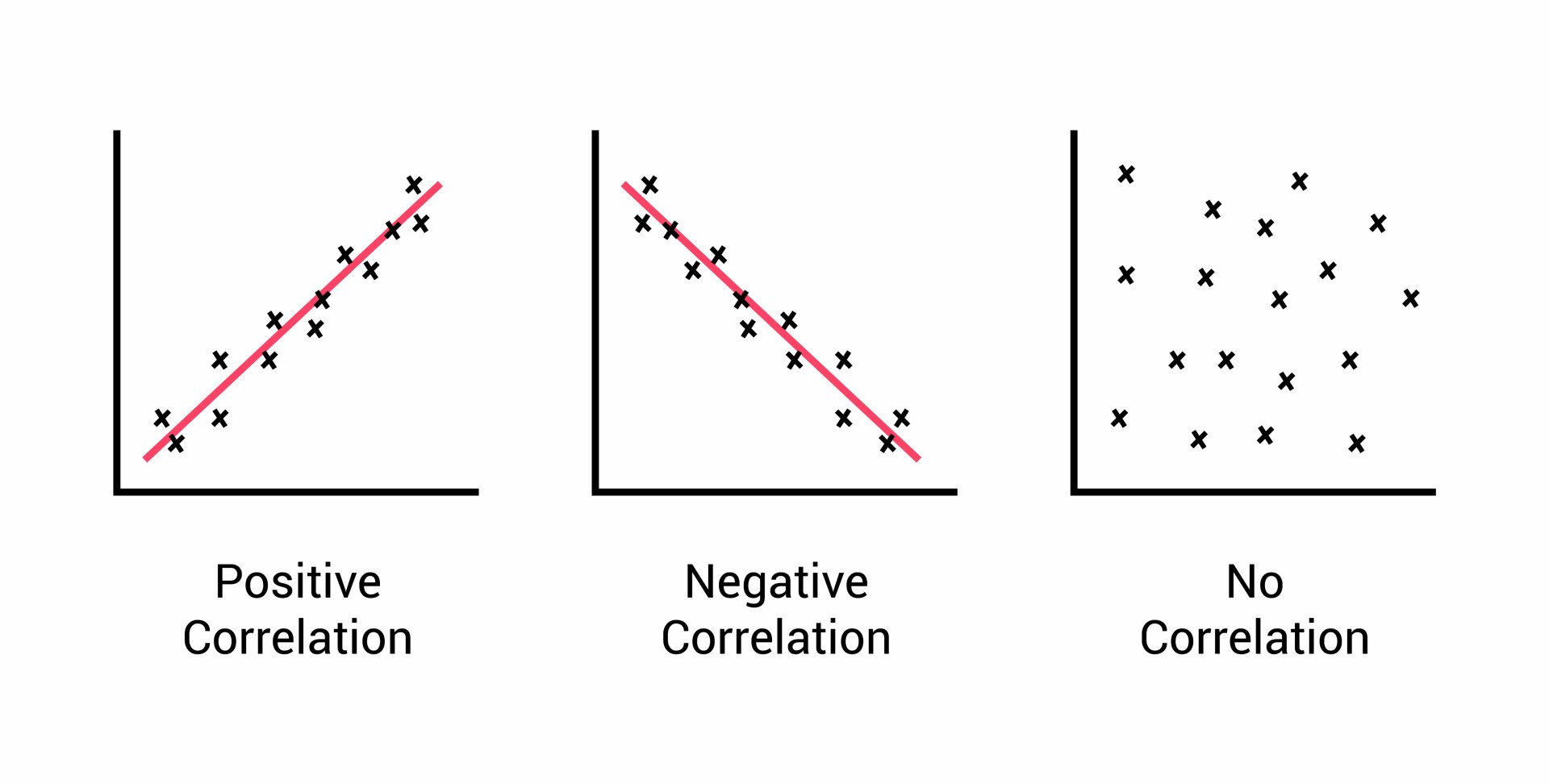
A correlation can be expressed visually. This is done by drawing a scatter plot (also known as a scattergram, scatter graph, scatter chart, or scatter diagram).
A scatter plot is a graphical display that shows the relationships or associations between two numerical variables (or co-variables), which are represented as points (or dots) for each pair of scores.
A scatter plot indicates the strength and direction of the correlation between the co-variables.
When you draw a scatter plot, it doesn’t matter which variable goes on the x-axis and which goes on the y-axis.
Remember, in correlations, we always deal with paired scores, so the values of the two variables taken together will be used to make the diagram.
Decide which variable goes on each axis and then simply put a cross at the point where the two values coincide.
Uses of Correlations
Prediction
- If there is a relationship between two variables, we can make predictions about one from another.
- Occupational Success: Self-report personality tests demonstrate predictive validity when traits measured early in life (like conscientiousness) are shown to be significantly correlated with future job performance, occupational attainment, and even physical health and well-being.
Validity
- Concurrent Validity: Correlation between a new measure and an established measure.
- When a new psychological test is developed, it is often compared against an existing, proven standard. For instance, scores on a newly developed depression questionnaire should be highly correlated with scores on the established Beck Depression Inventory (BDI).
Reliability
- Test-Retest Reliability: If a psychological test (like a personality inventory) is reliable, a person taking it on a Tuesday should get a nearly identical score if they take it again on Friday. The correlation between the two sets of scores should be very high and positive.
- Inter-rater Reliability: When multiple professionals (like mental health diagnosticians or observational researchers) are assessing the same person or data, their judgments must be consistent. Ensuring that two different raters are in agreement is established by correlating their assessments.
Correlation Coefficients
Instead of drawing a scatter plot, a correlation can be expressed numerically as a coefficient, ranging from -1 to +1. When working with continuous variables, the correlation coefficient to use is Pearson’s r.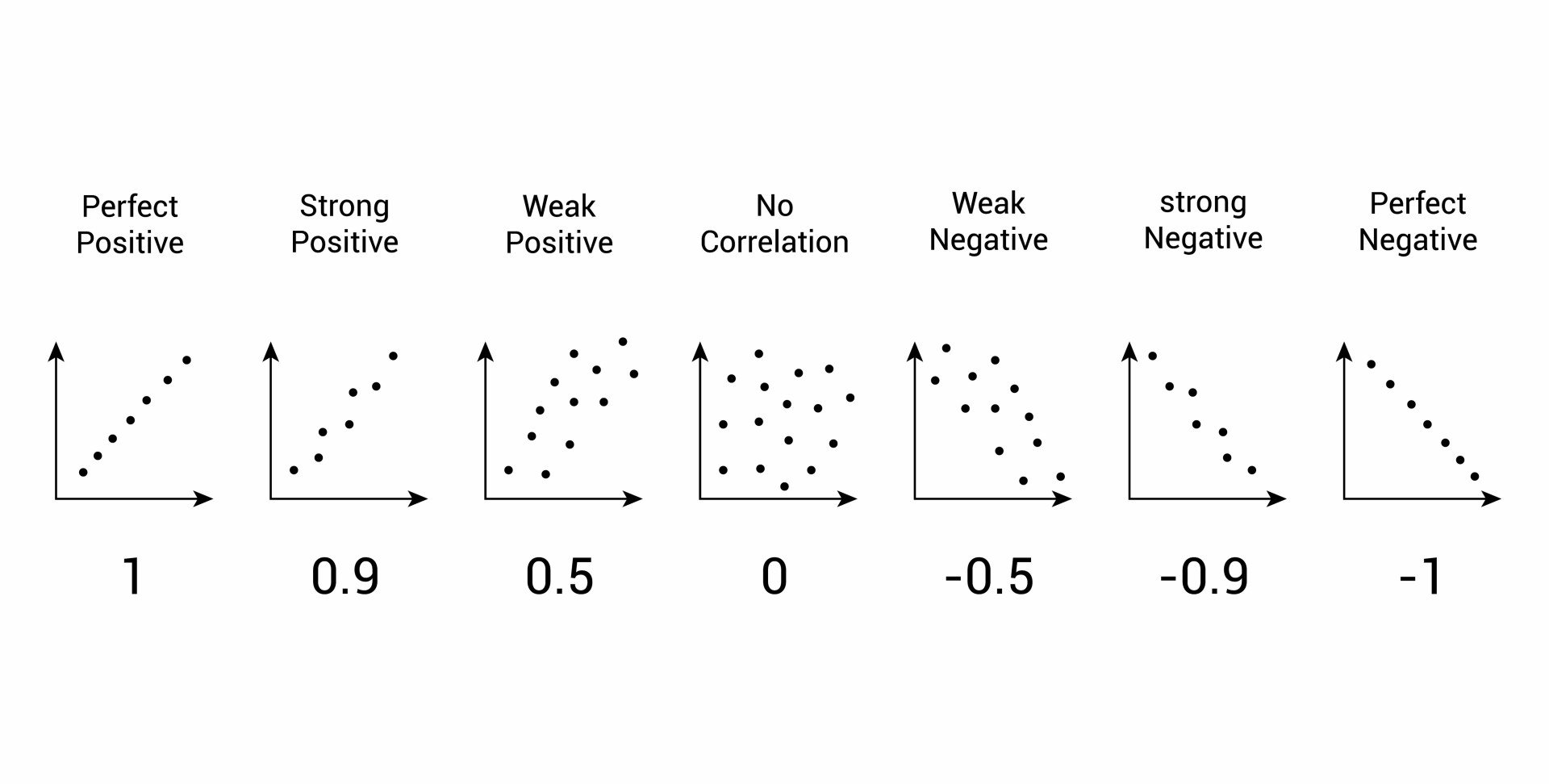
Correlation coefficients are standardized statistical measures used to quantify the strength and direction of the relationship between two variables.
The correlation coefficient (r) indicates the extent to which the pairs of numbers for these two variables lie on a straight line. Values over zero indicate a positive correlation, while values under zero indicate a negative correlation.
A correlation of –1 indicates a perfect negative correlation, meaning that as one variable goes up, the other goes down. A correlation of +1 indicates a perfect positive correlation, meaning that as one variable goes up, the other goes up.
There is no rule for determining what correlation size is considered strong, moderate, or weak. The interpretation of the coefficient depends on the topic of study.
When studying things that are difficult to measure, we should expect the correlation coefficients to be lower (e.g., above 0.4 to be relatively strong). When we are studying things that are easier to measure, such as socioeconomic status, we expect higher correlations (e.g., above 0.75 to be relatively strong).)
In these kinds of studies, we rarely see correlations above 0.6. For this kind of data, we generally consider correlations above 0.4 to be relatively strong; correlations between 0.2 and 0.4 are moderate, and those below 0.2 are considered weak.
When we are studying things that are more easily countable, we expect higher correlations. For example, with demographic data, we generally consider correlations above 0.75 to be relatively strong; correlations between 0.45 and 0.75 are moderate, and those below 0.45 are considered weak.
Correlation vs. Causation
Causation means that one variable (often called the predictor variable or independent variable) causes the other (often called the outcome variable or dependent variable).
Experiments can be conducted to establish causation. An experiment isolates and manipulates the independent variable to observe its effect on the dependent variable and controls the environment in order that extraneous variables may be eliminated.
A correlation between variables, however, does not automatically mean that the change in one variable is the cause of the change in the values of the other variable. A correlation only shows if there is a relationship between variables.
“Correlation is not causation” means that just because two variables are related it does not necessarily mean that one causes the other.
A correlation identifies variables and looks for a relationship between them. An experiment tests the effect that an independent variable has upon a dependent variable but a correlation looks for a relationship between two variables.
This means that the experiment can predict cause and effect (causation) but a correlation can only predict a relationship, as another extraneous variable may be involved that it not known about.
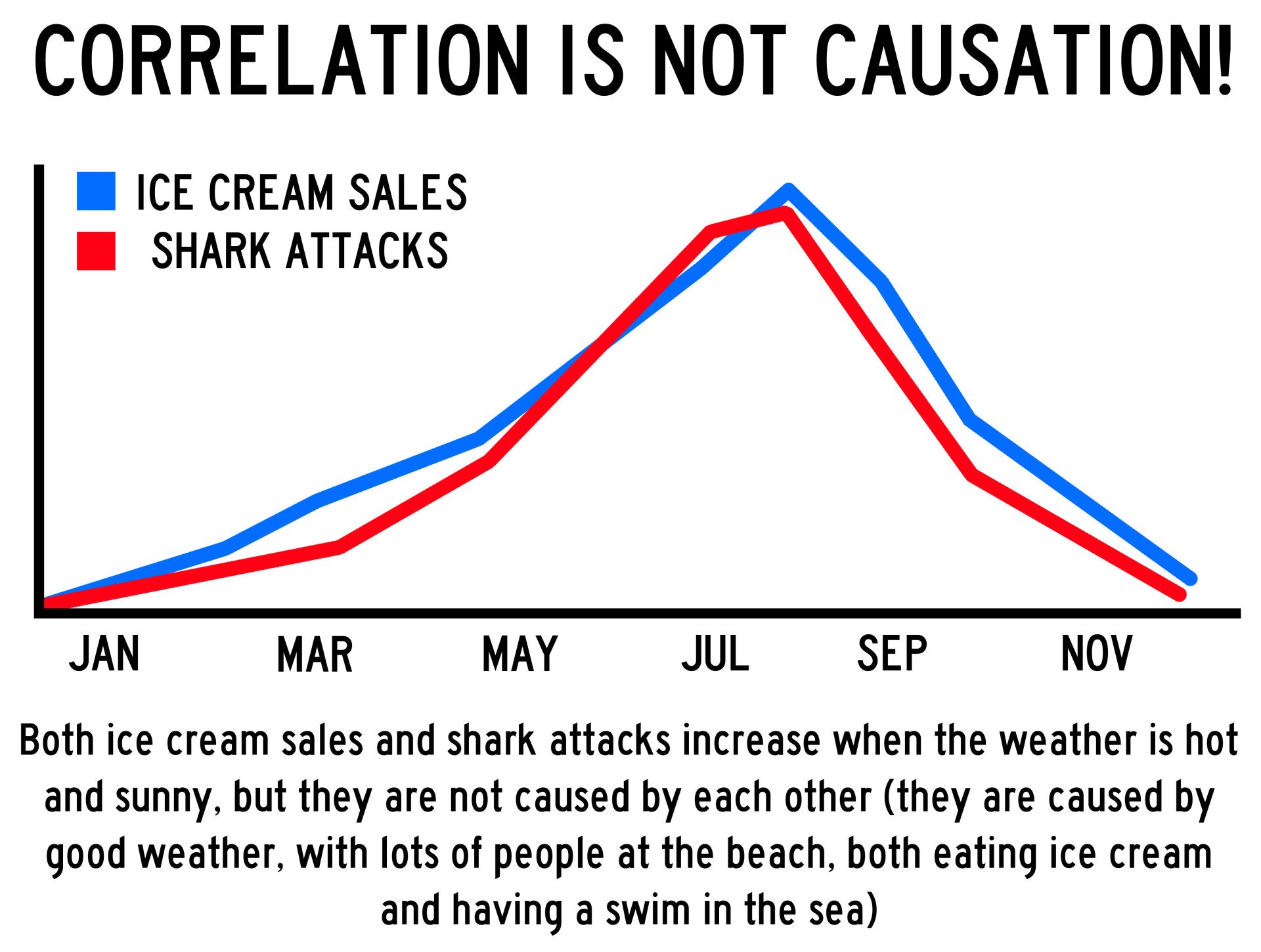

Third-Variable Problem
While variables are sometimes correlated because one does cause the other, it could also be that some other factor, a confounding variable, is actually causing the systematic movement in our variables of interest.
Correlation does not always prove causation, as a third variable may be involved.
The third-variable problem occurs when two variables appear to be systematically related to one another, but there is actually no direct causal link between them.
Instead, the relationship exists because an unseen or unmeasured “third variable” is independently influencing both of the observed variables, creating the illusion of a direct connection.
For example, being a patient in a hospital is correlated with dying, but this does not mean that one event causes the other, as another third variable might be involved (such as diet and level of exercise).
This problem is the primary reason why researchers constantly emphasize that correlation does not imply causation.
Even when a cause-and-effect relationship seems highly intuitive, a correlational study cannot rule out the possibility that a confounding third variable is responsible for the pattern.
Examples of the third-variable problem
To understand how deceptive this can be, consider these examples from the sources:
- Ice Cream and Crime: There is a positive correlation between ice cream sales and crime rates; as ice cream sales increase, so does crime. However, eating ice cream does not cause people to commit crimes. The third, confounding variable is warm weather. Higher temperatures cause more people to buy cold treats, and they also cause more people to leave their homes and interact, which independently leads to an increase in crime.
- Spa Salons and Criminals: A study might find a correlation showing that cities with a larger number of spa salons also tend to have a higher number of criminals. This correlation becomes meaningless once you account for the third variable: city size. A larger city population naturally accounts for both more salons and more criminals.
- Breast Implants and Suicide: A correlation has been observed between individuals having breast implants and committing suicide. It is highly unlikely that the physical implants cause suicide; rather, an extraneous third variable, such as low self-esteem, might independently drive a person to seek cosmetic surgery and also attempt suicide.
- TV Violence and Aggression: While there is a correlation between children watching violent television and exhibiting aggressive behavior, a third variable like neglectful parenting could be the true cause. Parents who do not monitor their children might allow them to watch violent television while simultaneously failing to correct their aggressive behavior.
- Generosity and Happiness: A positive correlation exists between spending money on others and personal happiness. However, wealth could be a third variable that causes both greater happiness and the financial ability to be more generous.
How researchers handle the third-variable problem
Because correlational studies cannot use experimental manipulation to completely isolate variables, researchers must be proactive to ensure their findings are credible.
The best way to combat the third-variable problem is to anticipate potential confounding variables in advance and include them in the research study.
By actively measuring these third variables, researchers can use advanced statistical techniques, such as partial correlations, to mathematically “remove” or hold constant the effect of the third variable.
If the correlation between the original two variables remains significant even after the third variable is factored out, researchers can be much more confident that the relationship is genuine and not spurious.
Strengths of Correlational Research
Correlational research offers several unique advantages that make it an indispensable tool, particularly when exploring complex or naturally occurring phenomena.
- Ability to Study Unmanipulable or Unethical Variables: One of the most significant strengths of correlational studies is that they allow researchers to investigate variables that cannot be manipulated experimentally. For instance, it is completely unethical to deliberately subject participants to high levels of stress or trauma to observe the effects on their health. Similarly, researchers cannot manipulate biological variables like genetics, making correlational methods (such as twin and adoption studies) the primary way to explore hereditary influences on behavior.
- Predictive Value: By determining the strength and direction of a relationship, correlational research provides valuable predictive power. If two variables are strongly correlated, knowing the value of one allows researchers to predict the other. For example, universities use correlational data between standardized test scores (like the SAT) and college GPAs to predict the relative success of incoming applicants.
- Numerical and Comparable Data: Correlational studies provide a specific numerical representation of a relationship, usually in the form of a correlation coefficient (such as Pearson’s r), which ranges from -1 to +1. This yields a standardized metric that makes the strength and direction of relationships extremely easy to interpret, communicate, and compare across different studies.
- Foundation for Future Research: Because they assess how two variables naturally co-occur, correlations serve as an excellent starting point for scientific inquiry. If a strong relationship is detected between two variables, it can generate new hypotheses that researchers can then test using more controlled experimental methods.
- Ecological Validity: Because correlational studies often observe and measure phenomena as they naturally occur in everyday life—without the artificial manipulation found in laboratory experiments—they can capture real-world behaviors and attitudes more authentically.
Limitations of Correlational Research
Despite its usefulness, correlational research carries significant methodological limitations that restrict how the data can be interpreted.
- Inability to Establish Causation: The most frequently cited limitation of correlational research is that it cannot prove cause-and-effect relationships. Even when a relationship seems highly intuitive, the correlational method alone only tells us that two variables change together. For example, if there is a correlation between the amount of violent television children watch and their aggressiveness, it is impossible to know from the correlation alone whether watching the violence caused the aggression, or if naturally aggressive children simply choose to watch more violent television.
- The Third-Variable Problem: A correlation between two variables might exist entirely because a separate, unmeasured “third variable” is influencing both of them. For example, there is a positive correlation between the number of spa salons in a city and the number of criminals. These are not causally linked; rather, a third variable—the overall size of the city—accounts for the increase in both.
- Failure to Capture Curvilinear Relationships: Standard correlation coefficients strictly measure linear relationships, meaning they look for patterns where variables increase or decrease together in a straight line. However, psychological reality is complex, and many variables share a curvilinear (e.g., U-shaped) relationship. For example, if both very young and very old people sleep more, while middle-aged adults sleep less, the relationship forms a U-shape. A standard correlation analysis would likely return a coefficient close to zero, falsely implying that age and sleep are completely unrelated.
- Spurious Correlations: When researchers measure many variables and calculate dozens of correlations in a single study, there is a statistical probability that some of the correlations will appear significant purely by random chance. If researchers only report the significant findings and ignore the rest, they may be promoting “spurious” correlations that do not genuinely exist in reality.
- Lack of Explanatory Depth: While a correlation quantifies that a relationship exists, it rarely explains why it exists. Furthermore, because correlational data is heavily reliant on surveys and self-reports, the data is highly vulnerable to social desirability bias (where participants alter their answers to look good) and lack of self-insight, which can severely compromise the validity of the findings.
FAQs
How do you know if a study is correlational?
A study is considered correlational if it examines the relationship between two or more variables without manipulating them.
In other words, the study does not involve the manipulation of an independent variable to see how it affects a dependent variable.
One way to identify a correlational study is to look for language that suggests a relationship between variables rather than cause and effect.
For example, the study may use phrases like associated with, related to, when describing the variables being studied.
Another way to identify a correlational study is to look for information about how the variables were measured. Correlational studies typically involve measuring variables using self-report surveys, questionnaires, or other measures of naturally occurring behavior.
Finally, a correlational study may include statistical analyses such as correlation coefficients or regression analyses to examine the strength and direction of the relationship between variables.
Why is a correlational study used?
Correlational studies are particularly useful when it is not possible or ethical to manipulate one of the variables.
For example, it would not be ethical to manipulate someone’s age or gender. However, researchers may still want to understand how these variables relate to outcomes such as health or behavior.
Additionally, correlational studies can be used to generate hypotheses and guide further research.
If a correlational study finds a significant relationship between two variables, this can suggest a possible causal relationship that can be further explored in future research.
What is the goal of correlational research?
The ultimate goal of correlational research is to increase our understanding of how different variables are related and to identify patterns in those relationships.
This information can then be used to generate hypotheses and guide further research aimed at establishing causality.
Example Correlation Studies
Vanderhasselt, M. A., Vergauwe, R., Baeken, C., Pulopulos, M. M., & De Raedt, R. (2025). Better together: The importance of brain health in the relationship between stress regulation, social connection and lifestyle in promoting mental health and well-being. Clinical Psychology Review, 102611.