Its core premise is that thoughts, emotions, and behaviors are deeply interconnected, so distorted thinking, not the situation itself, drives distress.
CBT helps people notice these unhelpful thought patterns. It teaches them to replace distorted thinking with more balanced, realistic ways of responding.
CBT Triangle
The CBT Triangle is a foundational model in cognitive behavioral therapy. It shows how thoughts, feelings, and behaviors are interconnected and continuously influence one another, shaping the development and maintenance of psychological disorders.

Recording and categorizing negative thoughts helps people spot and avoid harmful patterns. Surface emotions are often easy to notice, but deeper feelings can still drive reactions without a person realizing it.
Addressing these deeper emotions and changing thought patterns can lead to healthier behavior, helping treat conditions like anxiety or depression.
Thoughts: Cognitive Processes
Situated at the top of the triangle, thoughts serve as the cognitive foundation. Research indicates that individuals produce thousands of thoughts daily.
Among these, cognitive distortions, or erroneous thinking patterns, can significantly influence one’s perceptions and interpretations. Common distortions include:
- All-or-nothing thinking: Viewing situations in binary terms, without considering nuance.
- Catastrophizing: Anticipating the most adverse outcomes without empirical justification.
- Mind Reading: Presuming to understand others’ thoughts without direct evidence.
- Emotional reasoning: Basing conclusions on emotions rather than objective data.
- Labeling: Characterizing oneself or others based on a singular trait or event.
- Personalization: Attributing external events to oneself without a clear causal link.
Intrusive thoughts, which can hinder daily functioning, are common, as evidenced by their mention by therapists.
Many people experience them, suggesting these thoughts might arise from inherent brain patterns rather than facts.
In CBT, challenging these thoughts is essential, and with practice, the brain can reprogram its default thinking patterns.
The cognitive therapist teaches clients how to identify distorted cognitions through a process of evaluation.
The clients learn to discriminate between their own thoughts and reality. They learn the influence that cognition has on their feelings, and they are taught to recognize, observe, and monitor their own thoughts.
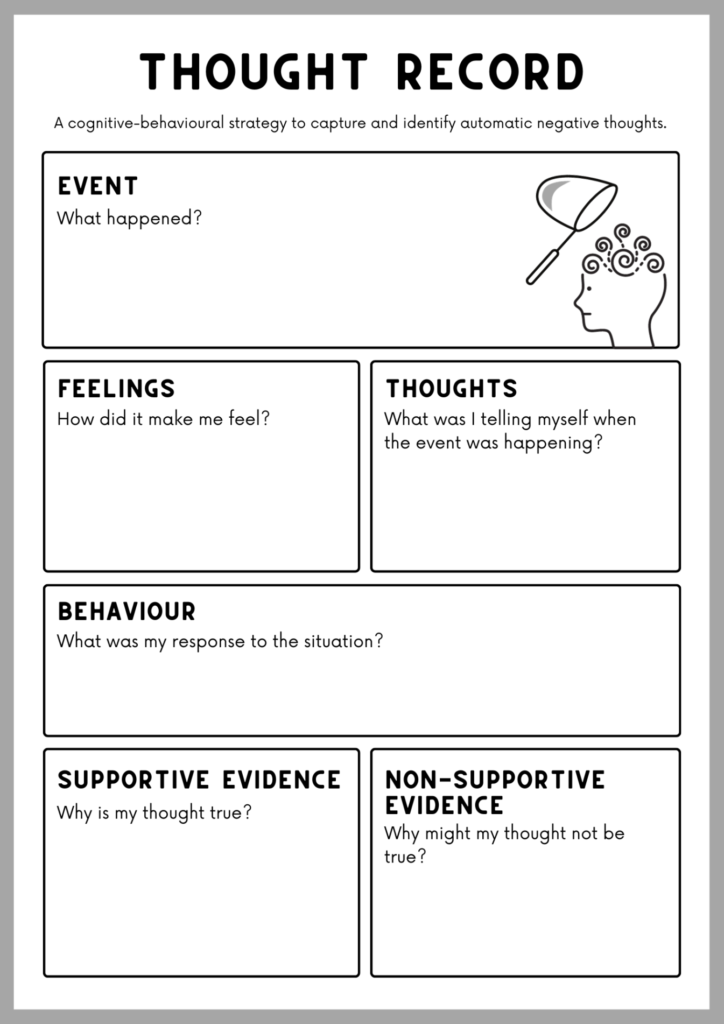
The behavior part of the therapy involves setting homework for the client to do (e.g., keeping a diary of thoughts). The therapist gives the client tasks to help them challenge their irrational beliefs.
The idea is that the client identifies their unhelpful beliefs and then proves them wrong. As a result, their beliefs begin to change.
Feelings: Emotional Responses
Feelings are emotional responses that influence our communication, reactions, and decisions.
They can motivate positive actions, such as waking up energized and ready to make breakfast. But unaddressed feelings can also lead to negative behaviors, like suppressing anger or turning to substance abuse.
Recognizing and healthily expressing these feelings is crucial for emotional well-being. Dismissing or ridiculing them is counterproductive.
Though feelings originate in the brain, they show up in the body too, alerting us to potential problems or affirming that things are going well.
Accepting and validating emotions, rather than dismissing them, is the healthiest way to manage them and reduce their intensity.
When managing challenging feelings, it’s essential to acknowledge them, seek balance, and, if persistent, examine underlying thoughts that might reinforce them.
Behaviors: Observable Actions
Behaviors are responses to stimuli and are influenced by thoughts and feelings. They can indicate an individual’s emotions, especially when not verbally expressed.
For instance, becoming an overly protective parent can be a behavior stemming from certain thoughts and feelings.
Cognitive Behavioral Therapy (CBT) can modify behaviors using techniques like behavioral activation and gradual exposure. Behavioral activation increases engagement in positive activities, while gradual exposure systematically introduces people to feared or avoided situations in a controlled way.
For example, someone anxious in social situations may set a homework assignment to meet a friend at the pub for a drink.
Over time, these methods help individuals confront and alter negative patterns, promoting healthier behaviors and responses.
General Assumptions
- Faulty cognitions: The cognitive approach believes that mental illness stems from faulty cognitions about others, the world, and ourselves, through cognitive deficiencies (lack of planning) or cognitive distortions (processing information inaccurately).
- Distorted thinking: These cognitions distort how we see things. Ellis proposed irrational thinking as the cause, while Beck proposed the cognitive triad.
- Mental representation: We interact with the world through our mental representation of it. Inaccurate representations or inadequate reasoning can leave our emotions and behavior disordered.
Cognitive behavioral therapy is, in fact, an umbrella term for many different therapies that share some common elements.
Two of the earliest forms of Cognitive Behavioral Therapy were Rational Emotive Behavior Therapy (REBT) and Cognitive Therapy. Albert Ellis developed REBT in the 1950s, and Aaron T. Beck developed Cognitive Therapy in the 1960s.
In both models, the goal is to help people see that their emotional reactions come from their thoughts about a situation, not the situation itself.
REBT
Rational Emotive Behavior Therapy (REBT) is a type of cognitive therapy first used by Albert Ellis, focusing on resolving emotional and behavioral problems.
The goal of this therapy is to change irrational beliefs to more rational ones.
REBT encourages people to identify their general and irrational beliefs (e.g., ‘I must be perfect’). It then helps them challenge these false beliefs through reality testing.
Albert Ellis (1957, 1962) proposes that each of us holds a unique set of assumptions about ourselves and the world. These assumptions guide us through life and shape how we react to different situations.
Unfortunately, some people’s assumptions are largely irrational, guiding them to act and react in inappropriate ways that prejudice their chances of happiness and success.
Albert Ellis calls these basic irrational assumptions.
Some people irrationally assume they are failures if they are not loved by everyone they know. They constantly seek approval and repeatedly feel rejected.
All their interactions are affected by this assumption so that a great party can leave them dissatisfied because they don’t get enough compliments.
According to Ellis, these are other common irrational assumptions :
- Demand for competence: The idea that one should be thoroughly competent at everything.
- Catastrophizing: The idea that it is catastrophic when things are not the way you want them to be.
- No control over happiness: The idea that people have no control over their happiness.
- Need for a stronger other: The idea that you need someone stronger than yourself to depend on.
- Past determines the present: The idea that your history greatly influences your present life.
- One perfect solution: The idea that there is a perfect solution to human problems, and it’s a disaster if you don’t find it.
Ellis believed that people often cling forcefully to this illogical thinking. He therefore used highly emotive techniques to help them challenge and change these irrational beliefs.
The ABC Model
A major aid in cognitive therapy is what Albert Ellis (1957) called the ABC Technique of Irrational Beliefs.
The first three steps analyze the process by which a person has developed irrational beliefs and may be recorded in a three-column table.
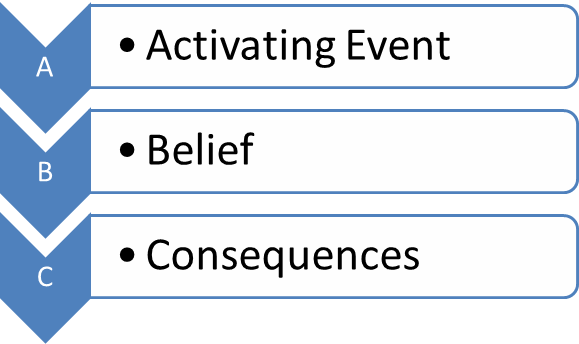
- A – Activating Event or objective situation. The first column records the objective situation, that is, an event that ultimately leads to some type of high emotional response or negative dysfunctional thinking.
- B – Beliefs. In the second column, the client writes down the negative thoughts that occurred to them.
- C – Consequence. The third column records the negative feelings and dysfunctional behaviors that follow, such as anger, sorrow, or anxiety. These feelings result from the belief in column B, not directly from the event in column A.
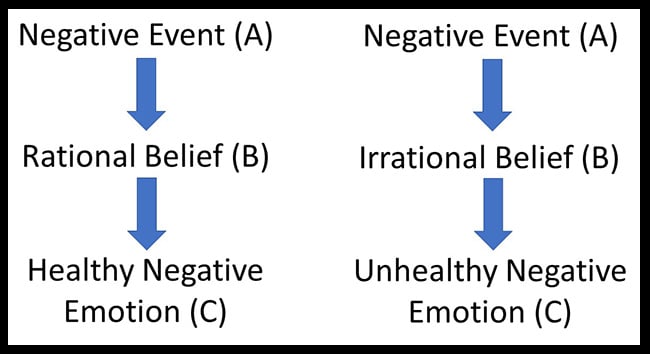
Ellis believed that the activating event (A) does not directly cause the emotional and behavioral consequences (C). Instead, a person interprets the event unrealistically, forming an irrational belief (B) that produces the consequences (C).
REBT Example
Gina is upset because she got a low mark on a math test.
The Activating event, A, is that she failed her test. The Belief, B, is that she must have good grades or she is worthless. The Consequence, C, is that Gina feels depressed.
After identifying irrational beliefs, the therapist works with the client to challenge these negative thoughts using evidence from the client’s own experience. This process, called reframing, means re-interpreting the situation in a more realistic light.
This helps the client to develop more rational beliefs and healthy coping strategies.
A therapist would help Gina realize that there is no evidence that she must have good grades to be worthwhile or that getting bad grades is awful.
She desires good grades, and it would be good to have them, but it hardly makes her worthless.
Getting bad grades is disappointing, but not awful. It means Gina is currently struggling with math or studying, not that she is worthless as a person. Realizing this, she feels sad or frustrated rather than depressed.
The sadness and frustration are likely healthy negative emotions and may lead her to study harder from then on.
Critical Evaluation
Rational emotive behavior therapists have cited many studies in support of this approach.
Most early studies were conducted on people with experimentally induced anxieties or non-clinical problems such as mild fear of snakes (Kendall & Kriss, 1983).
However, several recent studies have been done on actual clinical subjects and have also found that rational emotive behavior therapy (REBT) is often helpful (Lyons & Woods 1991).
Cognitive Therapy
Aaron Beck’s (1967) therapy system is similar to Ellis’s but has been most widely used in cases of depression. Cognitive therapists help clients to recognize the negative thoughts and errors in logic that cause them to be depressed.
The therapist also guides clients to question and challenge their dysfunctional thoughts, try out new interpretations, and ultimately apply alternative ways of thinking in their daily lives.
Aaron Beck believes that a person’s reaction to specific upsetting thoughts may contribute to abnormality.
As we confront the many situations that arise in life, both comforting and upsetting thoughts come into our heads. Beck calls these unbidden cognitions automatic thoughts.
When a person’s stream of automatic thoughts is very negative, you would expect a person to become depressed (e.g., ‘I’m never going to get this essay finished, my girlfriend fancies my best friend, I’m getting fat, I have no money, my parents hate me – have you ever felt like this?’).
Quite often, these negative thoughts will persist despite contrary evidence.
Beck (1967) identified three mechanisms that he thought were responsible for depression:
- The cognitive triad (of automatic negative thinking)
- Negative self-schemas
- Errors in Logic (i.e., faulty information processing)
The Cognitive Triad
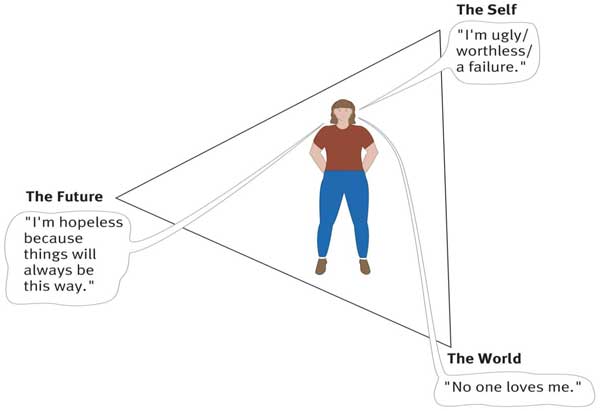
The cognitive triad is three forms of negative, helpless thinking typical of depression. It targets the self, the world, and the future.
These thoughts tended to be automatic in depressed people as they occurred spontaneously.
As these three components interact, they interfere with normal cognitive processing. This leads to impairments in perception, memory, and problem-solving, leaving the person increasingly preoccupied with negative thoughts.
Negative Self-Schemas
Beck believed that depression-prone individuals develop a negative self-schema.
They possess a set of beliefs and expectations about themselves that are essentially negative and pessimistic.
Beck claimed that negative schemas might be acquired in childhood due to a traumatic event. Experiences that might contribute to negative schemas include:
- Death of a parent or sibling.
- Parental rejection, criticism, overprotection, neglect, or abuse.
- Bullying at school or exclusion from a peer group.
People with negative self-schemas become prone to logical errors in their thinking. They tend to focus selectively on certain aspects of a situation while ignoring equally relevant information.
Cognitive Distortions
Beck (1967) identifies several illogical thinking processes (i.e., distortions of thought processes). These illogical thought patterns are self-defeating and can cause great anxiety or depression for the individual.
- Arbitrary inference: Drawing conclusions based on insufficient or irrelevant evidence: for example, thinking you are worthless because an open-air concert you were going to see has been rained off.
- Selective abstraction: Focusing on one detail of a situation while ignoring others, such as feeling responsible for a football match your team lost even though you are just one player.
- Magnification: exaggerating the importance of undesirable events. E.g., if you scrape a bit of paintwork on your car and, therefore, see yourself as a totally awful driver.
- Minimization: underplaying the significance of an event. E.g., you get praised by your teachers for an excellent term’s work, but you see this as trivial.
- Overgeneralization: Drawing a broad negative conclusion from a single insignificant event, such as getting a D on one exam and deciding you are stupid, despite normally scoring As.
- Personalization: Attributing the negative feelings of others to yourself. E.g., your teacher looks really cross when he comes into the room, so he must be cross with you.
Critical Evaluation
Butler and Beck (2000) reviewed 14 meta-analyses investigating the effectiveness of Beck’s cognitive therapy and concluded that about 80% of adults benefited from the therapy.
It was also found that the therapy was more successful than drug therapy and had a lower relapse rate, supporting the proposition that depression has a cognitive basis.
This suggests that knowledge of the cognitive explanation can improve the quality of people’s lives.
REBT Vs. Cognitive Therapy
- Therapist role: Ellis views the therapist as a teacher and does not see a warm personal relationship as essential, while Beck stresses the quality of the therapeutic relationship.
- Style: REBT is often highly directive, persuasive, and confronting. Beck places more emphasis on the client discovering misconceptions for themselves.
- Method selection: REBT varies its methods by the client’s personality, while Beck’s cognitive therapy bases its method on the particular disorder.
Strengths of CBT
Empirical Support and Broad Applicability
Cognitive Behavioral Therapy (CBT) has the largest evidence base of any psychological therapy. This makes it one of the most widely supported and frequently used treatments in modern psychology.
Extensive research, including hundreds of randomized controlled trials and meta-analyses, consistently demonstrates that CBT is highly efficacious.
Because of this rigorous scientific validation, it is often considered a first-line intervention or the “treatment of choice” for a massive array of psychiatric illnesses.
Its flexibility allows it to be successfully adapted to treat depression, generalized anxiety disorder, panic disorder, eating disorders, bipolar disorder, obsessive-compulsive disorder (OCD), post-traumatic stress disorder (PTSD), schizophrenia, substance abuse, and even insomnia.
Long-Lasting Results and Lower Relapse Rates
A defining strength of CBT is its enduring, long-term impact that persists well beyond the termination of therapy.
While prescription medications can effectively target the immediate symptoms of disorders like depression, they often do not address the underlying causes. This can lead to high relapse rates once the medication is stopped.
In contrast, CBT is designed to permanently alter a person’s thought processes. By equipping patients with techniques to identify and challenge irrational, maladaptive thinking, CBT provides a lasting preventative effect.
Patients who successfully complete CBT are significantly less likely to relapse than those who only take medication (Hollon & Beck, 1994). This shows that CBT offers a more enduring, long-term solution.
Brief, Structured, and Cost-Effective
Unlike traditional psychoanalysis which can last for many years, CBT is characteristically a short-term, brief intervention, typically lasting between 12 to 20 weekly sessions.
This brief and highly structured format makes it an incredibly cost-effective option for both patients and healthcare systems.
Additionally, the structured nature of CBT allows it to be easily adapted into alternative delivery methods. It has been proven effective in group therapy formats, which lowers costs and allows patients to learn from peers.
Clinician-supervised online CBT modules and internet-based programs have also been developed to widen access. These especially help people who lack geographical or socioeconomic access to traditional face-to-face therapy, while remaining highly cost-effective.
A 2023 systematic review and meta-analysis found internet-delivered CBT (iCBT) effective for obsessive-compulsive disorder (Machado-Sousa et al., 2023). This supports iCBT as a lower-cost alternative to face-to-face therapy.
Stepped-care systems build on this by offering low-intensity, guided self-help first, and reserving full CBT for clients who need more support.
Intuitive, Practical, and Present-Focused
CBT is highly acceptable to clients because it is an intuitive treatment that makes logical sense.
Rather than dwelling extensively on early childhood experiences or unconscious conflicts, CBT is present-focused, concentrating on the “here and now”.
It operates on the premise that a person’s thoughts, emotions, and behaviors all interact and influence one another.
Through practical tools, such as maintaining thought diaries, completing “homework” assignments between sessions, and conducting behavioral experiments, patients become active participants in their recovery.
This active involvement empowers clients, giving them the lifelong tools and coping mechanisms needed to manage their moods and handle stressful situations independently on a daily basis.
Effectiveness Comparable to Medication and Observable Brain Changes
For moderate to severe depression, CBT has been shown to be as effective as prescription medications (DeRubeis et al., 2005). Its exact effect can depend on the therapist’s skill and experience.
The most comprehensive analysis to date pooled 409 trials and 52,702 patients. It confirmed that CBT outperforms control conditions and rivals pharmacotherapy, with combined treatment often working best (Cuijpers et al., 2023).
Interestingly, neuroimaging studies using PET scans reveal that successful CBT actually causes significant metabolic changes in the brain.
While medications typically produce “bottom-up” changes in the brain’s limbic and subcortical regions, CBT produces distinct “top-down” changes in the cortex. This shows that actively changing one’s thought processes can tangibly alter brain function.
Furthermore, when combined with medication, CBT can act synergistically to target different clusters of symptom.
For example, CBT has been shown to be particularly superior to medication in reducing vegetative symptoms like insomnia.
Collaborative Empiricism: An Empowering Therapeutic Relationship
Rather than acting as an authority who dictates truths, the CBT therapist works in equal partnership with the client to investigate their distress. This approach is known as collaborative empiricism.
Through guided discovery and Socratic questioning, clients are encouraged to treat their negative thoughts as hypotheses rather than absolute facts, critically gathering real-world evidence to test their validity.
This honors the client’s expertise in their own lived experience and enhances their self-efficacy, autonomy, and competence in managing their own mental health.
Limitations of CBT
Cognitive Behavioral Therapy (CBT) is widely considered a gold-standard, empirically supported treatment for many psychological conditions. Even so, it has several notable limitations, contraindications, and areas of ongoing criticism.
These limitations span across treatment efficacy, theoretical assumptions, cultural applicability, and challenges in clinical implementation.
Requires High Patient Effort and Motivation
One of the primary disadvantages of CBT is that it requires a significant amount of effort and active participation from the patient.
Unlike more passive forms of therapy, CBT involves regular weekly sessions and assigns homework, such as maintaining thought diaries and practicing new behavioral habits between appointments.
Because patients with severe depression frequently suffer from low energy levels and lack of motivation, they may struggle to attend sessions or complete these cognitive exercises.
Furthermore, researchers have noted that CBT may not be a suitable intervention for individuals with learning difficulties.
High Dropout and Relapse Rates
Because of the heavy demands placed on the patient, CBT can suffer from high dropout rates.
Some clinical studies have reported dropout rates of roughly 25% to 32%, which can diminish the overall effectiveness of the treatment program.
Additionally, while CBT aims to provide long-lasting results, it is not a cure-all and relapse is still common.
For instance, in one study by Wiles, 54% of participants did not show improvement after CBT.
Another study found that 42% of patients relapsed within six months of ending CBT, and 53% relapsed within a year. This suggests that CBT may need to be repeated periodically for some individuals.
Can Be Perceived as Inflexible or Invalidating
Because CBT is highly structured, rational, and present-focused, some clients find the approach to be simplistic, limiting, or overly rational.
Clients who desire a deeper exploration of their past or emotional experiences may feel objectified, unseen, and devalued by the therapy’s focus on correcting “faulty” thinking.
In addition, psychoanalyst John Bowlby criticized cognitive therapists for failing to pay enough attention to how early childhood shapes adult mental models. He argued that the approach underestimates how deeply embedded and emotionally defensive these models can be.
Direction of Causality
A core challenge for cognitive theories of depression is proving that negative thoughts cause the disorder, rather than simply resulting from it.
Longitudinal research has questioned whether depressive thinking comes before or after low mood (Lewinsohn et al., 1981).
Because depression itself distorts thinking, the relationship likely runs in both directions. Beck himself later moved toward this bidirectional view.
Cultural Limitations
CBT was largely developed by individuals of European and North American descent, and its core tenets are heavily influenced by the values of these cultures.
The model places a strong emphasis on rationality, individualism, independence, and assertiveness.
Consequently, it actively deemphasizes spirituality, emotional expressiveness, and interdependence, concepts that are central to the cultural values and practices of many diverse populations.
Because of this, some critics have likened CBT’s hierarchical and rational framework to European, White, male systems of patriarchy.
If a therapist strictly adheres to determining whether a belief is “rational,” they may inadvertently pathologize normal human thinking or dismiss beliefs that are entirely normative within the client’s specific culture.
Applying cognitive restructuring to reframe thoughts about oppressive situations, without acknowledging systemic issues like poverty, racism, or structural violence, can also be deeply invalidating. It may inadvertently blame the client for their own distress.
Unsurprisingly, some clients find CBT to be too simplistic, overly rational, limiting, or oppressive.
Declining Effect Sizes Over Time
A notable meta-analysis found that CBT’s anti-depressive effect has weakened over the decades.
Comparing trials across different time periods, Johnsen and Friborg (2015) reported a genuine decline in how strongly CBT outperforms control conditions for depression.
Possible explanations include fading novelty, publication and allegiance effects in early trials, and drift in how faithfully therapists deliver the treatment. The trend is a caution against assuming early, impressive results will hold in routine practice.
Questions About the True Mechanism of Change
While CBT is effective, some researchers question why it works.
A foundational premise of CBT is that therapeutic change occurs by altering the content of maladaptive thoughts and beliefs.
However, clinical research has frequently failed to find compelling evidence that cognitive change is the primary mechanism driving symptom relief.
Dismantling studies break the therapy down into its individual components. They have found that the full CBT package, including complex cognitive restructuring, is sometimes no more effective than its simpler behavioral activation component alone.
This has led researchers to theorize that CBT’s success may rely heavily on “non-specific factors” rather than its specific cognitive techniques. These factors include the placebo effect, the client’s willingness to trust the therapist, and the strength of the working alliance.
This pattern is sometimes called the “dodo bird verdict”: the finding that different bona fide therapies tend to produce similarly good outcomes.
Challenges with Complex and Characterological Presentations
Traditional CBT relies on several assumptions that often prove untrue for clients presenting with personality disorders or chronic, characterological issues. CBT typically assumes that clients:
- Motivation: Clients are motivated to comply with treatment procedures, such as completing homework assignments.
- Insight: Clients can readily access and verbalize their cognitions and emotions.
- Alliance: Clients can quickly form a collaborative therapeutic alliance.
- Capacity for change: Clients can modify distorted thoughts through empirical analysis, logical discourse, and experimentation.
Clients with complex characterological issues frequently violate these assumptions.
They may engage in deeply ingrained cognitive and affective avoidance, blocking disturbing thoughts and fleeing from negative emotions.
Their dysfunctional life patterns are often highly resistant to simple logical modification, and they may struggle profoundly to form a secure, collaborative relationship with the therapist.
Additionally, standard CBT protocols generally target single, specific psychiatric diagnoses, offering little guidance for clients presenting with multiple, overlapping comorbid disorders or vague, pervasive life dissatisfaction.
Rigidity, Dissemination, and the Medical Model
The reliance on manualized, structured treatment protocols has drawn criticism for discouraging clinical judgment, limiting therapist flexibility, and restricting creativity.
If a therapist mechanically applies CBT techniques, the therapy can feel invalidating and may send the patient the harmful message that their distress is purely “in their head”.
Finally, there are massive barriers to the real-world dissemination of CBT.
There is a severe shortage of mental health professionals who are adequately trained to deliver CBT with competency and fidelity.
Often, community clinicians receive only knowledge-based training rather than the rigorous skill-based supervision required to master the therapy.
As a result, CBT is frequently delivered suboptimally in community settings. Therapists most notably tend to omit the highly efficacious, yet challenging, exposure components of the treatment.
While computer-based CBT (cCBT) has been developed to improve access, it introduces its own limitations:
- Access: It discriminates against those without financial access to technology or those with lower cognitive functioning.
- Dropout: It suffers from high dropout rates.
- Ethics: It presents ethical challenges regarding confidentiality and risk management.
Who Was Aaron Beck?
Aaron T. Beck, born in 1921 to Russian Jewish immigrants, was the psychiatrist who founded cognitive therapy.
Beck trained in psychoanalysis but grew disillusioned with it. He found no reliable studies of its success, only anecdotal case reports, and concluded the approach rested on faith rather than evidence.
This dissatisfaction led him to develop cognitive therapy. He went on to found the Beck Institute, now directed by his daughter, Dr. Judith Beck.
Beck also created widely used clinical tools. These include the Beck Depression Inventory (BDI) and the Beck Anxiety Inventory (BAI), both still used today to measure symptom severity.
Key Takeaways
- What CBT Is: CBT is a talking therapy that treats problems like anxiety and depression by changing the unhelpful thoughts and behaviors that maintain them.
- The CBT Triangle: Thoughts, feelings, and behaviors are interconnected, so changing one can change the others.
- Two Founding Approaches: CBT grew out of Albert Ellis’s REBT and Aaron Beck’s cognitive therapy, both developed to help people separate their interpretations from reality.
- Strong Evidence Base: CBT has the largest evidence base of any psychological therapy. A comprehensive 2023 meta-analysis of over 400 trials confirms it rivals medication for treating depression.
- Real Limitations: Dropout and relapse remain common, and effect sizes for depression may be shrinking over time, so CBT is not a guaranteed one-off cure.
- Brief and Structured: Sessions typically run 12 to 20 weeks, use homework between sessions, and can be delivered online or through stepped-care systems.
References
Beck, A. T. (1967). Depression: Causes and treatment. Philadelphia: University of Pennsylvania Press.
Beck, A. T., Epstein, N., & Harrison, R. (1983). Cognitions, attitudes and personality dimensions in depression. British Journal of Cognitive Psychotherapy.
Beck, A. T, & Steer, R. A. (1993). Beck Anxiety Inventory Manual. San Antonio: Harcourt Brace and Company.
Butler, A. C., & Beck, J. S. (2000). Cognitive therapy outcomes: A review of meta-analyses. Journal of the Norwegian Psychological Association, 37, 1-9.
Cuijpers, P., Miguel, C., Harrer, M., Plessen, C. Y., Ciharova, M., Ebert, D., & Karyotaki, E. (2023). Cognitive behavior therapy vs. control conditions, other psychotherapies, pharmacotherapies and combined treatment for depression: a comprehensive meta‐analysis including 409 trials with 52,702 patients. World Psychiatry, 22(1), 105-115.
DeRubeis, R. J., Hollon, S. D., Amsterdam, J. D., Shelton, R. C., Young, P. R., Salomon, R. M., O’Reardon, J. P., Lovett, M. L., Gladis, M. M., Brown, L. L., & Gallop, R. (2005). Cognitive therapy vs medications in the treatment of moderate to severe depression. Archives of General Psychiatry, 62(4), 409-416.
Dobson, K. S., & Block, L. (1988). Historical and philosophical bases of cognitive behavioral theories. Handbook of Cognitive behavioral Therapies. Guilford Press, London.
Ellis, A. (1957). Rational Psychotherapy and Individual Psychology. Journal of Individual Psychology, 13: 38-44.
Ellis, A. (1962). Reason and Emotion in Psychotherapy. New York: Stuart.
Hollon, S. D., & Beck, A. T. (1994). Cognitive and cognitive-behavioral therapies. In A. E. Bergin & S.L. Garfield (Eds.), Handbook of psychotherapy and behavior change (pp. 428—466). New York: Wiley.
Johnsen, T. J., & Friborg, O. (2015). The effects of cognitive behavioral therapy as an anti-depressive treatment is falling: A meta-analysis. Psychological Bulletin, 141(4), 747-768.
Kendall, P. C., & Kriss, M. R. (1983). Cognitive-behavioral interventions. In: C. E. Walker, ed. The handbook of clinical psychology: theory, research and practice, pp. 770–819. Homewood, IL: Dow Jones-Irwin.
Lewinsohn, P. M., Steinmetz, J. L., Larson, D. W., & Franklin, J. (1981). Depression-related cognitions: antecedent or consequence?. Journal of abnormal psychology, 90(3), 213.
Lyons, L. C., & Woods, P. J. (1991). The efficacy of rational-emotive therapy: A quantitative review of the outcome research. Clinical Psychology Review, 11(4), 357-369.
Machado-Sousa, M., Moreira, P. S., Costa, A. D., Soriano-Mas, C., & Morgado, P. (2023). Efficacy of internet-based cognitive-behavioral therapy for obsessive-compulsive disorder: A systematic review and meta-analysis. Clinical Psychology: Science and Practice, 30(2), 150–162
Rimm, D. C., & Litvak, S. B. (1969). Self-verbalization and emotional arousal. Journal of Abnormal Psychology, 74(2), 181.
Zhang, Y., Hedley, F. E., Zhang, R.-Y., & Jin, J. (2025). Toward quantitative cognitive–behavioral modeling of psychopathology: An active inference account of social anxiety disorder. Journal of Psychopathology and Clinical Science, 134(4), 363–388.
Further Information

What is the main difference between CBT and DBT?
The main u003ca href=u0022https://www.simplypsychology.org/whats-the-difference-between-cbt-and-dbt.htmlu0022 data-type=u0022postu0022 data-id=u002211200u0022u003edifference between CBT and DBTu003c/au003e is CBT focuses on challenging negative thought patterns, while DBT emphasizes acceptance and change, offering skills for emotional regulation, interpersonal effectiveness, distress tolerance, and mindfulness.


Download this worksheet as a PDF

