Depression is a mood disorder that prevents individuals from leading a normal life at work, socially, or within their family. Seligman (1973) referred to depression as the ‘common cold’ of psychiatry because of its frequency of diagnosis.
Psychologists have proposed several theories. These include behaviorist, psychodynamic, cognitive, and humanistic approaches, each locating the cause differently.
Estimates vary depending on how data are gathered and how diagnoses are made. As many as 27% of some population groups may be suffering from depression at any one time (NIMH, 2001; data for older adults).
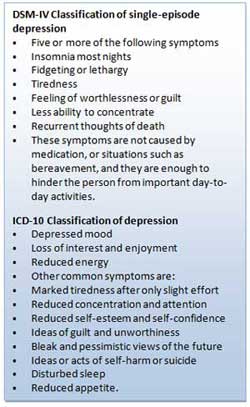
Key Takeaways
- Behaviorist View: Depression follows the loss of positive reinforcement from the environment, such as after losing a job or a loved one.
- Psychodynamic View: Freud linked depression to anger turned inward after a real or symbolic loss.
- Cognitive Triad: Beck argued depression stems from negative thinking about the self, the world, and the future, especially in people with a pre-existing negative self-schema.
- Learned Helplessness: Seligman proposed that depression follows repeated experiences of feeling unable to control negative events.
- Humanistic View: Maslow saw depression as the result of blocked self-actualization: an inability to fulfill your potential.
- Modern Evidence: CBT, the treatment built on the cognitive model, now has a large evidence base: it works about as well as medication, with longer-lasting benefits.
Behaviorist Theory
Behaviorism emphasizes the importance of the environment in shaping behavior.
The focus is on observable behavior. This includes the conditions through which people learn it: classical conditioning, operant conditioning, and social learning theory.
Therefore, depression is the result of a person’s interaction with their environment.
For example, classical conditioning proposes depression is learned through associating certain stimuli with negative emotional states. There is a second route, too. Social learning theory states behavior is learned through observation, imitation, and reinforcement.
Operant Conditioning
Operant conditioning states that depression is caused by the removal of positive reinforcement from the environment (Lewinsohn, 1974).
Certain events, such as losing your job, induce depression because they reduce positive reinforcement from others (e.g., being around people who like you).
Depressed people usually become much less socially active. In addition, depression can also be caused by inadvertent reinforcement of depressed behavior by others.
For example, when a loved one is lost, an important source of positive reinforcement has lost as well. This leads to inactivity.
The main source of reinforcement is now the sympathy and attention of friends and relatives.
However, this tends to reinforce maladaptive behavior, i.e., weeping, complaining, and talking of suicide.
This eventually alienates even close friends leading to even less reinforcement and increasing social isolation and unhappiness. In other words, depression is a vicious cycle in which the person is driven further and further down.
Also, if the person lacks social skills or has a very rigid personality structure, they may find it difficult to make the needed adjustments. They struggle to find new reinforcement sources (Lewinsohn, 1974). So they get locked into a negative downward spiral.
Critical Evaluation of Behaviorist Theory
Behavioral/learning theories make sense in terms of reactive depression, where there is a clearly identifiable cause of depression.
However, one of the biggest problems for the theory is that of endogenous depression. This is depression that has no apparent cause (i.e., nothing bad has happened to the person).
An additional problem of the behaviorist approach is that it fails to consider cognitions (thoughts) influence on mood.
Psychodynamic Theory
During the 1960s, psychodynamic theories dominated psychology and psychiatry. Depression was understood in terms of the following:
- Inwardly-Directed Anger: Anger toward the lost person turns inward against the self (Freud, 1917).
- Introjection: The individual internalizes the lost love object as part of themselves.
- Severe Super-Ego Demands: An excessively harsh conscience punishes the self (Freud, 1917).
- Narcissistic Needs: Excessive narcissistic, oral, or anal personality needs go unmet (Chodoff, 1972).
- Loss of Self-Esteem: Self-worth collapses following a setback (Bibring, 1953; Fenichel, 1968).
- Early Deprivation: A lack of warmth in the mother-child relationship during the first year (Klein, 1934).
Freud’s psychoanalytic theory is a psychodynamic approach. Freud (1917) linked some depression to biological factors.
However, Freud also argued that some cases of depression could be linked to loss or rejection by a parent. Depression is like grief in that it often occurs as a reaction to the loss of an important relationship.
However, there is an important difference because depressed people regard themselves as worthless.
The individual identifies with the lost person. Repressed anger towards the lost person is then directed inwards towards the self.
The inner-directed anger reduces the individual’s self-esteem and makes him/her vulnerable to experiencing depression in the future.
Freud distinguished between actual losses (e.g., the death of a loved one) and symbolic losses (e.g., the loss of a job).
Both kinds of losses can produce depression this way. They cause the individual to re-experience childhood episodes of lost affection from a significant person, such as a parent.
Later, Freud modified his theory stating that the tendency to internalize lost objects is normal and that depression is simply due to an excessively severe super-ego.
Thus, the depressive phase occurs when the individual’s super-ego or conscience is dominant. The manic phase is different. It occurs when the individual’s ego or rational mind asserts itself, and they feel in control.
Loss need not lead to depression. The individual can avoid this by engaging in a period of mourning work, recalling memories of the lost one.
This allows the individual to separate himself/herself from the lost person and reduce inner-directed anger. However, individuals very dependent on others for their sense of self-esteem may be unable to do this and so remain extremely depressed.
Critical Evaluation of Psychodynamic Theory
Psychoanalytic theories of depression have had a profound impact on contemporary theories of depression.
Beck’s (1983) model drew on several psychoanalytic ideas. These include the loss of self-esteem (re: Beck’s negative view of self) and object loss (re: the importance of loss events).
They also include external narcissistic deprivation (re: hypersensitivity to loss of social resources) and oral personality (re: sociotropic personality).
However, psychoanalytic theories are hard to test scientifically.
For example, its central features cannot be operationally defined with sufficient precision to allow empirical investigation. Mendelson (1990) concluded his review of psychoanalytic theories of depression by stating:
“A striking feature of the impressionistic pictures of depression painted by many writers is that they have the flavor of art rather than of science and may well represent profound personal intuitions as much as they depict they raw clinical data” (p. 31).
Another criticism concerns the psychanalytic emphasis on the unconscious, intrapsychic processes, and early childhood experience as being limiting in that they cause clinicians to overlook additional aspects of depression.
For example, conscious negative self-verbalization (Beck, 1967) or ongoing distressing life events (Brown & Harris, 1978).
Cognitive Explanation of Depression
This approach focuses on people’s beliefs rather than their behavior. Depression results from systematic negative bias in thinking processes.
Emotional, behavioral (and possibly physical) symptoms result from cognitive abnormality. This means that depressed patients think differently from clinically normal people.
The cognitive approach also assumes changes in thinking precede (i.e., come before) the onset of a depressed mood.
Beck’s (1967) Theory
One major cognitive theorist is Aaron Beck. He studied people suffering from depression and found that they appraised events in a negative way.
Beck (1967) identified three mechanisms that he thought were responsible for depression:
- The cognitive triad (of negative automatic thinking)
- Negative self schemas
- Errors in Logic (i.e. faulty information processing)
The cognitive triad names three kinds of negative thinking. Each is typical of people with depression: negative thoughts about the self, the world, and the future.
These thoughts tended to be automatic in depressed people as they occurred spontaneously.
For example, they see themselves as helpless, worthless, and inadequate.
They interpret events in the world in an unrealistically negative and defeatist way, and they see the world as posing obstacles that can’t be handled.
Finally, they see the future as totally hopeless because their worthlessness will prevent their situation from improving.
As these three components interact, they interfere with normal cognitive processing, leading to impairments in perception, memory, and problem-solving, with the person becoming obsessed with negative thoughts.
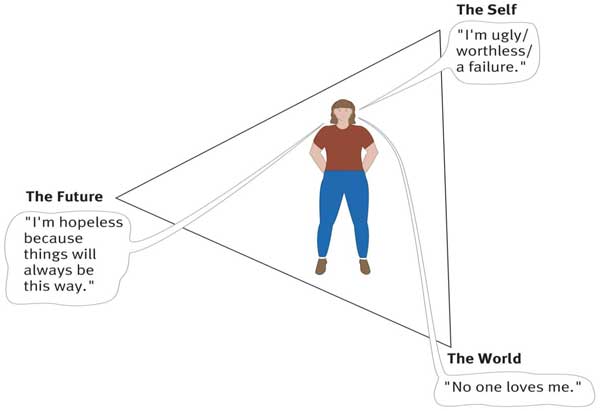
Beck believed that depression-prone individuals develop a negative self-schema.
They possess a set of beliefs and expectations about themselves that are essentially negative and pessimistic.
Beck identified three specific types of negative self-schema. An ineptness schema makes someone expect to fail. A self-blame schema makes them feel responsible for every misfortune. A negative self-evaluation schema produces constant feelings of worthlessness.
Beck claimed that negative schemas might be acquired in childhood as a result of a traumatic event. Experiences that might contribute to negative schemas include:
- Death of a parent or sibling.
- Parental rejection, criticism, overprotection, neglect, or abuse.
- Bullying at school or exclusion from a peer group.
However, a negative self-schema alone does not cause depression. It is only a predisposition, or diathesis, a vulnerability that needs a stressful life event to activate it. This makes Beck’s a diathesis-stress theory, not a simple direct-cause account.
Once activated, cognitive biases seem to dominate thinking.
People with negative self-schemas become prone to making logical errors in their thinking, focusing selectively on certain aspects of a situation while ignoring equally relevant information. Beck (1967) identified a number of systematic negative biases in information processing known as logical errors or faulty thinking.
Such thinking is self-defeating. These illogical thought patterns can cause great anxiety or depression for the individual.
For example:
- Arbitrary Inference: Drawing a negative conclusion in the absence of supporting data.
- Selective Abstraction: Focusing on the worst aspects of any situation.
- Overgeneralisation: Drawing a sweeping conclusion from a single, often trivial, event, such as treating one poor grade as proof of stupidity.
- Magnification and Minimisation: If they have a problem, they make it appear bigger than it is. If they have a solution they make it smaller.
- Personalization: Negative events are interpreted as their fault.
- Dichotomous Thinking: Everything is seen as black and white. There is no in between.
Such thoughts exacerbate and are exacerbated by the cognitive triad. Beck believed these thoughts or this way of thinking become automatic.
When a person’s stream of automatic thoughts is very negative, you would expect a person to become depressed. Quite often these negative thoughts will persist even in the face of contrary evidence.
Critical Evaluation of Beck’s Cognitive Theory
Alloy et al. (1999) followed the thinking styles of young Americans in their early 20s for two and a half years. Their thinking style was tested, and they were placed in either the ‘positive thinking group’ or ‘negative thinking group’.
After two and a half years, the researchers found that only 1% of the positive group developed depression compared to 17% of the ‘negative’ group.
This hinted at a link between cognitive style and depression.
However, this kind of study may suffer from demand characteristics: cues that hint to participants what a study expects, changing how they respond. The results are also correlational, so the precise causal role of cognitive processes remained unclear.
A later, larger study addressed this weakness directly. Alloy et al. (2006) measured cognitive style before any depression began, then tracked students prospectively for the same two and a half years.
The high-risk group proved far more likely to develop depression.
Specifically, they were 3.5 to 6.8 times more likely than the low-risk group to develop major, minor, or hopelessness depression.
Because the negative thinking came first this time, the design offers stronger evidence that it causes depression rather than just accompanying it. This is not conclusive, however.
An unmeasured factor, such as a shared vulnerability, could still explain both the thinking style and the later depression. The maladaptive cognitions seen in depressed people may still be, in part, a consequence rather than a cause of depression.
Cognitive Behavioral Therapy (CBT)
Beck’s theory led to a treatment. It is called cognitive-behavioral therapy (CBT). CBT helps people identify their automatic thoughts, negative schemas, and cognitive biases, then test them against real evidence.
Aim: Cuijpers et al. (2023) set out to comprehensively synthesize randomized trials of CBT for depression.
Method: They pooled 409 randomized trials with 52,702 patients in total, comparing CBT against waitlist controls, other therapies, and antidepressant medication. It was the largest review of its kind.
Results: CBT produced a moderate-to-large benefit over control conditions, with 42% of patients responding to treatment versus 19% of controls. It performed about as well as other therapies and medication in the short term.
But it held its advantage over medication better after six to twelve months, likely because CBT teaches lasting skills.
Conclusion: CBT is an effective, evidence-based treatment for depression. It works about as well as other therapies, with a particular edge in preventing relapse. However, the authors cautioned that trials varied widely in quality, and the true effect may be somewhat smaller than the headline figure suggests.
Even so, the evidence for CBT remains strong.
Ellis’s ABC Model
Albert Ellis proposed a second cognitive explanation of depression, developed independently of Beck’s.
His approach is rational emotive behavior therapy (REBT), also known as rational emotive therapy (Ellis, 1962).
Both men reached the same core claim. Events do not directly cause our emotions. Our beliefs about those events do.
The A-B-C Sequence
Ellis set this out as a three-step sequence.
A is the activating event. This is something that happens, such as a loss, a failure, or a rejection.
B is the belief the person holds about that event.
C is the consequence: the emotion and behavior that follow.
It is the belief at B, not the event at A, that decides the consequence. The sequence extends to D, disputing the belief, and E, an effective new belief to replace it.
Depression is a consequence. It is one of several unhealthy negative emotions that can follow an activating event. That happens once the event is filtered through an irrational belief. An irrational belief is a rigid, absolutist demand rather than a flexible preference.
Three Irrational Beliefs
Ellis argued that most such demands reduce to three core irrational beliefs (Ellis, 1962, 1977). Each can generate depression when applied to loss, failure, or rejection.
- Self-Downing: “I must perform well and be approved of by significant others, and if I do not, I am a worthless, inadequate person.”
- Other-Downing: “Other people must treat me considerately and fairly, and if they do not, they are bad people who deserve condemnation.”
- Life-Downing: “Life conditions must be the way I want them to be, and it is awful and unbearable when they are not.”
Self-downing turns a real setback into a global negative rating of the self. This closely parallels the negative-self component of Beck’s cognitive triad.
The result is depression, self-hatred, and inertia. A healthier response would be proportionate disappointment.
Other-downing tends to fuel anger. Turned into a demand that you should have been treated better, and were not, it can curdle into bitter, hopeless resignation and depressive withdrawal.
Life-downing underlies Beck’s future-negativity. It is the hopeless conviction that things can only get worse. An unwanted world is judged not merely bad but intolerable, which saps the motivation to act.
Worked Example: Losing a Job
Imagine two people made redundant on the same day. The activating event is identical. What differs is the belief.
The first thinks: “I very much wanted to keep this job and I am genuinely disappointed to have lost it. But losing a job does not make me worthless, and I can look for another.”
That belief produces sadness and disappointment. Both are healthy negative emotions. The person stays able to act, updating a CV and applying elsewhere.
The second thinks: “I must always be able to provide for my family. Having failed at this, I am a worthless failure, and things can only get worse.”
Now the demand, the global self-rating, and the catastrophizing combine. The result is a disabling low mood, plus a loss of the motivation needed to take the very actions that could improve things.
Disputing Irrational Beliefs
REBT starts by working out which irrational belief is doing the causal work. The therapist and client then dispute that belief.
Disputing happens on three fronts. Is the belief logical? Is there evidence for it? And does holding it actually help?
This is the D and E of the model. The client disputes the rigid demand, then arrives at an effective new belief that is flexible and self-accepting.
The process is cognitive restructuring. Beck’s cognitive therapy uses it too, which is why both models feed into modern CBT. There, patients test their thoughts against evidence and build more flexible, realistic alternatives.
As Wessler (1986) puts it, “changing cognition is always a means to an end, that end being lasting changes in target emotions and behaviour.”
Critical Evaluation of Ellis’s ABC Model
Ellis’s model is one of the three most influential cognitive accounts of depression, alongside Beck’s and Seligman’s. It converges with Beck’s on the central claim, and it generates a treatment that can be tested.
The evidence is more modest. Meta-analytic work links irrational beliefs to psychological distress, but the association is only moderate, and it is with distress in general.
Three criticisms of the wider ABC model apply here too. The first is measurement confounds in how irrational beliefs are assessed.
The second is that the rational/irrational distinction is value-laden. Calling a belief irrational involves a judgment about how a person ought to think, not a purely logical test.
The third is cultural bias. What counts as an irrational demand in one culture may be an unremarkable expectation in another.
Learned Helplessness
Martin Seligman (1974) proposed a cognitive explanation of depression called learned helplessness.
According to Seligman’s learned helplessness theory, depression occurs when a person learns that their attempts to escape negative situations make no difference.
Consequently, they become passive and will endure aversive stimuli or environments even when escape is possible.
Seligman based his theory on research using dogs.
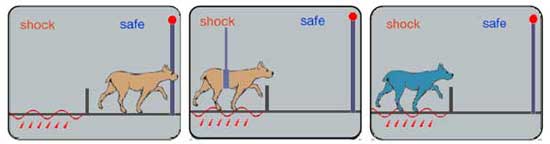
Aim: Seligman and Maier (1967) tested whether a dog’s later ability to escape a shock depends on the shock itself, or on whether the dog can control it.
Method: Dogs were assigned to one of three conditions. One group could escape a shock in a harness by making a response. A second, yoked group received the same shock, but had no control over it.
A third group received no shock. All three groups were then tested in a shuttle box, where a signalled shock could easily be escaped by jumping a low barrier.
Results: Dogs that had previously escaped shock, or received none, quickly learned the new escape response. Most dogs from the uncontrollable-shock group did not even try. They lay down and whined instead, passively enduring shock they could easily have escaped.
Conclusion: The dogs had learned that responding made no difference. That expectation, not the shock itself, then stopped them from escaping later. The profile looked like depression: passive, inactive, and in Seligman’s dogs, off their food.
Seligman (1974) applied this directly to humans. He called it learned helplessness: giving up on influencing your environment once you have learned that you are helpless.
However, this early version had a problem. It could not explain why many depressed people blame themselves, rather than feeling simply and passively helpless.
Abramson, Seligman, and Teasdale (1978) then introduced a cognitive version of the theory. They reformulated learned helplessness in terms of attributional processes, meaning how people explain the cause of an event.
The depressive attributional style rests on three dimensions. Locus asks whether a cause is internal, to do with the person, or external, to do with the situation.
Stability asks whether it is stable and permanent or unstable and transient. Global or specific asks whether it explains the “whole” person or just one feature.
A negative event alone was not enough. It had to combine with this cognitive style to produce a helpless or depressive state, in this new version of the theory.
Instead, Abramson et al. argued that people who attribute failure to internal, stable, and global causes are more likely to become depressed. Those attributing failure to external, unstable, specific causes are not.
This is because the former attributional style leads people to the conclusion that they are unable to change things for the better.
Is this pattern just a quirk of one small sample?
Joiner and Wagner (1995) tested this by pooling the results of many independent studies in a meta-analytic review. Across well over four thousand children and adolescents, an attributional style of blaming bad events on internal, stable, and global causes was consistently linked to depression.
This held across age, gender, and community versus clinical samples. Because the pattern replicated across so many independent studies, it is unlikely to be a fluke of any single sample or measure.
Even so, the evidence remains mostly correlational. A meta-analysis of correlational studies cannot, by itself, prove that a pessimistic attributional style causes depression rather than resulting from it.
Critical Evaluation of Learned Helplessness Theory
Gotlib and Colby (1987) studied formerly depressed people. They found no difference from those never depressed. Both groups showed similar tendencies toward helpless resignation when facing negative events.
This suggests that helplessness could be a symptom rather than a cause of depression. Moreover, it may be that negative thinking generally is also an effect rather than a cause of depression.
The writer Andrew Solomon has experienced this himself. As he explains, it can feel like more than passivity.
He gave a widely viewed talk on this in 2013.
Solomon recalled that ‘the opposite of depression is not happiness, but vitality.’ That vitality, he said, seemed to drain away during his lowest periods. Nothing felt like it could make a difference.
He described feeling unable to sense that engaging with his own life mattered, however good that life objectively was. This first-hand account echoes the loss of perceived control at the center of Seligman’s theory.
Humanist Approach
Humanists believe that there are needs that are unique to the human species. According to Maslow (1962), the most important of these is the need for self-actualization (achieving our potential).
The self-actualizing human being has a meaningful life. Anything that blocks our striving to fulfill this need can be a cause of depression. What could cause this?
- Conditional Love: Parents who make love conditional on good behavior, rather than giving unconditional love, risk the child developing a negative self-image and depression.
- False Self: Some children avoid this by denying their true selves and projecting a false self to please others, which can lead them to despise themselves for living a lie.
- Unfulfilling Adult Life: Unhappy relationships and unfulfilling jobs can undermine self-actualization, leaving a person unable to give or receive love, or to be creative at work.
References
Abramson, L. Y., Seligman, M. E. P., & Teasdale, J. D. (1978). Learned helplessness in humans: Critique and reformulation. Journal of Abnormal Psychology, 87(1), 49–74.
Alloy, L. B., Abramson, L. Y., Whitehouse, W. G., Hogan, M. E., Tashman, N. A., Steinberg, D. L., Rose, D. T., & Donovan, P. (1999). Depressogenic cognitive styles: Predictive validity, information processing and personality characteristics, and developmental origins. Behaviour Research and Therapy, 37(6), 503–531.
Alloy, L. B., Abramson, L. Y., Whitehouse, W. G., Hogan, M. E., Panzarella, C., & Rose, D. T. (2006). Prospective incidence of first onsets and recurrences of depression in individuals at high and low cognitive risk for depression. Journal of Abnormal Psychology, 115(1), 145–156.
Beck, A. T. (1967). Depression: Causes and treatment. Philadelphia: University of Pennsylvania Press.
Beck, A. T., Epstein, N., & Harrison, R. (1983). Cognitions, attitudes and personality dimensions in depression. British Journal of Cognitive Psychotherapy.
Bibring, E. (1953). The mechanism of depression.
Brown, G. W., & Harris, T. (1978). Social origins of depression: a reply. Psychological Medicine, 8(04), 577-588.
Chodoff, P. (1972). The depressive personality: A critical review. Archives of General Psychiatry, 27(5), 666-673.
Cuijpers, P., Miguel, C., Harrer, M., Plessen, C. Y., Ciharova, M., Ebert, D., & Karyotaki, E. (2023). Cognitive behavior therapy vs. control conditions, other psychotherapies, pharmacotherapies and combined treatment for depression: A comprehensive meta-analysis including 409 trials with 52,702 patients. World Psychiatry, 22(1), 105–115.
Ellis, A. (1962). Reason and emotion in psychotherapy. Lyle Stuart.
Ellis, A. (1977). The basic clinical theory of rational-emotive therapy. In A. Ellis & R. Grieger (Eds.), Handbook of rational-emotive therapy (pp. 3–34). Springer.
Fenichel, O. (1968). Depression and mania. The Meaning of Despair. New York: Science House.
Freud, S. (1917). Mourning and melancholia. Standard edition, 14(19), 17.
Gotlib, I. H., & Colby, C. A. (1987). Treatment of depression: An interpersonal systems approach. Pergamon Press.
Joiner, T. E., & Wagner, K. D. (1995). Attributional style and depression in children and adolescents: A meta-analytic review. Clinical Psychology Review, 15(8), 777–798.
Klein, M. (1934). Psychogenesis of manic-depressive states: contributions to psychoanalysis. London: Hogarth.
Lewinsohn, P. M. (1974). A behavioral approach to depression.
Maslow, A. H. (1962). Towards a psychology of being. Princeton: D. Van Nostrand Company.
National Institute of Mental Health. (2001). Depression research at the National Institute of Mental Health http://www.nimh.nih.gov/health/publications/depression/complete-index.shtml.
Seligman, M. E. (1973). Fall into helplessness. Psychology today, 7(1), 43-48.
Seligman, M. E. (1974). Depression and learned helplessness. John Wiley & Sons.
Seligman, M. E. P., & Maier, S. F. (1967). Failure to escape traumatic shock. Journal of Experimental Psychology, 74(1), 1–9.
Solomon, A. (2013, October). Depression, the secret we share [Video]. TEDxMet. https://www.ted.com/talks/andrew_solomon_depression_the_secret_we_share
Wessler, R. L. (1986). Conceptualizing cognitions in the cognitive-behavioural therapies. In W. Dryden & W. Golden (Eds.), Cognitive-behavioural approaches to psychotherapy. Harper & Row.

