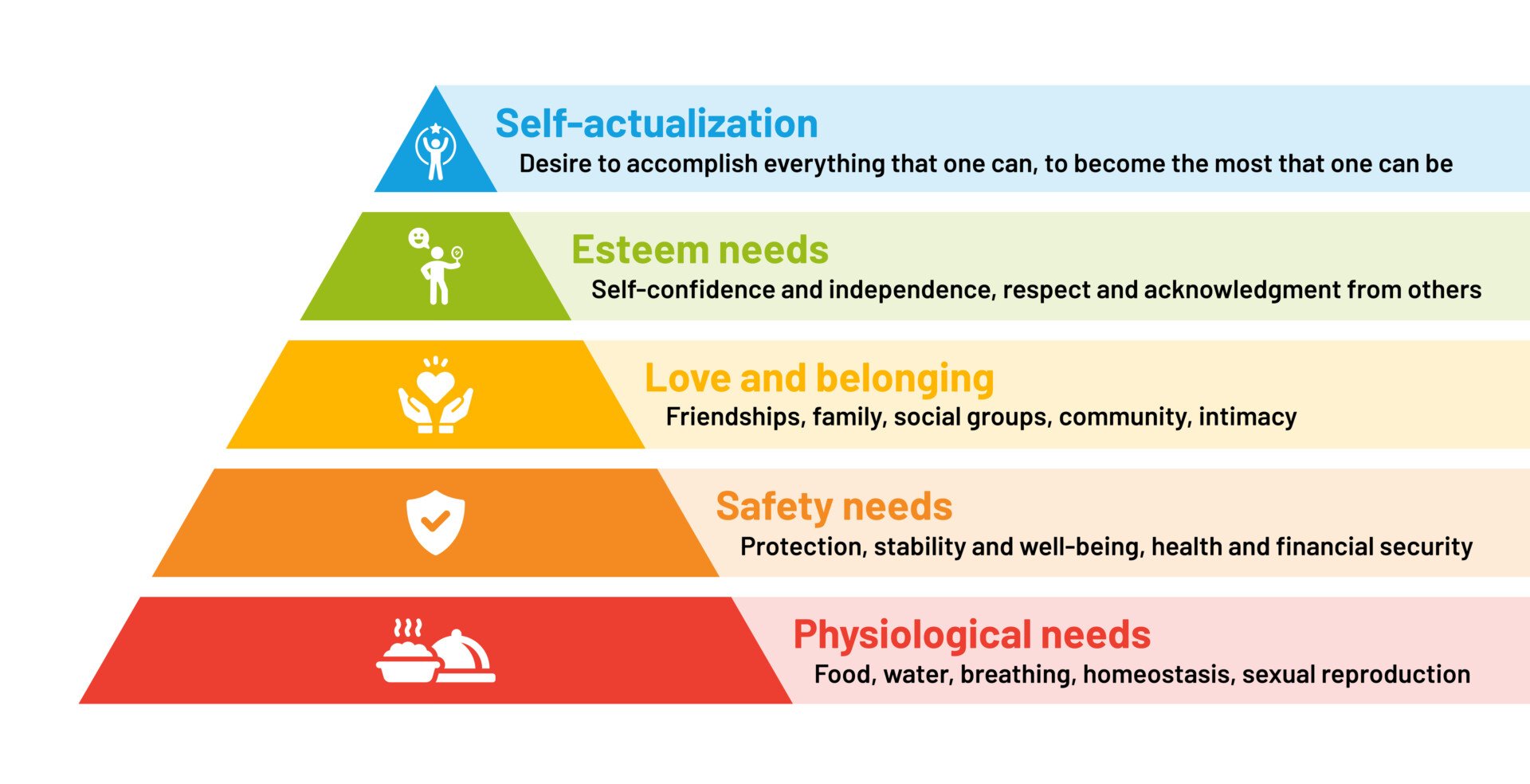
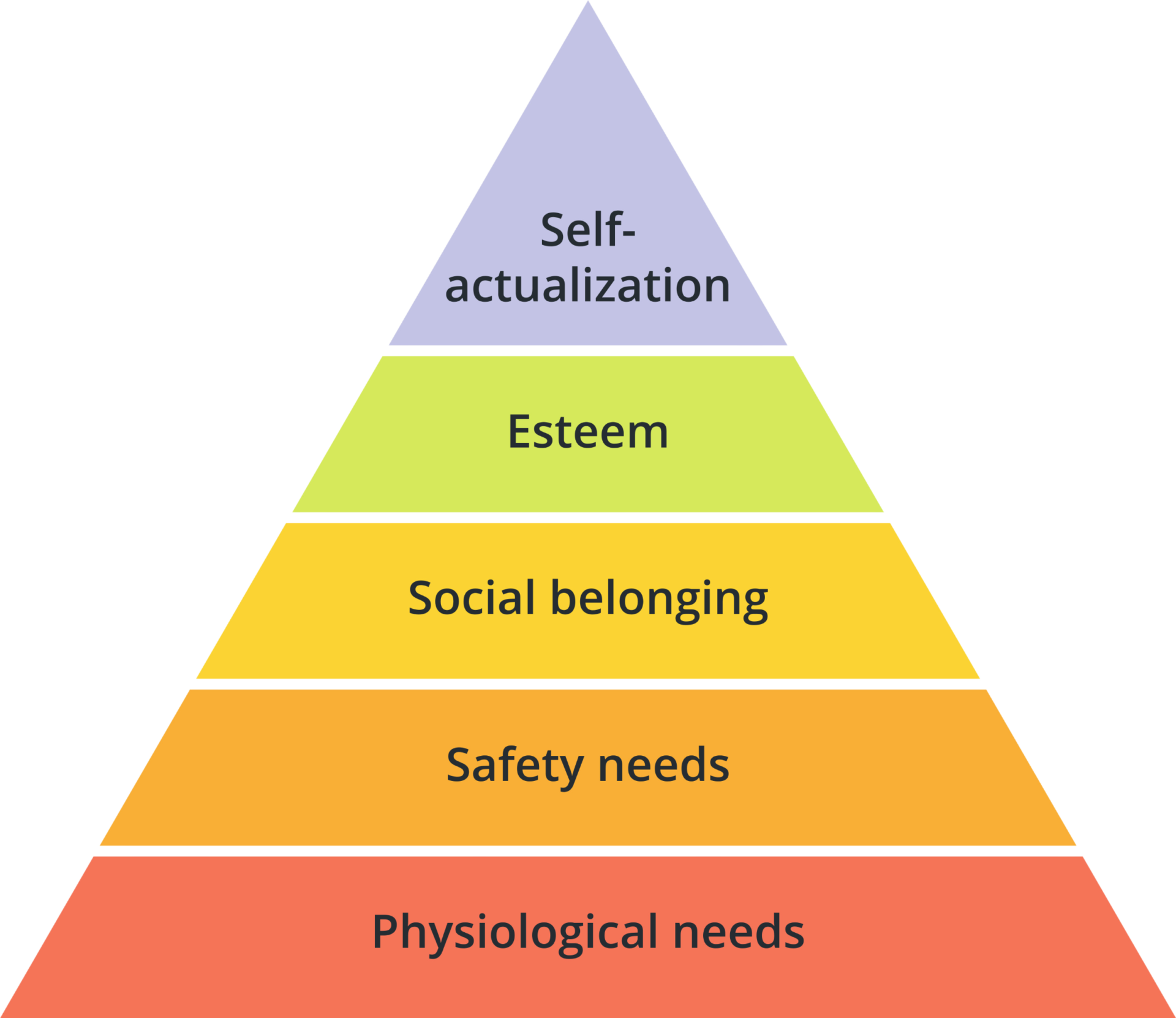
Maslow’s hierarchy of needs is a motivational theory in psychology comprising a five-tier model of human needs, often depicted as hierarchical levels within a pyramid. Needs lower down in the hierarchy must be satisfied before individuals can attend to needs higher up.
- Physiological Needs: The essential biological requirements, such as air, food, and sleep, that keep the human body alive.
- Safety Needs: The desire for a predictable and secure life, including protection from danger, financial stability, and health.
- Love and Belongingness: The emotional need for connection through friendships, intimacy, and being part of a supportive group.
- Esteem Needs: The pursuit of self-respect and the desire for status, recognition, and appreciation from the people around you.
- Self-Actualization: The personal drive to reach your full potential, grow your talents, and find true self-fulfillment.

Key Takeaways
- Needs Hierarchy: From the bottom of the hierarchy upwards, the needs are: physiological (food and clothing), safety (job security), love and belonging needs (friendship), esteem, and self-actualization.
- Not Strictly Linear: While Maslow initially proposed that lower needs must be relatively satisfied before higher ones, modern research suggests people often pursue multiple needs simultaneously.
- Cultural Variations: Different societies may prioritize needs differently. Individualistic vs. collectivist cultures, for example, can shape which needs take precedence.
- Practical Applications: In fields like education, healthcare, and workplace management, Maslow’s framework helps identify barriers to motivation and guides strategies to fulfill various needs.
- Criticisms: Maslow’s biographical approach, cultural biases, and the debate over rigid vs. flexible ordering highlight the importance of viewing his theory as a starting point rather than an absolute rule.
What is Maslow’s Hierarchy of Needs?
According to Maslow, human needs were arranged in a hierarchy, with physiological (survival) needs at the bottom, and the more creative and intellectually oriented ‘self-actualization’ needs at the top.
Maslow argued that survival needs must be satisfied before the individual can satisfy the higher needs.
The higher up the hierarchy, the more difficult it is to satisfy the needs associated with that stage, because of the interpersonal and environmental barriers that inevitably frustrate us.
Maslow described this shift as gradual, not sudden.
Higher needs become increasingly psychological and long-term rather than physiological and short-term, as in the lower survival-related needs.

1. Physiological needs
Physiological needs are biological requirements for human survival and functioning, e.g., air, food, drink, shelter, clothing, sleep, and homeostasis.
These are the most important needs, as all others become secondary until these are met.
Physiological needs include:
-
Fundamental Survival: Air, food, water, and shelter to prevent immediate death.
-
Regulation & Maintenance: Sleep, clothing, homeostasis, and the elimination of waste.
-
Biological Drives: Sex and physical movement required for long-term bodily health and species survival.
- Sensory Stimulation: In extreme cases (like total sensory deprivation), the brain actually struggles to function. We have a physical need for some level of light, sound, and touch.
According to Maslow, physiological needs are “instinctoid,” meaning they are biologically determined inborn patterns rather than learned behaviours.
Healthy Attitudes toward Basic Biological Functions
While these needs are biological, Maslow described specific psychological attitudes associated with their healthy fulfillment.
-
Acceptance and Function: The ability to accept natural bodily functions without experiencing shame, internal conflict, or obsessive preoccupation.
-
Healthy Enjoyment: The capacity to fully enjoy and derive gratification from physical activities, such as eating and sleeping, without feelings of fear or guilt.
-
Absence of Fixation (Moderation): A healthy state is defined by the lack of an excessive or compulsive need to indulge in these activities once the biological requirement is met.
2. Safety Needs
Safety needs represent the second level of Abraham Maslow’s hierarchy of needs, emerging as primary motivators once physiological requirements (such as food and water) are reasonably satisfied.
This level encompasses the desire for a stable, predictable environment and freedom from anxiety and chaos.
Safety needs include:
Safety needs encompass the human requirement for predictability, order, and control.
Key elements include:
- Physical Safety: Protection from physical harm, accidents, or injury.
- Financial Security: Stability through employment, social welfare, and resource insurance.
- Health and Well-being: Access to medical care and the maintenance of physical health.
- Emotional Security: Freedom from fear, anxiety, chaos, and social instability.
Satisfying safety needs involves experiencing a reasonable sense of consistency and predictability in life.
This includes feeling safe in one’s contact with others across occupational, social, and family settings.
While safety needs are “lower-order” needs, Maslow clarified that a need does not require 100% satisfaction before higher needs emerge.
For example, a person might have their safety needs 70% satisfied while simultaneously addressing belongingness needs.
Examples of safety needs
Safety needs can be fulfilled by the family and societal structures, such as law enforcement and medical care.
- Physical Protection: Use of home security (locks, alarms), dwelling in safe neighborhoods, and access to basic health infrastructure like sanitation.
- Employment & Finance: Possessing job security (stable contracts), financial savings, and insurance policies for health and property.
- Legal & Social Order: Relying on societal structures such as law enforcement, the judicial system, and social welfare programs to maintain stability.
- Health & Wellness: Access to medical care and adherence to health and safety legislation in the workplace to prevent injury or chronic illness.
After physiological and safety needs have been fulfilled, the third level of human needs is social and involves feelings of belongingness.
3. Love and Belongingness Needs
Love and belongingness needs represent the third tier of Abraham Maslow’s hierarchy, emerging as primary motivators only after physiological and safety needs have been reasonably satisfied.
Love and belongingness reflects the human need for social connection, including friendship, family, and romantic relationships.
A sense of belonging and acceptance is essential for psychological well-being and can even override safety needs in some cases.
Examples of belongingness needs include friendship, family, intimacy, trust, acceptance, receiving and giving affection, and love.
Love & belonging needs include:
-
Giving and Receiving Affection: This level involves the need to both obtain and give affection; it is not a passive receipt of love but an active, reciprocal process.
-
Intimacy and Trust: This specifically requires deep emotional bonds, sexual intimacy, and the establishment of trust within relationships.
-
Social Connection: The drive to establish stable, meaningful relationships with family, friends, and romantic partners.
-
Secure Attachment: Relying on a secure base of relationships to navigate stress and explore the environment confidently, a need rooted in early infancy.
-
Acceptance: The need to feel valued and included in social circles, teams, or groups.
-
Group Membership: Identifying as a contributing member of professional teams, religious groups, or local communities.
Why it’s important?
The frustration of love and belongingness needs is a significant driver of maladjustment and psychopathology.
-
Psychological Distress: A chronic lack of meaningful relationships can cultivate deep-seated feelings of worthlessness, hopelessness, and powerlessness.
-
The Protective Role of Social Support: Scial support serves as a vital buffer against stress and the adverse effects of trauma. High-quality social networks are associated with improved immune function, lower mortality risk, and increased longevity.
-
Developmental Sensitivity: This need is especially strong in childhood and can override the need for safety, as witnessed in children who cling to abusive parents.
4. Esteem needs
Maslow’s esteem needs, the fourth level in his hierarchy, involve the desire for self-respect, achievement, and recognition from others.
For self-esteem to be meaningful, it must be based on genuine achievement and deserved respect rather than false praise.
The two categories of esteem
Maslow distinguished between two categories of esteem needs, which encompass both internal and external validation:
-
Internal Esteem (Self-Respect): This involves the desire for a stable, firmly based evaluation of oneself. It encompasses feelings of competence, mastery, achievement, adequacy, and independence.
-
External Esteem (Reputation): This is the desire for status and recognition from others. It includes seeking prestige, appreciation, attention, and importance in the eyes of society.
Esteem requires a synergy between internal self-worth (feelings of mastery and adequacy) and external reputation (recognition and appreciation from others).
Healthy esteem
Healthy satisfaction of esteem needs allows individuals to feel confident and useful in the world. It is characterized by:
- Realistic Appraisal: A stable and accurate evaluation of one’s own strengths and limitations.
- Originality & Independence: The ability to maintain individuality and independence from group opinions.
- Dignity: A fundamental desire for self-respect and the appreciation of cultural differences.
Unhealthy esteem
Esteem is classified as a deficiency need (D-need), meaning it primarily motivates behavior when an individual feels a lack of worth or recognition.
-
Status-Seeking: When driven by deficiency rather than growth, this need can manifest as a desperate pursuit of prestige or external validation.
- Inferiority Complex: Failure to satisfy esteem needs often results in an inferiority complex. This manifests as persistent feelings of weakness, helplessness, and inadequacy.
-
Archetypal Bureaucrat: Maslow used this term to describe individuals preoccupied with rigid regulations and social standing to compensate for unmet internal esteem.
- Predatory Capitalism: Critics point out that predatory capitalism often exploits esteem deficiency needs, fueling materialistic competition and status-seeking.
- Developmental Imbalance: For children and adolescents, the desire for reputation often precedes real self-esteem. If they do not move past this stage into internal dignity, they may remain dependent on others for their sense of worth throughout adulthood.
5. Self-actualization needs
The pinnacle of Abraham Maslow’s original hierarchy, self-actualization is the pursuit of realizing one’s full potential through personal growth, creativity, and the attainment of meaningful goals.
Maslow described it as the desire “to become everything one is capable of becoming,” reflecting a commitment to authenticity and purpose.
This state looks different for each individual. For one person, it may mean becoming an ideal parent. For another, it may be fulfilled through artistic expression, professional invention, or scientific discovery.
Core nature
Maslow described self-actualization not as a static destination or a trait (a noun), but as an iterative, ongoing process (a verb).
It involves the active engagement in seeking knowledge, transcending familiar circumstances, and taking healthy risks to explore new possibilities.
- Instinctoid Nature: Maslow suggested that self-actualization is “instinctoid,” meaning it is a biologically based, fundamental human right, rather than a blank slate upon which culture writes.
- Growth Motivation: Unlike lower-level needs, which are motivated by a deficiency (a lack of something), self-actualization is a “growth need” or “Being-need” that motivates individuals to expand their horizons and express their deepest truths.
Components of self-actualization needs
- Authenticity: Self-actualization reflects a commitment to authenticity, living in alignment with one’s own values rather than following socially conditioned roles.
- Creativity and Growth: Self-actualization is an ongoing, lifelong process of “becoming” rather than a static achievement. It involves the continuous pursuit of personal growth, intellectual development, or artistic expression.
- Purpose and Meaning: Seeking a sense of purpose and a commitment to a cause outside oneself, often through work, hobbies, or helping others.
Characteristics of self-actualized individuals
-
Acceptance of Self, Others, and Nature: These individuals accept themselves and the world as they are, without judgment, shame, conflict, or obsessive preoccupation.
-
Problem-Centered Focus: Sense of purpose and a commitment to a cause outside themselves. This involves focusing on solving real existential problems rather than dwelling on personal troubles.
-
Capacity for Peak Experiences: Experience transitory moments of absolute euphoria, awe, and wonder known as peak experiences. These typically occur during significant life events such as childbirth, creative breakthroughs, or sporting achievements.
-
Continued Freshness of Appreciation: They maintain an honest curiosity and the ability to appreciate the “small things” in life with a sense of freshness and awe.
-
Deep Identification with Humankind: They share a “fellow-feeling” and a strong identification with the human race as a whole.

Maslow (1943, p. 375) posited that human needs are arranged in a hierarchy:
It is quite true that man lives by bread alone — when there is no bread. But what happens to man’s desires when there is plenty of bread and when his belly is chronically filled?
At once other (and “higher”) needs emerge and these, rather than physiological hungers, dominate the organism.
And when these in turn are satisfied, again new (and still “higher”) needs emerge and so on.
This is what we mean by saying that the basic human needs are organized into a hierarchy of relative prepotency.
Keep in mind that Maslow’s hierarchy of needs doesn’t follow a strict linear progression.
Individuals can feel various needs at the same time. They may also shift between levels as circumstances change. Maslow refined this idea over several decades (Maslow, 1943, 1962, 1987).
Maslow (1987) later softened his own claim. He wrote that the order “is not nearly as rigid” (p. 68) as he had implied earlier, and that it could flex with circumstances or individual differences.
For example, some people find self-esteem more urgent than love. Others place creative fulfilment above even their most basic needs.
Maslow (1987) also stressed that behaviour is rarely driven by one need alone. He noted that “any behavior tends to be determined by several or all of the basic needs simultaneously rather than by only one of them” (p. 71).
Maslow (1954) proposed that human beings possess two sets of needs. This five-stage model can be divided into deficiency needs and growth needs. The first four levels are often referred to as deficiency needs (D-needs), and the top level is known as growth or being needs (B-needs).

Deficiency needs
Deficiency needs concern basic survival. They include physiological needs, such as food, sex, and sleep, and safety needs, such as security and freedom from danger. Both are non-negotiable.
Behaviors associated with these needs are seen as ‘deficiency’ motivated, as they are a means to an end.
Deficiency needs arise due to deprivation. They motivate people specifically when they are unmet.
Also, the motivation to fulfill such needs will become stronger the longer they are denied. For example, the longer a person goes without food, the more hungry they will become.
How Deficiency Needs Drive Motivation
Maslow (1943) initially stated that individuals must satisfy lower-level deficit needs before progressing to meet higher-level growth needs.
However, he later clarified that this process is not all-or-nothing. Needs do not have to be met completely before the next level becomes relevant (Maslow, 1987, p. 69).
When a deficit need has been “more or less” satisfied, it fades. Our activities then become habitually directed toward the next set of needs we have yet to satisfy.
These then become our salient needs. However, growth needs continue to be felt and may even become stronger once engaged.
Growth needs
Growth needs are psychological rather than physical.
They are linked to realizing one’s full potential and the desire to self-actualize—to become everything one is capable of being.
Unlike deficiency needs, growth needs do not arise from a lack or deprivation. Instead, they come from a natural drive to develop, learn, and create.
These needs are fulfilled through intellectual, artistic, and personal growth activities that expand one’s understanding and capabilities.
Reaching Self-Actualization
When growth needs are reasonably satisfied, individuals may progress toward the highest level of Maslow’s hierarchy: self-actualization.
Everyone has the potential to reach this stage, but progress is often disrupted when lower-level needs (like safety or belonging) are unmet.
Major life events, such as divorce, illness, or job loss, can temporarily push individuals back down the hierarchy.
As a result, movement through the hierarchy is not strictly one-directional.
People may move up and down between levels depending on their circumstances, continually striving toward balance and growth.
The expanded hierarchy of needs
Maslow later expanded his original five-stage model to include cognitive and aesthetic needs (Maslow, 1970a), and later still added transcendence needs (Maslow, 1970b).

Changes to the original five-stage model are highlighted and include a seven-stage model and an eight-stage model; both developed during the 1960s and 1970s.
- Biological and physiological needs – air, food, drink, shelter, warmth, sex, sleep, etc.
- Safety needs – protection from elements, security, order, law, stability, freedom from fear.
- Love and belongingness needs – friendship, intimacy, trust, and acceptance, receiving and giving affection and love. Affiliating, being part of a group (family, friends, work).
- Esteem needs – which Maslow classified into two categories: (i) esteem for oneself (dignity, achievement, mastery, independence) and (ii) the need to be accepted and valued by others (e.g., status, prestige).
-
Cognitive needs – knowledge and understanding, curiosity, exploration, need for meaning and predictability.
Cognitive needs drive our pursuit of knowledge and understanding.
For instance, a student’s desire to understand complex mathematical theories, a traveler’s curiosity about diverse cultures, or an individual’s quest for life’s deeper meanings all exemplify these needs.
Meeting these needs facilitates personal growth, comprehension, and a deeper understanding of life and its complexities.
-
Aesthetic needs – appreciation and search for beauty, balance, form, etc.
Fulfilling these needs leads to a deeper sense of satisfaction and harmony in life, as individuals seek environments and experiences that are pleasing and resonant with their sense of beauty.
This involves the appreciation and pursuit of art, music, nature, and other forms of aesthetic expression.
Fulfilling these needs isn’t just about physical beauty but also the emotional and psychological satisfaction derived from experiencing order and elegance.
- Self-actualization needs – realizing personal potential, self-fulfillment, seeking personal growth, and peak experiences.
-
Transcendence needs – A person is motivated by values that transcend beyond the personal self. Beyond self-actualization, they represent the human desire to connect with a higher reality, purpose, or the universe.
This level emphasizes altruism, spiritual connection, and helping others achieve their potential.
Individuals seek experiences that move beyond personal concerns, aiming to achieve a deep sense of unity, understanding, and belonging within the vast expanse of existence.
Examples of transcendence needs include mystical experiences and certain experiences with nature, aesthetic experiences, sexual experiences, service to others, the pursuit of science, religious faith, etc.).
Self-Actualization Needs
Instead of focusing on psychopathology and what goes wrong with people, Maslow developed a more positive approach to understanding human behavior – one centered on what goes right.
He was interested in human potential, and how we fulfill that potential.
Psychologist Abraham Harold Maslow (1943, 1954) stated that human motivation is based on people seeking fulfillment and change through personal growth.
Self-actualized people are those who are fulfilled and doing all they are capable of.
The Journey Toward Self-Actualization
The drive toward self-actualization reflects a lifelong need for growth, creativity, and discovery (Maslow, 1962).
Maslow believed that people are always “becoming”—constantly evolving and searching for meaning in their lives.
Because every person is unique, the motivation to self-actualize takes many forms.
For some, it may be expressed through art, writing, or music; for others, through sport, teaching, leadership, or innovation (Kenrick et al., 2010).
Maslow (1962) suggested that self-actualization can be recognized through peak experiences.
These are moments of deep joy, creativity, and connection in which individuals perceive the world with heightened clarity and awe.
However, self-actualization is not a final destination but a continuous process of becoming, not a “happily ever after” (Hoffman, 1988).
Maslow (1943, p. 382–383) described it as:
It refers to the person’s desire for self-fulfillment, namely, to the tendency for him to become actualized in what he is potentially.
The specific form that these needs will take will of course vary greatly from person to person.
In one individual it may take the form of the desire to be an ideal mother, in another it may be expressed athletically, and in still another it may be expressed in painting pictures or in inventions.
Characteristics of Self-Actualized People
Although we are all, theoretically, capable of self-actualizing, most of us will not do so, or only to a limited degree.
Maslow (1970) estimated that only two percent of people would reach the state of self-actualization.
He was especially interested in the characteristics of people whom he considered to have achieved their potential as individuals.
By studying 18 people, he considered to be self-actualized (including Abraham Lincoln and Albert Einstein), Maslow (1970) identified 15 characteristics of a self-actualized person.
Characteristics of self-actualizers:
- Reality Perception: They perceive reality efficiently and can tolerate uncertainty.
- Self-Acceptance: They accept themselves and others for what they are.
- Spontaneity: They are spontaneous in thought and action.
- Problem-Centred: They focus on problems outside themselves, not on themselves.
- Humour: They have an unusual sense of humour.
- Objectivity: They can look at life objectively.
- Creativity: They are highly creative.
- Resists Enculturation: They resist enculturation, the everyday process of absorbing a culture’s norms and expectations without consciously noticing it, though they are not deliberately unconventional.
- Social Concern: They are concerned for the welfare of humanity.
- Appreciation: They deeply appreciate basic life experiences.
- Deep Relationships: They form close, satisfying relationships with a few people.
- Peak Experiences: They have peak experiences.
- Privacy: They need privacy.
- Democratic Attitudes: They hold democratic attitudes.
- Moral Standards: They maintain strong moral and ethical standards.
Behavior leading to self-actualization:
-
Experiencing life with full absorption and curiosity, like a child.
-
Trying new experiences rather than always choosing the safe or familiar path.
-
Trusting personal feelings when evaluating experiences, instead of conforming to external authority or tradition.
-
Being genuine and honest, avoiding pretense or “game playing.”
-
Having the courage to be unpopular when your views differ from others.
-
Taking responsibility and working hard toward meaningful goals.
-
Recognizing and overcoming personal defenses with courage and self-awareness.
These actions reflect a commitment to authenticity, creativity, and growth—the hallmarks of self-actualizing behavior.
What Self-Actualized People Have in Common
Although each individual achieves self-actualization in their own unique way, people who reach this level tend to share common traits.
Maslow (1970a, p. 176) noted that self-actualization is a matter of degree, not perfection—“There are no perfect human beings.”
It’s not necessary to display every characteristic, nor are they exclusive to self-actualized individuals.
Self-actualization simply means fulfilling one’s potential, not being flawless.
A person can still be imperfect, humorous, or unconventional, yet live in a deeply authentic and self-directed way.
Maslow estimated that fewer than two percent of people reach full self-actualization in their lifetime.
Applications & Examples
Workplace organizations and employee motivation
The theory applies to organizational structures and the motivation of employees.
To enhance performance, the organizational culture and HR strategies must address and fulfill the needs of employees.
HR strategies, including compensation, benefits, job design, training, cultural development, and performance evaluations, can be tailored to cater to Maslow’s hierarchy of needs (Jerome, 2013).
1. What can managers do to motivate employees with physiological needs?
At the foundational physiological level, organizations should provide wages that support a decent standard of living.
They should also offer comprehensive benefits so employees can comfortably meet their basic needs, such as food, shelter, and medical care.
- Offer comprehensive healthcare benefits: Quality health insurance, dental, vision, mental health coverage, and wellness programs demonstrate you care about employees’ overall health and ability to afford care.
- Subsidize gym memberships: Some companies offer monthly gym subsidies or onsite fitness centers to support physical health and stress management.
- Make the space ergonomic: Ensure workstations, chairs, keyboards, etc. are height adjustable and comfortable to work at for extended periods to prevent bodily strain or injury.
- Pay for wellness services: Some companies offer perks like free annual flu shots, smoking cessation programs, or biometric screenings to proactively address health.
2. What can managers do to motivate employees with safety needs?
For the safety tier, offering job stability, secure working conditions, and equitable compensation is essential.
Employees are more motivated when they feel both financially stable and physically safe within their workplace.
- Establish anti-harassment policies and reporting procedures: Ensure strong systems are in place for reporting issues confidentially and without retaliation.
- Cultivate psychological safety: Foster an environment where people feel safe to take risks, make mistakes, and speak up without fear of embarrassment or punishment.
- Define and reinforce ethical standards: Clearly establish and model expected conduct to prevent ethical lapses that undermine security.
- Promote transparency in pay and promotion practices: Clearly communicate compensation structure, advancement criteria, and salary negotiation options to build trust.
3. What can managers do to motivate employees with social needs?
Addressing social needs involves cultivating an inclusive community within the organization.
Team-building exercises, social gatherings, mentorship initiatives, and transparent communication can foster a sense of belonging.
Motivation is heightened when employees feel appreciated and integrated within their teams.
- Develop mother’s rooms: Providing clean, private lactation rooms supports new mothers’ needs to pump breast milk during work hours.
- Train supervisors in mental health first aid: Equip leaders to recognize signs of depression, anxiety, substance abuse and properly intervene or connect employees with help.
- Develop a mentorship program: Allow experienced employees to mentor newer ones to establish interpersonal bonds and a sense of support.
- Model inclusive language and behavior: Use words and actions that are welcoming and respectful to all groups.
- Share vulnerability and imperfections: Leaders should open up on mistakes, challenges, and lessons learned to humanize the workplace.
4. What can managers do to motivate employees with esteem needs?
To cater to esteem needs, organizations should implement recognition systems, merit-based promotions, and leadership roles.
- Leverage unique talents – Properly designated titles that reflect an individual’s role and status can also be beneficial.
- Make the most of performance reviews – Regular performance evaluations not only offer recognition but also highlight areas for growth, feeding into the employees’ need for esteem. Thoroughly highlight strengths, progress made, and areas of influence.
- Entrust employees with mentoring roles – Having them share knowledge and coach others recognizes their expertise.
What can managers do to motivate employees with self-actualization needs?
For self-actualization, organizations should ensure that job roles align with employees’ talents and passions.
By empowering employees, presenting them with challenges, and fostering an environment that encourages innovation, organizations can facilitate their journey toward self-actualization.
- Foster innovation: Dedicate time and resources for experimenting with new ideas without pressure.
- Sponsor continuing education: Provide tuition reimbursement or subsidies for advanced courses and certificate programs. Offer paid time for relevant reading, online courses, conferences, and seminars.
Workplace Motivation
A recent quantitative study by McConnell and Metz (2024) examined how different work arrangements (on-site, remote, hybrid) fulfill employees’ needs.
Surveying full-time U.S. employees, McConnell and Metz found that hybrid workers reported significantly higher satisfaction across all five need levels than fully on-site or fully remote employees.
Hybrid work combines flexibility with in-person collaboration. This appears to satisfy basic needs, such as job security and comfort, while also supporting social connection and personal growth more than the other two arrangements.
This finding suggests that workplaces which balance remote flexibility with opportunities for face-to-face interaction can better motivate employees by addressing the full spectrum of human needs.
How Herzberg’s Theory Supports Maslow
The research by Ihensekien and Joel (2023) compares Maslow’s hierarchy with Herzberg’s two-factor theory, finding clear alignment between the frameworks.
Maslow’s lower-level needs correspond to Herzberg’s “hygiene” factors, while higher-level needs match his intrinsic motivators.
Their review concludes that organizations must address both basic extrinsic needs (salary, job security) and higher intrinsic needs (recognition, growth opportunities) simultaneously to develop a motivated, high-performing workforce.
Effective management requires recognizing employees’ diverse needs and creating conditions that satisfy both fundamental necessities and growth needs, resulting in more engaged and productive employees.
Nursing
The hierarchy provides a framework for understanding patients as multifaceted human beings.
Patient care should be holistic, not just medical. Nurses must assess and address the spectrum of patient needs – physical, mental, emotional, and social (Jackson et al., 2014; Toney-Butler & Thayer, 2023).
Doing so motivates greater engagement in care, faster healing, and improved outcomes.
- Physiological needs (ABC + D) – Ensure patients have adequate nutrition, hydration, pain control, sleep, and physical comfort. Address pain that hinders sleep and recovery.
- A – Airway: Ensure the patient has an open airway.
- B – Breathing: Assess and support adequate breathing and gas exchange.
- C – Circulation: Evaluate and maintain proper blood circulation.
- D – Decreased level of consciousness: Monitor for any changes in behavior or mental status.
- Safety needs – Maintain a clean, quiet environment with call bells for assistance. Prevent injuries through fall precautions, blood clot prevention, and pressure ulcer avoidance.
Explain tests, treatments, and medications to patients to relieve anxiety. Keep patient info confidential. Foster a climate of trust through compassionate listening. Prevent medication errors.
- Belongingness – Loneliness impedes healing. Make patients feel welcomed and included. Introduce them to other patients. Allow for family visitation and spiritual practices.
- Esteem – Show respect through courteous communication and cultural sensitivity. Maintain dignity and privacy.
Empower patients in care decisions. Explain care in an easy-to-understand way. Listen attentively to their concerns. Make them feel valued.
- Self-actualization— Align care with patient values and aspirations. Perhaps share motivational stories of those with similar diagnoses who stayed active or provide resources on coping with grief over health changes.
Special Considerations
- Pain Management: While pain is typically considered a physiological need, its priority can vary. Acute, severe pain or pain indicating a life-threatening condition should be addressed immediately.
- Hospice Care: For end-of-life care patients, comfort and quality of life may take precedence over addressing physiological needs.
Education
Maslow’s (1962) hierarchy of needs theory has made a major contribution to teaching and classroom management in schools.
Rather than reducing behavior to a response in the environment, Maslow (1970a) adopts a holistic approach to education and learning.
Maslow examines an individual’s complete physical, emotional, social, and intellectual qualities and how they impact learning.
Applying Maslow’s hierarchy theory to the work of the classroom teacher is obvious.
Before a student’s cognitive needs can be met, they must first fulfill their basic physiological needs.
Meeting Students’ Basic Needs for Learning
For example, a tired and hungry student will find it difficult to focus on learning.
Students need to feel emotionally and physically safe and accepted within the classroom to progress and reach their full potential.
Maslow suggests students must be shown that they are valued and respected in the classroom, and the teacher should create a supportive environment.
Students with a low self-esteem will not progress academically at an optimum rate until their self-esteem is strengthened.
Maslow’s hierarchy provides a humanistic lens for teaching the whole child.
Maslow (1971, p. 195) argued that a humanistic educational approach would develop people who are “stronger, healthier, and would take their own lives into their hands to a greater extent. With increased personal responsibility for one’s personal life, and with a rational set of values to guide one’s choosing, people would begin to actively change the society in which they lived”.
Here are some ways a teacher can apply Maslow’s hierarchy of needs in the classroom:
- Physiological – Ensure students have access to water, food, restroom breaks, and movement. Allow snacks, flexible seating, and adequate breaks.
- Safety – Maintain an orderly classroom with clear expectations. Prevent bullying. Build trust through consistency and fairness. Allow students to make mistakes safely.
- Belongingness – Facilitate community and collaboration. Foster teamwork through group projects. Learn student names and backgrounds. Appreciate diversity.
- Esteem – Recognize student strengths and progress. Display student work. Empower leadership roles like line leader or tech helper. Praise efforts, not just achievement.
- Self-Actualization – Help students pursue interests creatively. Assign passion projects. Encourage goal-setting. Provide enrichment opportunities. Support challenging oneself.
When these foundational needs are met, students are more motivated to learn and perform well academically. But needs fluctuate. Be observant and nurture needs as they arise.
Sport
Athlete Motivation and Performance
A 2016 study by Coulter and colleagues found that high performance is impossible without a solid base:
- The Foundation: Athletes first need the basics: proper nutrition, enough sleep, and physical safety (freedom from injury).
- The Middle: Once they feel physically secure, they need to feel like they belong to a team and are recognized for their hard work.
- The Peak: Only when these “lower” levels are stable can an athlete reach self-actualization, which in sports is that “peak performance” or “clutch” state where they play to their full potential.
High-Intensity Sports and Self-Actualization
To understand why people climb massive mountains or skydive, we have to look at the very top of Maslow’s pyramid.
A 2024 study by Maher suggests that for extreme athletes, “reaching the top” is about more than just a trophy – it’s about discovering who they truly are.
Usually, we think people need to be 100% safe before they can worry about personal growth. However, this research shows that extreme athletes often flip the script:
-
Calculated Risk: Athletes may intentionally ignore their “Safety Needs” (like the fear of falling) to reach a state of self-actualization.
-
Peak Experiences: These athletes seek out “mountain-top moments” where they feel completely alive and at their best.
-
Meaning over Security: For a mountaineer, the reward of personal growth and meeting a huge challenge is more important than the comfort of staying safe on the ground.
This research helps us understand the “why” behind intense motivation.
It shows that self-actualization is a powerful force that can sometimes override our basic survival instincts.
For these athletes, the risk isn’t a mistake; it’s the path they take to find their ultimate potential.
Modern Applications in Technology and Society
1. AI and Ethics:
With the rapid rise of artificial intelligence in everyday life, scholars have started using Maslow’s human-centric perspective to guide AI design and ethics.
For example, Montag et al. (2025) discuss how AI could foster or hinder human well-being at each level of need.
By adopting Maslow’s hierarchy as a design framework, they argue that AI systems can remain “needs-aware.”
In practice, this means technology should support human needs at every level:
- physiological needs (e.g. health monitoring),
- safety needs (e.g. privacy and security),
- social needs (e.g. facilitating meaningful connection rather than isolation),
- esteem (e.g. supporting learning and achievement),
- self-actualization (e.g. creative AI tools).
This approach reframes AI’s role as not just efficiency or profit, but promoting human flourishing.
It also raises ethical concerns. If AI algorithms manipulate our needs, for instance social media AI drawing on esteem or belonging needs to keep users hooked, they can work against people rather than for them. Technology must be governed in line with human values.
2. Digital Wellness and Social Media:
Digital technology has made some needs easier to satisfy. It has also introduced new pitfalls.
Online grocery and food delivery, telemedicine, and smart home security can now meet physiological and safety needs without anyone leaving home.
This convenience has a cost. Over-reliance on the internet and supply chains creates new vulnerabilities, and cyber-security risks are threats Maslow never had to consider.
Love, belonging and esteem needs are also reshaped by social media. Digital platforms make it easier to connect with friends, find communities, and gain recognition through likes and followers.
Yet they can create illusions of connection. People may chase “likes” as a substitute for esteem, or feel lonelier despite being constantly connected through shallow online interactions.
Dopamine-driven feedback loops can hijack belonging and esteem needs. The result is often anxiety and comparison rather than genuine fulfilment.
3. Climate Change and Disaster Preparedness:
Researchers in the 2020s have started reframing environmental issues through the hierarchy of needs.
Adepoju (2025) argues that disaster preparedness should count as a basic human need, on par with food, water, and shelter.
This matters most in vulnerable communities. In low-income and historically marginalised areas hit hardest by floods, hurricanes, and wildfires, having evacuation plans, emergency supplies, and resilient infrastructure is literally a matter of survival.
Adepoju uses Maslow’s framework to argue that without this safety-level “preparedness” secured, people struggle to pursue higher aspirations while crises keep knocking them down.
Climate psychologists make a related point. If society wants people to engage in pro-environmental behaviour, a higher-order concern tied to self-actualization or transcendence, their basic economic and safety needs must be met first.
Someone preoccupied with daily survival will understandably care less about recycling or their carbon footprint.
The reverse also holds. Once people have stability, appealing to purpose and legacy can motivate climate action, framing environmental stewardship as a path to meaning or community belonging.
Criticisms
Before exploring each critique in detail, here are the main concerns raised about Maslow’s Hierarchy of Needs:
- Subjective Methodology: Maslow’s biographical analysis (based on a small, primarily Western sample) risks researcher bias and limited generalizability.
- Cultural Bias: Critics argue the hierarchy reflects Western, individualistic values and does not always apply uniformly across cultures.
- Lack of Empirical Rigor: Testing self-actualization and proving a strict stepwise sequence is challenging, making parts of the theory more speculative than scientifically proven.
- Rigid Progression: Real-world examples show people often meet higher-order needs (like belonging or creativity) even when some basic needs remain unmet.
- Modern Pluralistic View of Motivation: Contemporary psychologists often see motivation as multidimensional: people can experience and pursue several needs at once rather than progressing linearly from lower to higher needs.
- Mental Health Contexts: Research on homelessness, serious mental illness, and recovery suggests individuals continue striving for self-actualization or personal growth despite unmet basic needs, challenging the notion that one must fully satisfy lower needs first.
- Overlooked Alternatives: Other models (e.g., Alderfer’s ERG, Self-Determination Theory) suggest more flexible or universal principles of motivation that do not rely on a linear structure.
1. Subjective Biographical Analysis
The most significant limitation of Maslow’s theory concerns his methodology.
Maslow formulated the characteristics of self-actualized individuals by undertaking a qualitative method called biographical analysis. The sample was small.
He looked at the biographies and writings of 18 people he identified as being self-actualized. From these sources, he developed a list of qualities that seemed characteristic of this specific group, as opposed to humanity in general.
That list became the theory’s foundation.
From a scientific perspective, there are numerous problems with this particular approach.
First, it could be argued that biographical analysis as a method is extremely subjective, since it rests entirely on the researcher’s own opinion. Bias is hard to avoid.
Personal opinion is always prone to bias, which reduces the validity of any data obtained. Therefore Maslow’s operational definition of self-actualization must not be blindly accepted as scientific fact.
2. Biased Sample and Limited Generalizability
Maslow’s biographical analysis focused on a biased sample of self-actualized individuals, prominently limited to highly educated white males. Examples include Thomas Jefferson, Abraham Lincoln, Albert Einstein, William James, Aldous Huxley, and Beethoven. The list is narrow.
Although Maslow (1970) did study self-actualized females, such as Eleanor Roosevelt and Mother Teresa, they comprised a small proportion of his sample.
This makes it difficult to generalize his theory to females and individuals from lower social classes or different ethnicity. Thus questioning the population validity of Maslow’s findings.
Critics have often pointed out that Maslow’s Hierarchy of Needs reflects Western, individualistic values.
In many collectivist or non-Western cultures, community, spirituality, and family obligations may rank as foundational priorities. They can even appear at or near the base of the “pyramid” rather than being relegated to higher tiers. The base looks different there.
Some cultures integrate spiritual fulfillment or communal welfare into their core survival needs, suggesting that people might see the entire group’s well-being as inseparable from their own.
In these settings, “belongingness” isn’t just a step toward individual esteem—it’s often woven into everyday life.
3. Difficulty in Empirical Testing
A primary criticism is that Maslow himself did not provide empirical work to support his hierarchy of needs.
This absence of empirical foundation from the originator made it inherently difficult for subsequent researchers to operationalise his theory effectively.
Consequently, much of the widespread adoption and dissemination of his theory, often through the iconic pyramid, has occurred without a robust empirical basis for its claims.
Furthermore, it is extremely difficult to empirically test Maslow’s concept of self-actualization in a way that causal relationships can be established.
Critics argue that his theory is more speculative than empirically proven, with a tendency to substitute rhetoric for rigorous research.
4. Rigid Progression of Needs?
Another criticism concerns Maslow’s assumption that lower needs must be satisfied before a person can achieve self-actualization. Real-world observations complicate this.
Some say parts of the hierarchy have been falsified. In practice, lower-order deficiency needs are often negated to reach higher-order growth needs.
Examples include athletes overtraining, workers giving up sleep to meet deadlines, and teachers enduring cold classrooms to keep teaching (Rojas, 2023).
These examples matter. They show that human motivation is more dynamic than the linear progression Maslow first proposed.
Rather than climbing a fixed ladder, people often work on several needs at once, shaped by their own goals and circumstances.
Montag et al. (2020) support this. Their large-scale survey found that many people prioritize social and esteem needs highly, even when lower-level physiological and safety needs are not fully satisfied.
Tay and Diener (2011) add cross-cultural weight. In poverty-stricken regions, people often pursue love, belonging, and esteem despite unresolved physiological or safety needs.
This challenges Maslow’s claim of one universal, sequential hierarchy.
Creative lives make the same point. Artists such as Rembrandt and Van Gogh produced profound work amid severe material deprivation.
Together, these findings suggest human needs are better understood as interrelated and overlapping than strictly hierarchical.
5. Modern Pluralistic View of Motivation
Psychologists increasingly see motivation as pluralistic. People can pursue multiple needs at once, not just one at a time (Wahba & Bridwell, 1976).
Aim: Tay and Diener (2011) had one central question. Do the needs behind Maslow’s hierarchy predict well-being everywhere, and only in his proposed order?
Method: They analysed Gallup World Poll data from 60,865 participants across 123 countries, gathered between 2005 and 2010. Respondents rated their fulfilment of six needs, resembling Maslow’s model, alongside three measures of well-being: life evaluation, positive feelings, and negative feelings.
The scale of the survey was unusual.
Respondents answered questions about six needs that closely resemble those in Maslow’s model: basic needs (food, shelter); safety; social needs (love, support); respect; mastery; and autonomy.
They also rated their well-being across three discrete measures: life evaluation (a person’s view of his or her life as a whole), positive feelings (day-to-day instances of joy or pleasure), and negative feelings (everyday experiences of sorrow, anger, or stress).
Results: Universal human needs did appear to exist regardless of culture. Fulfilling each need was linked to higher well-being everywhere, though the individual links were modest (correlations of .38 or below).
The hierarchical ordering, crucially, was not supported. Basic-need fulfilment predicted life evaluation most strongly, while respect and social needs predicted positive feelings best, and psychosocial needs still mattered even when basic needs were unmet.
Conclusion: Tay and Diener concluded that Maslow’s needs are universal in content. The proposed sequence, though, is not. Diener compares the needs to “vitamins”:
“Although the most basic needs might get the most attention when you don’t have them,” Diener explains, “you don’t need to fulfill them in order to get benefits [from the others].”
Even when we are hungry, for instance, we can be happy with our friends. “They’re like vitamins,” Diener says about how the needs work independently. “We need them all.”
Evaluation: This is the most direct test of the theory’s central structural claim. Its scale gives it far more statistical power than the 18-person biographical method Maslow used to justify self-actualization.
Two limits temper the conclusion, though. The design is correlational and cross-sectional, so it cannot show that an unmet lower need never constrains growth-need pursuit. The modest correlations, r ≤ .38, also mean need fulfilment is one contributor to well-being among many, not the dominant one.
6. Mental Health Contexts
Maslow’s hierarchy has proven valuable in mental health research and practice, offering insight into patient goals and system priorities.
A 2015 mixed-methods study by Henwood et al. applied Maslow’s theory to homeless adults with serious mental illness entering housing programs.
Quantitatively, the researchers found a counterintuitive result. Individuals who still lacked basic necessities were often more likely to voice self-actualization goals, such as pursuing education or creative ambitions, rather than focusing exclusively on securing food and shelter.
Qualitative interviews revealed a complex interplay between basic and higher needs.
The pattern held across interviews. Many participants continued striving for meaning and personal growth even while some fundamental needs were unmet.
These findings suggest that, in the context of extreme hardship, people do not always follow a strict stepwise needs progression.
Care must adapt accordingly. The authors argue that recovery-oriented care should be highly person-centered, helping clients pursue higher goals alongside efforts to meet basic needs.
Mental health services should not assume that no self-improvement goals exist until housing and food are secured.
The aspiration rarely disappears. Often, the aspiration for purpose and self-worth persists and can be harnessed as part of the recovery process.
Zheng et al. (2016) proposed a reordering of Maslow’s hierarchy for mental disorders. They prioritize safety needs above physiological needs.
This is because chronic insecurity is a key factor in anxiety, depression, and trauma-related disorders.
The brain’s safety circuitry (amygdala and stress response) demonstrates how a lack of safety triggers severe distress.
The wiring is protective, not broken.
Essentially, they suggest “flipping” Maslow’s bottom two layers, making safety, meaning the absence of violence, financial stability, and health security, the primary need for mental well-being.
This implies that mental health interventions and social policies should prioritize establishing safety as a foundation for other interventions (healthcare, social support, therapy).
Trauma-Informed Applications
According to Maslow’s original theory, things like food and sleep (Physiological Needs) come first.
However, recent research by Bowen (2024) suggests that for people who have experienced trauma, the brain actually reorders these priorities.
In these cases, the “Safety” and “Physiological” layers of the pyramid essentially swap places.
-
Safety First, Always: For trauma survivors, feeling safe is more important than anything else. The study shows that the brain’s “alarm system” (the amygdala) stays stuck in “high alert.”
-
The Survival Loop: When a person feels unsafe, their body is flooded with stress hormones. This makes it almost impossible for them to focus on eating well or sleeping soundly because their brain is too busy looking for danger.
This research proves that “Safety-First” counseling is essential.
You can’t effectively help someone with their health or self-esteem if their brain still feels like it’s in a danger zone.
By establishing a sense of physical and emotional security first, therapists help “turn off” the brain’s alarm system. This finally allows the person to focus on the rest of the pyramid.
Contemporary Research
Aim: Rojas et al. (2023) built directly on Tay and Diener’s cross-national result above. They tested four specific predictions of Maslow’s theory against real economic and well-being data.
The stakes were practical.
Method: The authors analysed a large, nationally representative dataset of need-satisfaction and well-being measures collected in Mexico. The dataset was large enough to model, tier by tier, how satisfaction related to household income and to overall life satisfaction.
Results: All four predictions were rejected. Income was linked to physiological-need satisfaction but not to safety, love/belonging, esteem, or self-actualization.
More money does not simply “unlock” the whole ladder. Needs were not satisfied in Maslow’s proposed sequence, and it was the love/belonging and esteem tiers, not the lower tiers, that contributed most to life satisfaction.
Conclusion: The authors argue for a “balanced strategy” in meeting human needs, not a strict developmental sequence. The policy implication is direct.
Raising income cannot be assumed, by itself, to free people to pursue belonging, esteem, or self-actualization.
Evaluation: This replicates the “universal needs, non-universal order” pattern Tay and Diener found. It does so in a very different dataset, a Latin American, household-economic sample rather than a global well-being poll.
The result held up. That strengthens confidence the pattern is not just an artefact of one survey instrument.
Even so, the design is correlational. It shows association between income, need satisfaction, and well-being, not that raising esteem alone causes more well-being than raising physical security would.
The theory’s cultural assumptions remain contested too. A 2026 metatheoretical critique examines Maslow’s hierarchy through anthropological, philosophical, and theological lenses.
It argues the model encodes Western, individualist assumptions about a single linear progression toward self-actualization. The critique is pointed.
There is no natural place for collectivist motivations, the critique argues, nor for transcendent ones (Schulz & Cornejo, 2026). This is a conceptual echo of the empirical finding above: no single fixed order fits everyone.
7. Alternate Motivation Theories
Alderfer’s ERG Theory
ERG theory offers a more flexible and dynamic model. It allows for overlapping needs and acknowledges that people often move back and forth between need levels based on circumstances, something Maslow hinted at but never emphasized as strongly.
Alderfer (1969) proposed three core categories of needs: Existence, Relatedness, and Growth (ERG):
- Existence Needs (E) – covering basic material and physiological requirements (food, water, shelter, safety).
- Relatedness Needs (R) – encompassing interpersonal relationships and social connections (love, belonging).
- Growth Needs (G) – focusing on personal development and self-fulfillment (parallels self-actualization).
How It Compares to Maslow:
- Simultaneous vs. Sequential: Unlike Maslow’s largely sequential framework, ERG theory posits that individuals can pursue multiple levels of needs at the same time.
- Frustration-Regression Hypothesis: If higher-level needs (Growth) are not met, people may refocus on lower-level (Existence or Relatedness) needs with renewed intensity, rather than simply stalling.
- Flexibility: Because ERG theory does not require that one need be “fully satisfied” before addressing another, it can accommodate cultural and personal variations more readily.
Herzberg’s Two-Factor Theory
Herzberg’s theory parallels Maslow’s distinction between basic (deficiency) needs and growth (fulfillment) needs but emphasizes that satisfying lower needs only neutralizes dissatisfaction.
True motivation emerges from meeting “higher” motivators.
- Hygiene Factors: Elements like salary, job security, and working conditions, which, if missing, cause dissatisfaction but do not necessarily motivate people when present.
- Motivators (Satisfiers): Factors such as recognition, responsibility, and personal growth, which genuinely drive motivation and satisfaction when they are fulfilled.
How It Compares to Maslow:
- Overlap with Lower vs. Higher Needs: Hygiene factors resemble Maslow’s lower-level needs (physiological and safety), while motivators align with higher-level needs (esteem, self-actualization).
- Importance of Elimination of Dissatisfaction: Herzberg argues that removing negative conditions (e.g., poor work environment) does not automatically result in motivation—workers need motivators for true engagement.
- Focus on Workplace: Herzberg’s theory is often applied in organizational settings, whereas Maslow’s model has broader applications, from education to personal development.
Self-Determination Theory (Deci & Ryan)
Deci and Ryan (1985) proposed that individuals have three fundamental psychological needs: Autonomy, Competence, and Relatedness:
- Autonomy: Feeling in control of one’s actions and decisions.
- Competence: Feeling capable and effective in interacting with the environment.
- Relatedness: Feeling connected and supported by others.
SDT shifts attention from a layered progression to a holistic view of motivation. Personal growth and well-being, on this view, arise from the constant interplay of autonomy, competence, and relatedness, regardless of a person’s stage in any hierarchy.
How It Compares to Maslow:
- Not Strictly Hierarchical: Deci and Ryan propose that humans continuously seek autonomy, competence, and relatedness; no single need must be fully addressed before another becomes important.
- Intrinsic Motivation Focus: Self-Determination Theory (SDT) spotlights how internal drives (e.g., genuine interest, personal values) fuel learning, well-being, and performance, rather than prioritizing external factors like pay or status.
- Cross-Cultural Flexibility: SDT has been explored extensively across different cultures, suggesting these three needs are universal and can be pursued simultaneously, an idea that overlaps with and expands Maslow’s “growth” dimensions.
Kaufman’s Sailboat Metaphor (2020)
Psychologist Scott Barry Kaufman, in his book “Transcend: The New Science of Self-Actualization,” proposed replacing Maslow’s pyramid with a sailboat metaphor to represent human needs.
Kaufman differentiates between two core categories of needs: security and growth.
-
Security Needs (Hull): These combine Maslow’s foundational needs—safety, connection/belonging, and self-esteem—forming the stable “hull” that keeps individuals afloat and secure.
-
Growth Needs (Sail): These include exploration, love, and purpose, represented as a “sail” that propels individuals forward once their foundational security needs are stable.
How It Compares to Maslow:
-
Overlap with Lower vs. Higher Needs: Kaufman’s security needs directly align with Maslow’s lower-level needs (physiological, safety, social connection, and self-esteem). His growth needs parallel Maslow’s higher-order needs, specifically self-actualization and transcendence.
-
Dynamic and Non-Linear Approach: Unlike Maslow’s hierarchical pyramid, Kaufman emphasizes a continuous balance between security and growth rather than sequential steps. Individuals constantly manage foundational security while pursuing personal and meaningful growth.
-
Inclusion of Self-Transcendence: Kaufman explicitly includes self-transcendence (pursuing purpose beyond oneself), reflecting Maslow’s later thoughts and extending the original hierarchy by integrating modern positive psychology and evolutionary research.
Kaufman’s sailboat metaphor serves as a practical, contemporary visualization of human motivation, addressing Maslow’s limitations by highlighting the fluid and interconnected nature of human needs.
Summary of Comparisons
-
Hierarchy vs. Overlap:
- Maslow mainly argued a loose progression (lower to higher needs).
- Alderfer and SDT allow multiple needs to coexist, granting greater flexibility.
- Herzberg splits conditions into hygiene factors (removing dissatisfaction) and motivators (driving satisfaction).
-
Deficiency vs. Growth:
- Maslow and Herzberg both highlight the difference between meeting basic needs (preventing dissatisfaction) and pursuing higher-level fulfillment.
- Alderfer’s Growth and SDT’s Competence/Autonomy similarly emphasize advanced, self-directed pursuits.
-
Cultural & Individual Variations:
- Alderfer and SDT more explicitly account for individual and cultural differences in the order or prominence of needs.
- Maslow acknowledged flexibility but still proposed a somewhat universal pattern.
Conclusion
Maslow’s theory differs from more purely physiological accounts of human motivation. Motivation, in his view, is not just about tension reduction and survival, but also about human growth and development.
Maslow’s work was relatively informal and clinically descriptive. Even so, it offered a rich source of ideas and a framework for discussing the richness and complexity of human motivation, one that goes beyond homeostatic and other biological models.
Supporting Evidence
1. Neurobiological of Needs
Recent science suggests that Maslow’s pyramid isn’t just a psychological theory; it is a reflection of how our brain prioritizes energy and development.
- The Survival Foundation: When safety and basic needs are not met, the amygdala (the brain’s alarm system) stays on high alert, flooding the body with stress hormones.
- The Growth Ceiling: Research by Hajong and Ambedkar (2025) found that chronic stress from unmet needs can actually alter the development of brain networks responsible for higher-order thinking.
- A “Green Light” for Growth: When basic needs are secured, the brain can move energy away from “survival” and toward the prefrontal cortex, which is the area responsible for self-actualization and reaching your full potential.
The Chemicals of Connection
Our need for Belonging (the third level) is also driven by the brain’s “social glue”.
- Bonding: Positive social interactions release oxytocin, which lowers stress levels and creates a sense of emotional security.
- Reward: Feeling accepted by a group activates dopamine pathways, making social connection feel physically rewarding.
- Social Intelligence: Managing complex relationships and understanding others requires the integration of the prefrontal cortex.
This neurobiological evidence validates Maslow’s hierarchical structure by demonstrating that fulfilling basic needs creates the physical foundation for the brain to pursue higher-level goals.
2. Clinical Evidence for Patient Care Outcomes
This research shows that Maslow’s hierarchy is a practical tool for evidence-based practice.
It shows that you can’t effectively give emotional support if a patient is in physical pain.
By building from the bottom up, healthcare providers create the best possible environment for a patient to get well.
Research from 2024 by Shaw et al. found that in critical care, recovery happens faster when nurses focus on the basics first:
-
The Foundation: Patients need pain management and a sense of safety (Physiological and Safety needs) before they can focus on anything else.
-
The Result: When these basic needs are met first, patients recover more quickly and feel more satisfied with their care.
A 2023 study by Zhou et al. looked at patients with diabetes and found a similar pattern:
-
Step-by-Step: Nurses who helped patients monitor their health (Physiological) before moving to personal goals (Self-actualization) saw better results.
-
Better Health: These patients were better at following their treatment plans and had more stable blood sugar levels.
3. Employee Motivation and Performance
A 2024 study by Eliana et al. found that for teachers, the most basic levels of the pyramid mattered most. The basics came first. A steady paycheck and a safe environment had the biggest impact on how well they did their jobs.
It turns out you can’t be a superstar at work if you’re worried about your bills or your safety.
A 2025 review of top companies like Google and Deloitte by Shinde showed that Maslow’s theory works even better when paired with other modern ideas. These include Herzberg’s two-factor theory and Vroom’s Expectancy Theory.
Companies that used this “teamwork” of theories saw:
-
Lower Turnover: A 20% drop in people quitting their jobs.
-
Better Retention: A 30% improvement in keeping their most talented workers.
This research strengthens our understanding by demonstrating that Maslow’s theory, when combined with complementary frameworks, provides actionable insights for modern HR management.
The studies show that addressing basic needs (job security, fair compensation) creates a foundation upon which higher-order motivators (recognition, growth opportunities) can effectively drive performance.
References
Adepoju, O. E. (2025). Not “woke” agendas, basic human rights: reimagining disaster preparedness through Maslow’s lens. Frontiers in Public Health, 13, 1533117.
Alderfer, C. P. (1969). An empirical test of a new theory of human needs. Organizational Behavior and Human Performance, 4(2), 142-175.
Bowen, B. (2024). The Matrix of Human Needs: Reframing Maslow’s Hierarchy of Needs. Authorea Preprints.
Buckler, S. (2025a). A critique of Maslow from a teacher’s perspective. Psychology of Education Review, 49(1), 33–37.
Buckler, S. (2025b). Maslow’s greatest critic was… Maslow. Psychology of Education Review, 49(1),29–32.
Coulter, T., Gilchrist, M., Mallett, C., & Carey, A. (2016). Abraham Maslow: Hierarchy of coach and athlete needs. In Learning in sports coaching (pp. 63-74). Routledge.
Deci, E. L., & Ryan, R. M. (1985). Intrinsic motivation and self-determination in human behavior. Plenum Press.
Eliana, L., Rosilawati, E., Muna, H. Z., & Norman, E. (2024). Implementation of Maslow’s motivation theory through a hierarchy of needs approach to improve teacher performance in Cirebon City elementary schools. Jurnal Dirosah Islamiyah, 6(3).
Geller, L. (1982). The failure of self-actualization theory: A critique of Carl Rogers and Abraham
Maslow. Journal of Humanistic Psychology, 22, 56–73.
Henwood, B. F., Derejko, K. S., Couture, J., & Padgett, D. K. (2015). Maslow and mental health recovery: A comparative study of homeless programs for adults with serious mental illness. Administration and Policy in Mental Health and Mental Health Services Research, 42, 220-228.
Herzberg, F. I. (1966). Work and the Nature of Man.
Hoffman, E. (1988). The right to be human: A biography of Abraham Maslow. Los Angeles, CA: Jeremy P. Tarcher.
Ihensekien, O. A., & Joel, A. C. (2023). Abraham Maslow’s hierarchy of needs and Frederick Herzberg’s two-factor motivation theories: Implications for organizational performance. The Romanian Economic Journal, 85, 32-49.
Ivtzan, I. (2008). Self actualisation: For individualistic cultures only? International Journal on
Humanistic Ideology, 1, 113–140.
Jackson, J. C., Santoro, M. J., Ely, T. M., Boehm, L., Kiehl, A. L., Anderson, L. S., & Ely, E. W. (2014). Improving patient care through the prism of psychology: Application of Maslow’s hierarchy to sedation, delirium, and early mobility in the intensive care unit. Journal of Critical Care, 29(3), 438-444.
Jerome, N. (2013). Application of the Maslow’s hierarchy of need theory; impacts and implications on organizational culture, human resource and employee’s performance. International Journal of Business and Management Invention, 2(3), 39-45.
Kaufman, S. B. (2020). Transcend: The New Science of Self-Actualization and How It Can Transform Your Life. Sheldon Press.
Kenrick, D. T., Neuberg, S. L., Griskevicius, V., Becker, D. V., & Schaller, M. (2010). Goal-driven cognition and functional behavior: The fundamental-motives framework. Current Directions in Psychological Science, 19 (1), 63-67.
King-Hill, S. (2015). Critical analysis of Maslow’s hierarchy of need. The STeP Journal (Student Teacher Perspectives), 2(4), 54-57.
Maher, M. (2024). The Risk of Self-Actualization: A Humanistic Exploration of Maslow.
Maslow, A. H. (1943). A theory of human motivation. Psychological Review, 50 (4), 370-96.
Maslow, A. H. (1954). Motivation and personality. New York: Harper and Row.
Maslow, A. H. (1962). Toward a psychology of being. Princeton: D. Van Nostrand Company.
Maslow, A. H. (1970a). Motivation and personality. New York: Harper & Row.
Maslow, A. H. (1970b). Religions, values, and peak experiences. New York: Penguin. (Original work published 1966)
Maslow, A. H. (1987). Motivation and personality (3rd ed.). Delhi, India: Pearson Education.
McConnell, J., & Metz, K. (2024). Finding Fulfillment: An Examination of the Fulfillment of Maslow’s Needs Among Traditional, Remote, and Hybrid-Setting Employees. American Journal of Management, 24(1), 1-15.
Mittelman, W. (1991). Maslow’s study of self-actualization: A reinterpretation. Journal of Humanistic Psychology, 31(1), 114-135.
Montag, C., Sindermann, C., Lester, D., & Davis, K. L. (2020). Linking individual differences in satisfaction with each of Maslow’s needs to the Big Five personality traits and Panksepp’s primary emotional systems. Heliyon, 6(7).
Neher, A. (1991). Maslow’s theory of motivation: A critique. Journal of Humanistic Psychology,
31, 89–112.
Rojas, M., Méndez, A., & Watkins-Fassler, K. (2023). The hierarchy of needs empirical examination of Maslow’s theory and lessons for development. World Development, 165, 106185.
Shaw, R. L., Morrison, R., Webb, S., Balogun, O., Duncan, H. P., & Butcher, I. (2024). Challenges to well‐being in critical care. Nursing in Critical Care, 29(4), 745-755.
Shinde, S. (2025). Motivation and Retention in the Modern Workplace: Adapting Maslow, Herzberg, and Vroom for Retention Strategies in the Digital Era. RESEARCH REVIEW International Journal of Multidisciplinary, 10(5), 205-214.
Tay, L., & Diener, E. (2011). Needs and subjective well-being around the world. Journal of Personality and Social Psychology, 101 (2), 354-356.
Toney-Butler, T.J., & Thayer, J.M. (2023, April 10). Nursing Process. In StatPearls. StatPearls Publishing. https://www.ncbi.nlm.nih.gov/books/NBK499937/
Vroom, V. H. (1964). Work and motivation.
Wahba, M. A., & Bridwell, L. G. (1976). Maslow reconsidered: A review of research on the need hierarchy theory. Organizational Behavior and Human Performance, 15 (2), 212-240.
Wininger, S. R., & Norman, A. D. (2010). Assessing Coverage of Maslow’s Theory in Educational Psychology Textbooks: A Content Analysis. Teaching educational psychology, 6(1), 33-48.
Wulff, D. M., & Maslow, A. H. (1965). Religions, values, and peak-experiences. The Journal of Higher Education, 36 (4), 235.
Zheng, Z., Gu, S., Lei, Y., Lu, S., Wang, W., Li, Y., & Wang, F. (2016). Safety needs mediate stressful events induced mental disorders. Neural plasticity, 2016(1), 8058093.
Zhou, J., Dang, W., Luo, Z., Fan, X., Shi, H., Deng, N., & Xiong, G. (2023). Telenursing needs and influencing factors in patients with type 2 diabetes mellitus: A cross‐sectional study. Journal of clinical nursing, 32(19-20), 7298-7309.
Further Information
- Download the Article as a PDF
- Maslow’s Theories
- Maslow Hierarchy of Needs Infographic Poster
- Hierarchy of Needs
- Maslow Reconsidered: A Review of Research on the Need Hierarchy Theor
- BBC Radio 4 Programme: Maslow and the Hierarchy of Needs
- Questionnaire: Are you self-actualized? How to Write a Psychology Essay
Hierarchy of Needs and Nursing
- A Nursing Diagnosis Using Maslow’s Hierarchy of Needs
- Improving Patient Care Through the Prism of Psychology: application of Maslow’s Hierarchy to Sedation, Delirium and Early Mobility in the ICU
- Maslow’s Hierarchy of Needs Adapted for Nursing (Image)
Hierarchy of Needs in the Workplace
- Organizational Culture, Human Resource and Employee’s Performance
- Improving Workplace Productivity: Applications of Maslow’s Need Theory and Locke’s Goal-Setting
Keep Learning
Here are questions specifically designed to guide students through critically evaluating Maslow’s Hierarchy of Needs, ranked from lower-level (basic comprehension and recall) to higher-level (critical analysis, synthesis, and evaluation):
Low-Level Questions (Recall & Understanding)
- What are the five main stages in Maslow’s original hierarchy?
- Can you give an example of physiological needs and safety needs from your own life or environment?
- How does Maslow suggest the hierarchy works regarding the progression of needs?
Medium-Level Questions (Application & Analysis)
- According to Maslow, why might someone focus on love and belongingness before completely satisfying safety needs? Provide an example.
- Maslow’s hierarchy has been expanded to include cognitive and aesthetic needs. Why might these needs be important for individuals even before reaching self-actualization?
- In your opinion, how might cultural differences impact the prioritization of these needs? Provide a specific example from a non-Western culture.
High-Level Questions (Synthesis & Evaluation)
- Critically evaluate whether Maslow’s hierarchy accurately represents the complexity of human motivation based on what you’ve read. What are its strengths and weaknesses?
- Can you compare Maslow’s theory with Alderfer’s ERG theory or Self-Determination Theory? How does Maslow’s model differ, and what implications does this have for understanding human motivation?
- How might you improve Maslow’s theory to make it more universally applicable to different cultures.
- Maslow suggests self-actualization is rare, achievable by fewer than 2% of people. Do you agree with this? Why or why not? How might societal changes (like increased educational access or technological advancements) alter the likelihood of achieving self-actualization?