Psychology is a science because it employs systematic methods of observation, experimentation, and data analysis to understand and predict behavior and mental processes, grounded in empirical evidence and subjected to peer review.
Key Takeaways
- No Single Answer: Psychology partly meets the criteria for a science, like falsifiable theories and controlled experiments, but some sub-fields and questions resist those methods entirely.
- Popper’s Test: Karl Popper argued that a theory only counts as scientific if it is falsifiable, meaning some possible observation could prove it wrong.
- Paradigm Debate: Thomas Kuhn argued mature sciences share one paradigm; psychologists disagree about whether the field has ever reached that consensus.
- Objectivity Problem: Because people can guess what a study is testing and react to that fact, experimenter bias and demand characteristics threaten objectivity in ways rocks and chemicals never could.
- Replication Crisis: A large 2015 study found that only 36% of 100 published psychology findings replicated successfully, raising serious doubts about the field’s reliability.
- Humanistic Alternative: Some psychologists, including Carl Rogers and Maslow, reject the natural-science model entirely, valuing subjective experience over prediction and control.
Science relies on empiricism: the idea that all knowledge comes from sensory experience rather than reason alone. John Locke founded this view, arguing that observation, not intuition, is the only real source of knowledge.
Empiricism contrasts with rationalism, which holds that knowledge can come from reason and logical argument alone. This experience-based approach became the foundation of the scientific method, driving the growth of physics and chemistry in the 17th and 18th centuries.
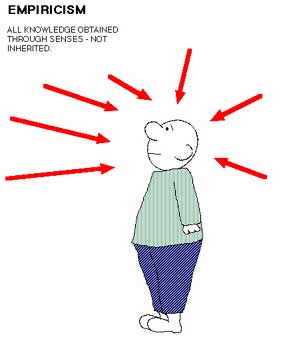
This experience-based approach became a method of inquiry. It used careful observation and experiments to gather facts and evidence.
The nature of scientific inquiry may be thought of at two levels:
1. That to do with theory and the foundation of hypotheses.
2. And actual empirical methods of inquiry (i.e. experiments, observations)
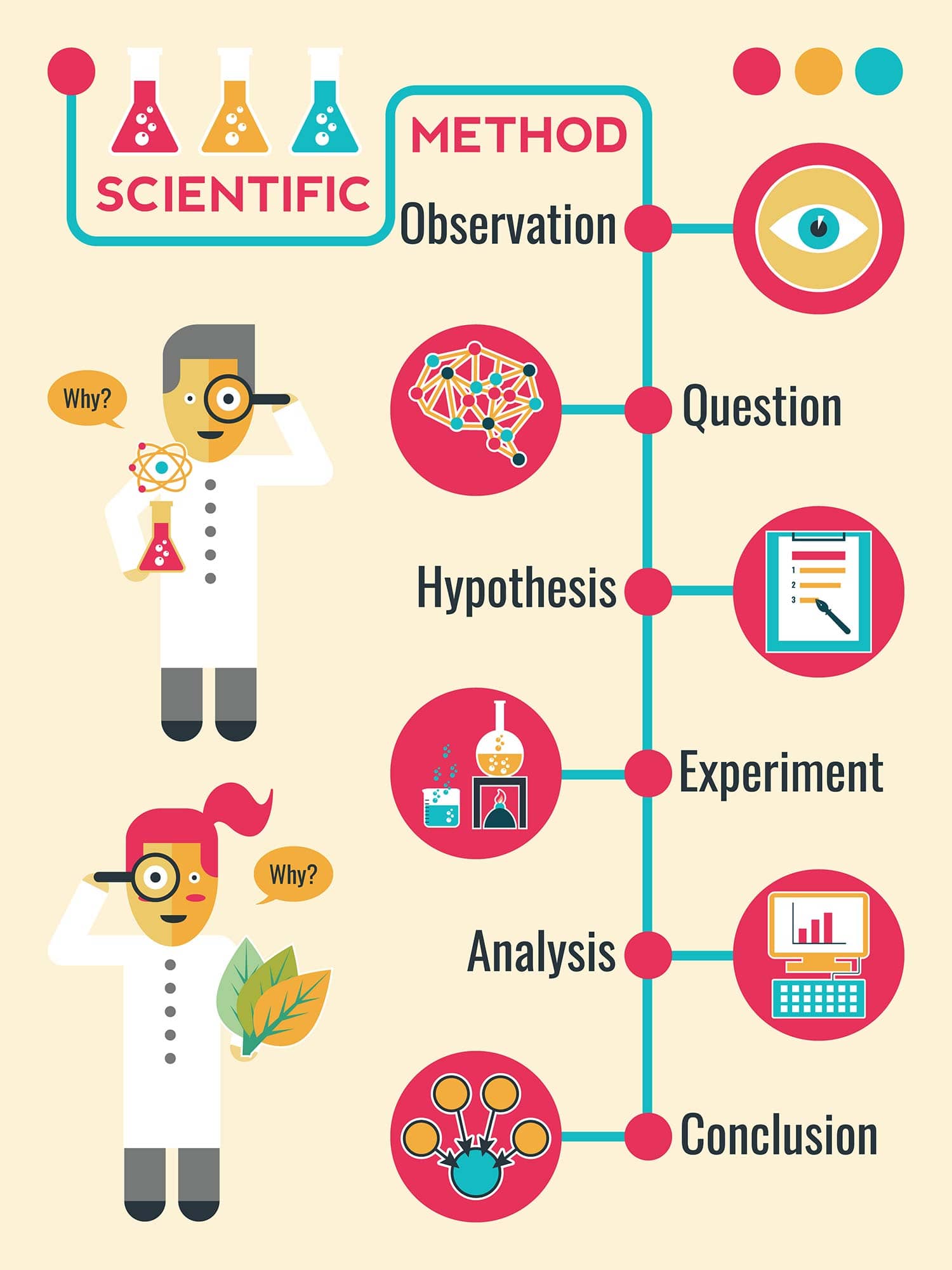
The prime empirical method of inquiry in science is the experiment.
The key features of the experiment are control over variables (independent, dependent, and extraneous), careful, objective measurement, and establishing cause and effect relationships.
Features of Science
Empirical Evidence
- Direct observation: data is collected through direct observation or experiment, not argument or belief.
- Precise reporting: experiments and observations are carried out carefully and reported in enough detail that other investigators can repeat them and attempt to verify the work.
- Checkable results: a claim only counts as empirical evidence once it has been reported precisely enough for someone else to check it, not just asserted.
- Transparent methods: the methods used to collect the evidence have to be transparent enough that a different researcher could, in principle, redo the study and see whether the same pattern turns up.
- Different from common sense: this is what separates empirical evidence from the everyday, common-sense views of behavior discussed later on this page. A single striking personal experience is not empirical evidence; a systematically collected, checkable set of observations is.
Objectivity
- Value-free: researchers try to remain unbiased in their investigations, not influenced by personal feelings and experiences.
- Facts speak for themselves: all sources of bias are minimized and personal or subjective ideas are eliminated, even when the facts differ from what the investigator hoped to find.
- Harder for psychology than physics: a rock or a chemical compound cannot guess what a researcher is hoping to find and adjust itself accordingly. A person can. That single difference, covered in detail below under The Objectivity Problem, makes objectivity harder to achieve in principle for psychology than for the natural sciences.
- Two documented threats: experimenter bias and demand characteristics are the two best-documented ways this criterion can fail even when no one involved is being dishonest.
Control
- Isolating cause and effect: extraneous variables need to be controlled so that any change in the effect (the DV) can be attributed to the cause (the IV) and nothing else.
- Why it matters: without control, a study can show that two things vary together without being able to say which one, if either, is actually causing the change.
- How it is achieved: researchers hold conditions constant or assign participants to conditions at random, so that any extraneous influence is spread evenly across groups rather than favoring one outcome.
- The trade-off: more control usually buys more certainty about cause and effect, but the tightly controlled setting itself can be unlike everyday life, the ecological-validity problem discussed later under Limitations of Scientific Psychology.
Hypothesis testing
- Stated before the data: a hypothesis is a prediction, derived from a theory, made at the beginning of an investigation, before the data are collected.
- Testable and unambiguous: it has to be operationalized in a form that can actually be tested, not left as a vague expectation.
- Null and alternative: psychology distinguishes different types of hypothesis, including the null hypothesis (predicting no effect) and the alternative hypothesis (predicting an effect).
- Why it has to be falsifiable: Karl Popper’s argument, covered in full under The Scientific Process, is that a hypothesis only counts as scientific if some possible result could show it wrong. A prediction that fits every possible outcome has not really been tested at all.
- Tested by trying to refute it: the point of stating a hypothesis this precisely is so a researcher can actively try to refute it, rather than simply looking for evidence that confirms what they already expected.
Replication
- Repeatable methods: a particular method and finding should be repeatable with different or the same people, on different occasions, to see if the results are similar.
- Acceptance depends on it: if a dramatic discovery is reported but other scientists cannot replicate it, it will not be accepted.
- Confidence in accuracy: getting the same results repeatedly under the same conditions gives confidence in their accuracy beyond a reasonable doubt.
- Builds a body of knowledge: reliable, repeated results are what let a field build up a body of knowledge or theory, which is vital for establishing a scientific claim.
- Psychology’s own record is mixed: a large 2015 project attempted to replicate 100 published psychology studies and found that only 36% of the replications reproduced the original result, detailed in full under The Replication Crisis below.
Predictability
- Anticipating, not just describing: a science should aim to predict future behavior from the findings of its research.
- Why it matters: a body of findings that only redescribes what has already happened, without anticipating new instances, has not yet met this criterion.
- Not every approach shares this goal: tightly controlled, lab-based sub-fields treat predicting new cases as a central measure of success. Humanistic and qualitative approaches, covered under Alternatives to Scientific Psychology, do not share that goal at all; they aim instead for depth and fidelity of understanding, on the view that a person’s behavior is too individual to usefully forecast.
- An honest limit: even where prediction is the goal, full prediction and control in psychology are probably unobtainable, since the environmental, mental, and biological influences on even the simplest behavior are too complex for every extraneous variable to be controlled.
The Scientific Process
Induction, Falsification, and Paradigms
Before the twentieth century, science largely used induction. Researchers made discoveries through accurate observation, then formulated theories based on the regularities they observed.
Newton’s Laws are an example of this. He observed the behavior of physical objects, such as apples, and produced laws that made sense of what he observed. The method was simple.
The scientific process is now based on the hypothetico-deductive model proposed by Karl Popper (1959). Popper suggested that theories/laws about the world should come first, and these should be used to generate expectations/hypotheses, which observations and experiments can falsify.
As Popper pointed out, falsification is the only way to be certain:
‘No amount of observations of white swans can allow the conclusion that all swans are white, but the observation of a single black swan is sufficient to refute that conclusion.’
Darwin’s theory of evolution followed the same pattern. He formulated a theory, then tested its predictions by observing animals in nature. His aim was simple. He looked for data that could prove the theory, or disprove it.
Thomas Kuhn argued that science does not progress gradually towards truth. Progress is not smooth. Instead, a field holds one paradigm until anomalies pile up that it cannot explain, which triggers a shift to a new paradigm.
Kuhn’s own standard says a field only counts as a mature science once its practitioners share a single paradigm.
By that test, psychologists disagree about which description fits best. Some call psychology pre-paradigmatic, a Kuhnian label for a field that has never reached that shared consensus.
Others see a candidate paradigm, such as cognitive psychology, already dominant. Still others describe it as multi-paradigmatic: several coexisting frameworks that have not displaced one another. No single description has won the argument.
There are many conflicting approaches, and the subject matter of Psychology is so diverse; therefore, researchers in different fields have little in common.
Psychology is really a very new science. Most of its advances have happened over the past 150 years or so.
However, it can be traced back to ancient Greece, 400–500 years BC. The emphasis then was a philosophical one, with great thinkers such as Socrates influencing Plato, who in turn influenced Aristotle. Three names matter most: Socrates, Plato, Aristotle.
Plato argued that there was a clear distinction between body and soul, and believed strongly in the influence of individual differences on behavior. He also played a key role in developing the notion of “mental health,” believing that the mind needed stimulation from the arts to keep it alive.
Aristotle, by contrast, firmly believed that the body strongly affected the mind. You might call him an early biopsychologist.
A Brief History of Psychology as a Science
Psychology as a science took a “back seat” until Descartes (1596-1650) wrote in the 17th century. He believed strongly in the concept of consciousness, maintaining that it was consciousness that separated us from animals.
He did, however, believe that our bodies could influence our consciousness, through interactions he located in the pineal gland. We now know this is probably not the case.
From this influential work came other important philosophies about psychology, including the work by Spinoza (1632-1677) and Leibnitz (1646-1716). But there still was no single, scientific, unified psychology as a separate discipline. You could certainly argue that there still isn’t.
When asked, “Who is the parent of psychology?” many people answer, “Freud.” Whether this is fair is open to debate. Ask who the parent of experimental psychology is instead, and few people would answer the same way.
Psychology took so long to emerge as a scientific discipline because it needed time to consolidate. Understanding behavior, thoughts, and feelings is not easy.
That difficulty may explain why the field was largely ignored between ancient Greek times and the 16th century, until researchers tired of speculation and argument alone.
Bearing in mind Aristotle’s plea for scientific investigation to support theory, psychology emerged as a scientific discipline in the late 1800s.
Wilhelm Wundt developed the first psychology lab in 1879. Introspection was used there, but systematically. It was really a place from which to start thinking about how to employ scientific methods to investigate behavior.
The behaviorists were the classic movement to adopt these strategies. They relied on controlled laboratory experiments and rejected unseen or subconscious forces as causes of behavior.
And later, cognitive psychologists adopted this rigorous (i.e., careful), scientific, lab-based approach.
Psychological Approaches
Psychoanalysis
Psychoanalysis has great explanatory power and understanding of behavior. Still, it has been accused of only explaining behavior after the event, not predicting what will happen in advance, and being unfalsifiable.
Some have argued that psychoanalysis functions more like a religion than a science. It is not alone in facing this charge. Evolutionary theory faces the same criticism, since it can explain any outcome as something that evolved that way.
Like other theories that are hard to refute, however, the possibility remains that psychoanalysis is actually right. Freud might still be right.
Kline (1984) argues that psychoanalytic theory can be broken down into testable hypotheses and tested scientifically. For example, Scodel (1957) postulated that orally dependent men would prefer larger breasts, a positive correlation. He found the opposite: a negative correlation.
Freudian theory could explain this finding through reaction formation: the subject shows exactly the opposite of their unconscious impulse. Even so, Kline points out that no significant correlation would have refuted the theory.
Behaviorism
Behaviorism builds parsimonious, or economical, theories of learning from a few simple principles: reinforcement, behavior shaping, and generalization. These principles explain behavior ranging from language acquisition to moral development.
Behaviorism advanced bold, precise, and refutable hypotheses, such as Thorndike’s law of effect. Watson’s Little Albert study is another. It conditioned a child to fear a neutral stimulus by pairing it repeatedly with a frightening one.
Behaviorism also rested on a hard core of central assumptions, especially environmental determinism. That assumption held until cognitive and ethological theorists mounted overwhelming criticism against it.
Behaviorists firmly believed in determinism and orderliness. They therefore made fairly consistent predictions about when an animal would respond, though they admitted that perfectly predicting any one individual was impossible.
The behaviorists used their predictions to control behavior in both animals, such as training pigeons to detect life jackets, and humans, through behavioral therapies.
Skinner even described a behaviorist-controlled society in his book Walden Two (1948).
Cognitive Psychology
Cognitive psychology adopts a scientific approach to unobservable mental processes, such as attention, working memory, and decision-making. It advances precise models and runs experiments on behavior to confirm or refute them.
Translating an invisible process into a testable, computational model is what keeps the field falsifiable even though its actual subject matter can never be observed directly.
Full understanding, prediction, and control in psychology are probably unobtainable.
Environmental, mental, and biological influences on even the simplest behavior are too complex for every extraneous variable to be controlled.
You will see, therefore, that there is no easy answer to the question, “is psychology a science?”. But many approaches of psychology do meet the accepted requirements of the scientific method, whilst others appear to be more doubtful in this respect.
Alternatives to Scientific Psychology
The Humanistic Rejection of Science
However, some psychologists argue that psychology should not be a science. There are alternatives to empiricism, such as rational research, argument, and belief.
The humanistic approach is one such alternative. It values private, subjective conscious experience and argues for the rejection of science.
Objective reality, on this view, matters less than a person’s own subjective perception and understanding of the world.
Because of this, Carl Rogers and Maslow placed little value on scientific psychology. They especially avoided the laboratory.
As Carl Rogers later put it, psychology needed “a more human science of the person” (Rogers, 1985). Rogers meant it literally.
He wanted a psychology answerable to subjective, first-person experience, not one borrowed wholesale from physics.
A person’s subjective experience of the world is an important and influential factor in their behavior. Only by seeing the world from the individual’s point of view can we really understand why they act the way they do.
This is what the humanistic approach aims to do. Humanism studies the whole person, seen through the eyes of the person doing the behaving, not just the observer.
An individual’s behavior, on this view, is connected to their inner feelings and self-image. The approach deliberately steps away from a scientific viewpoint.
It rejects determinism in favor of free will. The aim is a unique, in-depth understanding, not prediction and control.
It does not have an orderly set of theories, though it shares some core assumptions. Predicting and controlling people’s behavior is not the goal. The individuals themselves are the only ones who can, and should, do that.
How Qualitative Research Checks Itself
Rejecting laboratory science does not mean rejecting rigor. Qualitative researchers judge their own work by a different set of standards, adapted for interpretive work rather than borrowed unchanged from the experimental tradition.
Shenton (2004) sets out four such standards, known as trustworthiness criteria. They stand in for the quantitative ideas of validity, reliability, and objectivity.
Credibility asks whether the findings genuinely reflect participants’ experience. Transferability asks whether the findings illuminate other, similar contexts, rather than generalizing in the statistical sense.
Dependability asks whether the process would yield a consistent account if repeated. Both matter for trust.
Confirmability asks how far the findings are shaped by participants’ own accounts rather than the researcher’s assumptions. A qualitative study can be judged rigorous on these four grounds even though it never reports a p-value.
Miller’s Critique of Control
Miller (1969), in Psychology as a Means of Promoting Human Welfare, criticizes the controlling view of psychology. He argues that understanding should be the field’s main scientific goal, asking who would do the controlling and whose interests it would serve.
Humanistic psychologists rejected a rigorous scientific approach for similar reasons. They saw it as dehumanizing and unable to capture the richness of conscious experience.
In many ways, this rejection in the 1950s, 1960s, and 1970s was a backlash. Its target was the dominance of the behaviorist approach in North American psychology.
Common Sense Views of Behavior
In certain ways, everyone is a psychologist. Formal training is not required.
People hold common-sense views of the world, of other people, and of themselves. These views come from personal experience, upbringing, and culture.
They cover many aspects of psychology: the causes of behavior, the personality traits people possess, what others should do, and how to raise children.
Informal psychologists acquire this knowledge in a subjective and anecdotal way. It rarely rests on systematic evidence. Sometimes a single experience is all it takes.
Racial or religious prejudice can masquerade as this kind of common sense. It rarely stands up to what is actually the case.
Common sense, then, is something that everybody uses in their day-to-day lives, guides decisions and influences how we interact with one another.
Common sense is not based on systematic, scientific evidence, so it can mislead. It may even lead one group to treat others unfairly.
The Objectivity Problem
Psychology faces a challenge that physics and chemistry do not: the object being studied can notice it is being studied, and react to that fact. A participant might guess a study’s hypothesis and change their behavior accordingly, something no rock or chemical compound can do.
Experimenter Bias
Experimenter bias occurs when what a researcher expects shapes what they unwittingly communicate, which then shapes how participants behave. No one has to handle the data dishonestly for this to happen.
Aim: Rosenthal and Fode (1963) tested whether an experimenter’s expectations could influence the outcome of a study, even without any dishonesty. The bias, if it existed, would be unintentional.
Method: Students were told they were testing rats bred to be either “maze-bright” or “maze-dull.” In fact, the rats were standard lab rats, assigned to groups at random.
Results: Students who believed their rats were “maze-bright” reported faster maze learning than those who believed their rats were “maze-dull.” The rats themselves had not differed at all.
Conclusion: An experimenter’s expectations can unintentionally bias the results, even in a tightly controlled study.
Rosenthal and Jacobson (1968) later found the same effect in real classrooms. Teachers were told certain students would soon show an “intellectual growth spurt.” The label alone did the work. Those randomly chosen students then showed bigger IQ gains than their classmates.
The Pygmalion effect, as this finding came to be known, shows that an expectation can become a self-fulfilling prophecy.
Demand Characteristics
Demand characteristics are cues in a study’s setting, instructions, or the experimenter’s manner that let participants guess the hypothesis being tested. Once participants think they know what a study is about, they often change their behavior. Sometimes this helps confirm the hypothesis; sometimes it deliberately sabotages it.
Orne (1962) coined the term. He argued that participants actively try to work out what an experiment is really testing, then adjust their behavior accordingly.
This makes demand characteristics one of the hardest sources of bias for researchers to eliminate. Even careful debriefing afterwards cannot undo behavior participants have already changed.
The change was already made. Together, experimenter bias and demand characteristics show that psychology’s objectivity problem is not just philosophical. It is a practical, well-documented pattern that researchers must actively guard against in every study design.
Limitations of Scientific Psychology
Despite having a scientific methodology worked out (we think), some further problems and arguments doubt psychology is ever a science.
Limitations may refer to the subject matter (e.g., overt behavior versus subjective, private experience). They may also refer to objectivity, generality, testability, ecological validity, ethical issues, and philosophical debates, etc.
Science assumes that there are laws of human behavior that apply to each person. Therefore, science takes both a deterministic and reductionist approach.
Science studies overt behavior because it is objectively observable and measurable. This lets psychologists agree on what they observed, so evidence can be collected to test a theory about people.
Scientific laws are generalizable, but psychological explanations are often restricted to specific times and places. Because psychology studies (mostly) people, it studies (indirectly) the effects of social and cultural changes on behavior.
Psychology does not go on in a social vacuum. Behavior changes over time and in different situations. These factors, and individual differences, make research findings reliable for a limited time only.
Are traditional scientific methods appropriate for studying human behavior? When psychologists operationalize their IV, it is highly likely that this is reductionist, mechanistic, subjective, or just wrong.
Operationalizing variables means defining and measuring a specific variable for use in a study. For example, a biopsychologist might operationalize stress as an increased heart rate.
Doing this may remove researchers from the human experience of what they are studying. The same problem applies to causality.
Experiments aim to show that X causes Y. But this deterministic view ignores extraneous variables, and the fact that a different time or place might remove X’s influence altogether. This raises the issue of ecological validity.
Objectivity is impossible. It is a huge problem in psychology, as it involves humans studying humans, and it is very difficult to study people’s behavior in an unbiased fashion.
A general philosophy-of-science problem compounds this: a theoretical standpoint always influences the researcher, as Freud’s own case shows.
The observer and the observed belong to the same species. That creates problems of reflexivity.
A researcher’s own assumptions and background shape the data, rather than the researcher standing outside it as a neutral instrument.
A behaviorist would never examine a phobia in terms of unconscious conflict. Paradigms cut both ways. Likewise, Freud would never explain a phobia as behavior acquired through operant conditioning.
This particular viewpoint that a scientist has is called a paradigm (Kuhn, 1962). Most mature disciplines share one predominant paradigm.
Psychology, by contrast, has several competing paradigms: psychoanalytic, biological, cognitive, and humanistic, among others.
Psychologists disagree about which label fits: pre-paradigmatic, multi-paradigmatic, or simply a period of normal science under a candidate paradigm. Normal science is Kuhn’s term for the everyday puzzle-solving a field does within one accepted paradigm.
Lakatos and Feyerabend: Two More Views
Popper and Kuhn are not the only philosophers with a stake in this argument.
Lakatos (1970) tried to keep Popper’s rigor. But he also accepted Kuhn’s point: scientists rarely drop a favoured theory the moment one prediction fails.
He proposed judging whole research programmes, not single theories.
Each has a “hard core” of central assumptions, protected by a “belt” of auxiliary hypotheses that can be revised to absorb an awkward result.
Progress means new predictions. A programme is progressive as long as revising the belt keeps generating new, confirmed predictions. It turns degenerating once its revisions do nothing but explain away each new anomaly.
The label matters. On this view, the real question about psychoanalysis is not Popper’s test of whether it risks an observation. It is whether the theory has generated novel confirmed predictions over its history, or merely patched its protective belt. That is a harder, more historical question.
Feyerabend (1975) pushed further still. No fixed methodological rule, he argued, has ever actually been followed throughout the history of science.
Insisting on one, Popper’s falsifiability included, would have blocked genuine advances. His slogan was blunt: “anything goes.”
Good method has to be judged case by case, not laid down in advance. Read this way, psychology’s mix of experiments, surveys, case studies, and qualitative analysis is not necessarily immaturity.
It could equally be exactly what a field honestly matched to a diverse subject matter should look like.
Verification (i.e., proof) may be impossible. We can never truly prove a hypothesis. We may find results supporting it for years, but we will never be 100% confident it is true.
It could be disproved at any moment. The main driving force behind this objection is Karl Popper, the famous philosopher of science and advocate of falsificationism.
Take the famous Popperian example hypothesis: “All swans are white.” How do we know for sure that we will not see a black, green, or hot pink swan in the future?
Confirmation is never proof. Even if there has never been a sighting of a non-white swan, we still haven’t really proven our hypothesis.
Popper argues that the best hypotheses are those which we can falsify: disprove them. Falsifiability alone is decisive. If we know something is not true, then we know something for sure.
Testability: much of psychology’s subject matter, such as memory, is unobservable and cannot be measured directly. So many variables influence human behavior that it is impossible to control them all effectively.
The Replication Crisis
Since replicability is one of the criteria a science must satisfy, psychology’s own replication record offers a direct empirical test of whether the field lives up to its scientific claims.
Aim: The Open Science Collaboration, a large multi-site group of researchers, set out to measure directly how reproducible published psychology findings really are. The question was empirical, not philosophical.
Method: The team selected 100 studies from three top psychology journals and attempted to replicate each one as closely as possible. They used larger sample sizes than the originals so that low statistical power could not explain any failures. The protocols were pre-registered.
Results: Of the 100 original studies, 97% had reported a statistically significant result, but only 36% of the replications did. Effect sizes roughly halved.
Conclusion: A large share of psychology’s headline findings do not survive an honest, well-powered attempt to reproduce them. Even when they do replicate, the true effect is usually smaller than first reported (Open Science Collaboration, 2015).
The finding sparked a wider reform movement.
Ioannidis (2005) had already argued that low statistical power and flexible analysis choices make many published findings, across many fields, likely to be false. Munafò et al. (2017) later proposed concrete fixes, including pre-registration, larger samples, and open data, aimed at raising psychology’s reproducibility rate.
So, are we any closer to understanding a) what science is and b) if psychology is a science?
Unlikely. There is no definitive philosophy of science and no flawless scientific methodology.
When people use the term “scientific,” they generally share a rough sense of what it means. But once we break the term down, as we just have, the picture gets far less certain.
What is science? It depends on your philosophy.
Is psychology a science? It depends on your definition.
So why bother asking, and how do we conclude all this?
Slife and Williams (1995) offer two answers.
- Keep striving for scientific methods: psychology needs a rigorous discipline, and abandoning the search for unified methods would mean losing a sense of what the field even is.
- Keep adapting methods to people: the methods built for the natural sciences may simply not fit human behavior, so psychology must keep developing methods suited to its own subject matter.
Further Information

Practical Applications
The demarcation question is not just academic. Whether psychology counts as a science has real, practical consequences.
Funding, Credibility, and Evidence-Based Practice
Funding bodies often weight research proposals by methodological rigor. A field seen as “less scientific” can lose out in competition for grants against fields whose findings look more cumulative and prediction-generating.
Credibility works the same way across a university. It shapes psychology’s standing, its access to interdisciplinary funding, and its influence on policy.
A field seen as rigorous gets invited into rooms, such as public-health planning, legal reform, or technology design, that a field regarded as merely “soft” or anecdotal is not.
Evidence-based practice runs on the same logic. In clinics, schools, and organizations, it depends on being able to say an intervention works because it was tested under conditions that could have shown it did not.
A therapy recommended on clinical impression alone carries a different evidential status than one backed by replicated, controlled trials. The stakes are real.
Where a discipline sits on the demarcation question shapes how much weight regulators, insurers, and professional bodies place on its recommendations. That holds even when both kinds of therapy feel equally convincing to the practitioner using them.
Workplace Assessment and Public Trust
Personnel selection, promotion, and the psychometric tests built into recruitment software rest on the same question, one step removed.
A selection tool is only defensible if the trait it claims to measure is real, its scores are reliable, and its predictions have actually been checked against job performance. Marketing a tool as “scientific” is not the same as it being tested. Marketing is not evidence.
Sometimes a testing method comes from a sub-field with a thin evidence base, or one never independently replicated. Treating that method as science, rather than a plausible-sounding heuristic, can affect who gets hired, promoted, or flagged as high-risk.
Public trust follows a similar logic. Reports of unreliable findings about parenting, memory, or mental illness do not stay contained to one study.
They color how much credibility any psychological claim receives, including well-supported ones.
References
Feyerabend, P. (1975). Against method: Outline of an anarchistic theory of knowledge. New Left Books.
Ioannidis, J. P. A. (2005). Why most published research findings are false. PLoS Medicine, 2(8), e124. https://doi.org/10.1371/journal.pmed.0020124
Kline, P. (1984). Psychology and Freudian theory: An introduction. Methuen.
Kuhn, T. S. (1962). The structure of scientific revolutions. University of Chicago Press.
Lakatos, I. (1970). Falsification and the methodology of scientific research programmes. In I. Lakatos & A. Musgrave (Eds.), Criticism and the growth of knowledge (pp. 91–196). Cambridge University Press.
Munafò, M. R., Nosek, B. A., Bishop, D. V. M., Button, K. S., Chambers, C. D., Percie du Sert, N., Simonsohn, U., Wagenmakers, E.-J., Ware, J. J., & Ioannidis, J. P. A. (2017). A manifesto for reproducible science. Nature Human Behaviour, 1, Article 0021. https://doi.org/10.1038/s41562-016-0021
Open Science Collaboration. (2015). Estimating the reproducibility of psychological science. Science, 349(6251), Article aac4716. https://doi.org/10.1126/science.aac4716
Orne, M. T. (1962). On the social psychology of the psychological experiment: With particular reference to demand characteristics and their implications. American Psychologist, 17(11), 776–783. https://doi.org/10.1037/h0043424
Popper, K. R. (1959). The logic of scientific discovery. Hutchinson.
Rogers, C. R. (1985). Toward a more human science of the person. Journal of Humanistic Psychology, 25(4), 7–24. https://doi.org/10.1177/0022167885254002
Rosenthal, R., & Fode, K. L. (1963). The effect of experimenter bias on the performance of the albino rat. Behavioral Science, 8(3), 183–189. https://doi.org/10.1002/bs.3830080302
Rosenthal, R., & Jacobson, L. (1968). Pygmalion in the classroom: Teacher expectation and pupils’ intellectual development. Holt, Rinehart & Winston.
Shenton, A. K. (2004). Strategies for ensuring trustworthiness in qualitative research projects. Education for Information, 22(2), 63–75. https://doi.org/10.3233/efi-2004-22201

