Science is not just knowledge. It is also a method for obtaining knowledge. Scientific understanding is organized into theories.
The scientific method is a step-by-step process used by researchers and scientists to determine if there is a relationship between two or more variables.
Psychologists use this method to conduct psychological research, gather data, process information, and describe behaviors.
It involves careful observation, asking questions, formulating hypotheses, experimental testing, and refining hypotheses based on experimental findings.
How the Scientific Method Is Used
The scientific method can be applied broadly in science across many different fields, such as chemistry, physics, geology, and psychology.
In a typical application of this process, a researcher will develop a hypothesis, test this hypothesis, and then modify the hypothesis based on the outcomes of the experiment.
The process is then repeated with the modified hypothesis until the results align with the observed phenomena. Detailed steps of the scientific method are described below.
Keep in mind that the scientific method does not have to follow this fixed sequence of steps; rather, these steps represent a set of general principles or guidelines.
Key Takeaways
- Not Fixed Steps: The steps below are general guidelines, not a rigid sequence every study must follow in order.
- Empirical Basis: The method rests on empiricism: the idea that reliable knowledge comes from direct observation, not intuition or authority alone.
- Falsifiable: A good hypothesis must be testable and capable of being proven wrong, not just confirmable.
- Bias Control: Because personal and cultural bias affects everyone, a systematic method, not personal judgment, is what keeps research more objective.
- Cyclical, Not Linear: The process ends with sharing results and starting again; no single study or result is ever considered final.
- Replication Matters: Large replication projects since 2015 (rerunning studies to check the findings hold up) found that many did not, prompting reforms such as preregistration (publicly registering a plan before data collection).
7 Steps of the Scientific Method
Psychology uses an empirical approach
Empiricism (founded by John Locke) states that the only source of knowledge comes through our senses – for example, sight, hearing, and touch.
Empirical evidence does not rely on argument or belief. Thus, empiricism is the view that all knowledge is based on or may come from direct observation and experience.
The empiricist approach of gaining knowledge through experience quickly became the scientific approach and greatly influenced the development of physics and chemistry in the 17th and 18th centuries.
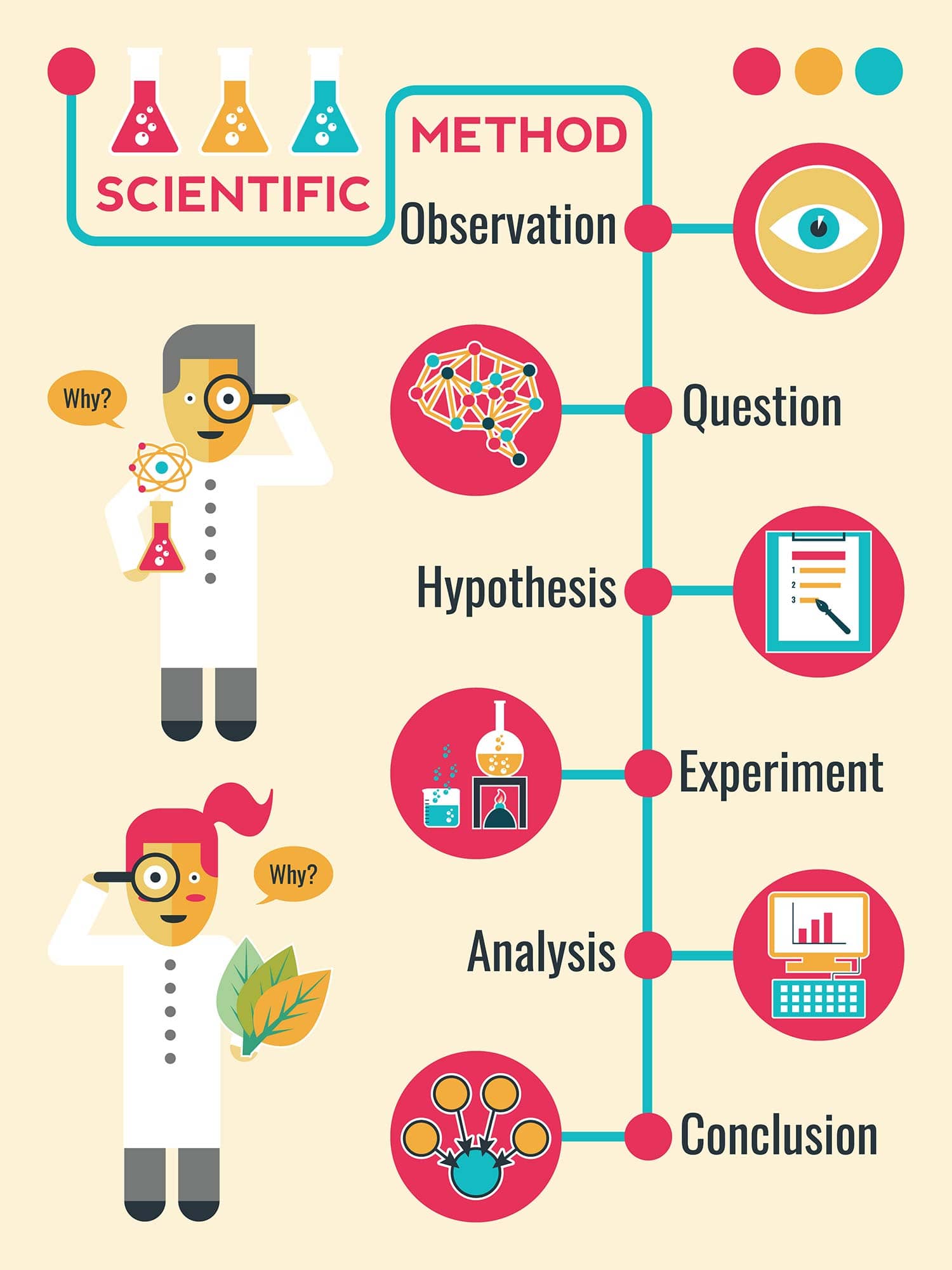
Step 1: Make an Observation (Theory Construction)
Every researcher starts at the very beginning. Before diving in and exploring something, one must first determine what they will study – it seems simple enough!
Reviewing the Existing Literature
By making observations, researchers can establish an area of interest. A researcher then reviews the literature. This means finding out what has already been tested and what questions remain unanswered.
This assessment will provide helpful information about what has already been comprehended about the specific topic and what questions remain, and if one can go and answer them.
Not everything makes the cut. Specifically, a literature review might implicate examining a substantial amount of documented material from academic journals to books dating back decades. The most appropriate information gathered by the researcher will be shown in the introduction section or abstract of the published study results.
The background material and knowledge will help the researcher with the first significant step in conducting a psychology study, which is formulating a research question.
Inductive Reasoning
This is the inductive phase of the scientific process. Observations yield information that is used to formulate theories as explanations. A theory is a well-developed set of ideas that propose an explanation for observed phenomena.
Inductive reasoning moves from specific premises to a general conclusion. It starts with observations of phenomena in the natural world and derives a general law.
Step 2: Ask a Question
Once a researcher has made observations and conducted background research, the next step is to ask a scientific question. A scientific question must be defined, testable, and measurable.
A useful way to frame a scientific question is “What is the effect of…?” or “How does X affect Y?” Both forms point to the same requirement. To answer an experimental question, a researcher must identify two variables: the independent and dependent variables.
The independent variable is the one manipulated: the cause. The dependent variable is the one measured: the effect.
An example of a research question could be, “Is handwriting or typing more effective for retaining information?” Answering the research question and proposing a relationship between the two variables is discussed in the next step.
Step 3: Form a Hypothesis (Make Predictions)
A hypothesis is an educated guess about the relationship between two or more variables. A hypothesis is an attempt to answer your research question based on prior observation and background research.
Theories are usually too complex to test all at once, so researchers create hypotheses to test specific aspects of a theory. One theory yields many hypotheses.
For example, a researcher might ask about the connection between sleep and educational performance. Do students who get less sleep perform worse on tests at school?
Formulating a good hypothesis takes thought. A researcher must weigh the different questions a topic raises and consider how each could be tested.
It is important that the hypothesis is both testable against reality and falsifiable. This means that it can be tested through an experiment and can be proven wrong.
Karl Popper proposed this as the falsification principle. It demarcates science from non-science by requiring that a theory be testable and, in principle, provable false.
To test a hypothesis, researchers rely on the null hypothesis: the default assumption that there is no difference between the populations the samples were taken from. It predicts that the independent variable will not influence the dependent variable.
Examples of “if…then…” Hypotheses:
- If one gets less than 6 hours of sleep, then one will do worse on tests than if one obtains more rest.
- If one drinks lots of water before going to bed, one will have to use the bathroom often at night.
- If one practices exercising and lighting weights, then one’s body will begin to build muscle.
The research hypothesis is often called the alternative hypothesis and predicts what change(s) will occur in the dependent variable when the independent variable is manipulated.
It states that the results are not due to chance and that they are significant in terms of supporting the theory being investigated.
Although one could state and write a scientific hypothesis in many ways, hypotheses are usually built like “if…then…” statements.
Step 4: Run an Experiment (Gather Data)
The next step in the scientific method is to test your hypothesis and collect data. A researcher will design an experiment to test the hypothesis. The experiment will either support or refute it.
The exact research methods used to examine a hypothesis depend on what is being studied.
A psychologist typically uses two kinds of research: experimental research, which manipulates a variable to test cause and effect, and descriptive research, which observes behaviour without manipulating anything.
The scientific method aims for objectivity. Researchers do not let preconceived ideas or biases influence how they collect data. It is also systematic, since experiments are conducted in a logical way.
Experimental Research
Experimental research investigates cause-and-effect relationships between variables. It manipulates an independent variable and measures its effect on a dependent one. Repeating the procedure confirms the result is accurate and consistent.
This lets researchers determine whether changes in one variable actually cause changes in another, something purely descriptive methods cannot establish.
Most simple experiments use a control group, which does not receive the treatment, and an experimental group, which does. A drug trial illustrates this: one group gets a placebo, the other the real pill.
Descriptive Research
Descriptive research is generally used when it is challenging or even impossible to control the variables in question. Examples include naturalistic observation, case studies, and correlation studies.
Phone surveys are a common example. They cannot usually establish cause and effect, but correlational studies remain widespread in psychology. They reveal associations between variables and measure how strong those relationships are.
Step 5: Analyze the Data and Draw Conclusions
Once the investigation is complete and the data collected, the researcher inspects the results. Statistics are used to summarize the data and draw conclusions. The outcome determines whether the hypothesis is rejected or confirmed.
Analyze the Data
So, how does a researcher determine what the results of their study mean? Statistical analysis can support or refute a hypothesis. It also shows whether the results are statistically significant, meaning unlikely to be due to chance.
When outcomes are said to be “statistically significant,” it is improbable that these results are due to luck or chance. Based on these observations, investigators must then determine what the results mean.
An experiment does not always confirm the hypothesis. Sometimes it fails to hold up in other cases.
A hypothesis that fails doesn’t mean the study was worthless. The findings still help scientists develop new questions and contribute to the field’s shared knowledge base.
If the hypothesis is not supported, a researcher should acknowledge the experiment’s results, formulate a new hypothesis, and develop a new experiment.
We must avoid any reference to results proving a theory as this implies 100% certainty, and there is always a chance that evidence may exist that could refute a theory.
Draw Conclusions and Interpret the Data
When the empirical observations disagree with the hypothesis, a number of possibilities must be considered:
- Theory: It may be incorrect and need altering so that it fully explains the data.
- Hypothesis: It may have been poorly derived from the theory, so the researchers expected the wrong outcome.
- Method: The research may have been poorly conducted, used an inappropriate approach, or overlooked other factors.
Any of these possibilities restarts the process of the scientific method.
If the hypothesis is supported, the researcher can find more evidence to support their hypothesis or look for counter-evidence to strengthen their hypothesis further.
In either scenario, the researcher should share their results with the greater scientific community.
Step 6: Share Your Results
One of the final stages of the research cycle involves the publication of the research. Once the report is written, the researcher(s) may submit the work for publication in an appropriate journal.
Usually, this is done by writing up a study description and publishing the article in a professional or academic journal. Such work appears in peer-reviewed journals. Examples include Developmental Psychology, Psychological Bulletin, and the Journal of Social Psychology.
Scientists write up their study and its findings. This enables other researchers to build upon the present research or replicate the results.
As outlined by the American Psychological Association (APA), there is a typical structure of a journal article that follows a specified format. In these articles, researchers:
- Background: Supply a brief narrative and background on previous research.
- Hypothesis: Give their hypothesis.
- Participants: Specify who participated in the study and how they were chosen.
- Operational Definitions: Provide operational definitions for each variable.
- Method: Explain the measures and methods used to collect data.
- Results: Describe how the data collected was interpreted.
- Discussion: Discuss what the outcomes mean.
A detailed record of psychological studies and all scientific studies is vital to clearly explain the steps and procedures used throughout the study. Other researchers can then repeat it.
The editorial process utilized by academic and professional journals guarantees that each submitted article undergoes a thorough peer review to help assure that the study is scientifically sound. It becomes part of the field’s shared knowledge.
This last step is important because all results, whether they supported or did not support the hypothesis, can contribute to the scientific community. Publication of empirical observations leads to more ideas that are tested against the real world, and so on. In this sense, the scientific process is circular.
By replicating studies, psychologists can reduce errors, validate theories, and gain a stronger understanding of a particular topic.
Step 7: Repeat the Scientific Method (Iteration)
If the hypothesis holds up, the researcher looks for further evidence or counter-evidence. If it does not, they form a new hypothesis and try again, perhaps narrowing the question or refining the original design.
The cycle never truly ends. No single result is ever considered final.
The scientific method endures because it is straightforward enough for scientists, and everyone else, to use again and again.
The scientific method is a process of:
- Making an observation.
- Forming a hypothesis.
- Making a prediction.
- Experimenting to test the hypothesis.
The procedure of repeating the scientific method is crucial to science and all fields of human knowledge.
Applications
The scientific method is not confined to research laboratories. Its systematic approach to testing ideas is used wherever a decision benefits from evidence.
Education
Educational psychologists run controlled experiments to compare teaching techniques. The aim is simple: which methods work best?
Teachers increasingly draw on meta-analyses that pool results across many studies rather than relying on one trial. The method also works as a teaching tool in its own right. Students learn to frame testable questions, design a study, and draw evidence-based conclusions, skills that transfer well beyond psychology.
Clinical Psychology and Mental Health
Evidence-based practice applies the scientific method directly to therapy. It combines assessment, case formulation, and the therapeutic relationship with the clinician’s professional judgement and each client’s preferences.
Clinicians use randomised controlled trials to test which interventions work for specific conditions, while controlling for other factors. Meta-analyses pool results across many trials. They estimate effect sizes and identify the moderators that make one treatment work better than another for a given client.
A 2023 systematic review looked at how these interventions perform once they leave the controlled trial and enter routine practice. Therapists also track client progress directly. They adjust treatment in light of the results, the repeating cycle described at Step 7.
Health Psychology and Behaviour Change
Health psychologists apply the scientific method to health-related behaviours such as physical activity, medication adherence, smoking cessation, and diet. Controlled experiments compare techniques, including goal-setting, self-monitoring, and motivational interviewing, to see which produce the largest and most sustained improvements in health outcomes.
Intuition is a poor guide here. An intervention that seems like it should work often does not, so only systematic testing reveals which changes actually help.
Meta-analyses now pool findings across hundreds of studies. This helps researchers identify the active ingredients, the specific components, that make behaviour-change interventions succeed. Interventions built this way tend to produce more durable results than ones based on intuition alone.
Workplace and Public Policy
Organisations use experimental and correlational designs to test hiring, training, and leadership practices. Results guide real decisions. Technology companies routinely A/B test interface and design changes on real users.
Policymakers draw on randomised trials and systematic reviews to judge which social programmes work, particularly in areas such as early childhood education and criminal justice. Replication, covered at Steps 6 and 7, matters here because the findings affect large populations.
Technology raises the same question in a different setting.
Technology and User Experience
User experience researchers formulate hypotheses about which interface designs will feel most intuitive. Testing settles it. They run controlled experiments comparing alternatives and collect behavioural data on how people actually use each version.
Rapid feedback loops in digital products let this cycle of testing and iteration run almost continuously. During the COVID-19 pandemic, the same logic helped researchers evaluate how well technology-supported teaching and therapy worked once delivery moved online.
Critical Evaluation
The seven-step model above describes how the scientific method should work. Research since 2015 has tested how well it works in practice, and the results have driven real reforms.
Contemporary Research
The most significant recent development is the replication crisis. Large-scale projects re-ran published psychology studies and found that many results did not hold up.
Aim: The Open Science Collaboration (2015) set out to estimate how reproducible published psychological findings actually are.
Method: A team of 270 researchers selected 100 psychology studies published in 2008 across three major journals. Each was repeated using its original design and materials.
Results: Only 36% of the replications reproduced the original effect, versus 97% of the original studies reporting one. A separate check judged just 39% of the replications a successful match to the original finding, and effect sizes were roughly halved.
Conclusion: Published findings had been systematically overestimated. That conclusion helped trigger the methodological reforms described below.
A second project reached a similar figure. It replicated 21 social-science experiments from Nature and Science, using much larger samples, and found a 62% success rate (Camerer et al., 2018). Two independent projects landing on comparable numbers points to a systemic problem, not one journal’s bad luck.
The evidence base has grown further still.
Aim: A 2026 multi-laboratory collaboration set out to estimate how replicable positive findings are across the social and behavioural sciences more broadly, not just within psychology’s own top journals.
Method: 292 researchers selected 274 claims of positive results from 164 papers published across 54 journals between 2009 and 2018. Each replication was high-powered and peer-reviewed in advance through a standardised protocol.
Results: The number held up. It replicated for 55.1% of claims, with rates ranging from 42.5% to 63.1% across disciplines (Tyner et al., 2026).
Conclusion: The result sits between the Open Science Collaboration’s 36% and Camerer and colleagues’ 62%. This larger, broader sample confirms the shortfall is a genuine pattern across the sciences, not a quirk of one journal.
Psychology has since adopted preregistration and Registered Reports. In one, methods and analysis plans are peer-reviewed and locked in before data collection, guaranteeing publication regardless of outcome.
Both formats require researchers to publish their hypotheses and analysis plan before seeing the data (Munafò et al., 2017). That closes off the chance to adjust a hypothesis after the fact, something Step 3 above depends on not happening.
Adoption remains uneven. A 2025 review found preregistration rates for psychology meta-analyses ranging from just 2% (in Psychological Bulletin, 1990–2017) to 36% (cognitive-training meta-analyses, 1997–2023) (Sandoval-Lentisco et al., 2025).
Confirmation Bias and Motivated Reasoning
Step 4 assumes researchers do not let their own views shape how they collect and read data, but confirmation bias shows how easily that assumption breaks down.
Confirmation bias is the tendency to notice, favour, and remember information that fits what someone already believes, while giving less weight to evidence that contradicts it.
Kahan and colleagues tested whether strong numerical skill protects people from motivated reasoning on a politically charged topic. It does not. The most numerate participants were the most polarised, using their quantitative skill to read ambiguous data in whichever direction matched their existing views (Kahan et al., 2017).
The finding challenges a basic assumption behind Step 4: that trained observers converge on the same reading of the same evidence. Objectivity may need external safeguards, such as preregistration and blind analysis, rather than good intentions alone.
Individual scientists are often poor judges of their own biases.
The Problem of Induction
Step 1 builds a theory up from individual observations, an approach philosophers call induction. David Hume spotted a logical gap here. Past observations cannot guarantee the next one. The sun has risen every day so far, but that alone cannot prove it will rise tomorrow.
Popper had an answer. Karl Popper’s falsification principle, introduced at Step 3, answers this problem: science should try to disprove its own theories rather than confirm them through repeated observation. No finite number of confirming observations can ever prove a theory true (Popper, 1959).
Popper’s own answer has a limit too.
When a prediction fails, researchers can never be fully certain whether the theory itself is wrong, the hypothesis was poorly derived, or some other assumption broke down.
Kuhn’s Paradigms and Scientific Revolutions
Thomas Kuhn saw science differently. He argued that mature sciences are organised around a paradigm, not a single logical method.
A paradigm is a shared set of assumptions, exemplary problems, and instruments that defines what counts as a meaningful question within a scientific community. Most research is just normal science. It solves puzzles within an unquestioned paradigm, rather than constantly trying to falsify it, as Step 3 describes.
Paradigms change only through scientific revolutions, when anomalies the existing paradigm cannot explain eventually force a shift to a new framework (Kuhn, 1962). The seven steps above describe normal science within a paradigm, not the far rarer process by which a paradigm itself gets overturned.
Lakatos and Feyerabend: Beyond Falsification
Popper’s falsification principle has its own critics. Lakatos argued for research programmes, not single theories.
Each programme has a hard core of assumptions researchers protect from refutation, surrounded by a protective belt of auxiliary ideas that can be revised when a prediction fails.
A programme is progressive when its revisions generate new, testable predictions that hold up. It is degenerating when revisions merely patch over anomalies after the fact (Lakatos, 1970).
Paul Feyerabend went further still. He argued that no single method, falsifiability included, has actually been followed consistently across science’s major discoveries (Feyerabend, 1975). Insisting on one, he thought, risks stifling the creativity that drives scientific progress.
Most working psychologists nonetheless still treat something close to the seven-step model as their working procedure.
Statistical Significance vs. Practical Importance
Step 5 treats statistical significance as the test of whether a hypothesis is supported. But significance alone says nothing about how large or meaningful an effect actually is. Effect size does. It measures a result’s real size, not just its existence.
With a large enough sample, even a trivial effect can reach statistical significance. A study with a small sample can miss a genuinely important one. Decades of treating p < .05 as the bar for publication rewarded researchers for chasing significance rather than effect size.
That incentive contributed directly to the replication crisis described above. Reform efforts now emphasise reporting effect size and confidence intervals alongside, not instead of, the p-value.
Ethical and Cultural Limits
Step 4 calls for systematic control and random assignment. Ethics often rules that out.
Researchers cannot assign children to abusive versus nurturing homes, or expose anyone to serious trauma. Such experiments would give the strongest evidence about cause and effect. They are also unconscionable.
For many of psychology’s biggest questions, from early adversity to poverty and discrimination, a true experiment simply is not possible.
Researchers rely instead on correlational designs, quasi-experiments, and longitudinal studies. Each provides weaker evidence of causation than an experiment does.
A separate limit concerns who the seven steps have been tested on. Many theories rest on WEIRD samples: Western, Educated, Industrialised, Rich, and Democratic populations.
Findings from these samples do not always generalise. The method does not fix this on its own. Researchers must deliberately sample more diversely, and test whether a finding is culturally specific or universal.
References
Camerer, C. F., Dreber, A., Holzmeister, F., Ho, T.-H., Huber, J., Johannesson, M., Kirchler, M., Nave, G., Nosek, B. A., Pfeiffer, T., Altmejd, A., Buttrick, N., Chan, T., Chen, Y., Forsell, E., Gampa, A., Heikensten, E., Hummer, L., Imai, T., … Wu, H. (2018). Evaluating the replicability of social science experiments in Nature and Science between 2010 and 2015. Nature Human Behaviour, 2(9), 637–644. https://doi.org/10.1038/s41562-018-0399-z
Feyerabend, P. (1975). Against method: Outline of an anarchistic theory of knowledge. New Left Books.
Kahan, D. M., Peters, E., Dawson, E. C., & Slovic, P. (2017). Motivated numeracy and enlightened self-government. Behavioural Public Policy, 1(1), 54–86. https://doi.org/10.1017/bpp.2016.2
Kuhn, T. S. (1962). The structure of scientific revolutions. University of Chicago Press.
Lakatos, I. (1970). Falsification and the methodology of scientific research programmes. In I. Lakatos & A. Musgrave (Eds.), Criticism and the growth of knowledge (pp. 91–196). Cambridge University Press.
Munafò, M. R., Nosek, B. A., Bishop, D. V. M., Button, K. S., Chambers, C. D., Percie du Sert, N., Simonsohn, U., Wagenmakers, E.-J., Ware, J. J., & Ioannidis, J. P. A. (2017). A manifesto for reproducible science. Nature Human Behaviour, 1, Article 0021. https://doi.org/10.1038/s41562-016-0021
Open Science Collaboration. (2015). Estimating the reproducibility of psychological science. Science, 349(6251), aac4716. https://doi.org/10.1126/science.aac4716
Popper, K. (1959). The logic of scientific discovery. Hutchinson.
Sandoval-Lentisco, A., Tortajada, M., López-Nicolás, R., López-López, J. A., Wagenmakers, E. J., Sánchez-Meca, J., & Hardwicke, T. E. (2025). Preregistration of psychology meta-analyses: A cross-sectional study of prevalence and practice. Advances in Methods and Practices in Psychological Science, 8(1). https://doi.org/10.1177/25152459241300113
Tyner, A. H., Abatayo, A. L., Daley, M., Field, S., Fox, N., Haber, N. A., Hahn, K. M., Kline Struhl, M., Mawhinney, B., Miske, O., Silverstein, P., Soderberg, C. K., Stankov, T., Abbasi, A., Aberson, C. L., Aczel, B., Adamkovič, M., Albayrak, N., Allen, P. J., … Errington, T. M. (2026). Investigating the replicability of the social and behavioural sciences. Nature, 652(8108), 143–150. https://doi.org/10.1038/s41586-025-10078-y
Further Information
- Karl Popper – Falsification
- Thomas Kuhn – Paradigm Shift
- Positivism in Sociology: Definition, Theory & Examples
- Is Psychology a Science?
- Psychology as a Science (PDF)
List the 7 steps of the scientific method in order
- Make an observation (theory construction)
- Ask a question. A scientific question must be defined, testable, and measurable.
- Form a hypothesis (make predictions)
- Run an experiment to test the hypothesis (gather data)
- Analyze the data and draw conclusions
- Share your results so that other researchers can make new hypotheses
- Repeat the scientific method, refining the hypothesis in light of the findings


