Carl Rogers (1902-1987) was a humanistic psychologist best known for his views on the therapeutic relationship and his theories of personality and self-actualization.
Carl Rogers’ humanistic theory focuses on the idea that people have an innate desire for personal growth and self-actualization.
He believed that people have an inherent tendency to realize their full potential when supported by an environment that provides unconditional positive regard. That means acceptance regardless of what someone says or does.
Rogers’ work transformed psychotherapy by promoting a client-centered approach, where the therapist provides empathy, genuineness, and acceptance to help clients achieve personal development.
Key Takeaways
- Subjective Experience: Reality is perceived subjectively; each person’s unique experience of the world shapes their behavior more than objective reality.
- Actualizing Tendency: Every individual has an inherent tendency to grow, develop, and fulfill their potential when the right conditions are present.
- Unconditional Positive Regard: People thrive when they receive acceptance, love, and respect without conditions.
- Congruence: Well-being depends on congruence: a close match between an individual’s self-image and their actual experiences. Incongruence (mismatch) leads to anxiety and inner conflict.
- Person-Centered Therapy: Effective therapy requires creating an environment of empathy, genuineness, and unconditional positive regard, allowing clients to explore and solve their own problems naturally.
The Third Force in Psychology
Carl Rogers’ ideas were part of a broader movement known as the “Third Force” in psychology.
Emerging in the 1950s, humanistic psychology developed as a reaction against the deterministic views of Freud’s psychoanalysis and the behavior-focused approach of Skinner’s behaviorism.
While these earlier schools emphasized unconscious drives or external conditioning, humanistic psychologists like Rogers and Abraham Maslow offered a more optimistic view. They focused on free will and personal growth. They believed in each person’s potential.
Rogers’ emphasis on self-actualization and the innate goodness of people aligned closely with these humanistic ideals.
His work helped establish humanistic psychology as a major alternative force in psychology, alongside psychoanalysis and behaviorism.
What is Humanism?
Humanistic psychology is a perspective that emphasizes looking at the whole person and the uniqueness of each individual. Humanistic psychology begins with the existential assumptions that people have free will and are motivated to achieve their potential and self-actualize.
Carl Rogers’ 19 Propositions: The Theoretical Foundation
In 1951, Carl Rogers outlined 19 propositions in Client-Centered Therapy. They form the foundation of his personality theory.
These propositions describe how people perceive their world. They also describe how self-concept develops over time.
At the heart of Rogers’ theory is the concept of the phenomenal field. Each person, in his view, lives in a constantly changing world of experience that only they truly perceive.
According to Rogers, behavior is the goal-directed attempt by the individual to satisfy their needs as they experience them in their own unique reality.
Some key ideas from the 19 propositions include:
-
Subjective experience is reality: A person’s perception of their experiences, rather than the experiences themselves, shapes their behavior and personality.
-
The self-concept develops from experience: Through interactions with others and reflections on experiences, individuals build a sense of who they are.
-
Organism and self can become incongruent: When a person’s actual experiences are denied or distorted to fit their self-concept, psychological distress can occur.
-
Change is possible when experiences are accurately symbolized: Psychological growth happens when individuals can openly accept and integrate new experiences into their self-concept without distortion.
Overall, the 19 propositions highlight Rogers’ view that people are naturally motivated toward growth, self-understanding, and fulfillment when they exist in an environment that supports openness, acceptance, and authenticity.
These theoretical ideas provided the backbone for Rogers’ development of client-centered therapy and his broader contributions to humanistic psychology.
Person-Centered Therapy
Carl Rogers developed client-centered therapy, later renamed person-centered therapy, a non-directive therapeutic approach emphasizing personal growth and psychological wellbeing.
This innovative method encourages clients to explore issues they find personally significant at their own pace, promoting greater self-acceptance and responsibility.
By actively removing obstacles, client-centered therapy fosters an environment conducive to clients’ natural development and realization of their human potential.
Rogers’ non-directive techniques focus on building a strong therapeutic alliance, empowering individuals to trust their inner compass rather than seeking external validation.
Core Conditions for Therapeutic Change
The core conditions are three essential attitudes that Carl Rogers identified as necessary and sufficient for effective therapeutic change.
Rogers (1959) believed that for a person to “grow”, they need an environment that provides them with genuineness (openness and self-disclosure), acceptance (being seen with unconditional positive regard), and empathy (being listened to and understood).
1. Unconditional Positive Regard: Accepting and valuing the client without judgment or conditions.
The therapist shows complete support and acceptance of the client, no matter what the client says, feels, or does.
The client is valued as a human being, not based on their actions or behaviors.
2. Empathy: Deeply understanding the client’s experience and feelings from their point of view.
The therapist doesn’t just intellectually “get it.” They emotionally connect with the client’s experience and reflect that understanding back. The client feels heard and validated.
3. Congruence (Genuineness): Being real, open, and authentic with the client.
The therapist is not hiding behind a professional facade.
Instead, they are genuine and transparent in their feelings and responses, modeling honesty and encouraging trust.
Rogers believed that when a therapist consistently provides these conditions within the therapeutic relationship, clients feel accepted, understood, and free to explore their thoughts and feelings without fear of judgment.
Rogers framed this as a specific, testable hypothesis: given congruence, unconditional positive regard and empathy, constructive change follows regardless of the therapist’s technique or the client’s diagnosis (Rogers, 1957).
This supportive environment fosters personal growth, self-acceptance, and movement toward self-actualization.
Rogers argued that emotional and psychological difficulties typically arise when individuals prioritize external approval over their authentic self-perceptions.
Personality Development
Central to Rogers’ personality theory is the notion of self or self-concept. This is the organized, consistent set of perceptions and beliefs about oneself.
The self is the humanistic term for who we really are as a person. The self is our inner personality, and can be likened to the soul, or Freud’s psyche.
Two primary sources that influence our self-concept are childhood experiences and evaluation by others.
The self-concept includes three distinct components:
-
Self-worth: The value individuals place on themselves.
-
Self-image: How individuals see their physical and personality traits.
-
Ideal self: The aspirational version of oneself, embodying goals and ambitions.
According to Rogers (1959), we want to feel and behave consistently with our self-image. This should also reflect our ideal self.
The closer our self-image and ideal self are to each other, the more consistent or congruent we are and the higher our sense of self-worth.
Discrepancies between self-concept and reality can cause incongruence, leading to psychological tension and anxiety.
A person is in a state of incongruence when part of their experience is unacceptable to them. That part gets denied or distorted in their self-image instead.
1. Self-worth
Self-worth (or self-esteem) is the value or worth an individual places on themselves.
It’s the evaluative aspect of self-concept, influenced by the individual’s perceived successes, failures, and how they believe others view them.
High self-esteem indicates a positive self-view, while low self-esteem signifies self-doubt and criticism.
Rogers believed feelings of self-worth developed in early childhood and were formed from the interaction of the child with the mother and father.
2. Self-image
Self-image refers to individuals’ mental representation of themselves, shaped by personal experiences and interactions with others.
It’s how people perceive their physical and personality traits, abilities, values, roles, and goals. It’s their understanding of “who I am.”
How we see ourselves, which is important to good psychological health. Self-image includes the influence of our body image on our inner personality.
At a simple level, we might perceive ourselves as a good or bad person, beautiful or ugly. Self-image affects how a person thinks, feels, and behaves in the world.
Self-image vs. Real self
The self-image can sometimes be distorted or based on inaccurate perceptions. In contrast, the real self includes self-awareness of who a person truly is.
The real self represents a person’s genuine current state, including their strengths, weaknesses, and areas where they might struggle.
3. Ideal self
The ideal self is the version of oneself that an individual aspires to become.
It includes all the goals, values, and traits a person deems ideal or desirable. It’s their vision of “who I want to be.”
This is the person who we would like to be. It consists of our goals and ambitions in life, and is dynamic – i.e., forever changing. The ideal self changes over time. It differs across childhood, our teens, and our late twenties.
According to Rogers, congruence between self-image and the ideal self signifies psychological health.
If the ideal self is unrealistic, or there’s a big gap between the real and ideal self, incongruence can follow. This may bring dissatisfaction, unhappiness, and even mental health issues.
Therefore, as per Rogers, one of the goals of therapy is to help people bring their real self and ideal self into alignment, enhancing their self-esteem and overall life satisfaction.
Contributions
He revolutionized psychotherapy by systematically recording therapy sessions, analyzing transcripts, and examining therapeutic outcomes.
Rogers was pioneering in publishing complete case studies of psychotherapy, significantly advancing both theory and practice.
His approach radically shifted traditional therapy dynamics by placing the client, rather than the therapist, at the center of the therapeutic process.
Rogers emphasized, “the client knows what hurts, what directions to go, what problems are crucial, what experiences have been buried” (Rogers, 1961). This reflects his belief in each person’s innate wisdom.
By focusing on the client’s subjective experience and creating a supportive environment, Rogers demonstrated that therapy could be effective without relying on traditional diagnostic methods.
As early as 1941, Rogers began recording therapy sessions and analyzing transcripts to better understand the process of therapeutic change.
These early studies provided some of the first systematic evidence that a non-directive, empathetic therapeutic style could lead to positive client outcomes.
Later research has continued to validate Rogers’ core concepts.
Studies on the therapeutic relationship consistently find that key factors Rogers emphasized, such as empathy, unconditional positive regard, and therapist congruence, predict outcomes well. This holds across a wide range of therapeutic approaches (Norcross & Lambert, 2019).
Positive Regard and Self Worth
Carl Rogers (1951) viewed the child as having two basic needs: positive regard from other people and self-worth.
How we think about ourselves and our feelings of self-worth are fundamental to psychological health. They also shape our goals and self-actualization.

Self-worth may be seen as a continuum from very high to very low.
To Carl Rogers (1959), a person with high self-worth has confidence and feels positively about themselves. They face life’s challenges. They accept failure and unhappiness at times, and stay open with people.
A person with low self-worth may avoid challenges in life. They may also deny life’s pain, and stay defensive and guarded with others.
These early childhood roots of self-worth (see Self-worth above) keep shaping how a person responds to others’ judgments as they grow older.
Rogers believed we need to be regarded positively by others. We need to feel valued, respected, treated with affection and loved.
Positive regard is to do with how other people evaluate and judge us in social interaction. Rogers made a distinction between unconditional positive regard and conditional positive regard.
Unconditional Positive Regard
Unconditional positive regard is a concept in psychology introduced by Carl Rogers, a pioneer in client-centered therapy.
Unconditional positive regard is where parents, significant others, and the humanist therapist accept and love the person for who they are. They do not judge or criticize.
Positive regard is not withdrawn if the person does something wrong or makes a mistake.
Parents, teachers, mentors, and social workers can all use unconditional positive regard with children. Doing so fosters a positive sense of self-worth and leads to better outcomes in adulthood.
For example
In therapy, it can substitute for any lack of unconditional positive regard the client may have experienced in childhood, and promote a healthier self-worth.
Unconditional positive regard has a consequence: the person feels free to try things out and make mistakes. Sometimes this means things get worse before they get better.
People who are able to self-actualize are more likely to have received unconditional positive regard from others, especially their parents, in childhood.
In counseling, this means the therapist stays non-judgmental even when a client’s behavior is harmful or wrong. The therapist does not react with blame.
The goal is not to validate or condone these behaviors, but to create a safe space for the client to express themselves and navigate toward healthier behavior patterns.
This complete acceptance and valuing of the client facilitates a positive and trusting relationship between the client and therapist, enabling the client to share openly and honestly.
Limitations
While simple to understand, practicing unconditional positive regard can be challenging, as it requires setting aside personal opinions, beliefs, and values.
It has been criticized as potentially inauthentic, as it might require therapists to suppress their own feelings and judgments.
Critics also argue that it may not allow for the challenging of unhelpful behaviors or attitudes, which can be useful in some therapeutic approaches.
Finally, some note a lack of empirical evidence supporting its effectiveness, though this is common for many humanistic psychological theories (Farber & Doolin, 2011).
Conditional Positive Regard
Conditional positive regard is a concept introduced by Rogers. It means acceptance and approval, often from parents or caregivers, is given only when a person behaves in an approved way.
This regard is conditional. It depends on matching what the giver expects or values.
According to Rogers, conditional positive regard in childhood can lead to conditions of worth in adulthood. These are standards a person must meet to feel acceptable, standards their self-esteem then comes to depend on.
These conditions of worth can create a discrepancy between a person’s real self and ideal self, possibly leading to incongruence and psychological distress.
For example
Conditional positive regard is where positive regard, praise, and approval, depend upon the child, for example, behaving in ways that the parents think correct.
Hence the child is not loved for who they are. Love is conditional on behaving only in ways the parent approves.
For example, a child whose parents only show love for good grades may grow up believing they are worthy of love only when they meet certain standards.
This may hinder their true self. It could also contribute to struggles with self-esteem and self-acceptance.
At the extreme, a person who constantly seeks approval from other people is likely only to have experienced conditional positive regard as a child.
Congruence & Incongruence
A person’s ideal self may not be consistent with what actually happens in life and the experiences of the person.
Hence, a difference may exist between a person’s ideal self and actual experience.
This is called incongruence.
Where a person’s ideal self and actual experience are consistent or very similar, a state of congruence exists.
Rarely, if ever, does a total state of congruence exist; all people experience a certain amount of incongruence.
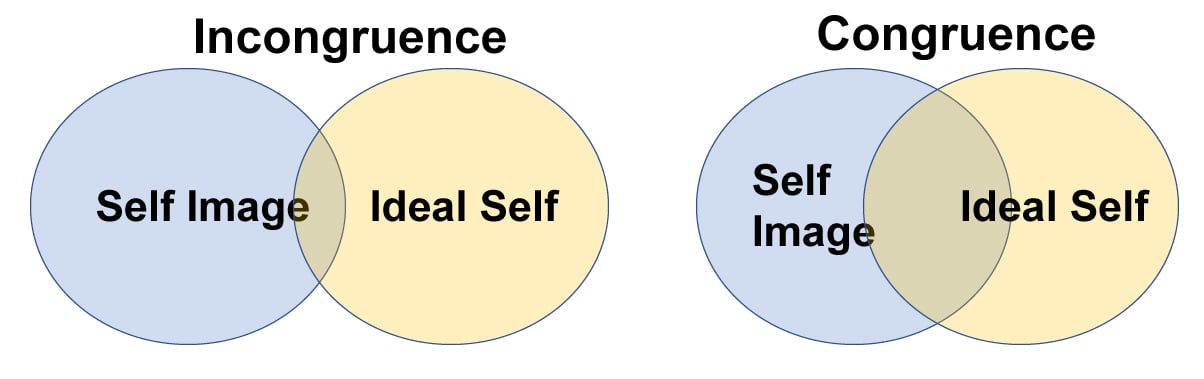
The development of congruence is dependent on unconditional positive regard. Carl Rogers believed that for a person to achieve self-actualization, they must be in a state of congruence.
According to Rogers, we want to feel, experience, and behave in ways which are consistent with our self-image and which reflect what we would like to be like, our ideal-self.
The closer our self-image and ideal-self are to each other, the more consistent or congruent we are and the higher our sense of self-worth.
Incongruence and Defense Mechanisms
Incongruence is a mismatch between real experience and self-image. As covered under Personality Development, some feelings are unacceptable and get denied or distorted instead.
Think of a time when you felt you had to hide your true feelings – Rogers would call this incongruence.
Incongruence is a discrepancy between the actual experience of the organism and the self-picture of the individual insofar as it represents that experience.
We prefer to see ourselves as consistent with our self-image. So we may use defense mechanisms like denial or repression, to feel less threatened by feelings we see as undesirable.
A person whose self-concept is incongruent with her or his real feelings and experiences will defend himself because the truth hurts.
Self Actualization
The organism has one basic tendency and striving – to actualize, maintain, and enhance the experiencing organism (Rogers, 1951, p. 487).
Rogers rejected the deterministic nature of both psychoanalysis and behaviorism. He believed we behave as we perceive our situation.
“As no one else can know how we perceive, we are the best experts on ourselves.”
Carl Rogers (1959) believed that humans have one basic motive: the tendency to self-actualize. This means fulfilling one’s potential and reaching the highest level of “human-beingness” we can.
People can only self-actualize with a positive self-view, Rogers argued.
That positive self-regard depends on unconditional positive regard from others. A person needs to feel valued and respected without reservation by those around them, especially their parents in childhood.
Conditions for Growth and Congruence
Self-actualization is only possible if there is congruence between the way an individual sees themselves and their ideal self (the way they want to be or think they should be).
If there is a large gap between these two concepts, negative feelings of self-worth will arise that will make it impossible for self-actualization to take place.
The environment a person interacts with can either frustrate or assist this natural growth: an oppressive environment frustrates it, a favorable one assists it.
Rogers compared this to a flower. Given the right conditions, it grows to its full potential, but its environment can constrain it.
People are similar, but each person’s potential is unique. Rogers believed people are inherently good and creative, developing in their own individual way.
They become destructive only when a poor self-concept or external constraints override this natural valuing process. Carl Rogers believed self-actualization needs congruence.
This means that self-actualization occurs when a person’s “ideal self” (i.e., who they would like to be) is congruent with their actual behavior (self-image).
Rogers describes an individual who is actualizing as a fully functioning person. The main determinant of whether we will become self-actualized is childhood experience.
The Fully Functioning Person
Rogers believed that every person could achieve their goals, wishes, and desires in life. When, or rather if they did so, self-actualization took place.
This was one of Carl Rogers most important contributions to psychology, and for a person to reach their potential a number of factors must be satisfied.
Rogers identified five characteristics of the fully functioning person:
- Open to experience: both positive and negative emotions accepted. Negative feelings are not denied, but worked through (rather than resorting to ego defense mechanisms).
- Existential living: in touch with different experiences as they occur in life, avoiding prejudging and preconceptions. Being able to live and fully appreciate the present, not always looking back to the past or forward to the future (i.e., living for the moment).
- Trust feelings: feeling, instincts, and gut-reactions are paid attention to and trusted. People’s own decisions are the right ones, and we should trust ourselves to make the right choices.
- Creativity: creative thinking and risk-taking are features of a person’s life. A person does not play safe all the time. This involves the ability to adjust and change and seek new experiences.
- Fulfilled life: a person is happy and satisfied with life, and always looking for new challenges and experiences.
Rogers believed that every person could achieve their goal. This means that the person is in touch with the here and now, his or her subjective experiences and feelings, continually growing and changing.
For Rogers, fully functioning people are well-adjusted, well-balanced, and interesting to know. Often such people are high achievers in society.
In many ways, Rogers regarded the fully functioning person as an ideal and one that people do not ultimately achieve.
It is wrong to think of this as an end or completion of life’s journey; rather it is a process of always becoming and changing.
Critics claim that the fully functioning person is a product of Western culture.
In other cultures, such as Eastern cultures, the achievement of the group is valued more highly than the achievement of any one person.
Applications Beyond Therapy
Carl Rogers’ humanistic principles have had a significant influence beyond the field of psychotherapy, shaping practices in education, leadership, communication, and conflict resolution.
In education, Rogers’ ideas about personal growth and self-directed learning led to the development of student-centered learning models.
In his book Freedom to Learn (1969), Rogers emphasized the importance of creating educational environments where students feel respected, valued, and free to pursue their own interests.
He advocated for a shift away from traditional, teacher-centered instruction toward more personalized, experiential learning approaches.
Educational research building on Rogers’ theories has shown that student-centered classrooms, where learners have more autonomy and collaborative opportunities, can enhance motivation, creativity, and academic achievement (Rogers, 1969).
Communication and Conflict Resolution
Rogers’ influence also extends into communication and conflict resolution.
His emphasis on empathetic listening and valuing others’ perspectives inspired the Rogerian argument style in rhetoric.
In contrast to adversarial debates, Rogerian argumentation focuses on finding common ground and understanding opposing viewpoints to reach mutually beneficial solutions.
This communication style is now widely taught in writing courses and negotiation training. It promotes empathy, reduces conflict, and fosters collaboration.
In his final years, Rogers took this belief in dialogue into real political conflicts. He facilitated encounter groups between Protestants and Catholics from Belfast, and ran workshops in apartheid South Africa and the Soviet Union.
Dialogue, not confrontation, was his tool.
He also convened Central American leaders and policy-makers at the 1985 Rust workshop in Austria, and was nominated for the Nobel Peace Prize shortly before he died in 1987.
Through these applications in education, communication, and leadership, Rogers’ belief in personal growth continues to shape a wide range of fields. It demonstrates the enduring relevance of his humanistic philosophy.
Critical Evaluation of Carl Rogers’ Theory
✅ Strengths
Rogers’ theory has earned lasting praise for several reasons:
-
Positive, Empowering View of Human Nature
-
Rogers emphasized personal growth, self-determination, and the innate goodness of people, offering a hopeful alternative to the more negative or deterministic views of Freud and behaviorists.
-
-
Influence on Therapy Practice
-
His emphasis on empathy, unconditional positive regard, and authenticity profoundly changed psychotherapy, making it more client-centered and relational — influences that remain today across many types of therapy.
-
-
Practical Applications Beyond Therapy
-
Rogers’ ideas shaped education (student-centered learning), leadership, communication skills, and even conflict resolution strategies (like Rogerian argument).
-
-
Empirical Support for the Core Conditions
-
Research into the therapeutic relationship confirms that empathy, warmth, and congruence predict positive outcomes across many different therapy models, supporting Rogers’ emphasis (Norcross & Lambert, 2019).
A 2018 meta-analysis puts a number on this: therapist empathy alone predicts a moderate, reliable share of outcome across many different types of therapy (Elliott et al., 2018).
-
-
Focus on Subjective Experience
-
By centering therapy on the client’s internal world, Rogers helped shift psychology’s focus toward understanding people’s lived experiences, a foundation for modern humanistic and positive psychology.
-
❌ Criticisms and Limitations
Critics have also raised several concerns about Rogers’ theory:
-
Lack of Scientific Rigor
-
Critics argue that Rogers’ theory is difficult to test empirically. Concepts like “self-actualization” and “unconditional positive regard” are abstract and hard to measure objectively.
-
-
Overly Idealistic View of Human Nature
-
Rogers assumed that people will naturally grow toward good, healthy outcomes if conditions are right. Critics argue this may underestimate the complexity of human aggression, selfishness, and destructiveness.
-
-
Cultural Bias
-
His theory is based largely on Western, individualistic values (self-growth, autonomy, personal achievement) and may not apply as well to collectivist cultures, where community and family harmony are prioritized over individual goals.
-
-
Limited Focus on External Factors
-
Rogers focused heavily on the individual’s inner experience, sometimes downplaying the impact of social, cultural, and economic environments on personal development.
-
-
Effectiveness in Severe Mental Health Conditions
-
While person-centered therapy is effective for mild to moderate issues (like anxiety and relationship problems), it may be less effective for more severe psychological disorders (e.g., schizophrenia) where more structured interventions are sometimes needed.
-
The Chicago Outcome Study
Rogers did not just theorize about therapy. His Counseling Center at the University of Chicago ran a controlled study of his own central claim. It used a measure called Q-sort to track a client’s self-concept over the course of therapy.
- Aim: Test with a quantifiable measure, not clinical impression alone, whether therapy narrows the gap between self-image and ideal self (Butler & Haigh, 1954).
- Method: Clients sorted self-descriptive cards as “myself as I am” and “myself as I would like to be” before therapy, after it, and at follow-up. A comparison group not in therapy repeated the same sorts over a matched interval.
- Results: The self-ideal correlation for clients was near zero before therapy, then rose substantially by treatment’s end and remained higher at follow-up. The comparison group showed no equivalent shift over the same interval.
- Conclusion: Client-centered counseling produced a measurable, durable rise in self-ideal congruence that time alone could not explain. It was one of psychotherapy’s first controlled, quantitative demonstrations that talking therapy changes personality (Rogers & Dymond, 1954).
That specific, well-controlled finding has held up better over time than Rogers’ wider claim that his three core conditions guarantee change in any therapy.
Contemporary Research
A more recent test asks a narrower question. Does therapist empathy, across the whole field of psychotherapy rather than just client-centered therapy, actually predict how well clients do?
- Aim: To test whether therapist empathy, the first of Rogers’s 1957 conditions, predicts outcome across all therapy types, not only person-centered therapy (Elliott et al., 2018).
- Method: Pooled 82 samples, 6,138 clients in all, across therapy orientations, correlating rated therapist empathy with outcome. Checked whether orientation, presenting problem, or how empathy was measured changed the effect.
- Results: Empathy correlated with outcome at r = .28, a moderate, reliable link equivalent to about 9% of outcome variance. The effect held across cognitive-behavioural, psychodynamic and humanistic therapies alike, with no significant difference by school (Elliott et al., 2018).
- Conclusion: Elliott and colleagues concluded that empathy works as a genuine common factor across therapy approaches, not a technique specific to the client-centered method Rogers built it for.
The finding generalises Rogers’ single most contested claim well beyond the school he founded. It complements a wider review reaching a similar conclusion about the therapeutic relationship (Norcross & Lambert, 2019).
Biography
Carl Rogers (1902–1987) was an influential American psychologist whose work fundamentally reshaped modern psychotherapy.

Early Life and Academic Journey
Rogers was born in 1902 in Oak Park, Illinois, the fourth of six children in a strict, hardworking religious family with little social life outside it.
When he was twelve the family moved to a farm. There he became a self-taught expert on night-flying moths, and absorbed his father’s scientific approach to farming, including how to run a controlled experiment.
He first studied agriculture at the University of Wisconsin. He then switched to history to prepare for the ministry.
A turning point came in 1922, when he travelled to China for six months as one of a dozen American students at a religious conference. Watching people of different faiths hold sincere but conflicting beliefs freed him from his parents’ religious thinking.
After enrolling at Union Theological Seminary in New York, Rogers grew curious about human behavior. He wanted to understand people outside strictly religious frameworks. He crossed the street to Teachers College, Columbia University, for its psychology and child-guidance work.
This shift led him to a Ph.D. in clinical psychology at Columbia, completed in 1931.
Rogers’ early career shaped his ideas profoundly. While working at the Society for the Prevention of Cruelty to Children in Rochester, New York, he counseled troubled and emotionally disturbed children.
Through this work, Rogers reached a key realization. Effective therapy depended more on creating a supportive environment than on directing or diagnosing clients.
He began to see the importance of empathy, acceptance, and authenticity in helping individuals heal and grow, laying the foundation for what would become client-centered therapy.
Rogers focuses on the present feelings and personal growth, whereas Freudian psychoanalysis delves into unconscious conflicts from the past.
Academic Career and Lasting Influence
In 1940, Rogers became a professor at Ohio State University. There he introduced his non-directive approach to therapy: a method that encouraged clients, not the therapist, to lead their own healing process.
His groundbreaking book, Client-Centered Therapy (1951), formally presented these ideas to the wider psychological community.
Rogers then moved to the University of Chicago to lead its Counseling Center, serving as president of the American Psychological Association in 1946–47. His team studied recorded therapy sessions there. They tracked the conditions that help people grow and change.
In 1956 Rogers received the APA’s first Distinguished Scientific Contribution Award, and publicly debated the behaviorist B. F. Skinner on the control of human behavior.
A joint post in psychology and psychiatry at the University of Wisconsin–Madison let him test whether his approach could help hospitalized patients with schizophrenia. The results were disappointing. The core conditions proved far harder to establish with withdrawn, involuntary patients than with his usual clients.
Later in his career, Rogers published On Becoming a Person (1961). This essay collection explored his views on therapy, personal development, and the pursuit of the “good life,” and made his thought a public possession.
Rogers resigned from academic life in 1963. He moved to California, where he co-founded the Center for Studies of the Person, his base for the rest of his career.
Rogers’ belief in the individual’s innate potential for growth continues to inspire counseling practices, educational methods, and leadership approaches worldwide.
In recognition of his contributions, Carl Rogers received the APA’s Award for Distinguished Professional Contributions to Psychology in 1972.
His influence on the field has been widely acknowledged. A study by Steven J. Haggbloom and colleagues ranked psychologists by citations, eminence, and professional recognition. Rogers placed sixth overall, and second among clinical psychologists behind only Sigmund Freud.
Additionally, a 1982 survey of U.S. and Canadian psychologists found that Rogers was considered the most influential psychotherapist in history, ranking even higher than Freud, who placed third.
Carl Rogers Quotes
The very essence of the creative is its novelty, and hence we have no standard by which to judge it.
(Rogers, 1961, p. 351)
I have gradually come to one negative conclusion about the good life. It seems to me that the good life is not any fixed state.
It is not, in my estimation, a state of virtue, or contentment, or nirvana, or happiness. It is not a condition in which the individual is adjusted or fulfilled or actualized.
To use psychological terms, it is not a state of drive-reduction, or tension-reduction, or homeostasis.
(Rogers, 1967, p. 185-186)
The good life is a process, not a state of being. It is a direction not a destination.
(Rogers, 1967, p. 187)
Unconditional positive regard involves as much feeling of acceptance for the client’s expression of negative, ‘bad’, painful, fearful, defensive, abnormal feelings as for his expression of ‘good’, positive, mature, confident, social feelings, as much acceptance of ways in which he is inconsistent as of ways in which he is consistent.
It means caring for the client, but not in a possessive way or in such a way as simply to satisfy the therapist’s own needs.
It means a caring for the client as a separate person, with permission to have his own feelings, his own experiences’
(Rogers, 1957, p. 225)
Frequently Asked Questions
How did Carl Rogers’ humanistic approach differ from other psychological theories of his time?
Carl Rogers’ humanistic approach differed from other psychological theories of his time by emphasizing the importance of the individual’s subjective experience and self-perception.
Unlike behaviorism, which focused on observable behaviors, and psychoanalysis, which emphasized the unconscious mind, Rogers believed in the innate potential for personal growth and self-actualization.
His approach emphasized empathy, unconditional positive regard, and genuineness in therapeutic relationships, aiming to create a supportive and non-judgmental environment where individuals could explore and develop their true selves.
Rogers’ humanistic approach placed the individual’s subjective experience at the forefront, prioritizing their unique perspective and personal agency.
What criticisms have been raised against Carl Rogers’ humanistic approach to psychology?
Critics of Carl Rogers’ humanistic approach to psychology argue that it lacks scientific rigor and empirical evidence compared to other established theories.
Some claim that its emphasis on subjective experiences and self-perception may lead to biased interpretations and unreliable findings. Additionally, critics argue that Rogers’ approach may overlook the influence of external factors, such as social and cultural contexts, on human behavior and development.
Critics also question the universal applicability of Rogers’ theories, suggesting that they may be more relevant to certain cultural or individual contexts than others.
How has Carl Rogers’ humanistic approach influenced other areas beyond psychology?
Carl Rogers’ humanistic approach has had a significant impact beyond psychology, influencing various areas such as counseling, education, leadership, and interpersonal relationships.
In counseling, his emphasis on empathy, unconditional positive regard, and active listening has shaped person-centered therapy and other therapeutic approaches. In education, Rogers’ ideas have influenced student-centered learning, fostering a more supportive and individualized approach to teaching.
His humanistic principles have also been applied in leadership development, promoting empathetic and empowering leadership styles.
Moreover, Rogers’ emphasis on authentic communication and understanding has influenced interpersonal relationships, promoting empathy, respect, and mutual growth.
What is the current relevance of Carl Rogers’ humanistic approach in modern psychology?
Carl Rogers’ humanistic approach maintains relevance in modern psychology by emphasizing the importance of individual agency, personal growth, and the therapeutic relationship.
It continues to inform person-centered therapy and other humanistic therapeutic modalities. Rogers’ focus on empathy, acceptance, and authenticity resonates with contemporary approaches that prioritize the client’s subjective experience and self-determination.
Additionally, his ideas on the role of positive regard and the creation of a safe, non-judgmental environment have implications for various domains, including counseling, education, and interpersonal relationships.
The humanistic approach serves as a reminder of the significance of the individual’s unique perspective and the power of empathetic connections in fostering well-being and growth.
References
- Bozarth, J. D. (1998). Person-centred therapy: A revolutionary paradigm. Ross-on-Wye: PCCS Books
- Butler, J. M., & Haigh, G. V. (1954). Changes in the relation between self-concepts and ideal concepts consequent upon client-centered counseling. In C. R. Rogers & R. F. Dymond (Eds.), Psychotherapy and personality change: Co-ordinated research studies in the client-centered approach (pp. 55–75). University of Chicago Press.
- Elliott, R., Bohart, A. C., Watson, J. C., & Murphy, D. (2018). Therapist empathy and client outcome: An updated meta-analysis. Psychotherapy, 55(4), 399-410.
- Farber, B. A., & Doolin, E. M. (2011). Positive regard. Psychotherapy, 48(1), 58.
- Haggbloom, S. J., Warnick, R., Warnick, J. E., Jones, V. K., Yarbrough, G. L., Russell, T. M., … & Monte, E. (2002). The 100 most eminent psychologists of the 20th century. Review of general psychology, 6(2), 139-152.
- Mearns, D. (1999). Person-centred therapy with configurations of self. Counselling, 10(2), 125±130.
- Norcross, J. C., & Lambert, M. J. (Eds.). (2019). Psychotherapy relationships that work: Volume 1: Evidence-based therapist contributions. Oxford University Press.
- Rogers, C. (1951). Client-centered therapy: Its current practice, implications and theory. London: Constable.
- Rogers, C. R. (1957). The necessary and sufficient conditions of therapeutic personality change. Journal of consulting psychology, 21(2), 95.
- Rogers, C. (1959). A theory of therapy, personality and interpersonal relationships as developed in the client-centered framework. In (ed.) S. Koch, Psychology: A study of a science. Vol. 3: Formulations of the person and the social context. New York: McGraw Hill.
- Rogers, C. R. (1961). On Becoming a person: A psychotherapists view of psychotherapy. Houghton Mifflin.
- Rogers, C. R. (1969). Freedom to Learn. Columbus, OH: Merrill.
- Rogers, C. R., & Dymond, R. F. (Eds.). (1954). Psychotherapy and personality change: Co-ordinated research studies in the client-centered approach. University of Chicago Press.
- Rogers, C. R., Stevens, B., Gendlin, E. T., Shlien, J. M., & Van Dusen, W. (1967). Person to person: The problem of being human: A new trend in psychology. Lafayette, CA: Real People Press.
- Smith, D. (1982). Trends in counseling and psychotherapy. American Psychologist, 37(7), 802.
- Wilkins, P. (1997). Congruence and countertransference: similarities and differences. Counselling, 8(1), 36±41.
- Wilkins, P. (2000). Unconditional positive regard reconsidered. British Journal of Guidance & Counselling, 28(1), 23-36.


