Self-actualization is the complete realization of one’s potential, and the full development of one’s abilities and appreciation for life. This concept is at the top of the Maslow hierarchy of needs, so not every human being reaches it.
Key Takeaways
- Three Key Thinkers: Kurt Goldstein, Carl Rogers, and Abraham Maslow each shaped today’s understanding of self-actualization.
- Maslow’s Version Dominates: the modern, popular understanding follows Maslow’s account more closely than Goldstein’s or Rogers’s.
- Needs Come First: Maslow argued the drive to self-actualize rarely surfaces until more basic needs, such as safety and belonging, are met.
- Self-Acceptance: self-actualized people accept their own flaws and limitations while staying creative across their lives.
- Deep Relationships: despite varied backgrounds, self-actualizers share traits such as close, loving relationships with a few people rather than many.
- Contested Method: Maslow built the theory from biographical case studies of hand-picked individuals, not controlled research. This is its best-known weakness.
- Modern Evidence: a validated 2023 scale supports Maslow’s descriptive portrait of self-actualizers, though not his strict ranking of needs.

Self-actualization (also referred to as self-realization or self-cultivation) can be described as the complete realization of one’s potential as manifest in peak experiences which involve the full development of one’s abilities and appreciation for life (Maslow, 1962).
The attainment of self-actualization involves one’s full involvement in life and the realization of that which one is capable of accomplishing.
Generally, the state of self-actualization is viewed as obtainable only after one’s fundamental needs for survival, safety, love, and self-esteem are met (Maslow, 1943, 1954).
Self-Actualization Theory
Self-actualization theory emphasizes the innate drive of individuals to reach their full potential.
Kurt Goldstein saw self-actualization as the single master drive of every organism.
Maslow proposed a hierarchy of needs with self-actualization at the highest level. Rogers focused instead on congruence and unconditional positive regard as the conditions for personal growth.
Kurt Goldstein
The term “self-actualization” is most associated with Abraham Maslow. But he did not coin it. Kurt Goldstein, a physician specializing in psychiatry and neuroanatomy, introduced it in the early 20th century.
Goldstein (1939, 1940) viewed self-actualization as the ultimate goal of every organism. It named an individual’s desire for self-fulfillment and the propensity to become actualized in one’s potential.
Every living thing counted.
He contended that each human being, plant, and animal has an inborn goal to actualize itself as it is.
Goldstein pointed out that organisms, therefore, behave in accordance with this overarching motivation.
Goldstein set out his view in The Organism: A Holistic Approach to Biology Derived from Pathological Data in Man. He argued that self-actualization involves the tendency to actualize an organism’s individual capacities as much as possible (Goldstein, 1939).
According to Goldstein’s (1940) view, self-actualization was not a goal to be reached in the future. It was an organism’s innate propensity to realize its potential at any moment, under the circumstances it faced.
Carl Rogers
Carl Rogers described self-actualization as a continuous, lifelong process. An individual’s self-concept is maintained and enhanced through reflection and the reinterpretation of experience, which lets the person recover, change and develop (Rogers, 1951).
This process never really stops.
According to Rogers (1967), the human organism has an underlying “actualizing tendency.” It works to develop all capacities in ways that maintain or enhance the organism and move it toward autonomy.
That regard has to come from somewhere.
According to Rogers, people could only self-actualize if they had a positive self-view, or positive self-regard. That depends on unconditional positive regard from others. People need to feel valued and respected without reservation, especially by their parents in childhood.
Self-actualization also requires congruence: how a person sees themselves (their self-image) must match their ideal self, the way they want to be. A large gap between the two breeds negative self-worth. Self-actualization then becomes impossible.
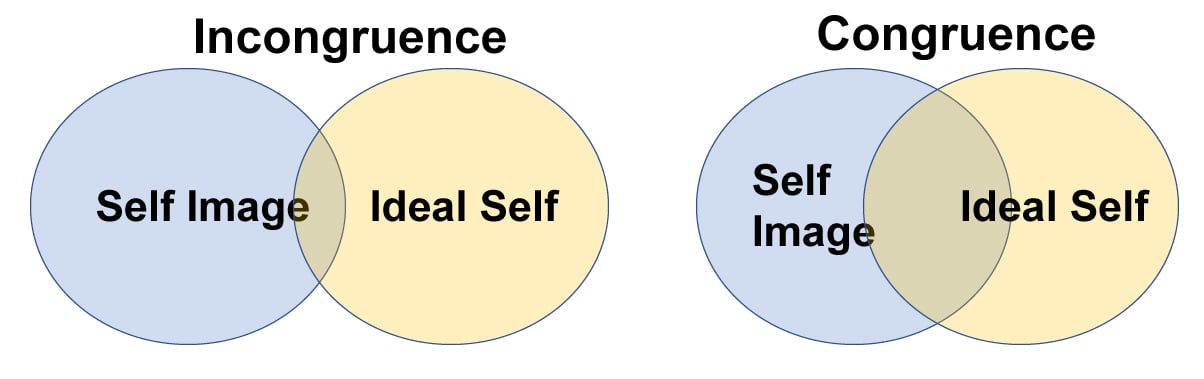
Rogers (1967) held that the self is a consistent yet fluid pattern of self-perceptions, organized and formed through evaluational interactions.
Tension can arise. When a person’s ideal self pulls away from their actual experience, incongruence results. This incongruence becomes a psychopathological state, rooted in the perversion of their own actualizing tendency.
For Rogers (1967), a person who is in the process of self-actualizing, actively exploring potentials and abilities and experiencing a match between real and ideal selves is a fully functioning person.
Rogers (1967) described what becoming a fully functioning person involves:
“[T]he individual moves towards “being”, knowingly and acceptingly, the process which he inwardly and actually “is.” He moves away from what he is not, from being a facade. He is not trying to be more than he is, with the attendant feelings of insecurity or bombastic defensiveness. He is not trying to be less than he is, with the attendant feelings of guilt or self-deprecation. He is increasingly listening to the deepest recesses of his physiological and emotional being, and finds himself increasingly willing to be, with greater accuracy and depth, that self which he most truly is.”
Fully functioning people are in touch with their own feelings and abilities and are able to trust their innermost urges and intuitions.
Unconditional positive regard is an attitude of acceptance of others despite their failings.
Not everyone gets this.
However, most people don’t perceive the positive regard of others as being unconditional. They tend to think they will only be loved and valued if they meet certain conditions of worth.
These conditions of worth create incongruity within the self: the gap between real and ideal self described above.
Abraham Maslow
As did Goldstein, Maslow viewed self-actualization as realizing one’s potential. However, Maslow (1943) described self-actualization more narrowly than Goldstein, restricting it to human beings rather than all organisms.
Maslow pointed out that humans have lower-order needs that must be generally met before their higher order needs can be satiated, such as self-actualization. He categorized those needs as follows (Maslow, 1943):
Maslow’s Hierarchy of Needs
- Basic needs:
- Physiological needs (e.g., water, food, warmth and rest).
- Safety needs (e.g., safety and security).
- Psychological needs:
- Belongingness needs (e.g., close relationships with loved ones and friends).
- Esteem needs (e.g., feeling of accomplishment and prestige).
- Self-actualization needs: realizing one’s full potential.
Self-actualization is the final stage of Maslow’s hierarchy of needs. Unlike the lower needs, it is a growth need. People pursue it for its own sake, not to remedy a felt lack.

To Maslow, self-actualization meant the desire for self-fulfillment, or a person’s tendency to be actualized in what he or she is potentially.
Individuals may perceive or focus on this need very specifically. For example, one individual may have a strong desire to become an ideal parent. In another, the desire may be expressed economically, academically, or athletically. For others, it may be expressed creatively in paintings, pictures, or inventions.
The form varies.
Maslow further explained that self-actualization involves the intrinsic development of an organism. He contended that self-actualization is more growth-oriented than deficiency-focused (Maslow, 1962).
Maslow acknowledged the apparent rarity of self-actualized people and argued that most people are suffering from psychopathology of normality.
Most people never fully reach it.
Maslow also stressed that self-actualization is a process, not a destination. There is no “happily ever after”: the self-actualizing person keeps choosing growth over safety across a lifetime.
He called the underlying potential instinctoid, meaning biologically rooted and shared by the whole species. Its form, though, is shaped almost entirely by individual experience.
“A musician must make music, an artist must paint, a poet must write, if he is to be ultimately at peace with himself” (Maslow, 1943).
Sigmund Freud’s psychodynamic approach focused on unhealthy individuals engaging in disturbing conduct. Maslow took the opposite path. He belonged to the humanistic approach, which focuses on healthy individuals.
Consequently, Maslow’s perspective is more consistent with a positive view of human nature, which sees individuals as driven to reach their potential. This humanistic perspective markedly differs from the Freudian view of human beings as tension-reducing organisms.
Examples of Self-Actualization
Examples of self-actualization vary greatly from person to person. Each involves pursuing personal growth and fulfillment in line with one’s own values and aspirations.
Some examples may include:
- Pursuing a passion or creative endeavor, such as painting, writing, or playing an instrument.
- Setting and achieving meaningful goals that align with personal values and aspirations.
- Engaging in acts of kindness and altruism to contribute to the well-being of others.
- Seeking personal development through continuous learning and acquiring new skills.
- Embracing authenticity and living in alignment with one’s true values and beliefs.
- Cultivating meaningful relationships and connections with others based on mutual respect and support.
- Engaging in self-reflection and introspection to gain deeper self-awareness and personal insight.
- Making choices and decisions that prioritize personal happiness and well-being rather than external validation.
- Embracing and accepting oneself fully, including both strengths and weaknesses.
- Experiencing moments of flow, where one is fully immersed and engaged in an activity that brings a sense of joy, purpose, and fulfillment.
Moving beyond mere theory and speculation, Maslow named or hinted at several individuals he considered to have attained a level of self-actualization (Maslow, 1954, 1970).
Noteworthy herein are the diversity of occupations and the variety of the backgrounds which these individuals represent while still meeting the criteria of self-actualization.
- Abraham Lincoln (1809-1865; American President)
- Albert Einstein (1879–1955; Theoretical Physicist)
- Albert Schweitzer (1875–1965; Writer, Humanitarian, Theologian, Organist, Philosopher, and Physician)
- Aldous Huxley (1894–1963; Philosopher and Writer)
- Baruch Spinoza (1632–1677; Philosopher)
- Eleanor Roosevelt (1884–1962; Diplomat and Activist)
- Jane Addams (1860–1935; Settlement Activist, Sociologist, Public Administrator)
- Thomas Jefferson (1743–1826; American President, Architect, Philosopher)
- William James (1842–1910; Philosopher and Psychologist)
How Maslow Identified Self-Actualizers
Maslow’s fifteen characteristics did not come from an experiment or a validated questionnaire. They came from his own biographical study of a small, hand-picked group of people he judged to be unusually psychologically healthy. How he arrived at the list shapes how much weight the list deserves.
The Biographical Method
- Aim: Maslow (1954) set out to describe what psychologically healthy people are like. He wanted to build a “positive” psychology of the fully developed person, instead of the clinical literature’s usual focus on the sick and the average.
- Method: Maslow screened out anyone showing neurosis or psychopathy, then sought positive evidence of self-actualization in people using their talents fully. His cases were personal acquaintances, public figures such as Lincoln and Einstein, and a few promising younger people.
- Findings: Maslow distilled a recurring cluster of about fifteen traits, including self-acceptance, deep relationships, and a philosophical sense of humour. He judged genuine self-actualization rare, and even self-actualizers “conspicuously not perfect.”
- Conclusion: Maslow believed he had found a real, describable pattern of psychological health, one that helped launch both humanistic and positive psychology.
Nothing about the selection was standardized, and Maslow himself later called the method “pretty crude.”
A Contested Foundation
The method is the theory’s best-known weakness.
It is subjective: Maslow alone decided who counted as self-actualized, so the portrait risks reflecting his own values rather than an independent standard.
It is also circular. Self-actualizers were defined by certain qualities, then found to have those qualities, with no control group and no test independent of Maslow’s own judgement.
Critics have also raised the nominal fallacy here: naming a pattern “self-actualization” can be mistaken for actually explaining it.
The sample was narrow, too. It leaned heavily on well-educated Western men.
Only a handful of women, such as Eleanor Roosevelt and Jane Addams, appear, and there was little ethnic or class diversity. That imbalance limits how far the portrait generalizes.
None of this erases the insight. It just means the fifteen traits describe a rich hypothesis, not an established finding.
Characteristics of Self-Actualized Individuals
Abraham Maslow based his theory on case studies of historical figures he saw as self-actualized, including Albert Einstein, Ruth Benedict, and Eleanor Roosevelt.
Maslow examined the lives of each of these people in order to assess the common qualities that led each to become self-actualized.
Based on Maslow’s description of self-actualizers, one can find several striking similarities that these supposedly self-actualized individuals share in common.
Some of such characteristics which distinguish self-actualized individuals from the rest of humanity are as follows (Maslow, 1954, 1970).
- Acceptance: self-actualized people accept their own flaws, and other people’s, with humor and tolerance, without crippling guilt or shame (Maslow, 1954, 1970).
- Independence: they tend to be self-governing and resourceful, relying on their own judgement rather than external authorities to direct their lives.
- Deep Relationships: they cultivate a few close, loving relationships rather than many shallow ones.
- Appreciation: they maintain a fresh, grateful appreciation even for life’s ordinary pleasures.
- Clear Perception: they judge people and situations accurately, comfortable with ambiguity and quick to spot dishonesty.
- Autonomy: they seldom depend on their environment or culture to form their opinions.
- Purpose: they see life as a mission or calling that reaches beyond themselves.
- Spontaneity: their behaviour is natural and unpretentious, even where their outer conduct stays conventional.
- Need for Solitude: they tolerate, and often enjoy, more privacy and solitude than most people.
- Sense of Humour: their humour is thoughtful and self-deprecating rather than hostile or superior.
- Kinship With Humanity: deep identification with everyone (Gemeinschaftsgefühl).
- Democratic Outlook: they are free from prejudice of class, race, education or politics, and will learn from anyone who has something to teach.
- Firm Ethics: they draw clear lines between means and ends, and between good and evil, even where their standards diverge from convention.
- Everyday Creativity: “childlike” originality in daily life.
- Resisting Enculturation: they stay inwardly detached from their culture, conforming outwardly where it does no harm.
- Peak Experiences: they report moments of ecstasy, wonder and self-transcendence more often than most people (see below).
This is a portrait of health, not sainthood. Maslow noted that self-actualizers can be stubborn, vain, absent-minded or boring, and they still know guilt, anxiety and conflict.
They also tend to resolve oppositions that trouble the rest of us, such as work against play. Doing one’s duty becomes the pleasure. And self-actualization is “a matter of degree”: no one shows every trait.
Peak Experiences and Being-Values
If the characteristics describe the self-actualizer from the outside, peak experiences describe self-actualization from the inside. Maslow (1962, 1964) made these moments central to his account of psychological health.
Peak Experiences and Being-Cognition
A peak experience is a fleeting episode of intense joy, awe or ecstasy. The person feels whole, integrated and fully themselves, at one with the world.
Peaks are not reserved for mystics.
Love, music, creative insight, athletic performance, childbirth and nature can all trigger them. Maslow insisted they are natural, recurrent features of psychological health.
The core of a peak is a shift in how a person perceives. Ordinary perception, which Maslow called Deficiency-cognition (D-cognition), is instrumental. Objects are categorised and judged by how useful they are for meeting our needs.
Being-cognition (B-cognition) is different. It sees the object whole, disinterestedly and without judgement, as an end in itself.
During B-cognition the ego recedes, and time and space lose their grip. Fear, anxiety and defensiveness drop away. The world feels unified, alive and valuable.
Maslow argued that this is where the Being-values become visible. In a peak, a person actually sees truth, beauty or justice, rather than merely believing in them.
Peakers, Plateaus, and the Sacred
In Religions, Values, and Peak-Experiences, Maslow (1964) made a sweeping claim. The historical core of every religion, he argued, is the private peak experience of a lone prophet or seer. Institutions then organise, codify and often ossify it.
He distinguished “peakers” from “non-peakers”: people who readily have such experiences, and people who suppress, deny or fear them. A mature psychology, he said, could study this “core-religious” experience naturalistically, without supernatural assumptions.
Late in life, Maslow (1971) added the plateau experience.
It is a calmer, more voluntary and more lasting form of B-cognition: a serene, appreciative witnessing of the miraculous in the ordinary. Plateaus can be cultivated to some degree. Peaks largely cannot.
He also described desacralisation, the modern habit of seeing nothing as sacred or worthy of awe.
Its reversal, resacralisation, is the recovery of the ability to perceive the eternal in the particular. Peak and plateau experiences can help restore it.
Being-Values, Metamotivation, and Metapathology
Maslow (1962, 1971) argued that self-actualizers differ in the kind of motivation they have, not just in having their needs met. They are drawn to the Being-values (B-values): ultimate goods valued for their own sake.
The B-values include truth, goodness, beauty, wholeness, aliveness, uniqueness, justice, order, simplicity, playfulness and meaningfulness. They are not ranked. Each can be described in terms of the others.
Because their deficiency needs are met, self-actualizers are metamotivated. They are moved by the B-values (growth motivation) rather than by lack (deficiency motivation). One sign is the fusion of work and play: they love their vocation so thoroughly that duty and pleasure blur into one.
The mirror image is metapathology. Maslow (1971) argued that chronic deprivation of the B-values produces “sicknesses of the soul”: meaninglessness, alienation, apathy, cynicism, despair and ennui.
These can strike people whose material and lower needs are fully met. Without truth, people grow mistrustful. Without justice, they grow angry and cynical. Without meaningfulness, they feel that nothing matters. This let Maslow explain the malaise of the comfortable.
He also named the chief internal obstacle to growth, the Jonah complex. It is the evasion of one’s own growth, a fear not of failure but of one’s own greatness. Like the biblical Jonah fleeing his calling, ordinary people flinch from their finest moments.
Critical Evaluation
Despite the popularity of self-actualization as a concept associated with positive psychology and motivation theories, it does not cease to draw criticism.
Eric Berne, a Canadian psychiatrist, saw self-actualization as a game. In his view, it is a game of self-expression based on the belief that good feelings are to be pursued (Berne, 1964).
Additionally, critics have pointed out that self-actualizing tendencies can lead to a positive but non-relational approach to human beings (Thorne, 1992).
Fritz Perls warned that the focus can drift, too. Striving to actualize one’s true self can turn into merely building an appearance of self-actualization, which is misleading (Perls, 1969).
Vitz (1994) has contended that Maslow and Rogers have turned the psychological concept of self-actualization into a moral norm. Finally, the possibility of self-actualization has also come to be seen as a special privilege reserved only for a select few.
Maslow disagreed.
In response to these concerns, Maslow acknowledged that unrestrained whims and private pleasures were often mislabeled as self-actualization (Daniels, 2005). He shared the worry that the concept might be misunderstood.
In fact, when many people wrote to Maslow describing themselves as self-actualized persons, Maslow doubted whether he had sufficiently articulated his theory (Stevens, 1975).
He kept refining the theory.
However, Maslow did not hold that only an elite few could attain the state of self-actualization. On the contrary, he pointed out that often people living in strikingly similar circumstances experience enormously different outcomes in life.
He reasoned that such a reality underscores the importance of attitude as a factor that influences one’s destiny.
The concept also has an enduring strength. It returned agency, choice and responsibility to a psychology dominated by behaviorist and psychodynamic determinism.
By insisting on uniquely human, growth-oriented motives, Maslow opened space for a psychology of health. Much of positive psychology descends directly from it.
Paradoxical narrative of self-actualization
Winston (2018) takes a fresh look at Abraham Maslow’s classic work on self-actualization. She provides a nuanced analysis of the paradoxical nature of self-actualizers’ perceptions of themselves, others, and the world.
Winston dismantles the self-actualization chapter of Maslow’s seminal Motivation and Personality and rearranges it. The result shows Maslow’s struggle to describe self-actualizers.
The contradictions are deliberate.
On one hand, he would characterize them in a certain way, only to provide a contradictory example shortly after. For instance, he described them as accepting reality yet noted they display resignation. Or as free from excessive guilt yet not immune to anxiety and self-criticism (Winston, 2018).
Both readings appear in his notes.
On one hand, Maslow portrayed self-actualizers as comfortable with uncertainty, doubt and vagueness. Yet he also stated they are rarely unsure or conflicted (Winston, 2018).
Both are true at once.
Additionally, he characterized them as capable of fully identifying with, and losing themselves in, close relationships. However, he also noted they retain a certain detachment from loved ones.
Some scholars dismiss these opposing descriptions as contradictions. Winston sees them as paradoxes that convey the complexity of psychological health. In her analysis, she uncovers three key paradoxes:
- Self-actualizers share common traits yet remain utterly unique individuals.
- Their perceptions of themselves, others and the world are simultaneously positive and negative. They have an accurate view of reality as messy rather than black-and-white.
- They can accept what cannot change yet have the courage to change what they can, displaying wisdom in discerning the difference (Winston, 2018).
Winston argues the paradoxes are not flaws to tidy away. They reflect the genuine, contextually appropriate complexity of psychological health.
Her framework challenges approaches that unconditionally promote some potentials while suppressing others. Instead, she advocates examining the conditions under which any given potentiality may be adaptive or maladaptive.
Measuring Self-Actualization
Turning so rich an idea into numbers has proved hard. Three questionnaires mark the main attempts.
- Personal Orientation Inventory (POI): Shostrom’s (1964) 150 paired-opposite statements score time competence and inner-directedness, plus ten subscales such as self-acceptance and spontaneity.
- Short Index of Self-Actualization: Jones and Crandall (1986) distilled a 15-item self-report that correlated respectably with the POI and was far quicker to give.
- Characteristics of Self-Actualization Scale (CSAS): Kaufman’s (2023) 30-item scale asks whether Maslow’s own characteristics cohere, instead of assuming one self-actualized type.
The POI’s weaknesses foreshadow the whole enterprise. It is vulnerable to social-desirability responding and deliberate faking, and its factor structure proved unstable. Its “healthy” pole also encodes the author’s own values, so scoring “self-actualized” can mean little more than endorsing the humanistic worldview.
The short index inherited the same problem. No brief questionnaire escapes a value-laden criterion. Kaufman’s scale is the most serious modern attempt to escape it (see Contemporary Research below).
For individualistic cultures only?
The concept of self-actualization, characterized by realizing one’s full potential, is often seen as the pinnacle of psychological development. However, the cultural specificity of self-actualization has been questioned (Ivtzan, 2008).
Specifically, the individualistic focus on developing uniqueness, fulfilling one’s capacities, and prioritizing personal growth over social belonging may not generalize across cultures.
Not every culture agrees.
Research suggests self-actualization aligns closely with individualistic values prominent in the West. It fits less well with the collectivist values of interdependence and social harmony found in Asia, Africa, and Central and South America.
Ivtzan tested this directly.
Itai Ivtzan (2008) compared 100 British (individualistic culture) and 100 Indian (collectivist culture) participants aged 18-25 on their responses to the Personal Orientation Inventory (POI). The POI measures 12 characteristics seen as central to self-actualization (Shostrom, 1964).
The results were striking.
As predicted, the British group scored significantly higher than the Indian group. The gap appeared on 10 of the 12 scales. These included time competence, inner-directedness, self-actualizing values, feeling reactivity, and self-acceptance.
Ivtzan concluded that the concept of self-actualization, as currently defined, lacks cross-cultural validity. The lower POI scores from the Indian group likely reflect measurement bias rather than truly less self-actualization.
Cultures shape the meaning of self-fulfillment in different ways. While the drive to achieve one’s potential is universal, how this manifests likely depends on cultural values.
These findings underscore the need to re-examine concepts like self-actualization through a cross-cultural lens.
Applying Western models globally risks promoting an ethnocentric view of human motivation and adjustment. Future research should explore how self-actualization presents in diverse cultures. Practically, the study also cautions the use of self-actualization theory in multi-cultural organizational contexts.
Contemporary Research
Recent studies ask whether Maslow’s descriptive portrait, not his strict ranking of needs, survives modern testing.
- Aim: Kaufman (2023) tested whether Maslow’s characteristics of self-actualizing people form one coherent, externally valid construct.
- Method: Kaufman built a 30-item scale, the Characteristics of Self-Actualization Scale, covering traits such as authenticity, purpose and peak experiences. He validated it against personality and well-being measures in adult samples.
- Results: The ten characteristics loaded onto a single general factor. Higher scorers were more growth-motivated than deficiency-motivated, and reported greater life satisfaction, self-acceptance, purpose and self-transcendent experiences.
- Conclusion: Kaufman concluded that Maslow’s portrait holds up under modern testing.
The design is correlational, though. So it shows the traits cohere and predict flourishing, not that self-actualization causes it.
Taken together, the newer evidence supports a measured conclusion. The strict ordering of Maslow’s needs is poorly supported (Wahba & Bridwell, 1976; Tay & Diener, 2011).
The descriptive portrait, though, is coherent, measurable and linked to eudaimonic well-being: flourishing through realizing one’s potential, as modelled by Ryff (1989) and Waterman (1993).
Four further studies test the portrait from different angles.
Meaning and Work
Martela and Pessi (2018) reviewed the meaningful-work literature. They found that work feels meaningful when it combines self-realization with a broader, self-transcendent purpose.
That is the fusion of self-actualization and self-transcendence that Maslow’s late work anticipated.
Peak Experiences at Work
Maslow treated peak experiences as private and hard to measure. Fu and Ma (2022) tested whether they could be measured at work. Drawing on affective events theory, they built a four-dimension scale of triggers: elevation, insight, pride and connection.
In a structural-equation model of 424 employees, peak experiences predicted proactive behaviour and positive word-of-mouth. The link was strongest for job-related triggers.
The study is single-sample and self-report. So it shows peaks can be measured, not that they restore people.
Measuring Self-Transcendence
Kitson et al. (2020) systematically reviewed how researchers measure self-transcendence, Maslow’s least-developed idea. They define it as shrinking self-focus and growing connection.
Questionnaire, physiological and qualitative measures now exist with reasonable psychometric support.
But the measures are fragmented, neurological validation is limited, and no single “gold standard” instrument has emerged. A systematic review outranks any single validation study. Self-transcendence is now measurable, if patchily.
A Brazilian Validation
De Souza et al. (2024) developed two scales, one for self-actualization attributes and one for Being-values, with 621 Brazilian participants from 25 professions. Both showed satisfactory factor validity and internal consistency. Scores also related to innovative work behaviour and to values such as maturity, knowledge and beauty.
It is one national sample, so it cannot settle the cultural question raised above. It does show the construct can be measured in a new setting.
Self-Transcendence and Theory Z
Late in his life, Maslow (1971) argued self-actualization is not actually the top of human development.
He distinguished two kinds of self-actualizer. “Merely healthy” self-actualizers are practical, effective people for whom peak experiences and mystical, cosmic awareness matter relatively little.
“Transcenders,” by contrast, are self-actualizers for whom peak experiences and a sense of connection to something larger are central and consciously motivating.
Few people reach this stage.
Maslow called this higher reach Theory Z, borrowing the label from McGregor’s Theory X and Theory Y in management. It holds that human development extends beyond self-actualization.
At the top sits self-transcendence: the motivation to go beyond the personal self to serve a cause, other people, or something larger.
Self-transcendence is the least-developed part of Maslow’s theory, cut short by his death in 1970. It remains the part most alive in contemporary positive psychology, where it has been revived and popularised as a “new science of self-actualization” (Kaufman, 2020).
Here Maslow meets Viktor Frankl, the founder of logotherapy. Frankl held that self-actualization is best reached as a by-product of self-transcendence and the pursuit of meaning, not as a direct aim.
References
Berne, E. (1964). Games people play: The psychology of human relationships. Grove Press.
Daniels, M. (2005). Shadow, self, spirit: essays in transpersonal psychology (p. 122). Imprint Academic.
de Souza, G. H. S., Coelho, J. A. P. M., Lima, N. C., Esteves, G. G. L., Queiroz, F. C. B. P., & Marques, Y. B. (2024). Self-actualization and B-values: Development and validation of two instruments in the Brazilian context. PLOS ONE, 19(6), e0302322. https://doi.org/10.1371/journal.pone.0302322
Fu, X., & Ma, J. (2022). Employees’ peak experience at work: Understanding the triggers and impacts. Frontiers in Psychology, 13, Article 993448. https://doi.org/10.3389/fpsyg.2022.993448
Goldstein, K. (1939). The organism: A holistic approach to biology derived from pathological data in man. American Book Company.
Goldstein, K. (1940). Human Nature. Cambridge, Mass. Harvard University Press.
Ivtzan, I. (2008). Self-actualisation: For individualistic cultures only? International Journal on Humanistic Ideology, 1(2), 113–140.
Jones, A., & Crandall, R. (1986). Validation of a short index of self-actualization. Personality and Social Psychology Bulletin, 12(1), 63–73. https://doi.org/10.1177/0146167286121007
Kaufman, S. B. (2020). Transcend: The new science of self-actualization. TarcherPerigee.
Kaufman, S. B. (2023). Self-actualizing people in the 21st century: Integration with contemporary theory and research on personality and well-being. Journal of Humanistic Psychology, 63(1), 51–83. https://doi.org/10.1177/0022167818809187
Kitson, A., Chirico, A., Gaggioli, A., & Riecke, B. E. (2020). A review on research and evaluation methods for investigating self-transcendence. Frontiers in Psychology, 11, Article 547687. https://doi.org/10.3389/fpsyg.2020.547687
Maslow, A. H. (1943). A theory of human motivation. Psychological Review, 50 (4), 370-96.
Maslow, A. H. (1954). Motivation and personality. New York: Harper and Row.
Maslow, A. H. (1962). Toward a psychology of being. Princeton: D. Van Nostrand Company.
Maslow, A. H. (1964). Religions, values, and peak-experiences. Ohio State University Press.
Martela, F., & Pessi, A. B. (2018). Significant work is about self-realization and broader purpose: defining the key dimensions of meaningful work. Frontiers in Psychology, 9, 363.
Maslow, A.H. (1970). Motivation and Personality. New York: Harper & Row.
Maslow, A. H. (1971). The farther reaches of human nature. Viking Press.
Perls, F. S. (1969). In and out the garbage pail. Real People Press.
Rogers, C. R. (1951). Client-centered therapy: Its current practice, implications, and theory. Houghton Mifflin.
Rogers, C. (1963) The Actualizing Tendency in Relation to “Motives” and to Consciousness. In: Jones, M.R., Ed., Nebraska Symposium on Motivation, University of Nebraska Press, Lincoln, 1-24.
Rogers, C. (1967). On becoming a person: a therapist’s view of psychotherapy. London: Constable.
Rogers, C., & Kramer, P. D. (1995). On becoming a person : a therapist’s view of psychotherapy. Houghton Mifflin.
Ryff, C. D. (1989). Happiness is everything, or is it? Explorations on the meaning of psychological well-being. Journal of Personality and Social Psychology, 57(6), 1069–1081. https://doi.org/10.1037/0022-3514.57.6.1069
Shostrom, E. L. (1964). An inventory for the measurement of self-actualization. Educational and Psychological Measurement, 24(2), 207–218. https://doi.org/10.1177/001316446402400203
Stevens, B. (1975). Body work. Gestalt is, 160-191.
Tay, L., & Diener, E. (2011). Needs and subjective well-being around the world. Journal of Personality and Social Psychology, 101(2), 354–365. https://doi.org/10.1037/a0023779
Thoma, E. (1963). Nebraska Symposium on Motivation. Psychosomatics, 4 (2), 122–123.
Thorne, B. (1992). Key figures in counselling and psychotherapy. Carl Rogers. Sage Publications, Inc.
Venter, Henry. (2017). Self-Transcendence: Maslow’s Answer to Cultural Closeness. Journal of Innovation Management, 4 (4), 3-7.
Vitz, P. C. (1994). Psychology as religion: The cult of self-worship . Wm. B. Eerdmans Publishing.
Wahba, M. A., & Bridwell, L. G. (1976). Maslow reconsidered: A review of research on the need hierarchy theory. Organizational Behavior and Human Performance, 15(2), 212–240. https://doi.org/10.1016/0030-5073(76)90038-6
Waterman, A. S. (1993). Two conceptions of happiness: Contrasts of personal expressiveness (eudaimonia) and hedonic enjoyment. Journal of Personality and Social Psychology, 64(4), 678–691. https://doi.org/10.1037/0022-3514.64.4.678
Winston, C. N. (2018). To be and not to be: A paradoxical narrative of self-actualization. The Humanistic Psychologist, 46(2), 159–174. https://doi.org/10.1037/hum0000082