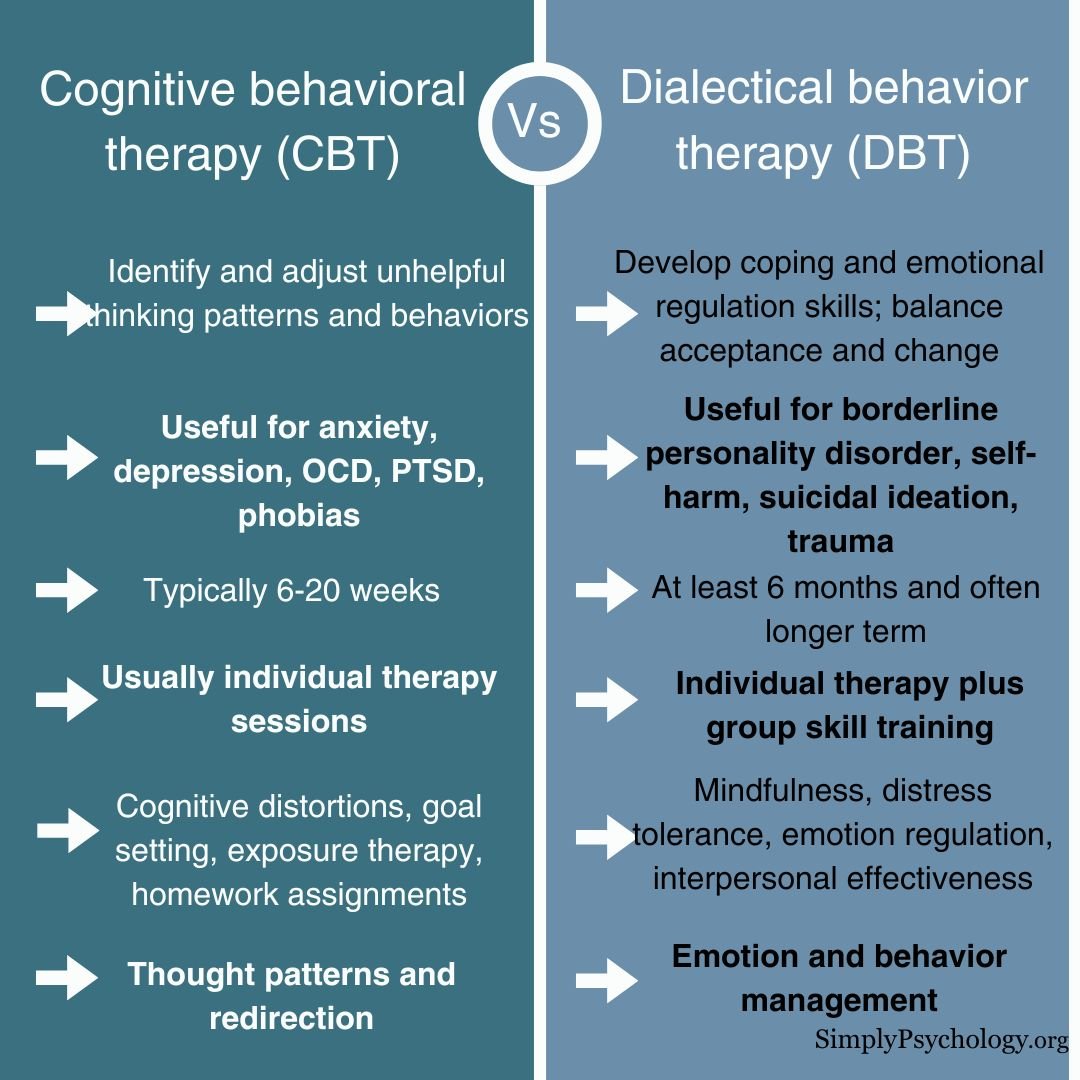
Cognitive behavioral therapy (CBT) targets unhelpful thoughts and behaviors, while dialectical behavior therapy (DBT), a form of CBT, adds acceptance and emotion-regulation skills.
CBT is usually shorter and suits conditions such as anxiety and depression. DBT usually runs longer and suits intense, hard-to-regulate emotions and self-harm.
The right therapy depends on the person. This article outlines how CBT and DBT are similar, how they differ, and what the research says about each.

Key Takeaways
- Core difference: CBT identifies and challenges negative thought patterns; DBT, a form of CBT, adds acceptance-based skills for intense, hard-to-regulate emotions.
- Origin: Marsha Linehan developed DBT in the 1980s for chronically suicidal, self-harming clients, many with borderline personality disorder (BPD), a diagnosis marked by intense, unstable emotions and relationships.
- Length: CBT usually finishes in 6 to 20 weeks. DBT typically runs at least six months, combining individual therapy with a weekly skills group.
- Best fit: CBT tends to work best for anxiety, depression, OCD, phobias, and PTSD. DBT tends to work best for BPD, self-harm, and chronic suicidal thoughts.
- Evidence base: Both have randomized trial support, but a 2020 Cochrane review rated the DBT trial evidence as consistently low quality, even where it found real benefits.
- Not either/or: Other approaches, such as ACT or EMDR, may suit a person whose needs differ from what either CBT or DBT targets.
CBT vs. DBT
Cognitive behavioral therapy (CBT) identifies and challenges negative thought patterns to change behaviors and emotional responses.
Dialectical behavior therapy (DBT), a form of CBT, emphasizes acceptance and change. It teaches four skill sets. These are mindfulness, distress tolerance, emotional regulation, and interpersonal effectiveness (asking for what you need while keeping relationships intact).
While both target behavior and thought, DBT places a stronger emphasis on emotional regulation and interpersonal relationships.
Difference in emphasis
Both CBT and DBT aim to help the client change unhelpful patterns. CBT focuses more heavily on thoughts themselves and how to redirect them.
CBT helps people spot cognitive distortions such as catastrophizing, mental filtering, and overgeneralization, then practice dropping these habits of thinking.
DBT works differently. It balances acceptance with change rather than leaning heavily on changing thoughts.
The client learns to validate their own reality rather than actively challenge it, unlike the more confrontational process used in CBT.
Difference in time
CBT is usually completed after a short amount of time. Sessions focus on specific problems with clear goals, so there is something concrete to work toward.
Clients usually finish CBT once they reach their goals, typically within 6 to 20 weeks. DBT takes longer.
It runs over an extended period so the therapist can consider the whole picture and work through several issues with the client. DBT often takes at least six months to complete all the modules, and can even last years in some cases.
The standard full-model course lasts about a year. A trial of 240 adults with BPD who self-harmed or felt suicidal compared six and twelve months of comprehensive DBT. The shorter course was no worse at reducing self-harm, even two years later (McMain et al., 2022).
Difference in practice
CBT nearly always takes place one-on-one with the therapist. Client and therapist work together in session, and the client often takes homework away too.
Full-model DBT runs four components in parallel, and each does a different job:
- Individual therapy: weekly sessions where client and therapist review a diary card, a daily log of emotions, urges, and target behaviors.
- Skills group: a weekly class where people learn skills from the four modules and practice them together in a safe, supportive setting.
- Phone coaching: clients can call their therapist between sessions for help using a skill during a real crisis.
- Consultation team: therapists meet regularly to support one another, in Linehan’s phrase “therapy for the therapists.”
Former patients describe the group in their own words. A young adult interviewed years after completing DBT as a teenager said of the skills group:
“…it confirmed that I was not alone, that there are others who feel in similar ways as I, that these people are not particularly weird or damaged” (Ohlis et al., 2023).
Differences in the kind of change created
CBT helps clients recognize and change their problematic patterns of thinking and behavior to have a healthier and more realistic outlook on life.
DBT works differently. It helps clients regulate intense emotions and improve relationships through validation, acceptance, and behavioral change.
Validation means the therapist communicates, again and again, that a client’s emotional reactions make sense given their history and circumstances. It is not agreement or approval, but a way of showing the client their pain is being taken seriously.
This acceptance is not passive. It sits alongside an active push toward new behavior, so the client changes without feeling dismissed along the way.
Difference in suitability
Each therapy suits different conditions. For depression, anxiety, obsessive-compulsive disorder (OCD), phobias, and posttraumatic stress disorder (PTSD), research has shown that CBT tends to be the more effective treatment.
In comparison, DBT tends to be better suited to those with BPD, self-harming behaviors, and chronic suicidal ideation.
The line is not rigid. In one trial, a trauma-focused version of DBT matched or beat cognitive processing therapy, an established trauma treatment. The women in it had PTSD after childhood abuse (Bohus et al., 2020).
CBT vs DBT Examples Side by Side
Here is how the two therapies compare, with a concrete example from each.
| Feature | CBT | DBT |
|---|---|---|
| Main focus | Challenging unhelpful thoughts and changing behavior | Balancing acceptance with change |
| Typical length | 6 to 20 weeks | At least six months; about a year in the standard course |
| Format | Mostly one-on-one | Individual therapy, weekly skills group, phone coaching, therapist consultation team |
| Often used for | Anxiety, depression, OCD, phobias, PTSD | BPD, self-harm, chronic suicidal thoughts |
| Example technique | Spotting catastrophizing, then practicing a more realistic thought | Behavioral chain analysis: tracing step by step what led up to a crisis |
| Example skill | Self-monitoring: keeping a diary of behaviors and symptoms to share with the therapist | Opposite action: gently approaching a feared but safe situation instead of avoiding it |
What is cognitive behavioral therapy?
Cognitive behavioral therapy (CBT) is a widely used type of psychotherapy. It helps people identify unhelpful thinking patterns and behaviors, then work with the therapist to build healthier ones.

CBT emerged in the 1960s. Psychiatrist Aaron Beck noticed that certain types of thinking worsened emotional problems, which he labeled automatic negative thoughts.
People commonly seek CBT for anxiety disorders and depression. It can also help with several other mental health conditions or general distress.
CBT focuses on changing the automatic negative thoughts that contribute to and worsen these difficulties.
What is the idea behind CBT?
CBT is based on the idea that how we think (cognition), how we feel (emotion), and how we act (behavior) all interact together.
Therefore, negative and unrealistic thoughts can result in feelings of distress and, in turn, have a negative impact on actions.
CBT aims to help people become aware of when they make negative interpretations and behavioral patterns and helps to develop alternative ways of thinking and behaving to reduce psychological distress.
What are some techniques used in CBT?
CBT therapists draw on five core techniques:
- Identifying negative thoughts: learning how thoughts, feelings, and situations can contribute to unhelpful behaviors.
- Practicing new skills: rehearsing coping skills with the therapist to use in real-life situations.
- Goal setting: the therapist helps the client set clear, specific goals. Short- and long-term goals both matter, and the process counts as much as the outcome.
- Problem-solving: identifying and solving problems from life stressors, which can reduce the negative impact of psychological and physical illness.
- Self-monitoring: tracking behaviors, symptoms, or experiences over time, often in a diary, and sharing them so the therapist can guide treatment.
What is dialectical behavioral therapy?
Dialectical behavioral therapy (DBT) is a type of CBT originally intended to treat borderline personality disorder but has since been adapted to treat other conditions.
DBT helps people who have difficulty regulating their emotions. It is also used for self-destructive behaviors, such as self-harm, eating disorders, and substance-use disorders.
DBT helps to address thoughts and behaviors while incorporating strategies such as emotional regulation and mindfulness.
DBT aims to teach people how to develop healthy ways to cope with stress, regulate their emotions, and improve relationships with others. This therapy can help people who may lack useful coping skills and find that they move from one crisis to another.
The Dialectic: Balancing Acceptance and Change
DBT gets its name from the dialectic, the idea that two seemingly opposite truths can both be true at once. A client is doing the best they can, and at the same time, they need to try harder and change.
DBT holds both together rather than picking one.
This plays out in every session. The therapist validates that the client’s reactions make sense given their history, while also pushing, step by step, toward new behavior. Neither side wins outright.
Marsha Linehan built this balance after her earlier, purely change-focused therapy kept backfiring. Clients felt constant pressure to change as proof their pain was not being taken seriously. But pure acceptance left dangerous behavior unaddressed. The dialectic was her answer to both problems.
Linehan drew on three traditions: behavioral science, dialectical philosophy, and Zen meditation, which she adapted into secular mindfulness (Linehan & Wilks, 2015).
In practice, DBT therapists combine three sets of techniques:
- Acceptance strategies: validation, plus radical acceptance, which means fully acknowledging a painful reality without fighting it or being consumed by it.
- Change strategies: CBT methods such as skills training and behavioral chain analysis, which traces step by step what led up to a crisis.
- Dialectical strategies: the therapist’s style for holding both sides, such as speaking from “wise mind,” a blend of logical and emotional thinking.
Why was DBT developed?
Marsha Linehan developed DBT in the 1980s to help people with suicidal thoughts who often had a borderline personality disorder (BPD) diagnosis. Individuals with BPD often experience the following:
-
Intense emotions
-
Difficulties in relationships
-
Impulsive actions
-
Black-and-white thinking
Therefore, DBT was developed to help people with BPD manage these core symptoms by providing them with skills to reach their goals.
This way, people with BPD would know how to respond to challenging situations or manage relationships, to improve their quality of life overall.
Linehan’s own history gives this origin story an unusual weight. In 2011, she spoke publicly for the first time about being hospitalized at seventeen for severe mental illness and self-harm. “I was in hell,” she said of that time.
She has described making a private vow that, once she got out, she would return and help other people find a way out of the same suffering. That same balance, between accepting unbearable pain as real and refusing to be defeated by it, became DBT’s central idea.
Why Emotions Feel So Intense: The Biosocial Theory
DBT explains the intense emotions common in BPD using the biosocial theory. It is not biology or environment alone.
It is a transaction between the two that builds up over childhood and adolescence.
Emotional vulnerability is the biological half: a temperament that reacts to emotional triggers faster, harder, and for longer than most people’s. It is a difference in degree, not a flaw.
An invalidating environment is the social half. This is most often a family in which a child’s emotional reactions are dismissed, punished, or labeled as “too sensitive” rather than taken seriously.
Neither factor works alone.
A sensitive child in an invalidating environment never gets the chance to learn to trust their own reactions, because the people around them keep saying those reactions are wrong.
Over time, the child learns to swing between hiding real reactions to avoid more invalidation and escalating until someone finally takes them seriously.
Research supports the environmental half. In case-control studies, people with BPD were almost 14 times more likely than non-clinical controls to report childhood adversity (Porter et al., 2020). The link is probabilistic, though: most people who experience childhood adversity do not develop BPD.
What are some techniques used in DBT?
There are four modules that are covered in DBT:

- Mindfulness: staying grounded in the present moment. Clients practice observing, describing, and participating, without judgment, one thing at a time, focused on what works.
- Distress tolerance: surviving an upsetting moment without making it worse. Crisis skills include cold water and paced breathing; acceptance skills help with painful situations that cannot change right now.
- Emotion regulation: learning to manage emotions so they do not take over. Clients name emotions accurately, protect their physical health, and practice opposite action, acting against an unhelpful urge.
- Interpersonal effectiveness: asking for what you need, saying no, and handling conflict while keeping both the relationship and your self-respect intact.
What can CBT and DBT Help With?
CBT is used to treat a range of conditions, including:
-
Bipolar disorder
-
Addiction
-
Anger
-
Eating disorders
-
Phobias
-
Personality disorders
Aside from mental health conditions, CBT has also been used to help people cope with the following:
-
Chronic pain
-
Divorce or breakups
-
Grief
-
Insomnia
-
Relationship problems
Although DBT was developed with borderline personality disorder in mind, the techniques used in DBT can be effective for many of the following mental health conditions:
-
Depression
-
Bipolar disorder
-
PTSD
-
Eating disorders
-
Substance-use disorders
Aside from mental health conditions, DBT has also been used to help people cope with the following:
-
Intense emotions
-
Managing challenging situations
-
Relationship difficulties
-
Self-injurious behavior and suicidal ideation
-
Extreme stress
CBT and DBT have shown to be very helpful for various issues. Some of the notable benefits include:
-
Improving communication skills
-
Healthier thinking patterns and a greater awareness of negative thoughts
-
Improved ability to make healthier choices
-
Greater insights into one’s own life
-
Improved coping strategies to manage distress
-
Being able to view situations from another perspective
-
Helping people to move toward a solution
-
Learning more about one’s own goals and values
-
Developing skills for facing challenges in the present and in the future
Effectiveness of CBT
CBT is one of the most researched therapy types, partly because treatment focuses on highly specific goals, and results can be measured relatively easily.
-
Anxiety and related disorders: Meta-analyses show CBT is strongly effective for anxiety-related disorders, including OCD and PTSD, as well as for anger problems, drug abuse, and general stress (Hofmann et al., 2012).
-
Versus placebo: Another meta-analysis found CBT to be a moderately effective treatment for anxiety disorders when compared to a placebo (Carpenter et al., 2018).
-
Online delivery: CBT delivered online has been found to be as effective as face-to-face sessions (Kumar et al., 2017).
-
Children and adolescents: CBT can be effective in treating depression and anxiety symptoms in children and adolescents (Oud et al., 2019).
-
Insomnia: CBT for insomnia is effective and helps prevent relapse (Okajima et al., 2011).
Effectiveness of DBT
Psychiatrist Blaise Aguirre is the founding medical director of McLean Hospital’s DBT-based program for adolescents with BPD. “DBT skills are very effective for getting patients to stop self-injury and suicidality,” he explains.
But he also cautions that “it’s tougher to change the self-loathing and self-hatred that can become fused with a borderline person’s identity.” The two goals are not the same. Reducing symptoms does not automatically change how a person sees themselves.
-
Founding trial: Linehan et al. (1991) ran the first randomized controlled trial of DBT in women with BPD. After DBT, participants showed significant improvements in chronic suicidal and self-injurious behavior.
-
Inpatient settings: A systematic review found that DBT delivered on psychiatric inpatient units shows promise for reducing self-harm and improving affect regulation during an admission. The inpatient evidence base remains smaller and more mixed than outpatient research (Bloom et al., 2012).
-
Routine outpatient care: DBT has continued to show benefit in ordinary clinical practice, with one study reporting substantial symptom improvement after a year of therapy (Stiglmayr et al., 2014).
-
Reduced service use: DBT is often recommended as a first-line treatment for BPD and has been linked to reduced need for medical care and medication (May et al., 2016).
-
Bipolar disorder: A small pilot trial found a trend toward fewer depressive symptoms and gains in mindfulness self-efficacy, compared with a wait-list (Van Dijk et al., 2013).
-
PTSD: A pilot trial found that adding trauma-focused exposure therapy to DBT was feasible and safe, without more dropout or self-harm (Harned et al., 2014).
Landmark DBT Trials
Two early trials from Marsha Linehan’s team built the case for DBT.
- Aim: Linehan et al. (1991) tested whether DBT reduces self-harm, suicide attempts, and psychiatric hospital days more than usual community care in women with BPD.
- Method: A randomized controlled trial compared one year of DBT with treatment as usual in the community, assessing outcomes every four months.
- Results: DBT participants had fewer, and less medically severe, self-harm and suicide-attempt episodes. They also spent fewer days in psychiatric hospital and were more likely to stay in therapy.
- Conclusion: DBT reduced the behaviors it targets most directly and improved retention, the very problem that had led Linehan to develop it.
As the founding trial, it had a modest, all-female, single-site sample. Comparing DBT with treatment as usual also cannot show which ingredient did the work. A second trial, fifteen years later, tackled that question.
- Aim: Linehan et al. (2006) tested whether DBT works because of the model itself or because expert therapists are skilled, warm, and experienced.
- Method: Women with BPD and recent suicidal or self-injurious behavior received one year of DBT or community treatment by experts, followed for a second year. These experts, nominated by peers as skilled with suicidal clients, did not use DBT.
- Results: Women receiving DBT were about half as likely to attempt suicide. They also needed less hospitalization for suicidal ideation and were less likely to drop out.
- Conclusion: DBT outperformed experienced therapists using their own approaches, so something specific to DBT’s structure and content appears to matter.
This is a rigorous test because it controls for therapist expertise, not just for treatment as usual. Like the 1991 trial, though, it recruited only adult women with BPD.
Contemporary Research
Since 2015, DBT research has moved in two directions. One line asks how strong the evidence really is once every trial is pooled and graded. The other extends DBT to new problems.
The 2020 Cochrane Review
- Aim: The DBT evidence base needed a stress test. Storebø and colleagues (2020) set out to establish, using Cochrane’s formal bias-grading methods, how effective psychological therapies for BPD actually are.
- Method: DBT led the field. A systematic review and meta-analysis pooled 75 randomized controlled trials involving 4,507 participants, testing DBT in 24 of them.
- Results: DBT reduced BPD symptom severity and self-harm versus treatment as usual. But every trial carried a high risk of bias, and most outcomes were rated low quality.
- Conclusion: DBT holds up. It is one of the two best-supported treatments for BPD, but the evidence remains thin and needs larger, better trials.
DBT for Trauma: The DBT-PTSD Trial
- Aim: Some DBT clients also carry serious trauma histories. Bohus and colleagues (2020) tested whether DBT-PTSD, a trauma-focused version of DBT, works as well as cognitive processing therapy (CPT), an established trauma treatment.
- Method: A trial ran across three German clinics. Researchers randomized 193 women with PTSD following childhood abuse to DBT-PTSD or CPT.
- Results: PTSD symptoms improved in both groups, with a small advantage for DBT-PTSD. DBT-PTSD also produced much larger drops in dissociative symptoms, such as feeling detached from yourself or your surroundings.
- Conclusion: DBT-PTSD works. It matched or beat an established trauma treatment, even in complex, multiply-traumatized clients.
Do the Benefits Last? The Adolescent Follow-Up
- Aim: Mehlum and colleagues (2019) asked a harder question. Do the short-term benefits of DBT-A, a version of DBT adapted for adolescents, persist three years later?
- Method: Researchers followed the trial for three years. They reached 92% of the original adolescent participants, an unusually high retention rate.
- Results: Mood and suicidal-ideation symptoms no longer differed between groups at three years. However, DBT-A kept a durable advantage in reducing the frequency of self-harm.
- Conclusion: DBT-A’s benefit narrowed but did not disappear. Fewer self-harm episodes persisted years later, even where other gains did not.
DBT vs CBT Head-to-Head: The ADHD Trial
Researchers have also tested DBT directly against CBT, in this case for adults with ADHD.
- Aim: Zhang and colleagues (2026) asked whether group DBT skills training can match group CBT, a therapy built for ADHD, in adults with ADHD.
- Method: A randomized controlled trial assigned 98 adults with ADHD, split evenly, to 12 weeks of either group therapy. Researchers followed them for six months.
- Results: Both groups improved substantially on core ADHD characteristics, emotion regulation, quality of life, and daily functioning. Differences between the groups were small and mostly non-significant.
- Conclusion: DBT skills training looked broadly comparable to ADHD-focused CBT, but the trial could not formally show DBT was no worse than CBT.
CBT kept one specific advantage, on a spatial working-memory measure that DBT does not directly target.
Are CBT and DBT my Only Options?
CBT and DBT are effective for many people, but they are not the only options. Other approaches may suit a person better.
Some therapies focus more on trauma, relationships, or building on a person’s existing strengths.
For example, acceptance and commitment therapy (ACT) uses acceptance, mindfulness, and personal values to build psychological flexibility. Eye movement desensitization and reprocessing (EMDR) specifically targets trauma and distressing memories.
Two other options are studied specifically for borderline personality disorder. Mentalization-based treatment (MBT) strengthens a person’s ability to understand their own and other people’s mental states.
A large Cochrane review found that DBT and MBT have the strongest supporting evidence, particularly for reducing self-harm. Neither was clearly ahead (Storebø et al., 2020).
Schema therapy works on deep-rooted patterns formed early in life. In a trial of 204 adults with BPD, it produced similar, large improvements to DBT (Wibbelink et al., 2026).
The relationship between patient and therapist matters too. A strong alliance, and an openness to trying different approaches, can shape outcomes as much as the technique itself.
If CBT or DBT is not the right fit, other options exist. No single therapy works for everyone.
Related Articles
- BounceBack® – a free skill-building program managed by the Canadian Mental Health Association (CMHA)
- Cognitive behavioral therapy
- Cognitive and behavioral therapies
References
Bloom, J. M., Woodward, E. N., Susmaras, T., & Pantalone, D. W. (2012). Use of dialectical behavior therapy in inpatient treatment of borderline personality disorder: a systematic review. Psychiatric Services, 63(9), 881-888.
Bohus, M., Kleindienst, N., Hahn, C., Müller-Engelmann, M., Ludäscher, P., Steil, R., Fydrich, T., Kuehner, C., Resick, P. A., Stiglmayr, C., Schmahl, C., & Priebe, K. (2020). Dialectical behavior therapy for posttraumatic stress disorder (DBT-PTSD) compared with cognitive processing therapy (CPT) in complex presentations of PTSD in women survivors of childhood abuse: A randomized clinical trial. JAMA Psychiatry, 77(12), 1235–1245.
Carpenter, J. K., Andrews, L. A., Witcraft, S. M., Powers, M. B., Smits, J. A., & Hofmann, S. G. (2018). Cognitive behavioral therapy for anxiety and related disorders: A meta‐analysis of randomized placebo‐controlled trials. Depression and anxiety, 35(6), 502-514.
Harned, M. S., Korslund, K. E., & Linehan, M. M. (2014). A pilot randomized controlled trial of Dialectical Behavior Therapy with and without the Dialectical Behavior Therapy Prolonged Exposure protocol for suicidal and self-injuring women with borderline personality disorder and PTSD. Behaviour research and therapy, 55, 7-17.
Hofmann, S. G., Asnaani, A., Vonk, I. J., Sawyer, A. T., & Fang, A. (2012). The efficacy of cognitive behavioral therapy: A review of meta-analyses. Cognitive therapy and research, 36(5), 427-440.
Kumar, V., Sattar, Y., Bseiso, A., Khan, S., & Rutkofsky, I. H. (2017). The effectiveness of internet-based cognitive behavioral therapy in treatment of psychiatric disorders. Cureus, 9(8).
Linehan, M. M., Armstrong, H. E., Suarez, A., Allmon, D., & Heard, H. L. (1991). Cognitive-behavioral treatment of chronically parasuicidal borderline patients. Archives of general psychiatry, 48(12), 1060-1064.
Linehan, M. M., Comtois, K. A., Murray, A. M., Brown, M. Z., Gallop, R. J., Heard, H. L., Korslund, K. E., Tutek, D. A., Reynolds, S. K., & Lindenboim, N. (2006). Two-year randomized controlled trial and follow-up of dialectical behavior therapy vs therapy by experts for suicidal behaviors and borderline personality disorder. Archives of General Psychiatry, 63(7), 757–766. https://doi.org/10.1001/archpsyc.63.7.757
Linehan, M. M., & Wilks, C. R. (2015). The course and evolution of dialectical behavior therapy. American Journal of Psychotherapy, 69(2), 97–110. https://doi.org/10.1176/appi.psychotherapy.2015.69.2.97
May, J. M., Richardi, T. M., & Barth, K. S. (2016). Dialectical behavior therapy as treatment for borderline personality disorder. Mental Health Clinician, 6(2), 62-67.
McMain, S. F., Chapman, A. L., Kuo, J. R., Dixon-Gordon, K. L., Guimond, T. H., Labrish, C., Isaranuwatchai, W., & Streiner, D. L. (2022). The effectiveness of 6 versus 12 months of dialectical behavior therapy for borderline personality disorder: A noninferiority randomized clinical trial. Psychotherapy and Psychosomatics, 91(6), 382–397. https://doi.org/10.1159/000525102
Mehlum, L., Ramleth, R.-K., Tørmoen, A. J., Haga, E., Diep, L. M., Stanley, B. H., Miller, A. L., Larsson, B., Sund, A. M., & Grøholt, B. (2019). Long-term effectiveness of dialectical behavior therapy versus enhanced usual care for adolescents with self-harming and suicidal behavior. Journal of Child Psychology and Psychiatry, 60(10), 1112–1122.
Ohlis, A., Bjureberg, J., Ojala, O., Kerj, E., Hallek, C., Fruzzetti, A. E., & Hellner, C. (2023). Experiences of dialectical behaviour therapy for adolescents: A qualitative analysis. Psychology and Psychotherapy: Theory, Research and Practice, 96(2), 410–425. https://doi.org/10.1111/papt.12447
Okajima, I., Komada, Y., & Inoue, Y. (2011). A meta-analysis on the treatment effectiveness of cognitive behavioral therapy for primary insomnia. Sleep and biological rhythms, 9(1), 24-34.
Oud, M., De Winter, L., Vermeulen-Smit, E., Bodden, D., Nauta, M., Stone, L., van den Heuvel, M., Al Taher, R., de Graaf, I., Kendall, T., Engels, R. & Stikkelbroek, Y. (2019). Effectiveness of CBT for children and adolescents with depression: A systematic review and meta-regression analysis. European psychiatry, 57, 33-45.
Porter, C., Palmier-Claus, J., Branitsky, A., Mansell, W., Warwick, H., & Varese, F. (2020). Childhood adversity and borderline personality disorder: A meta-analysis. Acta Psychiatrica Scandinavica, 141(1), 6–20. https://doi.org/10.1111/acps.13118
Stiglmayr, C., Stecher-Mohr, J., Wagner, T., Meiβner, J., Spretz, D., Steffens, C., Roepke, S., Fydrich, T., Salbach-Andrae, H., Schulze, J. & Renneberg, B. (2014). Effectiveness of dialectic behavioral therapy in routine outpatient care: the Berlin Borderline Study. Borderline personality disorder and emotion dysregulation, 1(1), 1-11.
Storebø, O. J., Stoffers-Winterling, J. M., Völlm, B. A., Kongerslev, M. T., Mattivi, J. T., Jørgensen, M. S., Faltinsen, E., Todorovac, A., Sales, C. P., Callesen, H. E., Lieb, K., & Simonsen, E. (2020). Psychological therapies for people with borderline personality disorder. Cochrane Database of Systematic Reviews, 2020(5), Article CD012955.
Van Dijk, S., Jeffrey, J., & Katz, M. R. (2013). A randomized, controlled, pilot study of dialectical behavior therapy skills in a psychoeducational group for individuals with bipolar disorder. Journal of affective disorders, 145(3), 386-393.
Wibbelink, C. J. M., Kamphuis, J. H., Sinnaeve, R., Grasman, R. P. P. P., Alberts, J., Alkema, M., Dek, E. C. P., Hupkes, M., James, C., Koppeschaar, A. M., Ploegmakers, M., Schuur, R. J., van Vliet, M., & Arntz, A. (2026). Dialectical behavior therapy vs schema therapy for patients with borderline personality disorder: The BOOTS multicenter randomized clinical trial. JAMA Psychiatry, 83(7), 669–681. https://doi.org/10.1001/jamapsychiatry.2026.0418
Zhang, L.-Q., Pan, M.-R., Dong, M., Kong, X., Yu, Z.-Y., Zhang, S.-Y., Li, H.-M., Liu, L., Wang, Y.-F., & Qian, Q.-J. (2026). Group dialectical behavior therapy skills training versus group cognitive behavioral therapy for adults with ADHD: A randomized controlled trial. BMC Psychiatry, 26, Article 512. https://doi.org/10.1186/s12888-026-08130-w