A Skinner box, formally known as an operant conditioning chamber, is a device developed by B.F. Skinner to carefully study the principles of modifying behavior through reinforcement and punishment.
The Skinner box is a chamber that isolates an animal from the external environment and has a behavior indicator such as a lever or a button.
The Skinner box revolutionized behavioral psychology by shifting the focus to objective, observable, and quantifiable data.
By utilizing an “auto-environmental chamber” that automatically measured the frequency of a behavior, Skinner established a rigorously scientific method for studying how consequences govern both animal and human actions.
Key Components of the Chamber
The interior of a standard Skinner box contains several mechanisms designed to interact with the animal:
- A behavior indicator, such as a lever for rats or an illuminated disk (pecking key) for pigeons, which the animal can voluntarily manipulate.
- A food dispenser that delivers positive reinforcement, like a food pellet, when the animal performs the desired behavior.
- Speakers and lights that can act as token conditioners or discriminative stimuli to signal when a behavior will be rewarded.
- An electrified floor that can be used to deliver a mild electric shock in order to study punishment or negative reinforcement.
- A recorder that automatically counts the number of responses made by the animal, allowing for the precise measurement of behavioral frequency and response rates.

How Does It Work?
The Skinner Box is a chamber, often small, that is used to conduct operant conditioning research with animals.
Within this chamber, there is usually a lever or key that an individual animal can operate to obtain a food or water source within the chamber as a reinforcer.
The chamber is connected to electronic equipment that records the animal’s lever pressing or key pecking, allowing for the precise quantification of behavior.

Before the works of Skinner, the namesake of the Skinner box, instrumental learning was typically studied using a maze or puzzle box.
Learning in these settings is well-suited to examining discrete trials or episodes of behavior instead of a continuous stream of behavior.
The Skinner box, meanwhile, was designed as an experimental environment better suited to examine the more natural flow of behavior in animals.
Example Experiment
In a typical experiment, a hungry rat is placed inside the chamber and allowed to wander and explore the space randomly.
Eventually, the rat will accidentally press the lever, causing a food pellet to drop into the dispenser.
Initially, the rat does not understand the connection, but after this accidental action happens a few more times, the rat learns that pressing the lever (the behavior) leads to receiving food (a satisfying consequence).
Once this association is learned, the rat will deliberately and continually press the lever to satisfy its hunger.
Because the animal must actively participate and “operate” on its environment to attain a reward this process is known as operant (or instrumental) conditioning.
Psychological Principles
Skinner built his research upon Edward Thorndike’s “law of effect,” which dictates that behaviors followed by satisfying consequences are more likely to be repeated, whereas behaviors followed by unpleasant consequences are less likely to be repeated.
Skinner used the operant conditioning chamber to systematically study and expand upon several related behavioral concepts:
- Positive Reinforcement: a direct reward for performing a certain behavior. For instance, the rat could be rewarded with a pellet of food for pushing the lever.
- Positive Punishment: a direct negative outcome following a particular behavior. Once the rat had been taught to press the lever, for instance, Skinner trained it to cease this behavior by electrifying the floor each time the lever was pressed.
- Negative Reinforcement: the removal of an unpleasant situation when a particular behavior is performed (thus producing a sense of relief). For instance, a mild electric current was passed through the floor of the cage and was removed when a desired behavior was formed.
- Negative Punishment: involves taking away a reward or removing a pleasant situation. In the Skinner box, for instance, the rat could be trained to stop pressing the lever by releasing food pellets at regular intervals and then withholding them when the lever was pressed.
- Stimulus Control: An operant response can be brought under stimulus control using the lights or speakers inside the chamber. For instance, a rat can be trained so that lever-pressing only dispenses food when a specific light is turned on in the box. The rat quickly learns to discriminate and only presses the lever in the presence of the light, making the light a “discriminative stimulus” that sets the occasion for the behavior to occur.
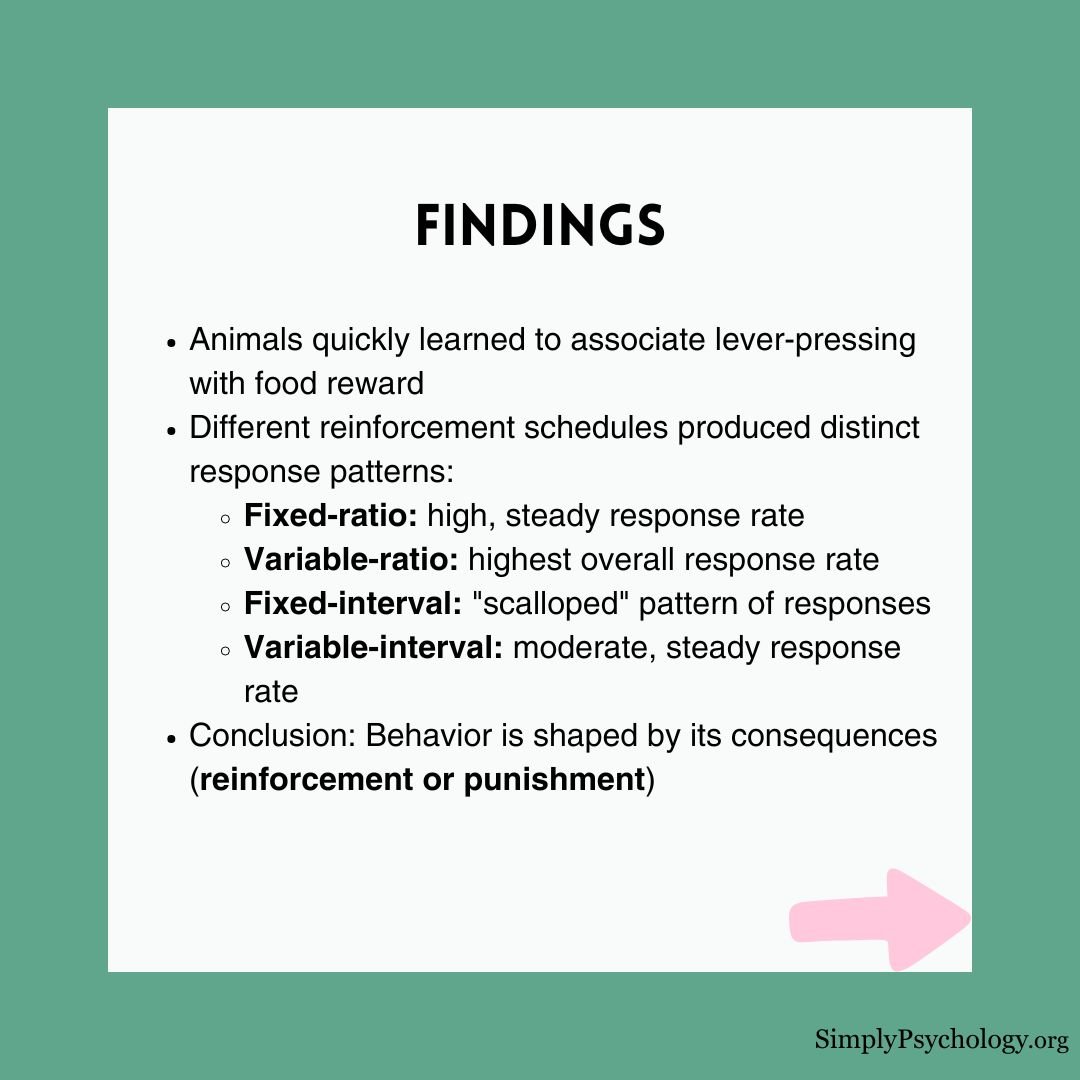
- Schedules of Reinforcement: By programming the food dispenser, Skinner studied how the frequency and predictability of rewards affect learning. He discovered that while continuous reinforcement (rewarding every single lever press) teaches a new behavior the quickest, partial or intermittent reinforcement schedules (such as rewarding the rat only after a certain number of presses or a varying amount of time) make the behavior much stronger and far more resistant to extinction.
- Shaping: For highly complex behaviors that an animal would never do by chance, researchers use the box to reward “successive approximations” of a target behavior. This step-by-step reinforcement method allowed Skinner to teach pigeons to perform highly unusual tasks, such as turning in circles, walking in figure eights, or even playing ping pong.
Strengths of the Skinner Box
- Total Environmental Control: The Skinner box operates as an “auto-environmental chamber” that allows researchers to have total control over the animal’s surroundings and the specific variables being tested. By manipulating exact antecedents (like lights or sounds) and consequences (like food pellets or shocks), researchers can precisely isolate cause-and-effect relationships in behavior.
- Scientific Objectivity and Credibility: Prior to behaviorism, psychology relied heavily on subjective methods like introspection. The Skinner box shifted the focus entirely to objective, observable, and directly measurable data, such as counting the exact number of times an animal pressed a lever. This rigorous experimental method helped psychology gain credibility and status as a legitimate, quantifiable scientific discipline.
- Minimization of Human Confounding Variables: By using non-human subjects like rats and pigeons in an isolated setting, the Skinner box eliminates the “demand characteristics” commonly found in human experiments. Animals do not try to guess the purpose of the experiment or alter their behavior to please the researcher, providing a purer look at basic learning mechanisms.
- Practical, Real-World Applications: The principles of operant conditioning discovered using the Skinner box have been successfully translated into everyday human applications. These include behavior modification therapies, programmed learning (computer-assisted education), biofeedback treatments for stress, and “token economies” used to encourage positive behaviors in psychiatric wards and prisons.
Limitations of the Skinner Box
- Ethical Concerns: The use of animals in Skinner boxes raises significant ethical issues regarding protection from harm. The methodology frequently involves keeping animals in highly confined, artificial spaces. Furthermore, to ensure the animals are motivated to operate the levers, they are often subjected to food deprivation to keep them hungry, or they are exposed to aversive stimuli like electrified floors to study punishment.
- Methodology Directing Theory (Focus on Frequency): A major criticism of the Skinner box is that it relies on “response rate” (counting the frequency of lever presses) as the primary measure of learning. This inherently ignores the intensity, duration, and quality of the behavior. Critics argue this is a problematic case of the research method narrowing and directing the theoretical framework, as everyday human behavior cannot solely be judged by frequency—just as an author’s worth should not be judged merely by the number of books they publish rather than their quality.
- Generalizability to Humans: Because the Skinner box relies heavily on animal models, many argue that its findings cannot be seamlessly generalized to human beings. Human environments are vastly more complex, and human learning involves nuanced social and cultural factors that an isolated box cannot replicate.
- Reductionism and the Rejection of Cognition: The radical behaviorist approach of the Skinner box treats the mind as a “black box” and ignores the role of internal cognitions, thoughts, and emotional factors in shaping behavior. This creates several explanatory gaps:
- It cannot account for spontaneous human creativity in fields like music, literature, and science.
- It cannot explain the productivity and innovative nature of human language, which is not merely a repeated set of reinforced behaviors.
- Even in animals, the Skinner box oversimplifies learning. Phenomena like “latent learning” (learning that occurs without any reinforcement) and the “reinforcer devaluation effect” prove that animals actually use cognitive processes to value consequences and make choices, rather than just mechanically repeating reinforced actions.
Skinner Box Myths
In 1945, B. F. Skinner invented the air crib, a metal crib with walls and a ceiling made of removable safety glass.
The front pane of the crib was also made of safety glass, and the entire structure was meant to sit on legs so that it could be moved around easily.
The air crib was designed to create a climate-controlled, healthier environment for infants. The air crib was not commercially successful, but it did receive some attention from the media.
In particular, Time magazine ran a story about the air crib in 1947, which described it as a “baby tender” that would “give infant care a new scientific basis.” (Joyce & Fay, 2010).
The general lack of publicity around Skinner’s air crib, however, resulted in the perpetuation of the myth that Skinner’s air crib was a Skinner Box and that the infants placed in the crib were being conditioned.
In reality, the air crib was nothing more than a simple bassinet with some features that were meant to make it easier for parents to care for their infants.
There is no evidence that Skinner ever used the air crib to condition children, and in fact, he later said that it was never his intention to do so.
One famous myth surrounding the Skinner Crib was that Skinner’s daughter, Deborah Skinner, was raised in a Skinner Box.
According to this rumor, Deborah Skinner had become mentally ill, sued her father, and committed suicide as a result of her experience. These rumors persisted until she publicly denied the stories in 2004 (Joyce & Fay, 2010).
References
Bandura, A. (1977). Social learning theory. Englewood Cliffs, NJ: Prentice Hall.
Dezfouli, A., & Balleine, B. W. (2012). Habits, action sequences and reinforcement learning. European Journal of Neuroscience, 35(7), 1036-1051.
Du Boulay, B. (2019). Escape from the Skinner Box: The case for contemporary intelligent learning environments. British Journal of Educational Technology, 50(6), 2902-2919.
Chen, C., Zhang, K. Z., Gong, X., & Lee, M. (2019). Dual mechanisms of reinforcement reward and habit in driving smartphone addiction: the role of smartphone features. Internet Research.
Dad, H., Ali, R., Janjua, M. Z. Q., Shahzad, S., & Khan, M. S. (2010). Comparison of the frequency and effectiveness of positive and negative reinforcement practices in schools. Contemporary Issues in Education Research, 3(1), 127-136.
Diedrich, J. L. (2010). Motivating students using positive reinforcement (Doctoral dissertation).
Dozier, C. L., Foley, E. A., Goddard, K. S., & Jess, R. L. (2019). Reinforcement. The Encyclopedia of Child and Adolescent Development, 1-10.
Ferster, C. B., & Skinner, B. F. (1957). Schedules of reinforcement. New York: Appleton-Century-Crofts.
Gunter, P. L., & Coutinho, M. J. (1997). Negative reinforcement in classrooms: What we’re beginning to learn. Teacher Education and Special Education, 20(3), 249-264.
Joyce, N., & Faye, C. (2010). Skinner Air Crib. APS Observer, 23(7).
Kamery, R. H. (2004, July). Motivation techniques for positive reinforcement: A review. In Allied Academies International Conference. Academy of Legal, Ethical and Regulatory Issues. Proceedings (Vol. 8, No. 2, p. 91). Jordan Whitney Enterprises, Inc.
Kohler, W. (1924). The mentality of apes. London: Routledge & Kegan Paul.
Staddon, J. E., & Niv, Y. (2008). Operant conditioning. Scholarpedia, 3(9), 2318.
Skinner, B. F. (1938). The behavior of organisms: An experimental analysis. New York: Appleton-Century.
Skinner, B. F. (1948). Superstition in the pigeon. Journal of Experimental Psychology, 38, 168-172.
Skinner, B. F. (1951). How to teach animals. Freeman.
Skinner, B. F. (1953). Science and human behavior. SimonandSchuster.com.
Skinner, B. F. (1963). Operant behavior. American Psychologist, 18(8), 503.
Smith, S., Ferguson, C. J., & Beaver, K. M. (2018). Learning to blast a way into crime, or just good clean fun? Examining aggressive play with toy weapons and its relation with crime. Criminal Behaviour and Mental Health, 28(4), 313-323.
Staddon, J. E., & Cerutti, D. T. (2003). Operant conditioning. Annual Review of Psychology, 54(1), 115-144.
Thorndike, E. L. (1898). Animal intelligence: An experimental study of the associative processes in animals. Psychological Monographs: General and Applied, 2(4), i-109.
Vu, D. (2017). An Analysis of Operant Conditioning and its Relationship with Video Game Addiction.
Watson, J. B. (1913). Psychology as the behaviorist views it. Psychological Review, 20, 158-177.