For many, the holiday season is billed as the “most wonderful time of the year.” But if you are Autistic, or love someone who is, you likely know the reality is often closer to an endurance test.
The sudden explosion of social demands, broken routines, and sensory chaos during the holiday season can leave you feeling exhausted, anxious, or completely shut down.
If this resonates with you, you are not “being difficult” and you are certainly not alone.

According to Dr. Alice Nicholls, an Autistic Clinical Psychologist, the holidays represent a “massive source of stress” specifically because they force you to break away from the very routines that keep you safe and regulated.
Instead of peace and joy, many Autistic people face a perfect storm of executive dysfunction and sensory discomfort.
This guide breaks down exactly why this season is so biologically taxing and offers expert-backed strategies to navigate it without burning out.
The “Triple Threat” of Holiday Stress
Why does December feel so much harder than August? Experts point to a specific combination of triggers that hit all at once.
David Gray-Hammond, author and advocate, explains that the holidays are often a “minefield” because they disrupt the three pillars of stability:
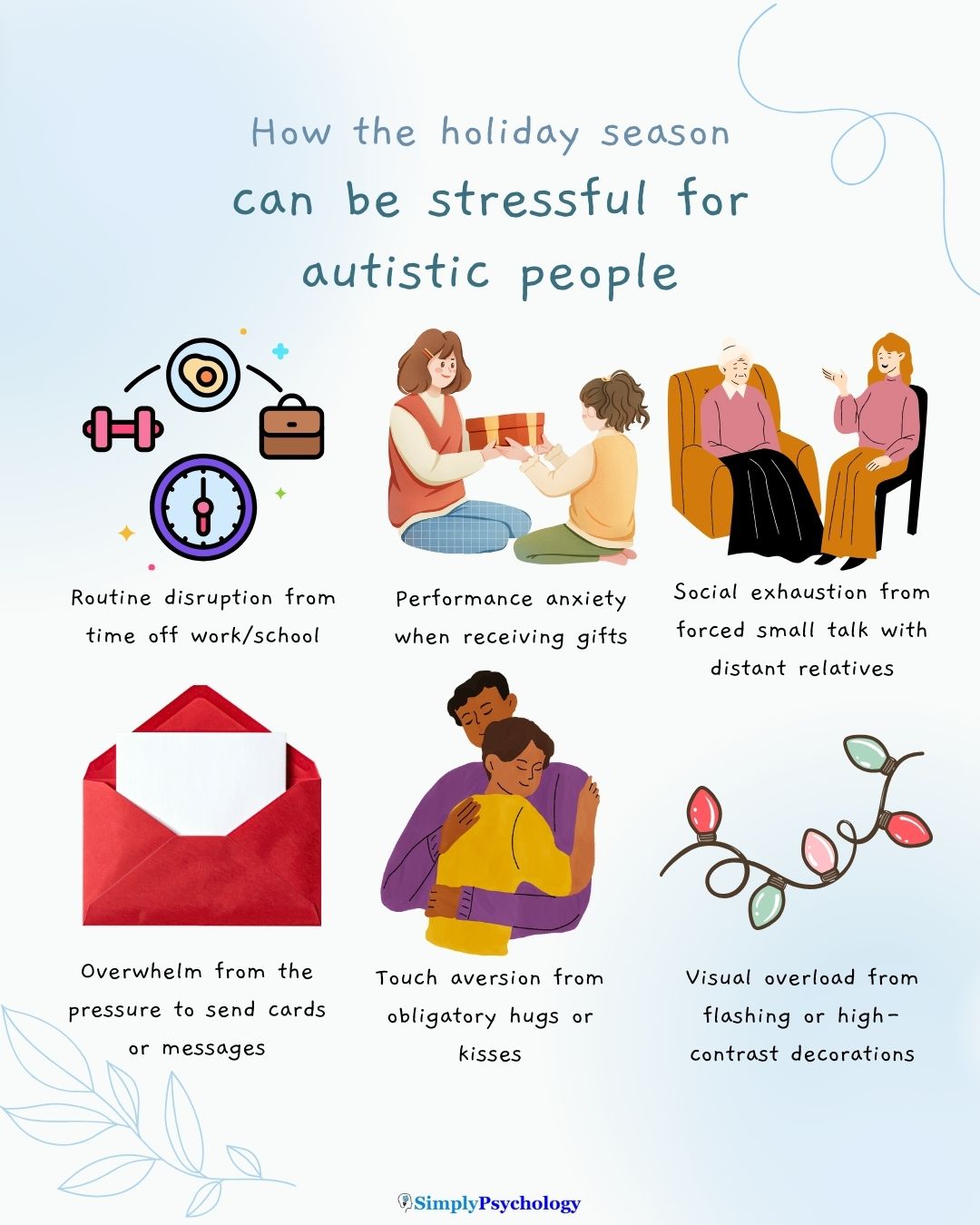
- Social Demands: You are suddenly expected to interact with larger groups, often including family members who may not understand neurodivergence.
- Sensory Assault: The environment changes aggressively. Bright fairy lights, loud Christmas music, and strong cooking smells can turn a safe home into a “sensory nightmare.”
- Routine Collapse: School or work schedules vanish. Dr. Nicholls explains that Autistic people rely on routine to save mental energy. When that routine breaks, simple tasks require intense planning, quickly draining your “executive function” battery.
Key Insight: It is not a character flaw if you feel overwhelmed. Your brain is processing a sudden, intense increase in data without its usual filing system (routine).
The Hidden Cost of “Happy” Reactions
Gift-giving is a central part of the season, but for Autistic individuals, it is often a source of deep anxiety.
Marie-Pier Leroux, an Autistic advocate, describes the exhaustion of “performative reactions.”
It isn’t just about liking or disliking the gift. It is the pressure to perform the “correct” emotion—the big smile, the hug, the happy tears.
Leroux explains that suppressing your natural reaction to make others feel comfortable is a form of masking.
Terra Vance, CEO of NeuroClastic, takes this further. She notes that for many Autistic people who value authentic expression, being forced to “fake” gratitude feels physically uncomfortable.
Vance describes the sensation of faking a reaction as wanting to “rip out of my fake skin.”
- The Conflict: You want to be kind, but the social script demands you be inauthentic.
- The Result: A building distress that can be traumatic, leading to a desire to withdraw completely to feel safe again.
Understanding the “Social Hangover”
Have you ever enjoyed a party, only to wake up the next day feeling physically ill or unable to think clearly? Catherine Londero, who is Autistic and ADHD, calls this the “social hangover.”
Londero explains that this exhaustion comes from:
- Complex Masking: You might have different “masks” for different family members. When everyone is in one room, switching between them is exhausting.
- Delayed Processing: You might not realize a loud noise or a rude comment hurt you until hours (or days) later.
Dr. Amy Pearson’s research confirms that this constant self-monitoring—trying not to appear "rude" or "weird"—drains the cognitive resources you need to regulate your emotions. This is why meltdowns often happen after the event, in the safety of your own home.
Expert Strategies: How to Protect Your Peace
You do not have to just “suck it up” until January. Dr. Megan Anna Neff, an Autistic ADHD Psychologist, and Dr. Alice Nicholls suggest proactive strategies to manage your nervous system.
1. Create a “Sanctuary Space”
Dr. Neff advises becoming a “sensory detective.” Look at the environment you are entering. Is it loud? Bright?
- The Fix: Establish a retreat space before you arrive. This should be a low-sensory room where you can go for 15 minutes to reset.
- The Tool: Use noise-canceling headphones or sunglasses indoors. Dr. Pearson emphasizes that these are necessities for functioning, not luxuries.
2. The “Aftercare” Plan
Treat social events like a workout: you need a cool-down period. Dr. Neff suggests planning your “aftercare” before the event even starts.
- Block out the day after a big gathering.
- Engage in a “deep focus” interest (a hobby you love) to recharge.
- Allow yourself to “stim” (pace, rock, hum) to release trapped energy.
3. Script Your Boundaries
Terra Vance highlights the importance of predictability. You cannot process new information instantly, so try to reduce surprises.
- Ask for the schedule: “What time are we eating? Who will be there?”
- Pre-state your limits: “I can stay for two hours, but then I will need to head home to rest.”
- Use written communication: If speaking is too hard, text your family member your needs. Dr. Sedgewick’s research shows that written communication often reduces anxiety significantly.
Conclusion
The holidays do not have to be a choice between pleasing others and destroying your own mental health. As Dr. Alice Nicholls and other experts illustrate, the key is self-compassion.
You are allowed to set boundaries. You are allowed to skip the loud party. You are allowed to wear comfortable clothes instead of itchy festive outfits.
By prioritizing your sensory needs and respecting your limits, you can navigate the season with your well-being intact.
Next Steps: Your Holiday Survival Checklist
- Identified a Safe Space: Do you know where you can go to be alone at the venue?
- Packed a Sensory Kit: Do you have earplugs, sunglasses, comfortable clothes, and a comfort object?
- Set an Exit Time: Have you decided (and communicated) when you are leaving?
- Planned Recovery: Is your calendar clear for the day after the event?

