Special interests, often seen in autistic individuals, are characterized by their significantly greater intensity and a tendency to center around less common topics compared to the interests of neurotypical individuals.
While both autistic and neurotypical individuals may enjoy similar activities, the depth of engagement and the potential impact on daily life typically differ.
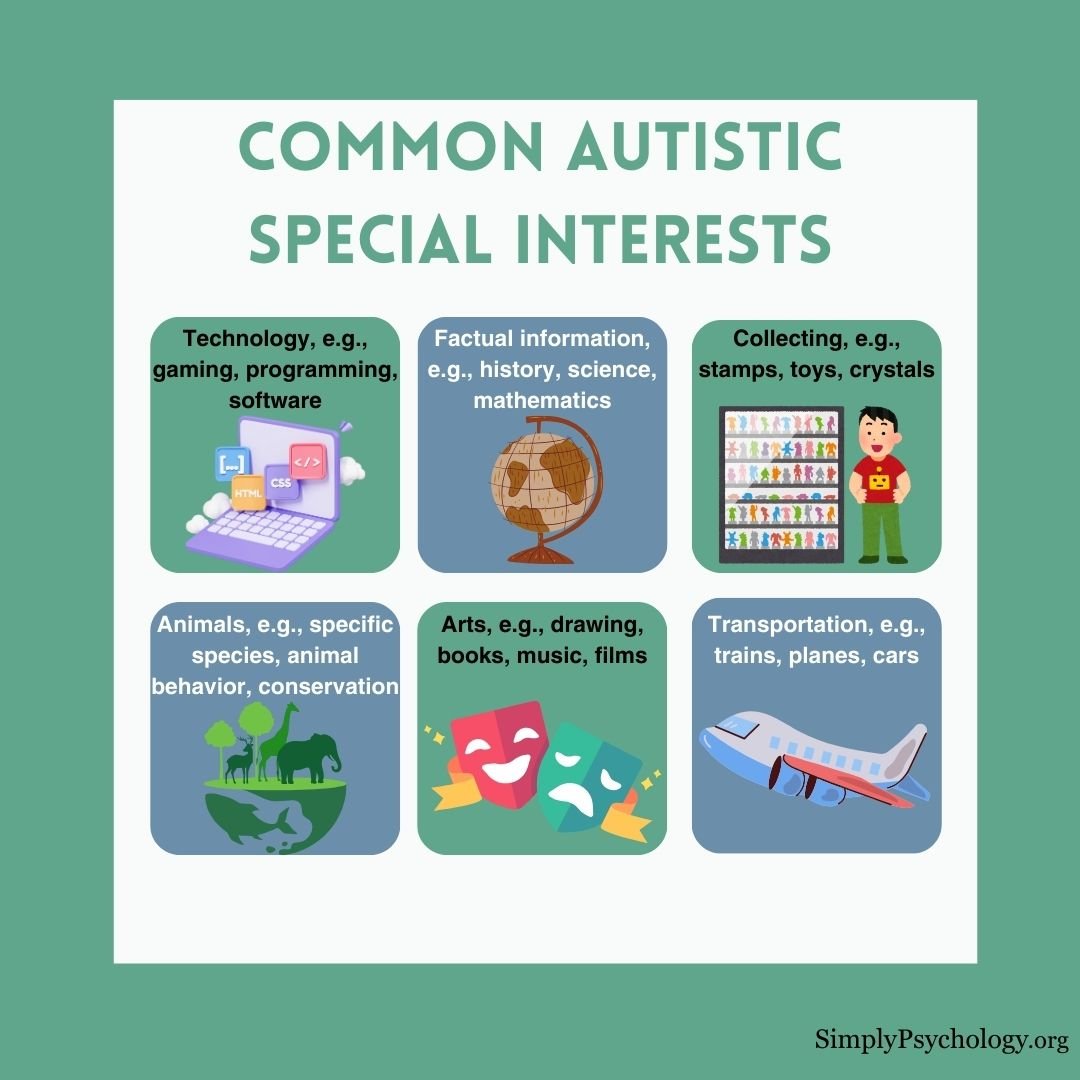
Special interests can be lifelong or change and adjust over time. Some examples of common special interests may include transportation, specific movies/ TV shows, animals, science, or history.
The exact reasons for special interests are unclear. They may relate to the restricted and repetitive behaviors that make up part of the core diagnostic criteria for autism.
Not every autistic person has a special interest. Even so, they are a common sign of autism.
This article will discuss some of the common special interests in autism, benefits, challenges, and ways you can support your interests.
As someone who is autistic and has experience with special interests, I will also be sharing some of my experiences and those of other autistic individuals throughout.
Examples of Common Special Interests in Autism
Below are some common autistic special interests:
- Technology: This category includes interests in computers, gaming, programming, software, and digital media.
- Animals: Many autistic individuals express a deep fascination with animals, ranging from domestic pets to wild creatures. This can include interests in specific species, animal behaviour, or conservation efforts.
- Music: Music is a common source of joy and engagement for many autistic people, with interests spanning various genres, instruments, and musical knowledge.
- Factual Information: Autistic individuals often enjoy acquiring and retaining factual information on a wide range of topics. This can include interests in history, science, mathematics, or specific areas of expertise.
- Collecting/Hoarding: Collecting and hoarding specific items is more commonly reported as a special interest in autistic individuals, compared to neurotypical individuals. This could include collecting objects such as stamps, coins, or toys, or amassing large quantities of particular items.
- Sensory-Seeking Activities: Some autistic individuals are drawn to sensory-seeking activities that provide enjoyable sensory input. This could involve engaging with specific textures, sounds, lights, or movements.
- Numbers and Mathematics: Interests in numbers, mathematics, and numerical patterns are common among autistic individuals, ranging from basic arithmetic to advanced mathematical concepts.
- Art and Creative Arts: Autistic individuals often find joy and self-expression through various forms of art, including drawing, painting, sculpture, writing, and performing arts.
- Transportation: Interests in different modes of transportation, such as trains, planes, cars, or buses, are also prevalent among autistic individuals. This can involve learning about mechanics, history, or design.
This is not an exhaustive list, as special interests vary widely from person to person. Below are some specific special interests of actual autistic individuals:
“My main special interest is history especially victorian and tudor era but i like pretty much anything historical except military history.”
“A lot of my special interests end up being tv shows. If i really like a show, I’ll watch it like a billion times, talk about it incessantly on Tumblr… i’ll look up other projects that the actors have done and watch some of those if I’m interested…”
“I can spend a few hours talking about musical influences and random facts from bands and artists I like.”
How Common Are Special Interests in Autism?
Special interests are common in autism, but not universal. The figures depend on who is asked and how.
How Many Autistic People Have One?
Three sources give a sense of scale:
- Adults: About two-thirds of autistic adults in one survey reported a special interest, and most of those had more than one (Grove et al., 2018).
- Children: In a pilot survey of 1,992 autistic children, parents reported a mean of nine current interests (Nowell et al., 2021).
- Diagnosis: The DSM-5-TR needs at least two of four restricted and repetitive patterns, so an intense interest is neither required nor sufficient (American Psychiatric Association, 2022).
Television, objects and music were the most often endorsed in the children’s survey. Parents reported a mean age of onset of 5.24 years.
Interests fall within a core diagnostic domain, but the criteria do not require them. A sizeable minority of autistic people report none.
The topics vary widely. In a German survey, the most important interests of 60 autistic adults fell most often into creative arts (57%), history and education (40%) and science, technology, engineering and mathematics (38%). Non-autistic adults named creative arts (75%) and sports (52%) most often (Bayer & Dziobek, 2026).
How Do They Differ From Other Interests?
The difference is not the number of interests. It is the type of interest and, above all, how intense it is.
In a comparison of 109 autistic and 76 non-autistic participants, the groups did not differ in the number of interest areas. Intensity alone classified 81% of participants correctly (Anthony et al., 2013).
Other work finds a continuum. In a mixed-methods survey of 45 autistic and 44 non-autistic adults, both groups reported focused interests that were similar in nature and served similar purposes (Dantas & Fletcher, 2025). Autistic adults reported them more often.
Time spent also differs. Autistic adults spent a mean of 28.6 hours a week on their interests, against 14.2 for non-autistic adults (Bayer & Dziobek, 2026).
This fits a continuum of intensity, with autistic interests at the intense end, more than a sharp category difference.
Gender Differences in Special Interests
Male and female autistic individuals may have special interests in any of the areas above. Studies suggest the differences lie mainly in the topics. They are much smaller for how intense the interests are.
Differences in Topic
Some research indicates differences in what the interests are about:
- Autistic boys and men: more likely to have interests considered ‘stereotypical’ for autism, such as technology, mathematics, and mechanics.
- Autistic girls and women: more likely to have ‘social interests’ that match typical gender roles, such as animals, fictional characters, celebrities, or music.
- Collecting: one study suggests girls and women are more prone to collecting ‘seemingly random’ items like rocks, pens, or stickers.
Caregivers report the same pattern (Brown et al., 2024). In 1,921 autistic youth, more boys were interested in mathematics and construction, and more girls in animals and in arts and crafts.
Even so, the differences were limited. They appeared for less than half (39%) of the categories. Boys and girls did not differ in age of onset or in how interfering the interests were thought to be.
The authors’ summary is that boys and girls are more similar than different.
Are Autistic Girls’ Interests Overlooked?
A potential reason for the differences in the types of special interests between boys and girls is societal expectations and gender roles. Girls may be more encouraged to engage in socially oriented or creative activities, while boys may be encouraged to pursue STEM-related interests.
Camouflaging may play a part. Girls and women camouflage their autistic traits more often.
A review of the female autism phenotype argues that this may shape their interests (Hull et al., 2020). They may choose topics judged typical for their age and gender, such as animals, fictional characters or psychology.
Parents, teachers and clinicians may not see such interests as unusual. They may never be asked. That could add to under-recognition in girls and women.
This is an argument, not a tested result. A meta-analysis found only a small difference in measured restricted interests, with higher levels in autistic males (Edwards et al., 2024). The large studies above rely on caregiver reports, so they show what caregivers notice and endorse.
One practical implication is an inference, not a tested result. Asking only about ‘unusual’ interests, such as trains or computers, may miss many autistic girls.
Why Autistic Interests Become So Intense
Researchers have proposed several explanations. None has been shown to be the whole story. Three have research behind them:
- Monotropism: attention is drawn into a narrow, intense “tunnel” towards a few interests.
- Reward: interests may be more rewarding for autistic people than social stimuli are.
- Knowledge-seeking: interests express a drive to understand how things work.
Monotropism: A Narrow Attention Tunnel
Monotropism is an autistic-developed account described by Murray, Lesser and Lawson (2005). It proposes that attention is drawn into a narrow, intense “tunnel” towards a few interests. That leaves less attention for everything else.
The account predicts difficulty shifting attention. It is popular in autistic communities, but it has had minimal direct quantitative testing (Dwyer et al., 2024).
Two recent studies tested it, with mixed results. A laboratory and questionnaire study of 18 autistic and 22 comparison adolescents found more reported hyperfocus on questionnaires (Dwyer et al., 2025).
Brain-wave measures and behavioural attention capture did not differ between the groups. In interviews with 13 autistic adults, themes of deep engrossment, devastation when interrupted and sanctuary were taken to support the account (Poole et al., 2026).
So far, support comes from self-report and interviews. Laboratory tasks have not yet confirmed it.
Reward and Knowledge-Seeking
A reward account says interests are rewarding in a way that social stimuli are not. In a brain-imaging study, 39 autistic youth and 22 controls watched short video rewards.
Autistic youth showed stronger reward-system responses to their own interests than to social rewards (Kohls et al., 2018). The interests were mostly non-social, such as video games.
The authors argue this could raise motivation for interests and lower it for social engagement. That is an interpretation, and the design is correlational.
The lab’s social rewards may simply have been less rewarding.
A knowledge-seeking account points to a different main function. In 260 online posts by autistic adults, knowledge-seeking appeared in 52% (Caldwell-Harris, 2026). Self-regulation (9%), career (6%) and socialising (4%) were far less common.
Interviews with nine autistic people instead described interests as a protective boundary and a “social compass” (Lizon et al., 2024). The findings are not contradictory. They ask different questions of different people.
Each account has been tested on its own, and none against the others. Which explains most of the pattern remains unknown.
Benefits of autistic special interests
Below are some of the benefits of autistic special interests:
Enjoyment and positive impact on wellbeing
Engaging in special interests can bring joy, happiness, and a sense of flow to autistic individuals.
This can contribute to increased self-esteem, particularly when the interests are shared and valued by others. They also provide comfort. They can act as a coping mechanism when feeling stressed.
For me, the repetitiveness of engaging in a special interest feels very self-soothing and I feel a spark of excitement when I learn something I didn’t know before.
Surveys suggest two things:
- Regulation: Autistic adults rated interests as a stronger source of emotion regulation than non-autistic adults did, and turned to them more than to people when stressed (Bayer & Dziobek, 2026).
- Wellbeing: Autistic adults with a special interest did not report higher wellbeing than those without one, but motivation helped and very high intensity hurt (Grove et al., 2018).
Social opportunities
Special interests can provide a helpful conversation starter for autistic people. They can help with making connections with like-minded individuals or engage in sharing interesting knowledge and activities with others. Overall, it can create a sense of belonging.
Interests can act as a bridge. In interviews with nine autistic people, they also worked as a “social compass” (Lizon et al., 2024). That gave structure to social situations.
I always used to hold back on speaking about my special interests due to high masking/camouflaging. But after pushing myself to share more, I have had a lot of positive interactions with others and developed stronger bonds.
It also helps encourage others to speak about things they are passionate about too.

Enhanced learning and knowledge
The intensity of special interests can facilitate deep learning, enhance research skills, and make the individual essentially an expert on their topic of interest.
These skills can be utilized within an educational setting, leading to more meaningful engagement. For example, a student’s interest in cars could be used to learn about speed, distance, time, and physics.
Research supports using interests in teaching.
A review covering 1990 to 2014 found 20 studies of 91 autistic children taught through their interests. All reported gains in learning, social engagement or both (Gunn & Delafield-Butt, 2016).
Most were small single-case studies, so the finding is encouraging, not decisive. Interests also drive learning outside school. Autistic adults rated their interests as a larger source of learning and knowledge than non-autistic adults did (Bayer & Dziobek, 2026).
“My special interest is Latin and Ancient Greek language, culture, literature, art etc. Next year I’m going to uni to study classics and I still can’t believe I’ll get to learn about my special interest full-time.”
Offers predictability in an unpredictable world
Many autistic people prefer sameness and predictability. A special interest can supply both when things feel uncertain.
If I am having an unpredictable day, it is relaxing for me to rewatch a movie or TV show that I have a strong interest in and have seen countless times.
I know exactly what happens, and I know that I enjoy it. So it does not feel like too much of a mentally demanding ‘risk’ to watch when I want to calm down.
It can be a great way to manage my anxiety.
In an Australian interview study of 20 autistic adults, one participant, given the pseudonym Betty, described what their interests did when life was hard. With access to them, it did not matter what else was going on (Browne et al., 2026).
“My special interests are the bedrock of my life.”
Potential for career paths
Autistic individuals may be fortunate enough to discover a career path that aligns with their special interests.
Their deep knowledge and passion can make them a highly suitable candidate in various fields. For example, an individual with a special interest in animation may thrive in this career. They can be very successful.
Being on a career path that aligns with your special interest can make life more satisfactory for autistic individuals.
Research on work is mostly qualitative. In interviews with 20 autistic adults in Australia, employment protected mental health only under conditions such as financial security or a link to a passion (Browne et al., 2026).
“Around a year ago, I was lucky enough to get a job basically researching and writing about cats in an office filled with cats. I wonder how many other people get lucky enough to be employed in a job that deals with their special interest (cats).”
Challenges Associated with Autistic Special Interests
Below are some of the challenges that may be associated with autistic special interests:
Social Isolation and Bullying
While special interests can foster social interaction, they can also lead to social isolation, particularly if the interest is highly specific or considered unusual by others.
Autistic children and adolescents are especially vulnerable to bullying, which can be exacerbated by intense or unconventional special interests.
Finding peers can be hard. In a survey of 492 adults, autistic adults and adults with ADHD both had more trouble finding people who shared their interests (Dwyer et al., 2024). Specific or unusual interests can make the search harder still.
We found no study that isolates whether an unusual interest in itself raises the risk of being bullied. The link rests on plausibility more than evidence.
Interference with Daily Functioning
The intensity of autistic special interests can sometimes interfere with daily activities and responsibilities.
This can show up in several ways:
- Switching: finding it difficult to transition between activities.
- Basic needs: neglecting basic needs while absorbed in the interest.
- Concentration: problems concentrating on tasks outside the special interest area.
- Distress: feeling distressed when not able to engage with the interest.
“… when my special interest was at its height, I had a hard time doing anything else. I thought about it when I woke up, as I was going about my daily errands, while I took my dog on walks, as I was falling asleep, etc. It took over my brain. I just wanted to think about it, write about it, watch it, and learn more about it. Pivoting to other thoughts and activities was genuinely hard.”
A group comparison found that autistic interests were more interfering as well as more intense (Anthony et al., 2013).
Losing access to an interest also has a cost. In the Australian interview study, a participant given the pseudonym Tina described a household that left no room for hobbies, and found this defeating. Being unable to engage with interests was reported to affect mental health negatively (Browne et al., 2026).
Negative Perceptions and Misunderstandings
Autistic special interests may be misunderstood by those unfamiliar with autism. They may be dismissed as mere hobbies or obsessions, rather than recognized as integral aspects of autistic identity.
This lack of understanding can lead to the invalidation of autistic experiences and create barriers to support.
Research bears this out. In an online survey of 60 autistic and 122 non-autistic adults, autistic adults reported far more negative consequences and stigma around their interests (Bayer & Dziobek, 2026). In an exploratory analysis, stigma was higher with:
- More autistic traits
- More time spent on the interest
- More social anxiety
Part of what looks like a cost of the interest may be a cost of other people’s reactions to it.
Words matter here too. Many autistic people find “special” patronising, and researchers have suggested “focused, intense, or passionate interests” instead (Bottema-Beutel et al., 2021). This article keeps “special interests” because it is still the most widely used phrase.
Supporting Your Special Interests
Below are some ways in which you can support your special interests while being mindful of some of the potential challenges:
Research on supporting interests is strongest in school. In therapy, NICE guidance suggests using the person’s special interests where possible to maintain attention (National Institute for Health and Care Excellence, 2012). The practical tips below are sensible, but they have not been tested in trials.
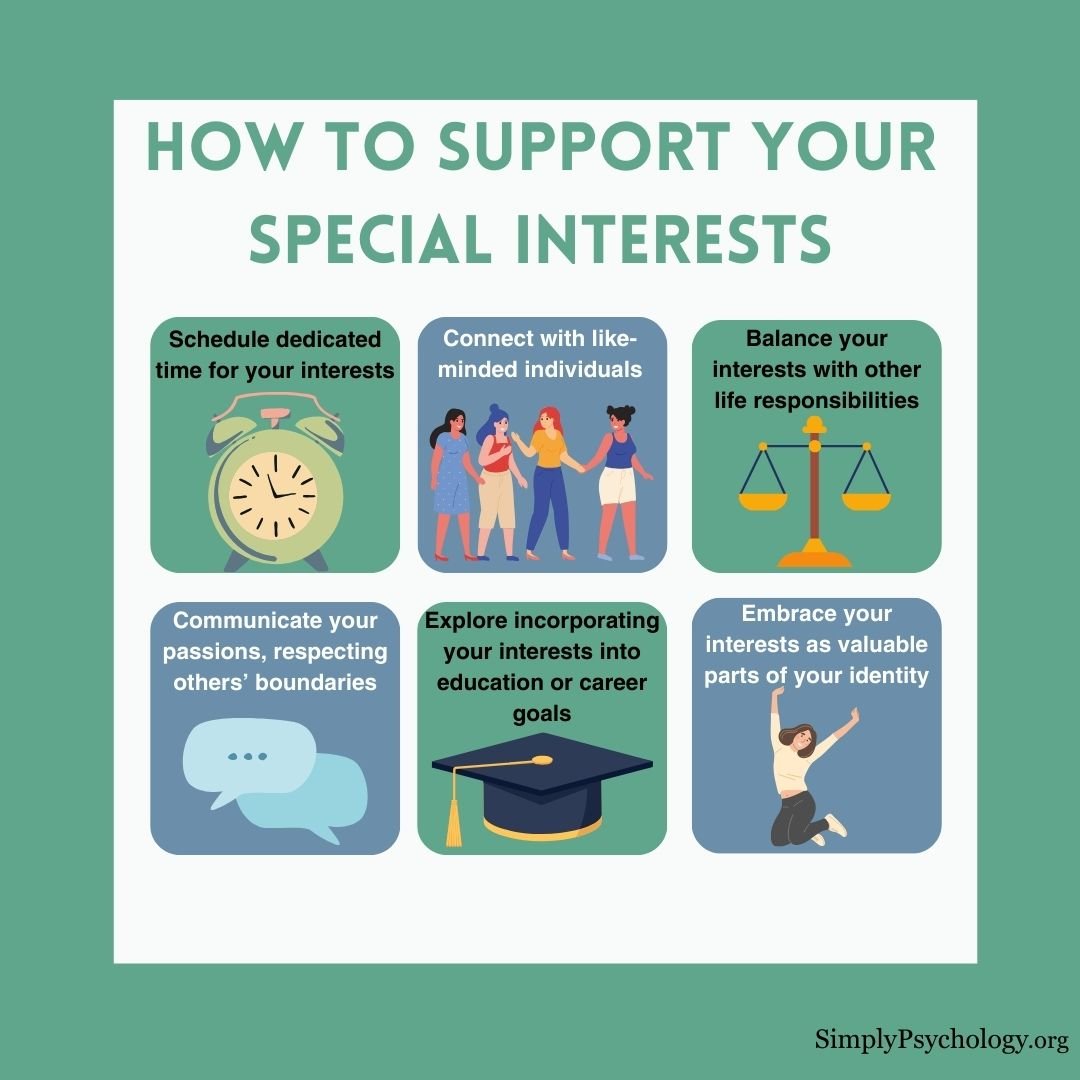
Embrace your interests
Recognize that your special interests are valuable aspects of your identity and can contribute to a fulfilling life. Embrace them, even if they seem unusual to others.
Set aside regular time to pursue your interests without distractions. This dedicated time can help you maintain engagement and prevent your interests from being squeezed out by other obligations.
I find that spending dedicated time on my special interests can help me regulate myself if I feel myself close to burnout. It is one of my favorite ways to make the most of my downtime.
Finding Like-Minded Individuals
Search for local clubs, groups, or organizations related to your interests. This could involve anything from hobbyist clubs to professional associations.
The internet provides a vast landscape for connecting with people who share your interests. Try online forums, social media groups, or virtual meetups. Choose ones dedicated to your specific passions. This can be an effective way to engage in discussions, share knowledge, and combat social isolation.
I have used Bumble BFF as a way to meet new friends. You can write a bit about yourself in your bio. Include your special interests so that you are catching the attention of those who are similar to you.
It can also be a great conversation starter if you share this interest with someone.
Balance Special Interests with Other Aspects of Life
A well-structured schedule can help you allocate time for both your special interests and other responsibilities. Establish a routine that balances dedicated time for your interests with time for work, social activities, self-care, and other obligations.
Sometimes, I find myself feeling a bit too fixated on my interests, where it feels like it is all-encompassing. I know that when I am getting to this stage, I need to have a break for a few days or weeks with a focus on different interests.
This feels important for my mental health, although it depends on what your interests are as to whether you feel you need extended breaks too.
“I can also use it as motivation. When I was still working and my special interest was a weekly anime, I’d just tell myself that at the end of every week, there will be a next episode, and it helped me get through the week…”
Communicate Your Special Interests Effectively
Be mindful of your audience and the social context when choosing to share your interests. Gauge their level of interest and tailor your approach accordingly.
When introducing your interest, start with a brief and engaging overview to pique their curiosity. Focus on the most intriguing aspects to capture their attention.
Draw connections between your interest and their own experiences or knowledge to make it more relatable and engaging for them.
Be respectful of others’ boundaries by looking at their body language and other cues. If they are turning away, looking bored, or not giving long responses while you are talking, they may be disinterested or overwhelmed. Gradually shift the conversation to another topic.
Remember that not everyone will be interested in hearing about your special interest as much as you would love to talk about it. Try to find a balance in how much you share.
Incorporate Special Interests into Education and Career Goals
You do not need a career in your special interest, and it may be unattainable, depending on what it is. It can be an option for some people.
Research academic programs or courses aligned with your passions. This could involve pursuing a degree in a field related to your interest or taking elective courses to expand your knowledge base.
For example, an interest in animals could lead to exploring careers in veterinary science, zoology, or animal behavior.
Seek out mentors who work in fields related to your interests. Ask about volunteering or internship opportunities.
If your interest lends itself to entrepreneurship, explore options for starting your own business or freelance work related to your passion. This can provide greater autonomy and flexibility in how you engage with your interests.
Special Interests vs. Hyperfixations
Autistic special interests may be comparable to hyperfixations, which are common in ADHD but can be experienced in many people.
Hyperfixation is a community term, not a diagnosis, for a subject or activity that keeps pulling the same attention back over days or weeks. Researchers mostly study hyperfocus, a state of absorbed attention so complete that time, hunger and other duties fade from awareness.
Both have similarities, including:
- Intensity: Both involve intense focus on specific topics or activities.
- Enjoyment: Each can provide enjoyment and comfort.
- Knowledge: Either may lead to extensive knowledge in the area of interest.
Popular accounts also describe differences between special interests and hyperfixations, such as the following. Few have been tested directly:
- Duration: In 1,992 autistic children, past interests most often lasted over two years (Nowell et al., 2021), but we found no study that compares this with ADHD.
- Variety: Autistic interests are said to be fewer but deeper, yet autistic children had a mean of nine current interests (Nowell et al., 2021).
- Depth: Autistic interests are often said to involve deeper knowledge, but this contrast rests on impressions, not direct comparison.
- Function: Autistic people often describe interests as comfort and identity, while dopamine findings in ADHD concern inattention and motivation, not hyperfixation (Volkow et al., 2009).
- Prevalence: Intense interests are common in autism but not universal, with about two-thirds of autistic adults reporting one (Grove et al., 2018).
Example of a Hyperfixation:
A person with ADHD becomes intensely focused on learning to play the guitar after watching a music documentary. For several weeks, they spend almost all their free time practicing, watching tutorial videos, and researching guitar techniques.

They may neglect other responsibilities, lose track of time while playing, and talk about guitars constantly. After a few months, the interest wanes. They move on to a new focus.
Example of a Special Interest:
An autistic individual has a longstanding fascination with astronomy. They've maintained this interest since childhood, collecting books, attending stargazing events, and learning about celestial bodies. This interest persists for years or even a lifetime.

They may pursue astronomy as a career or hobby, join astronomy clubs, and find comfort in exploring this topic. While intense, it doesn't typically interfere with daily responsibilities. It becomes an integral part of their identity and social connections.
Both can bring enjoyment, knowledge and skills. Both can also cost.
The one study that compared both groups directly surveyed 492 adults (Dwyer et al., 2024). Hyperfocus was higher in autistic-only, ADHD-only and combined groups than in adults with neither. ADHD-only adults reported more general, hobby and screen-time hyperfocus than autistic-only adults.
Costs showed up in both groups. They reported more negative effects of intense interests than comparison adults. So the idea that special interests are positive and hyperfixations stressful is too tidy.
Some people’s interests cost them sleep, health, relationships or work. Support can help. It is more likely to work if it helps them keep the interest.
Understanding these differences helps in providing appropriate support and accommodations for neurodivergent individuals, recognizing that experiences vary widely among people with autism or ADHD.
Evidence Check: How Well Do These Claims Hold Up?
Verdict: Supported with qualifications. The core descriptive claims rest on consistent but self-reported, cross-sectional evidence.
Whether hyperfocus is specific to diagnosed ADHD is contested. The popular contrasts between autistic interests and ADHD hyperfixation have not been tested. Three claims sit behind the verdict:
- Regulation and stigma: Autistic adults commonly describe intense interests as a source of regulation, learning and meaning, and also as a target of stigma.
- Hyperfocus: It is a self-reported experience that rises with ADHD symptoms in many studies, but it is not specific to ADHD.
- The contrasts: Autistic interests and ADHD hyperfocus overlap a great deal, and the commonly stated differences are best presented as impressions.
The strongest evidence on regulation is an online survey of 60 autistic and 122 non-autistic adults (Bayer & Dziobek, 2026). Autistic adults scored higher on emotion regulation (d = 0.64), learning (d = 0.61) and stigma (d = 1.39). The stigma gap was large.
Wellbeing is less settled. A survey found no difference between autistic adults with and without a special interest, and lower wellbeing at very high intensity (Grove et al., 2018).
A mixed-methods survey of 45 autistic and 44 non-autistic adults found no significant effect of focused interests on wellbeing (Dantas & Fletcher, 2025).
All of these studies are cross-sectional self-report. So none shows that interests cause better regulation. The main comparison also used autistic participants from one German clinic. It set their special interests against non-autistic adults’ main hobbies, which may not be the same thing.
A preregistered study with samples of 251 and 372 adults found more hyperfocus with more ADHD symptoms in school, hobbies, screen time and real-world scenarios (Hupfeld et al., 2019).
Whether a diagnosis adds anything is open. A comparison of 78 patients with matched controls found no difference in how often or how long hyperfocus occurred (Groen et al., 2020).
A smaller comparison of 26 adults with self-reported ADHD and 26 matched adults reported that hyperfocus was specific to ADHD (Ayers-Glassey & MacIntyre, 2024). It rests on self-reported diagnoses.
The contrasts are mostly impressions. The one direct comparison, a four-group survey of 492 adults, found hyperfocus elevated in all three neurodivergent groups (Dwyer et al., 2024). ADHD-only adults reported more general, hobby and screen-time hyperfocus than autistic-only adults.
That survey did not measure duration. In 1,992 autistic children, past interests most often lasted more than two years, but there was no comparison with children with ADHD (Nowell et al., 2021).
Key Takeaways
- Definition: Special interests are intense, long-lasting passions for a topic or activity. They are common in autism, and some autistic people prefer the term focused interests.
- Examples: Common topics include technology, animals, music, facts and history, numbers, art and transportation.
- Benefits: Interests can bring joy, calm, deep learning, connection with others and, for some people, a career.
- Challenges: Costs include difficulty switching activities, neglected needs, stigma and isolation. Losing access to an interest also hurts.
- Gender: Differences between autistic boys and girls lie mainly in the topics, not in how intense the interests are.
- Hyperfixation: Autistic interests and ADHD hyperfixation overlap a great deal, and most popular contrasts between them are untested.
- Verdict: Supported with qualifications – the main claims rest on consistent but self-reported evidence.
References
Allely, C. (2019). Exploring the female autism phenotype of repetitive behaviours and restricted interests (RBRIs): a systematic PRISMA review. Advances in Autism, 5(3), 171-186. https://doi.org/10.1108/AIA-09-2018-0030
American Psychiatric Association. (2022). Diagnostic and statistical manual of mental disorders (5th ed., text rev.). https://doi.org/10.1176/appi.books.9780890425787
Anthony, L. G., Kenworthy, L., Yerys, B. E., Jankowski, K. F., James, J. D., Harms, M. B., Martin, A., & Wallace, G. L. (2013). Interests in high-functioning autism are more intense, interfering, and idiosyncratic than those in neurotypical development. Development and Psychopathology, 25(3), 643-652. https://doi.org/10.1017/S0954579413000072
Ayers-Glassey, S., & MacIntyre, P. D. (2024). Investigating emotion dysregulation and the perseveration- and flow-like characteristics of ADHD hyperfocus in Canadian undergraduate students. Psychology of Consciousness: Theory, Research, and Practice, 11(2), 234-251. https://doi.org/10.1037/cns0000299
Bayer, M., & Dziobek, I. (2026). Special interests in autism: Functions, benefits, and challenges. Autism, 30(10), 2545-2557. https://doi.org/10.1177/13623613261471572
Bottema-Beutel, K., Kapp, S. K., Lester, J. N., Sasson, N. J., & Hand, B. N. (2021). Avoiding ableist language: Suggestions for autism researchers. Autism in Adulthood, 3(1), 18-29. https://doi.org/10.1089/aut.2020.0014
Brown, C. E., Bernardin, C. J., Beauchamp, M. T., Kanne, S. M., & Nowell, K. P. (2024). More similar than different: Characterizing special interests in autistic boys and girls based on caregiver report. Autism Research, 17(11), 2333-2345. https://doi.org/10.1002/aur.3216
Browne, K., Lawson, W., McGarry, S., Scott, M., Girdler, S., & Milbourn, B. (2026). “Consistent support is good for my mental health”: Exploring the lived experience of autistic mental health. Autism in Adulthood, 8(3), 443-456. https://doi.org/10.1089/aut.2024.0141
Caldwell-Harris, C. L. (2026). Autistic interests: Wide-ranging and intellectually oriented. Frontiers in Psychiatry, 17, Article 1749552. https://doi.org/10.3389/fpsyt.2026.1749552
Dantas, S., & Fletcher, A. (2025). Focused interests, motivation, and museum/gallery attendance: A mixed-methods survey exploring autistic adults’ experiences and wellbeing outcomes. Neurodiversity, 3, Article 27546330251394513. https://doi.org/10.1177/27546330251394513
Davey, L. (2020). Using the special interests of autistic children to facilitate meaningful engagement and learning. Good Autism Practice (GAP), 21(1), 43-64.
Dwyer, P., Sillas, A., Saron, C. D., & Rivera, S. M. (2025). Investigating autistic hyperfocus and monotropism: Limited convergence of event-related potentials, laboratory tasks, and questionnaire responses. Research in Autism, 127, Article 202683. https://doi.org/10.1016/j.reia.2025.202683
Dwyer, P., Williams, Z. J., Lawson, W. B., & Rivera, S. M. (2024). A trans-diagnostic investigation of attention, hyper-focus, and monotropism in autism, attention dysregulation hyperactivity development, and the general population. Neurodiversity, 2, 1-27. https://doi.org/10.1177/27546330241237883
Edwards, H., Wright, S., Sargeant, C., Cortese, S., & Wood‐Downie, H. (2024). Research review: A systematic review and meta‐analysis of sex differences in narrow constructs of restricted and repetitive behaviours and interests in autistic children, adolescents, and adults. Journal of Child Psychology and Psychiatry, 65(1), 4-17. https://doi.org/10.1111/jcpp.13855
Groen, Y., Priegnitz, U., Fuermaier, A. B. M., Tucha, L., Tucha, O., Aschenbrenner, S., Weisbrod, M., & Garcia Pimenta, M. (2020). Testing the relation between ADHD and hyperfocus experiences. Research in Developmental Disabilities, 107, Article 103789. https://doi.org/10.1016/j.ridd.2020.103789
Grove, R., Hoekstra, R. A., Wierda, M., & Begeer, S. (2018). Special interests and subjective wellbeing in autistic adults. Autism Research, 11(5), 766-775. https://doi.org/10.1002/aur.1931
Gunn, K. C. M., & Delafield-Butt, J. T. (2016). Teaching children with autism spectrum disorder with restricted interests: A review of evidence for best practice. Review of Educational Research, 86(2), 408-430. https://doi.org/10.3102/0034654315604027
Hiller, R. M., Young, R. L., & Weber, N. (2014). Sex differences in autism spectrum disorder based on DSM-5 criteria: evidence from clinician and teacher reporting. Journal of abnormal child psychology, 42, 1381-1393. https://doi.org/10.1007/s10802-014-9881-x
Hull, L., Petrides, K. V., & Mandy, W. (2020). The female autism phenotype and camouflaging: A narrative review. Review Journal of Autism and Developmental Disorders, 7(4), 306-317. https://doi.org/10.1007/s40489-020-00197-9
Hupfeld, K. E., Abagis, T. R., & Shah, P. (2019). Living “in the zone”: Hyperfocus in adult ADHD. ADHD Attention Deficit and Hyperactivity Disorders, 11(2), 191-208. https://doi.org/10.1007/s12402-018-0272-y
Kohls, G., Antezana, L., Mosner, M. G., Schultz, R. T., & Yerys, B. E. (2018). Altered reward system reactivity for personalized circumscribed interests in autism. Molecular Autism, 9, Article 9. https://doi.org/10.1186/s13229-018-0195-7
Lizon, M., Taels, L., & Vanheule, S. (2024). Specific interests as a social boundary and bridge: A qualitative interview study with autistic individuals. Autism, 28(5), 1150-1160. https://doi.org/10.1177/13623613231193532
Murray, D., Lesser, M., & Lawson, W. (2005). Attention, monotropism and the diagnostic criteria for autism. Autism, 9(2), 139-156. https://doi.org/10.1177/1362361305051398
National Institute for Health and Care Excellence. (2012). Autism spectrum disorder in adults: Diagnosis and management (NICE Clinical Guideline CG142; last updated 2021). https://www.nice.org.uk/guidance/cg142
Nowell, K. P., Bernardin, C. J., Brown, C., & Kanne, S. (2021). Characterization of special interests in autism spectrum disorder: A brief review and pilot study using the Special Interests Survey. Journal of Autism and Developmental Disorders, 51(8), 2711-2724. https://doi.org/10.1007/s10803-020-04743-6
Poole, D., Molloy, H., Butnicu, B., Milne, E., & Buckle, K. L. (2026). Exploring the phenomenology of autistic attention. Autism in Adulthood. https://doi.org/10.1177/25739581261489267
Spackman, E., Smillie, L. D., Frazier, T. W., Hardan, A. Y., Alvares, G. A., Whitehouse, A., & Uljarević, M. (2023). Characterizing restricted and unusual interests in autistic youth. Autism Research, 16(2), 394-405. https://doi.org/10.1002/aur.2863
Volkow, N. D., Wang, G.-J., Kollins, S. H., Wigal, T. L., Newcorn, J. H., Telang, F., Fowler, J. S., Zhu, W., Logan, J., Ma, Y., Pradhan, K., Wong, C., & Swanson, J. M. (2009). Evaluating dopamine reward pathway in ADHD: Clinical implications. JAMA, 302(10), 1084-1091. https://doi.org/10.1001/jama.2009.1308