Autism is not a learning disability. It is a neurodevelopmental condition, while a learning disability (intellectual disability) means significant difficulty learning new skills and living independently. The two can co-occur, but many autistic people have no learning disability. Instead, many have a “spiky profile”: strengths and support needs that peak and dip across skills, so one IQ score misses the mark.
If you or a loved one has recently received an autism diagnosis, you might be navigating a maze of confusing terms.
Is it a learning disability? A learning difficulty? What does “high functioning” actually mean?
You are not alone in this confusion. For decades, history and old diagnostic manuals blurred the lines between these concepts. But modern research is painting a very different picture.
According to renowned experts, autism and learning disabilities are distinct experiences, though they can happen at the same time.
This guide explains how the two differ. It also shows why your “IQ score” might be misleading, and why experts are moving away from labels like “high functioning.”
The Short Answer: No, But They Can Co-Occur
Let’s start with the most important fact: Autism is not a learning disability.
Autism is a neurodevelopmental condition that affects how you communicate, process sensory information, and interact with the world.
A learning disability (often called an Intellectual Disability or ID in clinical terms) specifically involves significant difficulties with learning new skills and managing daily life independently.
The terms shift by setting. UK social care says “learning disability,” UK schools say “learning difficulties,” and the DSM-5 says “intellectual disability” (American Psychiatric Association, 2013). Dyslexia, a specific learning disorder, is a separate diagnosis again.
Diagnosis needs significant limits in two areas: intellectual functioning (reasoning and problem-solving) and adaptive functioning (the practical, social, and conceptual skills of daily life).
Severity is judged from adaptive functioning rather than IQ bands, because IQ predicts everyday support needs poorly (American Psychiatric Association, 2013). A single IQ score cannot decide it.
Professor Francesca Happé, a leading researcher in cognitive neuroscience, explains that while these two conditions are different, they do overlap.
- Historical Confusion: Decades ago, it was assumed that most autistic people had a learning disability.
- The Real Numbers: Modern research suggests co-occurrence is common (estimates vary, but often sit around 30% for clinically diagnosed adults), but most autistic people do not have an intellectual disability.
The old assumption came from early research. Wing and Gould (1979) found that 90 per cent of children with “full,” typical autism had an IQ between 20 and 69.
Diagnosis has since widened. Most researchers now attribute rising prevalence mainly to broader criteria, greater awareness, and better identification of groups once overlooked, including autistic people without a learning disability.
Current surveillance shows the same pattern. The CDC’s monitoring network tracked 8-year-olds at 11 US sites in 2020. Among the 4,165 autistic children with cognitive test data, 37.9% were classified as having an intellectual disability (Maenner et al., 2023). Most were not.
Key Takeaway: You can be autistic and have a high IQ, an average IQ, or a learning disability. As Prof. Happé notes, autism exists at all IQ levels.
Understanding the “Spiky Profile”
If autism isn’t a lack of intelligence, what is it?
Dr. Amy Pearson, a developmental psychologist and expert in neurodiversity, argues against looking at autism through a “lens of incompetence.”
Instead of seeing it as a list of deficits, she suggests viewing it as a difference in how the brain is wired.
She describes the autistic experience as having a “Spiky Profile.”
A spiky profile is an uneven pattern of abilities. Strengths and support needs peak and dip across skills. They do not move together.
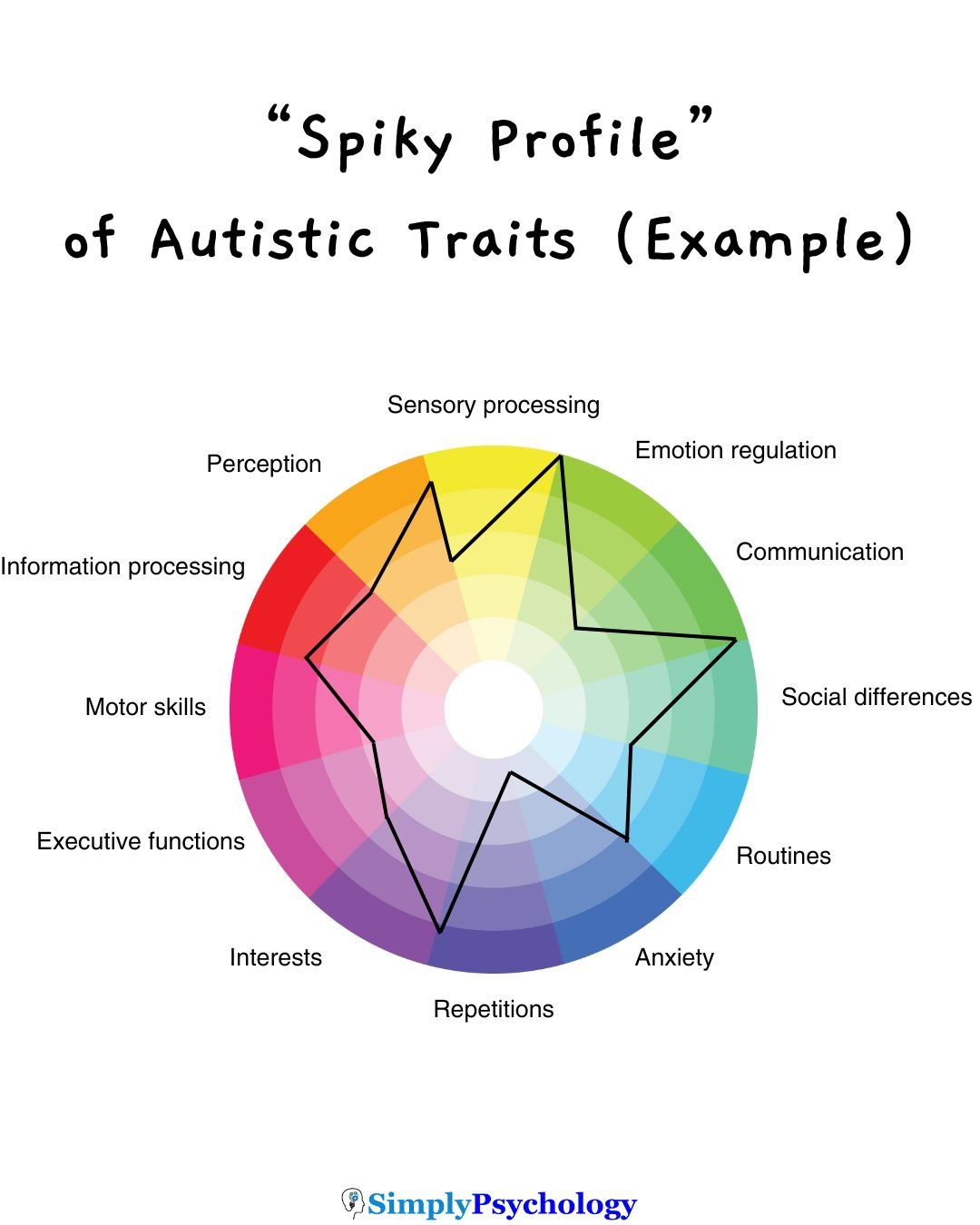
In a neurotypical person (someone without autism), skills tend to be relatively flat or even. If they are “average” at math, they are likely “average” at reading and social skills.
In a Spiky Profile, you might see:
- Incredible Strengths: Exceptional vocabulary, deep focus, or pattern recognition.
- Specific Struggles: Difficulty with sensory overload, executive function (planning), or auditory processing.
Dr. Pearson emphasizes that judging a person based on a single “functioning label” (like low-functioning or high-functioning) is “vague” and often considered rude.
A person might be able to write a PhD thesis (high competence) but be unable to cook a meal without overwhelming sensory pain (high support need).
Why “High IQ” Doesn’t Mean “Mild” Autism
One of the most dangerous myths is that if you have a high IQ or good verbal skills, your autism is “mild” or you don’t need support.
Dr. Felicity Sedgewick disagrees. Her research focuses on autistic women and girls, and highlights a hidden crisis among those often labeled as “cognitively able.”
The Cost of Compensation
Prof. Happé and Dr. Sedgewick discuss a concept called “Compensation” (often related to masking).
This is when an autistic person uses their intellect to logically “solve” social situations that don’t come naturally.
- You might force eye contact because you know you “should.”
- You might script conversations in your head before having them.
The result? While you might look like you are coping well on the outside, the internal effort is exhausting.
In an online survey of 92 autistic adults, participants described what keeping up a “normal” presentation feels like (Hull et al., 2017). As one participant explained:
“It’s exhausting! I feel the need to seek solitude so I can ‘be myself.'”
Another participant described the longer-term cost to mood and identity:
“the weight of a black cloud is hanging on me having to be this fake version of me.”
Researchers can now measure this effort. The Camouflaging Autistic Traits Questionnaire (CAT-Q) scores compensation, masking, and assimilation separately. It was validated in a large mixed-sex sample of autistic and non-autistic adults (Hull et al., 2019).
Dr. Sedgewick points out that mental health issues, such as anxiety and depression, can actually be more pronounced in autistic people without cognitive impairments.
Co-occurring conditions are common across the spectrum. Simonoff et al. (2008) studied a population-derived UK sample of autistic children. Over 70 per cent met criteria for at least one other psychiatric condition, and almost half met criteria for two or more.
Anxiety was among the most common, alongside ADHD.
Expert Insight: Being “clever” doesn’t make the autism go away; it often just means you are working ten times as hard to hide it.
It’s Not a Deficit, It’s a Mismatch
If you are struggling, it is easy to feel like something is “wrong” with you. Dr. Pearson encourages us to flip the script using the Social Model of Disability.
She argues that many of the difficulties autistic people face aren’t caused by their brains being “broken,” but by a mismatch between their needs and the environment.
- Example: If you struggle in a loud office, is it because you have a “sensory deficit,” or because the office is designed for people who filter out noise differently?
Researchers call this two-way mismatch the double empathy problem. Milton (2012) argued that the difficulty autistic and non-autistic people have understanding one another is not a one-sided deficit. It is a “disjuncture in reciprocity between two differently disposed social actors,” and both sides produce and experience it.
Historically, only autistic people were described as impaired.
Dr. Pearson notes that “functioning labels” are dehumanizing because they ignore this context. When we classify someone as “low functioning,” we often ignore their potential.
When we classify someone as “high functioning,” we ignore their struggle and deny them support.
Autism researchers have reached the same view. Functioning labels are inaccurate because intellectual and adaptive ability vary independently and by context.
Bottema-Beutel et al. (2021) drew on autistic scholarship and advocacy to compile alternatives to ableist research language. Their suggestion here is to name specific support needs, domain by domain.
This does not deny real support needs. Kapp et al. (2013) argued that “deficit” and “difference” views need not be mutually exclusive. Genuine support needs can sit alongside a rejection of pathologising language.
Autistic adults were also significantly more likely than parents of autistic children to describe autism in terms consistent with the neurodiversity paradigm.
A 2026 survey asked 902 UK neurodivergent adults about language. Autistic adults significantly preferred identity-first terms, such as “autistic person,” over person-first ones (Pearson et al., 2026). The effect size was large.
An individual’s own stated preference always comes first.
Conclusion: Embracing the Difference
Key Takeaways
- Not Synonymous: Autism is a neurodevelopmental condition, not a learning disability, though the two can co-occur.
- IQ Range: Autistic people can have a high, average, or low IQ. Many have no learning disability.
- Spiky Profile: Strengths and support needs peak and dip across skills, so one IQ score cannot summarise a person.
- Functioning Labels: “High” and “low functioning” hide specific support needs. Naming needs by domain is more accurate.
- Compensation: Using intellect to solve social situations is exhausting and can hide real difficulties.
- Mismatch: Many difficulties come from the fit between a person and their environment, not a “broken” brain.
- Advocacy: Describe your own spikes and ask for specific accommodations, such as written instructions or a quiet workspace.
Autism is not a learning disability. It is a distinct neurotype, a different way the brain is wired. While some autistic people do have co-occurring learning disabilities that require specific support, many others do not.
The work of Dr. Pearson, Dr. Sedgewick, and Prof. Happé teaches us to stop looking at linear scales of “severity.”
Instead, we must recognize the spiky profile. It is a unique combination of strengths and support needs that varies from person to person.
Your worth is not defined by your productivity, your IQ score, or your ability to act neurotypical. It is defined by your unique perspective and humanity.
Next Steps: How to Advocate for Yourself (or Your Child)
If you feel your specific needs are being ignored because of an IQ score or a “high functioning” assumption, try these steps:
- Map Your Spiky Profile: Instead of telling people “I’m autistic,” list your specific spikes. (e.g., “I am excellent at data analysis, but I cannot process verbal instructions in a noisy room.”)
- Request Specific Accommodations: Move away from generic requests. Ask for noise-canceling headphones, written instructions, or a quiet workspace based on your specific profile.
- Check Your Energy: If you are “compensating” all day, you are burning energy. Schedule specific “downtime” where you do not have to mask or socialize.
Research on autism in the workplace points to fixable barriers. Day et al. (2025) interviewed UK employers involved in recruitment about hiring autistic candidates and analysed their answers thematically.
Employers described limited autism knowledge and confidence, conventional interview formats that disadvantage autistic communication styles, and worries about the cost of adjustments that were often unfounded. The barriers were mainly about process and knowledge, not candidates’ competence.
References
American Psychiatric Association. (2013). Diagnostic and statistical manual of mental disorders (5th ed.). https://doi.org/10.1176/appi.books.9780890425596
Bottema-Beutel, K., Kapp, S. K., Lester, J. N., Sasson, N. J., & Hand, B. N. (2021). Avoiding ableist language: Suggestions for autism researchers. Autism in Adulthood, 3(1), 18–29. https://doi.org/10.1089/aut.2020.0014
Day, M., Wood, C., Corker, E., & Freeth, M. (2025). Understanding the barriers to hiring autistic people as perceived by employers in the United Kingdom. Autism, 29(5), 1263–1274. https://doi.org/10.1177/13623613241301493
Hull, L., Mandy, W., Lai, M.-C., Baron-Cohen, S., Allison, C., Smith, P., & Petrides, K. V. (2019). Development and validation of the camouflaging autistic traits questionnaire (CAT-Q). Journal of Autism and Developmental Disorders, 49(3), 819–833. https://doi.org/10.1007/s10803-018-3792-6
Hull, L., Petrides, K. V., Allison, C., Smith, P., Baron-Cohen, S., Lai, M.-C., & Mandy, W. (2017). “Putting on my best normal”: Social camouflaging in adults with autism spectrum conditions. Journal of Autism and Developmental Disorders, 47(8), 2519–2534. https://doi.org/10.1007/s10803-017-3166-5
Kapp, S. K., Gillespie-Lynch, K., Sherman, L. E., & Hutman, T. (2013). Deficit, difference, or both? Autism and neurodiversity. Developmental Psychology, 49(1), 59–71. https://doi.org/10.1037/a0028353
Maenner, M. J., Warren, Z., Williams, A. R., Amoakohene, E., Bakian, A. V., Bilder, D. A., Durkin, M. S., Fitzgerald, R. T., Furnier, S. M., Hughes, M. M., Ladd-Acosta, C. M., McArthur, D., Pas, E. T., Salinas, A., Vehorn, A., Williams, S., Esler, A., Grzybowski, A., … Shaw, K. A. (2023). Prevalence and characteristics of autism spectrum disorder among children aged 8 years — Autism and Developmental Disabilities Monitoring Network, 11 sites, United States, 2020. MMWR Surveillance Summaries, 72(2), 1–14. https://doi.org/10.15585/mmwr.ss7202a1
Milton, D. E. M. (2012). On the ontological status of autism: The ‘double empathy problem’. Disability & Society, 27(6), 883–887. https://doi.org/10.1080/09687599.2012.710008
Pearson, A., Grant, A., Leigh, J., Macdonald, S. J., Williams, K., Williams, G., Spaeth, E., Rose, K., Memmott, A., & Botha, M. (2026). ‘It’s like calling short people vertically challenged’: Language and terminology preferences among neurodivergent adults in the United Kingdom. Neurodiversity, 4, 1–16. https://doi.org/10.1177/27546330261428235
Simonoff, E., Pickles, A., Charman, T., Chandler, S., Loucas, T., & Baird, G. (2008). Psychiatric disorders in children with autism spectrum disorders: Prevalence, comorbidity, and associated factors in a population-derived sample. Journal of the American Academy of Child & Adolescent Psychiatry, 47(8), 921–929. https://doi.org/10.1097/CHI.0b013e318179964f
Wing, L., & Gould, J. (1979). Severe impairments of social interaction and associated abnormalities in children: Epidemiology and classification. Journal of Autism and Developmental Disorders, 9(1), 11–29. https://doi.org/10.1007/BF01531288

