Asperger’s syndrome is no longer a separate diagnosis. Since 2013, people who once received it have been described as autistic.
Why? Clinicians could not reliably tell it apart from other autism.
For years, the world separated people into two boxes: “Asperger’s” or “Autism.” Today, experts explain that this division was more about surface-level observations than how the brain actually works.
Understanding the shift from these separate labels to a unified “Autism Spectrum” isn’t just about changing words; it’s about recognizing the unique, spiky profile of every individual. A spiky profile is uneven: marked strengths alongside marked difficulties.
This guide explores why the medical community moved away from Asperger’s and how a neuroaffirming perspective helps us see the person, not the deficit.
Key Takeaways
- Current Status: Asperger’s is no longer a separate diagnosis. DSM-5 (2013) and ICD-11 merged it into autism spectrum disorder.
- Why It Merged: Clinicians could not reliably tell Asperger’s from high-functioning autism, and the old split often reflected early speech rather than current support needs.
- Earlier Diagnoses: An Asperger’s diagnosis from before 2013 still counts. Clinicians treat it as equivalent to a current autism diagnosis.
- Name Controversy: Archival research shows Hans Asperger cooperated with Nazi-era child “euthanasia” policy, which has accelerated the move away from his name.
- Spiky Profile: Autistic people have uneven strengths and difficulties, so “high-functioning” labels can hide real support needs.
- Personal Choice: Some autistic adults still use “Asperger’s” for themselves. Neuroaffirming practice respects the words each person chooses.
Why Asperger’s and Autism Became One Diagnosis
For decades, Asperger’s was used to describe autistic people who did not have a language delay or an intellectual disability.
However, the line was blurry. As Prof. Francesca Happé explains in her extensive research, clinicians often found it impossible to consistently tell the difference between “High-Functioning Autism” and “Asperger’s.”
The labels were often based on a child’s early development rather than their needs as an adult.
On paper, the main difference was early speech. Under DSM-IV, the doctors’ diagnostic manual before DSM-5, a child with Asperger’s had no early language delay. People called “high-functioning autistic” (an informal term, not a diagnosis) had average or above-average IQ but did have an early delay.
That line proved hard to apply. Field trials and later research found that clinicians could not reliably tell the two groups apart (Volkmar & McPartland, 2014; Barahona-Corrêa & Filipe, 2016).
Early speech history is hard to reconstruct years later, and it does not predict later functioning well. By school age, the two groups often looked the same.
In 2013, the DSM-5 (the manual used by doctors) officially merged these categories into one: Autism Spectrum Disorder (ASD). The new diagnosis replaced Asperger’s disorder, autistic disorder, childhood disintegrative disorder and PDD-NOS (a catch-all label for presentations that fit no other category).
This was done to ensure that everyone on the spectrum could access the support they need, regardless of how “verbal” or “intelligent” they appeared on the surface. Support should follow need, not labels.
Here are the key dates in the life of the Asperger’s label:
- 1943–1944: Leo Kanner in the United States and Hans Asperger in Vienna independently described autistic children (Kanner, 1943; Asperger, 1944). Asperger’s group spoke fluently and had average to high intelligence.
- 1981: Psychiatrist Lorna Wing introduced Asperger’s work to English-language psychiatry, proposing the name “Asperger’s syndrome” and a wider autistic spectrum (Wing, 1981).
- 1992–1994: The World Health Organization’s ICD-10 (1992) and the American DSM-IV (1994) listed Asperger’s as an official diagnosis separate from autism.
- 2013: DSM-5 merged Asperger’s and related labels into autism spectrum disorder (American Psychiatric Association, 2013).
- 2019–2022: The ICD-11, the World Health Organization’s manual, made the same change. It was adopted in 2019 and took effect in 2022 (World Health Organization, 2019).
What if you were diagnosed with Asperger’s before 2013? Your diagnosis still counts. Clinicians are advised to treat it as equivalent to a current autism diagnosis (American Psychiatric Association, 2013, 2022). They should also explain the change in terminology to patients and families.
The change had side effects. Katz et al. (2020) gave 71 undergraduates a short vignette about a student described as having Asperger’s, ASD or no diagnosis. Participants then completed questionnaires about the student.
Both labels earned more positive ratings than no diagnosis in low-contact situations. In high-contact situations, the Asperger’s label was rated more favorably than the ASD label.
The authors concluded that labels carry social consequences and called for education about what the change in terminology means.
Asperger’s vs Autism: Old Beliefs vs Modern Understanding
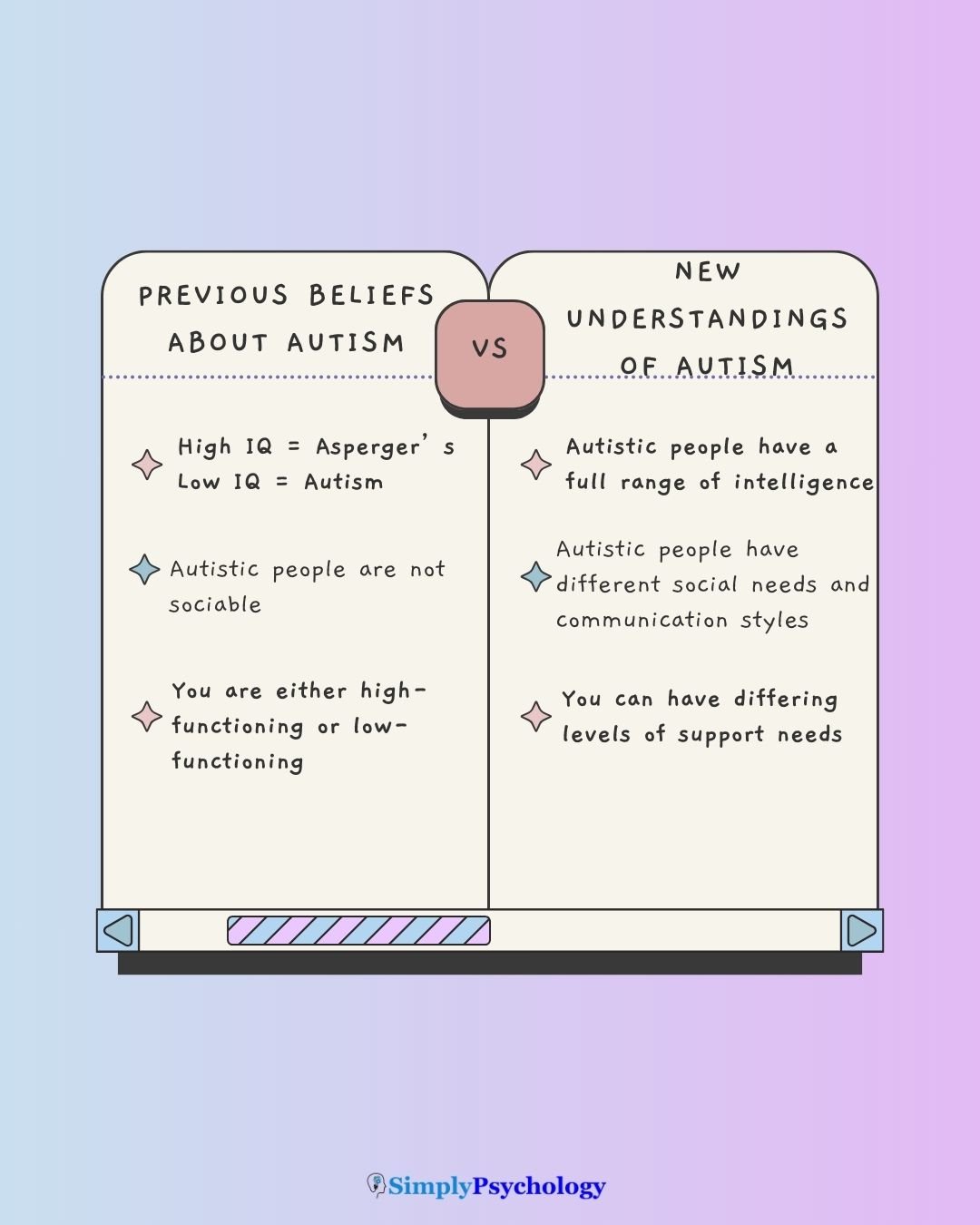
To understand where we are, we have to look at where we were. Previously, medical professionals viewed autism through a “deficit lens,” focusing only on what a person couldn’t do.
| Feature | Previous Belief (Asperger’s vs. Autism) | Modern Understanding (The Spectrum) |
| Language | Asperger’s had “normal” speech; Autism had delays. | Language is just one part of a spiky profile; it can change with age and stress. |
| Intelligence | Asperger’s required an average or above-average IQ; Autism was linked to lower IQ. | Autistic people have a full range of intelligence, just like neurotypical people. |
| Socializing | Asperger’s people “wanted” friends; Autistic people “didn’t.” | Everyone has social needs, but communication styles differ between neurotypes. |
| Functioning | You were either “High” or “Low” functioning. | Functioning labels are harmful; a person can be highly verbal but need 24/7 sensory support. |
As Dr. Megan Anna Neff suggests, these old distinctions often missed the “internalized” experience of many individuals. This was particularly true for women and girls. Clinicians frequently misdiagnosed them because they didn’t fit the narrow “Asperger’s” stereotype.
Large-scale evidence backs this up. Loomes, Hull, and Mandy (2017) pooled 54 prevalence studies covering over 13.7 million people to compare autistic boys and girls.
The overall ratio was 4.2 boys for every girl. It fell to 3.3 in the highest-quality studies. Studies that screened whole populations found 3.25 to 1, compared with 4.56 to 1 in studies that counted only people already diagnosed.
Their verdict: the true ratio is closer to 3 boys for every girl. Girls who meet the criteria are at disproportionate risk of never receiving a diagnosis.
Why We Don’t Say “Asperger’s” Anymore
While you might still hear people use the term Asperger’s, it is rapidly fading from use, and for very good reasons.
Beyond the medical changes, the autistic community has largely moved away from the term. Here is why:
- A Dark History: The label is named after Hans Asperger, a pediatrician in 1940s Vienna. Modern historical research revealed that he cooperated with the Nazi regime, separating autistic children into those who were “useful” to society and those who were sent to clinics where they were killed.
- The “High-Functioning” Myth: As Dr. Neff points out, labels like “high-functioning” (often tied to Asperger’s) are deeply harmful. They dismiss the very real internal struggles, sensory overload, and burnout that these individuals face daily.
- It Divides the Community: Using a separate label creates an “us vs. them” mentality. It implies that some autistic people are “better” or “more acceptable” than others.
What the Archives Show About Hans Asperger
The history behind that first point is well documented. Herwig Czech (2018) examined previously unexplored archival documents, including Asperger’s personnel files and the clinical assessments he wrote about his patients.
Czech found that Asperger accommodated himself to the Nazi regime and was rewarded with career opportunities.
He joined several organizations affiliated with the Nazi party and publicly backed “race hygiene” (Nazi eugenics) policies such as forced sterilization. He also cooperated actively with the child “euthanasia” program.
His diagnostic language was often remarkably harsh, even compared with assessments written by staff at Vienna’s notorious Spiegelgrund institution. That undermines the idea that he protected the children in his care.
Historian Edith Sheffer (2018), in Asperger’s Children, reached a similar conclusion from partly overlapping archives.
None of this means the clinical observations were invented. Later research, notably Wing’s, confirmed that the syndrome Asperger described was real.
Baker and Lang (2017) add that eugenic thinking about which children were “valuable” shaped early autism diagnosis well beyond Vienna. Czech (2018) concluded that any future use of the name should reflect its troubling origins.
Why Some Autistic People Still Use the Word
Not every autistic person has moved on from the word. Many adults were diagnosed with Asperger’s before 2013. For them, the label became part of how they understand themselves.
Seers and Hogg (2021) interviewed eight autistic women about being the “autistic other.” One described a doctor who dismissed her possible diagnosis because she had finished university: “I think if you finished university, you can’t have Asperger’s.”
Another participant explained why she still used the older term. In her words, “we’re wired differently, we communicate differently, we work differently, but I don’t think we’re as far as the Autism.”
Language preferences also vary. Kenny et al. (2016) surveyed 3,470 UK residents about the words they use for autism.
“Autistic” was widely endorsed by autistic adults, parents and family members, but by far fewer professionals. No single term was accepted by everyone.
That is why the guidance below puts personal preference first.
The “Spiky Profile” vs. The Linear Spectrum
One of the most important concepts in modern autism research is the spiky profile. Prof. Happé points out that we shouldn’t think of autism as a straight line from “mild” to “severe.” Instead, imagine a person has different “peaks” and “valleys” in their abilities.
- Peak: A person might have an incredible memory or a deep specialized interest in science.
- Valley: That same person might struggle deeply with “executive function” (like organizing a meal) or have intense sensory pain from loud noises.
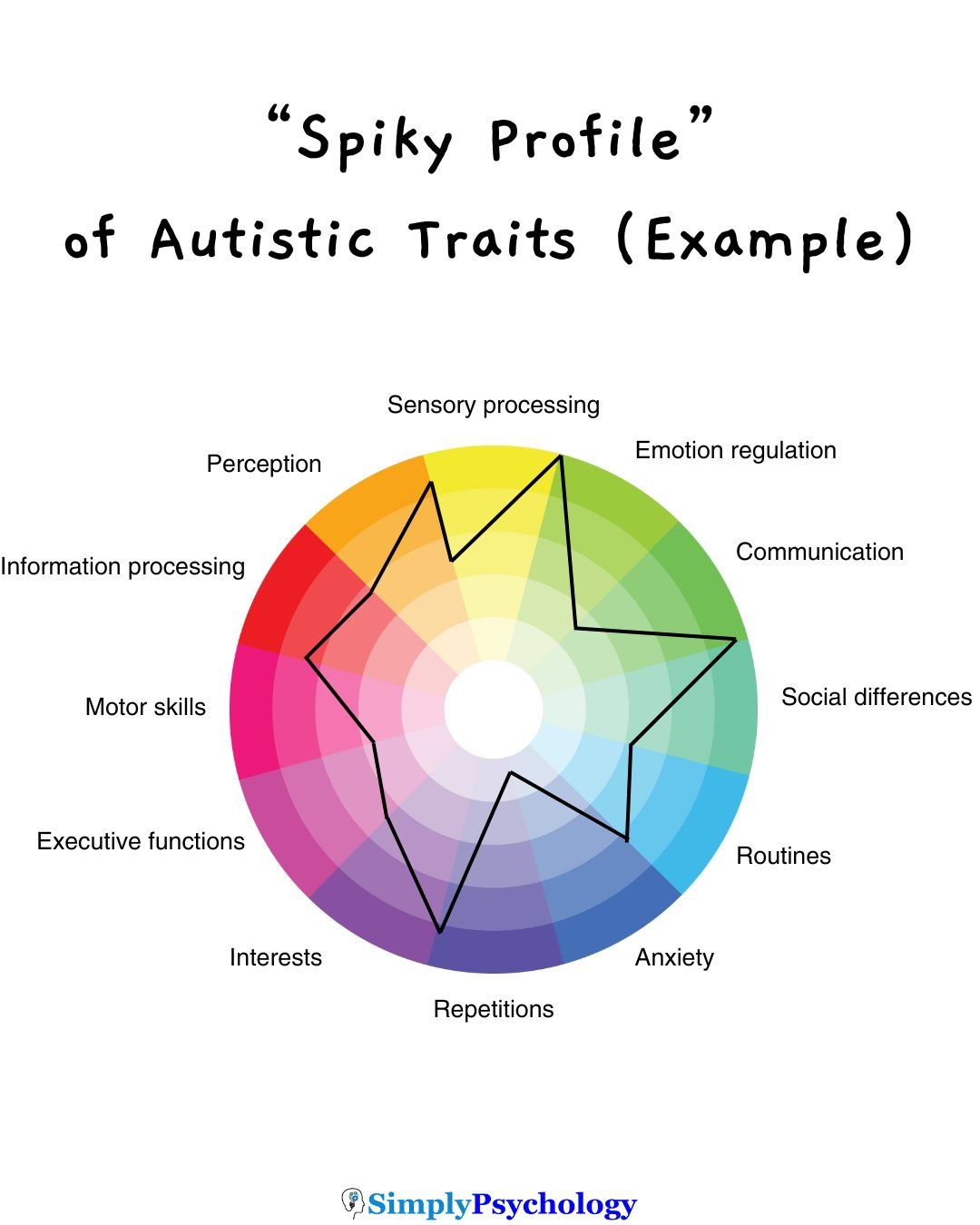
By using the unified term “Autism,” we acknowledge that a person’s ability to speak fluently doesn’t mean they aren’t struggling with other invisible challenges.
Research on theory of mind helps explain this. Theory of mind is the ability to understand that other people have their own beliefs and intentions.
Senju et al. (2009) compared two versions of a false-belief task, which tests whether someone understands that another person can hold a mistaken belief.
Adults with Asperger syndrome passed the version that asked them to reason it out. The automatic version told a different story.
Unlike typical adults, they showed no automatic eye-movement anticipation of the other person’s belief. In other words, many people with Asperger’s reached an understanding of others’ minds by reasoning rather than automatically.
That helps explain why fluent speech can sit alongside real difficulty. Fast, unscripted social situations are where it shows.
Dr. Luke Beardon, a senior lecturer in autism, often emphasizes that Autism + Environment = Outcome. If the environment is supportive, the “spiky” parts of the profile don’t have to lead to distress.
Moving Toward Neuroaffirming Language
The shift away from Asperger’s is also a step toward neurodiversity-affirming care. This perspective views autism as a natural variation of the human brain, an alternative neurotype, rather than a broken version of a “normal” brain.
The idea has a clear origin. In 1999, sociologist Judy Singer coined the term “neurodiversity” to describe autistic neurology as natural variation in human cognition, not a deviation from a normal baseline (Singer, 1999). It is now known as the neurodiversity paradigm.
Survey evidence supports this view. Kapp et al. (2013) asked 657 autistic people, relatives, friends and others how they saw autism and neurodiversity.
Autistic people and those aware of neurodiversity were more likely to see autism as a positive identity that needs no cure. Yet all groups recognized its negative aspects. Seeing autism as a difference does not mean denying real difficulty.
Dr. Neff and other experts advocate for language that respects the individual’s identity. This includes:
- Using identity-first language (e.g., “autistic person”) if that is the person’s preference.
- Focusing on support needs rather than “functioning labels.”
- Validating sensory experiences as real physical events, not “behavioral issues.”
As Steve Silberman, author of NeuroTribes, notes, reclaiming the word “Autism” helps build a broader community where everyone, regardless of their specific traits, can find belonging and shared understanding.
For some people, though, the Asperger’s label brought relief. As writer and engineer John Elder Robison describes in his memoir Look Me in the Eye: My Life with Asperger’s (2007), he grew up in the 1960s.
Teachers and peers saw him as an odd, difficult child. That was decades before the diagnosis existed.
He was diagnosed at forty, after his own child received the same diagnosis. Robison has called it a transformative moment of self-understanding, reframing social difficulty he had long put down to personal failure.
This is one person’s account, not a claim about how everyone diagnosed with Asperger’s feels.
Conclusion: A More Accurate Future
The transition from Asperger’s to the broader Autism Spectrum reflects a deeper, more compassionate understanding of human biology.
We now know that the boxes we created in the past were too small to hold the reality of autistic lives.
By focusing on the spiky profile and environmental fit, we move away from “fixing” people and toward accommodating them.
Next Steps for Learning
If you or a loved one are navigating a new diagnosis or moving away from an old label, consider these actions:
- Audit Your Language: Start replacing “high/low functioning” with “low/high support needs” in specific areas (e.g., “I need high support with sensory environments”).
- Explore Your Spiky Profile: Map out where your strengths lie and where you encounter “friction” in your daily life.
- Connect with Autistic-Led Resources: Follow experts who share the lived experience of being autistic, such as the Neurodivergent Insights platform or community-led podcasts.
- Prioritize Sensory Safety: Recognize that sensory overwhelm is not “anxiety,” but a biological response. Adjust your environment to reduce the “too-muchness” of the world.
References
American Psychiatric Association. (2013). Diagnostic and statistical manual of mental disorders (5th ed.). https://doi.org/10.1176/appi.books.9780890425596
American Psychiatric Association. (2022). Diagnostic and statistical manual of mental disorders (5th ed., text rev.).
Asperger, H. (1944). Die “Autistischen Psychopathen” im Kindesalter. Archiv für Psychiatrie und Nervenkrankheiten, 117, 76–136.
Baker, J. P., & Lang, B. (2017). Eugenics and the origins of autism. Pediatrics, 140(2), Article e20171419. https://doi.org/10.1542/peds.2017-1419
Barahona-Corrêa, J. B., & Filipe, C. N. (2016). A concise history of Asperger syndrome: The short reign of a troublesome diagnosis. Frontiers in Psychology, 6, Article 2024. https://doi.org/10.3389/fpsyg.2015.02024
Czech, H. (2018). Hans Asperger, National Socialism, and “race hygiene” in Nazi-era Vienna. Molecular Autism, 9, Article 29. https://doi.org/10.1186/s13229-018-0208-6
Kanner, L. (1943). Autistic disturbances of affective contact. Nervous Child, 2, 217–250.
Kapp, S. K., Gillespie-Lynch, K., Sherman, L. E., & Hutman, T. (2013). Deficit, difference, or both? Autism and neurodiversity. Developmental Psychology, 49(1), 59–71. https://doi.org/10.1037/a0028353
Katz, L., Nayar, K., Garagozzo, A., Schieszler-Ockrassa, C., & Paxton, J. (2020). Changes in autism nosology: The social impact of the removal of Asperger’s disorder from the Diagnostic and Statistical Manual for Mental Disorders, fifth edition (DSM-5). Journal of Autism and Developmental Disorders, 50(9), 3358–3366. https://doi.org/10.1007/s10803-019-04233-4
Kenny, L., Hattersley, C., Molins, B., Buckley, C., Povey, C., & Pellicano, E. (2016). Which terms should be used to describe autism? Perspectives from the UK autism community. Autism, 20(4), 442–462. https://doi.org/10.1177/1362361315588200
Loomes, R., Hull, L., & Mandy, W. (2017). What is the male-to-female ratio in autism spectrum disorder? A systematic review and meta-analysis. Journal of the American Academy of Child & Adolescent Psychiatry, 56(6), 466–474. https://doi.org/10.1016/j.jaac.2017.03.013
Robison, J. E. (2007). Look me in the eye: My life with Asperger’s. Crown Publishers.
Seers, K., & Hogg, R. C. (2021). “You don’t look autistic”: A qualitative exploration of women’s experiences of being the “autistic other.” Autism, 25(6), 1553–1564. https://doi.org/10.1177/1362361321993722
Senju, A., Southgate, V., White, S., & Frith, U. (2009). Mindblind eyes: An absence of spontaneous theory of mind in Asperger syndrome. Science, 325(5942), 883–885. https://doi.org/10.1126/science.1176170
Sheffer, E. (2018). Asperger’s children: The origins of autism in Nazi Vienna. W. W. Norton & Company.
Singer, J. (1999). “Why can’t you be normal for once in your life?” From a “problem with no name” to the emergence of a new category of difference. In M. Corker & S. French (Eds.), Disability discourse (pp. 59–67). Open University Press.
Volkmar, F. R., & McPartland, J. C. (2014). From Kanner to DSM-5: Autism as an evolving diagnostic concept. Annual Review of Clinical Psychology, 10, 193–212. https://doi.org/10.1146/annurev-clinpsy-032813-153710
Wing, L. (1981). Asperger’s syndrome: A clinical account. Psychological Medicine, 11(1), 115–129. https://doi.org/10.1017/S0033291700053332
World Health Organization. (2019). International statistical classification of diseases and related health problems (11th ed.). https://icd.who.int/

