Autism diagnoses have risen sharply since 2000. Most researchers think this mainly reflects broader criteria, greater awareness and better recognition of overlooked groups, not a large rise in autistic people.
The Centers for Disease Control and Prevention (CDC) have reported on the number of children diagnosed as autistic since the year 2000. It has found a marked increase in prevalence. (Please note these numbers come from samples of eight-year-olds in the United States only.)
In 2000, around 1 in every 150 children had an autism diagnosis. This rose to 1 in 44 children in 2018, then to 1 in 36 children in 2020.

Additionally, the CDC reported that significantly more Black and Hispanic children and those from various socioeconomic backgrounds had received a diagnosis. In the past, White children from higher socioeconomic status were more likely to be diagnosed as autistic.
Due to this increase in people receiving an autism diagnosis, there is this idea that autism is somehow on the rise, and many question why this is.
Is autism really increasing, or are there other contributing factors to explain the increase in diagnoses?
This article explores the potential reasons behind the observed increase in autism prevalence rates and addresses common misconceptions about the condition.
Key Takeaways
- Rising Counts: US surveillance shows diagnosed autism in eight-year-olds rising from about 1 in 150 in 2000 to 1 in 36 in 2020.
- Main Explanation: Most researchers attribute the rise mainly to broader criteria, greater awareness and better identification, not a large real increase in autistic people.
- Awareness: More people recognize autistic traits in themselves or loved ones, helped by online content from autistic people.
- Diagnostic Criteria: In 2013 the DSM-5, the main US diagnostic manual, merged autism, Asperger syndrome and related diagnoses into one spectrum diagnosis.
- Overlooked Groups: Girls, women, adults and people of color were underdiagnosed in the past, partly because masking hides autistic traits.
- Stigma: Greater acceptance, including from the neurodiversity movement, makes people more comfortable seeking a diagnosis.
- Open Question: Researchers cannot yet say how much each factor explains, because surveillance data alone cannot separate them.
Increased awareness
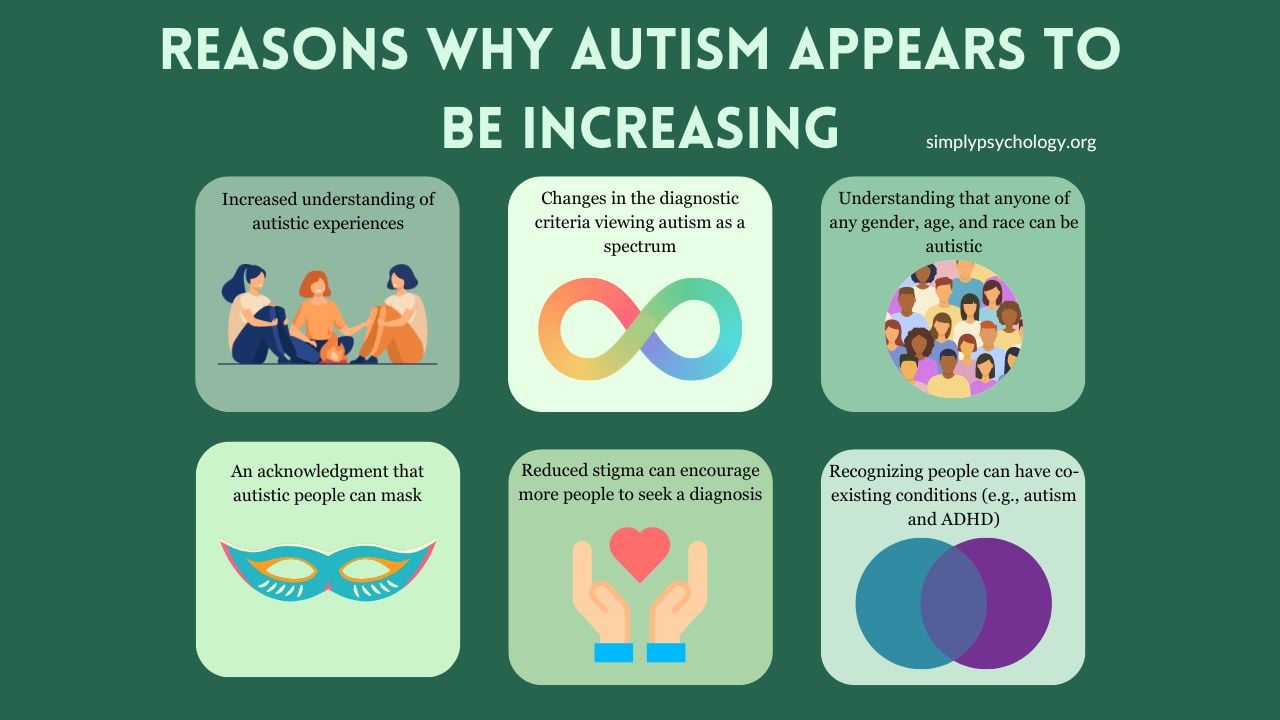
One of the biggest reasons for an increase in people diagnosed as autistic is that there is an increased understanding of autism.
This awareness may come from videos and online content from actual autistic people sharing their experiences. People may listen to these experiences and recognize similarities in traits, behaviors and challenges in themselves or loved ones.
This can result in more people seeking an autism diagnosis.
My own understanding of autism was limited up until a few years ago, and it is still something I am constantly learning about. I had a narrow idea in my mind about what autism looked like, and it was not something I particularly related to.

It wasn't until I started looking into other people's experiences and hearing real autistic voices that I realized how diverse autism is. I realized how much I actually relate to the traits.

The more I increased my understanding, the more things started to click into place. I decided to seek a diagnosis to find answers.
We also live in an age where we can easily research different conditions online – information that would have been harder to find before the internet. This ease of access to understanding autism can mean that more people know what it is and can relate to the traits.
Additionally, heightened public awareness educates parents, teachers, and caregivers about the diverse ways autism presents, enabling them to identify potential signs in children better. They may therefore refer more children for evaluation.
World Autism Awareness Day is a campaign on social media that has been shown to successfully increase awareness and positive sentiments about autism, according to one study.
Changes in diagnostic criteria
Advancements in diagnostic tools have led to better identification and recognition of individuals on the autism spectrum.
The most recent diagnostic criteria have been expanded to encompass more traits and differences in behavior to address how varied autism can present. This change has led to the inclusion of individuals who have lower support needs who may have previously gone undiagnosed.
Counting methods have changed as well. Early surveys were simple head counts of children already diagnosed with severe presentations in small areas. They found 0.4 to 2 cases per 1,000 (Fombonne, 2018).
Modern surveys use large populations and screening, but methods are not standardized, so comparing studies across decades is risky.
Consider someone who lives independently and works full time. They can still meet the criteria for autism.
Such a person may seem to manage most parts of daily life without difficulty. They may still have characteristics like these:
- Social differences: They may read social situations and cues differently from non-autistic people, which can cause misunderstanding in both directions (the double empathy problem; Milton, 2012).
- Sensory sensitivity: They may be sensitive to certain sensory experiences.
- Repetitive patterns: They may have restricted, repetitive patterns of behavior.
The image below, while not official, provides a useful visual for how traits of autism can vary on a personal level.

Likewise, the DSM-5 (American Psychiatric Association, 2013) folded autism, Asperger syndrome, and pervasive developmental disorder not otherwise specified (PDD-NOS) into one diagnosis, “autism spectrum disorder.” People diagnosed under those labels would now be considered autistic.
The DSM-5 also merged the older three-part “triad of impairments” into two domains: social communication and interaction, and restricted, repetitive behavior. Social and communication difficulties rarely separate in practice, so a single domain matched how they cluster.
The DSM-5-TR (American Psychiatric Association, 2022) adds support levels. They run from Level 1, “requiring support,” to Level 3, “requiring very substantial support.”
So, while autism may seem more common these days, its definition has changed over the decades. There is more than one way to be autistic.
Inclusion of Underrepresented Groups
In the past, autism was primarily viewed as something affecting white boys, largely due to early research that focused on studying autism in these populations.
This narrow understanding informed the diagnostic criteria. It led to a significant underrepresentation of autistic people who are female, non-white, or gender diverse.
However, our understanding of autism has evolved. It has become clear that autism exists in any type of individual. This expanded knowledge has led to an increase in diagnoses among previously overlooked populations, particularly in females and adults.
Growing up as a girl with undiagnosed autism, I always had this nagging feeling that there was something different with me that I couldn't put my finger on.

I was always quiet and felt lost in social situations. This became more apparent as a teenager, when girls would typically hang out in groups and socialize a lot more.

I was watching my peers 'master' social situations and wondered why it didn't come naturally to me. Realizing I am autistic as an adult has been helpful in answering many of the questions I had as a child.
How the Male-to-Female Ratio Is Changing
Historical studies have estimated the ratio of autistic males to females to be anywhere from 2:1 to 16:1.
Part of the gap reflects who gets referred. A 2017 meta-analysis of 54 studies found a pooled ratio of 3:1 (Loomes et al., 2017). Studies that screened whole populations, rather than relying on clinical referrals, reported smaller gaps.
A major 2026 Swedish study followed more than 2.7 million people born between 1985 and 2020 (Fyfe et al., 2026). The male-to-female ratio fell with age at diagnosis.
By 2022, the cumulative ratio by age 20 was 1.2, and the authors suggest it may no longer be distinguishable in adulthood. They call for research into why girls and women are diagnosed later than boys and men.
Acknowledgment of masking
As our understanding of autism has grown, so has our recognition of masking behaviors among autistic individuals. Masking refers to strategies used to hide or suppress autistic traits to fit in with neurotypical expectations and avoid stigma.
Recognizing masking has contributed to an apparent rise in diagnoses. This is most noticeable among groups previously overlooked or misdiagnosed, such as girls, women, people of color, and transgender individuals.
These groups may be more likely to mask because of societal pressures and norms. This led to underdiagnosis in the past.
Autistic individuals with low support needs may mask more effectively. This can lead to delayed or missed diagnoses.
Understanding what it means to mask autism is what propelled me to seek a diagnosis. I always felt like I was hyper-aware of my facial expressions and body language in social situations. I often felt like I was putting on a performance and pretending to be 'normal'.
Professionals are getting better at spotting masking. More accurate and timely diagnoses follow, contributing to the apparent rise in autism prevalence.
What Masking Costs
Researchers can now measure camouflaging. The Camouflaging Autistic Traits Questionnaire (CAT-Q) has subscales for compensation, masking and assimilation (Hull et al., 2019).
Qualitative research shows the personal cost. In a study of social camouflaging in autistic adults (Hull et al., 2017), one participant said, “I’m hiding behind what I want people to see.”
Another described the longer-term cost to mood and identity: “the weight of a black cloud is hanging on me having to be this fake version of me.”
A third found it tiring: “It’s exhausting! I feel the need to seek solitude so I can ‘be myself.'”
These are individual participants’ words. Some autistic people mask far less. Others find adapting their presentation useful.
Reduced stigma
While stigma is still prevalent, in the past, autism was often highly stigmatized as a disorder that burdened individuals and society. This negative perception may have led many people to feel ashamed or hesitant to seek a diagnosis.
However, the neurodiversity movement has helped shift perspectives toward acceptance and understanding of autism as a neurological difference.
Language matters here. Autistic scholars and advocates caution against calling the rise an “epidemic,” because that word presents a change in diagnostic practice as a disease outbreak. They suggest describing autism as increasingly recognized and diagnosed (Bottema-Beutel et al., 2021).
Society is becoming more accepting, and stigma is diminishing. This creates a more supportive environment where individuals feel comfortable seeking a diagnosis and identifying as autistic.
Acceptance has likely contributed to the apparent rise in diagnoses. As more people feel comfortable seeking help and identifying as autistic, the true prevalence of autism becomes more apparent.
A couple of times when I have expressed to people that I think I may be autistic (before I received a diagnosis), I have had disbelieving comments. One was, "I really don't think you are."

Other times, people acted as if I had told them terrible news, such as "Oh no! Why do you think that?" It can feel disheartening to receive these types of comments when autism is not a death sentence.
Recognizing co-existing conditions
Before 2013, earlier editions of the DSM did not allow a diagnosis of both autism and attention deficit hyperactivity disorder (ADHD). The two were considered opposing conditions.
Now, it is understood that there are many overlapping autistic and ADHD traits and that it is common to have both.
It is unclear precisely how common it is, but a 2022 scientific literature review suggests 50-70% of autistic individuals may have co-occurring ADHD.
The overlap is not limited to ADHD. In a UK population-derived sample, Simonoff et al. (2008) found that over 70% of autistic children met criteria for at least one co-occurring psychiatric condition.
The most common were social anxiety disorder, ADHD, oppositional defiant disorder and specific phobias. Almost half met criteria for two or more.
So emotional or behavioral difficulties should not automatically be put down to autism alone.
Because of this, there are now individuals who have ADHD who have also sought an autism diagnosis, when they would not have been able to do this before. This has possibly contributed to the increased prevalence of people being diagnosed as autistic.
Conclusion and Implications
To summarize, the core reason that autism appears to be ‘increasing’ is mostly due to our understanding of autism increasing rather than the actual number of autistic people increasing.
Researchers still cannot say exactly how much each factor contributes. Surveillance data alone cannot separate broader criteria, greater awareness, more screening and better identification of overlooked groups from any real change in how many people are autistic.
It might just be that autism is not as rare as was once believed, and perhaps this will be reflected in future editions of the diagnostic criteria going forward.
More people are being diagnosed even well into adulthood, which suggests that autism is not a new thing.
Clinicians described autism as far back as the 1940s. Kanner (1943) in the United States and Asperger (1944) in Austria each published accounts of autistic children, independently of each other.
If we hear stories about our grandparents and great-grandparents that describe similar traits and experiences of autistic people, it is very possible they could have also been autistic.
We just have a better understanding these days!
The increased autism prevalence has significant implications for society, highlighting the need for more resources, support services, and accommodations in schools and workplaces.
Demand for specialist assessment has risen, producing long waiting lists in many public health systems.
It has also directed attention to groups that diagnostic pathways have historically under-served: girls, women, adults, and autistic people without a co-occurring intellectual disability. Their needs might otherwise go unrecognized for years.
Embracing neurodiversity is crucial in accepting autism as a neurological difference rather than a disorder.
As we move forward, raising awareness, promoting acceptance, and advocating for the rights of autistic individuals is essential.
By creating a more inclusive society, we can ensure that all individuals, regardless of their neurological differences, have the opportunity to thrive and contribute their unique talents to the world.
References
Ahmed, W., Bath, P. A., Sbaffi, L., & Demartini, G. (2018). Measuring the effect of public health campaigns on Twitter: the case of World Autism Awareness Day. In Transforming Digital Worlds: 13th International Conference, iConference 2018, Sheffield, UK, March 25-28, 2018, Proceedings 13 (pp. 10-16). Springer International Publishing. https://doi.org/10.1007/978-3-319-78105-1_2
American Psychiatric Association. (2013). Diagnostic and statistical manual of mental disorders (5th ed.). https://doi.org/10.1176/appi.books.9780890425596
American Psychiatric Association. (2022). Diagnostic and statistical manual of mental disorders (5th ed., text rev.). https://doi.org/10.1176/appi.books.9780890425787
Asperger, H. (1944). Die “Autistischen Psychopathen” im Kindesalter. Archiv für Psychiatrie und Nervenkrankheiten, 117(1), 76–136. https://doi.org/10.1007/BF01837709
Bottema-Beutel, K., Kapp, S. K., Lester, J. N., Sasson, N. J., & Hand, B. N. (2021). Avoiding ableist language: Suggestions for autism researchers. Autism in Adulthood, 3(1), 18–29. https://doi.org/10.1089/aut.2020.0014
Fombonne, E. (2018). The rising prevalence of autism [Editorial]. Journal of Child Psychology and Psychiatry, 59(7), 717-720. https://doi.org/10.1111/jcpp.12941
Fyfe, C., Winell, H., Dougherty, J., Gutmann, D. H., Kolevzon, A., Marrus, N., Tedroff, K., Turner, T. N., Weiss, L. A., Yip, B. H. K., Yin, W., & Sandin, S. (2026). Time trends in the male to female ratio for autism incidence: population based, prospectively collected, birth cohort study. BMJ, 392, Article e084164. https://doi.org/10.1136/bmj-2025-084164
Hours, C., Recasens, C., & Baleyte, J. M. (2022). ASD and ADHD comorbidity: What are we talking about? Frontiers in Psychiatry, 13, 837424. https://doi.org/10.3389/fpsyt.2022.837424
Hull, L., Mandy, W., Lai, M.-C., Baron-Cohen, S., Allison, C., Smith, P., & Petrides, K. V. (2019). Development and validation of the Camouflaging Autistic Traits Questionnaire (CAT-Q). Journal of Autism and Developmental Disorders, 49(3), 819–833. https://doi.org/10.1007/s10803-018-3792-6
Hull, L., Petrides, K. V., Allison, C., Smith, P., Baron-Cohen, S., Lai, M.-C., & Mandy, W. (2017). “Putting on my best normal”: Social camouflaging in adults with autism spectrum conditions. Journal of Autism and Developmental Disorders, 47(8), 2519–2534. https://doi.org/10.1007/s10803-017-3166-5
Hull, L., Petrides, K. V., & Mandy, W. (2020). The female autism phenotype and camouflaging: A narrative review. Review Journal of Autism and Developmental Disorders, 7, 306-317. https://doi.org/10.1007/s40489-020-00197-9
Kanner, L. (1943). Autistic disturbances of affective contact. Nervous Child, 2, 217–250.
Lai, M. C., Lombardo, M. V., Ruigrok, A. N., Chakrabarti, B., Auyeung, B., Szatmari, P., … & MRC AIMS Consortium. (2017). Quantifying and exploring camouflaging in men and women with autism. Autism, 21(6), 690-702. https://doi.org/10.1177/1362361316671012
Loomes, R., Hull, L., & Mandy, W. P. L. (2017). What is the male-to-female ratio in autism spectrum disorder? A systematic review and meta-analysis. Journal of the American Academy of Child & Adolescent Psychiatry, 56(6), 466–474. https://doi.org/10.1016/j.jaac.2017.03.013
Maenner, M. J., Warren, Z., Williams, A. R., Amoakohene, E., Bakian, A. V., Bilder, D. A., Durkin, M. S., Fitzgerald, R. T., Furnier, S. M., Hughes, M. M., Ladd-Acosta, C. M., McArthur, D., Pas, E. T., Salinas, A., Vehorn, A., Williams, S., Esler, A., Grzybowski, A., Hall-Lande, J., … Shaw, K. A. (2023). Prevalence and characteristics of autism spectrum disorder among children aged 8 years—Autism and Developmental Disabilities Monitoring Network, 11 sites, United States, 2020. MMWR Surveillance Summaries, 72(2), 1–14. https://doi.org/10.15585/mmwr.ss7202a1
Milton, D. E. M. (2012). On the ontological status of autism: The ‘double empathy problem’. Disability & Society, 27(6), 883–887. https://doi.org/10.1080/09687599.2012.710008
Pearson, A., & Rose, K. (2021). A conceptual analysis of autistic masking: Understanding the narrative of stigma and the illusion of choice. Autism in Adulthood, 3(1), 52-60. https://doi.org/10.1089/aut.2020.0043
Simonoff, E., Pickles, A., Charman, T., Chandler, S., Loucas, T., & Baird, G. (2008). Psychiatric disorders in children with autism spectrum disorders: Prevalence, comorbidity, and associated factors in a population-derived sample. Journal of the American Academy of Child & Adolescent Psychiatry, 47(8), 921–929. https://doi.org/10.1097/CHI.0b013e318179964f
Strang, J. F., Powers, M. D., Knauss, M., Sibarium, E., Leibowitz, S. F., Kenworthy, L., … & Anthony, L. G. (2018). “They thought it was an obsession”: Trajectories and perspectives of autistic transgender and gender-diverse adolescents. Journal of Autism and Developmental Disorders, 48, 4039-4055. https://doi.org/10.1007/s10803-018-3723-6