Remote work represents a paradigm shift for individuals with Attention-Deficit/Hyperactivity Disorder (ADHD).
While home environments offer a sanctuary from sensory overload, they also remove the external scaffolding that many ADHD brains require to function.
Understanding this balance is essential for occupational success.

The Sensory and Social Advantages of the Home Office
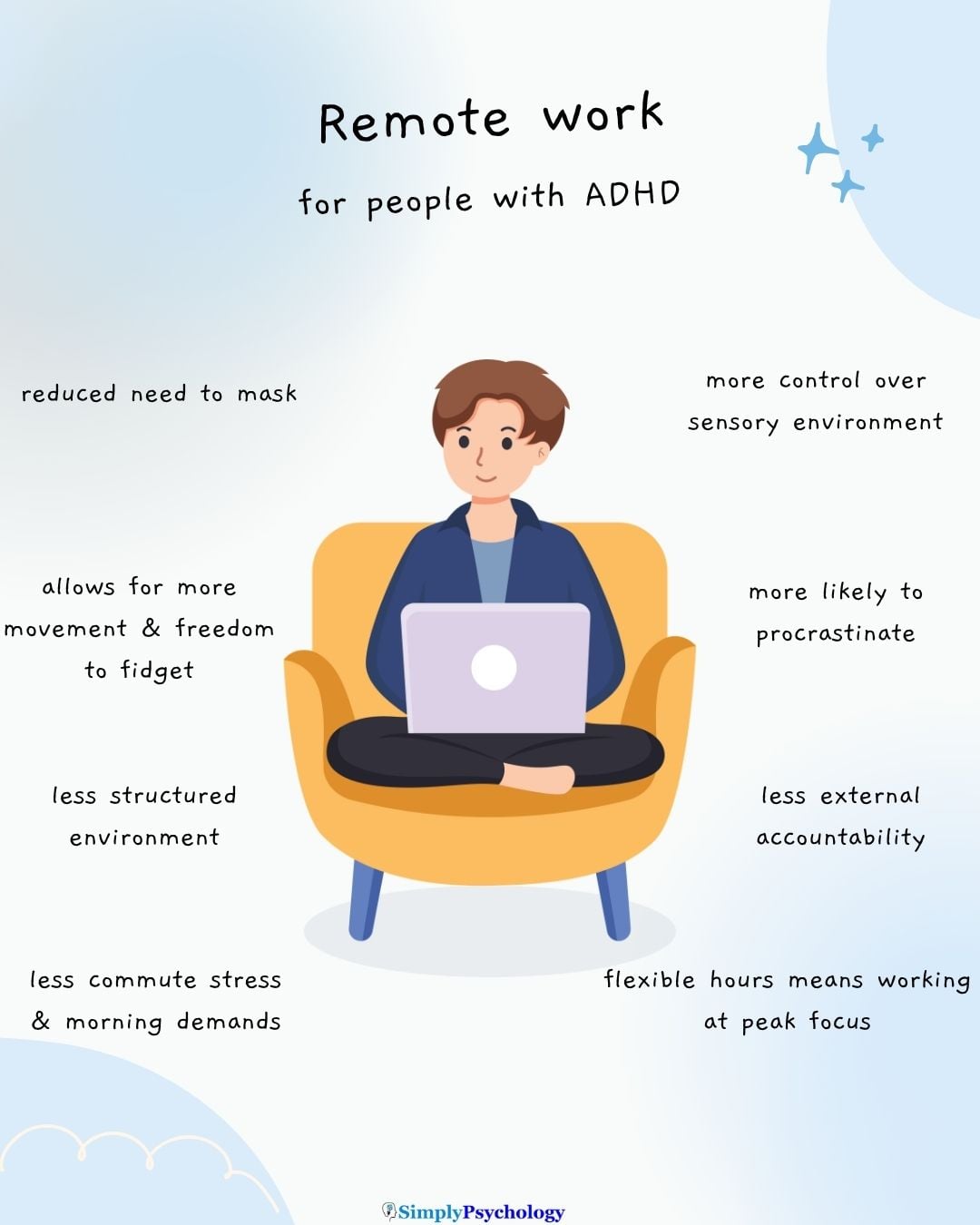
Working from home serves as a vital clinical accommodation by mitigating sensory overstimulation.
Sensory overstimulation occurs when the brain receives more information from its senses than it can process.
Traditional offices often present “sensory nightmares” involving fluorescent lighting and ambient noise. These factors trigger the stress response in neurodivergent individuals.
By working remotely, employees gain total environmental control. They can adjust lighting, manage acoustics, and eliminate the “masking” required in social settings.
Masking refers to the conscious or unconscious suppression of natural neurodivergent traits to fit social norms, which can be amplified in workspace environments, resulting in exhaustion and burnout.
Preservation of Cognitive Energy
Remote environments preserve the “executive fuel tank” by removing the logistical tax of commuting.
Executive functions are the mental processes that enable us to plan, focus, and multitask. For those with ADHD, the simple act of preparing for an office day can deplete these resources before work begins.
Hybrid or fully remote models prevent the cumulative burnout often seen in traditional settings.
Burnout is a state of emotional, physical, and mental exhaustion caused by excessive and prolonged stress.
Individuals can utilize their peak focus periods more effectively when they are not bound by rigid office hours.
The Risks of Autonomy and Executive Dysfunction
The absence of external structure can paradoxically impair performance due to a lack of immediate consequences.
ADHD is fundamentally a disorder of performance rather than knowledge. This means individuals often know what to do but cannot execute the task at the “point of performance.”
The point of performance is the exact time and place where a person must use their skills to complete a task.
Without the “chaos” or pressure of an office, the ADHD brain may struggle to initiate tasks. This results in task paralysis or significant time-consuming distractions.
Physical Stagnation and Time Blindness
Remote work increases the risk of time blindness and physical inactivity.
Time blindness is the inability to sense the passage of time accurately. An individual may sit in one position for hours, unaware that the day has vanished.
This stagnation often leads to emotional dysregulation. Emotional dysregulation is an inability to manage emotional responses within a typical range of intensity.
Furthermore, prolonged isolation can cause a regression in social skills. This “shrinking world” effect makes eventual re-entry into social spaces highly anxiety-inducing.
Expert insights: Dr Russell Barkley
Dr. Russell Barkley, a leading expert in ADHD asserts that individuals must artificially engineer their environments to compensate for inherent executive deficits when working in self-directed settings.
The ADHD brain struggles to bridge the gap between knowing a task and actually executing it without immediate external consequences.
Barkley advocates for the implementation of high-frequency social accountability to serve as a “proxy frontal lobe,” which provides the necessary stimulation the internal prefrontal cortex fails to generate.
By checking in with a colleague or coach multiple times daily, the worker creates “skin in the game” that transforms abstract deadlines into urgent, manageable actions.
This structural scaffolding effectively bypasses the motivation deficit, ensuring that productivity remains consistent even in the absence of a traditional office hierarchy.
Practical Strategies for Remote Success
Successful remote work for ADHD individuals requires externalizing time and memory into the physical environment.
Body Doubling and Social Scaffolding
Implementing “body doubling” is one of the most effective strategies for breaking through executive dysfunction.
Body doubling is a productivity technique where another person works alongside you to improve your focus. This can be done in person or via online platforms like some “Study With Me” YouTube videos.
The presence of another person creates a collaborative “energy exchange.” This subtle pressure helps overcome demand avoidance (internal resistance to following instructions or meeting expectations).
Environmental Engineering and Movement
Integrating movement into the workday helps replenish the brain’s executive resources. Tools like “walking pads” or under-desk treadmills allow for physical activity during meetings.
Additionally, using visual timers helps combat time blindness. This allows the individual to physically see how much time remains for a specific task.
Task and Perfectionism Management
Managing perfectionism is crucial to prevent “over-researching” and missed deadlines.
Individuals should break work into small, manageable quotas rather than viewing a project as a single unit.
Use visible reminders like sticky notes or a second monitor dedicated solely to the weekly agenda.
Keeping goals in the direct visual field prevents the “out of sight, out of mind” phenomenon common in ADHD.