When emotions become too much
Emotional dysregulation is a common sign of ADHD defined as the reduced ability to control emotions and related behaviors arising from those emotions.
People with ADHD tend to have more frequent and intense emotional reactions compared to others. They may feel emotions very strongly or have difficulty calming down once emotionally aroused.
Not everyone with ADHD experiences this.
It is estimated that 30% to 70% of adults who have ADHD and 25% to 45% of children with the disorder have significant emotion dysregulation. Many others do not reach that level.
Behaviors linked to regulation struggles range from worry and fatigue to drops in productivity and self-esteem.

Dr Russell Barkley, a Clinical Psychologist who focuses on ADHD, has stated the following:
‘The emotion that an individual experiences would come up very quickly, much more strongly than in others, because they are not suppressing and inhibiting and moderating it… it’s especially problematic with the negative emotions of impatience, frustration, hostility, anger…’
Examples of Emotional Dysregulation in ADHD
Someone with ADHD may feel heightened emotional sensitivity. They react intensely, perhaps with anger or frustration, to a situation that others might see as a minor inconvenience.
For example, imagine your friend cancels on you last minute. Someone who regulates their emotions easily may feel disappointed but texts back, ‘Ok, no worries. Let’s plan something for another time.’ Then they move on with their day.
However, someone with ADHD and difficulties regulating emotions may feel intense disappointment, anger, and even rejection. They may impulsively send a lengthy accusatory text expressing their annoyance at their friend.
The sequence can go differently at four points, each covered in more detail below:
- First response: Frustrating tasks provoke more negative affect and temper outbursts in children diagnosed with ADHD than in comparison children (Shaw et al., 2014).
- Calming down: Young adults diagnosed with ADHD described replaying an upsetting event long after others had moved on (Ginapp et al., 2023).
- Turning attention away: In laboratory tasks that require looking past emotional content, the existing performance gap widened in ADHD (Shaw et al., 2014).
- A fitting second emotion: The research reviewed here did not measure this step on its own, so descriptions of it rest on clinical accounts.
Why Do People with ADHD Struggle with Emotion Regulation?
Individuals with ADHD often face challenges in regulating their emotions due to several factors related to the disorder’s core characteristics:
- Impulsivity: The impulsive nature of ADHD can lead to quick, intense emotional reactions before the person has a chance to process and modulate their response.
- Executive function deficits: ADHD affects executive functions, including impulse control and emotional self-regulation.
- Inhibitory control difficulties: Research suggests that problems with inhibitory control in ADHD can make it harder to suppress strong emotional responses.
- Attention issues: Difficulty shifting attention away from emotional stimuli can prolong and intensify emotional experiences.
Executive function is only part of the picture. In one sample of boys, response inhibition accounted for 11% of the variance in dysregulated behavior during a frustrating task.
In a study of 424 children diagnosed with ADHD and their siblings, ADHD symptom severity almost entirely explained the links between thinking-skills tests and emotional lability (Shaw et al., 2014). Attention to emotional cues and amygdala-prefrontal circuitry have also been proposed. None accounts for the whole pattern alone.
Additionally, people who have ADHD may develop maladaptive cognitions, or negative thought patterns, over time. These often follow experiences of perceived failure or negative feedback.
In a comparison of 299 adults diagnosed with ADHD and 122 without, the ADHD group reported more automatic negative thoughts. They also reported more anxiety and depression symptoms and lower psychological quality of life (Pan et al., 2023). That study measured anxiety and depression, not emotion regulation.
In 213 newly diagnosed adults, dysregulation was most strongly tied to problems with self-concept (Hirsch et al., 2018).
Both studies were cross-sectional, so neither can show whether low self-worth feeds dysregulation, the reverse, or both.
Emotion dysregulation is common in ADHD but not universal. Difficulty varies widely, and many people who have ADHD develop effective strategies with proper support and treatment.
Some people who have ADHD describe the opposite. In a focus-group study of 43 young adults diagnosed with ADHD, three participants said they did not experience intense emotion because of their ADHD (Ginapp et al., 2023).
As one explained, attention that moves on quickly meant something that bothered them in the moment was soon forgotten. Their accounts are a reminder that ADHD does not give everyone the same emotional life.
Signs of Emotional Dysregulation in ADHD
Emotion dysregulation in ADHD can manifest in various ways, including:
- Heightened emotional sensitivity, where individuals react more intensely to both positive and negative stimuli
- Difficulty self-soothing or calming down after experiencing intense emotions
- Problems refocusing attention away from strong emotions
- In some cases, emotional detachment as a coping mechanism for overwhelming feelings
Discussion of these and other signs are below:
Emotional sensitivity
Individuals with ADHD may react more intensely to both positive and negative stimuli. For example, a minor problem can lead to disproportionally heightened levels of frustration, or similarly, a small achievement can trigger excessive excitement.
“I equated it to feeling like living without skin – it’s everything just pricks a little harder or hurts a little more and I do feel that this is something that I relate to.”
Ardelle
This can lead to mood swings and impulsivity in emotional reactions, making it challenging to maintain emotional stability.
For example, you get positive feedback at work and subsequently shout in happiness in the office instead of having a more controlled reaction to the good news.
Sensitivity to rejection and arguments is also common. Some people have a negativity bias and interpret ambiguous situations for the worse instead of viewing them from a neutral lens.
Increased sensitivity to perceived rejection or criticism can also happen, potentially leading to emotional distress in social situations.
Difficulty self-regulating primary emotional response
Difficulty in self-regulating primary emotional responses can be directly linked with impulsivity reactions, with outbursts and on-the-spot-made decisions being the frequent default reaction.
For example, a student with ADHD struggles with homework. They become increasingly frustrated with a difficult piece. As a result, they shout in anger, slam the textbook and give up on completing their work.
Their anger is more intense and disruptive than the situation warrants. That makes it hard to finish the task.
This can also happen for positive emotional responses as well, e.g., receiving a gift and yelling loudly out of heightened excitement.
“I’m very emotionally volatile. Something will happen and it’ll be like, this is literally the best day ever or something else will happen and I’ll just be so sad that I cannot stop crying for five hours. And it’s very little things that set me off.”
From Ginapp et al. (2023).
Difficulties self-soothing
People with ADHD may find it hard to calm down after experiencing intense emotions. This emotional overwhelm can then make it hard to focus and relax.
If it is a difficult emotion, such as stress or frustration, it may linger a lot longer than for neurotypical people.
For example, you had an argument with your partner. The issue has since been resolved. Even so, you struggle to calm down. You keep replaying everything in your head, and your heart is still beating quickly.
Such persistence in emotional distress can have severe consequences in day-to-day functioning with a direct impact on both emotional and psychological states.
“When I become so stressed that I can’t do anything, then I lie down and stop caring and I feel like I’m a failure.”
From Öster et al. (2020).
These self-soothing challenges can have a particularly negative impact on people who have both ADHD and have experienced a traumatic event.
Difficulty organizing and executing appropriate secondary emotions
Difficulty organizing and executing appropriate secondary emotions is linked to moving from the initial emotional response to a secondary, more socially appropriate emotion.
This shift can be tricky for people who have ADHD. They may struggle to curb their initial impulsive reaction, calm down, reassess the situation and respond thoughtfully.
For example, your partner expresses dislike for something you have done. You immediately feel a big influx of frustration and anger. It becomes difficult to have a level-headed discussion and resolve the issue.
You can think of it as emotionally dominant reactivity and logically dominant reactivity fighting for the wheel. More often than not, due to executive function difficulties, emotional reactivity takes precedence.
“I worry that my emotions are too intense for other people … I perceive myself as being exhausting to others. But maybe I’m just exhausted with myself because it’s exhausting being in my brain.”
‘Alex’
Consequently, such difficulties can directly affect social interactions with others, as people with ADHD may struggle to convey their feelings effectively.
People may thus find this difficulty in organizing emotions challenging to deal with, leading to less intent to socialize with others.
Problems refocusing attention away from strong emotions
Maintaining attention and concentration for prolonged periods of time is a commonly shared experience for people with ADHD.
Add a strong emotional reaction, and refocusing gets harder.
For example, someone gets chastised at work for missing a deadline. This yields intense frustration and sadness, and the person is left emotionally frozen, unable to return to a relaxed baseline and proceed with their work.
“(describing an experience with being rejected) It’s literal pain for me. I literally feel it in my chest and it hurts. I’ll sit and think about it for an extremely long time and nit-pick it and replay it over and over again.”
From Ginapp et al. (2023).
Emotional detachment
Emotional detachment can manifest as a coping mechanism for all the aforementioned struggles.
Some people who have ADHD may therefore withdraw completely. This minimizes exposure to potential triggers and helps them regain a sense of control.
For example, someone close to you is going through a breakup, and your friends get together to offer support.
You might appear disinterested or emotionally distant even when you genuinely care. From the outside, that can look like indifference. Or you might remain silent even if you want to comment or contribute.
“I don’t deal with anger outbursts. I don’t really feel like I’m emotionally reactive in a flamboyant or extreme way. I feel it’s a lot of internal stuff for me.”
Ardelle
Detachment is not always visible from outside. In focus groups with young adults, participants described several patterns (Ginapp et al., 2023).
- Calm on the surface: One participant likened looking calm while feeling a great deal inside to a duck whose feet paddle hard under the water.
- Delayed overwhelm: Some felt little at the time and were overwhelmed hours later, perhaps in bed that night.
- Trouble naming feelings: Some found it hard to say what they felt, which added to frustration or self-blame. This is called alexithymia.
These patterns, and the effort of hiding intense feeling, often called masking, are easy to miss if dysregulation is pictured only as visible outbursts.
Reduced expressiveness and emotional detachment can make it harder to connect with others on an emotional level. They can also make it harder to process emotions in a healthy way. Both matter for building long-lasting, meaningful connections.
It can thus be easy for relationships, both romantic and platonic, to get damaged because of it.
Consequently, one’s social life can be reduced, romantic partners may be difficult to reach and maintain, and family relationships can begin to strain if frequent friction points arise.
Researchers cannot yet say whether a calm surface reflects suppression, shutdown or slow processing. The research on suppression itself is mixed. A systematic review of 22 adult studies found that some reported more suppression in adults diagnosed with ADHD, while another did not.
The same review concluded that adults diagnosed with ADHD use non-adaptive regulation strategies more often overall, while stressing that the studies were few and varied (Soler-Gutiérrez et al., 2023).
Is Emotional Dysregulation a Core Symptom of ADHD?
Not officially. Emotional dysregulation is not one of the 18 symptoms used to diagnose ADHD. The current diagnostic manual names it only as a common accompanying feature. Researchers still debate whether it should count as a defining feature.
The idea is not new. Shaw et al. (2014) trace its history:
- Early description: Still described the “morbid excitability” of children with what is now called ADHD.
- Minimal brain damage: In this early concept of the disorder, emotional dysregulation ranked above inattention among the cardinal symptoms.
- Third edition of the manual: Emotional symptoms became an “associated feature” rather than a diagnostic criterion.
The modern argument partly asks to reverse a classification decision. It is not a call to discover a new symptom.
What the Diagnostic Manual Says
The current text revision of the diagnostic manual does not list emotional dysregulation among the symptoms of ADHD (American Psychiatric Association, 2022).
It is named elsewhere, though. The associated features state that emotional dysregulation or emotional impulsivity commonly occurs in children and adults. Those who have ADHD are described as quick to anger, easily frustrated and emotionally overreactive.
The manual also uses mood changes to tell ADHD apart from other conditions. Timing is the key. Same-day mood changes in ADHD differ from a manic or hypomanic episode, which must last four or more days.
ADHD is common among children and adolescents who show marked anger and irritability. Bipolar disorder is rare before adolescence. That holds even when severe irritability is prominent.
So dysregulation sits outside the diagnostic criteria but is named as an associated feature. It has not been left out of the manual.
Core Symptom, Separate Subgroup or Companion?
Shaw et al. (2014) set out three models for how dysregulation and ADHD overlap:
- Core feature: Dysregulation expresses the same difficulties that underlie inattention and impulsivity.
- Distinct subgroup: ADHD with dysregulation has its own course, cognition and genetics.
- Correlated dimensions: The two are separable but overlap, with partly shared and partly different causes.
They concluded that the evidence could not choose among the models. Few studies were designed to test their differing predictions.
A later practitioner review judged that emotional impulsiveness and deficient emotional self-regulation may be specific enough to serve as diagnostic criteria. Without an agreed definition, and an instrument that separates them from irritability, it found no consensus (Faraone et al., 2019).
The clinical psychologist Russell Barkley argues that emotional self-regulation should be restored to the definition of ADHD. That position matches the first model.
A meta-analysis of adults also concluded that dysregulation is a core feature (Beheshti et al., 2020). Yet a large group difference would also arise if the two were separate dimensions that correlate.
What Can Happen if Someone With ADHD Becomes Overwhelmed?
When someone with ADHD becomes overwhelmed, it can have a significant impact on their well-being and daily functioning.
ADHD already presents challenges in areas like attention, organization, and impulse control, so being overwhelmed can exacerbate such difficulties.
Overwhelm-Shutdown Cycle
The overwhelm-shutdown cycle is a behavioral response and emotional pattern that can happen in individuals with ADHD. The stages can look like the following:
- Initial Overwhelm: A task or situation feels overwhelming, e.g., a complex project, a high-pressure deadline, or a socially demanding event. The individual may then experience heightened stress, anxiety, or frustration in response to perceived demands.
- Escalating Stress: As the overwhelming situation continues, stress and emotional intensity can increase with challenges in emotional management, staying focused, procrastinating, and maintaining a sense of control. This heightened emotional state can lead to emotional dysregulation, including mood swings and impulsivity.
- Depleting Coping Resources: With this stress and emotional intensity, individuals with ADHD can deplete coping resources with the ability to self-regulate and manage emotions diminishing. This can result in exhaustion, burnout, and helplessness.
- Shutdown Response: In direct response to the overwhelming and emotionally charged situation, the individual then enters a “shutdown” phase, such as withdrawal from the task or situation. The person may disengage, become uncommunicative, or avoid the task altogether. This withdrawal is a coping mechanism to protect themselves from further emotional turmoil.
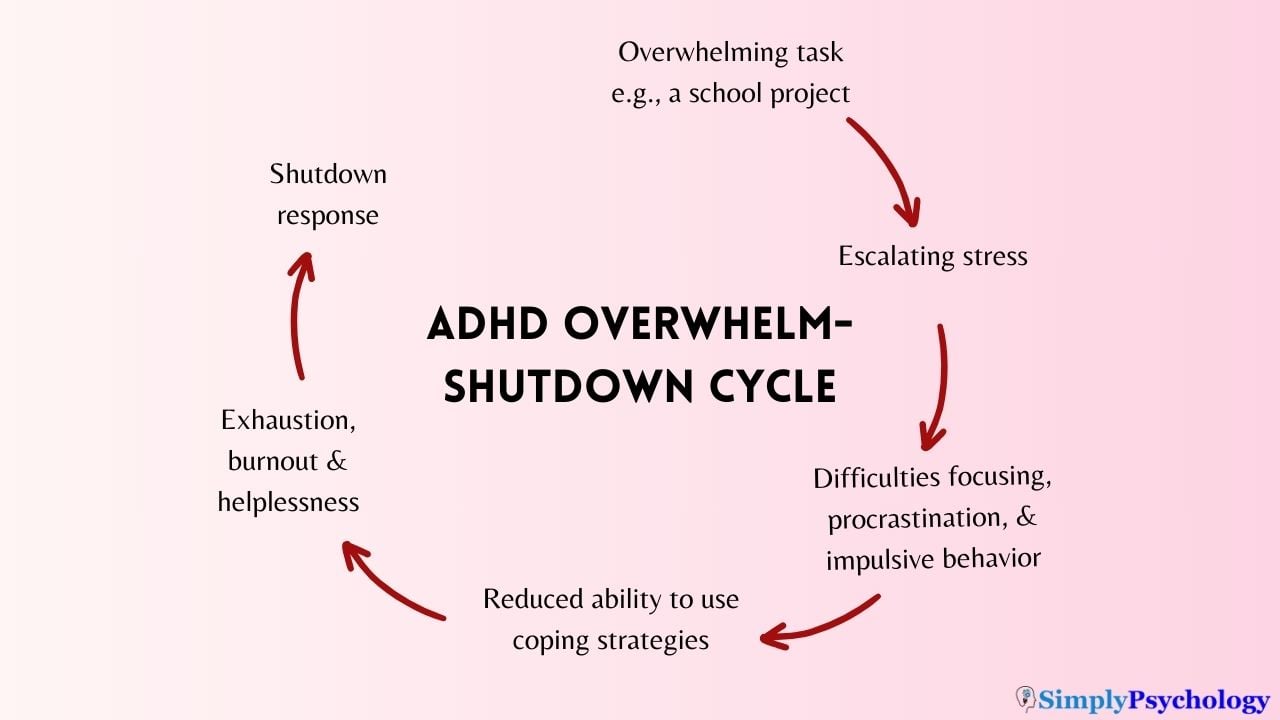
This cycle can become repetitive, so when faced with similar situations, this sequence of stages can be automatically triggered, affecting daily functioning, work/school, and relationships.
“I just feel paralyzed like I shut down completely, all the emotions are just gone and I cant do anything anymore.”
From Ginapp et al. (2023).
Let us look at some of these areas in more detail.
Difficulties Concentrating
Being overwhelmed can lead to heightened emotional responses. Individuals may experience intense frustration, anxiety and irritability (a lowered threshold for anger or annoyance), making it hard to manage emotions effectively.
These can manifest as outbursts, mood swings, and emotional shutdowns.
Additionally, overwhelm can impair focus due to challenges in task concentration and decreased productivity, leading to increased frustration.
Similarly, procrastination may also manifest as a coping mechanism, as facing an overwhelming task or situation may lead to avoidance and delaying important responsibilities.
Physical and Mental Overwhelm
Overwhelm can bring physical symptoms. These include headaches, muscle tension and sleep disturbances.
Emotionally, it can negatively affect self-esteem and lead to mental exhaustion and burnout. This can create a vicious cycle. Overwhelm feeds these symptoms and makes them worse.
In interviews with 20 adolescents diagnosed with ADHD (mean age 16.3), stress was often present and out of proportion to reality (Öster et al., 2020). They linked it to ADHD traits, school demands, unpredictable situations and relationship problems.
Reported consequences included postponing schoolwork and giving up, although some said they performed better when stressed. This was a small interview study. It examined stress, not emotional dysregulation.
Relationship Struggles
Overwhelm in ADHD may also pressurize relationships, whether romantic or between friends or family.
Loved ones may struggle to understand this reactive behavior, which can then lead to conflicts and misunderstandings.
“I feel like I’m very ambivalent. I blow hot and cold when it comes to people and friends and connections. One minute, like I really like you; in the next minute, I’m like, I don’t know what I think of that person.”
Ardelle
Additionally, performance at work or school may be affected in terms of missed deadlines, incomplete assignments, and difficulty managing responsibilities.
Consequently, some people may choose to withdraw and socially isolate themselves. This can be both to avoid such relationship strains and work expectations and also to get away from emotionally intense external stimuli.
“In my experience with rejection, I feel like a lot of the time it can make me self-isolate. If I feel like someone has excluded me over something trivial, I’ll just push myself away farther.”
From Ginapp et al. (2023).
Unfortunately, this can exacerbate loneliness and increase fears around socializing.
Therefore, it is imperative that individuals with ADHD develop strategies to manage overwhelm.
Recognizing the signs and taking proactive steps to address them can help them navigate daily life more successfully and maintain a healthy and balanced well-being.
The ADHD Brain’s Role In Emotional Dysregulation
Studies find group differences in brain structure and function between people with and without ADHD. The differences are clearest in areas related to executive function, which help us regulate emotions.
Most of the studies below were not designed to test emotional dysregulation. They point to possible explanations, not proven causes.
Some of the key differences can be seen in:
- Prefrontal cortex: Delayed maturation and reduced volume in the region that supports decision-making, impulse control and emotional regulation.
- Frontostriatal pathways: Communication between the prefrontal cortex and the striatum may not function optimally.
- Dopamine levels: Differences in the dopamine system, though scans measure transporter and receptor binding, not dopamine itself.
- Brain connectivity: Atypical connectivity, including the amygdala, linked to emotional lability in children.
Prefrontal Cortex
The prefrontal cortex (PFC) is a critical brain region responsible for executive functions such as decision-making, impulse control, emotional regulation, and attention.
Research has shown that individuals with ADHD often exhibit structural and functional differences in the PFC compared to non-ADHD individuals. These differences may include reduced volume or activity in this region.
Research has also uncovered notable delays in PFC maturation. Children diagnosed with ADHD also show reduced volume, and these structural differences appear from a young age.
In a longitudinal imaging study, half of the cortical points reached peak thickness at a median age of 10.5 years in 223 children diagnosed with ADHD. In 223 comparison children, the median age was 7.5 years (Shaw et al., 2007). The delay was most marked in prefrontal regions.
Frontostriatal Pathways
The communication pathways between the prefrontal cortex and the striatum, which is part of the brain’s reward and motivation system, are vital for executive function.
These pathways help integrate processes needed for healthy emotional regulation. Disruptions can make it harder to regulate attention, emotions and motivation, and to control emotional responses and impulses.
In ADHD, these pathways may not function optimally. That may contribute to emotional dysfunction.
Shaw et al. (2014) place dysregulation in a network linking the striatum, amygdala and medial prefrontal cortex. They describe the imaging findings behind this as disparate, partly because tasks and samples differ and smaller studies have limited power.
Dopamine Levels
ADHD is also associated with differences in the dopamine system in the brain.
Dopamine is a neurotransmitter involved in reward, motivation, and the regulation of emotions and attention.
Research suggests the dopamine system differs in ADHD. Receptor sensitivity may vary. This is often summarized as lower dopamine levels.
This can affect how people respond to tasks that do not offer an immediate emotional reward. It may also change the brain’s response to rewarding stimuli and its ability to regulate motivation and impulsive behaviors, which can shape emotional reactivity.
Scans measure the binding of dopamine transporters and receptors, not the amount of dopamine itself. So ‘lower dopamine levels’ is a loose summary.
A PET brain-scan study compared 53 unmedicated adults diagnosed with ADHD and 44 comparison adults. Binding of dopamine transporter and D2/D3 receptor markers was lower in the nucleus accumbens and midbrain (Volkow et al., 2009).
A meta-analysis of nine transporter-imaging studies found striatal transporter density 14% higher on average in ADHD. The result depended on stimulant history. It was lower in people who had never taken medication and higher in those previously medicated (Fusar-Poli et al., 2012).
Neither study measured emotion.
Brain Connectivity
Functional MRI studies have revealed altered connectivity patterns in the brains of individuals with ADHD.
These differences can affect how well the brain regions responsible for executive functions coordinate. That, in turn, may affect emotional regulation.
Atypical amygdala connectivity has also been noted from early on, as seen in ADHD research with a children’s cohort.
The amygdala is responsible for how we react to stimuli and certain behavioral reactions like the fight-or-flight response. Differences in its connectivity may relate to emotion regulation. The evidence is correlational.
In 63 children diagnosed with ADHD, aged 6 to 13, higher parent-rated emotional lability went with stronger connectivity between the amygdala and the rostral anterior cingulate cortex.
It also went with weaker connectivity between the amygdala and the posterior insula and superior temporal gyrus (Hulvershorn et al., 2014).
Children diagnosed with ADHD and low lability did not differ significantly from typically developing children, though each subgroup had only about 20 children. That suggests connectivity tracks lability more than ADHD itself. The design cannot show which comes first.
Evidence Check: How Well Does the Research Hold Up?
Verdict: Supported with qualifications.
The strength of the evidence differs by claim:
- Group difference: Well established in children and adults, although studies disagree on the size.
- Medication: ADHD medication reduces dysregulation on average, but effects in adults are small to moderate.
- Skills programs: Promising, but randomized trials show no clear gain yet on emotion regulation scales.
- Core symptom: Still open. A large group difference does not show that dysregulation defines ADHD.
The group difference is the best-established finding. A meta-analysis pooled 77 studies with 32,044 young people. It found the largest ADHD difference on emotional reactivity, negativity and lability (d = 0.95) (Graziano & Garcia, 2016).
A separate meta-analysis of 13 studies with 2,535 adults found a pooled difference of g = 1.17 (95% CI 0.70 to 1.64) (Beheshti et al., 2020). Two teams, covering two age groups, agree on the direction.
The studies disagree widely on size, though, and most rely on questionnaires.
Medication has credible but modest support. A meta-analysis of 21 double-blind randomized trials in adults found small to moderate effects on emotional dysregulation (Lenzi et al., 2018).
Standardized mean differences were 0.34 for methylphenidate (95% CI 0.23 to 0.45), 0.24 for atomoxetine (0.15 to 0.34) and 0.50 for lisdexamfetamine (0.21 to 0.80).
The newest child trial found lability fell on both methylphenidate and atomoxetine, but it had no placebo arm (Gao et al., 2026). Some amphetamine preparations raised irritability (Shaw et al., 2014).
Skills-based and mindfulness programs are the least tested. A preregistered randomized trial of 121 adults found that DBT-based group treatment beat usual care on executive-function difficulties.
At the end of treatment, the difference on the Difficulties in Emotion Regulation Scale was not significant (Halmøy et al., 2022). A meta-analysis of 10 controlled studies found that mindfulness improved self-reported ADHD symptoms but had no significant effect on negative affect (Kim & Jung, 2025).
Uncontrolled studies report large gains, so these programs are promising. None can yet be called an established treatment for dysregulation.
Key Takeaways
- Prevalence: Many people who have ADHD, but not all, have emotional dysregulation, and how much varies widely between people and between studies.
- Experience: Emotions arrive quickly, feel stronger than the situation seems to warrant, and take longer than usual to settle. Anger is common but not the only form.
- Hidden Feelings: Some people show little outwardly while feeling a great deal inside, or shut down and withdraw when overwhelmed.
- Causes: Weak inhibition, attention to emotional cues and brain circuits linking the amygdala and prefrontal cortex have each been proposed. None explains it alone.
- Diagnosis: Dysregulation is not one of the criteria used to diagnose ADHD, but the current diagnostic manual names it as a common accompanying feature.
- Treatment: Medication reduces dysregulation on average, though effects in adults are small to moderate. Skills programs are promising but not yet proven.
- Verdict: Supported with qualifications – the research clearly shows more dysregulation in people who have ADHD, but whether it is a core symptom is still open.
Further Reading
References
Albesisi, S., & Overton, P. G. (2023). Relationship Between ADHD-Like Traits and Emotion Dysregulation in the Adult General Population. Advances in Neurodevelopmental Disorders, 1-11.
American Psychiatric Association. (2022). Diagnostic and statistical manual of mental disorders (5th ed., text rev.). https://doi.org/10.1176/appi.books.9780890425787
Arnsten, A. F. (2009). Toward a new understanding of attention-deficit hyperactivity disorder pathophysiology: an important role for prefrontal cortex dysfunction. CNS drugs, 23, 33-41.
Barkley, R (Host). (2021-present). ADHD Experts Podcast. 369 – Deficient Emotional Self-Regulation: The Overlooked ADHD Symptom That Impacts Everything [Audio podcast].
Beheshti, A., Chavanon, M.-L., & Christiansen, H. (2020). Emotion dysregulation in adults with attention deficit hyperactivity disorder: A meta-analysis. BMC Psychiatry, 20, Article 120. https://doi.org/10.1186/s12888-020-2442-7
Biederman, J., Spencer, T. J., Petty, C., Hyder, L. L., O’Connor, K. B., Surman, C. B., & Faraone, S. V. (2012). Longitudinal course of deficient emotional self-regulation CBCL profile in youth with ADHD: prospective controlled study. Neuropsychiatric disease and treatment, 267-276.
Blum, K., Chen, A. L. C., Braverman, E. R., Comings, D. E., Chen, T. J., Arcuri, V., … & Oscar-Berman, M. (2008). Attention-deficit-hyperactivity disorder and reward deficiency syndrome. Neuropsychiatric disease and treatment, 4(5), 893-918.
Bodalski, E. A., Flory, K., Canu, W. H., Willcutt, E. G., & Hartung, C. M. (2023). ADHD symptoms and procrastination in college students: The roles of emotion dysregulation and self-esteem. Journal of Psychopathology and Behavioral Assessment, 45(1), 48-57.
Carroll, P., Hirvikoski, T., Lindholm, C., & Thorell, L. B. (2023). Group-based emotion regulation skills training for adults with ADHD: A feasibility study in an outpatient psychiatric setting. Applied Neuropsychology: Adult, 30(1), 71-82.
Faraone, S. V., Rostain, A. L., Blader, J., Busch, B., Childress, A. C., Connor, D. F., & Newcorn, J. H. (2019). Practitioner review: Emotional dysregulation in attention-deficit/hyperactivity disorder – implications for clinical recognition and intervention. Journal of Child Psychology and Psychiatry, 60(2), 133–150. https://doi.org/10.1111/jcpp.12899
Friedman, L. A., & Rapoport, J. L. (2015). Brain development in ADHD. Current opinion in neurobiology, 30, 106-111.
Fusar-Poli, P., Rubia, K., Rossi, G., Sartori, G., & Balottin, U. (2012). Striatal dopamine transporter alterations in ADHD: Pathophysiology or adaptation to psychostimulants? A meta-analysis. American Journal of Psychiatry, 169(3), 264–272. https://doi.org/10.1176/appi.ajp.2011.11060940
Gao, Y., Wu, Z., Yang, B., Chen, W., Dang, C., Zhu, Y., Pan, M., Dong, M., Li, H., Zhao, M., Yue, X., Guo, H., Fu, S., Su, Y., Wang, Y., Qian, Q., Sun, L., & Liu, L. (2026). The effect of atomoxetine and methylphenidate on emotional dysregulation in children with attention deficit/hyperactivity disorder: A multicenter randomized clinical trial. Journal of Child Psychology and Psychiatry. Advance online publication. https://doi.org/10.1111/jcpp.70217
Ginapp, C. M., Greenberg, N. R., Macdonald-Gagnon, G., Angarita, G. A., Bold, K. W., & Potenza, M. N. (2023). The experiences of adults with ADHD in interpersonal relationships and online communities: A qualitative study. SSM-Qualitative Research in Health, 3, 100223.
Ginapp, C. M., Greenberg, N. R., MacDonald-Gagnon, G., Angarita, G. A., Bold, K. W., & Potenza, M. N. (2023). “Dysregulated not deficit”: A qualitative study on symptomatology of ADHD in young adults. Plos one, 18(10), e0292721
Graziano, P. A., & Garcia, A. (2016). Attention-deficit hyperactivity disorder and children’s emotion dysregulation: A meta-analysis. Clinical Psychology Review, 46, 106–123. https://doi.org/10.1016/j.cpr.2016.04.011
Gruber, R. (2014). ADHD, anxiety and sleep: a window to understanding the interplay between sleep, emotional regulation and attention in children?. Behavioral Sleep Medicine, 12(1), 84-87.
Halmøy, A., Ring, A. E., Gjestad, R., Møller, M., Ubostad, B., Lien, T., Munkhaugen, E. K., & Fredriksen, M. (2022). Dialectical behavioral therapy-based group treatment versus treatment as usual for adults with attention-deficit hyperactivity disorder: A multicenter randomized controlled trial. BMC Psychiatry, 22, Article 738. https://doi.org/10.1186/s12888-022-04356-6
Hirsch, O., Chavanon, M., Riechmann, E., & Christiansen, H. (2018). Emotional dysregulation is a primary symptom in adult Attention-Deficit/Hyperactivity Disorder (ADHD). Journal of affective disorders, 232, 41-47. https://doi.org/10.1016/j.jad.2018.02.007
Hulvershorn, L. A., Mennes, M., Castellanos, F. X., Di Martino, A., Milham, M. P., Hummer, T. A., & Roy, A. K. (2014). Abnormal amygdala functional connectivity associated with emotional lability in children with attention-deficit/hyperactivity disorder. Journal of the American Academy of Child & Adolescent Psychiatry, 53(3), 351-361. https://doi.org/10.1016/j.jaac.2013.11.012
Johns-Mead, R., Vijayakumar, N., Mulraney, M., Melvin, G., Anderson, V. A., Efron, D., & Silk, T. J. (2024). The longitudinal relationship between socioemotional difficulties and irritability in ADHD. Journal of Affective Disorders, 350, 573–581.
Kim, H. H., & Jung, N. H. (2025). Mindfulness-based interventions for adults with ADHD: A systematic review and meta-analysis. Medicine, 104(37), Article e44308. https://doi.org/10.1097/MD.0000000000044308
Lenzi, F., Cortese, S., Harris, J., & Masi, G. (2018). Pharmacotherapy of emotional dysregulation in adults with ADHD: A systematic review and meta-analysis. Neuroscience & Biobehavioral Reviews, 84, 359–367. https://doi.org/10.1016/j.neubiorev.2017.08.010
Marques, S., Correia-de-Sá, T., Guardiano, M., Sampaio-Maia, B., & Ferreira-Gomes, J. (2024). Emotion dysregulation and depressive symptoms mediate the association between inhibitory control difficulties and aggressive behaviour in children with ADHD. Frontiers in psychiatry, 15, 1329401.
Öster, C., Ramklint, M., Meyer, J., & Isaksson, J. (2020). How do adolescents with ADHD perceive and experience stress? An interview study. Nordic Journal of Psychiatry, 74(2), 123-130.
Pan, M. R., Zhang, S. Y., Chen, C. L., Qiu, S. W., Liu, L., Li, H. M., … & Qian, Q. J. (2023). Bidirectional associations between maladaptive cognitions and emotional symptoms, and their mediating role on the quality of life in adults with ADHD: a mediation model. Frontiers in Psychiatry, 14, 1200522.
Retz, W., Stieglitz, R. D., Corbisiero, S., Retz-Junginger, P., & Rösler, M. (2012). Emotional dysregulation in adult ADHD: what is the empirical evidence?. Expert review of neurotherapeutics, 12(10), 1241-1251.
Ross, P., & Randolph, J. (2016). Differences between students with and without ADHD on task vigilance under conditions of distraction. Journal of educational research and practice, 4(1), 1-10.
Sato, J. R., Hoexter, M. Q., Castellanos, X. F., & Rohde, L. A. (2012). Abnormal brain connectivity patterns in adults with ADHD: a coherence study.
Scherer, K. R. (2005). What are emotions? And how can they be measured?. Social science information, 44(4), 695-729.
Sedgwick-Müller, J. A., Müller-Sedgwick, U., Adamou, M., Catani, M., Champ, R., Gudjónsson, G., … & Asherson, P. (2022). University students with attention deficit hyperactivity disorder (ADHD): a consensus statement from the UK Adult ADHD Network (UKAAN). BMC psychiatry, 22(1), 292.
Shaw, P., Eckstrand, K., Sharp, W., Blumenthal, J., Lerch, J. P., Greenstein, D., Clasen, L., Evans, A., Giedd, J., & Rapoport, J. L. (2007). Attention-deficit/hyperactivity disorder is characterized by a delay in cortical maturation. Proceedings of the National Academy of Sciences, 104(49), 19649–19654. https://doi.org/10.1073/pnas.0707741104
Shaw, P., Stringaris, A., Nigg, J., & Leibenluft, E. (2014). Emotion dysregulation in attention deficit hyperactivity disorder. American Journal of Psychiatry, 171(3), 276-293. https://doi.org/10.1176/appi.ajp.2013.13070966
Soler-Gutiérrez, A. M., Pérez-González, J. C., & Mayas, J. (2023). Evidence of emotion dysregulation as a core symptom of adult ADHD: A systematic review. Plos one, 18(1), e0280131.
Szymanski, K., Sapanski, L., & Conway, F. (2011). Trauma and ADHD–association or diagnostic confusion? A clinical perspective. Journal of Infant, Child, and Adolescent Psychotherapy, 10(1), 51-59.
Volkow, N. D., Wang, G.-J., Kollins, S. H., Wigal, T. L., Newcorn, J. H., Telang, F., Fowler, J. S., Zhu, W., Logan, J., Ma, Y., Pradhan, K., Wong, C., & Swanson, J. M. (2009). Evaluating dopamine reward pathway in ADHD: Clinical implications. JAMA, 302(10), 1084–1091. https://doi.org/10.1001/jama.2009.1308




