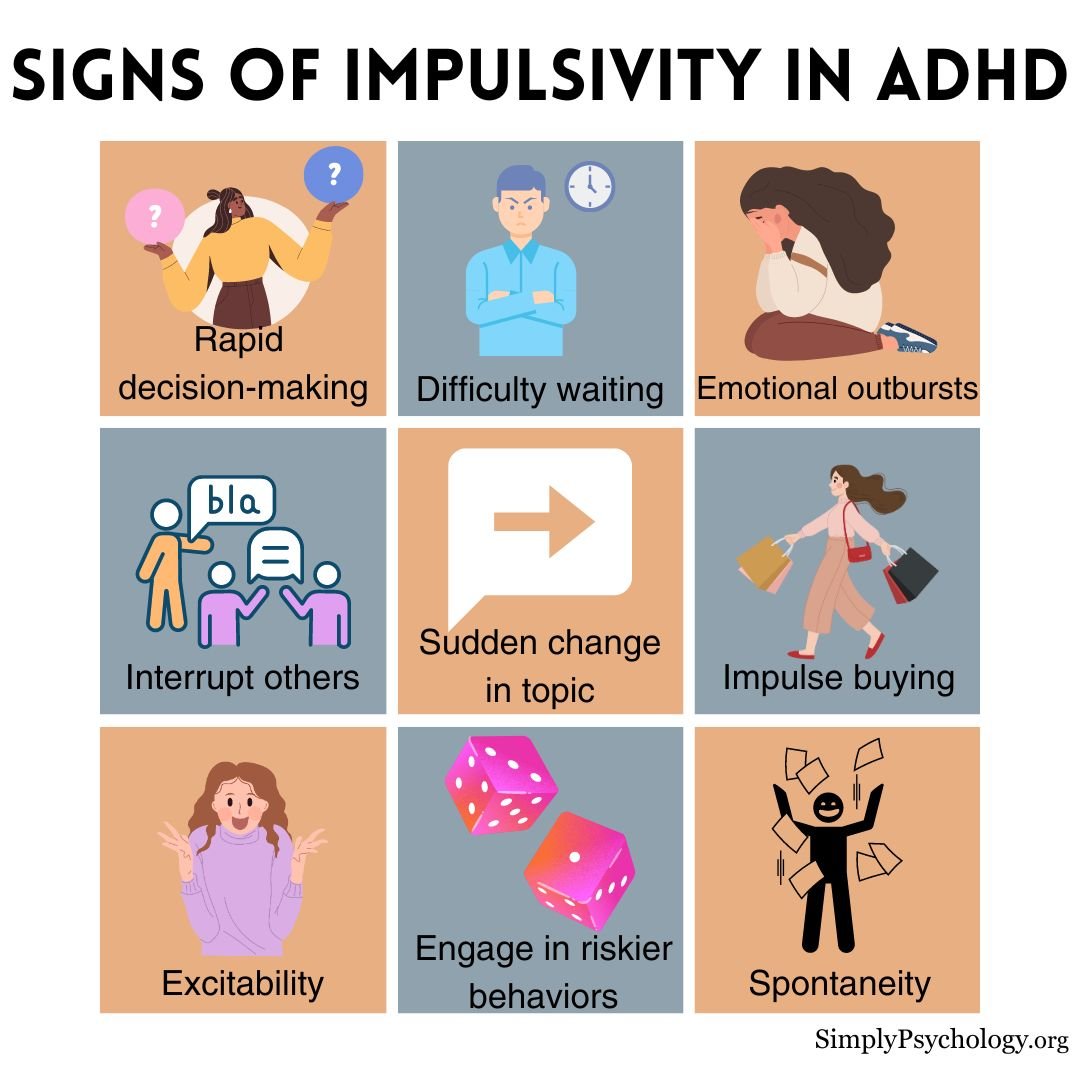
Impulsivity in ADHD means acting, speaking or reacting before thinking things through. It is one of the primary ADHD symptoms, found in the hyperactive-impulsive domain of DSM-5-TR.
It is almost like a knee-jerk reaction, or the inability to apply the brakes before acting. People with ADHD tend to react first and think afterward.
Due to the way the ADHD brain is functioning, resisting such impulses can be extremely difficult. Many people do not recognize the consequences of their words or actions until the act is well under way or already finished (Winstanley, Eagle & Robbins, 2006).

Key Takeaways
- Definition: Acting, speaking or reacting before thinking things through. It belongs to ADHD’s hyperactive-impulsive domain.
- Forms: Impulsive decisions, blurting out comments, emotional outbursts, impulse buying, impatience, and risky behavior.
- Causes: No single cause. ADHD is highly heritable (about 74%), and executive function, dopamine reward pathways and delay aversion all play a part.
- Delayed Rewards: People with ADHD discount delayed rewards more steeply than controls (d = 0.43), so a distant payoff is worth less in the moment.
- Consequences: Strained relationships, problems at school or work, money troubles, and higher stress or isolation.
- Management: Self-compassion, fewer triggers, planning ahead and therapy such as CBT all help. For many people, medication does too.
- Not Always ADHD: Autism, bipolar disorder, borderline personality disorder, substance use and age can also bring impulsivity.
Signs of Impulsivity In ADHD
There are many ways impulsivity can manifest, with some being more obvious than others. Let us now look at some of the most common ways it can be expressed:
Impulsive decision-making
People with ADHD are more prone to impulsive decision-making and quicker reactions to situations without thinking about the end result.
In her TED talk The double-edged sword: ADHD and impulsivity, Kimberly Quinn described one of her experiences. She said, “there was no way to see around these impulse buys, there was no shut-off switch” (TEDx Talks, 2020).
Such impulsive decision-making can thus have a direct impact on various areas of one’s life, making it difficult to tune out more rational thoughts.
Reward appears to play a part. In one brain-imaging study, 30 adults with ADHD and 30 comparison adults completed a reward-learning task. Off medication, the ADHD group chose novel options more often and did worse. The more they kept choosing novelty, the worse they did (Sethi et al., 2018).
Novelty acted like a reward. It tilted choices towards uncertain options. Stimulant medication improved performance. A meta-analysis of 59 studies in adults likewise found small to medium differences on reward-based decision tasks (Mowinckel et al., 2015).
Verbal impulsivity
Verbal impulsivity is the tendency to voice thoughts, emotions, and opinions without thinking about how they may come across or affect others. The diagnostic criteria for ADHD (DSM-5-TR) include blurting out answers, talking excessively, and interrupting others.
For example, they may:
- Interrupt people
- Jump into conversations
- Change topics suddenly
- Blurt out thoughts on what you said, did, or are even wearing
This is not stemming from a malicious point but from them talking without thinking fully about how their words may come across to others.
Emotional impulsivity
Emotional impulsivity can be characterized by outbursts, overreactions to situations, and feelings of being overwhelmed with strong emotions and needing to express them immediately (Mitchell et al., 2012).
For example, crying intensely when receiving constructive criticism, angrily shouting when feeling emotionally attacked, or having more heightened emotional excitability overall.
This type of impulsivity can often stem from other ADHD symptoms, such as troubles with emotional regulation, sensitivity to criticism, and perfectionistic tendencies.
Financial impulses
Financial impulsivity is a form of reactive behavior with people being more susceptible to things such as deals, sales, or limited-time offers.
With the rise of fast fashion and heavily discounted websites, the pull to buy something new can make this worse. A popular explanation is that buying gives a dopamine hit. Dopamine is the brain chemical involved in motivation and reward.
This is still a hypothesis, as no study has yet measured dopamine during spending in people with ADHD. What studies do show is that waiting is harder.
In 225 adults with ADHD and 121 university students, the ADHD group bought on impulse more often and was less able to defer gratification (Einarsson et al., 2024). Deferral helped explain the link in both groups.
Additionally, big and more expensive purchases may be more rushed without fully considering their value, need, and usability in their lives. Someone with ADHD may spontaneously choose a new hobby and impulsively buy all of the equipment they need immediately.
People with ADHD often struggle with delaying gratification, meaning they might buy things impulsively without thinking through the consequences.
Impatience
People with ADHD are likely to be impatient in many situations, such as at work, in relationships, and even with themselves.
For example, they may get easily frustrated when queuing, waiting for their turn to speak, receiving an answer, or getting something done.
They can also feel restless or uneasy, and this grows the longer they wait. Waiting itself can feel unpleasant. Researchers call this delay aversion (Sonuga-Barke, 2003).
Such impatience can then directly link and lead to several other impulses mentioned previously, such as emotional, verbal, and even financial.
Risky behaviors
Lastly, risky behavior is the tendency to seek out activities that could lead to dangerous and negative consequences. Sometimes the aim is instant stimulation.
For example, this can include reckless driving, pranks, trespassing, gambling, misuse of substances (Ortal et al., 2015), or sexual acts without adequate protection.
Research links such behaviors to self-control. A meta-analysis found a small positive link between ADHD symptoms and gambling severity (r = .17; Theule et al., 2019).
Effortful control, the ability to override a dominant impulse, may matter here. In 555 college students, it helped explain the link between ADHD symptoms and risky driving and financial behavior (Graziano et al., 2015). Sensation seeking did not.
These actions can be destructive not only to themselves but also to their loved ones and wider circle.
What are the Consequences of Impulsivity?
Just as impulsivity can manifest in various different forms, so can the consequences of it, which can range from mild to rather dangerous.
Relationships, school and work
The most common consequence is challenges with interpersonal relationships. These include misunderstandings, hurt feelings, and people not feeling heard, which can lead to conflicts and falling outs.
Safety concerns can also arise, especially when impulses are linked with risky behaviors or quick decisions made on the spot.
People can react without thinking. They can get into dangerous situations rather quickly. Repercussions range from physical and mental harm to legal trouble.
Issues at school, university or the workplace may also arise.
For example, focusing on tasks can be more challenging, disrupting classes or work meetings and struggling to prioritize work, which can hinder performance.
People may also be labeled as misbehaved or difficult to work with, leading to academic or occupational troubles. In severe cases, someone may be expelled or let go.
Others feel the impulse to quit jobs or switch educational pathways and degrees.
Money and wellbeing
Finances may take a hit as well, especially in relation to financial impulses such as erratic spending or impulse buying. Certain sale periods may be especially triggering for people.
This can lead to troubles managing finances, having savings, and budgeting for necessities (Bangma et al., 2020).
Long-term studies point the same way.
In the Pittsburgh ADHD Longitudinal Study, 364 children diagnosed with ADHD and 240 matched controls were followed for nearly 20 years. By age 30, the ADHD group had worse outcomes on most financial indicators (Pelham et al., 2020).
Impulse buying is not the only route.
Adults with ADHD also scored lower than controls on tests of financial competence, and reported an avoidant or spontaneous decision-making style (Bangma et al., 2019).

Lastly, someone’s mental and physical well-being can be directly affected by all of the above. Feelings of regret over actions and behaviors can arise, which can also lead to higher stress.
Some people may also withdraw socially or be ostracised. This increases the chances of social isolation and loneliness (Bastien, 2013).
More broadly, ADHD is linked with higher risks of accidents and injury, substance misuse, and co-occurring mood and anxiety conditions.
What Causes Impulsivity in ADHD?
ADHD impulsivity does not have a single attributable cause. It is more of a collection of neurobiological and environmental factors working together to generate and sustain it.
Genes play the largest part in ADHD overall.
Family, twin and adoption studies put its heritability at about 74%, which is comparable to height (Faraone & Larsson, 2019). Heritability describes differences across a population, not destiny for one person.
Executive function and delay aversion
Primarily, differences in how the brain handles executive function have been noted (Swanson, 2003). Executive function is the set of control processes that let a person plan, hold information in mind, and hold back an impulse.
This can make inhibition harder, especially around emotions and behavior.
Barkley’s influential model treats difficulty with behavioral inhibition, holding back a dominant response, as the core problem.
On this view, it disrupts working memory and emotional self-regulation, so behavior follows immediate cues instead of internally held plans (Barkley, 1997).
Sonuga-Barke’s dual-pathway model proposes two routes into ADHD. One is executive dysfunction.
The other is delay aversion: waiting itself feels aversive, so behavior is organized to escape or shorten the delay (Sonuga-Barke, 2003).
A meta-analysis of 21 investigations and 3,913 participants supports this. People with ADHD discounted delayed monetary rewards more steeply than controls, a medium effect (d = 0.43; Jackson & MacKillop, 2016).
The effect held across age, real versus hypothetical rewards, and co-occurring conditions. Publication bias suggests the true effect may be smaller.
Put simply, a distant payoff is worth less in the moment of choice.
Dopamine and reward
Neurotransmitter imbalances, especially those responsible for reward and pleasure such as dopamine, can also be present. Neurotransmitters are chemical messengers. They pass signals between brain cells, and dopamine helps drive motivation and reward.
Dysregulation in these pathways can cause a reduction in dopamine, increasing the likelihood of impulsive behavior to get that sense of reward (Williams & Dayan, 2005).
A brain-imaging study of 53 unmedicated adults with ADHD and 44 controls found lower availability of dopamine transporters and receptors in the brain’s reward pathway.
Lower availability went with more inattention (Volkow et al., 2009).
The picture is not simply too little dopamine. Researchers describe atypical dopamine signaling in reward circuits. Gene studies point the same way: ADHD risk genes are enriched in midbrain dopamine neurons (Demontis et al., 2023).
People with ADHD are, thus, more likely to act impulsively in pursuit of reward, while also struggling to apply the brakes because of executive function challenges.
Co-occurring conditions
Lastly, impulsivity can also be heightened by conditions that often co-occur with ADHD. Examples include Intermittent Explosive Disorder, or IED (Gnanavel, Sharma, Kaushal & Hussain, 2019), and Bipolar Disorder (Nandagopal et al., 2011).
Co-occurrence is common. More than two-thirds of people with ADHD have at least one co-occurring condition, such as anxiety, depression, autism, or substance-use disorders.
Such conditions often show their own impulsivity, so co-occurrence increases such behaviors and emotions further.
ADHD Impulse Control
As impulsivity is one of the core symptoms of ADHD, its consequences can range and affect several areas of life.
Learning how better to control such actions, emotions, and behaviors can, thus, have wide-reaching benefits on someone’s well-being, relationships, and overall life.
Let us discuss some ways in which ADHD impulsivity can be managed.
Self-compassion
Being kind and compassionate to yourself is key. Navigating the world through an ADHD lens is no easy task. It helps to understand that certain behaviors are a byproduct of ADHD, not a reflection of your personality and values.
Remember to give yourself time to process and reflect without going into self-destructive talks or using diminishing language to punish yourself.
Identify behaviors
To manage impulsivity, first notice which behaviors are linked to it. ADHD looks different in different people. Understanding how impulsivity shows up for you is a good first step.
You can speak to trusted loved ones and see their opinions as people who know you, and of course, seek advice from a professional who can better help guide you.
You can also keep a journal to document your reflection so you can keep better track of your thoughts and progress.
Remove or reduce triggers
Ensuring your environment is not actively encouraging or triggering impulsive actions or decisions is another way to manage impulsivity.
For example, unsubscribe from marketing emails around sales periods. If you tend to have verbal impulses, try writing down your thoughts first. You could also suggest less stimulating places to hang out with friends.
By doing this, you are actively limiting situations that exacerbate any impulsive tendencies.
Create obstacles
On a similar note, you can actively try and create obstacles that will prevent you from engaging in impulsive behaviors. Some examples can be:
- Not having card details saved to reduce impulsive online purchases
- Leaving sticky notes in places of high visibility to remind you to think first before acting
- Leaving your car key at home if you know you will be out drinking
- Learning to deploy mindfulness and breathing when impulsive thoughts arise
- Learn emotion management skills
Learning emotional management skills can be a great way to both prevent impulses but also de-escalate them before they enter a more dangerous or distractive zone.
They are especially helpful for verbal and emotional impulses. Examples include outbursts, intense emotional swings, or buying, drinking, or eating your way out of strong emotions.
Some examples of such techniques are breathing exercises, mindfulness (Aksen et al., 2026; Virone, 2023), and physical exercise (Wigal, Emmerson, Gehricke & Galassetti, 2013).
Adult evidence is growing. A systematic review of 14 studies meta-analysed eight trials in adults with ADHD. A single exercise session had a moderate effect on inhibitory control, the ability to hold back an automatic response (Hedges’ g = 0.55).
It also had a small effect on core ADHD characteristics (g = 0.23). Results for longer programmes were mixed (Xu et al., 2026).
Take responsibility
Taking responsibility for your actions and behaviors can greatly help in several different areas and show that you have reflected on your behavior.
Firstly, in your interpersonal relationships, take accountability and apologize for any outburst or for not considering a loved one’s feelings.
Secondly, at work, take responsibility if you frequently interrupt colleagues or meetings. Lastly, it can make you feel better. You are taking charge in mending situations and relieving the stress of things left unspoken.
Plan and think ahead
You can also tackle impulsivity head-on by planning and thinking ahead. For example, if a big project is coming up, reduce triggers, create buffers, and organize yourself. That makes it easier to tackle.
You can use visual cues like Post-Its or even digital apps to help you stay focused and organized. Through trial and error, you can slowly figure out what works best for you.
Break down long-term goals
Lastly, breaking long-term goals into smaller, more manageable action points can greatly help curb impulses. Smaller steps are easier to start. It can also help with getting motivated to do tasks you struggle to focus on due to impulsivity.
Begin by reflecting on where you are at the moment and where you see yourself in the future.

You can ask loved ones for their help in keeping you accountable, and remember to celebrate all milestones and small victories.
Consider therapy
Seeking therapy can be invaluable for gaining skills and strategies tailored to your unique needs. A therapist specializing in ADHD and impulsivity can help identify your triggers, teach coping methods, provide accountability through regular check-ins, and support you on harder days.
Whether individual or group therapy, having a safe space to process emotions and experiences can lessen impulses and build self-awareness.
Therapy need not be lifelong either – even short-term can equip you with skills to better manage impulsivity moving forward.
Several therapies may help. These include cognitive behavioral therapy (CBT), dialectical behavior therapy (DBT), and acceptance and commitment therapy (ACT). Each may help you learn techniques for managing impulsivity.
CBT has been tested in randomized trials with adults. In one trial, 86 adults whose symptoms persisted despite medication received either 12 sessions of CBT or relaxation with educational support.
More people responded to CBT. The rates were 53% against 23% on one clinician rating. Among responders, gains held at 6 and 12 months (Safren et al., 2010).
A meta-analysis of 28 trials found that CBT-based therapy also reduced emotional symptoms and improved self-esteem and quality of life (Liu et al., 2023). These studies looked at ADHD overall, so the effect on impulsivity alone is less clear.
Medication
Medication is one option. Treatment is individualized. It often combines medication with the strategies above.
Stimulant medications such as methylphenidate and amphetamines increase the availability of dopamine and noradrenaline in the brain. They are used to improve attention and reduce impulsivity and overactivity.
In one study of 35 children with ADHD, long-acting methylphenidate improved choice impulsivity compared with placebo (Campez et al., 2022). Working memory improved too.
A network meta-analysis compared the main ADHD medications. It pooled 133 double-blind randomized trials. On clinicians’ ratings, all of them beat placebo in children and adolescents. In adults, amphetamines, methylphenidate, bupropion and atomoxetine did (Cortese et al., 2018).
The authors identified methylphenidate as the preferred first choice for children and adolescents, and amphetamines for adults. That finding is short-term. The robust evidence runs only to about 12 weeks. These ratings cover ADHD overall, not impulsivity alone.
Whether medication suits you is a decision to make with a prescriber.
FAQs
Is impulsivity always a sign of ADHD?
Impulsivity, while being one of the core symptoms of ADHD, is not necessarily always a sign of ADHD. Other people on the neurodiverse spectrum can also experience impulsive tendencies, e.g., individuals with Autistic traits (Hlavatá, Kašpárek, Linhartová, Ošlejšková & Bareš, 2018).
In addition, some mental health conditions can bring impulsivity. These include bipolar disorder (Najt et al., 2007) and borderline personality disorder (Berlin, Rolls & Iversen, 2005). Drug or alcohol dependence may show this behavior too.
Moreover, people in the neurotypical population may express impulsive behavior simply due to their personalities.
Lastly, age also plays a factor, e.g., children tend to be more impulsive as they are still in their early developmental stages.
Are people with ADHD more prone to angry outbursts?
While not every person with ADHD may experience angry outbursts, it can make people more prone to reacting this way.
There are several reasons why this might happen. Impulsivity makes it easier to react verbally and negatively to situations. Troubles with emotional regulation make it harder to separate feelings from reactions.
Attention matters too. A reduced ability to sustain attention can make losing patience more likely. Heightened sensitivity to conflict and criticism can also trigger defensive anger.
If you feel like you are prone to such reactions, reaching out to a mental health professional specializing in ADHD can be a great step in learning about emotional regulation strategies and how to navigate situations better.
Are there any situations where it is beneficial to be impulsive?
Impulsivity is generally considered a more challenging trait; however, there can be situations where reacting a bit more quickly and impulsively can have its benefits.
Firstly, in emergency situations where time is of the essence, thinking quickly is key and can even save a life. Secondly, in fast-paced and time-sensitive work environments, e.g., hospitals, impulsivity may help someone adjust to professional challenges more.
Thirdly, impulsive people can be more prone to seizing opportunities and not letting them fade away, as sometimes they can be hard to come by. Lastly, impulsivity can add a feeling of adventure and spontaneity in relationships, whether platonic or romantic.
Strengths matter too. According to Sedgwick, Merwood and Asherson (2019), successful adults with ADHD described energy, courage and adventurousness, which they used to work with their difficulties.
These were a selected group, so the findings do not represent everyone.
References
Aksen, D. E., Sleight, F. G., & Lynn, S. J. (2026). Mindfulness intervention for impulsivity as a stand-alone treatment: A qualitative review of emerging evidence. Psychology of Consciousness: Theory, Research, and Practice, 13(1), 82–103. https://doi.org/10.1037/cns0000367
Bangma, D. F., Koerts, J., Fuermaier, A. B. M., Mette, C., Zimmermann, M., Toussaint, A. K., Tucha, L., & Tucha, O. (2019). Financial decision-making in adults with ADHD. Neuropsychology, 33(8), 1065–1077. https://doi.org/10.1037/neu0000571
Bangma, D. F., Tucha, L., Fuermaier, A. B., Tucha, O., & Koerts, J. (2020). Financial decision-making in a community sample of adults with and without current symptoms of ADHD. PloS one, 15(10), e0239343.
Barkley, R. A. (1997). Behavioral inhibition, sustained attention, and executive functions: Constructing a unifying theory of ADHD. Psychological Bulletin, 121(1), 65–94. https://doi.org/10.1037/0033-2909.121.1.65
Bastien, M. (2013). Examining the relationship between ostracism and ADHD. UC Merced Undergraduate Research Journal, 5(1).
Berlin, H. A., Rolls, E. T., & Iversen, S. D. (2005). Borderline personality disorder, impulsivity, and the orbitofrontal cortex. American journal of psychiatry, 162(12), 2360-2373.
Campez, M., Raiker, J. S., Little, K., Altszuler, A. R., Merrill, B. M., Macphee, F. L., Gnagy, E. M., Greiner, A. R., Musser, E. D., Coles, E. K., & Pelham, W. E. (2022). An evaluation of the effect of methylphenidate on working memory, time perception, and choice impulsivity in children with ADHD. Experimental and Clinical Psychopharmacology, 30(2), 209–219. https://doi.org/10.1037/pha0000446
Cortese, S., Adamo, N., Del Giovane, C., Mohr-Jensen, C., Hayes, A. J., Carucci, S., Atkinson, L. Z., Tessari, L., Banaschewski, T., Coghill, D., Hollis, C., Simonoff, E., Zuddas, A., Barbui, C., Purgato, M., Steinhausen, H.-C., Shokraneh, F., Xia, J., & Cipriani, A. (2018). Comparative efficacy and tolerability of medications for attention-deficit hyperactivity disorder in children, adolescents, and adults: A systematic review and network meta-analysis. The Lancet Psychiatry, 5(9), 727–738. https://doi.org/10.1016/S2215-0366(18)30269-4
Demontis, D., Walters, G. B., Athanasiadis, G., Walters, R., Therrien, K., Nielsen, T. T., Farajzadeh, L., Voloudakis, G., Bendl, J., Zeng, B., Zhang, W., Grove, J., Als, T. D., Duan, J., Satterstrom, F. K., Bybjerg-Grauholm, J., Bækved-Hansen, M., Gudmundsson, O. O., Magnusson, S. H., … Børglum, A. D. (2023). Genome-wide analyses of ADHD identify 27 risk loci, refine the genetic architecture and implicate several cognitive domains. Nature Genetics, 55(2), 198–208. https://doi.org/10.1038/s41588-022-01285-8
Einarsson, S. B., Sigurðsson, B. H., Kjartansdóttir, S. H., Magnússon, P., & Sigurðsson, J. F. (2024). Impulsive buying and deferment of gratification among adults with ADHD. Clinical Psychology in Europe, 6(3), Article e9339. https://doi.org/10.32872/cpe.9339
Faraone, S. V., & Larsson, H. (2019). Genetics of attention deficit hyperactivity disorder. Molecular Psychiatry, 24(4), 562–575. https://doi.org/10.1038/s41380-018-0070-0
Gnanavel, S., Sharma, P., Kaushal, P., & Hussain, S. (2019). Attention deficit hyperactivity disorder and comorbidity: A review of literature. World journal of clinical cases, 7(17), 2420–2426. https://doi.org/10.12998/wjcc.v7.i17.2420
Graziano, P. A., Reid, A., Slavec, J., Paneto, A., McNamara, J. P., & Geffken, G. R. (2015). ADHD symptomatology and risky health, driving, and financial behaviors in college: The mediating role of sensation seeking and effortful control. Journal of Attention Disorders, 19(3), 179–190. https://doi.org/10.1177/1087054714527792
Hlavatá, P., Kašpárek, T., Linhartová, P., Ošlejšková, H., & Bareš, M. (2018). Autism, impulsivity and inhibition a review of the literature. Basal Ganglia, 14, 44-53.
Jackson, J. N. S., & MacKillop, J. (2016). Attention-deficit/hyperactivity disorder and monetary delay discounting: A meta-analysis of case-control studies. Biological Psychiatry: Cognitive Neuroscience and Neuroimaging, 1(4), 316–325. https://doi.org/10.1016/j.bpsc.2016.01.007
Liu, C.-I., Hua, M.-H., Lu, M.-L., & Goh, K. K. (2023). Effectiveness of cognitive behavioural-based interventions for adults with attention-deficit/hyperactivity disorder extends beyond core symptoms: A meta-analysis of randomized controlled trials. Psychology and Psychotherapy: Theory, Research and Practice, 96(3), 543–559. https://doi.org/10.1111/papt.12455
Mitchell, J. T., Robertson, C. D., Anastopolous, A. D., Nelson-Gray, R. O., & Kollins, S. H. (2012). Emotion dysregulation and emotional impulsivity among adults with attention-deficit/hyperactivity disorder: results of a preliminary study. Journal of Psychopathology and Behavioral Assessment, 34, 510-519.
Mowinckel, A. M., Pedersen, M. L., Eilertsen, E., & Biele, G. (2015). A meta-analysis of decision-making and attention in adults with ADHD. Journal of Attention Disorders, 19(5), 355–367. https://doi.org/10.1177/1087054714558872
Najt, P., Perez, J., Sanches, M., Peluso, M. A. M., Glahn, D., & Soares, J. C. (2007). Impulsivity and bipolar disorder. European neuropsychopharmacology, 17(5), 313-320.
Nandagopal, J. J., Fleck, D. E., Adler, C. M., Mills, N. P., Strakowski, S. M., & DelBello, M. P. (2011). Impulsivity in adolescents with bipolar disorder and/or attention-deficit/hyperactivity disorder and healthy controls as measured by the Barratt Impulsiveness Scale. Journal of child and adolescent psychopharmacology, 21(5), 465-468.
Ortal, S., van de Glind, G., Johan, F., Itai, B., Nir, Y., Iliyan, I., & van den Brink, W. (2015). The role of different aspects of impulsivity as independent risk factors for substance use disorders in patients with ADHD: a review. Current drug abuse reviews, 8(2), 119-133.
Pelham, W. E., III, Page, T. F., Altszuler, A. R., Gnagy, E. M., Molina, B. S. G., & Pelham, W. E., Jr. (2020). The long-term financial outcome of children diagnosed with ADHD. Journal of Consulting and Clinical Psychology, 88(2), 160–171. https://doi.org/10.1037/ccp0000461
Safren, S. A., Sprich, S., Mimiaga, M. J., Surman, C., Knouse, L., Groves, M., & Otto, M. W. (2010). Cognitive behavioral therapy vs relaxation with educational support for medication-treated adults with ADHD and persistent symptoms: A randomized controlled trial. JAMA, 304(8), 875–880. https://doi.org/10.1001/jama.2010.1192
Sedgwick, J. A., Merwood, A., & Asherson, P. (2019). The positive aspects of attention deficit hyperactivity disorder: A qualitative investigation of successful adults with ADHD. ADHD Attention Deficit and Hyperactivity Disorders, 11(3), 241–253. https://doi.org/10.1007/s12402-018-0277-6
Sethi, A., Voon, V., Critchley, H. D., Cercignani, M., & Harrison, N. A. (2018). A neurocomputational account of reward and novelty processing and effects of psychostimulants in attention deficit hyperactivity disorder. Brain, 141(5), 1545–1557. https://doi.org/10.1093/brain/awy048
Sonuga-Barke, E. J. S. (2003). The dual pathway model of AD/HD: An elaboration of neuro-developmental characteristics. Neuroscience & Biobehavioral Reviews, 27(7), 593–604. https://doi.org/10.1016/j.neubiorev.2003.08.005
Swanson, J. M. (2003). Role of executive function in ADHD. Journal of Clinical Psychiatry, 64, 35-39.
TEDx Talks. (2020, June 1). The double-edged sword: ADHD and impulsivity | Kimberly Quinn | TEDxAmoskeagMillyard [Video]. YouTube. https://www.youtube.com/watch?v=34rniXluGxY
Theule, J., Hurl, K. E., Cheung, K., Ward, M., & Henrikson, B. (2019). Exploring the relationships between problem gambling and ADHD: A meta-analysis. Journal of Attention Disorders, 23(12), 1427–1437. https://doi.org/10.1177/1087054715626512
Virone, M. L. (2023). The use of mindfulness to improve emotional regulation and impulse control among adolescents with ADHD. Journal of Occupational Therapy, Schools, & Early Intervention, 16(1), 78-90.
Volkow, N. D., Wang, G.-J., Kollins, S. H., Wigal, T. L., Newcorn, J. H., Telang, F., Fowler, J. S., Zhu, W., Logan, J., Ma, Y., Pradhan, K., Wong, C., & Swanson, J. M. (2009). Evaluating dopamine reward pathway in ADHD: Clinical implications. JAMA, 302(10), 1084–1091. https://doi.org/10.1001/jama.2009.1308
Wigal, S. B., Emmerson, N., Gehricke, J. G., & Galassetti, P. (2013). Exercise: Applications to childhood ADHD. Journal of attention disorders, 17(4), 279-290.
Williams, J., & Dayan, P. (2005). Dopamine, Learning, and Impulsivity: A Biological Account of Attention-Deficit/Hyperactivity Disorder. Journal of Child & Adolescent Psychopharmacology, 15(2), 160–179. https://doi.org/10.1089/cap.2005.15.160
Winstanley, C. A., Eagle, D. M., & Robbins, T. W. (2006). Behavioral models of impulsivity in relation to ADHD: translation between clinical and preclinical studies. Clinical psychology review, 26(4), 379-395.
Xu, S., Zhao, C., & Hu, L. (2026). The effects of acute and chronic exercise on executive functions and core symptoms in adults with ADHD: A systematic review and meta-analysis. Psychology of Sport and Exercise, 84, Article 103088. https://doi.org/10.1016/j.psychsport.2026.103088