If you feel like every other person on your social media feed suddenly has an ADHD diagnosis, you aren’t imagining things.
Diagnosis rates, especially among adults, have surged in recent years. Many people now wonder: Is ADHD becoming a trend, or are we just finally paying attention?

It is easy to dismiss this rise as the result of viral videos or a “medicalized society.” The data says otherwise. According to Dr. Russell Barkley, a clinical psychologist and one of the world’s leading researchers on ADHD, the real story is much more complex.
We aren’t creating new cases out of thin air. Instead, we are finally identifying a “Lost Generation” of people who have been struggling in silence for decades.
Most experts say no: ADHD is not broadly overdiagnosed. The rise mainly reflects people who were missed in the past finally being recognized, although overdiagnosis and misdiagnosis do happen in specific pockets.
This article draws on insights from Dr. Barkley, Dr. Megan Anna Neff, and ADHD expert Caren Magill.
The “Trend” Myth: Are We Really Overdiagnosed?
The short answer from the experts is: no, not broadly.
Dr. Russell Barkley argues against the idea of widespread overdiagnosis. He suggests that current diagnosis rates are simply catching up to the actual number of people living with ADHD.
Dr. Barkley points to the hard numbers to validate this:
- Prevalence vs. Prescriptions: In the US, approximately 6.6% of adults are on ADHD medication.
- Actual Cases: Dr. Barkley puts adult prevalence at 5–6%, which aligns closely with that figure.
If ADHD were truly being overdiagnosed on a massive scale, we would expect prescription rates to vastly outpace the estimated prevalence. Instead, they match.
Prevalence estimates do vary, though. Lifespan reviews put adult prevalence nearer 2.5%, around half the childhood figure of about 5% (Demontis et al., 2019; Franke et al., 2018). The exact numbers depend on how and when ADHD is measured.
Key Insight: Dr. Barkley suggests we view this rise not as a “flood” of new cases, but as turning on the lights in a previously dim room. The people were always there; we just couldn’t see them before.
Why Now? The “Perfect Storm” for Diagnosis
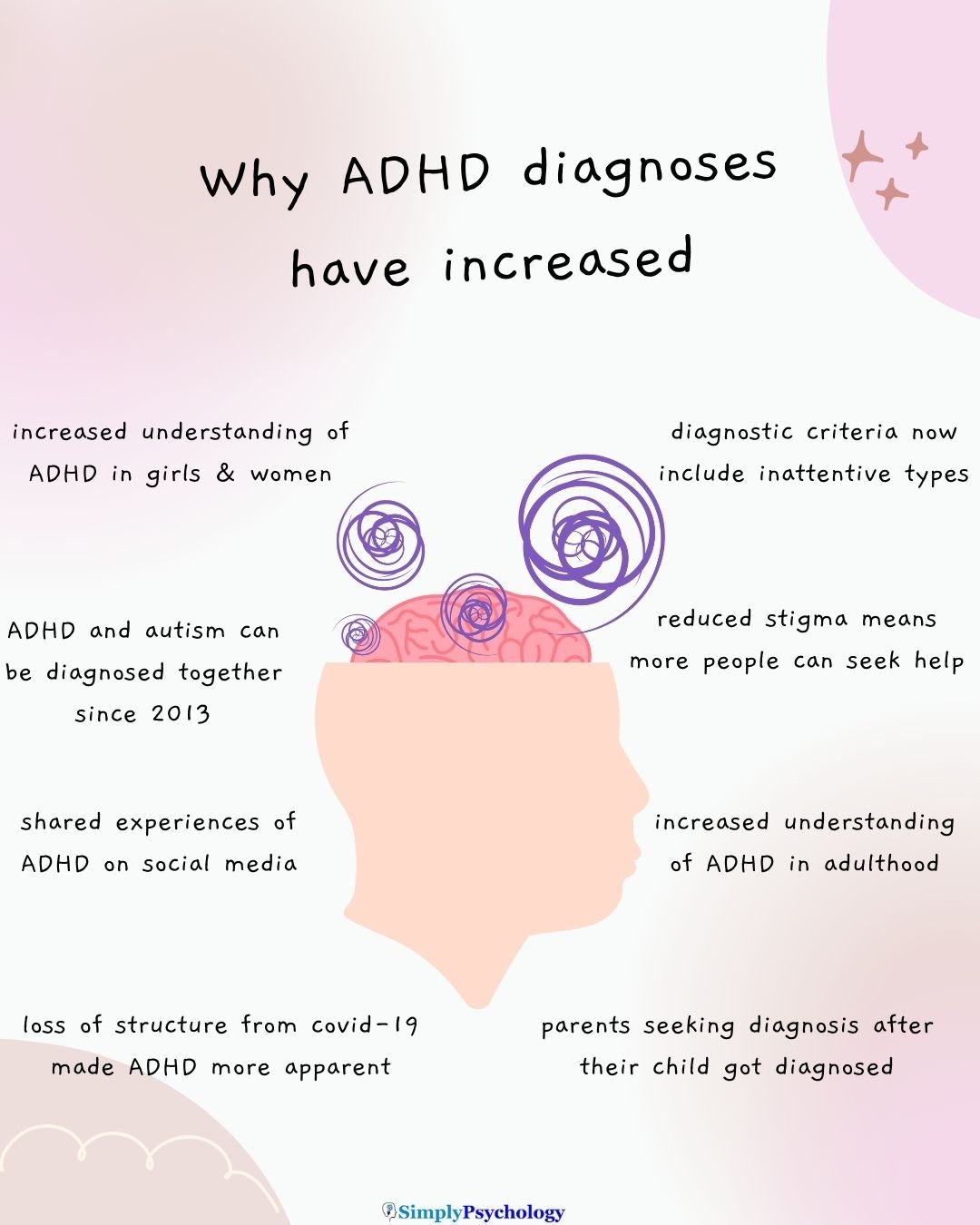
If these people were always there, why are they all getting diagnosed now? Caren Magill, an ADHD expert and author, explains that the surge is due to a collapse of coping mechanisms, particularly since 2020.
Magill notes that the rate of adult diagnosis has more than doubled since 2020. She attributes this to three specific triggers:
- The Loss of Structure: When the pandemic hit, the external routines (office hours, commutes, gym classes) that held people’s lives together vanished. Without this “scaffolding,” the internal chaos of ADHD became impossible to ignore.
- The “Child-to-Parent” Pipeline: Magill highlights that ADHD is highly hereditary. Many adults only realize they have it when sitting in a doctor’s office getting their child diagnosed.
- The Collapse of Masking: Those labelled as “high-functioning” adults often use “compensatory methods” (like extreme anxiety or perfectionism) to hide their symptoms. When the stress of the world increased (i.e. the COVID-19 pandemic), these masks fell apart.
Heritability is easy to misread. Twin research puts ADHD’s heritability at about 74% (Faraone & Larsson, 2019), which describes how much variation between people comes from genetic differences. It is a population-level figure, not a prediction of whether any one child inherits ADHD.
The “Lost Generation”: Women and Inattentive Types
For decades, the medical standard for ADHD was a hyperactive 12-year-old boy. If you didn’t fit that mold, you were likely missed.
Dr. Megan Anna Neff, a clinical psychologist, describes a “Lost Generation” of women, genderqueer people, and people of color. They were overlooked because they didn’t act out in class.
The research backs this up. A UK expert consensus statement on girls and women with ADHD points to referral bias and masking (Young et al., 2020).
It argues these, rather than true prevalence, explain much of the roughly 3:1 male-to-female diagnostic ratio. Visibly hyperactive children are referred quickly. Quiet, inattentive ones often are not.
Girls more often show the inattentive form and develop masking strategies, which hide their difficulties from others. Many are treated for anxiety or depression first.
The Criteria Changed
Dr. Barkley explains that a massive shift occurred when diagnostic manuals (the DSM-4 and DSM-5) finally recognized the “Inattentive Presentation.” This label describes ADHD that shows up mainly as difficulty sustaining attention rather than hyperactivity.
- Previously, you had to be hyperactive to get help.
- When “inattentive” criteria were added, the prevalence of the disorder in US children jumped from about 2–5% to 5–8%.
This wasn’t an inflation of the condition; it was the inclusion of the quiet daydreamers who had been struggling without support.
Current criteria also reflect how ADHD changes with age. DSM-5-TR requires six characteristics in a domain (inattention or hyperactivity-impulsivity) for children up to age 16. From age 17, the bar drops to five.
The lower bar recognizes that overt hyperactivity fades with age, while inattention, disorganization, and internal restlessness are more likely to persist (Franke et al., 2018). Adults can therefore look very different from the textbook hyperactive child, which is one reason adult ADHD is missed.
ADHD and co-existing Autism
Prior to the release of the DSM-5 in 2013, ADHD could not be diagnosed if someone already had a diagnosis of autism.
If a clinician diagnosed a child as autistic (or with Pervasive Developmental Disorder), they were instructed not to diagnose ADHD. That held even if the child showed clear hyperactivity or inattention (difficulty sustaining focus and following through on tasks).
Why this matters: many autistic people lacked ADHD support. We now know that ADHD commonly co-occurs with autism, and many people are described as being AuDHD.
This can also help explain the rise in ADHD diagnoses since 2013. Many autistic people can now receive an ADHD diagnosis, which was not an option for them before.
Where Overdiagnosis (and Underdiagnosis) Actually Happens
While the experts generally agree that broad overdiagnosis is a myth, they acknowledge that misdiagnosis does happen. It is critical to look at the specific statistics to understand where the errors lie.
Potential Overdiagnosis Areas
There are specific pockets where numbers may be inflated:
- College Campuses: Dr. Barkley notes that students may feign symptoms to get stimulants for studying.
- Regional Spikes: In Stockholm, Sweden, diagnosis rates for adolescent males are estimated to reach 15%, far above the global expected average of 5–7%. This suggests that in some highly medicalized areas, the bar for diagnosis may be too low.
Self-report is one weak point. Adult diagnosis rests largely on a person’s own account of their difficulties, which can be embellished to gain stimulant medication or accommodations (Lee et al., 2023). Clinicians therefore routinely check how credible the reported difficulties are. This is a safeguard, not an accusation.
The Reality of Underdiagnosis
Conversely, huge groups are still being left behind. Dr. Neff and recent studies point to significant racial disparities:
- Racial Gaps: Research indicates that non-Hispanic Black and Hispanic children have significantly lower odds of receiving an ADHD diagnosis compared to non-Hispanic White children, despite exhibiting similar symptoms.
- The Consequence: These children often face disciplinary action in school for behavior that would trigger a medical referral for their White peers.
Why Overdiagnosis Is Hard to Measure
ADHD traits lie on a continuum. Genetic research shows that clinical ADHD is the extreme end of heritable traits found across the whole population (Demontis et al., 2019).
The diagnostic threshold is therefore a practical cut-point on a dimension. That is why debates about “how much is too much” are so hard to settle.
Method matters too. Polanczyk et al. (2007) pooled 102 studies covering 171,756 children and adolescents, finding a worldwide prevalence of 5.29%. Most differences between studies reflected how they were run (diagnostic criteria, who reported, whether impairment was required) rather than where they took place.
Both errors cause harm. A European consensus statement concludes that adult ADHD remains widely underdiagnosed and undertreated (Kooij et al., 2019). Even a well-validated diagnosis leaves open where any individual’s threshold should sit.
Key Takeaways
- Verdict: Experts such as Dr. Russell Barkley say ADHD is not broadly overdiagnosed. Rising rates mostly reflect people who were missed before.
- Why Now: Pandemic disruption, parents recognizing their own traits through a child’s diagnosis, and the collapse of masking prompted many adult diagnoses.
- Missed Groups: Girls, women, and people with the inattentive form were overlooked. Wider criteria brought many in, and racial gaps in diagnosis persist.
- Autism Overlap: Before DSM-5 in 2013, ADHD could not be diagnosed alongside autism, so many autistic people lacked support.
- Prevalence: Adult estimates run from about 2.5% in lifespan reviews to the 5–6% Dr. Barkley cites, so method matters.
- Pockets: Overdiagnosis and misdiagnosis do occur in places, such as students seeking stimulants and some highly medicalized regions.
- Next Steps: Gather childhood evidence, rule out lookalikes, and seek neuroaffirming care.
Conclusion: It’s About Visibility, Not Virality
The rise in ADHD diagnoses can feel overwhelming, but the experts agree it is largely a positive correction of historical neglect. As Dr. Neff argues, identifying people who “have always been here” allows them to access the support they were previously denied.
According to Jane Ann Sedgwick and colleagues at King’s College London, successful adults with ADHD describe positive themes (Sedgwick et al., 2019). These include energy, resilience, and self-acceptance.
In their interviews, participants also described hyperfocus (intense absorption in engaging tasks) and divergent thinking, and using such strengths to work with their difficulties rather than only against them. These are the accounts of a selected group, not everyone.
A woman may realize her “laziness” is actually executive dysfunction: trouble with the planning and organizing skills that help people start and finish tasks. A parent may recognize their own struggles in their child. Either way, the data suggests we aren’t broadly overdiagnosing: we are finally just listening.
Next Steps: What to Do If You Resonate With This
If you suspect you might be part of the “Lost Generation,” here are three concrete steps to take:
- Look for “Life Evidence”: Before your appointment, write down examples of characteristics from childhood. A diagnosis requires evidence that several were present before age 12, so clinicians often ask people who knew you then.
- Check for “Lookalikes”: Burnout, anxiety, and trauma can mimic ADHD. Dr. Barkley recommends a thorough evaluation to rule these out. Sleep problems and thyroid conditions can also look like ADHD.
- Seek Neuroaffirming Care: If possible, find a clinician who understands “inattentive” or “high-masking” presentations to avoid being dismissed because you “have a job” or “did well in school.”
There is no single biological or psychological test for ADHD, so assessment is a careful clinical process. It usually combines four strands:
- Rating scales: Standardized checklists, completed by you and by people who know you, show whether enough characteristics are present to meet diagnostic criteria.
- Developmental history: A clinician asks when difficulties began and whether they appear across settings. For adults, this means looking back through your memory and accounts from people who knew you as a child.
- Medical check: Thyroid problems, sleep disorders, and sensory impairments can mimic ADHD, so they are ruled out or identified.
- Co-occurring conditions: Anxiety, depression, autism, and learning difficulties often co-occur, and they can both mask ADHD and be masked by it.
References
Demontis, D., Walters, R. K., Martin, J., Mattheisen, M., Als, T. D., Agerbo, E., Baldursson, G., Belliveau, R., Bybjerg-Grauholm, J., Bækvad-Hansen, M., Cerrato, F., Chambert, K., Churchhouse, C., Dumont, A., Eriksson, N., Gandal, M., Goldstein, J. I., Grasby, K. L., Grove, J., … Neale, B. M. (2019). Discovery of the first genome-wide significant risk loci for attention deficit/hyperactivity disorder. Nature Genetics, 51(1), 63–75. https://doi.org/10.1038/s41588-018-0269-7
Faraone, S. V., & Larsson, H. (2019). Genetics of attention deficit hyperactivity disorder. Molecular Psychiatry, 24(4), 562–575. https://doi.org/10.1038/s41380-018-0070-0
Franke, B., Michelini, G., Asherson, P., Banaschewski, T., Bilbow, A., Buitelaar, J. K., Cormand, B., Faraone, S. V., Ginsberg, Y., Haavik, J., Kuntsi, J., Larsson, H., Lesch, K.-P., Ramos-Quiroga, J. A., Réthelyi, J. M., Ribasés, M., & Reif, A. (2018). Live fast, die young? A review on the developmental trajectories of ADHD across the lifespan. European Neuropsychopharmacology, 28(10), 1059–1088. https://doi.org/10.1016/j.euroneuro.2018.08.001
Kooij, J. J. S., Bijlenga, D., Salerno, L., Jaeschke, R., Bitter, I., Balázs, J., Thome, J., Dom, G., Kasper, S., Nunes Filipe, C., Stes, S., Mohr, P., Leppämäki, S., Casas, M., Bobes, J., McCarthy, J. M., Richarte, V., Kjems Philipsen, A., Pehlivanidis, A., … Asherson, P. (2019). Updated European Consensus Statement on diagnosis and treatment of adult ADHD. European Psychiatry, 56(1), 14–34. https://doi.org/10.1016/j.eurpsy.2018.11.001
Lee, G. J., Do, C., & Suhr, J. (2023). Noncredible presentations of symptoms and functional impairment in the assessment of adult attention-deficit/hyperactivity disorder. Psychology & Neuroscience, 16(3), 284–301. https://doi.org/10.1037/pne0000319
Polanczyk, G., de Lima, M. S., Horta, B. L., Biederman, J., & Rohde, L. A. (2007). The worldwide prevalence of ADHD: A systematic review and metaregression analysis. American Journal of Psychiatry, 164(6), 942–948. https://doi.org/10.1176/ajp.2007.164.6.942
Sedgwick, J. A., Merwood, A., & Asherson, P. (2019). The positive aspects of attention deficit hyperactivity disorder: A qualitative investigation of successful adults with ADHD. Attention Deficit and Hyperactivity Disorders, 11(3), 241–253. https://doi.org/10.1007/s12402-018-0277-6
Young, S., Adamo, N., Ásgeirsdóttir, B. B., Branney, P., Beckett, M., Colley, W., Cubbin, S., Deeley, Q., Farrag, E., Gudjonsson, G., Hill, P., Hollingdale, J., Kilic, O., Lloyd, T., Mason, P., Paliokosta, E., Perecherla, S., Sedgwick, J., Skirrow, C., … Woodhouse, E. (2020). Females with ADHD: An expert consensus statement taking a lifespan approach providing guidance for the identification and treatment of attention-deficit/hyperactivity disorder in girls and women. BMC Psychiatry, 20(1), 404. https://doi.org/10.1186/s12888-020-02707-9

