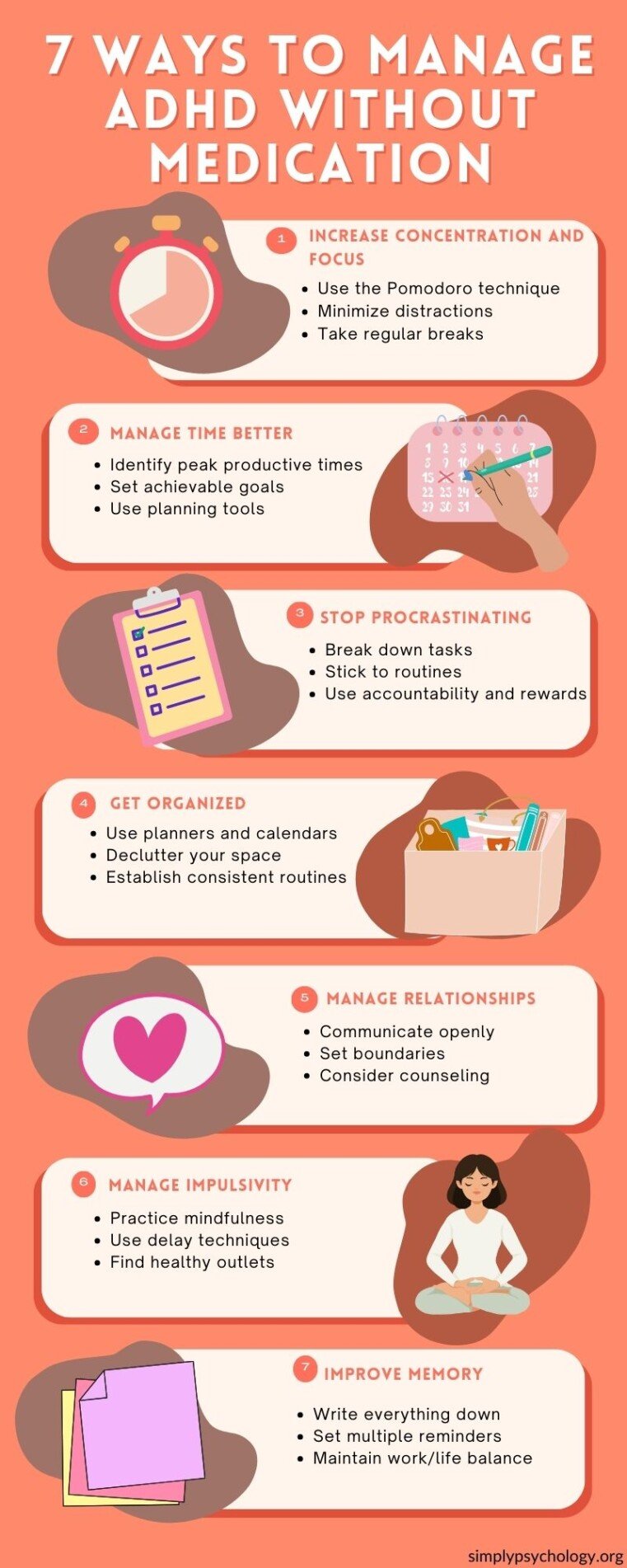
Living with ADHD can present unique challenges, often causing individuals to struggle with various aspects of daily life.
From traits of ADHD such as difficulties with focus and organization to impulsivity and hyperactivity, it’s crucial to recognize the need for effective coping strategies.
By implementing coping methods, individuals with ADHD can better navigate their challenges and enhance their overall well-being.

Key Takeaways
- Seven Techniques: The strategies below cover focus, time, procrastination, organization, relationships, impulsivity and memory.
- External Supports: Planners, timers, alarms and visible reminders stand in for the internal sense of time and memory that ADHD can make unreliable.
- Small Steps: Starting is often the hardest part, so shrink the first step until it feels easy.
- Not Laziness: Delayed starting reflects differences in how delay, effort and reward register, not a lack of commitment.
- Evidence: Most everyday tactics are untested in trials, but cognitive behavioral therapy, which teaches similar skills, has supporting evidence in adults.
- With Treatment: These strategies work alongside medication and therapy, not instead of them.
Below are some coping mechanisms for managing ADHD:
1. How to increase concentration and focus
Firstly, ensure you minimize any distractions. This can be from the environment, e.g., noise and bright lights, or electronic, e.g., app notifications and messages.
Secondly, remove any temptations. That might be your phone, a website, or a colleague who wants to chat. Make sure nothing around you can shift your focus.
Website blockers can help. These apps lock you out of a chosen site, e.g., Instagram, for a set amount of time to increase productivity.
Lastly, break down work into smaller chunks and incorporate comfort breaks.
The Pomodoro technique can be very beneficial, especially when working or studying.
Set a timer for 25 minutes. Work on one task until it goes off. Then take a 5-minute break. Repeat as often as you like, or until you are satisfied with your work.

One person with ADHD describes how they modify the Pomodoro method:
“One thing I’ve been trying recently is reverse pomodoros – a short, intense period of work, followed by a long rest. Basically, ADHD brains are often sprinters rather than long-distance runners, so short bursts of productivity work better for me than trying to knuckle down for hours on end.”
‘Oliver’
Why Distractions Pull So Hard
People with ADHD often describe attention that follows interest rather than importance.
Novelty may play a part.
In a brain-imaging study, 30 adults with ADHD and 30 controls completed a reward-learning task. Off medication, the ADHD group chose novel options more often, and heavier novelty-seeking went with poorer performance (Sethi et al., 2018).
This was a laboratory task. Still, it suggests making necessary tasks more engaging, for example by adding a timer or a short feedback loop.
That is an application of the findings, not a tested intervention.
Absorbing interests can also be a strength. Sedgwick, Merwood and Asherson (2019) interviewed successful adults with ADHD. They described positives such as energy, resilience, divergent thinking and hyper-focus, which means intense absorption in a task.
According to Sedgwick and colleagues, participants used these attributes to compensate for, and even harness, their difficulties. They treated ADHD as something to work with.
These adults are a selected group, so their experiences do not represent everyone with ADHD.
2. How to manage time better
Firstly, identify your peak productive days and times, and schedule your tasks around them. Working during your most energized hours helps you finish tasks faster. It also leaves time for other activities.
Secondly, set achievable goals and leave enough time to complete them (Modesto-Lowe, Chaplin, Soovajian & Meyer, 2013). Build in some extra buffer time for unexpected delays.
Lastly, use a planner or organization calendar to note down everything that needs to be done. This lets you set reminders, track your progress, and arrive on time.
“…through trial and error, I’ve learned a lot about what environments I work better in than others. I tend to take lots of breaks from work, often with a timer, so I don’t forget to go back to it. I still have a lot of trouble paying attention to assignments that don’t interest me, but as long as I block out enough time to work in I get things done eventually.”
‘Sam’
Why External Time Supports Help
External reminders help because time can be harder to sense with ADHD. A meta-analysis of 27 studies found that children and adolescents with ADHD judged durations less accurately and tended to overestimate them (Zheng et al., 2022).
The difference can last. Adults diagnosed in childhood still reproduced longer durations less consistently 20 years on, whether or not their ADHD persisted (Barkley & Fischer, 2019).
Time-management training has some support. In a Japanese pilot trial, 24 adults received group cognitive behavioral therapy focused on time management (planning how you use your time). Another 24 received usual care. The therapy group showed greater reductions in ADHD traits (Nakashima et al., 2022).
Planners, alarms and buffer time have not been tested on their own. Treat them as personal experiments and keep what works.
3. How to stop procrastinating
Firstly, break the task into smaller, more manageable targets. Big, imposing tasks invite procrastination, while small ones feel less daunting. Frame each step as a specific behavior you can “do”. Actionable plans tap into the “implementation problem” of ADHD.
“When tasks seem too overwhelming to start, it means that the task is too big. So you break it down into parts.”
Dr Tracey Marks, Psychiatrist
Then add structure around the task:
- Structure Your Day: Use time management techniques, ways of planning how you spend your time, to build a schedule.
- Limit Temptations: Remove access to tempting distraction activities during work blocks.
- Reward Effort: Give yourself rewards only after effortful priority tasks are completed, which reinforces their priority.
- Normalize Discomfort: Treat discomfort as an expected part of valuable tasks, not a reason to quit. Unease around starting is short-term and fades once you get going.
- Motivation: Use motivation as a driving force: ask friends or family to keep you accountable (Ventouri, 2020), or reward yourself with breaks, a snack or screen time.
- Body Doubling: Work alongside another person, in the room or online, to start and stay on task. Surveys describe use, but controlled evidence is sparse (Eagle et al., 2024).
Social pressure can also activate motivation and effort in people who struggle with self-regulation.
Why Starting Is So Hard
Feeling stuck is often called ADHD paralysis. The gap often lies between deciding and doing.
In one study, 50 children aged 9 to 15 chose between high-effort, high-reward and low-effort, low-reward options. Children with ADHD chose the high-effort option as often as their peers but carried it out less often (Winter et al., 2019).
Procrastination is a consistent finding. A systematic review of 11 studies (2,788 participants) linked ADHD traits to procrastination, with inattention (difficulty sustaining attention) the strongest link (Suriano, 2026).
None of this points to laziness. It points to differences in how delay, effort and reward register. Tactics that add immediacy, such as small first steps, outside prompts and quick rewards, fit these findings. Few have been tested in ADHD, so treat them as personal experiments.
Therapy can also help. A meta-analysis of 12 randomized trials found a small overall benefit of psychological treatments for procrastination, and a larger one for cognitive behavioral therapy (Rozental et al., 2018). The trials were not limited to people with ADHD.
4. How to get organized
Organization strategies work by moving demands off working memory, the mental workspace that holds information for a few seconds, and onto your environment:
- Organization Tools: Use planners and calendars, electronic or pen and paper. Having a system to track what you need to do is key.
- Declutter: Keep your working environment free of unnecessary items so you stay focused on the project at hand.
- Set Homes: Give commonly misplaced items like keys, wallets and smartphones assigned spots. This makes it easier to retrace your steps when distracted.
- Automate: Use features that remove self-regulatory demands, like automated bill payments and online grocery ordering. Outsourcing reduces the burden of monitoring and prompting routine chores.
- Keep a Routine: Find a routine that works for you and be consistent. Stay flexible and open to adjusting your system.
- External Motivators: Add visible reminders of rewards or ask others to check in. External drives can sustain organization better than relying only on inconsistent internal signals.
5. How to manage relationships
These habits can help your relationships:
- Mutual Trust: Build trust and an environment where you can both communicate openly. This helps you discuss disagreements more amicably and understand where you are both coming from.
- Clear Boundaries: Be clear about your own needs, wants and boundaries. Honoring them helps you feel fulfilled in your relationships, whether romantic or platonic.
- Explain, Don’t Excuse: Telling people your ADHD may explain how you act is fine, but it should not be used as an excuse for hurtful behavior. Accountability still applies.
- Professional Support: Do consider counseling or speaking to a professional to help express your views and get support managing ADHD and the specific relationships in question.
How you explain matters.
In three online experiments, adults read about a child with ADHD whose difficulties were explained biologically or psychosocially. The biological explanation reduced social distance but increased doubt that the problem could be treated (Lebowitz et al., 2016).
Pairing an explanation with a plan may help. For example, you could say that you lose track of appointments unless there is a cue, so you now use a shared calendar.
6. How to manage impulsivity and strong emotions
Try these strategies for impulsivity and strong emotions:
- Mindfulness: Try to incorporate mindfulness and breathing exercises into your daily routine. These can help ground you and let you step back from impulsive thoughts.
- Delay Techniques: Note things down first, ask yourself “Is this a true need or want?”, or count down from 5 before reacting. These help you minimize reactivity.
- Expression Strategies: Get your emotions out where you cannot affect others, for example by journaling, exercising, drawing, recording a voice note, or talking to a trusted person.
- Label Feelings: Name your feelings with words like “ugh” or “bleh” to express discomfort about tasks. Putting feelings into words can deflate emotional reactions, making impulsive behaviors less likely.
- Escape Plan: Anticipate situations that spark intense emotions and plan how to remove yourself. A walk or some music cools heated reactions before they control behavior. Planning ahead builds self-regulatory capacity.
Delay techniques tap into the inhibitory role of executive functions, the mental skills that help you pause to consider consequences.
7. How to remember things better
“With ADHD, out of sight is out of mind. So if it’s not on your planner, it doesn’t exist.”
Dr Tracey Marks, Psychiatrist
Firstly, ensure you are organized and make reminders your best friend. You can create these into calendar reminders or even set an alarm. If you need to set multiple alarms to remind you, then do this!
Secondly, place reminders in places you frequently see or visit. That could be leaving a sticky note on your fridge or your car or even changing the background of your phone to something important you want to remember.
Lastly, ensure a healthy and balanced lifestyle. Lack of sleep, for example, can impact memory (Harrison & Horne, 2000), alongside other things such as stress.
One person with ADHD shares their tips for what they find works for them:
“Keep your tasks as visible and quantifiable as possible. Calendar alerts are a godsend, but double up as much as possible. Besides phone alerts, I have a physical calendar, a meeting notebook, and a ton of sticky notes all over my desk. Once there’s something that I have to do, even if I can do it right now, I write it down somewhere and physically cross it off when I’m done. The act of writing it helps me remember, and crossing it off is satisfying enough to keep me on top of it.”
‘Adelaide’
Why Reminders and Movement Help
Visible reminders fit what researchers call prospective memory, the ability to remember to do something later.
In one study, 29 adults with ADHD and 24 controls completed real-life memory tasks. The adults with ADHD recalled and carried out fewer of their own intentions (Altgassen et al., 2019).
A visible cue swaps memory search for an external prompt. Trials have not yet tested whether reminders improve everyday outcomes.
Movement is one habit that has been tested.
A meta-analysis of eight trials in adults with ADHD found that one exercise session moderately improved inhibitory control, the ability to stop an automatic response (g = 0.55). Core ADHD traits improved only slightly (g = 0.23), and results for longer programmes were mixed (Xu et al., 2026).
How Can Coping Strategies Help Someone With Undiagnosed ADHD?
Coping strategies can offer several benefits for someone who is undiagnosed with ADHD, as they can provide practical techniques to manage some of the related signs.
No official diagnosis yet does not mean no struggles. Many people experience the world through an ADHD lens before they receive a diagnosis.
Coping strategies can help in four main ways:
- Self-Regulation: Strategies built around time, relationships and organization strengthen self-regulation. They provide structured routines, fewer distractions and better overall productivity.
- Lower Stress: Stress, anxiety and feelings of being overwhelmed may lessen as procrastination and disorganization ease.
- Better Mood: Fewer unhelpful emotions about unfinished projects can improve overall mood and how you relate to yourself and others.
- Communication: Signs of ADHD such as impulsivity or trouble sustaining focus can strain relationships at home and at work. Strategies can build skills and social confidence and reduce conflict.
Assessment and Professional Support
Coping strategies do not replace an assessment. No single test diagnoses ADHD.
Instead, a qualified professional, such as a psychiatrist or clinical psychologist, brings several sources together. These include rating scales, your developmental history, views from people who know you well, and a medical check for conditions that can mimic or accompany ADHD.
Support also has an evidence base.
A large analysis pooled 133 double-blind trials. On clinician ratings, all the main ADHD medications reduced core traits over about 12 weeks in children and adolescents, and several did in adults. Long-term evidence remains thin (Cortese et al., 2018).
Therapy has been tested too.
In a trial of 86 adults whose ADHD traits persisted despite medication, 12 sessions of cognitive behavioral therapy (CBT) produced more responders than relaxation with educational support. On one clinician rating, 53% responded to CBT versus 23% to relaxation (Safren et al., 2010).
If you suspect ADHD, a clinician can assess whether it explains your difficulties and which supports fit you best.
What Difficulties Can People With ADHD Face?
People with ADHD can face several difficulties in their daily lives, making it a challenge to navigate certain environments and situations.
Let us discuss some of the most common difficulties typically experienced:
- Attention: Focus is harder to sustain when a task feels boring, and distractions pull attention away more easily.
- Impulsivity: Reacting or acting in the spur of the moment, sometimes without weighing the risks.
- Organization: Keeping structure, routines and priorities can be hard, which can lead to missed deadlines and stress.
- Memory: Forgetfulness can mean missed appointments, forgotten instructions and lost details in conversations.
- Emotional Regulation: Emotions can feel stronger, and rejection or arguments can hit especially hard.
- Social Life: Interrupting, missing cues or forgetting plans can strain relationships, especially when criticism hurts.
Attention and concentration
Maintaining attention and concentration for prolonged periods of time is a commonly shared experience for people with ADHD.
This is more pronounced when the task feels boring, uninteresting, or mundane (Fugate & Gentry, 2016). It applies to tasks as well as conversations and presentations.
Someone with ADHD may drift off and daydream about more stimulating things. That can make it harder to regain focus.
Lastly, they are more susceptible to distractions, e.g., loud noises, bright lights, or sudden movements (Ross & Randolph, 2016).
Impulsivity
Impulsivity is another big challenge. People with ADHD are more prone to having both impulsive thoughts and behaviors, leading them to react or do things in the spur of the moment.
This can range from interrupting others when talking and changing subjects suddenly to potentially putting themselves in risky situations as they have not thought out any potential consequences beforehand.
Poor organization and planning
Challenges in being organized and well-planned can arise as a byproduct of attentional difficulties and impulsivity.
Oftentimes, people with ADHD experience difficulties maintaining structure, upholding routines and can find it challenging to organize and prioritize tasks.
This can lead to missed deadlines, procrastination (Bolden & Fillauer, 2020), and increased stress about daily life activities.
Executive functions help explain why. These are the mental skills that plan and organize behavior. A meta-analysis of 83 studies found weaker performance in people with ADHD on every executive-function task tested (Willcutt et al., 2005).
The differences were clearest for planning, working memory, vigilance (sustained alertness) and response inhibition (stopping an automatic response). They were neither necessary nor sufficient to cause every case, so organization problems have more than one source.
Forgetfulness and memory difficulties
Being forgetful and having overall memory difficulties is another sign of ADHD that can interfere with daily life (Raggi & Chronis, 2006).
Deadlines, appointments, anniversaries, and special celebrations can all be missed because people with ADHD do not remember them.
This can also impact work, with instructions being forgotten, or personal relationships with not remembering stories or information that people have expressed before.
Emotional regulation
Challenges with emotional regulation are another common ADHD struggle (Christiansen, Hirsch, Albrecht & Chavanon, 2019).
Due to impulsivity, emotional expressions may be exacerbated above what the situation calls for, with less thought being put into how these outbursts might impact others.
Someone with ADHD may find it more difficult to control anger and irritation or struggle to feel centered again after a confrontation.
Sensitivity to negative situations is also common. Examples include rejection (rejection-sensitive dysphoria) and arguments. People may have a negativity bias. They may read ambiguous situations in the worst light instead of a neutral one.
Social difficulties
Social difficulties are also a common struggle for someone with ADHD. This can stem from impulsivity, trouble sustaining attention, forgetting, or mishandling situations due to emotional dysregulation (Litner, 2003).
Some social skills can also be harder for people with ADHD. Examples include active listening and picking up on social cues. This can lead to mirroring or masking behaviors, which means hiding neurodivergent traits to appear more neurotypical.
None of these behaviors stems from malicious intent. In fact, people with ADHD are often sensitive to criticism and to situations where conflict may arise.
What are Some of the Consequences of Having ADHD?
ADHD can impact several areas of life, with traits leaking into both professional and personal relationships.
Let us look at some of the main consequences in three key life areas:
- Personal Struggles: Co-occurring anxiety and depression, ongoing stress and worry, and a more negative self-perception.
- Academics and Work: Inattention and impulsivity can lower performance, with grades, assignments and work projects taking the hit.
- Interpersonal and Social: Missed cues, forgotten dates and impulsive behavior can strain relationships and cause misunderstandings or conflict.
Personal Struggles
People with ADHD are more likely to have co-occurring mental health conditions such as anxiety and depression (Fischer et al., 2007).
Even if signs of these conditions do not become severe enough for a clinical diagnosis, stress and worry are often prevalent in this population group.
Additionally, struggles with not feeling good or capable enough and heightened sensitivity to criticism and judgment can lead to avoidance behaviors, imposter syndrome, and a negative self-perception.
Academics and Work
Challenges with inattention (difficulty sustaining attention) and impulsivity can consequently lead to lower academic or work performance.
This directly stems from difficulties with managing time, organization, and forgetfulness and finding it more challenging to remain engaged, focused, and interested. This directly impacts one’s ability to do work to the best of their abilities, with grades, assignments, and work projects taking the hit.
Research gives a partial picture of work outcomes:
- Employment: In a clinic sample of 414 adults with ADHD, 24% were in work, against 79% of a population comparison group (Halmøy et al., 2009).
- Associated Factors: Being out of work went with having both inattentive and hyperactive-impulsive traits, substance misuse, and a history of depression or anxiety (Halmøy et al., 2009).
- Workplace Support: A review of 143 studies found that most evaluated drug treatment, and research on workplace interventions was limited (Lauder et al., 2022).
These studies describe clinic samples and cannot show cause. Adjustments such as written instructions, quieter spaces and warning before task changes follow from the research on attention and time, but none has been tested against a comparison condition.
Interpersonal and Social
Additionally, interpersonal and social difficulties are another common consequence of having ADHD.
Social cues may be missed and important anniversaries forgotten. People close to the person with ADHD may feel they are not getting quality time because of distractions and impulsive behaviors.
Rifts may begin to form, which can lead to misunderstandings or even conflicts. Disagreements may also arise if impulsive behaviors, e.g., gambling addiction, become risky.
Frequently asked questions
How can ADHD coping strategies be applied at work?
As many ADHD strategies are centered around enhancing productivity, they can be a great addition to be applied at work. Here are a few ways you can begin doing that:
– Ensure your work desk is organized and clutter-free to help you focus better
– Check if there are any distractions in your environment, e.g., bright lights, loud noises, or online messages, and try to minimize them.
– Utilize technology to support you. For example, the Pomodoro method for focused work time, to-do list apps for reminders, and collaborative software for group work.
– Check-in with yourself around areas of stress, perfectionism, or imposter syndrome, and remember that mistakes are a universal experience and a chance for us to learn.
How can ADHD coping strategies be applied to studying?
As many ADHD strategies are centered around minimizing distractions, increasing focus, and enhancing productivity, they can be a great resource to apply for studying.
Here are a few ways you can begin incorporating them into your study routines:
– Firstly, identify your peak productive days/times, and establish a routine around them
– Ensure your environment is helping you to study. For example, good lighting, reduced outside noise, and minimized distractions from electronic devices.
– Break down larger assignments into smaller, more manageable tasks
– Incorporate technology to help you, e.g., timer apps for focused studying or online organization tools, or flashcards for spaced repetition
– Ensure you have everything you need with you before starting to study to overcome procrastination barriers and frequent interruptions.
Is it possible to calm down ADHD signs?
While it is not possible to completely eradicate ADHD signs, their impact can be reduced through coping mechanisms and management strategies.
In terms of consulting professionals, medication and therapy are two evidence-based avenues people can take to help manage ADHD.
On a more personal level, ensuring your environment is adjusted to your needs can be an excellent first step. For example, reducing distractions, stimuli and having an organized space.
Secondly, establishing solid routines around your peak productivity times and asking for support from your friends or family (if you are comfortable doing so) is another possible way to help calm down signs.
Lastly, ensuring healthy lifestyle habits are sustained, such as adequate sleep, balanced eating, and some form of exercise, are key to ensuring your body is getting the rest, fuel, and movement it needs for day-to-day functioning.
How can someone with ADHD deal with rejection?
Dealing with rejection can be challenging for several people. Having ADHD can present additional difficulties that can make rejections even more tricky to manage (Canu & Carlson, 2007).
However, there are still ways that can be used to help. Here are a few suggestions:
– Allow yourself to feel whatever emotions have risen and recognize that it is okay to be upset or hurt
– Reach out to people you feel safe with for support and to express your thoughts and feelings
– Try to take a step back from the situation and do not internalize what has happened. View it as an isolated incident and not a reflection of who you are and your value as a person
– Identify what you can learn from the rejection and use it as an opportunity to work on skill sets
– Remember to take care of yourself. Do an activity you enjoy or a self-care night and give yourself the time and space to recharge
References
Altgassen, M., Scheres, A., & Edel, M.-A. (2019). Prospective memory (partially) mediates the link between ADHD symptoms and procrastination. ADHD Attention Deficit and Hyperactivity Disorders, 11(1), 59–71. https://doi.org/10.1007/s12402-018-0273-x
Barkley, R. A., & Fischer, M. (2019). Time reproduction deficits at young adult follow-up in childhood ADHD: The role of persistence of disorder and executive functioning. Developmental Neuropsychology, 44(1), 50–70. https://doi.org/10.1080/87565641.2018.1541992
Bolden, J., & Fillauer, J. P. (2020). “Tomorrow is the busiest day of the week”: Executive functions mediate the relation between procrastination and attention problems. Journal of American College Health, 68(8), 854-863.
Canu, W. H., & Carlson, C. L. (2007). Rejection sensitivity and social outcomes of young adult men with ADHD. Journal of Attention Disorders, 10(3), 261-275.
Christiansen, H., Hirsch, O., Albrecht, B., & Chavanon, M. L. (2019). Attention-deficit/hyperactivity disorder (ADHD) and emotion regulation over the life span. Current psychiatry reports, 21, 1-11.
Cortese, S., Adamo, N., Del Giovane, C., Mohr-Jensen, C., Hayes, A. J., Carucci, S., Atkinson, L. Z., Tessari, L., Banaschewski, T., Coghill, D., Hollis, C., Simonoff, E., Zuddas, A., Barbui, C., Purgato, M., Steinhausen, H.-C., Shokraneh, F., Xia, J., & Cipriani, A. (2018). Comparative efficacy and tolerability of medications for attention-deficit hyperactivity disorder in children, adolescents, and adults: A systematic review and network meta-analysis. The Lancet Psychiatry, 5(9), 727–738. https://doi.org/10.1016/S2215-0366(18)30269-4
Eagle, T., Baltaxe-Admony, L. B., & Ringland, K. E. (2024). “It was something I naturally found worked and heard about later”: An investigation of body doubling with neurodivergent participants. ACM Transactions on Accessible Computing, 17(3), 1–30. https://doi.org/10.1145/3689648
Fischer, A. G., Bau, C. H., Grevet, E. H., Salgado, C. A., Victor, M. M., Kalil, K. L., Sousa, N. O., Garcia, C. R. & Belmonte-de-Abreu, P. (2007). The role of comorbid major depressive disorder in the clinical presentation of adult ADHD. Journal of psychiatric research, 41(12), 991-996.
Fugate, C. M., & Gentry, M. (2016). Understanding adolescent gifted girls with ADHD: Motivated and achieving. High Ability Studies, 27(1), 83-109.
Halmøy, A., Fasmer, O. B., Gillberg, C., & Haavik, J. (2009). Occupational outcome in adult ADHD: Impact of symptom profile, comorbid psychiatric problems, and treatment. Journal of Attention Disorders, 13(2), 175–187. https://doi.org/10.1177/1087054708329777
Harrison, Y., & Horne, J. A. (2000). Sleep loss and temporal memory. The Quarterly Journal of Experimental Psychology: Section A, 53(1), 271-279. https://doi.org/10.1080/713755870
Lauder, K., McDowall, A., & Tenenbaum, H. R. (2022). A systematic review of interventions to support adults with ADHD at work—Implications from the paucity of context-specific research for theory and practice. Frontiers in Psychology, 13, Article 893469. https://doi.org/10.3389/fpsyg.2022.893469
Lebowitz, M. S., Rosenthal, J. E., & Ahn, W.-K. (2016). Effects of biological versus psychosocial explanations on stigmatization of children with ADHD. Journal of Attention Disorders, 20(3), 240–250. https://doi.org/10.1177/1087054712469255
Litner, B. (2003, June). Teens with ADHD: The challenge of high school. In Child and Youth Care Forum (Vol. 32, pp. 137-158). Kluwer Academic Publishers-Plenum Publishers.
Modesto-Lowe, V., Chaplin, M., Soovajian, V., & Meyer, A. (2013). Are motivation deficits underestimated in patients with ADHD? A review of the literature. Postgraduate medicine, 125(4), 47-52.
Nakashima, M., Inada, N., Tanigawa, Y., Yamashita, M., Maeda, E., Kouguchi, M., Sarad, Y., Yano, H., Ikari, K., Kuga, H., Oribe, N., Kaname, H., Harada, T., Ueno, T., & Kuroki, T. (2022). Efficacy of group cognitive behavior therapy targeting time management for adults with attention deficit/hyperactivity disorder in Japan: A randomized control pilot trial. Journal of Attention Disorders, 26(3), 377–390. https://doi.org/10.1177/1087054720986939
Raggi, V. L., & Chronis, A. M. (2006). Interventions to address the academic impairment of children and adolescents with ADHD. Clinical child and family psychology review, 9, 85-111.
Ramsay, J. R. (2021). Adult attention-deficit/hyperactivity disorder. In A. Wenzel (Ed.), Handbook of cognitive behavioral therapy: Applications (pp. 389–421). American Psychological Association. https://doi.org/10.1037/0000219-012
Ross, P., & Randolph, J. (2016). Differences between students with and without ADHD on task vigilance under conditions of distraction. Journal of educational research and practice, 4(1), 1-10.
Rozental, A., Bennett, S., Forsström, D., Ebert, D. D., Shafran, R., Andersson, G., & Carlbring, P. (2018). Targeting procrastination using psychological treatments: A systematic review and meta-analysis. Frontiers in Psychology, 9, Article 1588. https://doi.org/10.3389/fpsyg.2018.01588
Safren, S. A., Sprich, S., Mimiaga, M. J., Surman, C., Knouse, L., Groves, M., & Otto, M. W. (2010). Cognitive behavioral therapy vs relaxation with educational support for medication-treated adults with ADHD and persistent symptoms: A randomized controlled trial. JAMA, 304(8), 875–880. https://doi.org/10.1001/jama.2010.1192
Sedgwick, J. A., Merwood, A., & Asherson, P. (2019). The positive aspects of attention deficit hyperactivity disorder: A qualitative investigation of successful adults with ADHD. Attention Deficit and Hyperactivity Disorders, 11(3), 241–253. https://doi.org/10.1007/s12402-018-0277-6
Sethi, A., Voon, V., Critchley, H. D., Cercignani, M., & Harrison, N. A. (2018). A neurocomputational account of reward and novelty processing and effects of psychostimulants in attention deficit hyperactivity disorder. Brain, 141(5), 1545–1557. https://doi.org/10.1093/brain/awy048
Suriano, R. (2026). A systematic review on the association between ADHD and procrastination. Research in Developmental Disabilities, 175, Article 105342. https://doi.org/10.1016/j.ridd.2026.105342
Ventouri, E. (2020). ADHD and Learning Motivations. Open Access Library Journal, 7(8), 1-28.
Willcutt, E. G., Doyle, A. E., Nigg, J. T., Faraone, S. V., & Pennington, B. F. (2005). Validity of the executive function theory of attention-deficit/hyperactivity disorder: A meta-analytic review. Biological Psychiatry, 57(11), 1336–1346. https://doi.org/10.1016/j.biopsych.2005.02.006
Winter, Y., Ben-Pazi, H., & Pollak, Y. (2019). Effort allocation in children with ADHD: Abnormal decision-making or poor execution? Journal of Attention Disorders, 23(11), 1240–1250. https://doi.org/10.1177/1087054716654569
Xu, S., Zhao, C., & Hu, L. (2026). The effects of acute and chronic exercise on executive functions and core symptoms in adults with ADHD: A systematic review and meta-analysis. Psychology of Sport and Exercise, 84, Article 103088. https://doi.org/10.1016/j.psychsport.2026.103088
Zheng, Q., Wang, X., Chiu, K. Y., & Shum, K. K. (2022). Time perception deficits in children and adolescents with ADHD: A meta-analysis. Journal of Attention Disorders, 26(2), 267–281. https://doi.org/10.1177/1087054720978557