ADHD overstimulation is a common sign of ADHD, defined as a state of heightened sensory, cognitive, or emotional arousal. It can occur when a person is either overwhelmed by environmental stimuli from their surroundings or internal input (Sikström & Söderlund, 2007).
Sensory overload, also called overstimulation, happens when sensory, social and mental demands exceed what a person can process at that moment.

Signs of Overstimulation in ADHD
ADHD overstimulation can manifest as several emotional and behavioral responses. Here are some of the most common signs:
- Sensory and emotional sensitivity, e.g., strong reactions to loud noises, bright lights, or intense reactions to criticism and negative feedback.
- Anxiety and stress, e.g., in specific social situations, crowded environments, or when having more challenging discussions.
- Restlessness and impulsivity, e.g., tendencies to fidget and react quickly without thinking things through.
- Emotional outbursts, e.g., intense crying fits, yelling, or even overexcitement.
- Cognitive overload and feeling unable to cope, e.g., feeling overwhelmed, unable to focus or complete tasks, increased stress, and feeling dread.
- Fatigue and overall physical and emotional exhaustion, e.g., feeling burned out, tendencies to shut down, and overall experiencing mental and physical tiredness.
- Information processing challenges, e.g., difficulty task switching, absorbing information, or remaining concentrated on the material.
What Does ADHD Overstimulation Feel Like?
Toby Shaw, in his TedTalk titled “ADHD from the inside,” describes the feeling of ADHD overstimulation as follows:
“Picture a big city and I want you to picture it in the intersection. You’ve got all these things going on: you’ve got buses, you’ve got cars, you’ve got people talking, you’ve got sounds, you’ve got all these things going on and it’s overwhelming. And I want you to imagine that sense of confusion and having that on a daily basis”.
Autistic adults have described overwhelm in similar terms. One interviewee called it a “traffic jam of processing” (Neville et al., 2026).
As we can see, ADHD overstimulation can feel extremely overwhelming and disorienting. Let us discuss in more detail some of these most common ways it can feel:
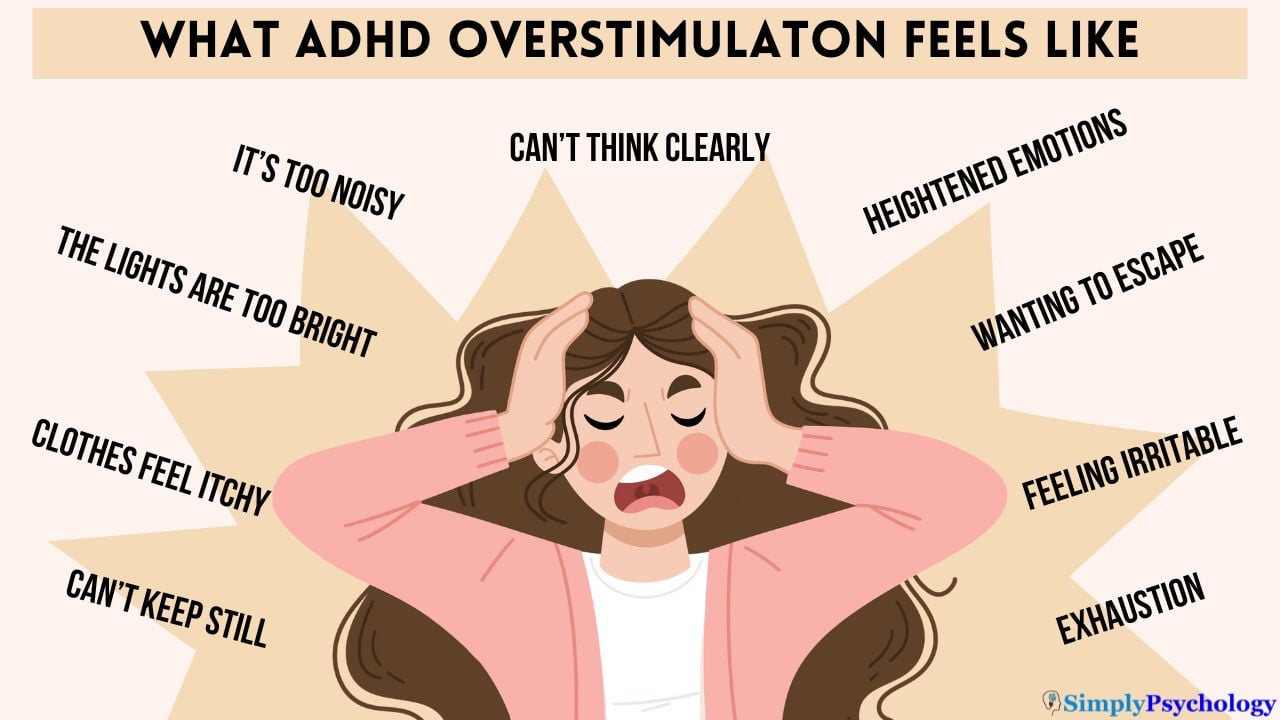
Restlessness
Intense, persistent restlessness may be part of ADHD overstimulation (Weyandt et al., 2003). It is like an itch that will not go away. Or like a surge of internal energy with nowhere to go.
You might be tempted to fidget, tap your fingertips, or move around a lot.
Your body may seem to demand movement, even if it is only shifting in your seat. Staying motionless can feel extremely difficult.
In a setting that calls for composure and concentration, this restlessness can be especially aggravating. It can leave you feeling on edge, both physically and mentally.
Fidgeting is not simply a nuisance. In 70 adults with ADHD, movement sensors recorded more fidgeting during correct trials of an attention task (Son et al., 2024). The authors suggest it may help sustain attention, although other explanations exist.
Extreme Discomfort
Extreme discomfort can arise when sensory input floods in. Adults with ADHD report heightened sensitivity more often than norm groups, especially to sound (Bijlenga et al., 2017).
Overstimulation can cause you to become more perceptive of your environment and make normal sensations seem overpowering. For example, lights, noises and textures can seem overly strong.
It can feel as if your senses are in overdrive. You may find it hard to get relief or to feel at peace. It can seem as though everything around you is turned up to an unpleasant volume.
Panic
When you are overstimulated, you could feel panicky and as though your body’s fight-or-flight response has been activated. It is comparable to being in a crowded space where the noise level peaks, and you immediately want to leave.
Physical and emotional symptoms of this anxiety are possible. Examples include a faster heart rate and trouble breathing.
A sense of imminent disaster or of being emotionally overwhelmed can also occur. Panic can make it hard to think clearly, which adds to the overwhelm.
The cause differs. Overload follows input that exceeds your capacity. A panic attack is a surge of fear that can arrive with no clear trigger.
In some cases, these symptoms may even progress to a panic disorder (Krone & Newcorn, 2015).
Physical and Mental Exhaustion
Overstimulation can paradoxically make you feel both energized and completely fatigued. You may feel exhausted from the effort your body and brain make to process the stream of sensations.
Even if you have not moved physically, it can feel like running a marathon in your head. This fatigue affects the mind as well as the body.
You may notice that you lose the capacity to focus or participate in activities, leaving you feeling mentally fatigued. It may also seem as though you have run out of cognitive capacity while attempting to process the stimuli in your environment.
‘One of the keys always behind when I get overwhelmed is that I’m doing too much. This is despite the fact that even when I have too much on my plate, it always feels like I should be doing more, that I could squeeze in a few more things and then, well, then I’d probably still try to add a few more things.’
William Curb, host of ‘Hacking Your ADHD’ podcast
Headaches
Headaches are a common report during overstimulation. A meta-analysis found that ADHD is associated with migraine, but not with tension-type headache (Salem et al., 2018).
That meta-analysis did not measure overstimulation, so it cannot show that overload causes headaches. Some autistic adults also describe headaches and nausea after strong sensory input (MacLennan et al., 2022).
Headaches can vary from a dull ache to severe pain.
Some people find the headache tracks their overstimulation: the more overstimulated they are, the worse it feels.
Energy Surges and Crashes
Energy surges and crashes from ADHD overstimulation can resemble a roller coaster with rapid ascents and descents. Your energy may spike at first as your brain attempts to process everything around you.
But over time, this surge can leave you physically and mentally exhausted.
The pattern can repeat daily or weekly.
The setting matters too. Energy swings may be less likely at home or in a safe space, and more likely outside, where overstimulation has more chances to build.
What are Meltdowns and Shutdowns?
Meltdowns and shutdowns can be defined as intense emotional and behavioral responses that individuals with ADHD can experience.
These typically manifest when overwhelmed by either sensory, cognitive, or emotional stimuli (Mayes, Calhoun, Mayes & Molitoris, 2012).
Meltdowns are extreme emotional outbursts that can include yelling, sobbing, smashing objects and often combine physical actions with intense uncomfortable feelings such as anger, frustration, sadness, or panic.
A meltdown is a response to overload, not a tantrum. It occurs when sensory or emotional input becomes too much to bear.
Shutdowns are disengagement from interactions and external stimuli. A shutdown can cause a person to withdraw and seem distant from their environment (Spaeth, 2022).
This serves as a coping strategy to control overstimulation and give the person a “break” from what is happening around them.
Research on ADHD meltdowns and shutdowns is much thinner than research on autistic meltdowns and shutdowns. Few studies have made them a main outcome.
What Can Cause Overstimulation in ADHD?

ADHD overstimulation can not only cause several mental and physical challenges but may also permeate into other areas of one’s life. Let us look in more detail at some of the most frequent areas of manifestation and impact.
Oversensitivity
A person with ADHD can have increased sensitivity to environmental stimuli (Panagiotidi, Overton & Stafford, 2018).
Light, sound, touch, smell and taste can all feel amplified or overwhelming. Social interactions can too.
As the brain tries to analyze and filter this incoming data, overstimulation can directly result in oversensitivity. For instance, someone with ADHD may become overstimulated by a mildly noisy situation that others may find tolerable.
Executive Dysfunction
Executive functions, which include abilities like working memory, decision-making, and attention management, can operate differently in ADHD (Barkley, 1997). They are the mental skills used to plan, switch tasks and control impulses.
For example, it may be harder to manage several tasks at once, filter out unimportant information and stay focused when these skills are stretched.
Busy settings can tip quickly into cognitive overload. For instance, following directions in a room full of competing demands can be hard.
ADHD coach Caren Magill explains how ‘time blindness‘ is an executive dysfunction in people with ADHD. This can include always being late or not noticing the passage of time, which can lead to rushing.
‘When you’re rushing, you’re not really paying attention to what you’re doing, you tend to make more mistakes, you lose things, you say things you don’t mean or agree to things you shouldn’t, and you just generally feel overstimulated… So if anything adds on top of that, you’re more than likely going to hit your threshold really quickly.’
Caren Magill, ADHD Coach
Emotional Dysregulation
Emotional dysregulation means having difficulty managing emotional experiences, which can lead to intense reactions.
In ADHD, emotional dysregulation may arise from imbalances in neurotransmitters, such as dopamine, which is involved in the reward and attention regulation pathways (Blum et al., 2008).
Differences in executive function (the mental skills that plan, switch tasks and control impulses) are also linked with ADHD (Brown, 2009). These can affect impulse control and emotional regulation.
These neurological differences can make it harder to modulate emotional responses. Other people may read the reactions as disproportionate.
Emotional dysregulation frequently involves strong and unpredictable emotions (Shaw, Stringaris, Nigg & Leibenluft, 2014).
Even minimally stressful situations can trigger powerful emotional reactions. Overstimulation can then build quickly, because of this intensity and the difficulty regulating emotion.
For example, constructive criticism may set off a strong emotional reaction that others would find manageable. That reaction can then lead to overstimulation.
Task Complexity
Complex jobs requiring careful planning and decision-making can be too much for those with ADHD to handle.
As task complexity rises, cognitive resources come under more pressure. Sensitivity and emotional reactivity can rise with it, which makes overstimulation more likely.
This susceptibility can also be increased by cognitive exhaustion brought on by completing challenging activities in difficult circumstances.
‘We tend to take on too much because we don’t think about how long things will take. So we agree to do too much, we want to do too much, and that leads us into a state of overwhelm.’
Caren Magill, ADHD Coach
Why Overstimulation Builds Up Across the Day
Overstimulation is not a fixed limit.
Your capacity moves with your state: it shrinks when you are tired, stressed or ill, and grows when you are rested, supported and in control.
In a survey of 49 autistic adults, many noises and lights were tolerable when people felt relaxed and rested. When they were stressed or tired, the same input became unpleasant or overwhelming (MacLennan et al., 2022).
Small pressures also pile up. One autistic woman, quoted in our guide to autism overstimulation, compared the feeling to a supermarket checkout. The cashier scans items faster than you can pack them.
At first it is manageable. Then things pile up, and the pressure to keep going makes it all feel like too much.
Overload is about rate and accumulation as well as intensity. That is why sleep and rest, covered below, matter so much.
Sensory Differences in ADHD: What the Research Shows
Sensory differences in ADHD are well described. Most studies, though, are cross-sectional and rely on self-report. They show what people experience rather than what causes it.
How Common Are Sensory Differences in ADHD?
Four sets of findings stand out.
- Adults: Among 116 adults with ADHD, heightened and reduced sensitivity were both reported more often than in norm groups, especially for sound (Bijlenga et al., 2017).
- Women and men: 43% of women reported heightened or reduced sensitivity, against 22% of men. This comes from one clinic sample and needs replication.
- General population: Among 234 people, more ADHD traits went with more sensory difficulties in every sense asked about (Panagiotidi, Overton & Stafford, 2018).
- Children: A review concluded that over-responsivity varies within ADHD and proposed adding it to assessments (Lane & Reynolds, 2019).
In the adult clinic study, both patterns rose with ADHD scores and were not linked to autistic characteristics. The two adult studies relied on questionnaires.
Too Much and Too Little Stimulation
Some accounts suggest ADHD involves a difficulty with arousal, not only with overload. Sikström and Söderlund (2007) proposed a model with four parts.
- Baseline: abnormally low baseline dopamine boosts the brain’s response to each new stimulus.
- Sensitivity: this produces heightened sensitivity to the environment.
- Performance: too little and too much stimulation both reduce performance.
- Compensation: a dull environment leads to low arousal, which is often offset by moving more.
This echoes older ideas about optimal arousal, such as the Yerkes-Dodson law.
The model makes a testable prediction. People with ADHD should need more background noise than others to perform at their best. In a test with children, white noise improved performance in the ADHD group and worsened it in controls (Söderlund, Sikström & Smart, 2007).
In practice, the same person may seek stimulation in a quiet room and be overwhelmed in a busy one.
ADHD and Autism: Overlap and Measured Responses
Sensory differences are not specific to ADHD. A study of 120 children aged 6 to 12 included 43 autistic children, 28 with ADHD, 18 with both and 31 typically developing children.
Atypical sensory processing was more common in each diagnostic group than in typically developing children. It did not detect a difference between the autism and ADHD groups (Dellapiazza et al., 2021).
So sensory differences cannot reliably tell the two apart. Assess them in anyone being evaluated for either condition, including people with both autism and ADHD.
Questionnaires and lab measures can also disagree. In one study of 26 adolescents with ADHD and 29 comparison adolescents, self-reported tactile sensitivity and avoidance differed between groups. Objective somatosensory thresholds did not reach significance (Buyuktaskin et al., 2026).
Questionnaires capture lived experience, which matters in its own right. They do not show that the sensory system itself responds differently.
Studies that follow children from infancy are only beginning. In one cohort of 151 infants, a family history of ADHD was linked to steeper increases in under-responsiveness to sensory input (Carter Leno et al., 2025). The direction of effects is unknown.
Taken together, experienced sensory difference in ADHD is well supported. Its mechanism is not yet known.
How to Cope with ADHD Overstimulation
ADHD overstimulation can impact several areas of life, so knowing how to manage symptoms can positively impact both day-to-day living as well as interpersonal relationships.
Most of these steps are practical suggestions rather than treatments tested against overstimulation in ADHD. Try them as experiments, and keep what works for you. Here is a quick overview, with detail on each below:
- Identify the triggers: note the situations, places and activities that leave you overstimulated.
- Gain control: limit your exposure to those triggers where you can.
- Sleep: keep a regular schedule so your brain can recover.
- Routine: use a simple schedule with buffer time and breaks.
- Safe spaces: set up a calm, private place to retreat to.
- Cool downs: build short rest periods into your day.
- Adapt and adjust: change your surroundings to meet your sensory needs.
- Self-soothing: find a go-to technique for restoring calm.
- Supportive relationships: lean on friends, family and professionals.
- Relaxation: practise yoga, meditation or mindfulness regularly.
- Professional help: seek support if overstimulation keeps disrupting daily life.
Identify the triggers
The first step in managing ADHD overstimulation is to pinpoint the precise triggers that result in these difficult situations.
You can begin considering everything from the circumstances, surroundings, and/or activities that frequently lead to overstimulation.
This could include social situations, busy areas, noisy environments or multitasking. Sorting what you notice into four groups can help:
- Sensory: sound, bright or flickering light, textures and smells.
- Environmental: crowds and cluttered or disorganised spaces.
- Social: long conversations and misunderstandings.
- Cognitive: too much information and complex instructions.
A personal rating scale for how stimulated you feel, checked regularly, can help you act before you reach your limit. Once you know your triggers, you can handle them early.
Gain control over triggers
Once you have determined the triggers, try to slowly begin to avoid them whenever you can. For example, this could look like making adjustments to your routine or environment as necessary.
Additionally, consider wearing noise-canceling headphones or choosing quieter areas, for instance, if loud situations trigger you. You can lessen the possibility of overstimulation by taking precautions to limit exposure to triggers.
Sleep schedule
A regular sleep schedule can make overstimulation easier to manage. In one study, losing an hour of sleep a night for six nights worsened attention-test scores in children with ADHD and in controls (Gruber et al., 2011).
That study did not measure sensory processing, so the link to overload is an inference.
Make adequate sleep a priority and set up a nighttime ritual that helps you unwind. Try a sleeping mask, white noise and a silenced phone.
A rested mind may find it easier to take in sensory information without becoming overwhelmed.
Develop a routine
Developing a routine can help provide structure, monitor activities, and create a sense of consistency.
Start by writing down a daily or weekly schedule of the activities you often do. Use it to block time for your goals. Leave room for breaks.
Buffer times keep your routine flexible. A routine can also give you a sense of control over environmental triggers, which makes sensory stimulation easier to manage.
ADHD coach Tara McGillicuddy explains that when she is working with people, she reminds them to ‘Only focus on the one thing they’re working on… break it down into actionable steps.’ She adds, ‘If you are overwhelmed… create some structure in your own life.’
Identify safe spaces
A calm, private and accessible space to go to when overstimulation happens is key. So identify safe spaces where you spend most time.
For example, this can range from a room in your house where you feel relaxed or a quiet corner in the office where you can retreat and decompress.
Add elements that help you calm down, such as items in your favorite colors, textures or scents. Keep a few with you for a mobile safe space.
In interviews with 16 autistic adults in the UK, recovery spaces shared six features (Neville et al., 2026).
- Clear and minimalist: uncluttered, minimalist surroundings.
- Controllable: temperature, light, sound and smell you can adjust.
- Cosy: a cosy feel.
- Visual interest: something engaging to look at.
- Safe and familiar: a place that feels safe and familiar.
- Intense interests: room for them.
Many people with ADHD may find the same features helpful, though that study did not test it.
Have regular ‘cool downs’
Include periodic “cool-down” or rest intervals in your day to allow yourself to unwind and prevent burnouts and shutdowns. For example, you can step away from potentially stressful circumstances during these periods to regroup.
Find a place that is peaceful so that you can practice soothing techniques like deep breathing, mindfulness exercises, or even just closing your eyes for a while.
Brief rest periods are protective. They can keep sensory overload from developing and escalating.
Adapt and adjust
Instead of getting rid of the triggers completely, try to modify your surroundings to meet your sensory needs. Some examples of these are rearranging your desk, utilizing task organizers, or creating designated quiet spaces throughout your home.
Overstimulation can be considerably decreased by designing an environment that has such measures put in place to either help avoid escalations entirely or minimize their intensity.
Plan Ahead and Communicate Your Needs
Planning can ease anxiety and prepare you for places you cannot avoid. Useful steps include:
- Preview the venue, schedule or route where you can.
- Carry a small kit, such as sunglasses, earplugs and a comforting object.
- Agree an exit strategy and a finish time.
- Schedule low-sensory breaks around a busy day.
- Avoid places where overstimulation is likely when you can.
Many sensory needs are invisible, so telling people helps. Agree a gesture for needing a break. Try a short phrase, such as “I need a quiet space for ten minutes”. Send a typed message if speaking is hard.
In a Swedish study, autistic adults in health care asked for written information in advance. They also wanted photos of the facilities and staff and a clear schedule (Strömberg et al., 2022). The same details may help before other events too.
Self-soothing
Self-soothing techniques can help when overstimulation arises. Options include grounding exercises, progressive muscle relaxation and deep breathing.
Each person is different in what works best for them, so try out various methods to see which one aligns with you the best.
A go-to technique gives you something to rely on when stress rises.
Chosen input can soothe too. In a survey of 49 autistic adults, people described keeping a blanket, something to hold or music at a volume they control. They said chosen input helped them filter out the rest (MacLennan et al., 2022).
Find supportive relationships
Supportive relationships can help adults with ADHD who are feeling overwhelmed or overloaded in their daily lives.
Specifically, research has found that having interpersonal and professional relationships is essential for helping manage daily life. Friends and family can provide support and guidance in coping with ADHD. Relationships also offer accountability: someone to turn to.
Relationships with healthcare professionals could also be beneficial when there is collaboration and ongoing guidance about things like medication adjustments. This active support from a provider can ease the burden on the individual trying to manage their ADHD independently (Becker et al., 2023).
Overall, having people to turn to likely prevents feelings of overload from becoming unmanageable for those with ADHD.
Relaxation techniques
Relaxation techniques may help you manage stress and avoid overstimulation. Popular options include yoga (studied in children with ADHD; Lange et al., 2014), meditation and mindfulness. They may support your sensory processing (the way your nervous system registers and filters input from the senses) and aid emotional response regulation.
The evidence is encouraging but limited. In a small study, eight weekly mindful awareness sessions improved sustained attention, mood and quality of life in adults with ADHD and in controls (Bueno et al., 2015).
Start weekly and build up to daily if you want to. Over time, such strategies may encourage calm and raise your general tolerance for sensory input.
Consider professional help
Lastly, you might find it helpful to seek professional assistance if overstimulation constantly disrupts your daily life.
A mental health professional, such as a therapist, ADHD coach or psychiatrist, can offer customized techniques and coping mechanisms.
Additionally, they can aid in addressing any underlying emotional or psychological issues that may be linked and exacerbating your overstimulation.
Three therapies may help you learn to soothe overstimulation:
- Cognitive behavioral therapy (CBT)
- Dialectical behavior therapy (DBT)
- Acceptance and commitment therapy (ACT)
Few trials have tested therapies aimed at sensory overstimulation in ADHD. One 2026 randomised trial tested ten weeks of Ayres Sensory Integration therapy against a waiting list in 94 children aged 6 to 8 with ADHD. This occupational therapy approach uses sensory-rich, child-directed activity.
The treated group improved on sensorimotor function, attention, executive function and emotional regulation (Kaplan Kılıç et al., 2026). A waiting list does not control for expectancy. So the trial cannot show that the sensory element was the active ingredient.
FAQs
What is the cause of ADHD overstimulation?
Neurobiologically, people with ADHD often process information differently. This is especially true in regions linked to attention, sensory perception and emotional control (Shaw, Stringaris, Nigg u0026amp; Leibenluft, 2014). u003cbru003eu003cbru003eThey might, therefore, be more vulnerable to being overwhelmed by stimuli that don’t generally disturb neurotypical non-ADHD individuals as much. For example, being in a loud, brightly lit office with lots of overlapping ongoing conversations and/or noises.
What is the difference between overstimulation and understimulation?
Overstimulation is a state in which a person’s sensory, cognitive, or emotional stimuli surpass their ability to effectively integrate and manage their feelings (Frankenhaeuser, Nordheden, Myrsten u0026amp; Post, 1971). u003cbru003eu003cbru003eRestlessness, feeling overwhelmed and intense emotions may result. Overstimulation frequently happens in settings with high sensory input or when performing activities that call for a lot of focus and attention. u003cbru003eu003cbru003eIt can also cause severe discomfort.u003cbru003eu003cbru003eUnderstimulation is the opposite. A person receives too little sensory or cognitive input. This could make someone feel bored, restless, or like they need more stimulation. u003cbru003eu003cbru003eUnderstimulation frequently happens when there is not enough novelty or difficulty to hold someone’s interest. Those who are understimulated may look for activities that are more stimulating, as the lack of involvement can make it difficult u003ca href=u0022https://www.simplypsychology.org/adhd-motivation.htmlu0022 data-type=u0022postu0022 data-id=u002233642u0022u003eto stay motivated and focused.u003c/au003e
Is overstimulation always a sign of ADHD?
Overstimulation can happen in various situations and even among people who do not have ADHD. This can include neurotypical people and other neurodiverse individuals such as those who are Autistic. u003cbru003eu003cbru003eAnyone can get overstimulated by circumstances outside themselves, such as overly exciting surroundings or environmental stimuli, e.g., a crowded concert. u003cbru003eu003cbru003eHowever, people with ADHD can be more susceptible to overstimulation due to their heightened sensory responses and challenges in controlling stimuli.
Are overstimulation and hypersensitivity the same thing?
Although related terms, overstimulation and hypersensitivity mean different things. u003cbru003eu003cbru003eHeightened sensitivity to sensory stimuli is referred to as hypersensitivity. This implies that hypersensitive people may receive sensory input more strongly than others. u003cbru003eu003cbru003eContrastingly, excessive sensory, cognitive, or emotional input that exceeds a person’s ability to efficiently handle it causes overstimulation. Overstimulation can be caused by hypersensitivity, but it also results from sensory overload.
Can overstimulation feel like a panic attack?
In terms of the intensity of the physical and mental symptoms, overstimulation and panic attack episodes can be comparable, but their causes and mechanisms differ. u003cbru003eu003cbru003eOverstimulation is a reaction to an individual’s processing capacity being surpassed by an overwhelming amount of sensory, cognitive, or emotional input. This may result in restlessness, impatience, and a sense of helplessness. u003cbru003eu003cbru003eIn comparison, panic attacks are episodes of extreme dread or worry that can cause physical symptoms, including a racing heartbeat, shortness of breath, and a sense of impending doom. u003cbru003eu003cbru003eEven while there may be some similarities in physiological reactions, the underlying reasons and emotional states are separate.
Do people with ADHD get overstimulated easily?
People with ADHD can indeed be more prone to overstimulation because of their heightened sensory sensitivity and difficulties controlling stimuli. u003cbru003eu003cbru003eTheir brains might have trouble effectively filtering and processing sensory, cognitive, or emotional information, which can make them more susceptible to feeling overloaded. u003cbru003eu003cbru003eFor those with ADHD, commonplace situations that would not normally cause overstimulation could have a higher effect. It is thus crucial to remember that people with ADHD have different levels of susceptibility to overstimulation. u003cbru003eu003cbru003eLastly, some people might encounter it more regularly or intensely than others, while for others, it may not impact them that significantly.
Key Takeaways
- Overstimulation: Sensory overload happens when sensory, social and mental demands exceed what you can process at that moment. It reflects capacity, not weakness.
- Common Signs: Restlessness, strong reactions to noise and light, anxiety or panic, emotional outbursts, cognitive overload and exhaustion.
- Capacity: Tiredness, stress and heavy demands lower how much you can handle, so overstimulation builds up across a day.
- Causes: Sensory sensitivity, executive function differences, emotional intensity and complex tasks can all contribute.
- Evidence: Sensory differences are well described in ADHD, but studies mostly rely on self-report (Bijlenga et al., 2017; Panagiotidi et al., 2018).
- Coping: Identify triggers, protect sleep, build routines and use safe spaces. Most steps are practical suggestions, not tested treatments.
References
Barkley, R. A. (1997). Behavioral inhibition, sustained attention, and executive functions: constructing a unifying theory of ADHD. Psychological bulletin, 121(1), 65.
Becker, P., Rask, M., Safipour, J., & Gunnarsson, A. B. (2023). Selfcare Strategies Shown to Be Useful in Daily Life for Adults Diagnosed with Attention Deficit Hyperactivity Disorder–A Systematic Review. Issues in Mental Health Nursing, 1-9.
Bijlenga, D., Tjon-Ka-Jie, J. Y. M., Schuijers, F., & Kooij, J. J. S. (2017). Atypical sensory profiles as core features of adult ADHD, irrespective of autistic symptoms. European Psychiatry, 43, 51–57. https://doi.org/10.1016/j.eurpsy.2017.02.481
Blum, K., Chen, A. L. C., Braverman, E. R., Comings, D. E., Chen, T. J., Arcuri, V., … & Oscar-Berman, M. (2008). Attention-deficit-hyperactivity disorder and reward deficiency syndrome. Neuropsychiatric disease and treatment, 4(5), 893-918.
Brown, T. E. (2009). ADD/ADHD and impaired executive function in clinical practice. Current Attention Disorders Reports, 1(1), 37-41.
Bueno, V. F., Kozasa, E. H., da Silva, M. A., Alves, T. M., Louzã, M. R., & Pompéia, S. (2015). Mindfulness meditation improves mood, quality of life, and attention in adults with attention deficit hyperactivity disorder. BioMed Research International, 2015.
Buyuktaskin, D., Aktar-Songür, İ., Özaslan, A., Kurt, Z. K., Guney, E., Iseri, E., Gunendi, Z., & Cengiz, B. (2026). Linking sensory processing patterns and somatosensory thresholds to behavioural and emotional symptoms in adolescents with ADHD. Scientific Reports, 16, Article 23879. https://doi.org/10.1038/s41598-026-63869-2
Carter Leno, V., Begum-Ali, J., Goodwin, A., Mason, L., Pasco, G., Narvekar, N., Pickles, A., Charman, T., Johnson, M. H., Jones, E. J. H., & the STAARS Team. (2025). Cortical markers of excitation/inhibition balance are associated with sensory responsivity from infancy in longitudinal cohorts enriched for autism and ADHD. Translational Psychiatry, 15, Article 532. https://doi.org/10.1038/s41398-025-03791-9
Curb, W. (Host). (2023, August 7). Too Much (rebroadcast). In Hacking Your ADHD.
Dellapiazza, F., Michelon, C., Vernhet, C., Muratori, F., Blanc, N., Picot, M.-C., Baghdadli, A., & the ELENA study group. (2021). Sensory processing related to attention in children with ASD, ADHD, or typical development: Results from the ELENA cohort. European Child & Adolescent Psychiatry, 30(2), 283–291. https://doi.org/10.1007/s00787-020-01516-5
Frankenhaeuser, M., Nordheden, B., Myrsten, A. L., & Post, B. (1971). Psychophysiological reactions to understimulation and overstimulation. Acta Psychologica, 35(4), 298-308.
Gruber, R., Wiebe, S., Montecalvo, L., Brunetti, B., Amsel, R., & Carrier, J. (2011). Impact of sleep restriction on neurobehavioral functioning of children with attention deficit hyperactivity disorder. Sleep, 34(3), 315-323.
Kaplan Kılıç, B., Bumin, G., Öğütlü, H., & Türkçapar, M. H. (2026). Comprehensive effects of occupational therapy using Ayres Sensory Integration in children with ADHD: A randomized controlled trial. American Journal of Occupational Therapy, 80(1), 23–37. https://doi.org/10.5014/ajot.2025.051083
Krone, B., & Newcorn, J. H. (2015). Comorbidity of ADHD and anxiety disorders. Attention-deficit hyperactivity disorder in adults and children, 98.
Lane, S. J., & Reynolds, S. (2019). Sensory over-responsivity as an added dimension in ADHD. Frontiers in Integrative Neuroscience, 13, Article 40. https://doi.org/10.3389/fnint.2019.00040
Lange, K. M., Makulska-Gertruda, E., Hauser, J., Reissmann, A., Kaunzinger, I., Tucha, L., … & Lange, K. W. (2014). Yoga and the therapy of children with attention deficit hyperactivity disorder. Yoga & Physical Therapy, 4(3), 1000168.
MacLennan, K., O’Brien, S., & Tavassoli, T. (2022). In our own words: The complex sensory experiences of autistic adults. Journal of Autism and Developmental Disorders, 52(7), 3061–3075. https://doi.org/10.1007/s10803-021-05186-3
Magill, C. (Host). (2023, May 19). Overstimulation in ADHD – How to avoid meltdown mode [Audio podcast episode]. In It’s The ADHD-Friendly Show | Personal Growth, Well-Being and Productivity for Distractible Minds.
Mayes, S. D., Calhoun, S. L., Mayes, R. D., & Molitoris, S. (2012). Autism and ADHD: Overlapping and discriminating symptoms. Research in Autism Spectrum Disorders, 6(1), 277-285.
McGillicuddy, T. & Edris, L. (Hosts). (2021, June 30). Time Estimates & ADHD [Audio podcast episode]. In ADHD Support Talk Radio.
Neville, F., Sedgewick, F., McClean, S., White, J., & Bray, I. (2026). Reacting, retreating, regulating, and reconnecting: How autistic adults in the United Kingdom use time alone for well-being. Autism in Adulthood, 8(1), 79–89. https://doi.org/10.1089/aut.2024.0148
Panagiotidi, M., Overton, P. G., & Stafford, T. (2018). The relationship between ADHD traits and sensory sensitivity in the general population. Comprehensive psychiatry, 80, 179-185.
Salem, H., Vivas, D., Cao, F., Kazimi, I. F., Teixeira, A. L., & Zeni, C. P. (2018). ADHD is associated with migraine: a systematic review and meta-analysis. European child & adolescent psychiatry, 27, 267-277.
Shaw, P., Stringaris, A., Nigg, J., & Leibenluft, E. (2014). Emotion dysregulation in attention deficit hyperactivity disorder. American Journal of Psychiatry, 171(3), 276-293.
Sikström, S., & Söderlund, G. (2007). Stimulus-dependent dopamine release in attention-deficit/hyperactivity disorder. Psychological review, 114(4), 1047.
Söderlund, G., Sikström, S., & Smart, A. (2007). Listen to the noise: Noise is beneficial for cognitive performance in ADHD. Journal of Child Psychology and Psychiatry, 48(8), 840–847. https://doi.org/10.1111/j.1469-7610.2007.01749.x
Son, H. M., Calub, C. A., Fan, B., Dixon, J. F., Rezaei, S., Borden, J., Schweitzer, J. B., & Liu, X. (2024). A quantitative analysis of fidgeting in ADHD and its relation to performance and sustained attention on a cognitive task. Frontiers in Psychiatry, 15, 1394096.
Spaeth, E. (2022). Constant vigilance: a conceptualisation of the vigilance regulation model of ADHD in relation to learning and teaching in higher education.
Strömberg, M., Liman, L., Bang, P., & Igelström, K. (2022). Experiences of sensory overload and communication barriers by autistic adults in health care settings. Autism in Adulthood, 4(1), 66–75. https://doi.org/10.1089/aut.2020.0074
Weyandt, L. L., Iwaszuk, W., Fulton, K., Ollerton, M., Beatty, N., Fouts, H., Schepman, S., & Greenlaw, C. (2003). The internal restlessness scale: performance of college students with and without ADHD. Journal of Learning Disabilities, 36(4), 382-389.