Autism masking, also known as camouflaging, is a coping strategy used by many autistic individuals to navigate social situations and conform to neurotypical expectations.
It involves intentionally or unintentionally suppressing natural autistic traits and behaviors while adopting neurotypical social norms and communication styles. This is often a way to avoid negative social consequences associated with being visibly autistic.
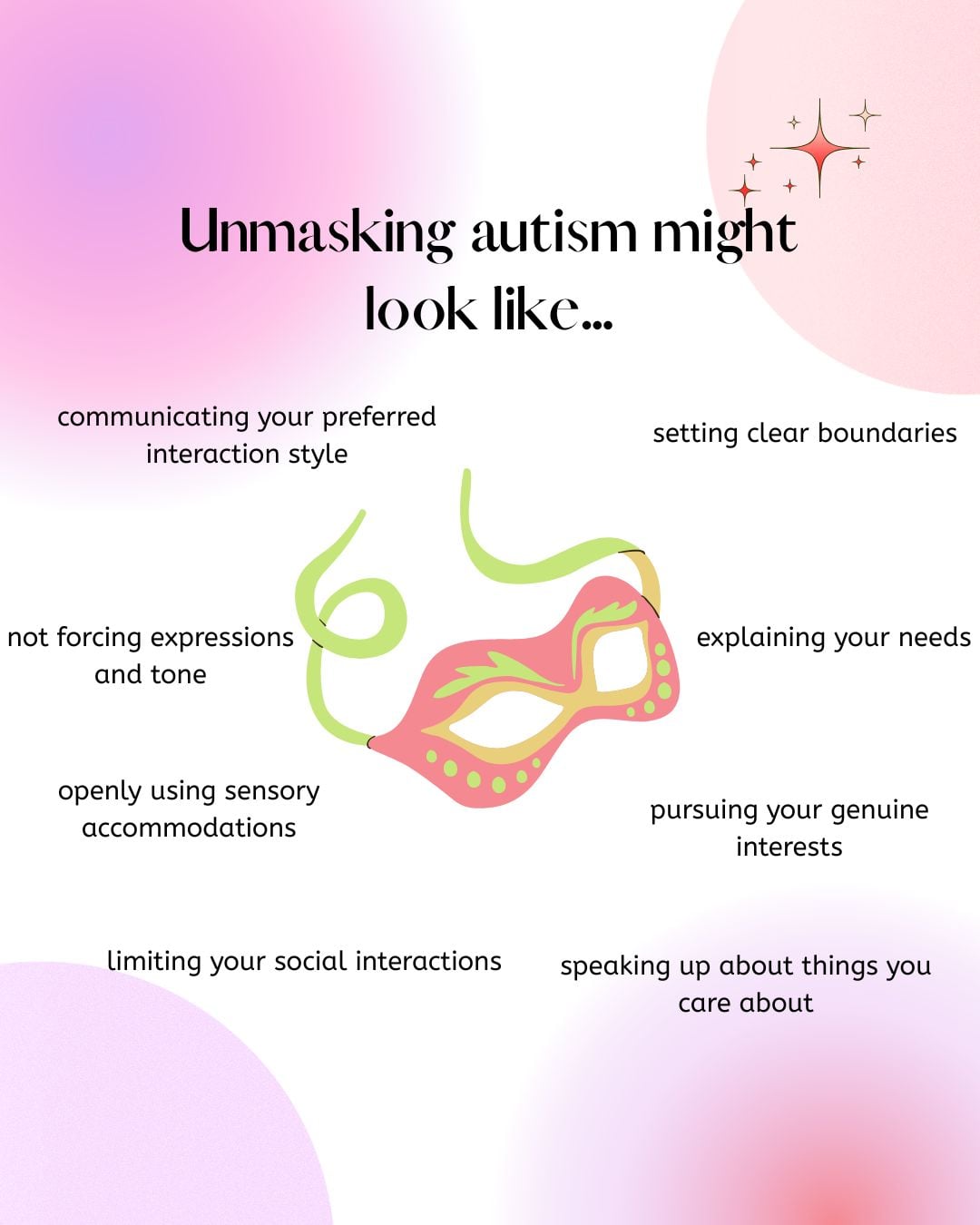
Unmasking means gradually reducing masking so that more of your autistic self shows, usually starting in settings that feel safe.

Common examples of autism masking include:
- forcing eye contact during conversations
- suppressing stimming behaviors like hand flapping or rocking
- scripting or rehearsing social interactions beforehand
- mimicking others’ facial expressions and gestures
- hiding special interests or pretending to be interested in topics others enjoy
Costs of Masking and Benefits of Unmasking
Masking can help autistic individuals navigate social situations more smoothly in the short term. However, it often comes with significant consequences.
The constant effort to suppress one’s true self can lead to exhaustion, burnout, and mental health challenges such as anxiety and depression. The link with anxiety and depression is well established, but studies that measure people once cannot show which causes which (Khudiakova et al., 2024).
Masking may also contribute to identity issues. Individuals can struggle to connect with their authentic selves (Hull et al., 2017).
In some cases, effective masking can even result in delayed or missed autism diagnoses, especially for girls and women who, on average, camouflage more (Lai et al., 2017).
Camouflaging is probably not the only cause, as diagnostic tools built around male-typical presentation may also miss autistic girls and women (Gonçalves Garcia et al., 2026).
What Unmasking Offers
Unmasking, or embracing one’s autistic identity, can offer numerous benefits. It can lead to improved mental health and well-being, as individuals no longer expend energy hiding their true selves.
Autistic adults who unmask describe more energy, less anxiety and a stronger sense of self, though these are reported experiences, not measured effects (Hedlund et al., 2026).
By unmasking, autistic individuals can contribute to greater autism awareness and acceptance, promoting a more diverse and inclusive society that values neurodiversity.
Below are some ways to start your unmasking journey.
Keep in mind that unmasking is a personal choice. It might not be a safe option for some people, depending on their life circumstances. Please only engage in unmasking if you feel able to. This article is meant for general guidance only.
Notice your masking behaviors
Paul from Autism From The Inside explains, “The first step to slowly safely taking the mask off is to find out for yourself who you are and what you want when you’re alone.”
This involves exploring and accepting aspects of yourself that you might usually hide, including your sensitivities, needs for isolation, or unique interests.
Start paying attention to times when you may say something or force an expression that does not feel natural. Examples include agreeing with opinions you do not share or laughing along when everyone else does.
Try keeping a journal of your masking behaviors. Then tackle each one at a time.
For example, I may notice that I often force eye contact during conversations, although this feels uncomfortable for me.
In my journal, I can now ask myself the following questions:
- Why do I engage in this masking behavior?
- What do I gain from this behavior?
- Is there anything I lose from this behavior?
I can write in my journal the following:
Why do I engage in this masking behavior? I engage in forced eye contact because I want the other person to know that I am listening to them and that I am not being rude by looking away.

What do I gain from this behavior? I might gain approval and acceptance from the other person through this behavior, although this can be hard to prove.

Is there anything I lose from this behavior? It takes a lot of effort for me to make eye contact so it can feel draining.

I also find it harder to concentrate on what the other person is saying. I spend too much time making sure I give the right amount of eye contact. I also wonder if I am making a good impression.
Explore the authentic ‘you’
It can be common, especially for people who have masked for most of their lives, to have identity issues and not know who their real self is.
Finding out the real ‘you’ is something that might take a lot of time and be a continuous process on your unmasking journey.
Identity confusion can run deep. One woman in Hull et al.’s (2017) study, describing years of camouflaging in her marriage, said, “I didn’t even know who the real me was.”
Below are some questions you can reflect on while you are learning who you are:
- How would you describe your personality when you are alone or not conforming to others?
- What activities or topics genuinely excite or interest me, regardless of what others think?
- In what situations do I feel most comfortable and at ease?
- What situations cause me to burnout or feel anxious?
- What values are most important to me?
- What are my strengths or positive qualities?
As you come to live your life more authentically, you may drop things that do not align with you and pick up new things that do.
“I’m learning about what genuinely makes me feel happy and fulfilled. Essentially I’m learning who I am underneath the mask, because every aspect of my identity was influenced by wanting to do and be whatever person would be acceptable to the world.”
Ella, an autistic woman, from Purple Ella
Try unmasking experiments
Dr. Devon Price, author of Unmasking Autism (Price, 2022), emphasizes that unmasking isn’t about instantly “taking off a mask” to reveal a fully-formed authentic self. Instead, it’s a gradual journey of rediscovery.
He suggests thinking of it as adjusting a filter, slowly letting more of your authentic self show over time.
To begin unmasking, try out the following unmasking experiment:
- Identify your masking behaviors: Take time to identify the specific ways in which you mask, such as suppressing stimming, forcing eye contact, or scripting social interactions.
- Identify safe spaces and people: Start by finding supportive environments and relationships where you feel comfortable being your authentic self. It may be best to start with a trusted friend or family member.
- Set small goals: Begin by setting small, achievable goals for unmasking, such as stimming openly in a safe space or sharing a special interest with a trusted friend.
- Reflect on what happened: After the social situation, consider how it went. Did the other person respond well? Did they even notice that you were stimming?
- Gradually increase unmasking: As you become more comfortable, gradually increase your unmasking behaviors in different settings and with more people. Remember to go at your own pace.
Repeat this for the masking behaviors that you wish to drop or reduce. It is crucial to remember that unmasking is a personal journey and may look different for everyone.
Some individuals may choose to unmask in certain settings or with specific people, while others may feel comfortable unmasking more broadly.
What Research Says About Unmasking
A neurodivergent-led team analyzed interviews with 29 autistic adults in Sweden, most of them women and 17 with co-occurring ADHD (Hedlund et al., 2026). Unmasking appeared as a circular process of recognizing the need to unmask, understanding one’s own masking, using strategies and managing the consequences.
Participants usually began with the most stressful or the easiest behaviors, in safer places such as home and with people who were not critical.
It was both hard and freeing. Several said the goal was less frequent, more deliberate masking, not none at all.
The consequences were mixed. Some participants described shame, a habit of apologizing or being read as challenging. Others described more energy, less anxiety, a stronger sense of self and, for several, more accommodation from others than they had expected (Hedlund et al., 2026).
These are participants’ experiences, not measured effects. A mixed-methods study of autistic college students found something similar: unmasking relieved stress and raised authenticity but also raised fears of social backlash, unless friends were supportive (Durben, 2026).
Set boundaries
Setting boundaries is a crucial step in unmasking autism, allowing you to honor your authentic needs and reduce the pressure to conform to neurotypical expectations.
Here are some specific boundaries you might set:
- Limiting social interactions to a manageable number per week
- Communicating preferred communication methods (e.g., text over phone calls)
- Declining physical touch or hugs when uncomfortable
- Setting clear start and end times for gatherings
- Requesting dimmed lights or quieter environments when possible
- Communicating the need for alone time, even with close friends or family
By consistently setting and maintaining these boundaries, you create a more comfortable environment for yourself, reduce stress, and conserve energy that might otherwise be spent on masking.
This practice encourages others to respect your autistic traits and needs, ultimately supporting your journey towards living more authentically.
Explain if you need to
If you are in a social situation and you want to drop your masking behaviors, it might be helpful to explain to others what you are doing and why.
This does not mean that you need to tell them that you are autistic if you do not want to disclose that, but you could say the following:
- For using neutral facial expressions: “This is my resting expression. Please don’t take it personally.”
- For not forcing eye contact: “Eye contact makes me uncomfortable, so I am going to look elsewhere, but please understand that I am listening to you.”
- For when you are stimming or fidgeting: “This helps me focus.”
- For when your facial expression may not display the felt emotion: “I feel (happy/upset/excited/angry) about that.”
- For special interests: “I tend to get very excited about this topic. Please let me know if I’m going into too much detail.”
- For needing breaks during social interactions: “I sometimes need a few minutes alone to recharge. If I step away, it’s not because I’m upset or uninterested.”
- For difficulty with unexpected changes or spontaneous plans: “I prefer to know what to expect in advance. Sudden changes can be challenging for me to process.”
By offering these explanations, you can help others understand your behaviors and needs, fostering better communication and reducing potential misunderstandings as you unmask.
Use masking when you need to
According to Dr. Devon Price unmasking is not simply about removing all masks and being completely unfiltered. Instead, it’s about learning to use masking strategically and intentionally.
Price acknowledges that sometimes masking is necessary or even helpful. He mentions that for some groups, like Black autistic individuals, masking can be “life-saving.”
He also suggests being selective with masking. The goal is not to completely stop masking, but to learn when it’s safe and beneficial to be more authentically yourself.
While masking can be useful, Price also notes that being more authentic can sometimes lead to better outcomes.
He gives an example. In a medical setting, he found that allowing himself to be more vulnerable and direct about his needs (less masked) resulted in better care.
However, he chose not to explicitly disclose his autism diagnosis. This shows how unmasking can be selective and strategic.
The goal is to make conscious choices about when to mask or unmask, always keeping in mind personal values and well-being.
What Research Says About Selective Masking
A systematic review of 48 studies of autistic burnout found that camouflaging was not always described as harmful, but as a risk when overused (Ali et al., 2025).
Some autistic adults described it as a tool for particular ends, not a way of being.
Unmasking is not equally safe for everyone. Conceptual work on intersectional experiences of autism, using a Black Feminist Disability Framework, argues that unmasking is a privilege not granted to everyone (Franklin et al., 2025).
Interviews with 43 Black caregivers of autistic children raised concerns about inappropriate policing of the children’s behaviors (Yates Flanagan et al., 2025). Fear of harm from police was another worry.
These are caregivers’ concerns, not counts of incidents, but they show why safety matters when deciding to unmask.
Consider disclosing your diagnosis
Disclosing your diagnosis is a personal choice, but in some instances, it can help with your unmasking journey.
I have found that when I mention to certain people that I am autistic, I feel I can be more myself around them. While this may not work for everyone (only people I feel safe around), I’ve found that this disclosure helps break down that barrier for me.
Most people I have told have been very understanding. They have asked interesting and respectful questions, and it has opened up exciting discussions.
I’ve found that people are also more open to sharing about themselves when I am honest with them. As someone who has a strong interest in the brain and human behavior, I really enjoy getting into these conversations!
Choosing Who to Tell
Dr Devon Price explains that it’s important to be selective about who you are vulnerable with. His advice is to watch people’s behavior. It shows whether they deserve your full disclosure.
If you decide to tell someone about your diagnosis, you could also explain to them what masking is and how you engage in these behaviors.
Megan Griffith, a neurodivergent life coach, suggests explaining to loved ones what masking is, why you did it, and how things might change as you unmask. This makes it easier to actually unmask around them.
The research on disclosure is mixed. In one experiment, non-autistic observers rated autistic adults more favorably when they were accurately labeled as autistic than when they were given no label (Sasson & Morrison, 2019).
A review of 33 studies on autistic careers found that participants in six worried that disclosure would harm their career (Davies et al., 2024).
Disclosure can improve how a stranger reads you and also expose you to bias. The dilemma is real.
Accept that some people may not like the unmasked you
Katie, who was diagnosed as autistic in adulthood, explains “As you unmask, it gets a lot easier to see who is genuine with you and who isn’t… because unmasking typically repels all the people who only want the masked you.”
Unmasking can come with some challenges. Imagine you are friends with someone, but they have only known the masked version of yourself.
Your masked behaviors around them are that you use the same mannerisms as them, agree with all of their opinions, and portray yourself as a bubbly, optimistic person.
As you start to gradually reduce those masked behaviors and live more authentically, your friend is likely to notice these changes. How they respond is their choice.
Some people might be surprised but happy that you are being true to yourself. Others might dislike that you have changed.
Some individuals might not like that you are no longer agreeing with everything they say or that you are setting boundaries.
Their reaction may also reflect a two-way gap in understanding. Milton (2012) named this the double empathy problem. It describes misunderstanding between autistic and non-autistic people as a mutual mismatch, not a deficit that sits only in the autistic person.
Megan Griffith, a neurodivergent life coach explains that, “The key to unmasking is getting in touch with who you truly are and accepting that you cannot control other people’s reactions to that true self.”
It can be tempting to fall back into unhealthy masking behaviors for fear of losing someone. But try to remember that if they are not accepting of the real you, then they are probably not a true friend.

Find a neurodivergent community for support
Neurodivergent communities can provide valuable support throughout the unmasking process, aiding in self-discovery and acceptance.
Dr. Devon Price encourages joining neurodivergent communities, particularly on social media platforms. He explains that connecting with other neurodivergent people can trigger memories and realizations about your authentic self before masking.
He finds comfort in socializing with other neurodivergent individuals. These spaces let him forget about being perceived as “weird” in the wider world.
Research points the same way, with a caveat. In a survey of 342 autistic adults, more involvement in the autistic community went with lower masking and higher self-esteem (Evans et al., 2024). The survey measured people once, so it cannot show that community involvement causes the difference.
Below are some ways in which you can find supportive communities:
- Social media websites: There are specific autistic accounts on Instagram, Twitter, and Tik Tok for instance.
- Forums: There are neurodivergent forums, but there are also forums to discuss your special interests, whatever they may be, and no matter how niche. This is a great way to find like-minded people who may also be neurodivergent.
- Meet-up groups: Take a look at meet-ups in your local area to see if there are any specific neurodivergent/autistic social groups.
- College/university groups: If you’re a student, check if your school has neurodiversity clubs or support groups.
- Workplace neurodiversity networks: Some companies have employee resource groups for neurodivergent individuals.
Review your progress
Paul from Autism From The Inside explains that initially dropping the mask and showing your authentic autistic self can feel vulnerable. Ultimately, it leads to a sense of empowerment.
As discussed, unmasking certain behaviors is a continuous and gradual process, so it might be helpful to reflect on how far you have come.
Masked Self vs Unmasked Self Exercise
To reflect, make a list of what your ‘Masked Self‘ looks like. Then compare it with what your ‘Unmasked Self‘ looks like.
I will complete this exercise for myself in the table below as an example:
| My ‘Masked Self’ | My ‘Unmasked Self’ |
| Attending group social events to fit in | Meeting friends one-on-one and enjoying alone time |
| Dressing in a way to not draw attention to myself | Experimenting with different styles to find something that I enjoy |
| Keeping quiet in situations where people are sharing opinions | Voicing more of my own opinions even if they differ to others |
| Trying to suppress stimming and fidgeting in public | Keeping something in my bag to fidget with if I need it |
| Drinking alcohol in social situations to appear more sociable and relaxed | Limiting alcohol intake or choosing not to drink at all in social situations |
Try to complete this exercise every 6 months or so to review your progress. Writing your progress down helps you see it.
You might not feel that you have made that many positive changes until you actually sit and think about it.
You can also use this opportunity to write down some goals for the next 6 months. Take it slowly. Do not pressure yourself to fully drop the masking behavior, as it can take a long time to unlearn something.

Evidence Check: What Does the Research Say About Masking?
Verdict: Supported with qualifications.
The best evidence supports two claims. Masking goes with more anxiety, depression and lower wellbeing in autistic adults. Autistic adults also say they mask at work mainly to protect their jobs.
It does not show that masking causes the poorer mental health, how common masking is at work, or that changing workplace practice reduces it.
The strongest evidence is a meta-analysis. It pools the results of many earlier studies. It was registered in advance and combined fourteen studies with 3,478 autistic participants.
More camouflaging went with more anxiety (r = .27), more depression (r = .36) and lower wellbeing (r = −.13) (Khudiakova et al., 2024). Here, r runs from 0 (no link) to 1 (perfect). Two broader reviews agree (Cook et al., 2021; Zhuang et al., 2023).
The link is real, but the cause is unsettled.
Every study in the meta-analysis measured people once. None can show whether masking wears people down, distress increases masking, or stress drives both.
A preregistered study followed 332 autistic adults and measured camouflaging and distress twice, about two years apart (van der Putten et al., 2025). Higher starting camouflaging went with a small decrease in distress.
That does not overturn the association, but it shows the link cannot be read as masking causing distress.
Experiments help explain why people mask. A meta-analysis of 21 articles found less favorable first impressions of autistic people in every format except speech transcripts (Wanigasekera et al., 2025). The pooled effect was 0.54, or 0.34 after correcting for publication bias.
That gives masking a plausible rationale. It is partly a response to a real social penalty.
The studies used rated clips and simulated interviews, so they cannot show what happens in real hiring decisions.
Autistic adults also report masking at work mainly to secure and keep jobs and to avoid bullying (Pryke-Hobbes et al., 2023). These are self-reports, so they cannot show whether masking helps or harms careers.
Key Takeaways
- Unmasking: Unmasking means gradually reducing masking so more of your autistic self shows, usually starting where it feels safe.
- Notice First: Start by noticing when and why you mask, then try small experiments with people you trust.
- Go Gradually: Unmasking is not all or nothing. Many autistic adults aim for less frequent, more deliberate masking.
- Safety: Unmasking is a personal choice and may not be safe in every setting, so choose where and with whom.
- Disclosure: Telling people you are autistic can bring understanding and can also bring bias, so weigh it carefully.
- Verdict: Supported with qualifications. Masking goes with more anxiety and depression, but research cannot yet show which causes which.
References
Ali, D., Bougoure, M., Cooper, B., Quinton, A. M. G., Tan, D., Brett, J., Mandy, W., Maybery, M., Magiati, I., & Happé, F. (2025). Burnout as experienced by autistic people: A systematic review. Clinical Psychology Review, 122, 102669. https://doi.org/10.1016/j.cpr.2025.102669
Cook, J., Hull, L., Crane, L., & Mandy, W. (2021). Camouflaging in autism: A systematic review. Clinical Psychology Review, 89, 102080. https://doi.org/10.1016/j.cpr.2021.102080
Davies, J., Romualdez, A. M., Pellicano, E., & Remington, A. (2024). Career progression for autistic people: A scoping review. Autism, 28(11), 2690–2706. https://doi.org/10.1177/13623613241236110
Durben, D. L. (2026). Unmasking: A mixed-methods study of autistic college students’ efforts to stop masking/camouflaging. Journal of Autism and Developmental Disorders. Advance online publication. https://doi.org/10.1007/s10803-026-07409-x
Evans, J. A., Krumrei-Mancuso, E. J., & Rouse, S. V. (2024). What you are hiding could be hurting you: Autistic masking in relation to mental health, interpersonal trauma, authenticity, and self-esteem. Autism in Adulthood, 6(2), 229–240. https://doi.org/10.1089/aut.2022.0115
Franklin, M. D., Taylor, E. E., Floríndez, D. C., Guzman, M., Lawson, T. L., Rios, J., & Angell, A. M. (2025). An occupational science contribution to camouflaging scholarship: Centering intersectional experiences of occupational disruptions. Autism in Adulthood, 7(3), 238–248. https://doi.org/10.1089/aut.2023.0070
Gonçalves Garcia, S., Simões-Pires, C. da S., Brum, J. A., & Cabral, J. C. (2026). Taking off the mask: Investigating autism diagnosis and camouflaging in adult women. Autism in Adulthood, 8(4), 677–686. https://doi.org/10.1089/aut.2024.0150
Hedlund, Å., Unéus, D., Wik, J., Ingard, C., Isakson, K., Black, M. H., Hirvikoski, T., & Bertilsdotter Rosqvist, H. (2026). Reclaiming selfhood: Towards a conceptualisation of the autistic unmasking process. Frontiers in Psychiatry, 17, 1929738. https://doi.org/10.3389/fpsyt.2026.1929738
Hull, L., Petrides, K. V., Allison, C., Smith, P., Baron-Cohen, S., Lai, M.-C., & Mandy, W. (2017). “Putting on my best normal”: Social camouflaging in adults with autism spectrum conditions. Journal of Autism and Developmental Disorders, 47(8), 2519–2534. https://doi.org/10.1007/s10803-017-3166-5
Khudiakova, V., Russell, E., Sowden-Carvalho, S., & Surtees, A. D. R. (2024). A systematic review and meta-analysis of mental health outcomes associated with camouflaging in autistic people. Research in Autism Spectrum Disorders, 118, 102492. https://doi.org/10.1016/j.rasd.2024.102492
Lai, M.-C., Lombardo, M. V., Ruigrok, A. N. V., Chakrabarti, B., Auyeung, B., Szatmari, P., Happé, F., & Baron-Cohen, S. (2017). Quantifying and exploring camouflaging in men and women with autism. Autism, 21(6), 690–702. https://doi.org/10.1177/1362361316671012
Milton, D. E. M. (2012). On the ontological status of autism: The “double empathy problem.” Disability & Society, 27(6), 883–887. https://doi.org/10.1080/09687599.2012.710008
Price, D. (2022). Unmasking autism: Discovering the new faces of neurodiversity. Harmony Books.
Pryke-Hobbes, A., Davies, J., Heasman, B., Livesey, A., Walker, A., Pellicano, E., & Remington, A. (2023). The workplace masking experiences of autistic, non-autistic neurodivergent and neurotypical adults in the UK. PLOS ONE, 18(9), e0290001. https://doi.org/10.1371/journal.pone.0290001
Sasson, N. J., & Morrison, K. E. (2019). First impressions of adults with autism improve with diagnostic disclosure and increased autism knowledge of peers. Autism, 23(1), 50–59. https://doi.org/10.1177/1362361317729526
van der Putten, W. J., Mol, A. J. J., Radhoe, T. A., Torenvliet, C., Agelink van Rentergem, J. A., Groenman, A. P., & Geurts, H. M. (2025). Camouflaging in autism: A cause or a consequence of mental health difficulties? Autism, 29(10), 2604–2617. https://doi.org/10.1177/13623613251347104
Wanigasekera, L. C., Maybery, M. T., Palermo, R., Whitehouse, A. J. O., & Tan, D. W. (2025). First impressions towards autistic people: A systematic review and meta-analysis. Autism Research, 18(5), 983–1010. https://doi.org/10.1002/aur.70019
Yates Flanagan, A., Cola, M., Yu, N., Peele, H., Dicette, K., Hicks, G., Pelella, M. R., King-Pointer, A., Owens, J., Truong, D. M., Hauptmann, A., Pacheco, J., Russell, A., Lee, A., Schillinger, S., Covello, M., Lyons, M., Solórzano, R., Turnacioglu, S., . . . Parish-Morris, J. (2025). Policing Black autistic children: A qualitative approach to understanding Black caregivers’ concerns. Autism, 29(5), 1303–1317. https://doi.org/10.1177/13623613241303549
Zhuang, S., Tan, D. W., Reddrop, S., Dean, L., Maybery, M., & Magiati, I. (2023). Psychosocial factors associated with camouflaging in autistic people and its relationship with mental health and well-being: A mixed methods systematic review. Clinical Psychology Review, 105, 102335. https://doi.org/10.1016/j.cpr.2023.102335

