Coding is the process of analyzing qualitative data by assigning short labels, called codes, to chunks that capture their meaning.
Think of a code as a hashtag for that chunk. It lets researchers condense, organize and interpret their data to help answer the research question.
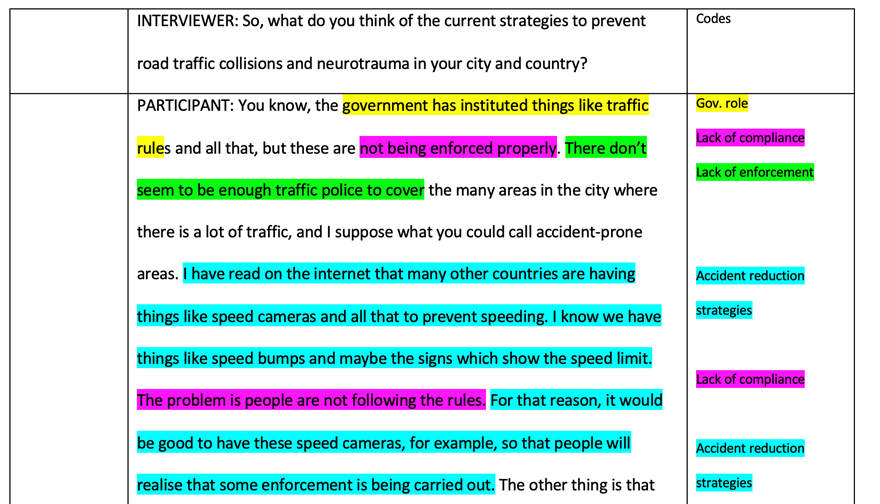
Coding is iterative. Researchers refine and revise their codes as their understanding of the data grows.
Step 1: Familiarize yourself with the data
- Read through your data (interview transcripts, field notes, documents, etc.) several times. This process is called immersion.
- Think and reflect on what may be important in the data before making any firm decisions about ideas, or potential patterns.
Step 2: Decide on your coding approach
- Will you use predefined deductive codes (based on theory or prior research), or let codes emerge from the data (inductive coding)?
- Will a piece of data have one code or multiple?
- Will you code everything or selectively? Broader research questions may warrant coding more comprehensively.
If you decide not to code everything, it’s crucial to:
- Have clear criteria for what you will and won’t code
- Be transparent about your selection process in research reports
- Remain open to revisiting uncoded data later in analysis
Step 3: Do a first round of coding
Start identifying preliminary codes which highlight important features of the data and may be relevant to the research question.
- Go through the data and assign initial codes to chunks that stand out
- Create a code name (a word or short phrase) that captures the essence of each chunk
- Keep a codebook – a list of your codes with descriptions or definitions
- Be open to adding, revising or combining codes as you go
First level coding mainly uses these descriptive, low inference codes, which are very useful in summarising segments of data and which provide the basis for later higher order coding.
Descriptive codes
- In vivo coding / Semantic coding: This method uses words or short phrases directly from the participant’s own language as codes. It deals with the surface-level content, labeling what participants directly say or describe. It identifies keywords, phrases, or sentences that capture the literal content.
Participant: “I was just so overwhelmed with everything.”
Code: “overwhelmed” - Process coding: Uses gerunds (“-ing” words) to connote observable or conceptual action in the data.
Participant: “I started by brainstorming ideas, then I narrowed them down.”
Codes: “brainstorming ideas,” “narrowing down” - Open coding: A form of initial coding where the researcher remains open to any possible theoretical directions indicated by the data.
Participant: “I found the class really challenging, but I learned a lot.”
Codes: “challenging class,” “learning experience” - Descriptive coding: Summarizes the primary topic of a passage in a word or short phrase.
Participant: “I usually study in the library because it’s quiet.”
Code: “study environment”
Step 4: Review and refine codes
Later codes may be more interpretive, requiring some degree of inference beyond the data.
- Look over your initial codes and see if any can be combined, split up, or revised
- Ensure your code names clearly convey the meaning of the data
- Check if your codes are applied consistently across the dataset
- Get a second opinion from a peer or advisor if possible
- When in doubt, generate more codes rather than fewer. It’s easier to discard a redundant code later than to notice a missed pattern after the fact.
Interpretive (latent) codes
Interpretive codes go beyond simple descriptions and reflect the researcher’s understanding of the underlying (latent) meanings, experiences, or processes captured in the data.
These codes require the researcher to interpret the participants’ words and actions in light of the research questions and theoretical framework.
They often draw on existing theories or concepts to interpret the data, providing a more conceptual “take” on what the participants are saying.
This takes real interpretive skill.
Latent codes require the researcher to dig beneath the surface and make inferences based on their expertise and knowledge. It requires more experience than semantic coding.
For example, latent coding is a type of interpretive coding which goes beyond surface meaning in data. It digs for underlying emotions, motivations, or unspoken ideas the participant might not explicitly state.
Latent coding looks for subtext, interprets the “why” behind what’s said, and considers the context (e.g. cultural influences, or unconscious biases).
- Example: A participant might say, “Whenever I see a spider, I feel like I’m going to pass out. It takes me back to a bad experience as a kid.” A latent code here could be “Feelings of Panic Triggered by Spiders” because it goes beyond the surface fear and explores the emotional response and potential cause.
It’s useful to ask yourself the following questions:
- What are the assumptions made by the participants?
- What emotions or feelings are expressed or implied in the data?
- How do participants relate to or interact with others in the data?
- How do the participants’ experiences or perspectives change over time?
- What is surprising, unexpected, or contradictory in the data?
- What is not being said or shown in the data? What are the silences or absences?
Theoretical codes
Theoretical codes are the most abstract and conceptual type of codes. They are used to link the data to existing theories or to develop new theoretical insights.
Theoretical codes often emerge later in the analysis process, as researchers begin to identify patterns and connections across the descriptive and interpretive codes.
This is theoretical coding. The analyst draws on a menu of abstract “coding families,” such as causes, contexts, conditions and consequences. These help weave the concrete codes into one coherent theoretical account instead of forcing the data into a fixed template.
Examples of Theoretical Codes
- Structural coding: Applies a content-based phrase to a segment of data that relates to a specific research question.
Research question: What motivates students to succeed?
Participant: “I want to make my parents proud and be the first in my family to graduate college.”
Interpretive Code: “family motivation”
Theoretical code: “Social identity theory” - Value coding: This method codes data according to the participants’ values, attitudes, and beliefs, representing their perspectives or worldviews.
Participant: “I believe everyone deserves access to quality healthcare.”
Interpretive Code: “healthcare access” (value)
Theoretical code: “Distributive justice”
Pattern codes
Second level coding tends to focus on pattern codes. A pattern code is more inferential, a sort of “meta-code.”

Pattern codes pull together material into a smaller number of more meaningful units…. a pattern code is a more abstract concept that brings together less abstract, more descriptive codes.
Pattern coding is often used in the later stages of data analysis, after the researcher has thoroughly familiarized themselves with the data and identified initial descriptive and interpretive codes.
By identifying patterns and relationships across the data, pattern codes help to develop a more coherent and meaningful understanding of the phenomenon and can contribute to theory development or refinement.
Pattern Coding: A Worked Example
Let’s say a researcher is studying the experiences of new mothers returning to work after maternity leave. They conduct interviews with several participants and initially use descriptive and interpretive codes to analyze the data. Some of these codes might include:
- “Guilt about leaving baby”
- “Struggle to balance work and family”
- “Support from colleagues”
- “Flexible work arrangements”
- “Breastfeeding challenges”
As the researcher reviews the coded data, they may notice that several of these codes relate to the broader theme of “work-family conflict.”
They might create a pattern code called “Navigating work-family conflict” that pulls together the various experiences and challenges described by the participants.
Codes vs. Themes: How Coding Relates to Thematic Analysis
Codes and themes work at different levels. A code is a short label attached to one small chunk of data. A theme is a broader pattern of meaning, built up from many related codes once the researcher has compared and clustered them.
This coding-to-theme process is the core of thematic analysis, a method for identifying and reporting patterns of meaning across a whole dataset. Grounded theory shares that starting point.
But grounded-theory coding builds toward an explanatory theory, and it typically continues alongside data collection rather than coding a dataset gathered in advance. See grounded theory vs thematic analysis for how the two approaches diverge from this shared starting point.

Strengths and Limitations of Qualitative Coding
Qualitative coding has clear strengths, but it also has real limitations worth knowing before you rely on it.
Strengths
- Grounded in the Data: Because codes come from participants’ own words rather than a fixed theory, the resulting concepts stay close to what people actually said, which makes findings easier to trust and especially useful in under-researched areas.
- Discovers the Unexpected: Careful coding can surface meanings and patterns a researcher would not have thought to look for in advance, unlike research designed only to test a hypothesis.
- Transparent and Systematic: A documented codebook, plus an audit trail of coding decisions, let other researchers check how conclusions were reached, answering the charge that qualitative analysis is just impressionistic.
- Keeps Participants’ Language: In-vivo coding preserves participants’ own words and priorities, reducing the risk that a researcher’s categories quietly replace what participants actually meant.
Limitations
- Time-Consuming: Coding line by line across many transcripts, and revising codes as understanding grows, is slow and demanding of expertise. It suits an in-depth study with a modest sample better than a large one.
- Subjective: Because the researcher is the coding instrument, another analyst may label the same data differently. Reflexivity, staying aware of your own assumptions, helps but does not remove the judgement calls involved.
- Risk of Fragmentation: Breaking an account into many small codes can strip out its narrative flow, cutting a person’s story into disconnected pieces that lose the connections between them.
- When to Stop Is Debated: Coding is meant to continue until no new patterns emerge, known as theoretical saturation, but what counts as “enough” data is a genuinely contested question.
Contemporary Research
Recent methodological work has tried to make the stopping point for coding, saturation, less vague.
Aim: Saunders et al. (2018) examined the widely used but loosely defined concept of saturation, to clarify how it is understood across different qualitative traditions.
Method: Rather than running a new empirical study, the authors reviewed and synthesised how “saturation” is defined and applied across the qualitative literature.
Results: They identified four distinct models of saturation. These include theoretical saturation (saturation of the categories and emerging theory) and data saturation (new data merely repeating what is already present). The two are often wrongly treated as interchangeable.
Conclusion: Which model applies depends on the study’s own analytic approach. Researchers should state and justify which kind of saturation they are claiming, rather than assuming that “enough interviews” settles the question on its own.
Key Takeaways
- Coding: Labelling chunks of qualitative data with short codes that capture their meaning, so patterns can be compared and organized.
- Iterative: Codes are refined and revised throughout analysis, not fixed after a single pass through the data.
- Descriptive vs Latent: Descriptive codes summarize what is said; latent codes interpret the underlying meaning behind it.
- Codes to Themes: Related codes are grouped into categories, which are then combined into broader themes.
- Over-Code First: Generate codes generously early on. It’s easier to discard a redundant code later than to notice a missed pattern after the fact.
- Software’s Role: Tools like NVivo or ATLAS.ti organize and search codes, but the analytic judgement stays with the researcher.
Bibliography
Auerbach, C., & Silverstein, L. B. (2003). Qualitative data: An introduction to coding and
analysis. New York, NY: New York University Press.
Bernard, H. R., Wutich, A., & Ryan, G. W. (2016). Analyzing qualitative data: Systematic
approaches. Los Angeles, CA: SAGE.
Corbin, J., & Strauss, A. L. (2015). Basics of qualitative research techniques and procedures
for developing Grounded Theory (4th ed.). Los Angeles, CA: SAGE.
Glaser, B. G. (1978). Theoretical sensitivity: Advances in the methodology of grounded theory. Sociology Press.
Holton, J. A. (2007). The coding process and its challenges. In A. Bryant & K. Charmaz (Eds.), The Sage handbook of grounded theory (pp. 265–289). Sage.
Miles, M. B., Huberman, A. M., & Saldaña, J. (2014). Qualitative data analysis: A methods sourcebook (3rd ed.). London, UK: SAGE.
Saldaña, J. (2009). The coding manual for qualitative researchers. London: Sage Publications.
Cite this article
McLeod, S. (2024, May 17). Qualitative data coding. Simply Psychology. https://www.simplypsychology.org/qualitative-data-coding.html

