Grounded theory is a useful approach when you want to develop a new theory based on real-world data Instead of starting with a pre-existing theory, grounded theory lets the data guide the development of your theory.
What Is Grounded Theory?
Grounded theory is a qualitative method specifically designed to inductively generate theory from data. It was developed by Glaser and Strauss in 1967.
- Data shapes the theory: Instead of trying to prove an existing theory, you let the data guide your findings.
- No guessing games: You don’t start with assumptions or try to confirm your own biases.
- Data collection and analysis happen together: You analyze information as you gather it, which helps you decide what data to collect next.
Grounded theory is an inductive approach: a theory is developed from collected real-world data, rather than a hypothesis being proved or disproved as in a deductive scientific approach.
You gather information. Then you look for patterns and use them to build an explanation.
It is a way to understand why people do things and how those actions create patterns. Imagine you’re trying to figure out why your friends love a certain video game.
You wouldn’t just ask an adult. Instead, you’d observe your friends while they’re playing, listen to them talk about it, and maybe even play a little yourself. By studying their actions and words, you’re using grounded theory to build an understanding of their behavior.
This qualitative method of research focuses on real-life experiences and observations, letting theories emerge naturally from the data collected, like piecing together a puzzle without knowing the final image.
When should you use grounded theory?
Grounded theory research is useful for beginning researchers, particularly graduate students, because it offers a clear and flexible framework for conducting a study on a new topic.
Grounded theory works best when existing theories are either insufficient or nonexistent for the topic at hand.
Since grounded theory is a continuously evolving process, researchers collect and analyze data until theoretical saturation is reached or no new insights can be gained.
What is the final product of a GT study?
The final product of a grounded theory (GT) study is an integrated and comprehensive grounded theory that explains a process or scheme associated with a phenomenon.
The quality of a GT study is judged on whether it produces this middle-range theory.
Middle-range theories are narrower in scope. They focus on a specific part of society or a particular event, not on everything in the world. Instead, they zero in on what is happening in certain groups, cultures, or situations.
Think of it like this: a grand theory is like trying to understand all of weather at once, but a middle-range theory is like focusing on how hurricanes form.
Here are a few examples of what middle-range theories might try to explain:
- How people deal with feeling anxious in social situations.
- How people act and interact at work.
- How teachers handle students who are misbehaving in class.
Core Components of Grounded Theory
This terminology reflects the iterative, inductive, and comparative nature of grounded theory, which distinguishes it from other research approaches.
- Theoretical Sampling: The researcher uses theoretical sampling to choose new participants or data sources based on the emerging findings of their study. The goal is to gather data that will help to further develop and refine the emerging categories and theoretical concepts.
- Theoretical Sensitivity: Researchers need to be aware of their preconceptions going into a study and understand how those preconceptions could influence the research. However, it is not possible to completely separate a researcher’s history and experience from the construction of a theory.
- Coding: Coding is the process of analyzing qualitative data (usually text) by assigning labels (codes) to chunks of data that capture their essence or meaning. It allows you to condense, organize and interpret your data.
- Core Category: The core category encapsulates and explains the grounded theory as a whole. Researchers identify a core category to focus on during the later stages of their research.
- Memos: Researchers use memos to record their thoughts and ideas about the data, explore relationships between codes and categories, and document the development of the emerging grounded theory. Memos support the development of theory by tracking emerging themes and patterns.
- Theoretical Saturation: This term refers to the point in a grounded theory study when collecting additional data does not yield any new theoretical insights. The researcher continues the process of collecting and analyzing data until theoretical saturation is reached.
- Constant Comparative Analysis: This method involves the systematic comparison of data points, codes, and categories as they emerge from the research process. Researchers use constant comparison to identify patterns and connections in their data.
Versions
Barney Glaser and Anselm Strauss introduced grounded theory in 1967, in their book The Discovery of Grounded Theory.
Their aim was a method that prioritized real-world data over pre-existing theory.
The two later diverged.
Their split produced two distinct versions, Glaserian and Straussian grounded theory, that differ in their approach to coding, theory construction, and the use of literature.
Every version still shares the same goal: generating a middle-range theory that explains a social process or phenomenon.
And every version still leans on the same three tools: theoretical sampling, constant comparative analysis, and theoretical saturation.
The Foundational Study: Awareness Of Dying
Grounded theory did not begin as an abstract set of rules. It grew directly out of one empirical study, rooted in the University of Chicago’s symbolic interactionist tradition, that the method’s two founders carried out together.
The setting was ordinary hospital wards.
Aim: Glaser and Strauss set out to describe how hospital staff and dying patients managed the knowledge, or lack of it, that the patient was dying. Their goal was an explanatory account, not just a description.
Method: Over roughly six years, the two researchers observed hospital wards and interviewed doctors, nurses, patients and families across several Californian hospitals. Rather than testing a prior hypothesis, they coded each incident as they collected it, comparing it against categories built from earlier incidents.
The result was striking.
Results: The analysis produced the concept of “awareness contexts”, the different states of mutual knowledge between staff, patient and family about the prognosis. Contexts ranged from closed awareness, where the patient does not know, to open awareness, where everyone acknowledges it, and each shaped ward interactions differently.
The implications ran deeper.
Conclusion: A theory of a social process could be built directly from compared field data, without pre-specifying hypotheses. Awareness of Dying (1965) was the first published grounded theory study; The Discovery of Grounded Theory (1967) generalized its procedures into a method others could apply elsewhere.
Glaserian Grounded Theory
Glaserian grounded theory emphasizes the emergence of theory from data and discourages the use of pre-existing literature.
Glaser believed that adopting a specific philosophical or disciplinary perspective reduces the broader potential of grounded theory.
For Glaser, prior understanding should rest on the general problem area, built from reading very widely. This keeps the frame open. It sensitizes the researcher to a wide range of possibilities, rather than fixing an approach in advance.
It prioritizes parsimony, scope, and modifiability in the resulting theory.
Straussian Grounded Theory
Strauss and Corbin (1990) focused on developing the analytic techniques and providing guidance to novice researchers.
Straussian grounded theory utilizes a more structured approach to coding and analysis and acknowledges the role of the literature in shaping research.
It also makes room for deduction and validation alongside induction, and it encourages unstructured interview questions so participants can speak freely.
Critics disagree. They say this produced a rigidity the method was never meant to have.
Constructivist Grounded Theory
This version, primarily associated with Kathy Charmaz, recognizes that knowledge is situated, partial, provisional, and socially constructed (Charmaz, 2006). It favors abstract, conceptual understanding over straightforward explanation.
Charmaz expanded on the original Glaserian and Straussian versions by emphasizing the researcher’s own role in interpreting the findings. Constructivist grounded theory treats the researcher’s influence on the analysis as unavoidable. The resulting theory is co-created with participants, not simply discovered in the data (Charmaz, 2012).
Situational Analysis
Developed by Clarke, this version builds upon Straussian and Constructivist grounded theory and incorporates postmodern, poststructuralist, and posthumanist perspectives.
Situational analysis is Clarke’s own term for this variant. It adds explicit “situational maps” to the standard procedures, extending the analysis to include nonhuman actors, such as objects, technologies, and settings, alongside human ones.
It uses mapping to analyze complex situations, treating both human and nonhuman elements as part of what shapes them.
Benefits
- Discover New Insights: Grounded theory lets you uncover new theories based on what your data reveals, not just on pre-existing ideas.
- Data-Driven Results: Your conclusions are firmly rooted in the data you’ve gathered, ensuring they reflect reality. This close relationship between data and findings is a key factor in establishing trustworthiness.
- Avoids Bias: Because gathering data and analyzing it are closely intertwined, researchers are truly observing what emerges from data, and are less likely to let their preconceptions color the findings.
- Streamlined data gathering and analysis: Analyzing and collecting data go hand in hand. Data is collected, analyzed, and as you gain insight from analysis, you continue gathering more data.
- Synthesize Findings: By applying grounded theory to a qualitative metasynthesis, researchers can move beyond a simple aggregation of findings and generate a higher-level understanding of the phenomena being studied.
Limitations
Grounded theory carries real limitations alongside its benefits:
- Time-Consuming: Analyzing qualitative data can be like searching for a needle in a haystack; it requires careful examination and can be quite time-consuming, especially without software assistance6.
- Potential for Bias: Despite safeguards, researchers may unintentionally influence their analysis due to personal experiences.
- Data Quality: The success of grounded theory hinges on complete and accurate data; poor quality can lead to faulty conclusions.
- The Glaser-Strauss Split: The method’s two founders disagreed sharply over what counts as a genuinely “grounded” theory, and that disagreement was never resolved.
- Limited Generalisability: Findings are grounded in the specific sample studied, so extending them to a different population is a further empirical question, not something the method itself answers.
Why Bias Is Hard To Fully Rule Out
Grounded theory builds in safeguards against this.
Theoretical sensitivity and memo-writing exist specifically because a researcher’s prior assumptions can shape which codes get noticed, and which do not (Glaser, 1978).
The constructivist version goes further.
Charmaz (2012) treats the researcher’s influence as unavoidable rather than a risk to be managed, reframing the goal as co-construction with participants rather than neutral discovery.
The practical difficulty is real.
Reflexivity is asked of the same person whose bias it is meant to check.
A memo trail shows reflection happened.
It does not prove the reflection changed the analysis.
Chun Tie, Birks, and Francis (2019) respond to this procedurally rather than philosophically.
Their fix: make the audit trail detailed enough for a reader, not just the researcher, to judge whether categories were forced or genuinely emerged.
The Glaser-Strauss Split
The two founders’ later disagreement is often presented as a difference of procedural taste.
The substance is a dispute about what a “grounded” theory actually is.
Glaser’s position was different.
Theory should emerge from data with minimal imposed structure.
Departing from this, he warned, risks “forcing” categories onto the data rather than discovering them.
He set this argument out at length in a direct response to Corbin and Strauss’s more structured 1990 text (Glaser, 1992).
Corbin and Strauss (1990), for their part, argued that some structure was necessary: a defined set of coding procedures, and an acknowledged role for the researcher’s own analytic questions.
Without it, they warned, novice accounts turn thin.
Charmaz’s (2006) constructivist version reframes the disagreement again.
For Charmaz, neither side’s theory is simply discovered: the categories a researcher builds are shaped by the interaction between researcher and participant.
None of the three positions has displaced the others.
That is itself evidence the underlying disagreement has not been resolved.
Limited Generalisability
Grounded theory studies use small, targeted samples.
Participants are chosen purposively or theoretically, from one setting.
The resulting middle-range theory is, by design, an account of that phenomenon in that context, not a claim about people or organisations in general (Corbin & Strauss, 1990).
Solomon, Pistrang, and Barker’s (2001) parent-support-group theory and Bolger’s (1999) “broken self” account were both built to explain the process in the specific groups studied.
Extending either finding to a new population is untested.
That is a further empirical question, one the original study does not answer.
This is not a flaw unique to grounded theory; it is the standard trade-off of small-sample qualitative work generally.
But it means the trustworthiness that theoretical saturation establishes is trustworthiness about the sampled context, not automatic transferability beyond it.
Contemporary Research
Grounded theory is a method rather than a testable substantive theory.
So the post-2015 literature about it is mostly methodological: papers that refine how it should be conducted, and applied studies that put those refinements into practice.
Chun Tie, Birks, and Francis (2019) addressed the field’s most-criticized weakness: that novice researchers cannot easily see what “good” practice looks like.
Their response was a design framework.
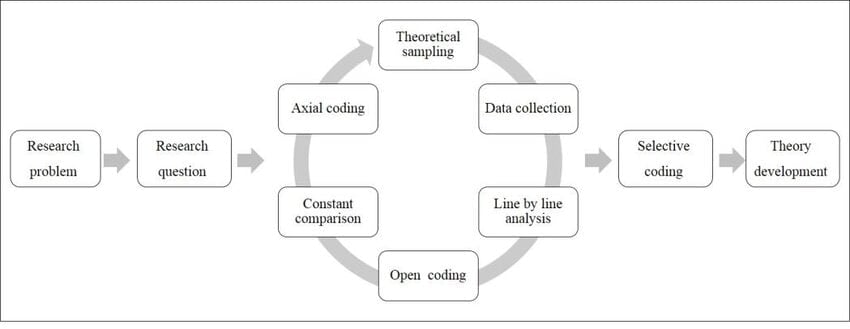
It centers on a diagram of the method’s essential procedures: sampling, concurrent data generation, constant comparison, coding, memoing, and saturation.
The diagram shows these procedures interacting.
It is a non-linear system, not a sequence of steps.
Their conclusion: quality depends less on which named “version” a researcher follows than on procedural precision.
What matters is a detailed, auditable record of the sampling decisions, memos, and comparisons made along the way.
Two gaps stand out for future work.
There is little methodological research on how software-mediated coding changes the constant comparative process itself.
Cross-cultural application remains thin too, with few studies testing whether the method’s assumptions about meaningful codes travel across languages.
Practical Steps
Grounded theory can be conducted by individual researchers or research teams. If working in a team, it’s important to communicate regularly and ensure everyone is using the same coding system.
Grounded theory research is typically an iterative process. This means that researchers may move back and forth between these steps as they collect and analyze data.
Instead of doing everything in order, you repeat the steps over and over.
This cycle keeps going, which is why grounded theory is called a circular process.
Continue to gather and analyze data until no new insights or properties related to your categories emerge. This saturation point signals that the theory is comprehensive and well-substantiated by the data.
Theoretical sampling, collecting sufficient and rich data, and theoretical saturation help the grounded theorist to avoid a lack of “groundedness,” incomplete findings, and “premature closure.
1. Planning and Philosophical Considerations
Begin by considering the phenomenon you want to study and assess the current knowledge surrounding it.
However, refrain from detailing the specific aspects you seek to uncover about the phenomenon to prevent pre-existing assumptions from skewing the research.
- Discern a personal philosophical position. Before beginning a research study, it is important to consider your philosophical stance and how you view the world, including the nature of reality and the relationship between the researcher and the participant. This will inform the methodological choices made throughout the study.
- Investigate methodological possibilities. Explore different research methods that align with both the philosophical stance and research goals of the study.
- Plan the study. Determine the research question, how to collect data, and from whom to collect data.
- Conduct a literature review. The literature review is an ongoing process throughout the study. It is important to avoid duplicating existing research and to consider previous studies, concepts, and interpretations that relate to the emerging codes and categories in the developing grounded theory.
2. Recruit participants using theoretical sampling
Initially, select participants who are readily available (convenience sampling) or those recommended by existing participants (snowball sampling).
As the analysis progresses, the researcher moves to theoretical sampling: deliberately choosing participants and data sources that will refine the emerging theory. This is not a fixed sample decided in advance. It is a moving target, steered by whatever the analysis so far says still needs exploring.
In practice this might mean recruiting participants who can shed light on a gap the initial analysis uncovered. Theoretical sampling typically starts early in a study, and researchers often need to amend their ethics approval to cover new participant groups as a result.
3. Collect Data
The researcher might use interviews, focus groups, observations, or a combination of methods to collect qualitative data.
- Observations: Watching and recording phenomena as they occur. Can be participant (researcher actively involved) or non-participant (researcher tries not to influence behaviors), and covert (participants unaware) or overt (participants aware).
- Interviews: One-on-one conversations to understand participants’ experiences. Can be structured (predetermined questions), informal (casual conversations), or semi-structured (flexible structure to explore emerging issues).
- Focus groups: Dynamic discussions with 4-10 participants sharing characteristics, moderated by the researcher using a topic guide.
- Ethnography: Studying a group’s behaviors and social interactions in their environment through observations, field notes, and interviews. Researchers immerse themselves in the community or organization for an in-depth understanding.
4. Begin open coding as soon as data collection starts
Open coding is the first stage of coding in grounded theory.
You examine segments of your data and label each one to capture the initial concepts and ideas it contains.
The codes stay close to the data itself, often using participants’ own words (in vivo terms) or gerunds that capture an action in progress. This keeps the analysis grounded, not abstract.
Here is how that works in practice.
You read through the data, such as interview transcripts, to understand what is being conveyed. You then assign a code, a short descriptive label, to each segment that represents a distinct idea, concept, or action.
For example, in a study of a new medication, a segment describing a participant’s trouble sleeping would be labeled with the code “trouble sleeping”. Other sleep-related excerpts join that code too.
The pattern holds.
This constant comparison, checking each new segment against the codes already in use, is what keeps the codes accurate. It is also what lets patterns start to emerge from data that would otherwise be unmanageable.
This is why open coding matters: it turns an unmanageable pile of data into units a researcher can actually work with.
5. Reflect on thoughts and contradictions by writing grounded theory memos during analysis
During open coding, it’s crucial to engage in , allowing you to reflect on the coding process. Memos are your own “notes to self”: they help you note emerging patterns and ask analytical questions about the data.
Document your thoughts, questions, and insights throughout the research process.
These memos serve multiple purposes: they trace your thought process, promote reflexivity, support collaboration in a team, and help develop the theory.
Early memos tend to be shorter and less conceptual, often serving as “preparatory” notes. Later ones grow more analytical and conceptual as the research progresses.
Memo Writing
- Reflexivity and Recognizing Assumptions: Researchers should acknowledge the influence of their own experiences and assumptions on the research process. Articulating these assumptions, perhaps through memos, can enhance the transparency and trustworthiness of the study.
- Write memos throughout the research process. Memo writing should occur throughout the entire research process, beginning with initial coding. Memos help make sense of the data and transition between coding phases.
- Ask analytic questions in early memos. Memos should include questions, reflections, and notes to explore in subsequent data collection and analysis.
- Refine memos throughout the process. Early memos will be shorter and less conceptual, but will become longer and more developed in later stages of the research process. Later memos should begin to develop provisional categories.
6. Group codes into categories using axial coding
Axial coding is the process of identifying connections between codes, grouping them together into categories to reveal relationships within the data.
Axial coding looks for the axes that connect separate codes together. Codes rarely stand alone.
For example, in research on school bullying, codes such as “doubting oneself” and “starting to agree with bullies” describe how a victim’s self-confidence erodes. Grouped together, they describe one thing: how bullying erodes self-perception.
Similarly, “being left by friends” and “avoiding school” group into a second category: the social consequences of bullying.
Each category joins the emerging theory. It explains one facet of the phenomenon.
Qualitative software often displays these as nested codes, a visual hierarchy showing how the concepts interconnect.
That structure helps researchers spot patterns and build a more nuanced picture of how different aspects of the phenomenon relate.
In short, axial coding is what moves the analysis beyond mere description toward a genuinely explanatory theory.
7. Define the core category using selective coding
During selective coding, the final stage of grounded theory analysis, a researcher selects a core category and connects it to every other category built during earlier coding. This produces one detailed, integrated theory rather than a set of loose categories.
The core category is the central concept that ties the theory together: it names, in a phrase, the process or phenomenon the whole study is about. Everything else has to connect back to it.
Reaching that point takes a concentrated effort to refine and integrate the categories so each one strengthens the theory’s explanatory power.
The finished theory should comprehensively describe the process being studied.
A Worked Example: School Bullying
For example, in a study on school bullying, the core category might be “victimization journey.” The researcher would then selectively code data about the stages of that journey, the factors behind each stage, and its consequences.
This might involve analyzing how victims initially attribute blame, their coping mechanisms, and the long-term impact of bullying on their self-perception.
8. Continue Until Theoretical Saturation
Selective coding saturates the core category. The result is one cohesive, integrated theory.
Saturation itself means no new properties or insights emerge from further analysis. At that point the core category and its related categories are well-defined, and the connections between them are fully explored.
The process is rigorous by design: it strengthens trust in the findings by keeping the theory grounded in a rich dataset.
Even so, a saturated theory stays grounded in the data. Its scope is limited to the phenomenon and context studied.
The researcher acknowledges that new data or perspectives might still lead to refinements of the theory.
- Constant Comparative Analysis: This method involves the systematic comparison of data points, codes, and categories as they emerge from the research process. Researchers use constant comparison to identify patterns and connections in their data. There are different methods for comparing excerpts from interviews, for example, a researcher can compare excerpts from the same person, or excerpts from different people. This process is ongoing and iterative, and it continues until the researcher has developed a comprehensive and well-supported grounded theory.
- Continue until reaching theoretical saturation: Continue to gather and analyze data until no new insights or properties related to your categories. This saturation point signals that the theory is comprehensive and well-substantiated by the data.
9. Theoretical Coding And Model Development
Theoretical coding uses advanced abstractions, often drawn from existing theories, to explain the relationships found in the data. It usually occurs later in the research process, once codes and categories are already in place.
This strengthens the explanatory power of the resulting theory. Theoretical coding is not simply describing the data: it aims to explain the phenomenon being studied, which is what distinguishes grounded theory from purely descriptive research (Glaser, 2005).
Using the developed codes, categories, and core category, create a model illustrating the process or phenomenon.
Here is some advice for novice researchers on how to apply theoretical coding:
- Begin with data analysis: Don’t start with a pre-determined theory. Instead, allow the theory to emerge from your data through careful analysis and coding.
- Use existing theories as a guide: While the theory should primarily emerge from your data, you can use existing theories from any discipline to help explain the connections you are seeing between your categories. This demonstrates how your research builds on established knowledge.
- Use Glaser’s coding families: Consider applying Glaser’s (1978) coding families in the later stages of analysis as a simple way to begin theoretical coding. Remember that your analysis should guide which theoretical codes are most appropriate.
- Keep it simple: Theoretical coding doesn’t need to be overly complex. Focus on finding an existing theory that effectively explains the relationships you have identified in your data.
- Be transparent: Clearly articulate the existing theory you are using and how it explains the connections between your categories.
- Theoretical coding is an iterative process: Remain open to revising your chosen theoretical codes as your analysis deepens and your grounded theory evolves.
10. Write Your Grounded Theory
Present your findings in a clear and accessible manner, ensuring the theory is rooted in the data and explains the relationships between the identified concepts and categories.
The end product of this process is a well-defined, integrated grounded theory that explains a process or scheme related to the phenomenon studied.
- Develop a dissemination plan: Determine how to share the research findings with others.
- Evaluate and implement: Reflect on the research process and quality of findings, then share findings with relevant audiences in service of making a difference in the world
Real-World Applications of Grounded Theory
Grounded theory spread quickly beyond the sociology of dying that produced it. It now has a working track record across several applied fields.
Healthcare and Nursing Research
Healthcare has been the method’s most consistent application.
Clinical and nursing research often meets experiences, such as coping with a diagnosis or adapting to a caregiving role, that existing theory does not adequately explain.
Bolger (1999) applied grounded theory to emotional pain among women in group therapy for adult children of alcoholics.
She called it the “broken self.”
It was built around woundedness, disconnection from others, loss of self, and heightened self-awareness.
Charmaz (1991) used the method to study people living with chronic illness.
Her account showed how illness reorganizes a person’s sense of time and, through that, their sense of self.
The resulting book was Good Days, Bad Days.
It remains one of the method’s most widely read applications.
Foley and Timonen (2015) took this further.
They used a study of health-service experiences among people with amyotrophic lateral sclerosis to show, step by step, how sampling, data collection, and coding actually happen.
The aim was to build confidence among clinical researchers trained mainly in quantitative methods.
Education and Training Research
Rennie and Brewer (1987) studied writer’s block among graduate students.
Their book, A Grounded Theory of Thesis Blocking, built an account of how the condition develops and what keeps it going.
They did not assume in advance which explanation was correct: procrastination, perfectionism, or anxiety.
Solomon, Pistrang, and Barker (2001) applied the same logic to support groups for parents of children with disabilities.
Their analysis found three categories: control, belonging, and self-change.
These were unified under one core category: “identity change.”
It captured how parents’ sense of who they were shifted through sustained contact with other parents facing the same situation.
Both studies suit the method to processes that unfold over time.
A single measurement point cannot capture that kind of change.
Organisational and Workplace Research
Management researchers have adapted grounded theory’s inductive logic to study how people make sense of organisational life.
They have not always kept its full procedure.
Gioia, Corley, and Hamilton (2013) set out an influential “systematic approach to new concept development” for building organisational theory from interview data.
Informants’ own terms are preserved as first-order categories.
These are then distilled into more abstract second-order themes and, ultimately, one aggregate theoretical dimension.
Their framework is often called the “Gioia methodology.”
It is now one of the most widely used templates for qualitative rigor in management journals.
That is because it makes grounded theory’s usually implicit move from raw description to abstraction visible and auditable to reviewers trained in quantitative methods.
The lesson travels well beyond management research itself.
Technology and User-Experience Research
Interaction and information-science researchers have used grounded theory to move from what users do to why they do it, a shift a fixed survey instrument cannot easily make.
Vassilakaki and Johnson (2015) studied searching for information across languages.
They coded the cognitive activities that made up the physical process of a search.
This showed how that experience is assembled from smaller, identifiable moves, rather than being a single undifferentiated act.
No predetermined framework of good use is required.
That is what makes grounded theory useful wherever a technology, a search interface, or an app is genuinely new.
The same logic applies to a brand-new app or interface, where no textbook yet describes what “good” use even looks like.
In those cases, no existing model of use yet fits.
How Grounded Theory Compares to Other Qualitative Methods
Grounded theory is often confused with, or measured against, other qualitative traditions that share its inductive, data-first orientation. What actually separates them is what the analysis is for.
Thematic Analysis
Thematic analysis is the comparison drawn most often.
Both methods code qualitative data inductively, and both can use constant comparison to refine their categories as analysis proceeds.
The difference is the end point.
Thematic analysis stops at a rich description of patterned meaning: a set of themes.
Grounded theory keeps going until those categories become an explanatory, process-based theory built around a core category.
They share a starting point, not an ending one.
A thematic analysis of interviews about chronic illness might identify themes such as “loss of independence” or “renegotiating identity.”
Charmaz’s (1991) grounded theory of the same topic went further.
It proposed a specific causal process for how illness restructures a person’s experience of time and, through that, their sense of self.
Phenomenology and IPA
Hermeneutic phenomenology and interpretative phenomenological analysis both share grounded theory’s close attention to first-person accounts.
But they pursue a different goal.
They aim to describe the structure and meaning of a lived experience as fully as possible.
This is usually done for a small, homogeneous sample.
There is no further step of building a generalizable process theory.
A phenomenological study of the very same chronic-illness interviews would aim to characterize, in rich detail, what living with the illness actually feels like.
Grounded theory instead asks a different question.
It asks what social or psychological process is going on, and builds a model of it that could, in principle, apply beyond the specific participants studied.
That is the key difference between the two traditions.
Ethnography
Ethnography differs on data collection rather than analytic goal.
It typically involves sustained immersion in a community’s own setting over an extended period.
Participant observation is its primary source of data.
Grounded theory can be, and often is, applied to ethnographic data.
Glaser and Strauss’s own foundational study of hospital wards was built from exactly this kind of fieldwork.
But it can equally be built from a single round of interviews, without the sustained immersion ethnography requires.
Fieldwork length is not what defines it.
In each of these comparisons, the real difference is not that grounded theory is more or less rigorous than its neighbors.
It is that grounded theory is built to answer a different kind of question.
Not “what happened,” but “what process explains what happened.”
Key Takeaways
- Definition: Grounded theory inductively builds a theory from real-world data instead of testing a hypothesis decided in advance.
- Core Product: A GT study aims to produce a middle-range theory, an explanation of one specific process, not a grand universal theory.
- Origins: Glaser and Strauss developed the method from their 1965 study of dying patients on hospital wards, then generalized it into a method in their 1967 book.
- Versions: Four main variants exist, Glaserian, Straussian, constructivist, and situational analysis, differing mainly in the role given to existing literature and the researcher’s own interpretive role.
- Process: Ten iterative steps run from theoretical sampling through open, axial, and selective coding to theoretical saturation.
- Applications: Used across healthcare, education, organisational, and technology research wherever no existing theory fits a phenomenon well enough to test directly.
- Limitations: Findings are grounded in the specific sample studied, so generalizing beyond it is a further empirical question, not something saturation itself guarantees.
Bibliography
Grounded Theory Review: This is an international journal that publishes articles on grounded theory.
- Birks, M., & Mills, J. (2015). Grounded theory: A practical guide. Sage.
- Bolger, E. A. (1999). Grounded theory analysis of emotional pain. Psychotherapy Research, 9(3), 342–362. https://doi.org/10.1093/ptr/9.3.342
- Charmaz, K. (1991). Good days, bad days: The self in chronic illness and time. Rutgers University Press.
- Charmaz, K. (2006). Constructing Grounded Theory: A practical guide through Qualitative Analysis. Thousand Oaks, California: Sage.
- Charmaz, K. (2012). The power and potential of grounded theory. Medical sociology online, 6(3), 2-15.
- Chun Tie, Y., Birks, M., & Francis, K. (2019). Grounded theory research: A design framework for novice researchers. SAGE Open Medicine, 7. https://doi.org/10.1177/2050312118822927
- Clarke, A. E. (2003). Situational analyses: Grounded theory mapping after the postmodern turn. Symbolic interaction, 26(4), 553-576.
- Corbin, J., & Strauss, A. (1990). Grounded theory research: Procedures, canons, and evaluative criteria. Qualitative Sociology, 13, 3-21.
- Foley, G., & Timonen, V. (2015). Using grounded theory method to capture and analyze health care experiences. Health Services Research, 50(4), 1195–1210. https://doi.org/10.1111/1475-6773.12275
- Gioia, D. A., Corley, K. G., & Hamilton, A. L. (2013). Seeking qualitative rigor in inductive research: Notes on the Gioia methodology. Organizational Research Methods, 16(1), 15–31. https://doi.org/10.1177/1094428112452151
- Glaser, B. G. (1978). Theoretical sensitivity. University of California.
- Glaser, B. G. (1992). Basics of grounded theory analysis: Emergence vs. forcing. Sociology Press.
- Glaser, B. G. (2005). The grounded theory perspective III: Theoretical coding. Sociology Press.
- Glaser, B. G., & Holton, J. (2004, May). Remodeling grounded theory. In Forum qualitative sozialforschung/forum: qualitative social research (Vol. 5, No. 2).
- Glaser, B., & Strauss, A. (1965). Awareness of dying. New Brunswick. NJ: Aldine.
- Glaser, B., & Strauss, A. (1967). The discovery of grounded theory: Strategies for qualitative research. Aldine.
- Pidgeon, N., & Henwood, K. (1997). Using grounded theory in psychological research. In N. Hayes (Ed.), Doing qualitative analysis in psychology Press/Erlbaum (UK) Taylor & Francis.
- Rennie, D. L., & Brewer, L. (1987). A grounded theory of thesis blocking. Teaching of Psychology, 14(1), 10–16. https://doi.org/10.1207/s15328023top1401_2
- Solomon, M., Pistrang, N., & Barker, C. (2001). The benefits of mutual support groups for parents of children with disabilities. American Journal of Community Psychology, 29(1), 113–132. https://doi.org/10.1023/A:1005253514140
- Vassilakaki, E., & Johnson, F. (2015). The use of grounded theory in identifying the user experience during search. Library & Information Science Research, 37(1), 77–87. https://doi.org/10.1016/j.lisr.2014.06.006