Separation anxiety disorder (SAD) is an anxiety condition most often seen in children, though it can also affect adolescents and adults. It involves excessive fear or worry about being separated from loved ones or familiar environments, leading to distressing symptoms such as constant worry, fear of harm or abandonment, physical complaints (e.g., headaches, stomachaches), and avoidance of separation situations.
Normal Separation Anxiety vs. Separation Anxiety Disorder
Some separation anxiety is a normal stage of development. Around 8 months, infants develop object permanence, the understanding that people still exist when out of sight. But they are not always certain that caregivers will return.
This uncertainty can trigger separation anxiety, which usually resolves naturally by age 3–4 as children mature emotionally.
If intense anxiety persists beyond this age or appears in older children and adolescents, it may indicate SAD. SAD is more disruptive and intrusive.
Disclaimer:
This article is for informational purposes only and is not a substitute for professional medical advice, diagnosis, or treatment. If you are concerned that your child may be experiencing separation anxiety disorder or any other mental health condition, please consult a qualified healthcare provider or licensed mental health professional.
Prevalence and Impact of Separation Anxiety Disorder
SAD can significantly interfere with daily functioning, well-being, school performance, and physical health.
Its symptoms sometimes overlap with those of other anxiety disorders, including panic disorder. SAD is common. Research suggests it is the most common anxiety disorder in children, accounting for about half of childhood anxiety diagnoses (Ehrenreich et al., 2008).
Prevalence estimates are around 3–4% in children (Walker et al., 2009), and community studies converge on roughly 4–5% (Mohammadi et al., 2020).
Adults are affected too. Lifetime prevalence in adults is 6.6% (Shear et al., 2006). Most adult cases (77.5%) first appear in adulthood rather than continuing from childhood.
Signs of Separation Anxiety Disorder
The symptoms of separation anxiety disorder (SAD) are more intense than what’s expected for a child’s age and can cause significant distress at home, school, and in daily life.
Symptoms vary from child to child, and experiencing just one or two does not mean a child has SAD.
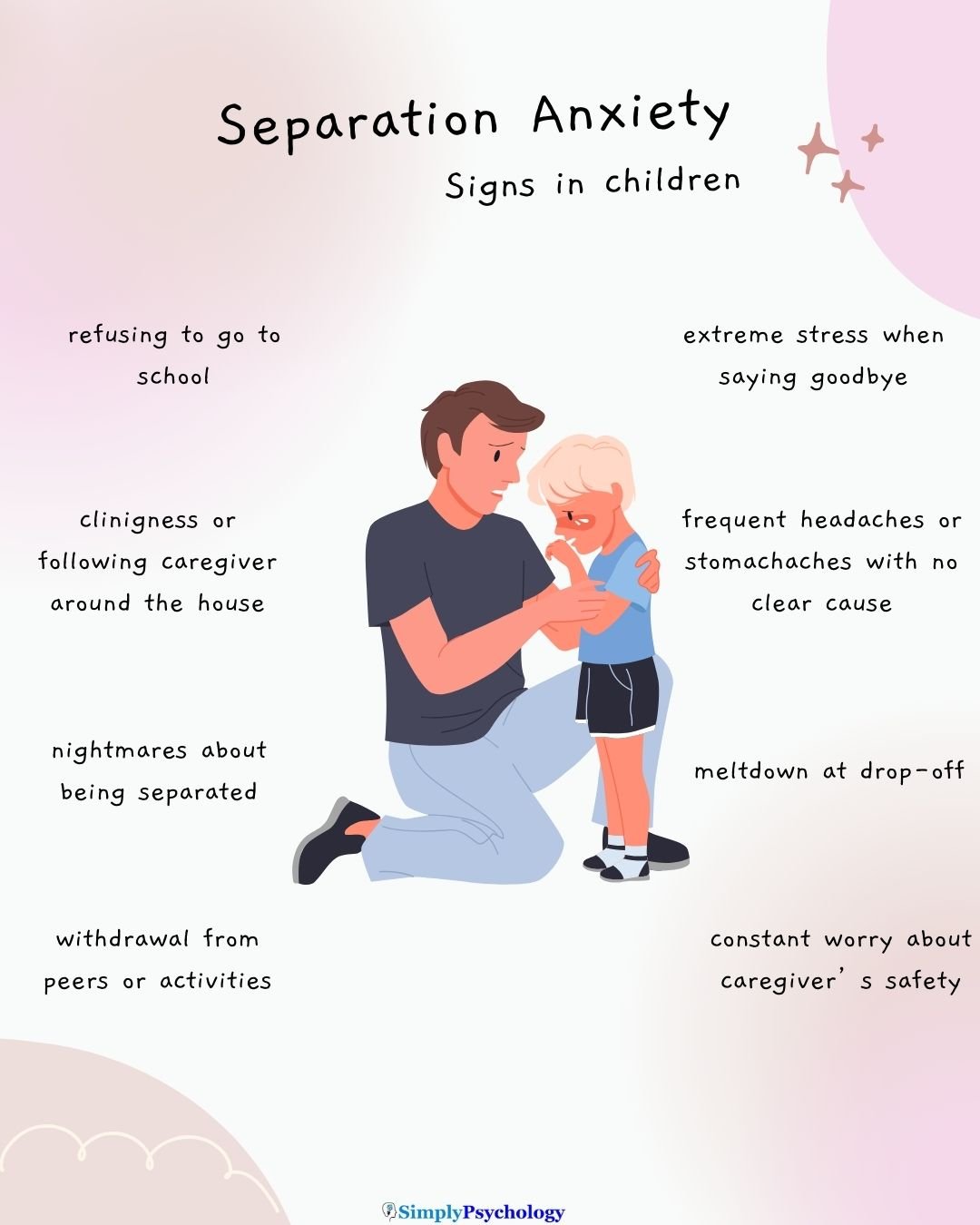
Common symptoms include:
- Excessive worry about losing a parent or something bad happening during separation
- Distress before or during separation, sometimes with nightmares about being apart
- Clinginess or refusal to be alone, go to school, or sleep without a caregiver
- Physical complaints such as headaches, stomachaches, nausea, or trouble sleeping
- Behavioral signs like tantrums, crying, meltdowns, or pretending to be sick to avoid school
Some children may also seem shy, withdrawn, or overly dependent on staying close to a parent, even at home.
Physical complaints deserve attention. A large minority of children referred for recurring stomachaches or headaches turn out to be showing separation fear rather than a primarily medical problem (Walker et al., 2009).
Refusing school is another common and disruptive sign. Clinicians call it school refusal when separation fear, not truancy or dislike of school, keeps a child at home.
John Bowlby argued that the fear is often about what might happen to the family during the child’s absence, rather than about school itself (Bowlby, 1973).
| Type | Examples |
|---|---|
| Cognitive | Excessive worry about losing a parent, fears of harm, nightmares about separation |
| Behavioral | Clinginess, tantrums, refusal to go to school, avoiding being alone or sleeping alone |
| Physical | Headaches, stomachaches, nausea, vomiting, trouble sleeping, bedwetting |
Bowlby described three stages of distress in young children separated from their mothers, often through hospital stays. James and Joyce Robertson filmed them in their series Young Children in Brief Separation (Robertson & Robertson, 1967–1973).
- Protest: the child cries, screams, kicks, and clings, openly expressing anger, fear, and bewilderment.
- Despair: struggling gives way to apathy and self-comforting, such as rocking or thumb-sucking, while the inner distress stays “locked up”.
- Detachment: the child responds to others again but only superficially, and may seem to reject a returning mother.
The Robertsons also found that context shaped the response. When they arranged one consistent substitute carer for children in comparable circumstances, distress was markedly reduced.
Consequences of Separation Anxiety
There are many complications that can manifest as a result of a child having separation anxiety:
- Poorer school performance
- It can result in other anxiety disorders if left untreated
- Low social performance and high social anxiety
- Difficulty initiating and maintaining friendships
- Family activities are limited by behaviors associated with SAD
- Parents of children with SAD have little to no time for themselves or each other
- Siblings become jealous of all the extra attention given to the child with SAD
💡 Did You Know?

While separation anxiety disorder is most often diagnosed in children, adults can experience it too. In adulthood, SAD may interfere with work, concentration, and relationships. Adults with the condition might struggle with being apart from partners or friends, sometimes appearing “clingy” or overly worried about loved ones’ safety.
What can cause separation anxiety disorder?
Several potential causes or risk factors can contribute to the development of separation anxiety disorder.
Environmental factors
Separation anxiety may manifest in children due to environmental factors, such as:
- A change in caregiver
- Change in routine
- Following a traumatic event
- Change in parent availability
- Change in family structure, e.g., through divorce or illness
- Moving house
- Starting a new school
- After any life change, even if it’s a positive change
Being bullied in childhood is itself an independent risk factor for developing SAD, separate from any single triggering event (American Psychiatric Association, 2022).
Long separations matter too. A 2025 systematic review of Romanian research compared children left behind by a parent working abroad with non-separated peers. The left-behind children showed moderately higher anxiety (Constantinescu et al., 2025).
Bowlby’s Attachment Theory of Separation Anxiety
John Bowlby argued that fear of separation is a primary, biologically given response, not a by-product of some other drive. It evolved because staying near a protective figure kept vulnerable young alive (Bowlby, 1973).
On this view, some situations are natural clues to danger: cues that signalled higher risk where humans evolved. They include:
- Being alone
- Darkness
- Sudden loud noises
- Strange people or places
- Above all, being alone in an unfamiliar setting
Separation from an attachment figure is alarming for the same reason.
An unaccompanied infant was an endangered infant, so a child needs no earlier trauma to find separation frightening. The readiness to fear it is built in.
Bowlby also saw the goal of the attachment system as access to a figure who is emotionally available and responsive. Anxiety can therefore be triggered by expected unavailability, not only by physical distance.
Earlier psychoanalytic theories, such as Freud’s build-up of undischarged libido and Rank’s birth trauma, treated separation anxiety as secondary to some other process. Bowlby rejected them for that reason (Bowlby, 1973).
Parenting style
Attachment styles may affect whether a child develops separation anxiety.
Having an insecure attachment style may affect a child’s ability to bond with others. It may also make it harder to feel safe away from loved ones, compared with children who form secure attachments to their caregivers.
Likewise, parenting that is overly critical, controlling, or overprotective may interfere with a child’s normal development of autonomy, as well as contribute to anxiety disorders.
Evidence supports this link. A 2011 meta-analysis pooled 46 studies covering 8,907 children and adolescents. It found that insecure attachment was linked to child anxiety (r = .30, a small-to-moderate effect). The ambivalent attachment style, marked by intense separation distress, showed the strongest link (Colonnesi et al., 2011).
Most were correlational. That means the link shows association, not proof that insecurity causes anxiety.
A 2026 study of 243 clinically anxious children looked at parental accommodation, such as staying until a child falls asleep. This tracked separation anxiety more strongly in children with lower attachment security (Weeks et al., 2026).
Economics
Lower household and neighborhood income have been linked to anxiety symptoms in young adolescents (Vine et al., 2012).
That research measured anxiety symptoms, not diagnosed SAD. Financial stress is therefore a possible contributor, not a proven cause.
A 2026 mixed-methods study looked at 202 children aged 8–12 in a low-income rural Colombian community (Chamorro Coneo et al., 2026). Caregivers described what managing separation anxiety costs them day to day.
One mother of a nine-year-old boy put it plainly:
“I no longer work, I’m at home fully dedicated to him… he does not want to sleep alone.”
Another mother traced her eight-year-old son’s anxiety to a bereavement: “he misses my (late) mum a lot.” These accounts are a reminder that coping advice assumes a caregiver has the time and support to apply it.
Mental health or neurodiversity
Separation anxiety may be related to another underlying mental health condition, such as delusions from psychotic disorders or fear of change relating to being autistic.
Individuals with a history of other anxiety disorders or mood disorders may be at increased risk of developing SAD. Examples include generalized anxiety disorder and major depressive disorder.
In children and adolescents, SAD often co-occurs with specific phobia or oppositional defiant disorder.
SAD in this age group is also linked to a higher risk of suicidal thoughts and behavior. The risk is not specific to SAD, though, and is better explained by its frequent overlap with other conditions (American Psychiatric Association, 2022).
Temperament
Those with timid or shy personalities may be more at risk of developing separation anxiety compared with more outgoing or extroverted children.
Studies have found that introversion combined with high neuroticism may play a role in the onset of anxiety disorders (Gershuny & Sher, 1998; Griffith et al., 2010).
A 2012 twin study followed anxiety-related behavior across middle childhood. Behavior that stayed stable was largely explained by stable genetic influences. Separation anxiety was among the presentations linked to this persistent component (Trzaskowski et al., 2012).
Temperament and genetic liability may shape both how a child experiences separation and the caregiving the child draws out. Parenting alone does not decide the outcome.
Family history
Some research suggests a genetic component to separation anxiety disorder. Individuals with a family history of anxiety disorders may be more susceptible to developing separation anxiety.
The strongest estimate comes from twin research. The DSM-5-TR reports heritability of 73% in six-year-old twins, higher in girls (American Psychiatric Association, 2022). Heritability is the share of differences between children that genes explain.
Biology plays a part too. Children with SAD also react more strongly to breathing air enriched with carbon dioxide, a laboratory test that provokes panic-like breathlessness. This suggests the fear response has a physiological basis, not only a behavioral one (American Psychiatric Association, 2022).
Diagnosing Separation Anxiety Disorder
Only a qualified mental health professional can diagnose separation anxiety disorder (SAD).
Part of the process involves distinguishing between normal developmental separation anxiety and a disorder that significantly interferes with a child’s daily life.
The first step is often a pediatrician visit. They may rule out physical conditions before referring families to a child psychologist or psychiatrist.
Assessment often includes a psychological evaluation, structured interviews, and input from parents about the child’s behavior.
Questionnaires can help too. The Children’s Separation Anxiety Scale (CSAS) explores worries and separation-related distress.
The Screen for Child Anxiety Related Emotional Disorders (SCARED) screens for several anxiety disorders. Its separation anxiety subscale yields a continuous symptom score (Birmaher et al., 1997).
DSM-5 Diagnostic Criteria
According to the DSM-5, SAD is defined as a developmentally inappropriate and excessive fear of separation from attachment figures. A diagnosis also requires:
- Persistence: symptoms last at least 4 weeks in children and adolescents, and 6 months or more in adults.
- Impairment: symptoms cause significant distress or impairment at home, school, or in social settings.
Because SAD can overlap with other mental health conditions, only a professional evaluation can determine whether a child’s anxiety meets the criteria for diagnosis.
Separation Anxiety Disorder in Adults
SAD is not only a childhood condition. The DSM-5 removed the childhood-onset requirement after epidemiological findings showed it is common in adults too.
Three studies show how common adult SAD is:
- US national survey: lifetime prevalence was 4.1% for childhood SAD and 6.6% for adult SAD, and 77.5% of adult cases first appeared in adulthood (Shear et al., 2006).
- Anxiety clinic: about a quarter of 520 Sydney patients had adult SAD, and they reported more depression, anxiety, and disability (Silove et al., 2010).
- Saudi national survey: lifetime prevalence was 7.6%, yet only 26.1% of affected people had ever received mental health treatment (Yezli et al., 2025).
The Saudi data show SAD is not only a Western finding.
Treatment Options for Separation Anxiety Disorder
Cognitive behavioral therapy
Cognitive behavioral therapy (CBT) helps children recognize and challenge unhelpful thoughts and develop healthier coping strategies.
Sessions often include relaxation techniques and gradual practice facing separation fears. Parents may be involved to learn how to support independence in encouraging ways.
CBT for SAD usually involves the family. A young child’s anxiety is partly maintained by how caregivers respond to it.
The approach treats two things as fuel for anxiety. One is avoidance of separation. The other is catastrophic beliefs about what will happen during one. Treatment combines graded exposure to separation situations with parent coaching.
Parents learn to stop reinforcing avoidance, for example by letting a child skip a sleepover. They learn to reward brave behavior instead.
CBT works. A 2025 meta-analysis of 86 randomized trials found a large effect on diagnosed anxiety in children and adolescents. Effects were largest with 9–16 hours of contact with a facilitator (Zhou et al., 2025).
A 2026 scoping review highlighted a German trial of CBT with parent training. The results were striking. At follow-up, 76.2% of treated children no longer met criteria for SAD, against 13.6% on a waitlist (Qutishat et al., 2026).
Play therapy and art therapy also showed promise in smaller, mostly non-randomized studies.
Parent-child interaction therapy
Parent-child interaction therapy may also be useful for those with SAD. This therapy usually has three main treatment phases:
- Child-directed interaction: focuses on improving the quality of the parent-child relationship with the aim of strengthening the child’s feelings of safety.
- Bravery-directed interaction: educates the parents about why their child feels anxious. The therapist will develop a bravery ladder that shows situations that cause anxious feelings and establishes rewards for positive reactions.
- Parent-directed interaction: teaches parents how to communicate clearly with their child so they can help manage unhelpful behaviors from their child.
Contingency management
Contingency management is used with children and is based on positive reinforcement. Parent and child first agree on goals.
When these goals are met, the parent can reward the child. This reward can be anything that the child values, such as stickers or extra TV time.
The goal of this treatment operates on the principle that positive behaviors that get rewarded will get repeated.
How parents get involved matters. Manassis et al. (2014) combined individual patient data from 18 randomized trials of CBT for anxious youth.
They compared minimal parental involvement, extensive but unstructured involvement, and involvement built around contingency management. Only the structured approach kept treatment gains significantly better a year after treatment ended.
Exposure therapy
Exposure therapy works on the idea that confronting your fears gives the person a chance to see that their fears are irrational. This usually involves gradually exposing someone to their feared situation, such as being left without a loved one.
This can start small. The first step might be talking about the idea of being left alone. The person then works up to being left alone for increasingly longer periods, until they feel comfortable being away from their loved one.
CBT is often paired with exposure-based treatments, and gives people with SAD ways of coping other than escape and avoidance.
Exposure works through extinction. Repeatedly staying in a feared separation without the expected catastrophe weakens the learned link between separation and danger, so anxiety falls with practice rather than through reassurance alone.
Safety behaviors can undermine this. They are small actions that make a situation feel safer without testing the feared belief. A child might repeatedly text a parent during the school day, or a parent might linger at the classroom door.
A review of the exposure literature found that safety behaviors reliably blunt the new learning that exposure is meant to produce (Blakey & Abramowitz, 2016).
Gains can also look fragile at first. Fear extinguished in a supportive classroom may not transfer to an overnight camp, and it can return after a long break. That is a normal feature of extinction learning, not a sign that treatment failed.
Medication
Medication is not usually the first treatment for children. In some cases, doctors may prescribe antidepressants (such as SSRIs) if other treatments are not effective, but this requires careful monitoring.
Support groups
Support groups may also be useful for those who have SAD. People who join these groups can gain assistance with learning techniques for reducing SAD symptoms in a group environment.
Everyday Coping Tips for Parents (Home & School)
These tips, drawn from pediatric psychologists and behavior experts, can help reduce your child’s separation anxiety even outside therapy.
Home & Drop-Off Routines
- Quick, predictable goodbyes. Dr Wendy Sue Swanson suggests keeping drop-offs short and consistent, with the same phrases or ritual each time. This helps establish trust in your child’s independence.
- Practice short separations. Dr Becky Kennedy suggests starting small, such as leaving your child with a grandparent or stepping out for a few minutes, to build confidence gradually.
- Use transitional objects. Let your child bring a favorite toy, blanket, or photo to feel connected when away from you.
As pediatrician Dr Wendy Sue Swanson explains, a well-meant return made things worse. About an hour after a difficult goodbye, she went back to her son’s classroom because she missed him.
The return, she says, “not only extended the separation anxiety, we started all over again in the process.” The second goodbye was “near nuclear.” Later drop-offs stayed harder.
Her advice is to keep goodbyes short, consistent, and final, however tempting it is to go back.
According to clinical psychologist Dr Becky Kennedy, parental confidence matters. Her argument is that a child keeps checking whether the adult leaving believes they will be safe.
A parent who lingers, looks anxious, or keeps returning signals that separation is something to worry about. Kennedy suggests tolerating the child’s tears at goodbye rather than dismissing them or being visibly thrown by them. This is her professional view, not a research finding.
School-Related & Communication Tips
- Build routine with the school. Dr Barbara Bentley suggests meeting teachers ahead of time or visiting the classroom before the school year starts so your child knows what to expect.
- Reassure, but don’t overdo it. Say something like, “I know it’s hard, but I’ll see you after school,” rather than offering repeated vague promises. This lets children feel heard without reinforcing anxious thinking.
If your child’s anxiety is intense, doesn’t improve with these strategies, or causes serious disruptions, please seek help from a pediatrician or child psychologist.
Do you need mental health support?
USA: If you or a loved one are struggling with symptoms of an anxiety disorder, contact the Substance Abuse and Mental Health Services Administration (SAMHSA) National Helpline. It offers information on support and treatment facilities in your area.
Call 1-800-662-4357.
UK
Contact the Samaritans for support and assistance from a trained counselor: https://www.samaritans.org/; email jo@samaritans.org .
Available 24 hours a day, 365 days a year (this number is free to call):
116-123
Rethink Mental Illness: rethink.org
0300 5000 927
Key Takeaways
- Normal Stage: Some separation anxiety is a typical stage of development and usually eases by age 3–4.
- SAD Criteria: SAD is excessive, impairing fear of separation lasting at least 4 weeks in children and 6 months in adults.
- Prevalence: Estimates are around 3–4% in children and 6.6% lifetime in adults, and most adult cases begin in adulthood.
- Causes: Risk factors include insecure attachment, major life changes, a shy temperament, and genetics.
- Treatment: Family-based CBT, with graded exposure and parents rewarding brave behavior, has the strongest evidence.
- Seeking Help: Only a qualified professional can diagnose SAD. Seek help if anxiety is intense or disrupts daily life.
References
Administration SA and MHS. Table 15, dsm-iv to dsm-5 separation anxiety disorder comparison. Updated June 2016.
American Psychiatric Association. (2022). Diagnostic and statistical manual of mental disorders (5th ed., text rev.). https://doi.org/10.1176/appi.books.9780890425787
Birmaher, B., Khetarpal, S., Brent, D., Cully, M., Balach, L., Kaufman, J., & Neer, S. M. (1997). The Screen for Child Anxiety Related Emotional Disorders (SCARED): Scale construction and psychometric characteristics. Journal of the American Academy of Child & Adolescent Psychiatry, 36(4), 545–553. https://doi.org/10.1097/00004583-199704000-00018
Blakey, S. M., & Abramowitz, J. S. (2016). The effects of safety behaviors during exposure therapy for anxiety: Critical analysis from an inhibitory learning perspective. Clinical Psychology Review, 49, 1–15. https://doi.org/10.1016/j.cpr.2016.07.002
Bowlby, J. (1973). Attachment and loss: Vol. 2. Separation: Anxiety and anger. Penguin.
Chamorro Coneo, A. M., Padilla Solano, P. E., & De Castro Correa, A. M. (2026). Exploring childhood separation anxiety in resource-limited contexts: A mixed-methods study with children and caregivers. Child and Adolescent Psychiatry and Mental Health, 20, Article 87. https://doi.org/10.1186/s13034-026-01090-9
Colonnesi, C., Draijer, E. M., Stams, G. J. J. M., Van der Bruggen, C. O., Bögels, S. M., & Noom, M. J. (2011). The relation between insecure attachment and child anxiety: A meta-analytic review. Journal of Clinical Child & Adolescent Psychology, 40(4), 630–645. https://doi.org/10.1080/15374416.2011.581623
Constantinescu, N., Sandnes, R., & Bacro, F. (2025). The psychological impact of parental work migration on left-behind children in Romania: A literature review. Attachment & Human Development, 27(5), 684–714. https://doi.org/10.1080/14616734.2025.2536935
Dabkowska, M., Araszkiewicz, A., Dabkowska, A., & Wilkosc, M. (2011). Separation anxiety in children and adolescents. In Different views of anxiety disorders. IntechOpen.
Ehrenreich, J. T., Santucci, L. C., & Weiner, C. L. (2008). Separation anxiety disorder in youth: Phenomenology, assessment, and treatment. Psicologia conductual, 16(3), 389.
Gershuny, B. S., & Sher, K. J. (1998). The relation between personality and anxiety: findings from a 3-year prospective study. Journal of abnormal psychology, 107(2), 252.
Griffith, J. W., Zinbarg, R. E., Craske, M. G., Mineka, S., Rose, R. D., Waters, A. M., & Sutton, J. M. (2010). Neuroticism as a common dimension in the internalizing disorders. Psychological medicine, 40(7), 1125-1136.
Manassis, K., Lee, T. C., Bennett, K., Zhao, X. Y., Mendlowitz, S., Duda, S., Saini, M., Wilansky, P., Baer, S., Barrett, P., Bodden, D., Cobham, V. E., Dadds, M. R., Flannery-Schroeder, E., Ginsburg, G., Heyne, D., Hudson, J. L., Kendall, P. C., Liber, J., … Wood, J. J. (2014). Types of parental involvement in CBT with anxious youth: A preliminary meta-analysis. Journal of Consulting and Clinical Psychology, 82(6), 1163–1172. https://doi.org/10.1037/a0036969
Mohammadi, M. R., Badrfam, R., Khaleghi, A., Hooshyari, Z., Ahmadi, N., & Zandifar, A. (2020). Prevalence, comorbidity and predictor of separation anxiety disorder in children and adolescents. Psychiatric Quarterly, 91(4), 1415–1429. https://doi.org/10.1007/s11126-020-09778-7
Qutishat, M., Elabasy, A. E., Lazarus, E., Al-Hadidi, M., & Al Gharibi, K. (2026). Effectiveness of therapeutic and educational interventions for childhood separation anxiety: A scoping review. Journal of Paediatrics and Child Health, 62(8), 1363–1376. https://doi.org/10.1111/jpc.70492
Robertson, J., & Robertson, J. (1967–1973). Young children in brief separation [Film series]. Tavistock Child Development Research Unit.
Shear, K., Jin, R., Ruscio, A. M., Walters, E. E., & Kessler, R. C. (2006). Prevalence and correlates of estimated DSM-IV child and adult separation anxiety disorder in the National Comorbidity Survey Replication. American Journal of Psychiatry, 163(6), 1074–1083. https://doi.org/10.1176/ajp.2006.163.6.1074
Silove, D. M., Marnane, C. L., Wagner, R., Manicavasagar, V. L., & Rees, S. (2010). The prevalence and correlates of adult separation anxiety disorder in an anxiety clinic. BMC Psychiatry, 10, Article 21. https://doi.org/10.1186/1471-244X-10-21
Trzaskowski, M., Zavos, H. M. S., Haworth, C. M. A., Plomin, R., & Eley, T. C. (2012). Stable genetic influence on anxiety-related behaviours across middle childhood. Journal of Abnormal Child Psychology, 40(1), 85–94. https://doi.org/10.1007/s10802-011-9545-z
Vine, M., Stoep, A. V., Bell, J., Rhew, I. C., Gudmundsen, G., & McCauley, E. (2012). Associations between household and neighborhood income and anxiety symptoms in young adolescents. Depression and anxiety, 29(9), 824-832.
Walker, L. S., Beck, J., & Anderson, J. (2009). Functional abdominal pain and separation anxiety: helping the child return to school. Pediatric annals, 38(5), 267.
Weeks, G. A., Sakmar, E., Clark, T. A., Rose, A. M., Silverman, W. K., & Lebowitz, E. R. (2026). Family accommodation and separation anxiety: The moderating role of child attachment. Child Psychiatry & Human Development, 57(2), 314–323. https://doi.org/10.1007/s10578-024-01705-2
Yezli, S., Albedah, N., Bilal, L., Stein, D. J., Al-Habeeb, A., Al-Subaie, A., & Altwaijri, Y. (2025). Epidemiology of adult separation anxiety disorder in the Kingdom of Saudi Arabia: Results from the Saudi National Mental Health Survey. Social Psychiatry and Psychiatric Epidemiology, 60(10), 2429–2439. https://doi.org/10.1007/s00127-025-02882-8
Zhou, S., Creswell, C., Košir, U., & Reardon, T. (2025). Moderators of cognitive and behaviour therapies for prevention and treatment of anxiety disorders in children and adolescents: A systematic review and meta-analysis. Clinical Psychology Review, 116, Article 102548. https://doi.org/10.1016/j.cpr.2025.102548


