Social facilitation is the change in a person’s performance that happens when other people are present, either as an audience or as co-actors doing the same task alongside them. This classic social psychology finding usually means better performance on simple, well-practiced tasks and worse performance on complex or unfamiliar ones.
Take-home Messages
- Definition: Social facilitation refers to the finding that people sometimes show an increased level of effort as a result of the real, imagined, or implied presence of others.
- Origins: Norman Triplett first identified the effect in 1898, noticing cyclists posted faster times racing against another rider than riding alone.
- Naming: Psychologist Floyd Allport coined the term social facilitation in his 1924 book Social Psychology, based on research he began publishing in 1920.
- Two Types: There are two types of social facilitation: co-action effects and audience effects.
- Facilitation vs Inhibition: Some performers improve with others present (social facilitation), while others perform worse (social inhibition).
- Task Type Matters: Familiar or well-learned tasks tend to benefit from social facilitation, but unfamiliar or difficult tasks suffer social inhibition when others are present.
Types of Social Facilitation
Co-action Effects
A co-action effect refers to a phenomenon whereby increased task performance comes about by the mere presence of others doing the same task. That means simply having other people nearby, without any competition or cooperation. An example would be running a 100 meter sprint against someone.
The mere presence of others can enhance performance on simple or well-learned tasks but may hinder performance on complex or unfamiliar tasks. Co-action effects emphasize how parallel activity, rather than direct competition or cooperation, can impact individual behavior.
Perhaps the first social psychology laboratory experiment was Norman Triplett’s (1898) study of competitive cycling, widely regarded as the founding demonstration of social facilitation.
- Aim: Triplett had noticed that competitive cyclists posted faster times when racing against another rider than when riding alone against the clock. He wanted to test this pacemaking effect under controlled laboratory conditions.
- Method: Children aged 8 to 17 wound a fixed length of fishing line onto a reel, alone or paired with another child. A specially built machine let both work side by side at the same time.
- Results: Of 40 children studied closely, about half reeled faster when paired with another child. A smaller group went slower (over-excitement, Triplett thought), and the rest showed little change.
- Conclusion: Triplett concluded that “the bodily presence of another contestant participating simultaneously in the race serves to liberate latent energy not ordinarily available” (1898, p. 533). His method — isolating co-actor presence as the only changed variable — became the template for later research.
Later reviewers have questioned whether Triplett’s results were statistically reliable, given his small sample and lack of control over motivation. Even so, its real legacy is methodological. It was the first study to isolate the presence of a co-actor as an independent variable affecting performance.
You may notice the co-action effect if you concentrate better in a library than at home, even though both places are quiet.
Other co-action studies point the same way. Chen (1937) found that worker ants dig more than three times as much sand per ant when working (non-co-operatively) alongside other ants than when working alone.
Platt, Yaksh, and Darby (1967) found that animals will eat more of their food if there are others of their species present.
Allport went further. His own coaction studies, reported in 1920 and expanded in his 1924 book, tested the same pattern more systematically. Participants completed simple tasks like cancellation and word-association, working alone or side by side with others, with no competition or evaluation involved.
Output-based tasks, like speed of cancellation, consistently improved with coaction. Reasoning quality did not. On tasks that demanded careful, logical thought, working alongside others actually made performance worse.
Audience Effects
Social facilitation occurs not only in the presence of a co-actor but also in the presence of a passive spectator/audience. This is known as the audience effect.
Dashiell (1935) found that the presence of an audience facilitated subjects’ multiplication performance by increasing the number of simple multiplications completed.
An audience effect is a type of social facilitation in which an individual’s performance is influenced by the presence of others, or an audience. This presence causes the individual’s dominant response to occur.
Travis (1925) found that well-trained subjects were better at a psychomotor task (pursuit rotor) in front of spectators.
However, Pessin (1933) found the opposite audience effect. Subjects needed fewer trials to learn a list of nonsense words when working alone than when in front of an audience.
It seems, then, that the extent of social facilitation or inhibition depends upon the nature of the interaction between the task and the performer.
Social Loafing
However, there are instances where the presence of others has the opposite effect. Sometimes we don’t work as hard in the presence of others as we do when alone, especially if our behavior is not under direct surveillance. This phenomenon is known as social loafing.
Social loafing is a psychological phenomenon wherein individuals exert less effort when working on a collective task with others compared to when they work individually.
Essentially, as the group size increases, some individuals tend to “hide in the crowd” and let others carry the workload.
In larger groups, responsibility for the task is spread across many members. This diffusion can make individuals feel less personally accountable.
Theories of Social Facilitation
Underlying mechanisms through which the basic phenomenon of social facilitation operates, include:
For decades, this puzzle had no answer. Some studies found facilitation, others found impairment, and no single explanation covered both patterns. Research on the topic almost stopped for nearly twenty years.
Robert Zajonc’s 1965 paper in Science broke the deadlock. He noticed a pattern earlier reviewers had missed: presence impaired performance whenever a task involved learning something new, but helped performance whenever the task involved doing something already well-learned.
Cognitive Factors (Distraction Conflict and Attention)
Distraction-conflict theory (Baron, 1986) offers a different explanation. It argues that the conflict between attending to a person and attending to a task, not mere presence, is what affects performance.
This idea has direct support.
Sanders, Baron, and Moore (1978) first tested this by varying how similar a co-actor’s task was to the participant’s own. The comparison alone was enough to distract. The same task-complexity pattern turned up: facilitation on simple tasks, impairment on complex ones.
This attentional conflict raises drive, which speeds up performance on simple, well-learned tasks. On complex or unfamiliar tasks, the same conflict impairs performance, because attention is split between the task and the other person (Baron, 1986).
The conflict also narrows attention. A narrower focus helps when the task’s key information sits front and centre, but hurts when a task needs peripheral or scattered information too.
Affective Factors (Anxiety of Being Evaluated)
According to Cottrell (1968), mere presence is not what drives social facilitation. What matters is the performer’s apprehension about being evaluated by others. Fear of judgement did the real work.
We know that approval and disapproval often depend on others’ evaluations. The presence of others therefore triggers an acquired arousal drive based on evaluation anxiety.
We are aroused by audiences because we have learned that they evaluate our performance; they are not merely passive spectators, we believe.
That fear has a name. This drive is called evaluation apprehension: arousal that rises specifically because an audience can judge us, not just because it is present. Cottrell tested this directly.
Participants performed a well-practised task alone, in front of two attentive observers, or in front of two people who were blindfolded and could not evaluate them. Attentive observers produced the usual boost to dominant responses.
Blindfolded observers did not; their results looked just like the alone condition. The presence of others was not enough. What mattered was whether they could actually judge the performance.
Physiological Factors (Drive and Arousal)
According to Zajonc’s drive theory of social facilitation, behavior that is instinctive or well-learned is improved, whereas behavior that is novel or complex is impaired.
Zajonc’s (1965) fundamental claim is that “an audience impairs the acquisition of new responses and facilitates the emission of well-learned responses” (p. 274).
His crucial theoretical contribution was that the presence of others enhances the emission of dominant responses.
Zajonc’s explanation draws on Clark Hull’s theory of motivation. Hull argued that a high level of arousal, or drive, strengthens whichever response is most dominant, or habitual, in a given situation.
The presence of others adds to a person’s arousal. On a difficult or unfamiliar task, that extra arousal strengthens the wrong, dominant response, producing the kind of performance-impairing stress seen under pressure.
The wrong response wins.
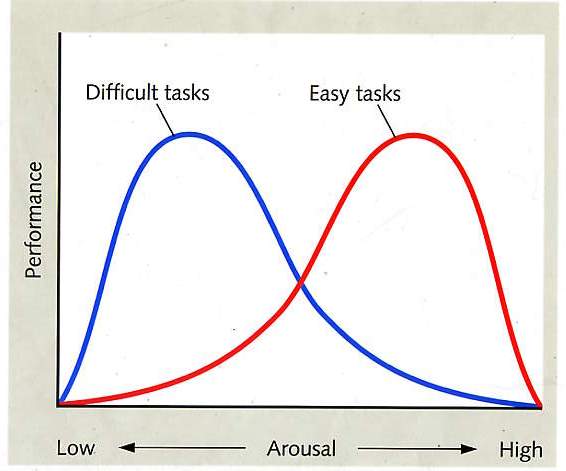
The extra arousal from the presence of others can push us past our optimum level of arousal. This makes the dominant response something we can do easily, not something new or demanding. The Yerkes-Dodson theory of optimal arousal supports this idea.
A dominant response is simply the response that is most likely to occur in the presence of the given array of stimuli.
If a task is easy, the dominant response is usually the correct one. The audience or co-actor helps bring out this response, which improves performance.
The reverse happens for hard tasks.
If a task is difficult, the dominant response is usually the incorrect one. The audience or co-actor still brings out this response, but now performance suffers because the response is wrong.
Challenge and Threat: A Physiological Reframe
A more recent account reinterprets audience effects in cardiovascular terms rather than generalised drive. Blascovich and colleagues (1999) found that when a task’s demands sit comfortably within a person’s own resources, an audience produces a challenge response. The heart pumps more blood and blood vessels relax, which supports performance.
It feels like a boost, not a burden. When demands exceed those resources, the same audience produces a threat response instead: blood vessels constrict, and performance suffers. This keeps Zajonc’s core idea of arousal-driven performance change, but gives it a specific, measurable bodily signature.
Implications
Social facilitation has several implications for understanding behavior in group settings and structuring group tasks. Here are some of the key implications:
- Performance Enhancement or Deterioration: The mere presence of others can improve or hinder performance, depending on task complexity. Simple tasks usually see a boost; complex tasks may decline.
- Training and Skill Development: Practicing a new skill alone first is often best. Once the skill feels familiar, practicing in front of others can help solidify it.
- Workplace Productivity: Social facilitation can guide office design. Open-plan offices suit routine tasks well but may hurt tasks that need deep concentration or problem-solving.
- Educational Settings: Social facilitation affects students differently. Some perform better on tests around others, while some find the same setting distracting.
- Sports and Athletics: Athletes often perform better with an audience, leveraging the arousal from the presence of spectators to enhance their performance.
- Online and Streamed Performance: Video calls, livestreams, and remote-monitored work bring the audience effect online: the same simple-task boost and complex-task cost can appear even without anyone in the room.
Critical Evaluation
Drive theory has held up well on its central prediction: presence helps performance on simple, well-learned tasks and hurts performance on complex ones. Two questions remain important. How strong is this effect in the research record? And what has more recent research added to Zajonc’s original account?
How Strong Is the Evidence?
The strongest test of drive theory comes from Bond and Titus (1983). They statistically combined 241 studies and roughly 24,000 participants published between 1898 and 1980. They calculated effect sizes separately for speed and accuracy, on both simple and complex tasks, across audience and co-action studies. It remains the benchmark.
The presence of others reliably sped up simple tasks and reliably slowed complex ones, confirming Zajonc’s prediction. But the effect was small: mere presence explained only 0.3 to 3% of the variance in performance.
Physiological arousal measures did not reliably track the presence manipulation across studies, a gap that has troubled drive theory ever since.
Zajonc and Sales (1966) confirmed the mechanism directly in humans. Participants first learned nonsense words to different levels of practice, so researchers knew which responses were dominant for each person. They then viewed degraded, hard-to-read versions of these words, either alone or with two observers watching.
The audience made no difference to accuracy overall. What changed was which words people reported: dominant, well-practised words came out more often, and less-practised ones less often, exactly as drive theory predicted.
The Cockroach Evidence
Zajonc, Heingartner, and Herman (1969) designed the study to strip away every cognitive explanation of social facilitation, using cockroaches (Blatta orientalis) as subjects. A cockroach cannot form self-presentation concerns or anticipate being judged, so if presence altered its performance, the effect could only be driven by non-specific arousal, not evaluation.
The setup was simple. Cockroaches ran individually through a Plexiglas runway apparatus, built as either a simple straight runway or a complex maze with a right-angle turn. In the simple runway, the dark-goal-box escape response was directly correct; in the maze, that same dominant response first had to be inhibited.
A bright overhead light supplied the escape motivation. Each animal ran alone, with an audience of other cockroaches watching from transparent side boxes, or paired with a co-acting cockroach in a matching runway.
In the simple runway, audience and co-action conditions produced faster times than running alone; in the maze, both conditions produced slower times. This is the same interaction found repeatedly in human studies: presence speeds simple, well-learned responses and slows complex ones.
The direction flipped completely.
Because cockroaches cannot plausibly feel evaluation anxiety, the pattern is difficult to explain without some form of drive-based mechanism.
Contemporary Research
The most influential recent synthesis is Belletier, Normand, and Huguet (2019), published in Current Directions in Psychological Science. Rather than pick a winner among drive, evaluation-apprehension, and distraction-conflict accounts, the review maps each onto distinct brain systems. The idea is simple.
Motivational accounts, like drive and evaluation apprehension, engage reward and threat circuits such as the ventral striatum and amygdala. Cognitive accounts, like distraction-conflict, engage attention circuits that narrow focus, helping simple tasks and hurting complex ones.
The review’s key claim is that arousal and attention are separable pathways to the same task-complexity effect. That distinction matters.
Together, these findings support Zajonc’s central insight while adding an important caveat. The task-complexity effect is genuine and now traced to specific brain systems, but its everyday impact on performance is usually modest, not dramatic.
Individual Differences: Who Is Most Affected?
Not everyone responds to an audience the same way. A review by Uziel (2007) found that people high in neuroticism or low in self-esteem tend to perform worse around others, regardless of the task.
The reverse was true for people low in neuroticism and high in self-esteem: their performance rose, even on complex tasks. The task’s difficulty is not the deciding factor here. It is how much the person chronically worries about being judged.
What Does the Evidence Add Up To?
Across a century of research, three qualifications are now widely accepted.
- Effect Size Is Small: Mere presence explains only 0.3 to 3% of the variance in performance, so claims that a crowd “transforms” performance overstate the effect.
- Presence and Evaluation Add Up: Mere presence is enough to produce the effect, but evaluation apprehension makes it stronger. The two are additive, not rival explanations.
- Attention Is a Separate Route: Distraction-conflict works alongside drive, not instead of it. Modern brain-imaging work treats motivation and attention as parallel pathways to the same outcome.
The theory’s lasting contribution is not the specific Hullian idea of “generalised drive,” whose physiological signature has been hard to pin down. It is the framework: a single mechanism that explains coaction, audience effects, humans, and animals through one interaction between presence and task difficulty.
References
Baron, R. S. (1986). Distraction-conflict theory: Progress and problems. In L. Berkowitz (Ed.), Advances in experimental social psychology (Vol. 19, pp. 1-40). Academic Press. https://doi.org/10.1016/S0065-2601(08)60211-7
Belletier, C., Normand, A., & Huguet, P. (2019). Social-facilitation-and-impairment effects: From motivation to cognition and the social brain. Current Directions in Psychological Science, 28(3), 260-265.
Blascovich, J., Mendes, W. B., Hunter, S. B., & Salomon, K. (1999). Social “facilitation” as challenge and threat. Journal of Personality and Social Psychology, 77(1), 68-77. https://doi.org/10.1037/0022-3514.77.1.68
Bond, C. F., Jr., & Titus, L. J. (1983). Social facilitation: A meta-analysis of 241 studies. Psychological Bulletin, 94(2), 265-292. https://doi.org/10.1037/0033-2909.94.2.265
Chen, S. C. (1937). The leaders and followers among the ants in nest-building. Physiological Zoology, 10(4), 437-455.
Cottrell, N. B., Wack, D. L., Sekerak, G. J., & Rittle, R. H. (1968). Social facilitation of dominant responses by the presence of an audience and the mere presence of others. Journal of personality and social psychology, 9(3), 245.
Dashiell, J. F. (1935). Experimental studies of the influence of social situations on the behavior of individual human adults. In C. Murchison (Ed.), A handbook of social psychology (pp. 1097-1158). Clark University Press.
Pessin, J. (1933). The comparative effects of social and mechanical stimulation on memorizing. The American Journal of Psychology, 45(2), 263-270.
Platt, J. J., Yaksh, T., & Darby, C. L. (1967). Social facilitation of eating behavior in armadillos. Psychological Reports, 20(3c), 1136-1136.
Sanders, G. S., Baron, R. S., & Moore, D. L. (1978). Distraction and social comparison as mediators of social facilitation effects. Journal of Experimental Social Psychology, 14(3), 291-303. https://doi.org/10.1016/0022-1031(78)90017-3
Travis, L. E. (1925). The effect of a small audience upon eye-hand coordination. The Journal of Abnormal and Social Psychology, 20(2), 142.
Triplett, N. (1898). The dynamogenic factors in pacemaking and competition. The American journal of psychology, 9(4), 507-533.
Uziel, L. (2007). Individual differences in the social facilitation effect: A review and meta-analysis. Journal of Research in Personality, 41(3), 579-601. https://doi.org/10.1016/j.jrp.2006.06.008
Zajonc, R. B. (1965). Social facilitation. Science, 149(3681), 269-274.
Zajonc, R. B., Heingartner, A., & Herman, E. M. (1969). Social enhancement and impairment of performance in the cockroach. Journal of Personality and Social Psychology, 13(2), 83-92.
Zajonc, R. B., & Sales, S. M. (1966). Social facilitation of dominant and subordinate responses. Journal of Experimental Social Psychology, 2 (2), 160-168.

