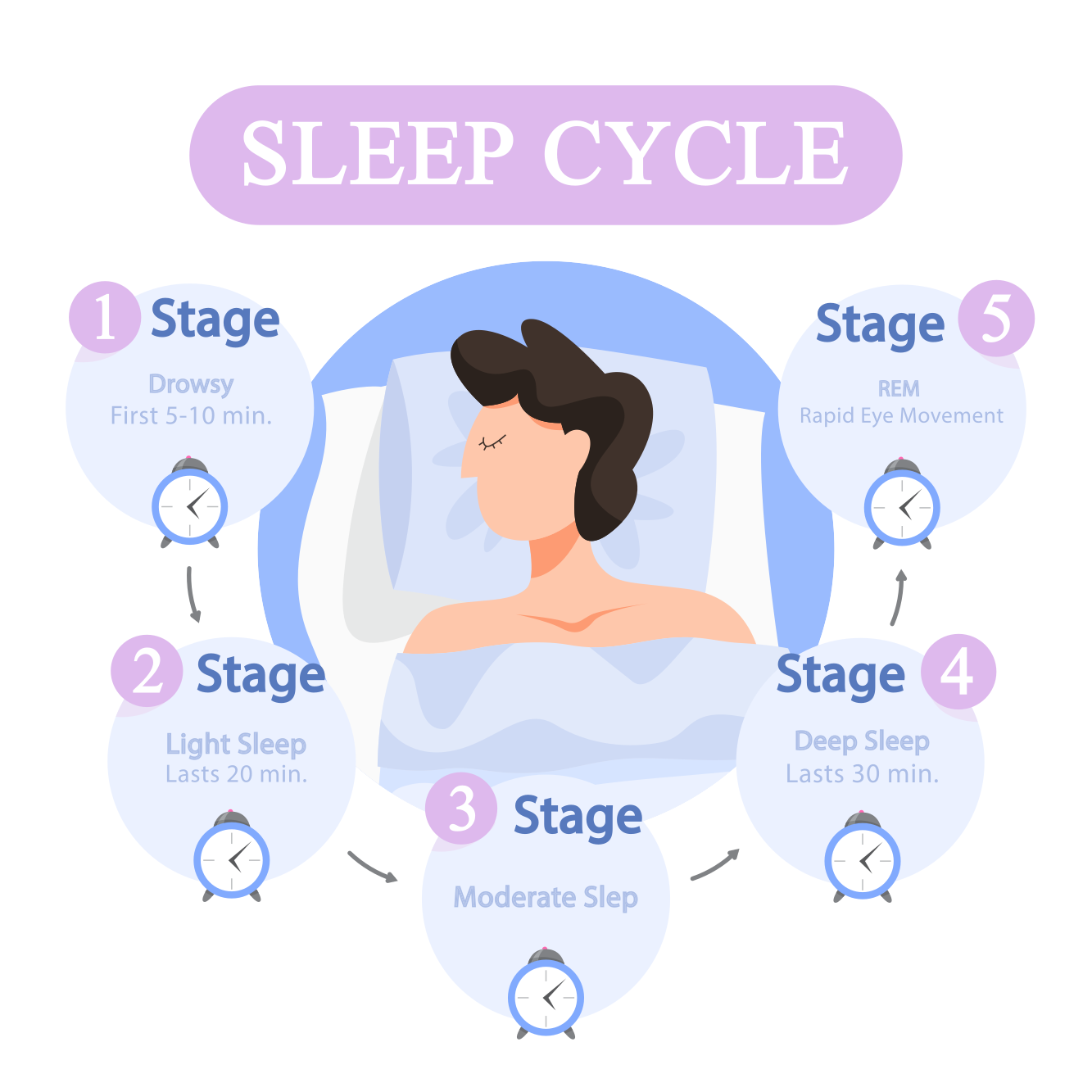
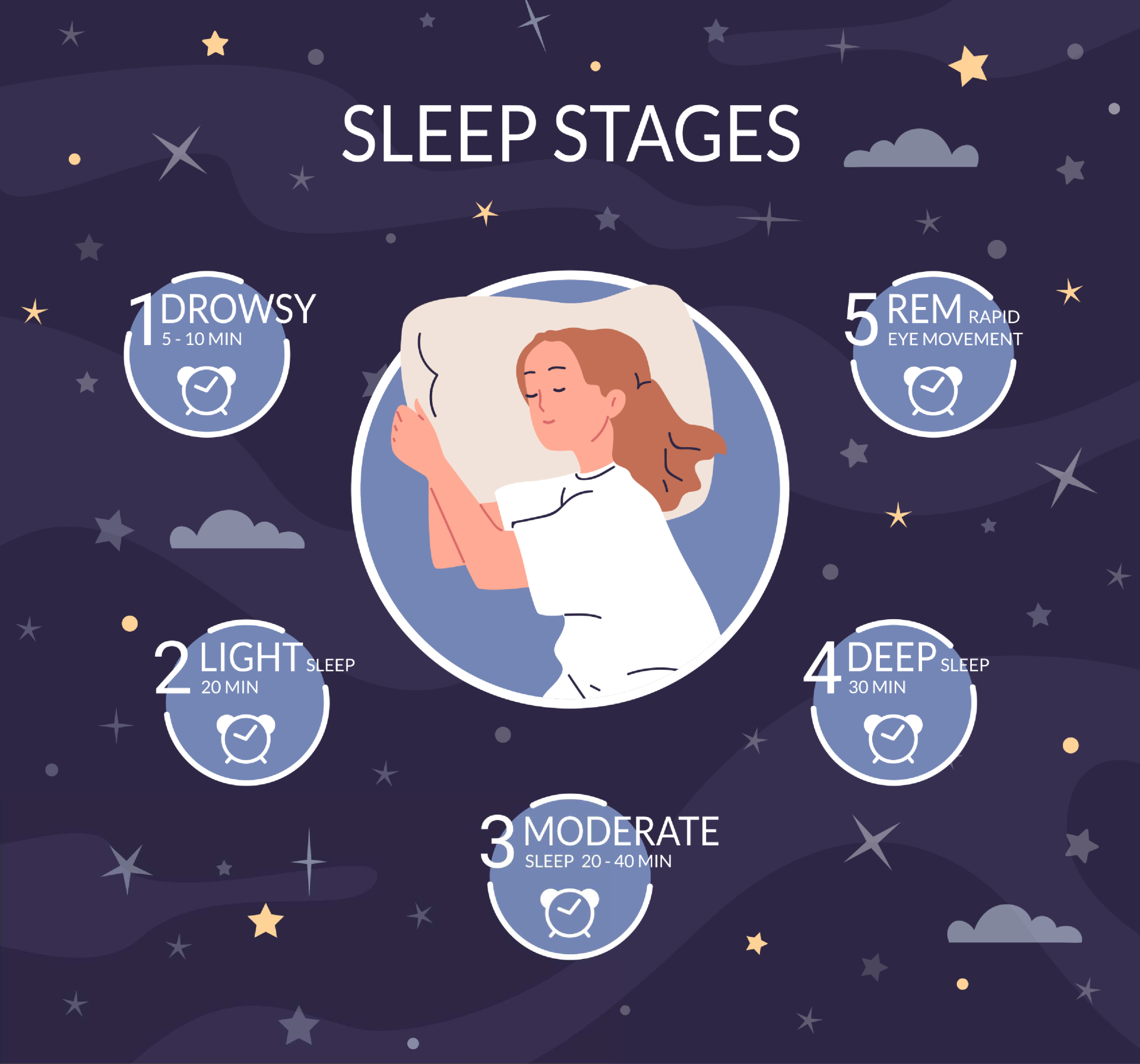
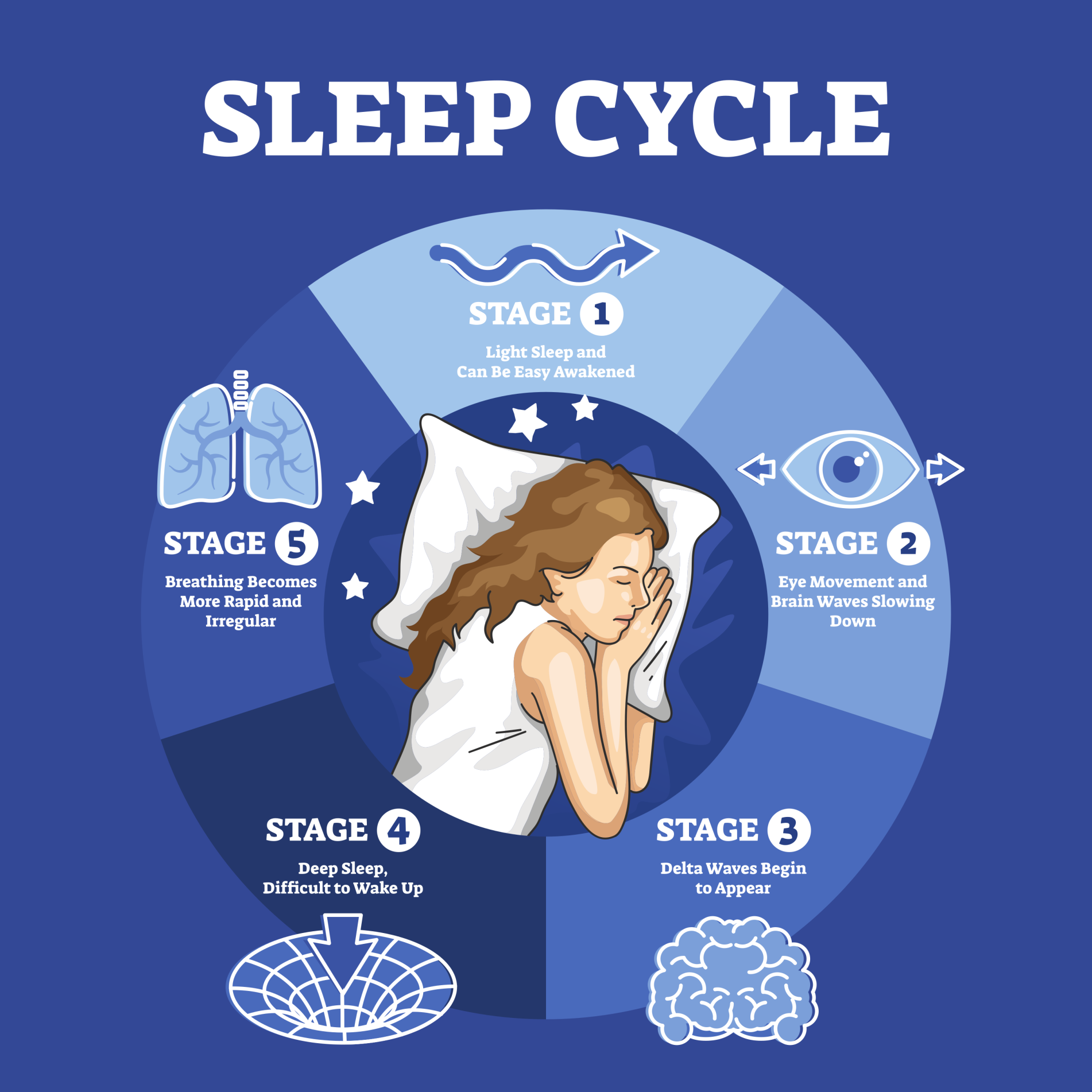
There are five different sleep stages, including REM (rapid eye movement) and NREM (non-rapid eye movement) sleep. The five stages make one sleep cycle, which usually repeats every 90 to 110 minutes.
-
Stage 1 (NREM): The transition from wakefulness to light sleep. Heart rate and breathing slow; muscles begin to relax.
-
Stage 2 (NREM): A deeper light sleep where body temperature drops and brain waves show specific bursts of activity (spindles). You spend the most time here.
-
Stage 3 (NREM): The beginning of Deep Sleep. It is difficult to wake someone from this stage; the body repairs tissues and builds bone/muscle.
-
Stage 4 (NREM): The deepest stage of sleep, characterized by slow delta waves. This is crucial for physical recovery and immune health.
-
REM (Rapid Eye Movement): Brain activity increases to near-awake levels. This is where dreaming occurs, while skeletal muscles are temporarily paralyzed to prevent acting them out.

Stage 1: lightest sleep
Stage 1 sleep is the initial phase of the sleep cycle, functioning as a transitional period between wakefulness and sleep.
It is the first of the non-rapid eye movement (NREM) stages and is characterized as a “light sleep” during which an individual drifts off. This stage typically lasts only a few minutes.
Neural Activity and Brain Waves
During Stage 1, brain activity shifts distinctly from the patterns observed during wakefulness.
This transition is visualized via electroencephalography (EEG) through changes in the frequency and amplitude of brain waves:
- Alpha Waves: The early portion of Stage 1 is characterized by alpha waves. These are relatively low-frequency (8–13 Hz), high-amplitude waves that become synchronized. This pattern resembles that of a person who is awake but very relaxed.
- Theta Waves: As the individual continues through Stage 1, there is an increase in theta wave activity. Theta waves have an even lower frequency (4–7 Hz) and higher amplitude than alpha waves.
- Overall Pattern: Generally, this stage is defined by relatively rapid, low-amplitude brain waves compared to the deeper stages that follow.
Physiological Changes
As the body enters Stage 1 sleep, several marked physical changes occur to facilitate the transition into deeper rest:
- Respiration and Heart Rate: Both the rate of breathing and the heartbeat begin to slowdown.
- Muscle Tension: There is a marked decrease in overall muscle tension.
- Body Temperature: Core body temperature begins to drop.
- Eye Movement: While rapid eye movements are absent (as this is an NREM stage), slow, rolling eye movements may occur during this period.
Subjective Experience and Wakefulness
Because Stage 1 is such a light phase of sleep, it is very easy to awaken someone during this time.
- Perception of Sleep: People awoken during Stage 1 often report that they have not been asleep at all.
- Mental Imagery: During this stage, images may appear to the sleeper, similar to viewing still photos. However, this is distinct from “true dreaming,” which typically occurs later in the night during REM sleep.
Clinical Context
Stage 1 sleep plays a role in the broader architecture of sleep health and pathology:
- Sleep Cycles: People progress through sleep stages in cycles lasting roughly 90 minutes; Stage 1 typically begins the cycle, followed by deeper NREM stages (2, 3, and 4) and eventually REM sleep.
- Depression: Individuals suffering from depression often exhibit altered sleep architecture, including a tendency to have more Stage 1 sleep and less slow-wave (deep) sleep.
- Disorders: In conditions like narcolepsy, individuals may skip NREM stages, including Stage 1, and go directly from wakefulness into REM sleep.
Stage 2: light sleep
Following the fleeting transition of Stage 1, the body enters Stage 2 sleep, a state of deep relaxation.
This phase represents a deepening of sleep where it becomes increasingly difficult to awaken the individual compared to the lighter initial stage.
In this stage, your body temperature drops, and your eye movements stop completely.
For young adults, Stage 2 accounts for approximately half of their total sleep time.
Neural Activity and Brain Waves
While theta waves continue to dominate brain activity during this stage, the electroencephalogram (EEG) reveals distinct patterns that differentiate Stage 2 from the wakefulness–sleep transition:
- Sleep Spindles: These are rapid bursts of higher frequency brain waves. They appear as momentary interruptions of spiky, sharply pointed waves within the generally slower, more regular wave pattern. Research suggests sleep spindles may be important for learning and memory,.
- K-complexes: These are characterized by a very high amplitude pattern of brain activity, K-complexes may occur in response to environmental stimuli and might serve as a mechanism to bridge higher levels of arousal in response to events in the immediate environment,.
Progression of Sleep Architecture
Stage 2 plays a significant role in the structure of a night’s rest:
- NREM Cycle: It is one of the distinct non-rapid eye movement (NREM) stages that people progress through in cycles lasting approximately 90 minutes.
- Shift Over Time: As the night progresses, the sleep architecture changes; less time is spent in the deepest sleep (Stage 4), and more time is spent in Stages 2 and 3.
Stages 3: deep sleep
Stage 3 sleep, often referred to as deep sleep or slow-wave sleep, is a period marked by greater muscle relaxation and a dramatic slowing of physiological functions.
As the body progresses from Stage 2 into Stage 3, it becomes much more difficult to awaken the sleeper compared to the earlier stages,.
Neural Activity and Brain Waves
In this stage, the brain’s electrical activity shifts significantly:
- Delta Waves: Stage 3 is characterized by the appearance of delta waves, which possess a low frequency (less than 3 Hz) and high amplitude. These are the slowest and highest amplitude brain wave patterns observed during sleep.
- Alpha Intrusion: Interestingly, some individuals exhibit increased levels of alpha brain wave activity – patterns usually associated with wakefulness – during Stage 3. Patients with this activity often report feeling unrefreshed upon waking, regardless of how long they slept,.
Physiological Functions and Benefits
Stage 3 sleep serves critical restorative and maintenance functions for the brain and body:
- Physical Restoration: During this deep sleep, heart rate and respiration slow dramatically. There is evidence that slow-wave sleep provides a general restorative function; for instance, local heating of the head or vigorous exercise that raises brain temperature can increase subsequent slow-wave sleep.
- Neurotoxin Clearance: This stage is critical for clearing neurotoxic proteins, such as beta-amyloid and tau, which accumulate during wakefulness.
- Memory and Learning: Slow-wave sleep appears to be essential for effective memory formation,. Engaging in slow-wave sleep after learning a new task can improve subsequent performance on that task.
Sleep Architecture and Parasomnias
Stage 3 plays a distinct role in the timing and phenomena of the sleep cycle:
- Timing: Deep sleep (Stages 3 and 4) dominates the first half of the night. As the night progresses, less time is spent in these deep stages.
- Parasomnias: This stage is associated with specific sleep disorders known as parasomnias, which involve unwanted motor behavior or experiences. Sleepwalking (somnambulism) and night terrors typically occur during slow-wave sleep. Contrary to popular belief, sleepwalking is not the enactment of dreams, as narrative dreams are least likely to occur during this phase.
Stages 4: deep sleep
Stage 4 sleep is the deepest phase of the sleep cycle, characterized as a period where the individual is least responsive to outside stimulation.
It is the final stage of non-rapid eye movement (NREM) sleep before the cycle typically loops back or transitions toward REM sleep.
Because of their physiological similarities, Stage 3 and Stage 4 are often grouped together and referred to collectively as slow-wave sleep or deep sleep,.
Neural Activity and Brain Waves
In this stage, the brain’s electrical activity slows further than in the preceding stages. The electroencephalogram (EEG) displays a specific pattern:
- Delta Waves: Stage 4 is marked by the predominance of delta waves. These are high-amplitude, low-frequency waves (less than 3 or 4 Hz).
- Comparison to Stage 3: While Stage 3 also features delta waves, this activity is more marked and continuous in Stage 4. The wave pattern becomes even slower and more regular than in the previous stage.
Physiological Changes and Functions
During Stage 4, the body is in a state of profound relaxation, making it very difficult to awaken the sleeper.
- Vital Signs: Heart rate and respiration slow dramatically during this phase.
- Growth Hormone: This stage appears to be essential for physical development and maintenance; increased secretion of growth hormone occurs during the first few hours of sleep, which coincides with the time when Stage 4 sleep dominates the cycle.
- Restoration: The quality of this deep sleep is vital for feeling rested. Individuals who experience intrusions of alpha brain waves (activity usually associated with wakefulness) during Stage 4 often report feeling unrefreshed upon waking, regardless of how long they slept.
Sleep Architecture
The presence of Stage 4 sleep changes as the night – and life – progresses:
- Early Night Dominance: Stage 4 is most likely to occur during the first half of the night. As the sleep cycles (which last about 90 minutes) repeat, the sleeper spends less time in Stage 4 and more time in Stages 1 and 2,.
- Age-Related Changes: The proportion of slow-wave sleep declines with age. In later life, Stage 4 sleep decreases significantly and may eventually disappear altogether.
Parasomnias
Specific sleep disturbances are closely linked to Stage 4 sleep. These phenomena are distinct from the narrative dreams that typically occur during REM sleep:
- Night Terrors: Occurring most frequently in children between ages 3 and 8, night terrors are sudden awakenings from Stage 4 sleep accompanied by extreme fear, panic, and strong physiological arousal.
- Sleepwalking and Sleeptalking: Both of these disturbances usually occur during Stage 4 sleep. Sleepwalkers may have a vague consciousness of the world around them and can maneuver around obstacles, but they are generally engaging in these complex behaviors while in this deep stage of NREM sleep.
Stage 5: REM sleep
Stage 5 sleep, most commonly known as REM (Rapid Eye Movement) sleep, is the final phase of the sleep cycle.
It is a unique state of consciousness characterized by rapid movements of the eyes under closed eyelids and brain activity that closely resembles wakefulness.
While the earlier stages (1 through 4) are collectively termed non-REM (NREM) sleep, REM sleep occupies a little more than 20% of an adult’s total sleeping time.
Neural Activity and “Paradoxical Sleep”
REM sleep is often referred to as paradoxical sleep because the brain appears to be awake while the body remains deeply asleep,.
- Brain Waves: Unlike the slow delta waves of Stage 4, the EEG patterns during Stage 5 are low-voltage, mixed-frequency waves (beta waves) that look very similar to those observed when a person is awake and alert.
- PGO Waves: In animal studies, the onset of REM is marked by bursts of spike discharges known as PGO waves, which originate in the pons, travel to the lateral geniculate nucleus, and then to the occipital cortex.
- Hippocampal Activity: Rhythmic “theta activity” (4–7 Hz) can be recorded from the hippocampus during this stage, which may be linked to memory consolidation.
Physiological Changes
Physiologically, Stage 5 is a time of high internal arousal contrasted with external immobility:
- Muscle Atonia: While the brain is active, the major voluntary muscle groups are paralyzed (atonia),. This paralysis is controlled by the magnocellular nucleus in the medulla and likely evolved to prevent the sleeper from acting out dreams.
- Autonomic Storms: Despite muscle paralysis, the heart rate increases and becomes irregular, blood pressure rises, and breathing becomes faster.
- Sexual Arousal: This stage is associated with increased genital blood flow, resulting in erections in males.
- Thermoregulation: The body’s homeostatic control of temperature is poor or reduced during REM sleep.
Dreaming and Function
Stage 5 is the period of sleep in which dreaming occurs most vividly.
- Dream Content: While some dreaming can occur in NREM stages, REM dreams are more likely to be vivid, emotional, bizarre, and easily remembered upon waking.
- Memory and Learning: REM sleep has been implicated in learning and memory formation, particularly for procedural memories (skills) and emotional processing.
- Development: This stage may play a key role in brain development. Neonates spend significantly more time in REM sleep (up to 50%) compared to adults, suggesting it assists in the maturation of neural circuits.
Regulation and REM Rebound
REM sleep is actively controlled by centers in the brain stem:
- Neurochemistry: The onset of REM is initiated by cholinergic neurons in the pons. Conversely, noradrenergic neurons (locus coeruleus) and serotonergic neurons (raphé nuclei) inhibit REM sleep; when these neurons stop firing, REM sleep begins.
- REM Rebound: The body appears to have a specific need for Stage 5 sleep. If a person is deprived of REM sleep, they will spend significantly more time in this stage during subsequent nights to “catch up,” a phenomenon known as REM rebound.
Disorders and Pathology
- Narcolepsy: Individuals with narcolepsy may skip NREM stages and pass directly from wakefulness into REM sleep. They may also suffer from cataplexy, a sudden loss of muscle tone similar to REM paralysis but occurring while awake.
- REM Sleep Behavior Disorder (RBD): In this condition, the normal muscle paralysis of Stage 5 fails to occur, allowing individuals to physically act out their dreams, which can result in injury.
- Depression: Interestingly, individuals suffering from major depression often exhibit more REM sleep and less slow-wave sleep. Deprivation of REM sleep can sometimes temporarily improve depressive symptoms.
The Sleep Cycle
Your body cycles through these stages four to five times each night.
Cycles earlier in the night tend to have more NREM sleep, while later cycles have a higher proportion of REM.
By the final cycle, your body may even skip NREM deep sleep entirely.
The sleep cycle is the orchestrator that binds the five stages of sleep into a cohesive biological rhythm.
Sleep is not a uniform state of quiescence; rather, it is an active, dynamic process where the brain cycles through distinct phases of electrical and physiological activity.

The 90-Minute Ultradian Rhythm
The alternation between non-REM (NREM) and REM sleep occurs in a regular, cyclical pattern known as an ultradian rhythm (a biological rhythm that occurs more frequently than once every 24 hours).
- Cycle Duration: Individuals progress through the sleep stages in cycles that last approximately 90 minutes.
- The Sequence: A typical cycle begins with the transition from wakefulness into Stage 1, deepens through Stage 2, and descends into the slow-wave sleep of Stages 3 and 4. After reaching the deepest point, the sleeper cycles back up through the lighter stages (often briefly returning to Stage 2 or 3) before entering Stage 5 (REM sleep).
- Cycle Frequency: During a typical night, a sleeper will experience approximately four to six of these cycles.
Shifting Architecture Throughout the Night
A critical feature of the sleep cycle is that it does not repeat identically throughout the night.
The composition of the 90-minute loops changes as the night progresses:
- First Half of the Night: The early cycles are dominated by slow-wave sleep (Stages 3 and 4). This suggests that the body prioritises physical restoration and growth hormone secretion immediately after falling asleep.
- Second Half of the Night: As the night continues, the deep, slow-wave stages decrease in duration and may disappear entirely,. Conversely, REM sleep (Stage 5) periods become longer and more frequent toward the morning. This is why dreaming is more likely to be reported when waking up naturally in the morning than during the first few hours of sleep.
Regulation: The Two-Process Model
The timing and structure of the sleep cycle are governed by the interplay of two major biological mechanisms:
1. Homeostatic Drive (Process S) This is the internal “pressure” to sleep that builds up during wakefulness.
- Sleep Debt: If an individual goes without sleep, they accrue a sleep debt, which results in decreased alertness and mental efficiency.
- Chemical Buildup: This pressure is partly regulated by neurochemicals such as adenosine, which accumulates in the basal forebrain during waking hours and inhibits neurons that promote wakefulness.
- Rebound Effect: If a person is deprived of specific stages, such as REM sleep, the body attempts to compensate. When finally allowed to sleep undisturbed, the individual will experience a REM rebound, spending significantly more time in REM than usual to “catch up”,.
2. Circadian Rhythm (Process C) This is the internal biological clock that regulates the timing of sleep and wakefulness over a 24-hour period.
- The Master Clock: This rhythm is controlled by the suprachiasmatic nucleus (SCN) located in the hypothalamus.
- Light Entrainment: The SCN is synchronized with the outside world primarily through light. Light-sensitive neurons in the retina send signals to the SCN, allowing the body to align its internal clock with the solar day.
- Melatonin: The SCN regulates the pineal gland’s secretion of melatonin, a hormone that rises during darkness to promote sleep and is inhibited by light.
Factors Influencing the Cycle
The architecture of the sleep cycle is not static and changes significantly across the lifespan and in response to environmental factors:
- Ageing:
- Infants: Newborns exhibit a polyphasic sleep pattern (sleeping multiple times a day) and spend approximately 50% of their sleep in REM.
- Adults: By adulthood, the pattern becomes monophasic (one major sleep period), and REM constitutes about 20–25% of total sleep.
- Elderly: In later life, the total amount of sleep may decrease, and the proportion of deep sleep (Stages 3 and 4) declines significantly or may disappear, leading to more frequent awakenings.
- Disruptions:
- Jet Lag: Travelling across time zones desynchronises the internal circadian rhythm from the external environment (zeitgebers), causing sleep disturbances.
- Shift Work: Working rotating shifts forces individuals to attempt sleep when their biological clock is promoting wakefulness, often resulting in insomnia and fatigue.
The Function of the Cycle
Why does the brain enforce this complex cycling? While fully understood, current theories suggest distinct functions for different phases:
- Memory Consolidation: Slow-wave sleep is often associated with the consolidation of declarative memory (facts and events), while REM sleep is implicated in procedural memory (skills) and emotional processing.
- Restoration: The high volume of slow-wave sleep early in the night supports physical repair and energy conservation,.
- Brain Development: The high proportion of REM sleep in infants suggests it plays a key role in the maturation of neural circuits.

Overall, your body spends more time in the NREM phases of sleep

REM and Non-REM Sleep
Sleep has been traditionally divided into two categories: Non-rapid eye movement (NREM) and rapid eye movement (REM).
Non-REM Sleep
Non-REM sleep is marked by a reduction of physiological activity as bodily functions slow down. There are three phases of non-REM sleep, commonly referred to as N1, N2, and N3.
Each stage is marked by unique characteristics and differs from the others in terms of the depth of sleep or the degree of the sensory and motor disconnects.
During non-REM sleep, electrical activity in the brain slows, growth hormone secretion occurs, and there is a decrease in muscle activity, heart rate, respiration, and oxygen consumption (Purves et al., 2001).
Non-REM sleep is regulated by many brain structures, especially that of the thalamus and the cerebral cortex (De Andrés, Garzón, & Reinoso-Suárez, 2011).
REM Sleep
REM sleep, on the other hand, is marked by intense brain activity and is a much more active period of sleep than non-REM.
This stage is heavily regulated by the brainstem (McCarley et al., 1995), which is the region of the brain that connects the cerebrum with the spinal cord. It consists of the midbrain, medulla oblongata, and pons.
REM sleep occurs after the brain passes through stages one, two, and three and typically occurs approximately every 90 minutes (McCarley et al., 1995).
During REM sleep, brain activity increases, voluntary muscles are inhibited, and rapid eye movements and dreams occur (McCarley et al., 1995).
Sleep Cycles in Other Animals
Humans may be unique in a lot of ways, but the fact that we sleep is not one of them. As discussed, sleep is important for recovery, memory storage, and growth, so it makes perfect sense that other animals need sleep, too.
However, the length of sleep, brain’s state of consciousness, and whether dreaming occurs differs among species.
But do all animals even sleep? Research has shown that birds and mammals sleep (Siegel, 2008).
That is, they become unconscious of their surroundings for a certain period of time. Reptiles sleep, but research is inconclusive regarding whether they reach a REM sleep-like state.
Fish and amphibians reduce their state of awareness but do not ever become unconscious (Siegel, 2008). Insects, on the other hand, do not appear to sleep (and have never been shown to enter REM sleep), although they may experience periods of inactivity (McCarley et al., 1995).
It is important to understand that while other animals also sleep, different types of animals have different sleep cycles.
Birds and mammals share non-REM and REM sleep, but for birds, both cycles are much shorter – non-REM averages roughly two and a half minutes, while REM lasts about only nine seconds (Ogden, 2015).
The length of these cycles also ranges from mammal to mammal. For example, REM sleep occurs for 24 minutes in a cat and 12 minutes in a rat (McCarley et al., 1995).
Although research on reptile sleep cycles is not completely conclusive, a 2016 study on the brain of a lizard, the Australian dragon, revealed that slow wave and REM sleep patterns oscillated continuously with a period of roughly 80 seconds each (Shein-Idelson et al., 2016).
Now that we know other animals also sleep, and some even alternate between cycles of REM and non-REM, just as humans do, you might be wondering if other animals dream.
By studying brainwaves and stages of sleep, research supports the claim that both mammals and birds dream, as both groups enter REM sleep where dreaming occurs.
It is possible that reptiles dream since past studies reveal they also exhibit some form of REM sleep (Libourel et al., 2018; Shein-Idelson et al., 2016), but researchers are still uncertain as to whether this is completely true.
And while it is difficult to discern whether animals do dream, it is even more challenging to understand the specific content of these dreams. It becomes clear that further research is necessary for this field.
When Should I Set My Alarm?
An individual sleep cycle typically lasts around ninety minutes to two hours, during which the brain cycles from slow-wave sleep to REM sleep. However, the sleep cycle is not as simple as cycling through the stages sequentially.
As the night progresses, the amount of time we spend in specific stages changes, as does the order of the stages.
For example, the average length of the first non-REM-REM sleep cycle is 70 to 100 minutes.
The second and subsequent cycles last longer – approximately 90 to 120 minutes (Carskadon & Rechtschaffen, 2011).
In adults, REM sleep increases as the night progress and is the longest in the last one-third of the time spent asleep. N2 begins to account for the majority of non-REM sleep, and N3 can even disappear altogether (Altevogt & Colten, 2006).
On an average night, adults typically need to complete at least four or five sleep cycles per night, or 7 to 9 total hours of sleep (Hirshkowitz et al., 2015). However, there is a large degree of variability from person to person and from night to night (Carskadon & Rechtschaffen, 2011).
Babies, for example, have shorter sleep cycles, lasting only about 50 minutes for the first nine months of life, and it is typical for newborns to sleep anywhere from 14 to 18 hours a day (Hirshkowitz et al., 2015).
Most professionals agree that shorter naps are better if a person’s goal is to wake up feeling refreshed and alert. However, the results of a 2019 study indicated that 25-, 35-, and even 45-minute naps significantly reduced signs of stress and fatigue in physically active men (Hsouna, 2019).
It also improved their attention and physical performance. The National Sleep Foundation warns that taking longer naps may leave you feeling groggy, as you will need to wake up from a deeper sleep.
In sum, if you want to take a nap, make sure it isn’t too short that you don’t wake up feeling refreshed or too long that you interrupt your REM sleep and feel even more tired than you did before your nap. Just like in Goldilocks, the length of your nap must be just right!
And when it is time to go to sleep for the night, make sure you are giving yourself a minimum of 7 hours of sleep. The bottom line is that sleep is important, and you should make sure to get enough sleep every day!
William Dement: The Father of Sleep
How do we know anything about sleep if we are, well, asleep? We can’t administer a questionnaire mid-nap or have people have a conversation while unconscious. Fortunately, we have a man named Dr. William Dement to thank for most of what we know about sleep.
Dr. Dement, known as the “Father of Sleep Medicine,” is a Washington state native who had dreams of becoming a journalist.
Unfortunately, all of the journalism classes at the University of Washington were full, so Dement opted to enroll in an Introduction to Psychology course instead.
He found this class to be so interesting that he scrapped his plans of becoming a journalist and decided he wanted to become a psychoanalyst (Stanford, 2008).
After attending the University of Washington, Dement went on to the University of Chicago School of Medicine, where the only person studying sleep was faculty member Nathaniel Kleitman (Stanford, 2008).
The two began to work together in the 1950s, making some of the greatest sleep discoveries in the field. Their first discovery, in 1953, was that of rapid eye movement (REM) sleep (Aserinsky & Kleitman, 1953).
FAQs
How long is a sleep cycle?
A typical sleep cycle lasts about 90 to 110 minutes, consisting of different stages: non-REM sleep stages 1, 2, 3, and the REM (Rapid Eye Movement) stage. Most adults experience 4 to 6 of these cycles per night.
How long is a REM cycle?
A REM (Rapid Eye Movement) cycle, in which most dreaming occurs, varies in length throughout the night. The first REM cycle is typically short, about 10 minutes, and occurs 90 minutes after falling asleep. Subsequent REM cycles lengthen, with the final one lasting up to an hour.
How do brain waves change as a sleeper progresses from stage 1 sleep to rem sleep?
As a sleeper progresses from stage 1 sleep to REM (Rapid Eye Movement) sleep, brain waves undergo distinct changes. In stage 1 sleep, brain waves slow down with irregular patterns known as theta waves.
In contrast, during REM sleep, brain waves become faster and more similar to the waves observed during wakefulness. This is when vivid dreaming occurs, and the brain shows increased activity and resembles the alert state. These transitions between sleep stages reflect different aspects of sleep and the corresponding brain activity.
References
Abeln, V., Kleinert, J., Strüder, H. K., & Schneider, S. (2014). Brainwave entrainment for better sleep and post-sleep state of young elite soccer players–A pilot study. European Journal of Sport Science, 14 (5), 393-402.
Abhang, P. A., Gawali, B. W., & Mehrotra, S. C. (2016). Introduction to EEG-and speech-based emotion recognition. Academic Press.
Altevogt, B. M., & Colten, H. R. (Eds.). (2006). Sleep disorders and sleep deprivation: an unmet public health problem. National Academies Press.
Aserinsky, E., & Kleitman, N. (1953). Regularly occurring periods of eye motility, and concomitant phenomena, during sleep. Science, 118 (3062), 273-274.
Brown, R. E., & McCarley, R. W. (2008). Neuroanatomical and neurochemical basis of wakefulness and REM sleep systems. In Neurochemistry of sleep and wakefulness/Eds.: JM Monty, SR Pandi-Perumal, CM Sinton (p. 23).
Carskadon, M. A., & Rechtschaffen, A. (2011). Monitoring and staging human sleep. Principles and practice of sleep medicine, 5, 16-26.
De Andrés, I. T., Garzón, M., & Reinoso-Suárez, F. (2011). Functional anatomy of non-REM sleep. Frontiers in neurology, 2, 70.
Dement, W., & Kleitman, N. (1957). Cyclic variations in EEG during sleep and their relation to eye movements, body motility, and dreaming. Electroencephalography and clinical neurophysiology, 9 (4), 673-690.
Dubocovich, M. L. (2007). Melatonin receptors: role on sleep and circadian rhythm regulation. Sleep medicine, 8, 34-42.
Eiser, A.S. (2005). Physiology and psychology of dreams. Seminars in Neurology 25, 97–105.
Fogel, S. M., & Smith, C. T. (2011). The function of the sleep spindle: a physiological index of intelligence and a mechanism for sleep-dependent memory consolidation. Neuroscience & Biobehavioral Reviews, 35 (5), 1154-1165.
Forget, D., Morin, C. M., & Bastien, C. H. (2011). The role of the spontaneous and evoked k-complex in good-sleeper controls and in individuals with insomnia. Sleep, 34 (9), 1251-1260.
Freud, S., & Strachey, J. (1984). On Metapsychology: the theory of psychoanalysis: ‘Beyond the pleasure principle,’ The ego and the id and other works. Penguin.
Hirshkowitz, M., Whiton, K., Albert, S. M., Alessi, C., Bruni, O., DonCarlos, L., … & Neubauer, D. N. (2015). National Sleep Foundation’s sleep time duration recommendations: methodology and results summary. Sleep health, 1 (1), 40-43.
Hsouna, H., Boukhris, O., Abdessalem, R., Trabelsi, K., Ammar, A., Shephard, R. J., & Chtourou, H. (2019). Effect of different nap opportunity durations on short-term maximal performance, attention, feelings, muscle soreness, fatigue, stress and sleep. Physiology & behavior, 211, 112673.
Iyo, J. (2020). How Sleep Affects Your Human Growth Hormone (HGH) Levels. Retrieved from https://www.tuck.com/sleep-hgh/
Kales, A., Soldatos, C. R., Bixler, E. O., Ladda, R. L., Charney, D. S., Weber, G., & Schweitzer, P. K. (1980). Hereditary factors in sleepwalking and night terrors. Br J Psychiatry, 137 (2), 111-118.
Libourel, P. A., Barrillot, B., Arthaud, S., Massot, B., Morel, A. L., Beuf, O., … & Luppi, P. H. (2018). Partial homologies between sleep states in lizards, mammals, and birds suggest a complex evolution of sleep states in amniotes. PLoS biology, 16 (10), e2005982.
Lockett, E. (2020). The Stages of Sleep: What Happens During Each. Retrieved from https://www.healthline.com/health/healthy-sleep/stages-of-sleep
Massimini, M., Boly, M., Casali, A., Rosanova, M., & Tononi, G. (2009). A perturbational approach for evaluating the brain’s capacity for consciousness. Progress in brain research, 177, 201-214.
McCarley, R. W., Greene, R. W., Rainnie, D., & Portas, C. M. (1995). Brainstem neuromodulation and REM sleep. In Seminars in neuroscience (Vol. 7, No. 5, pp. 341-354). Academic Press.
Medrano-Martinez, P., & Ramos-Platón, M. J. (2014). Generation and functions of dreams. Revista de neurologia, 59 (8), 359-370.
Niedermeyer, E., & da Silva, F. L. (Eds.). (2005). Electroencephalography: basic principles, clinical applications, and related fields.
Lippincott Williams & Wilkins.
Ogden, D. (2015). How do birds sleep? Retrieved from https://ca.audubon.org/news/how-do-birds-sleep
Pace-Schott, E. F. (2013). Dreaming as a story-telling instinct. Frontiers in Psychology, 4, 159.
Purves, D., Augustine, G. J., Fitzpatrick, D., Katz, L. C., LaMantia, A. S., McNamara, J. O., & Williams, S. M. (2001). Physiological changes in sleep states. Neuroscience . 2nd edn. Sunderland, MA: Sinauer Associates.
Schwartz, J. R., & Roth, T. (2008). Neurophysiology of sleep and wakefulness: basic science and clinical implications. Current neuropharmacology, 6 4), 367-378.
Shein-Idelson, M., Ondracek, J. M., Liaw, H. P., Reiter, S., & Laurent, G. (2016). Slow waves, sharp waves, ripples, and REM in sleeping dragons. Science, 352 (6285), 590-595.
Siegel, J. M. (2008). Do all animals sleep? Trends in neurosciences, 31 (4), 208-213.
[Stanford]. (2008). A Tribute for William C. Dement [Video file]. Retrieved from https://www.youtube.com/watch?v=UWkeI45kbNU
Tirapu-Ustarroz, J. (2012). Neuropsychology of dreams. Revista de Neurologia, 55 (2), 101-110.
Tononi, G., & Cirelli, C. (2006). Sleep function and synaptic homeostasis. Sleep medicine reviews, 10 (1), 49-62.
Valli, K., Revonsuo, A., Pälkäs, O., Ismail, K. H., Ali, K. J., & Punamäki, R. L. (2005). The threat simulation theory of the evolutionary function of dreaming: Evidence from dreams of traumatized children. Consciousness and cognition, 14 (1), 188-218.
Verma, A., Radtke, R. A., VanLandingham, K. E., King, J. H., & Husain, A. M. (2001). Slow wave sleep rebound and REM rebound following the first night of treatment with CPAP for sleep apnea: correlation with subjective improvement in sleep quality. Sleep medicine, 2 (3), 215-223.

BSc (Hons) Psychology, MRes, PhD, University of Manchester
Chartered Psychologist (CPsychol)
Saul McLeod, PhD, is a qualified psychology teacher with over 18 years of experience in further and higher education. He has been published in peer-reviewed journals, including the Journal of Clinical Psychology.

BSc (Hons) Psychology, MSc Psychology of Education
Associate Editor for Simply Psychology
Olivia Guy-Evans is a writer and associate editor for Simply Psychology, where she contributes accessible content on psychological topics. She is also an autistic PhD student at the University of Birmingham, researching autistic camouflaging in higher education.

Charlotte Ruhl graduated from Harvard University with a degree in Psychology and African American Studies. During her studies she worked at Harvard's Implicit Social Cognition Lab under Dr. Mahzarin Banaji, researching implicit racial bias and outgroup exposure, and contributed to the Decision Science Lab administering studies in behavioural economics and social psychology.