Albert Bandura’s Bobo doll experiments, starting in 1961, showed that children learn aggression simply by watching an adult model it.
Children who watched an adult attack an inflatable Bobo doll later copied that aggression themselves, even with no reward or punishment of their own. The findings became the founding evidence for Bandura’s social learning theory.
In short: people learn just by watching others. No reward or punishment of their own is needed.
Key Takeaways
- Aim: Bandura aimed to investigate whether children learn aggressive behaviors through observing adults, and whether gender impacts imitation.
- Method: Children watched either an aggressive adult, a calm adult, or no adult, and were later observed to see if they imitated aggression.
- Results: Children who observed aggression were significantly more aggressive, especially boys who copied male adults the most.
- Conclusion: Children can learn aggressive behavior simply by watching others, emphasizing the importance of role models in shaping behavior.
Background
By the early 1960s, people were becoming increasingly worried about violence in society, especially how watching violence on TV might affect children.
Researchers wondered if seeing aggressive behaviors could teach children to act aggressively themselves.
Before this time, scientists had different ideas about how aggression was learned:
- Behaviorists like Skinner believed children learned through rewards and punishments from their own actions.
- Psychoanalysts, inspired by Freud, suggested that watching aggression could actually help reduce aggressive feelings by providing a safe outlet, an idea known as catharsis.
Albert Bandura challenged these theories with his famous experiment. He tested whether children would copy aggressive actions simply by observing an adult, without any reward or punishment of their own.
Bandura and Walters (1959) found that children with aggressive parents often behaved aggressively themselves. This suggested that imitation and modeling played key roles in how aggression develops.
Bandura’s Bobo doll experiment was designed to test this idea directly: could aggression be learned purely by observation, without any direct reward or punishment?
He created a controlled situation in which children watched an adult act aggressively toward a doll, then observed whether the children copied that behavior.
During the 1960s, Albert Bandura conducted a series of experiments on observational learning, collectively known as the Bobo doll experiments. Two of the experiments are described below:
Aim
Bandura (1961) conducted a controlled experiment study to investigate if social behaviors (i.e., aggression) can be acquired by observation and imitation.
The study also examined whether children were more likely to imitate a same-sex model. It tested whether boys would display more aggression than girls after watching an aggressive model.
Sample
The experiment involved 72 children (36 boys and 36 girls), ages roughly 3 to 6 years old, enrolled at the Stanford University Nursery School.
The researchers pre-tested the children for how aggressive they were, by observing them in the nursery. They judged each child’s aggressive behavior on four 5-point rating scales.
It was then possible to match the children in each condition so that they had similar starting levels of aggression.
This made the study a matched groups design. Children were matched on aggression, then split across three conditions, rather than paired individually as in a true matched pairs design.
To test the inter-rater reliability of the observers, 51 of the children were rated by two observers independently, and their ratings were compared.
These ratings showed a very high-reliability correlation (r = 0.89), which suggested that the observers had a good agreement about the behavior of the children.
Method
Design
The Bobo doll experiment was a laboratory experiment with an independent groups design.
Each child experienced one of three conditions: an aggressive model, a non-aggressive model, or no model at all.
The independent variable (IV) was the type of model behavior the child observed (aggressive, non-aggressive, or none), with sub-variations of the model’s gender.
- Aggressive model is shown to 24 children
- Non-aggressive model is shown to 24 children
- No model is shown (control condition) – 24 children
The dependent variable (DV) was the amount of aggressive behavior the child showed in the later test situation. Researchers measured this through observational counts of specific actions and remarks.
Observers coded four categories of behavior:
- Imitative aggression: the model’s exact acts and phrases.
- Partially imitative aggression: related but not identical acts.
- Non-imitative aggression: aggressive acts the model never showed.
- Non-aggressive behavior: including time spent sitting quietly and not playing at all.
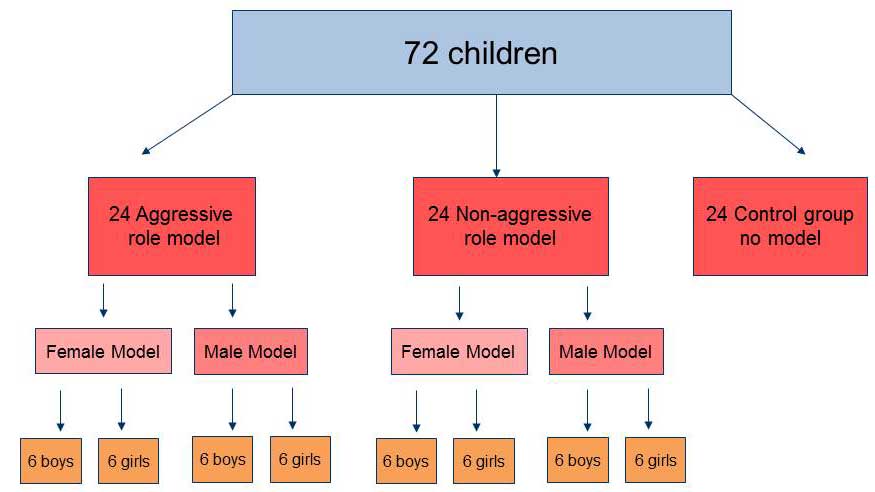
Stage 1: Modeling
In the experimental conditions, children were individually shown into a room containing toys. Each child played with potato prints and pictures in a corner for 10 minutes.
Children were randomly assigned to one of three experimental groups (24 children per condition):
1. Aggressive Model Condition:
Each child individually observed an adult model (either a man or a woman) behave aggressively toward a large inflatable Bobo doll.
In a room set up for play, the model first played quietly with tinker toys for about a minute. The model then physically and verbally attacked the Bobo doll for the remaining time.
The model’s aggressive repertoire included novel actions: punching the doll, hitting it with a mallet, tossing it, and kicking it.
The model also used distinctive aggressive phrases, including “Sock him in the nose,” “Hit him down,” “Kick him,” and “Pow!”
None of these actions or phrases were common playground behavior.
This modeling session lasted about 10 minutes
2. Non-Aggressive Model Condition:
Each child observed an adult model in the same playroom who did not display aggression.
The model simply sat quietly and assembled the tinker toy set, ignoring the Bobo doll entirely, for the 10-minute period.
No aggressive physical or verbal acts were demonstrated in this condition.
3. Control Condition:
The child had no adult model to observe.
There was no pre-play modeling session in this group. The child did not see any adult behavior with the Bobo doll, providing a baseline for typical behavior without modeling.
Stage 2: Aggression Arousal
After the modeling phase (or equivalent time in control), each child was subjected to a mild frustration intended to provoke arousal. The aim was simple: upset the child a little.
Each child was (separately) taken to a room with relatively attractive toys, e.g. a fire engine, doll set.
As soon as the child started to play with the toys, the experimenter intervened. She told the child that these were her very best toys, reserved for other children.
This step was included to make sure even typically calm children had some reason to feel frustrated.
Earlier research had shown that if children weren’t frustrated at all, simply watching aggression might not lead them to act aggressively themselves.
Stage 3: Test for Delayed Imitation
Finally, the child was taken into a third room that contained a variety of both aggressive and non-aggressive toys.
Aggressive toys included the Bobo doll (identical to the one the model used), a mallet, and a toy gun. Non-aggressive toys included dolls, tea sets, crayons, three bears and plastic farm animals.
The child was then left to play freely for 20 minutes in this room.
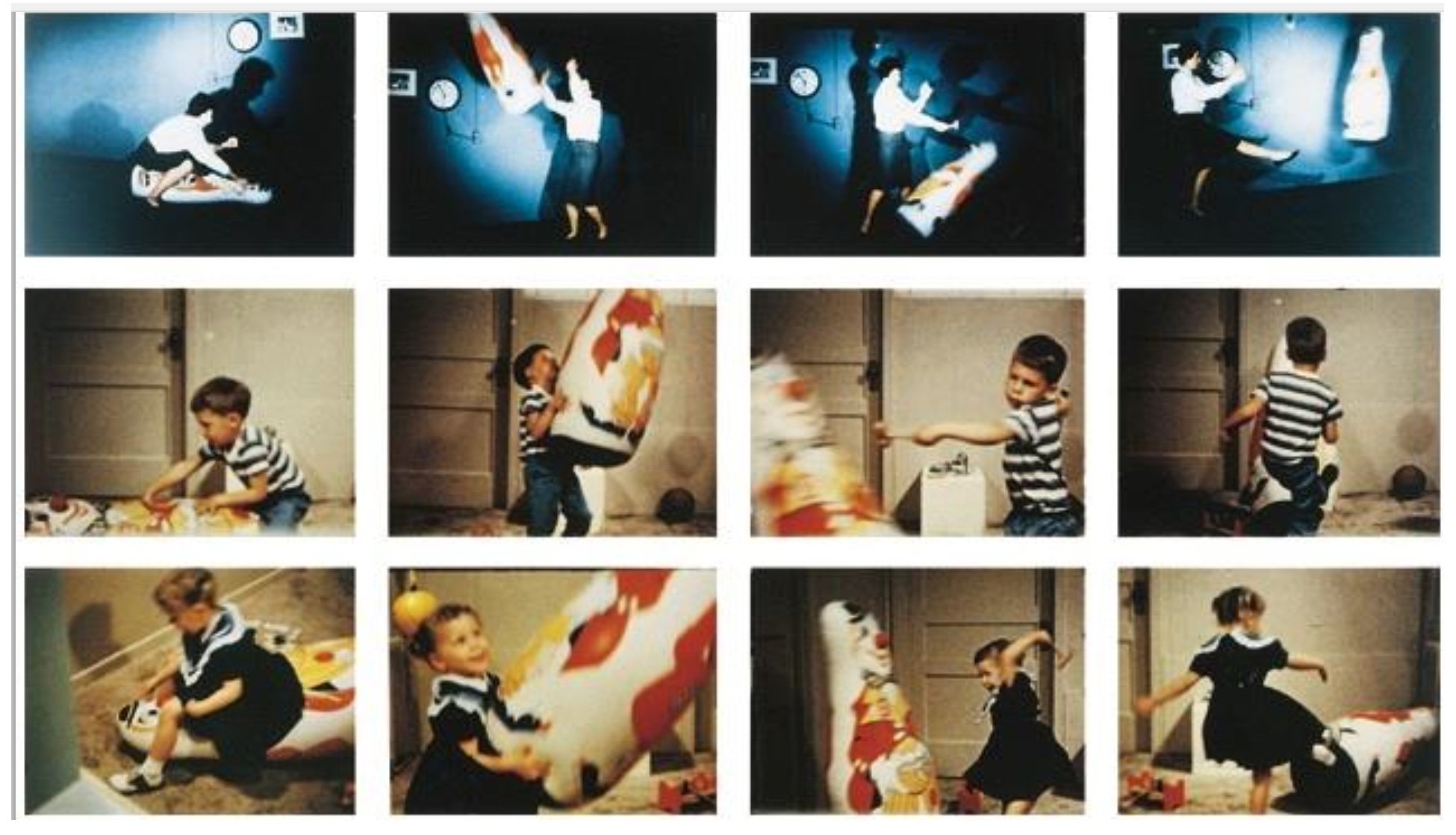
During this period, researchers observed the child’s behavior through a one-way mirror, making systematic records.
Observations were made at 5-second intervals, therefore, giving 240 response units for each child.
The experimenter remained in the room during the play period but stayed in a corner. This avoided interaction with the child. The child felt free to behave naturally.
Results
Imitative Aggression:
-
Aggressive-model group: Children who watched an aggressive adult were significantly more likely to imitate aggressive behavior (both physically and verbally).
-
Control and non-aggressive groups: Children who saw a calm adult or no adult showed almost no aggressive imitation.
-
Exact copying: About 70% of children in the non-aggressive or control groups showed no imitative aggression at all. Many who observed the aggressive model, though, copied specific actions like hitting the doll and repeating its aggressive phrases (e.g., “Sock him!”).
General Aggression Levels:
-
Beyond imitation: Exposure to aggressive models didn’t just encourage copying; it increased overall aggression, including new aggressive acts not shown by the model.
-
Less inhibited: Children who saw aggressive adults were less inhibited. They were more likely to show creative forms of aggression, such as pretending to shoot the doll with a toy gun.
-
Girls’ scores: girls who watched the aggressive adult averaged 18 aggressive acts, such as hitting with a mallet, versus almost none (0.5 acts) for girls who watched the calm adult.
Gender Differences:
-
Boys vs girls: Boys were generally more likely to imitate physical aggression than girls, especially when the model was male.
-
Model’s sex mattered for girls: Girls showed more physical aggression when watching a male model but were more verbally aggressive after watching a female model.
-
Male models had more influence: Boys and girls were both more strongly influenced by male models overall. This likely reflected societal views at the time, which saw aggression as a “masculine” behavior.
Qualitative Observations:
-
Copying language: Children closely copied the language used by aggressive adults (e.g., shouting “Pow!” and “Sock him!”).
-
Children’s comments revealed that they actively processed what they saw. For example:
-
Aggression by a female adult was criticized by children as inappropriate (“Ladies shouldn’t behave that way”).
-
Aggression by a male adult was often praised (“He’s strong like Daddy!”).
-
-
Social norms mattered: These observations show that social expectations (such as gender norms) played a significant role in how children interpreted and copied aggression.
Conclusion
The Bobo doll experiment showed that children can learn social behavior, including aggression, simply by watching another person, with no reinforcement to the child. Bandura drew three broad implications from this.
- Challenging behaviorism: the findings directly challenge the strict behaviorist view that behavior must be reinforced to be learned; new responses can be acquired through observation alone.
- Refuting catharsis: the results refute the catharsis hypothesis (the idea that acting out aggression “drains off” aggressive urges harmlessly). Watching violence increased aggression instead of reducing it.
- The power of role models: the study highlighted the influence of role models, such as parents, peers, and TV characters, who can shape children’s behavior and attitudes for good or ill.
Bandura used these findings to argue that aggression, and other social behaviors, can be learned observationally, laying the groundwork for his broader Social Learning Theory.
The Four Mediational Processes
Simple stimulus-response learning could not explain the Bobo doll findings. Children reproduced brand-new acts they had never been reinforced for, sometimes after a delay, and only when they felt motivated to.
Bandura (1977) argued that four cognitive processes sit between watching a model and copying them:
- Attention: the child must notice and focus on the model’s behavior. Distinctive, high-status or similar models capture attention most easily.
- Retention: the child must remember what they saw, storing a mental image of the act. This is what allows imitation to happen after a delay.
- Reproduction: the child must be physically capable of carrying out the behavior. Punching and shouting were well within a preschooler’s abilities.
- Motivation: the child needs a reason to act, driven by vicarious reinforcement (the rewards or punishments they expect after seeing what happened to the model). This is exactly what the vicarious reinforcement study tested.
All four processes must be in place for imitation to occur. A child who is distracted, forgets the act, cannot physically perform it, or expects punishment will not imitate it, even if they learned it perfectly well.
Strengths
1. Experimental Control:
One significant strength of Bandura’s Bobo doll study was its high level of experimental control.
The study was a controlled laboratory experiment with a standardized procedure.
Each child experienced exactly the same environment, toys, timing, and scripted behaviors from the adult model. The only difference was whether the model showed aggressive or non-aggressive behavior.
Researchers also matched children beforehand on their existing levels of aggression, reducing differences between the groups that could have skewed the results. The groups started out alike.
Because of this rigorous control, differences in aggression can be attributed specifically to whether children observed aggressive or non-aggressive behavior. The design rules out other explanations.
This clearly supports a cause-and-effect relationship, strengthening the validity of Bandura’s conclusion that observing aggression leads to increased aggression.
2. Reliability and Replicability:
Bandura’s procedures were highly replicable.
The study was designed in a structured way, clearly outlining procedures and behaviors to be observed.
Multiple researchers independently observed and scored the children’s behavior, achieving high inter-observer reliability, indicating consistent measurement.
Because the experiment was carefully documented and structured, other researchers have been able to repeat aspects of it.
Bandura himself repeated similar studies in 1963 and 1965, finding consistent results each time.
3. Rich Data (Quantitative and Qualitative):
Bandura’s study benefited from collecting rich, detailed data – both quantitative and qualitative.
The study gathered quantitative data (counts of aggressive acts) that allowed for statistical comparison between groups.
Such data provided objective evidence for the hypotheses.
Bandura also recorded qualitative observations, including children’s remarks and nuanced behaviors. These enriched the findings by illustrating the children’s thought processes and social understanding, such as their comments on the female model.
This combination of structured numerical data with anecdotal evidence gave a more comprehensive picture of the phenomena.
The quantitative results showed clear patterns and statistical significance. The qualitative notes then helped interpret those patterns, for instance explaining why girls might not imitate a female aggressor.
4. Novelty and Theoretical Impact:
A particularly strong point of Bandura’s research is its groundbreaking nature and theoretical significance.
Before this experiment, psychologists widely believed behaviors needed direct reinforcement, such as rewards or punishments, to be learned.
Bandura’s study challenged this assumption, clearly showing that children could learn aggressive behaviors simply by observing others, with no direct reinforcement involved.
This had major theoretical and practical implications, fundamentally changing how psychologists understood learning and aggression.
It laid the foundation for Social Learning Theory, influencing parenting, education, and discussions about media violence. This shows how significant and broadly relevant Bandura’s findings are, to psychology and to society.
5. Usefulness of Research (Practical Applications)
A significant strength of Bandura’s Bobo doll experiment is its practical usefulness, with extensive real-world applications.
Bandura’s findings highlight the powerful role adults and media figures play as role models for children.
Advice to parents often includes behaving in the way you want your child to behave (since children are watching and learning).
In education, teachers and mentoring programs use the power of modeling to encourage prosocial behavior.
The study’s usefulness is also seen in therapy and interventions. Behavior therapy techniques use modeling, called participant modeling, to help children overcome fears or build social skills. This shows that observational learning can be harnessed for positive outcomes too.
Bandura’s research also shaped public understanding of media violence. It sparked ongoing debates and led to regulatory policies, such as content ratings and parental guidance warnings.
Limitations
Before exploring each criticism in detail, here is a quick overview of the study’s main weaknesses:
- Artificial setting: a strange adult attacking a toy in a lab is not how children usually encounter aggression, which may have created demand characteristics, cues that hint to participants how they’re expected to behave.
- Limited sample diversity: all 72 children came from one Stanford nursery school, mostly white and middle-class, limiting how far the findings generalize.
- Short-term, narrow measure: the study recorded only immediate imitation of a doll, with no follow-up to test lasting, real-world aggression.
- Potential observer bias: observers knew which condition each child was in, risking unconscious over-scoring of borderline aggressive acts.
- Influence of novelty: Cumberbatch (1990) found unfamiliarity with the Bobo doll, not learned aggression, may explain some of the imitation.
1. Artificial Setting (Ecological Validity)
A common criticism is that the study’s lab environment was quite artificial. It may not represent how children learn and act in more natural social contexts.
The scenario of a child watching a strange adult behave violently toward a toy is not a typical real-life situation.
Also, the model and the child are strangers. This, of course, is quite unlike normal modeling, which often takes place within the family.
Furthermore, children do not often see adults attacking dolls, so the setup may have encouraged demand characteristics.
For example, the Bobo doll itself is a toy designed to be hit (it bounces back up when knocked over).
Children might have inferred that they were supposed to play aggressively with it, especially after seeing the model do so.
This could mean some of the aggressive behavior reflected cues in the environment, like the mallet and the Bobo doll itself. Children may also have wanted to please the experimenter, rather than showing genuine aggression they would display elsewhere.
Because of such factors, the external validity of the findings is in question. We must be cautious generalizing these findings to real-world aggression. A lab is not a playground.
2. Limited Sample Diversity:
Another weakness is that Bandura’s sample was not diverse enough, limiting how widely the results apply.
The participants were all young children from one nursery school at Stanford University, primarily from middle-class and white backgrounds.
Because of this narrow demographic, the findings might not reflect how children from different cultures, socio-economic backgrounds, or age groups would respond to observing aggression.
For example, children raised in environments where aggression is handled differently or where modeling from adults follows other norms might react differently.
The experiment also only looked at ages 3–6; it cannot tell us directly about older children, teenagers, or adults.
This lack of diversity weakens population validity. We cannot be sure similar results would emerge among children raised differently, or in other cultures.
Thus, while insightful, Bandura’s conclusions about aggression and observational learning may not fully represent all children’s experiences or behaviors.
3. Short-Term and Narrow Measure of Aggression
The study measured only short-term aggressive behaviors directed at a doll, providing a limited view of aggression.
The Bobo doll experiment only measured immediate imitation in the minutes following exposure.
It’s unclear whether the observed behavior was a transient effect. Or did the children carry these aggressive tendencies forward, long-term?
The study did not follow up afterward. It did not check whether, in the following days or weeks, children who observed aggression were more likely to be aggressive during nursery play.
Thus, one limitation is the short-term focus: we cannot be sure if observational learning of aggression has a lasting impact from this study alone.
Moreover, the operational definition of “aggression” in this experiment was hitting and verbal assault on a doll.
While these are aggressive behaviors, they are relatively low-stakes (no one is actually harmed). It is a leap to assume that children would equally aggress against a real person.
Some critics argue that hitting a clown doll might have been perceived as a permissible game. Real aggression toward a peer might still have been inhibited.
Therefore, the construct validity of the aggression measure can be questioned. Does Bobo doll play truly indicate a child’s aggression, or just playfulness in a novel situation?
Bandura later explored a scenario using a live clown as the target, to show children would also hit a live target. The core 1961 study’s own measures, however, remain limited to the doll and toy context.
4. Potential Observer Bias
There was potential for observer bias, as the researchers observing the children’s behavior knew the studies aims and which condition the child had been in.
Observers were aware of which condition each child was in (aggressive or non-aggressive).
This could introduce observer bias. Observers might, even unconsciously, interpret borderline or unclear actions as aggressive for children who had witnessed aggression.
Although Bandura used clear behavioral categories and multiple observers to reduce this risk, the possibility of subtle bias remained.
Observer bias could have exaggerated differences between groups, slightly weakening confidence in the results.
Ideally, observers should not know participants’ conditions to ensure completely unbiased measurements, which is now standard practice in psychological research.
5. Influence of Novelty (Familiarity with the Bobo Doll)
Cumberbatch (1990) found that the novelty of the Bobo doll influenced children’s likelihood of imitating aggressive behavior, indicating a weakness in Bandura’s experiment.
Specifically, Cumberbatch observed that children who had never played with a Bobo doll before were five times more likely to imitate aggression. Children already familiar with the doll were far less likely to do so.
According to Cumberbatch, the doll’s novelty increased the children’s curiosity. This curiosity prompted them to mimic the adult’s aggressive actions, simply because the situation and the object were new and intriguing.
This suggests Bandura’s findings might be partly due to the novelty of the toy, rather than true learned aggression. It questions the validity of his conclusions about observational learning.
As a result, the practical relevance of the findings could be limited. Children might not react the same way to aggression in more familiar, everyday contexts.
Ethical Issues
Conducted in 1961, the study predates modern ethics codes and thus raises several ethical concerns by today’s standards.
Protection from harm is a major issue:
Children in the aggressive-model condition were exposed to quite violent behavior by an adult.
Some children were reportedly distressed or confused by witnessing the adult’s aggression.
There is a risk that learning aggression had a lasting negative effect on the children. Participants are supposed to leave an experiment in “the same state they entered it,” which may not have been true here.
Encouraging children to act aggressively (even toward a doll) could be seen as “normalizing” unhelpful behaviors that might persist beyond the study.
Informed consent and assent:
The preschool children could not give informed consent themselves.
Bandura did obtain informed consent from the nursery school, and presumably from parents, known as presumptive consent. The children themselves, however, had no say in participation.
They were not fully informed about the purpose of the study (which might have been beyond their capacity to understand at that age).
The children were also not explicitly debriefed afterward, in a way they could understand. There is no sign the researchers explained to them that the behavior they saw was “pretend,” or discouraged them from copying it outside the study.
Without debriefing, children might have left with the impression that such aggression is acceptable, which is ethically concerning.
Right to withdraw:
It’s not clear that the young children knew they could withdraw from the study.
Reports suggest that at least one child wanted to stop, upset by the aggressive model, and remarked that the behavior was wrong. In general, though, the experiment was structured so that the child was led from one stage to the next, with no clear option to leave.
This raises concerns about whether participants could quit if they felt uncomfortable, an important aspect of ethical treatment.
Bandura argued that the benefits to society outweighed the risks to the children.
The study did yield important insights about learning and has been influential in understanding and reducing real-world aggression.
Nonetheless, by modern ethical standards, exposing children to aggression deliberately and possibly inducing aggressive behavior in them is problematic.
Researchers today would likely mitigate these issues.
This could include thorough debriefing, explaining to children and parents that the violence was pretend and undesirable. It also means ensuring any distressed child is comforted or removed.
Film and Cartoon Models
Bandura, Ross and Ross (1963) asked a further question about the original Bobo doll findings. Does a child need to see a real, live adult behave aggressively to learn from it? Or can watching aggression on a screen have the same effect?
Live, Filmed and Cartoon Aggression
Around 96 children from the Stanford nursery school were assigned to one of three aggressive-model conditions, or to a control group with no model at all.
The setup closely followed the 1961 study, so any difference in imitation could be attributed to how the aggression was delivered, not to a different procedure.
- Live model: a real adult attacked the Bobo doll in person, exactly as in the 1961 study.
- Filmed model: a film showed an adult performing the identical aggressive sequence on a screen.
- Cartoon model: a cartoon character costumed as a cat, nicknamed “Herman the Cat,” performed the same aggressive acts against a fantasy backdrop of cartoon trees and clouds.
Each version showed exactly the same aggressive acts, so only the model’s medium, not its behavior, differed between conditions.
Screen Violence Produced Imitation Too
All three aggressive-model conditions produced substantially more imitative aggression than the control group. The filmed and cartoon conditions produced about as much aggression as the live model.
All three aggressive conditions produced roughly twice the aggression of the control group.
This mattered theoretically. It showed that observational learning does not require a child to be in the physical presence of a model. A child could learn just as readily from a screen. The person delivering the aggression did not need to be in the room.
The finding gave the Bobo doll research a direct link to concerns about media violence. Screens matter. If children could imitate a cartoon cat as readily as a live adult, then television and film aggression seen at home became a plausible source of learned aggression too.
The implication was striking.
This 1963 study is often called “phase one” of the scientific study of media-violence effects, because so much of its modelling was filmed rather than live. The debate it opened is still active today.
Why This Extended the Theory
The result fit neatly with Bandura’s later account of mediational processes. A child does not need to physically stand next to a model to pay attention to it, remember it, and reproduce it.
The medium was irrelevant.
A screen carries the same cues just as well. This is one reason later research into observational learning and media effects treats televised and filmed models as functionally equivalent to live ones.
Attention and retention work the same way whether the model is a person in the room or a face on a screen. A distinctive, dramatic act captures a child’s notice and gets stored as a memory either way. Only the channel changes, not the underlying process.
Reproduction and motivation followed the same rule.
A child’s physical ability to copy an act, and their reason to perform it, do not depend on whether they watched a person or a screen.
Vicarious Reinforcement Bobo Doll Study
An observer’s behavior can also be affected by the consequences a model experiences, not just by what the model does. This is known as vicarious reinforcement.
We are more likely to imitate behavior we see rewarded. We are less likely to imitate behavior we see punished.
Bandura (1965) used a similar experimental set-up to the 1961 study to test this directly, using a five-minute film of an adult model, nicknamed Rocky, attacking the Bobo doll.
Rewarded, Punished or No Consequence
The experiment gave three groups of children different endings to the same film. Only the ending changed.
One group saw the model rewarded with sweets, a drink and praise for a “championship performance.” A second group saw the model scolded, spanked, and warned never to behave that way again. The third group’s film showed no consequence at all. Nothing else differed.
The set-up was otherwise identical for all three groups.
When later allowed into the playroom, children in the reward and control groups imitated more of the model’s aggression than children in the punishment group. This was the first, spontaneous-performance result.
Yet the punished children had not simply failed to learn the aggression. They had learned it just as well as everyone else. They just were not yet willing to show it.
The Incentive Test: Learning vs Performance
Bandura then tested this idea directly.
He offered every child in all three groups an incentive, fruit juice and sticker pictures, to copy exactly what the model had done.
Children in all three groups, including those who had watched the model punished, now reproduced the aggression equally well. The incentive worked for everyone. The earlier differences between the groups largely disappeared once every child was offered the reward.
This confirmed that the punished children had learned the aggression all along. They had simply not performed it while they still expected to be punished for it.
Observation determines what a child learns. A model’s observed consequences determine only whether that learning is ever performed, not whether it happened at all.
Psychologists call this the learning-performance distinction. A child who stays quiet has not necessarily learned nothing at all.
Media Violence Debate
The Bobo doll findings opened a debate about screen violence that remains unresolved today.
Psychologists Craig Anderson and Brad Bushman developed the General Aggression Model, which treats media violence as a risk factor for aggression. The evidence is extensive. Their large meta-analyses of hundreds of studies report small but reliable effects.
These effects are comparable in size to other accepted public-health findings (Anderson & Bushman, 2002; Anderson et al., 2003).
Not all psychologists agree. Christopher Ferguson argues that these conclusions are inflated by publication bias and weak measures of aggression. His critique remains contested.
His meta-analysis of video game research found only negligible effects on children’s and teenagers’ aggression, with no meaningful link to reduced prosocial behavior (Ferguson, 2015).
The honest summary is that media violence research remains balanced and unresolved. Most psychologists agree media can be one risk factor among many, including family, temperament and peers, but they disagree sharply about how large that effect really is.
References
Anderson, C. A., Berkowitz, L., Donnerstein, E., Huesmann, L. R., Johnson, J. D., Linz, D., Malamuth, N. M., & Wartella, E. (2003). The influence of media violence on youth. Psychological Science in the Public Interest, 4(3), 81–110. https://doi.org/10.1111/j.1529-1006.2003.pspi_1433.x
Anderson, C. A., & Bushman, B. J. (2002). The effects of media violence on society. Science, 295(5564), 2377–2379. https://doi.org/10.1126/science.1070765
Bandura, A., & Walters, R. H. (1959). Adolescent aggression: A study of the influence of child-training practices and family interrelationships.
Bandura, A. (1965). Influence of models’ reinforcement contingencies on the acquisition of imitative responses. Journal of Personality and Social Psychology, 1(6), 589–595. https://doi.org/10.1037/h0022070
Bandura, A., Ross, D., & Ross, S. A. (1961). Transmission of aggression through imitation of aggressive models. Journal of Abnormal and Social Psychology, 63(3), 575–582. https://doi.org/10.1037/h0045925
Bandura, A., Ross, D., & Ross, S. A. (1963). Imitation of film-mediated aggressive models. Journal of Abnormal and Social Psychology, 66(1), 3–11. https://doi.org/10.1037/h0048687
Bandura, A. (1977). Social Learning Theory. Englewood Cliffs, NJ: Prentice Hall.
Ferguson, C. J. (2015). Do angry birds make for angry children? A meta-analysis of video game influences on children’s and adolescents’ aggression, mental health, prosocial behavior, and academic performance. Perspectives on Psychological Science, 10(5), 646–666. https://doi.org/10.1177/1745691615592234

