Crossing a boundary means ignoring or overriding the limits someone has set, accidentally or on purpose. Boundaries are the values, rules, and limits in your life and relationships that help you feel healthy and safe. When yours are crossed, it can harm your well-being and make you feel unsafe.
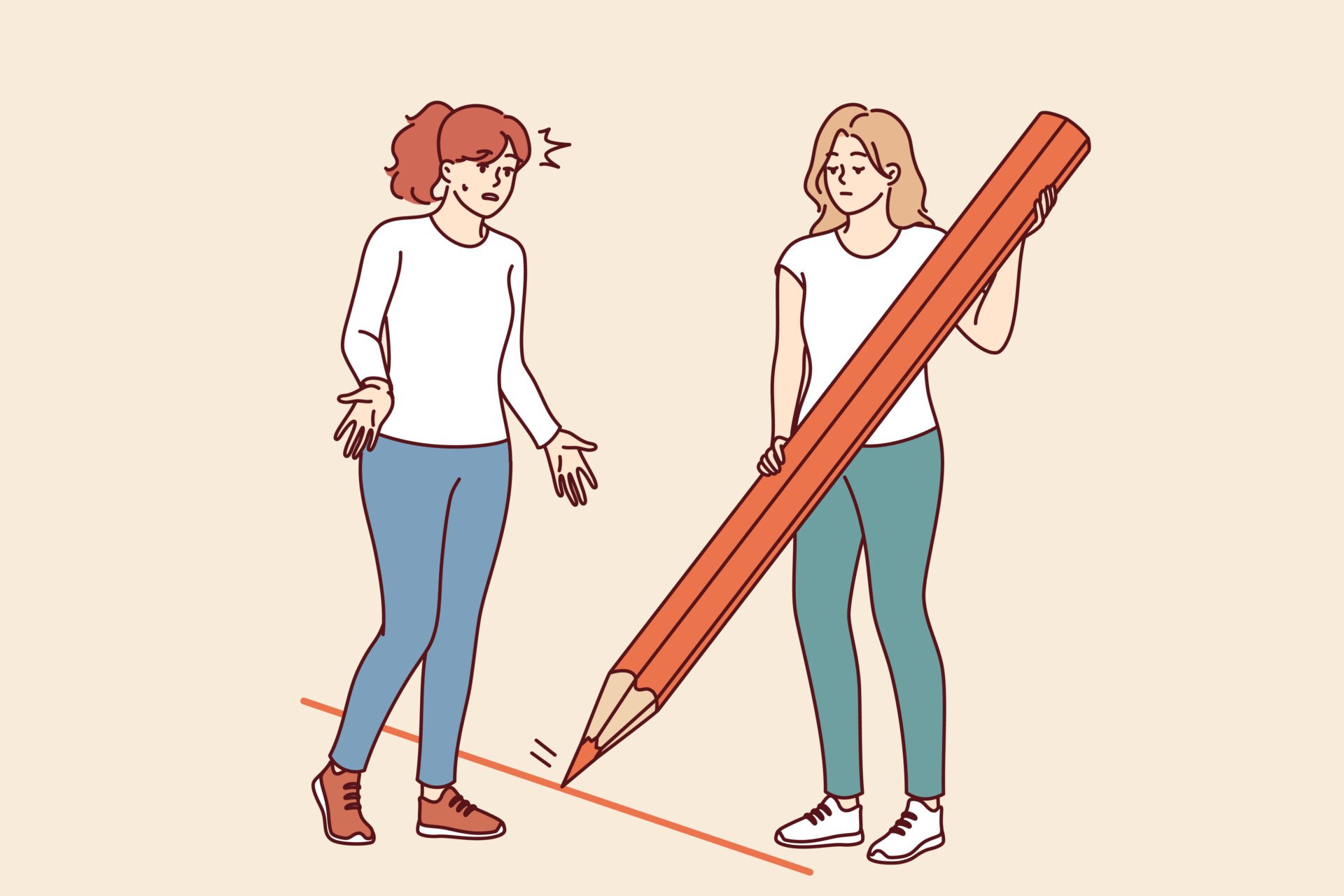
Many people struggle to maintain and protect their boundaries. They fear seeming selfish or confrontational, or upsetting people.
But if you want healthy relationships and good mental health, you must communicate what is acceptable and unacceptable.
You have to tell people when they’ve done something you don’t like so they can learn how to treat and love you.
When a boundary has been crossed, don’t quietly grow resentful and disappointed. Speak up.
If they keep disrespecting your boundaries, show them how much you care by letting them feel the consequences of their actions.
Let’s explore this in more detail.
Signs Your Boundaries Have Been Crossed
A person disrespects your boundaries if they violate them repeatedly, make you feel uncomfortable, or put pressure on you. They may also minimize or mock your requests and needs.
Here are more signs that your boundaries are being crossed, with an example of each:
- Not listening when you say no: You said you don’t want to eat right now, but they keep offering you food and telling you to eat.
- Continuing to do something you asked them not to: You asked them not to shout at you, but they keep doing it.
- Breaching your privacy: reading your journal or looking through your phone without permission.
- Touching you without consent: touching you when you say you don’t want to be touched or when you can’t consent (e.g., when you’re asleep).
- Making you feel guilty for asserting yourself: “If you really loved me then you would…”
- Pressuring you against your values: trying to convince you to do something that goes against your morals, beliefs, and values (e.g., trying to convince you to steal for them).
- Emotional blackmail: crying, shouting, or saying “You clearly don’t love me” or “You’re always so mean to me” when you implement a boundary or a consequence.
- Being deceitful: lying, stealing, cheating, etc.
- Breaking confidences: telling other people things you told them in confidence.
Listen to Your Body and Emotions
Often, your body will give you a sign that your boundaries have been crossed. Watch for two kinds of signal:
- Body: your heart races, or you get a “gut feeling”.
- Emotions: guilt, fear, shame, or sadness can also indicate that a boundary has been crossed.
Essentially, you experience anxiety because your body and brain are sensing a threat to your well-being, safety, and self.
What to Do When Someone Crosses Your Boundaries
When someone crosses your boundaries, some sort of action must follow. What that action is depends on what kind of boundary has been crossed, how often it’s been crossed, and how you feel.
In any case, you must take ownership of what you will and will not tolerate.
We often focus too much on the other person changing. That’s a losing game. We have no control over other people’s actions and words.
Therefore, the focus should be “What can I do to ensure my boundaries, and therefore my well-being and safety, are protected?”
When you’re in a relationship, feelings are going to get hurt, and boundaries are going to be crossed. That’s normal (to an extent).
The important thing is how you deal with these situations when they arise.
The psychotherapist Esther Perel, author of Mating in Captivity, treats this as ongoing work. On her podcast Where Should We Begin?, she tells a couple: “Every couple has to negotiate separateness and togetherness. It’s probably one of the core tasks of a relationship.”
No one is perfect or blameless. Aim for a balance between having compassion for the mistakes and faults of others and protecting your needs and well-being.
Here’s some advice on how to approach a boundary being crossed:
- Responsibility: you may not be to blame, but you must hold the boundary-crosser accountable.
- Proactive vs. reactive boundaries: state your limits early, and set new ones when something happens.
- Communication: tell them clearly what crossed the line and how it affected you.
- Consequences: follow through on what you said you would do.
- Ultimatums: use them carefully, and never to control or punish.
- Positive reinforcement: thank people when they respect your boundaries.
- Accept reality: when someone keeps crossing your boundaries, accept that you cannot change them.
Who’s Responsible?
Although you might not be to blame for your boundary being crossed, you are responsible for holding the boundary-crosser accountable.
People often don’t realize they’ve crossed a boundary, and if they do, they’re unlikely to change their behavior voluntarily.
If there’s a problem in the relationship, fault is irrelevant if you want the relationship to last. You both have to work towards a solution.
For example, if your partner spends your money carelessly, that might be their doing, but it’s up to both of you to solve the issue.
If you don’t see a solution and therefore can’t see a future with that person, you must still take the initiative and end the relationship.
Don’t wait around for other people to meet your needs. Be assertive in having them met.
Proactive vs. Reactive Boundaries
Communicating about boundaries should be done as proactively as possible. Be honest about who you are and what you want and expect from the very beginning. In return, be open and respectful of their boundaries.
But not all boundaries can be proactive. Some come up when something happens (known as reactive boundaries).
For example, they ask you about the relationship you have with your family, but that’s not something you want to talk about.
You tell them “I don’t like talking about my family, let’s talk about something else” and thereby you’ve reactively set a boundary.
If, a few days later, they ask you the same question, you’ll probably feel like they’re not respecting your boundaries.
In this situation, you can:
- Remind them you don’t want to talk about your family.
- Explain why you don’t want to talk about them e.g., “It brings up difficult feelings for me.”
- Tell them it’s important for you that they don’t ask you again and that you’ll explain when you’re ready.
Communication
The first thing you need to do when a boundary has been crossed is to communicate that.
For example, “I didn’t appreciate it when you made fun of me in front of those people. It made me feel like you don’t respect me. Please don’t do that again.”
In most cases, they will apologize, promise not to do it again, and probably say they didn’t realize it came across like that.
Saying this clearly is a skill you can practise. Psychologists call it assertiveness.
A 2018 review argued that assertiveness training deserves wider clinical use. It found that difficulty standing up for yourself is linked to social anxiety, depression, eating disorders, and relationship distress (Speed et al., 2018).
If you don’t tell them, you’re tolerating this behavior. They’ll probably do it again.
Some boundaries shouldn’t have to be communicated such as treating you with respect and not lying or stealing from you.
But unfortunately, some people need to be reminded of basic moral behavior. If someone is constantly lying, stealing, or disrespecting you, they probably need professional help. That’s not your responsibility.
If you’ve said it once and they continue, remind them. Importantly, tell them what the consequence will be if they do it again.
Consequences
Part of becoming an adult is learning that actions have consequences. You’re doing yourself, your relationship, and your partner a disservice if you don’t hold them accountable for crossing your boundaries.
Relationships are about growth and that can only happen if you’re honest about your boundaries and consistent in implementing them with your words and actions.
Above all, consequences are never empty threats. If you say you’re going to sleep in another room if they drink again, but you don’t follow through, they won’t learn.
You’re essentially communicating that your boundaries are negotiable and that you tolerate their behavior.
Examples of consequences include:
- “I love you, but I will no longer bail you out of trouble anymore.”
- Leaving the room when they shout at you after you’ve asked them not to.
- Moving out if they lie/ cheat.
- Leaving the venue or event if they’re late again.
- Not letting someone back into your life until they’ve made the change/gotten help (e.g., for addiction or poor behavior).
Ultimatums
When our boundaries have been crossed, we often give the other person an ultimatum: either you do this, or you suffer the consequences.
Sometimes, ultimatums are necessary if you need to get a very strong message across and your repeated attempts at communicating your boundaries have been unsuccessful.
Having to give someone an ultimatum signals that the other person hasn’t respected your boundaries (maybe many times). It also means you haven’t enforced your limits strongly enough.
However, they should be used carefully and have a healthy, positive intention rather than to control or punish the other person.
Sometimes, ultimatums are necessary when the relationship doesn’t have a strong foundation of boundaries and respectful behavior.
Positive Reinforcement
Though it’s important to let people know what you don’t like, it’s also good to get into a habit of positive reinforcement.
That means, you reward someone for “good behavior” i.e., you let someone know when they’ve done something you do like.
People feel good when they get a compliment and praise, and it encourages them to do it more often.
Don’t be condescending, like giving them a gold star. You’re simply expressing your gratitude and joy about the way they treat you.
For example:
- “Thank you so much for listening to me.”
- “I’m so grateful for the way you respect my boundaries.”
- “I really like how you ask before you borrow my things.”
Accept Reality
Some people’s boundaries and values are just not compatible. In some cases, it’s not because of disrespect but because you have needs and wants that are not aligned.
But sometimes a person will continue to cross your boundaries because they’re unboundaried themselves and/or want to control you.
If that’s the case, you’re better off accepting this reality. Let go of the toxic hope that an abusive, immature, or irresponsible person will change because of you. They can only do that themselves.
It can feel unfair and upsetting but sometimes giving up is the best thing you can do for your health and well-being.
Control vs Boundaries
Control can be financial, physical, emotional, intellectual, or sexual (or a combination of them all).
Sometimes, people dress up control as “their boundaries,” but they are two entirely different things. If someone is controlling towards you, they are crossing your boundaries. They ignore your needs and wishes. They force you to give up your autonomy.
Much like in any other form of toxic relationship, the only way to deal with a controlling partner is to set firm and consistent boundaries.
If nothing changes, it might be necessary to leave the relationship.
Control is not just unpleasant. A meta-analysis pooled 45 studies of coercive control, a pattern of intimidation, isolation, monitoring, and restriction.
It found moderate links with post-traumatic stress disorder (r = .32) and depression (r = .27) (Lohmann et al., 2024). These are associations, not proof of cause.
Enforcing a boundary against a coercive partner can be risky, because follow-through is when some abusive partners escalate. If you feel unsafe, get support from a therapist or someone you trust first.
You should:
- Make a firm decision to no longer tolerate control.
- Set a boundary e.g., “If you threaten me again, I will leave the house/move out.”
- If they do it again, stay strong and do what you said you were going to do.
- They might argue and complain but don’t allow them to talk you out of it or excuse it somehow.
- Your feelings, behaviors, and choices are your responsibility. Their feelings, behaviors, and choices are their responsibility. If they can’t respect your boundaries and well-being, you have to take control and do what’s best for you (in many cases, that means ending the relationship).
Are You Confusing Boundaries with Control?
Sometimes, in a bid to have our needs met, we might become controlling.
If you want to relinquish control and embrace true love and growth, consider the following:
What is the cost of control?
Your partner might comply, but they will lose their trust and love for you and grow resentful and emotionally absent over time.
Can you control another person?
The only person you have control over is you. No matter how much you try, the other person will not change until they are ready to.
Do you like your freedom being taken away?
Relationships are about freedom. You agree to each other’s boundaries but remain two separate individuals.
How does it make you feel when another person tries to control you?
Control creates distance rather than closeness.
When you accept this reality and the fact that you cannot change another person, you make room for closeness and growth.
Are you dependent?
Do you rely on your partner to meet all of your needs? The love, approval, and forgiveness you seek must come from within you and should be spread across the people you know.
It shouldn’t be limited to your partner.
Does a difference of opinion feel like an attack on you?
If you overly define yourself by your partner and relationship, it will feel like an attack against you if they disagree or make a different decision.
When you define yourself by your own boundaries, you will realize their feelings and decisions have more to do with them than you.

Key Takeaways
- Crossed Boundary: Someone ignores or overrides a limit you have set, accidentally or on purpose.
- Warning Signs: Repeated disregard, pressure, guilt-tripping, privacy breaches, and deceit show your boundaries are not being respected.
- Body Signals: A racing heart, a gut feeling, guilt, fear, shame, or sadness can warn you first.
- Your Response: Say what crossed the line, state the consequence, and follow through every time.
- Responsibility: You may not be to blame, but you must hold the boundary-crosser accountable.
- Control: Controlling you crosses your boundaries, and only firm, consistent limits can answer it.
References
Lohmann, S., Cowlishaw, S., Ney, L., O’Donnell, M., & Felmingham, K. (2024). The trauma and mental health impacts of coercive control: A systematic review and meta-analysis. Trauma, Violence, & Abuse, 25(1), 630–647. https://doi.org/10.1177/15248380231162972
Speed, B. C., Goldstein, B. L., & Goldfried, M. R. (2018). Assertiveness training: A forgotten evidence-based treatment. Clinical Psychology: Science and Practice, 25(1), Article e12216. https://doi.org/10.1111/cpsp.12216