The division of labor describes the splitting up of a complex productive task into a number of specialized, simpler tasks.
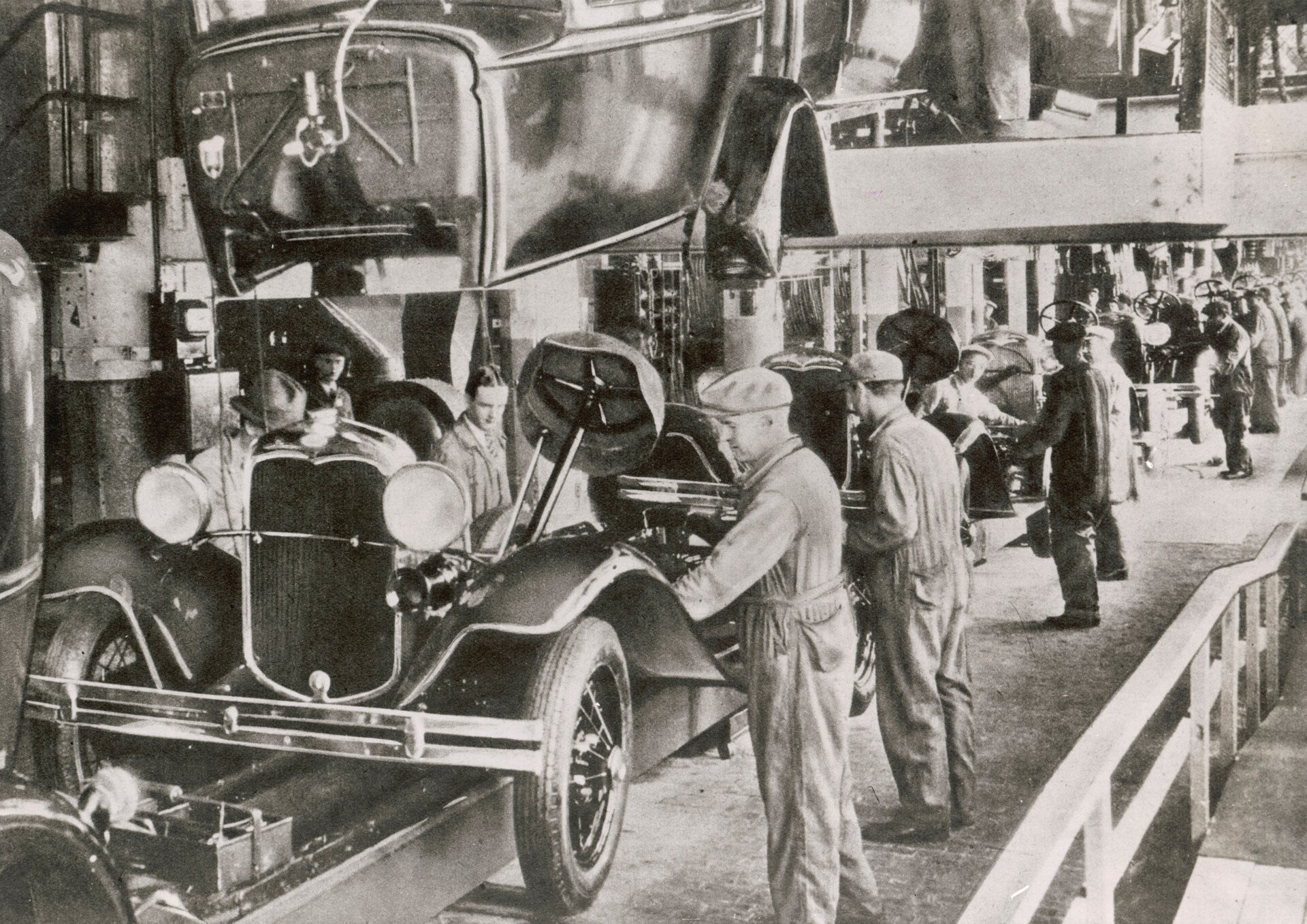
For example, an assembly line in a car manufacturing company may have one dedicated area for attaching wheels to cars and another for affixing doors. Workers are assigned to just one of these tasks.
This specialization allows for greater efficiency and productivity (Littek, 2001). The division of labor has been a major driving force behind the growth and prosperity of civilization.
It is one of the key reasons why, today, people can produce more goods and services than ever before.
The division of labor is not just limited to factories and businesses. It also exists in our homes, schools, and government. There is almost no area of human activity where the division of labor does not play a role (Littek, 2001).
Key Points
- Definition: The division of labor is the specialization of tasks within a production process, and a major driver of productivity growth since the Industrial Revolution.
- How It Works: Workers are allocated different tasks, and each becomes more efficient at their specific piece of the process.
- Economies of Scale: Specialization lets businesses produce more output with fewer inputs.
- Downsides: It can leave workers bored, dependent on others, and without a clear sense of individual responsibility.
- Beyond the Factory: The same logic extends to housework and childcare, historically borne more by women than men.
Theories About Division of Labor
Adam Smith, a social philosopher and economist, is credited as the first to analyze the division of labor in depth.
In his book, The Wealth of Nations, Smith discusses how the division of labor leads to greater efficiency and productivity, tracing the gain to specialization within the production process.
The division of labor is not just economically motivated. Many sociologists consider division of labor to be a pre-condition for conceptualizing society. The social division of labor is a term used by sociologists to describe the divisions at different levels of society, which comprise its complex structure.
Division of labor comes in many forms. These divisions can fall along several lines: class, gender, or ethnicity. They also touch the distribution of power, and the forces of social cohesion, disintegration, solidarity, and morale.
Although originally an economic concept, division of labor came to heavily influence the thought of the first major sociologists (Littek, 2001).
Smith’s Pin Factory
Smith illustrated his argument with a single example that became one of the most famous passages in economics: the manufacture of pins.
A single worker could scarcely make one pin a day. They would be unfamiliar with the trade, working alone through every stage.
A small pin-making business divided the work into distinct steps instead: drawing the wire, cutting it, sharpening the point, attaching the head. Ten specialized workers could then produce upward of 48,000 pins between them in a single day.
Smith traced this gain to three mechanisms. Workers who repeat one operation grow faster and more skilled at it. Specialization also eliminates the time lost switching between different tasks.
A narrowed, repeated operation is easier to mechanize, too, than an entire complex craft.
Smith also argued that specialization has a limit: the extent of the market. A highly specialized producer needs enough trading partners to buy what they make and sell everything else.
A small village, though, supports only a handful of trades. A large city or national market can support many narrow specialisms. The market sets the ceiling.
This anticipates Durkheim’s own account of social solidarity, covered later in this article. Both writers independently treated population growth and interconnection as what allows specialization to intensify. The parallel is striking.
Following Adam Smith, Immanuel Kant, another social philosopher, took a different approach to the division of labor. In his view, the division of labor leads to people becoming more like machines.
This, in turn, makes them less capable of thinking for themselves and living meaningful lives (Littek, 2001). Kant, in short, feared a duller humanity.
Karl Marx, a political economist, believed that the division of labor leads to workers becoming alienated from their work. He saw this as a major problem with capitalism and believed it was one of the key ways capitalists exploit workers (Littek, 2001). Marx called it exploitation.
Emile Durkheim believed that the division of labor is directly proportional to a society’s “dynamic,” or moral, density. Density combines concentration with socialization.
As people become more concentrated, towns grow, and so does the amount and efficiency of communication. Increasingly, labor is becoming more divided, and jobs are becoming more specialized.
Simultaneously, tasks grow more complex. Because people handle only a small part of them, the struggle for meaningful existence becomes more strenuous (Crossman, 2019).
What Factors Led Societies to Develop the Division of Labor?
As societies have developed and become more complex, the division of labor has become more and more commonplace. There are several factors that have led to this development.
One factor is population growth. More people create greater demand for goods and services, pushing specialization further.
Technology is another driver. As it advances, tasks can be divided even further, though workers must also learn to maintain that technology.
Trade added a third push. Producers able to buy and sell across regions needed to specialize in whatever was economically viable to produce.
Advantages of Division of Labor
1. Efficient Mastery (Specialization of labor)
When workers specialize in a particular task, they are able to perfect their technique and produce a higher quality product (Boyce, 2021).
This mirrors the “increased dexterity” mechanism Smith identified in the pin factory: repeating one task builds skill and speed that switching between many tasks never allows.
2. Quicker Training
The process of training an employee to carry out and perfect a complex task — like creating an entire knife from start to finish — requires, in some cases, years.
However, dividing the task into simpler subtasks changes this. Once those subtasks are learned quickly and distributed among a team, training becomes much shorter and requires less skill and experience.
As a result of the division of labor, what was once considered to be manufacturable only by artisans and experts can become accessible to relatively low-skilled workers (Boyce, 2021).
3. Productivity
As the scope of each worker’s task becomes smaller, workers are better able to complete that task in a short amount of time. As a result, they can complete more tasks in a day, leading to increased productivity (Boyce, 2021).
4. Efficient Allocation of Workers
The division of labor allows for a more efficient allocation of workers. When each worker is assigned a specific task suited to their specific skills, the use of their time and skills is maximized.
This results in fewer idle workers and less wasted time and resources (Boyce, 2021).
5. Cheaper Products
There are a few reasons why division of labor can drive down prices. Firstly, task allocation can lead to increased productivity.
This means that businesses can produce more products in a shorter amount of time. As the number of products available in a market increases relative to demand, price decreases (Francois, 1990).
Secondly, the division of labor often leads to economies of scale. Prices fall as supply rises. This is when the cost of production decreases as the volume of production increases.
This can happen two ways. A manufacturer may negotiate cheaper bulk prices with its suppliers, or the cost of transporting each item may fall once items ship en masse.
Finally, as workers specialize, they work faster. Manufacturers no longer need to hire artisan-level workers to complete a task.
Because these workers are less skilled individually, they demand lower wages than those who are skilled, allowing a manufacturer to gain a greater margin on their products (Francois, 1990).
6. Higher Wages
Although the division of labor can lead to the hiring of lower-skilled and lower-paid workers, the wages of each of these workers can increase as a result of this process. When workers are able to perfect their technique and work more quickly, their value to the company increases.
In addition, as companies experience increased productivity and profitability, they can afford to share these gains with their employees in the form of higher wages (Francois, 1990).
7. Innovation
Additionally, the division of labor can lead to a greater variety of products being produced. This is because each worker is specialized in a particular task and so can contribute to the production of a range of different products.
This greater capacity to create different types of goods incentivizes manufacturers to develop a broader range of goods, increasing competition and, ultimately, innovation (Francois, 1990).
Disadvantages of Division of Labor
1. Boredom from Repetition
When workers are assigned the same task day in and day out, they can become bored. This is a particular problem when the task is simple and does not require much thought or skill.
Boredom can lead to absenteeism and turnover as workers seek out jobs that are more stimulating.
Repetition breeds boredom. For example, factory workers who screw in the same screw on the same part of a toy, day after day, are performing a monotonous job. This often leads to apathy.
This can lead to low productivity and poor quality products. Marx called this loss of meaning alienation: the sense of estrangement workers feel from their work, its product, and even their own creative capacities.
2. Interdependence and dependence
The division of labor can also create dependence. Workers become experts in their own narrow task.
But that expertise has a cost. It leaves them reliant on other workers to complete the steps outside their own area (Schoenberger, 1988).
Consider a worker responsible only for a product’s finishing touches. That worker depends entirely on colleagues completing every step that came before.
One absent or careless worker can disrupt the whole line. The final product suffers as a result.
The division of labor can also limit opportunities for advancement. As workers narrow their expertise, it can become difficult for them to move into other positions within the company that require different skills.
For example, a worker skilled in assembling one type of widget may lack the skills to design or sell it.
As a result, their career path can stay narrow. They may never earn a higher salary or move into a different role at the company.
When they no longer work for the company they were trained for, they may find that their hyper specialized skills are not transferable elsewhere (Schoenberger, 1988).
3. Lack of Responsibility
When each person is just a small cog in a large machine, they can feel like their work is not important. This can lead to a lack of motivation and a feeling of disconnection from the company’s goals. Responsibility feels diffuse.
When a task fails, it becomes time-consuming to find out where exactly the line made the error. This simultaneously allows workers to take little responsibility for their lack of effort (Schoenberger, 1988).
When one person produces an output, it is easy to measure and compare their work against others.
Accountability blurs when many people work on the same task. It becomes difficult to compare outputs and identify which workers are not working as hard as they could be (Schoenberger, 1988).
Examples of Division of Labor
The Assembly Line
One of the most famous examples of division of labor is Henry Ford’s assembly line for mass-producing cars. Ford’s innovation was to break down the process of assembling a car into smaller, more manageable tasks.
In fact, he divided his car manufacturing process into 84 distinct steps. Each worker had one job. That might mean fitting tires or adding seats.
This division of labor meant that each worker could become an expert in their particular task. It also reduced the time it took to assemble a car (Royston, 2015).
This boosted efficiency sharply. Ford cut his retail prices from $850 ($25000 USD in 2022) to $300 ($9,000 USD in 2022).
Ford also grasped something the assembly line alone did not guarantee: mass-produced cars need buyers. In 1914, he unilaterally raised wages at his Dearborn plant to five dollars for an eight-hour day, a strikingly generous rate for the time.
The raise had two aims. It secured workers’ compliance with the assembly line’s demanding pace, and it helped ensure Ford’s own employees could afford the cars they built.
This became known as Fordism. It paired standardized mass production with deliberately cultivated consumer demand.
While the assembly line increased efficiency and productivity, it also had some drawbacks. The workers on the assembly line often found their jobs boring and repetitive, as they had little control over the production process.
As a result, many workers quit. Others went on strike.
Many other businesses copied Ford’s assembly-line model, including firms in the food, garment, and electronics industries.
In the modern garment industry, for example, one worker cuts the fabric, another sews the pieces together, and a third adds the buttons or zippers.
The result: efficient production across almost every industry (Boyce, 2021).
Domestic (Gendered) Division of Labor
The gendered division of labor allocates tasks between men and women according to gender norms. It typically gives women more responsibility for cooking, cleaning, and child care. Men are cast as breadwinners.
Research suggests women spend roughly twice as much time as men on domestic tasks (Baxter, 2002). This costs women leisure time and paid-work opportunities. It reinforces gender inequality.
Sociologist Arlie Hochschild studied dual-earner American couples. Even as more women took paid jobs, housework at home did not shrink to match. Employed women went on to perform a “second shift” of housework and childcare after a full day’s paid work (Hochschild, 1989).
Hochschild called this a “stalled revolution.” Women’s economic roles changed fast. Expectations about masculinity did not keep pace.
One explanation for why this persists comes from Hartmann (1976). She argued that job segregation by sex in the paid labor market keeps women economically dependent on a male wage. That dependency, in turn, obliges women to take on unpaid domestic labor in exchange.
Oakley (1974) makes a related argument. She insists that housework is genuine work: skilled, time-consuming, and economically valuable, not a natural extension of womanhood.
Sociologists have also identified a further, often-overlooked layer: emotion work. Duncombe and Marsden (1993) found that women disproportionately manage a family’s emotional life, smoothing over conflict and attending to others’ feelings. This labor goes unrecognized. It is coded as love, not effort.
Sociologists have argued that there is a narrowing of the gender gap in the domestic division of labor.
Young and Wilmott (2013) point to more women in paid work, and families becoming more symmetrical as both parents attend to children.
They also credit the “commercialization of housework”: washing machines, cleaning devices, and fridge-freezers have cut the time housework takes.
The COVID-19 pandemic narrowed the gap further, at least temporarily. In 2014-2015, women did an average of 1 hour 50 minutes more housework and childcare than men each day. That gap fell to 1 hour 7 minutes during the first lockdown (ONS, 2020).
Critical Evaluation
Efficiency, Cohesion, or Alienation?
Smith, Durkheim, and Marx look at the same fact: specialized, interdependent tasks. They reach very different verdicts.
For Smith, the case is simple. Dividing a task increases dexterity, saves time switching between jobs, and encourages new machinery.
Even Smith saw a cost. He warned that a worker confined to a few simple operations could become “as stupid and ignorant as it is possible for a human creature to become.”
Durkheim was more optimistic. A growing, more densely interacting population divides into complementary roles, not identical ones, he argued.
The result is not just efficiency. It is a new form of social solidarity, provided the division of labor stays regulated. Left unregulated, Durkheim warned, it tips into anomie.
Marx read the same trend as exploitation, not cohesion. Later scholars extended this into the twentieth century.
Frederick Taylor’s “scientific management” broke industrial work down through detailed time-and-motion study, standardizing each small operation and assigning it to one closely supervised worker (Taylor, 1911).
Harry Braverman named this shift “labor process theory.” Its key claim: Taylorism separated the conception of how a task should be done from its execution, moving craft knowledge out of workers’ hands and into management. Braverman (1974) called the resulting trend deskilling.
Deskilling means breaking skilled work into simpler, cheaper, interchangeable pieces. Not every sociologist accepts the thesis in full, though.
Some argue new technology also creates new skilled roles even as it eliminates old ones. The net effect on a workforce’s skill level stays contested.
Contemporary Research
Most classic evidence on the gendered division of labor comes from interviews conducted decades ago. Two newer bodies of research test how well these patterns hold up today.
Aim: to test whether household labor includes a hidden cognitive dimension: noticing what a household needs, deciding how to meet it, and checking it got done. Does this labor, like physical housework, fall unevenly by gender?
Method: Daminger (2019) interviewed 70 members of 35 different-sex couples in depth. Each partner described, separately, how everyday household decisions actually got noticed, thought through, and acted on.
Results: women performed substantially more of this cognitive labor overall. The gap was widest in the anticipating and monitoring components: noticing needs early, and checking they were resolved. It narrowed sharply for deciding, where men weighed in about as often as women.
Conclusion: this undercounts women’s real workload. It omits the ongoing mental labor of running a household.
Evaluation: as a qualitative study of 35 couples, it cannot establish how common the pattern is across the wider population. But it identifies a dimension of household labor that survey instruments built around discrete chores cannot detect at all.
Large-scale survey evidence backs this up. During COVID-19 school and daycare closures, American mothers absorbed most of the added childcare. This held regardless of their own working hours.
The extra load was linked to mothers cutting their paid hours, or leaving work altogether, more often than fathers (Zamarro & Prados, 2021).
Together, the two studies point the same way. Physical, cognitive, and economic burdens still fall unevenly on women.
Comparing Rival Theories
The same theoretical split recurs in the household. A functionalist reading, extending Durkheim’s logic, treats the unequal domestic division of labor as an efficient specialization: each partner concentrating on what they do best.
Feminist theory rejects this framing.
Dual-systems and second-shift research treat the same pattern as a structure of gendered power, one that persists even when it does not track partners’ relative earnings (Hochschild, 1989).
A separate, biologically grounded account (Wilson, 1975) locates the gendered division of labor in evolved behavioral tendencies rather than social structure. Most sociologists reject this: the gap has narrowed sharply within just a few decades, a pace no purely genetic account can easily explain.
References
Baxter, J. (2002). Patterns of change and stability in the gender division of household labor in Australia, 1986–1997. Journal of Sociology, 38 (4), 399-424.
Boyce, P. (2021). Division of Labor Definition.
Braverman, H. (1974). Labor and monopoly capital: The degradation of work in the twentieth century. Monthly Review Press.
Crossman, A. (2019). The Division of Labor.
Daminger, A. (2019). The cognitive dimension of household labor. American Sociological Review, 84(4), 609-633. https://doi.org/10.1177/0003122419859007
Duncombe, J., & Marsden, D. (1993). Love and intimacy: The gender division of emotion and “emotion work.” Sociology, 27(2), 221-241. https://doi.org/10.1177/0038038593027002003
Durkheim, E. (1892). The division of labor in society. Free Press.
Francois, J. F. (1990). Producer services, scale, and the division of labor. Oxford Economic Papers, 42 (4), 715-729.
Hartmann, H. (1976). Capitalism, patriarchy, and job segregation by sex. Signs, 1(3, Pt. 2), 137-169. https://doi.org/10.1086/493283
Hochschild, A. R. (1989). The second shift: Working parents and the revolution at home. Viking.
Littek, W. (2001). Labor, division of. In International Encyclopedia of the Social & Behavioral Sciences.
Oakley, A. (1974). The sociology of housework. Martin Robertson.
ONS. (2020). Coronavirus and how people spent their time under lockdown: 28 March to 26 April 2020.
Royston, A. (2015). Henry Ford and the assembly line. The Rosen Publishing Group, Inc.
Schoenberger, E. (1988). Multinational corporations and the new international division of labor: A critical appraisal. International Regional Science Review, 11 (2), 105-119.
Smith, A. (1776). An inquiry into the nature and causes of the wealth of nations.
Wilson, E. O. (1975). Sociobiology: The new synthesis. Harvard University Press.
Young, M., & Wilmott, P. (2013). Family and kinship in East London. Routledge.
Zamarro, G., & Prados, M. J. (2021). Gender differences in couples’ division of childcare, work and mental health during COVID-19. Review of Economics of the Household, 19(1), 11-40. https://doi.org/10.1007/s11150-020-09534-7
FAQs
What is the division of labor according to Durkheim?
The division of labor, according to Durkheim, is a key element in creating social cohesion and stability in complex societies, provided it is regulated and does not lead to extreme disparity and social disintegration.
Durkheim believed that as societies become more complex, the division of labor increases, which leads to the transition from mechanical to organic solidarity. This happens because as tasks become more specialized, people become more dependent on each other for their needs.
However, Durkheim also warned of the dangers of “anomie” (a state of normlessness), which could occur if the division of labor was unregulated, leading to social disorder and potential conflict.
What is the division of labor according to Durkheim?
According to Marx, the division of labor is a central aspect of capitalism and is closely linked to class struggle.
In Marx’s view, the division of labor creates a class hierarchy based on controlling the means of production. Those who own the means of production (the bourgeoisie or capitalist class) have power over those who sell their labor (the proletariat or working class).
This division of labor, Marx argued, leads to the alienation of workers as they do not have control over what they produce, how they produce it, or what happens to their products.