The Little Peter study (Cover Jones, 1924) showed that a child’s fear of rabbits could be removed. Mary Cover Jones paired the rabbit with food Peter liked and moved it closer as he ate, while fearless children modeled calm behavior. It foreshadowed systematic desensitization.
Aim
Mary Cover Jones studied several children to find the best way to remove children’s fear responses.
This mattered because Watson & Rayner (1920) had shown that fear could be produced experimentally in a child (Little Albert). They planned to remove his phobia of rats using classical conditioning. But Albert was taken away before they could.
- To investigate whether a phobia in a child could be counter-conditioned.
- To demonstrate whether counter-conditioning would generalize to other objects.
Procedure
The case described was of ‘Little Peter,’ an active, easily interested, intelligent boy (with an IQ of 102).
He was 2 years 10 months old. Jones began observing him at that age, and his general behavior was typical for a child his age.
On the first day with Peter, Jones watched him playing with toys, including some beads. An experimenter (who was out of sight) put a white rat into Peter’s cot. Peter screamed and fell over.
He was moved away, leaving his beads behind. Another child, Barbara, was put in his cot.
When the rat appeared, she was unafraid and picked the rat up. When the rat touched Peter’s beads, he protested, saying, “My beads,” but he didn’t object when Barbara touched them.
The next day Peter’s reactions to different situations and objects were observed.
| Object(s) | Peter’s Reaction |
|---|---|
| white ball, rolled in | picked it up and held it |
| fur rug over cot | cried until it was removed |
| fur coat over cot | cried until it was removed |
| cotton | cried |
| hat with feathers | cried |
| blue woolly jumper | looked, turned away, no fear |
| white cloth rabbit | no interest, no fear |
| wooden doll | no interest, no fear |
Peter was also shown a live rabbit and he was more afraid of this than of the rat, so a rabbit was chosen for counter-conditioning.
Peter had daily play sessions with three other children and the rabbit.
The other children (Laurel, Arthur, and Mary) were unafraid of the rabbit. Peter was sometimes observed alone to track his progress. Jones used new situations to bring Peter closer.
Six people (psychology students and instructors) were given the descriptions A-Q in random order. They put them in order of improvement. The resulting list is called a tolerance series.
Peter’s different reactions to the rabbit (the tolerance series)
- Rabbit in cage anywhere in room causes fear
- Accepts rabbit in cage 12 feet (4 meters) away
- Accepts rabbit in cage 4 feet (1.3 meters) away
- Accepts rabbit in cage 3 feet (1 meter) away
- Accepts rabbit in cage close by
- Rabbit accepted free in room
- Rabbit touched when experimenter held it
- Rabbit touched when free in room
- Peter reacted badly to rabbit e.g., throwing things at it but also imitated it
- Rabbit allowed on tray of high-chair
- Squats beside rabbit
- Helps experimenter to carry rabbit to cage
- Holds rabbit on lap
- Alone in room with rabbit
- In playpen with rabbit
- Fondles rabbit
- Lets rabbit nibble fingers
The series works as a fear hierarchy: Peter moved up it one step at a time. Wolpe later built systematic desensitization on the same idea. He let patients build their own hierarchy and used deep muscle relaxation instead of food.
Findings
Uneven Progress
Peter’s progress was uneven. Sometimes his tolerance improved (e.g., between sessions 11 and 22, from step b to step m on the tolerance series). Sometimes it worsened. In session 33 the rabbit scratched him, and he fell from step n to step f of the series.
However, the changes were not continuous or equally spaced in time.
In the figure below the scale along the x-axis is the session number.
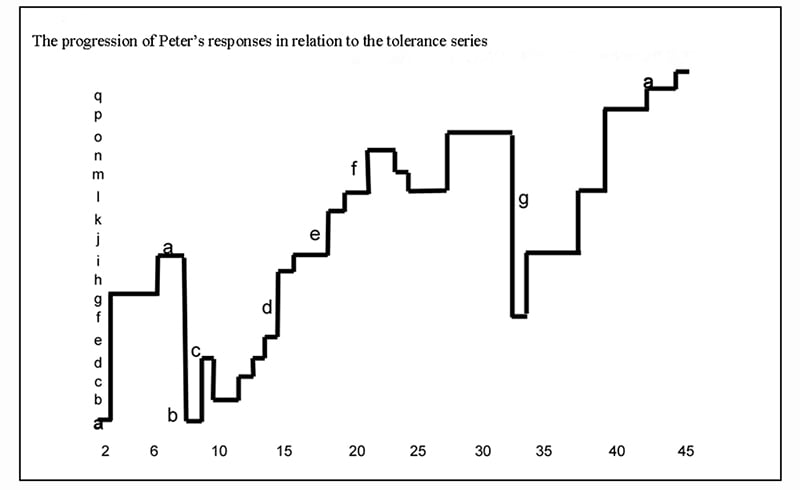
Peter was observed at irregular intervals. Sometimes he was seen twice a day (sessions 11 and 12). At other times two months separated sessions (7 and 8).
Just before this long break, Peter touched the rabbit after positive comments from the other children. Arthur said, “Peter doesn’t cry when he sees the rabbit come out.”
Counter-Conditioning With Food
Peter was then ill in hospital. When he came back, a big dog jumped at him and his carer. It scared them both.
Following this event, from session 8 onwards, classical conditioning was used to help Peter. He was given food he liked while the rabbit was brought within sight in its cage.
The pairing was repeated. The rabbit moved closer each time, but only as close as Peter would allow while he kept eating. Eating was the pleasant response. Because fear never interrupted it, the pleasant response gradually replaced the fear.

Peer Modeling
Other children also acted as role models. In session 9, the rabbit made Peter cry.
Another child ran over, saying, “Oh, rabbit.” Peter followed and watched, so the child acted as a role model to help Peter to move closer to the rabbit.
In session 21, an experimenter sat the rabbit in front of Peter while he was eating but he cried out, “I don’t want him,” and pulled away. Another child sitting nearby held the rabbit.
Peter then wanted the rabbit on his lap and held it briefly.
Outcomes for Peter
Peter was sometimes asked what he did at the laboratory. At the start, he didn’t mention the rabbit. Later, he would say, “I like the rabbit.”
By the end of the study, the counter-conditioning had spread beyond the rabbit:
- He had lost his fear of cotton, the fur coat, and feathers.
- His reaction to rats and the fur rug with a stuffed head improved, though he liked them less than the rabbit.
- He accepted new animals, such as frogs, worms, and a mouse.
Conclusion
Classical conditioning and social learning both helped to decondition Peter. Jones, who worked under Watson, had now shown that conditioning can remove a fear as well as create one.
This deconditioning also reduced the fear which had generalized to other objects, so it helped Peter to cope with new animals.
Modern Applications
Three areas still draw on the logic Jones worked out with Peter.
- Treating phobias: Peter’s tolerance series is the ancestor of the fear hierarchy in graded exposure therapy, where patients work up from the least to the most frightening step.
- Children’s healthcare: Pediatric psychologists use graded, comfort-paired exposure to help children tolerate injections and blood tests.
- Nurseries and schools: Pairing a hesitant child with calm, confident peers helps when introducing animals or new places.
Key Takeaways
- Purpose: Little Albert showed a fear could be created. Jones tested whether a child’s fear could be removed.
- Method: Peter, aged 2 years 10 months, ate food he liked while a caged rabbit was moved gradually closer.
- Peer Modeling: Fearless children played calmly with the rabbit, and watching them helped Peter move closer.
- Results: Peter progressed to fondling the rabbit. His fear of similar furry objects also fell, and he accepted new animals.
- Limitations: One child, two techniques used together and irregular sessions make the cause of his recovery unclear.
- Legacy: Jones’s graded approach foreshadows systematic desensitization. Wolpe called her “a pioneer in behavior therapy.”
Critical Evaluation
Jones’s case study offers detailed, long-running evidence. But its design leaves open which part of the treatment removed Peter’s fear.
- Longitudinal tracking: Jones studied Peter over a long period, so his progress and the changes in it were shown clearly.
- Detailed observation: Her records were thorough, session-by-session notes, so the data was very thorough.
- Bias control: Jones asked other people to put the tolerance-series items in order, so she avoided introducing her own bias.
- Influential techniques: Counter-conditioning with food and social learning from peers were both effective. Wolpe (1990, p 7), who developed modern systematic desensitization, called Jones “a pioneer in behavior therapy.”
- Confounded techniques: Two techniques and other people’s reassurance were used together, so the most effective factor is unclear.
- Irregular session spacing: The gaps between sessions varied, so progress may reflect time rather than treatment.
- Single case: One child cannot show how reliably the method works for other children or phobias.
Confounded Techniques
Jones used two techniques at once. One was classical conditioning, pairing the rabbit with food. The other was social learning, with fearless children as models.
The reassuring presence of other people added a third influence. That makes it hard to tell which factor did the work.
Later research sharpens the problem. Bandura and Menlove (1968) tested modeling on its own. Fearful children who simply watched fearless models interact with dogs showed less avoidance, with no food or relaxation paired with the dog.
This suggests counter-conditioning may have mattered less than Jones concluded. Peter’s playmates may have done more of the work than the food.
The case still shows that a child’s fear can be reduced. It cannot show which technique reduced it.
Irregular Session Spacing
The gaps between Jones’s sessions with Peter varied widely. Sometimes he was seen twice in a day, in sessions 11 and 12. At other times two months separated sessions, between 7 and 8.
This weakens the claim that the procedure caused the change. A young child’s fears can shift through ordinary development. Peter’s progress could reflect time passing, not deconditioning.
Unequal gaps also make the figure hard to read. Equal steps along the session axis are not equal stretches of time.
Unplanned events add to the problem. Peter was ill in hospital, was frightened by a big dog, and was scratched by the rabbit in session 33.
Jones could not separate the effect of these events from the effect of her treatment.
Single Case
Jones’s findings rest on one child. As with Little Albert, a single child’s response cannot show how reliably the method works for other children or other phobias.
The drop in Peter’s fear also extended to frogs, worms, and a mouse, but that result was seen in one boy only. His case is best read as an influential demonstration, not proof.
It showed that a child’s fear could be reduced. It also gave later therapists a graded method to develop, most directly in Wolpe’s systematic desensitization.
Contemporary Research
Peter’s fear fell for animals he had never met. Modern research asks how far a reduction in fear spreads to new stimuli, which matters for exposure treatments of phobias. The picture is more cautious than Jones’s case suggests.
- Aim: Wong (2025) reviewed how far fear reduced toward one stimulus spreads to similar stimuli, and why that matters for exposure treatments.
- Method: A narrative review of human fear-conditioning research on extinction learning, a fall in fear once a feared stimulus no longer signals a threat. It covered three cases: the original stimulus, one similar stimulus, or several.
- Results: Extinguishing fear of the original stimulus generalized well to new, similar stimuli. Extinguishing fear of only a similar stimulus, or several, generalized poorly to other stimuli or the original.
- Conclusion: Real treatment rarely reproduces the original trigger. Poor generalization may be another route by which fear returns.
As a narrative review, it gives no pooled effect size. It draws mainly on fear-conditioning experiments rather than outcomes in real patients.
Even so, it qualifies Jones’s optimistic reading. Her single case was a favorable example. Whether deconditioning spreads depends on how similar the new stimulus is to the one treated.
Questions
- Explain why it was important that the other children were not afraid of the rabbit.
- Jones used food as the pleasant stimulus. Why might food suit a young child, and what did Wolpe use with adult patients instead?
- Why did the response of his carer to the big dog make such a difference to Peter’s fear?
- Suggest two other objects that Peter’s fear might have generalized to.
References
Bandura, A., & Menlove, F. L. (1968). Factors determining vicarious extinction of avoidance behavior through symbolic modeling. Journal of Personality and Social Psychology, 8(2, Pt.1), 99-108. https://doi.org/10.1037/h0025260
Jones, M. C. (1924). A laboratory study of fear: The case of Peter. Pedagogical Seminary, 31(4), 308-315. https://doi.org/10.1080/08856559.1924.9944851
Watson, J. B., & Rayner, R. (1920). Conditioned emotional reactions. Journal of Experimental Psychology, 3(1), 1-14. https://doi.org/10.1037/h0069608
Wolpe, J. (1990). The practice of behavior therapy (4th ed.). Pergamon Press.
Wong, A. H. K. (2025). Spreading the reduction of fear: A narrative review of generalization of extinction learning in human fear conditioning. Clinical Psychology Review, 118, Article 102580. https://doi.org/10.1016/j.cpr.2025.102580