McGinnies’s 1949 study tested whether emotionally charged words take longer to recognise than neutral ones. Sixteen American students saw words flashed very briefly, each flash lengthened until they could say the word. Charged words needed longer flashes, and the skin reacted to them before the word was named. McGinnies explained the delay as perceptual defence.
Key Takeaways
Aim
- To test whether emotionally charged words, which make people feel strongly, take longer to recognise (say correctly) than neutral words, and whether the skin reacts first.
Method
- In a laboratory, 16 students from one psychology class at the University of Alabama each saw 18 words: 11 neutral and 7 charged (taboo).
- Everyone saw both kinds of word (a repeated measures design, so each person is compared with themselves).
- A tachistoscope, a machine that flashes words for a split second, showed each word a little longer each time until the person could say it.
- Wires on both palms led to a meter. It measured galvanic skin response (GSR), a tiny change in the skin that shows the body reacting to emotion.
- The independent variable (what was changed) was the type of word. The dependent variables (what was measured) were the flash length, the skin response and the guesses (the wrong words people said first).
Results
- Charged words needed a flash nearly twice as long as neutral words before people could say them. This was true for every person.
- The skin also reacted more to charged words, before they were said, in 14 of the 16 people.
- Both differences were too big to put down to chance, meaning unlikely to be just luck.
Conclusion
- People react emotionally to a charged word before they can say it, and this delays recognition. McGinnies called this perceptual defence: perception slowed to avoid upset.
- He explained it as conditioned avoidance: people learn early that taboo words are bad, which creates anxiety, and the delay avoids more anxiety.
Strengths
- Objective measure: the skin response is not a self-report, so people could not say what they thought the researcher wanted. It was also recorded before the word was named.
- Repeated measures: each person saw both types of word, so differences between people, such as eyesight, cannot explain the gap.
- Control: the machine set every flash in exact steps, the same way for every word, so the test was fair.
Limitations
- Validity: the flash length shows when the person said the word, not when they saw it. Someone too embarrassed to say a known word would look slow, so the delay does not prove perception itself changed.
- Control: the charged words may be used less often (lower word frequency), so unfamiliar words, not emotion, could explain the delay.
- Ecological validity: words flashed in a machine, with wires on both palms, are far from everyday reading, so results may not apply to real life.
- Sample bias: only 16 students from one class took part, so the results may not apply to everyone (generalisability).
Ethical Issues
- Protection from harm: charged words such as whore and bitch could embarrass or upset people. A way of dealing with this is to keep the risk no greater than in everyday life.
- Informed consent (agreeing once told what will happen): the paper does not say people were told what kinds of words to expect. A way of dealing with it: explain what they will take part in and ask if they are happy.
- Right to withdraw (stop at any time): the paper does not say people could stop. A way of dealing with it: tell people before and during the study that they can stop, and afterwards that they can remove their results.
- Debriefing (explaining the study afterwards): the paper does not describe one. A way of dealing with it: explain afterwards what they took part in, why, and how the results will be used.
- Confidentiality (keeping identities private): the paper does not raise this issue. A way of dealing with it: use a number or a letter, not a name, in any report.
- Deception (lying to people about the study): the paper does not say people were lied to. A way of dealing with it: tell people as soon as possible if they were lied to.
Exam Use
- In the exam you get marks for saying emotion research supports Gregory’s idea that perception is actively constructed. People build what they see from what they expect and feel.
- In a design question, better answers based their experiment on this study. They used neutral against taboo words, named a design and gave the expected result for both kinds of word. Any known study counts.
Aim
McGinnies wanted to know whether emotion changes how quickly we recognise a word. Here, recognise means the person could say the word. He also asked whether the body reacts first.
He used emotionally charged words. They make people feel strongly, like taboo words.
The idea is called perceptual defence: perception slowed to protect us from something upsetting. For example, a rude word might take longer to see than a plain one, because the mind holds it back. McGinnies took the idea from earlier work. He tested it with words and the skin.
Emotion is one of four factors that AQA lists as affecting perception, alongside culture, motivation and expectation. The wider topic is perceptual set. A related idea is top-down processing, where knowledge, expectation and motivation shape what we perceive.
The AQA specification does not name McGinnies. It names Gilchrist and Nesberg for motivation and Bruner and Minturn for perceptual set, and no study for emotion.
Of all the AQA papers and reports, only one names him. It is the June 2024 Paper 1 examiners’ report, which says better answers to a question on designing an emotion experiment were based on his study.
So it is not a study the specification names. Revision guides use it as their emotion study, and it is useful for design questions.
The aim can be put as two questions.
- The Delay: Do people need a longer flash to recognise charged words than neutral words?
- The Body: Does the skin react more strongly to charged words, before the person can name them?
McGinnies measured the skin because he guessed that the body’s automatic reactions might respond to a threat before the person is aware of it. He chose the skin because it can be measured easily and precisely.
Method
Design and Variables
McGinnies (1949) ran a laboratory experiment: a study run in a controlled setting. In outline, people looked at words flashed very briefly. The flash was lengthened until they could say each word.
Everyone saw both kinds of word. This is a repeated measures design, so each person is compared with themselves. That way, differences between people, such as eyesight, cannot explain the gap.
The independent variable is what the researcher changes. The dependent variable is what the researcher measures. McGinnies’s paper does not use these labels, or the terms repeated measures, laboratory experiment or opportunity sample.
- Independent Variable, Type of Word: Neutral or critical (emotionally charged). Each person met both types. Each type was a different set of words.
- Dependent Variable 1, the Threshold: The exposure, in seconds, at which the person first named the word correctly. Exposure means how long the word was shown.
- Dependent Variable 2, the Skin Response: The mean meter reading before the person named the word.
- Dependent Variable 3, the Guesses: The wrong words people said before they got the word right, sorted into four kinds.
- Kept the Same: The apparatus, the way the flash was lengthened, one word list, which appears to have been shown in one order, and the instructions.
- Not Controlled: Eyesight. McGinnies says individual differences in visual sharpness were not controlled.
In an exam, name the type of word as the independent variable and the threshold as the dependent variable.
Participants
The sample is the group of people who take part. There were 16 undergraduates, eight men and eight women. They were “drawn from an elementary psychology class at the University of Alabama”. None knew the purpose of the experiment.
They all came from one class. This is an opportunity sample (the exam name for people who happened to be available). The paper does not say how they were chosen.
The paper gives no ages. It does not say whether they volunteered, were paid or earned course credit. It does not say whether their eyesight was checked.
The Words
A list of 11 neutral words and 7 “critical, or emotionally toned” words was devised. The paper does not say by whom or how. Revision notes often call the second group taboo words.
- Neutral Words: apple, dance, child, glass, river, sleep, broom, stove, music, trade, clear.
- Critical Words: raped, belly, whore, kotex, penis, filth, bitch.
These are the words as printed in the paper. They include words that were socially taboo in 1949, and words linked to sex, bodily waste and other unpleasant ideas. Some readers may find them upsetting.
It does not say whether anyone else rated the words. It does not say whether the two lists were matched for how common the words are.
Table 1 of the paper lists the words “in order of their presentation to each observer”. The most natural reading is one random order shared by all 16 people. The first charged word, raped, came third.
The Machine and the Meter
A tachistoscope is a device that shows a word for a very short, exactly controlled time. McGinnies’s could show a word for as little as 0.01 second, which is a hundredth of a second.
The person looked into it. Electrodes were strapped to both palms.
Electrodes are small metal contacts that pick up electrical signals from the skin. Wires took the signal to a meter. It measured the galvanic skin response (GSR). This is a tiny change in the skin’s electrical activity that shows the body reacting to emotion.
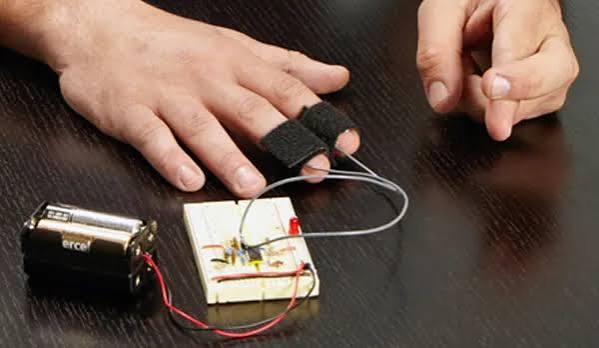
McGinnies used it as a measure of the body’s automatic emotional reaction. He counted any such bodily response, whether or not the person felt anything.
A meter showed the reading. A higher reading means a larger skin response. Two experimenters took part. One ran the machine and the other recorded the skin response.
The Procedure
- Practice: First, each person’s threshold was found for four trial words. This let them get used to the apparatus.
- Instructions: People were told the words might be hard to recognise at first. They reported whatever they saw, or thought they saw, then held each guess until the experimenter’s signal.
- Finding the Threshold: Each word was shown once at 0.01 second, once at 0.02 second, and so on, until the person named it correctly.
- Recording the Skin: After each flash, an experimenter noted the biggest swing of the meter in the next six seconds. Only flashes before the correct answer were used in the analysis.
- Sorting the Guesses: Wrong guesses were sorted into four kinds. They were similar (trace for trade), unlike (roared for belly), nonsense (egtry for kotex) or part, meaning only a few letters.
- Afterwards: People were asked whether they had reported promptly and accurately.
The paper does not say that people were warned that charged words would appear.
Results
Recognition Thresholds
One result is the threshold. Charged words needed a longer flash than neutral words.
- Neutral Words: a mean threshold of about 0.053 second.
- Charged Words: about 0.098 second.
- Difference: 0.045 second, so charged words needed nearly twice the exposure.
Every one of the 16 people had a higher mean threshold for the charged words. The gap was smallest for one person (.033 against .037 second) and largest for another (.049 against .223 second).
The paper reports that the difference was too big to put down to chance, meaning unlikely to be just luck.
Skin Responses
The other main result is the skin response before the word was named.
- Neutral Words: a mean meter reading of 40.19.
- Charged Words: 42.17.
- Difference: 1.98.
A higher reading means a bigger skin response. The reading was higher for charged words in 14 of the 16 people. Two people went the other way.
The paper says this difference was also too big to put down to chance. McGinnies adds that the skin response was almost always largest on the flash at which a charged word was finally named.
The Guesses
The third result is the guesses. These are what people said before they got the word right. The lists show the share of guesses of each kind.
- Neutral Words: 28% similar, 25% part, 27% unlike, 20% nonsense.
- Charged Words: 22% similar, 13% part, 31% unlike, 34% nonsense.
Neutral words drew a larger share of similar or part guesses. Charged words drew a larger share of unlike or nonsense guesses. The paper reports that this difference was too big to put down to chance.
The 7 charged words were 39% of the words. They produced 58% of the guesses (433 of 746). That is what would be expected if they needed more flashes before they were named.
Not Every Word Fitted
The picture is not perfectly clean.
In the paper’s graphs, the neutral word dance shows a larger skin response than the charged word kotex. The neutral word child needed a longer flash than the charged word filth. These readings are approximate.
Conclusion
McGinnies drew three conclusions.
- The Body Reacts First: The skin reacted to charged words before people could report them, yet recognition was still delayed.
- Conditioned Avoidance: This means avoiding something you have learned is bad. People learn early that words such as whore and bitch are taboo. This creates anxiety. The delay holds off more anxiety.
- The Guesses Fit: He read the extra nonsense and unlike guesses for charged words as tactics apparently designed to delay recognition.
McGinnies wrote that the person “actually discriminates the stimulus before he fully perceives it”. He said people learn the taboo because parents tell them off for using such words, and this is where the anxiety starts.
He thought the early reaction lasts, as the skin shows, even when the words are used freely later.
McGinnies also offered a brain explanation. He called it ad hoc, meaning put together for this case, and presented it as such. The study did not test it.
Revision guides use it as the usual example for the emotion factor. The paper shows a delayed report and larger skin readings, not proof that perception itself changed.
Strengths
The study has four main strengths:
- Objective Measure: The skin response is not a self-report, so people could not say what they thought the researcher wanted. It was also recorded before the word was named.
- Repeated Measures: Each person met both word types, so each acted as their own control. The threshold gap held for all 16 people.
- Fine Control: The tachistoscope set each flash in exact steps of 0.01 second, the same way for every word.
- A Serious Alternative Tackled: McGinnies put Bruner’s objection in print and replied to it. He also asked people about reluctance. Three measures all pointed the same way.
Limitations
Before working through each one, here is a one-line summary of the main limitations:
- Reports, Not Percepts: The threshold is when the person said the word. Someone who knew it but felt embarrassed would look slow.
- Unmatched Words: The charged words were not shown to differ from the neutral ones only in emotion. They could simply be rarer words.
- One Fixed Order: Everyone probably met the words in the same order, so word type and position were mixed up.
- Small, Narrow Sample: Only 16 students from one class, with no ages or eyesight checks reported.
- Low Ecological Validity: Words flashed in a machine, with electrodes on both palms, are far from everyday reading.
- A Puzzling Explanation: To defend against a word, the mind must first identify it. The brain explanation was never tested.
- Time and Place: American students in the late 1940s, and words whose taboo status depends on culture and era.
Reports, Not Percepts
The threshold is the exposure at which the person first said the word correctly. A person might recognise a word but be reluctant to say it. That would raise the threshold.
For example, someone who knew a rude word might wait for a longer flash before saying it aloud. The measure would then show when they were ready to say it. It would not show when they saw it.
McGinnies checked by asking people afterwards. They said they had not held back, apart from occasionally on the first charged word. That is people’s own account of embarrassing behaviour. The paper names no other test.
Broadbent (1958) made the same point soon afterwards. Embarrassing words may be seen by people who are reluctant to say them aloud, especially to a professor. So the study shows a delay in saying the word. It does not prove that people saw it later.
Proving a word was unseen is also hard. McGinnies counted a word as not yet recognised until the person said it. The paper describes no separate check on awareness.
Later researchers say a person’s own report is only a subjective check of awareness (van der Ploeg et al., 2017).
Unmatched Words
A list of 11 neutral and 7 critical words was devised. The paper does not say by whom or how.
The paper reports no independent ratings of how emotional the words were. It reports no matching for how common or familiar they were. It counts belly and kotex as charged but gives no reason.
Jerome Bruner raised the obvious problem. The charged words are rarer in print, so they may simply be unfamiliar. Extra effort to recognise unfamiliar words could cause the larger skin response.
Broadbent (1958) suggested that embarrassing words are possibly unfamiliar, which would raise the threshold.
McGinnies replied that the words are common in conversation. He gave no counts. He offered two more arguments, but none measured how common the words were.
One Fixed Order
If the order was the same for all 16 people, the charged words always fell at positions 3, 5, 8, 10, 13, 16 and 18. This follows from the paper’s Table 1.
Surprise at the first offensive word, practice or tiredness would then be built into the comparison. The paper itself says people occasionally held back on the first charged word.
Counterbalancing means changing the order between people. It would have separated word type from position.
Small, Narrow Sample
There were 16 undergraduates from one class. The paper gives no ages, no recruiting details and no eyesight checks. McGinnies says individual differences in visual sharpness were not controlled.
Eyesight affects thresholds. The repeated measures design cancels this out for the main comparison.
Generalisability means how far results apply beyond the people studied. A sample that does not represent everyone is called sample bias. Sixteen students from one class may not represent everyone.
Low Ecological Validity
Ecological validity means how well findings apply to real life. Words flashed one at a time in a machine, with electrodes strapped to both palms, are far from reading in everyday life. So ecological validity is low.
In everyday life, we read words in sentences, for as long as we like.
A Puzzling Explanation
To defend against a word, the mind must in some sense identify it first. McGinnies used Miller’s term, discrimination without awareness, meaning responding to a word before being able to say what it is.
Broadbent (1958) called this a double mechanism. The word is perceived without awareness so it can be judged upsetting, then kept from awareness. He found it unlikely at first. He suggested a way it might work but said the evidence was not compelling.
McGinnies’s brain explanation was also not tested. He called it ad hoc.
Time and Place
The students were American undergraduates in the late 1940s. The words were English. Whether a word counts as taboo depends on the culture and the era, meaning the time period.
A 2024 study covering 13 languages and 17 countries found considerable variation in how taboo and offensive words were judged (Sulpizio et al., 2024).
A word list that works in one community cannot be assumed to work in another.
Ethical Issues
The paper does not describe any ethical procedures. Its silence is not evidence that there were none. By today’s standards, four points matter. The first is informed consent.
- Informed Consent: Agreeing to take part after being told what will happen. The instructions said words might be hard to recognise, not that offensive words would appear.
- Protection from Harm: The words included whore, bitch, penis and raped. Some people could be embarrassed or upset. The paper does not discuss this.
- Right to Withdraw: The right to stop taking part at any time. The paper does not say people could stop.
- Debriefing: This means explaining the study afterwards. The paper says people were asked afterwards about their responses, but does not describe a debrief.
AQA credits these ways of dealing with such issues.
- For Consent: Explain what people will take part in and ask if they are happy to.
- For Harm: Make sure the risk is no greater than people face in everyday life. For a design like this, one suggestion is to choose words that are only mildly unpleasant.
- For Withdrawal: Tell people before and during the study that they can stop, and afterwards that they can remove their results.
- For Debriefing: Afterwards, explain what they took part in, why and how the results will be used.
- For Confidentiality: This means keeping identities private. Do not use names in any report. Use a number or a letter. The paper does not raise this issue, but AQA credits it.
- For Deception: This means lying to people about the study. Tell people as soon as possible if they were lied to. The paper does not say they were, but AQA credits this way.
Exam Questions
What Examiners Look For
Across the exam papers from the specimen to June 2025, only one question asks about emotion and perception. It does not name this study.
It is June 2024 Paper 1, Question 12. It was worth 6 marks, 4 for AO2 and 2 for AO3.
The question asked students to explain how they would design an experiment to investigate the effect of emotion on perception. That is a summary, not the exact wording.
Answers had to cover the task, the data collected, the design and the expected results. The marks were as follows.
- Task, 1 Mark: A suitable task with experimental conditions that investigates emotion and perception. Without one, no marks for the data collected.
- Data, 1 Mark: What data would be collected.
- Design, 1 Mark: Naming a design: independent groups, repeated measures or matched pairs.
- Justification, 1 Mark: An appropriate reason for the design.
- Expected Results, Up to 2 Marks: Both conditions of the independent variable, clearly and accurately for 2 marks, limited or muddled for 1.
The design marks can be earned without a suitable task.
Describing a known experiment, without basing your own design on one, earns a maximum of 1 mark. The mark scheme gives no model design and does not mention McGinnies.
The 2024 examiners’ report gives this advice in plain words.
- Better Answers Used McGinnies: Better answers based their experiment on the McGinnies study, with neutral and taboo words.
- Follow the Bullets: Students who answered bullet point by bullet point also gained good marks.
- Do Not Leave Parts Out: Several students left out the design or the data they would collect.
- Do Not Over-Describe: Many described the task in far more detail than the 2 marks available for it needed.
- Use a Known Study: Students should base their study on a known study, not devise one of their own.
- Keep It Ethical: Some experiments were somewhat concerning and “would not pass an ethics committee”.
Question 12 (June 2024, 6 marks) with a Model Answer
These model answers and practice questions are examples, not the exam board’s own wording. Here is an answer that follows the mark scheme.
Model answer: Participants would be shown neutral words and mildly unpleasant words for a fraction of a second. The flash would be lengthened until they could say the word.
The data collected would be the length of flash at which each word was named. I would use a repeated measures design. Each person sees both types of word, so differences in eyesight cannot explain the result.
The independent variable is the type of word. I expect the unpleasant words to need a longer flash than the neutral words.
- Mark Scheme: 1 for the task, 1 for the data, 1 for the design, 1 for the reason, 2 for the expected results with both conditions.
- Ethics: Choosing only mildly unpleasant words would help. It answers the examiners’ warning about designs that would not pass an ethics committee.
Using McGinnies as Evidence
Revision guides use the study as the usual example for the emotion factor. In the exam you get marks for saying that emotion research supports the idea that perception is actively constructed.
This is Gregory’s idea that we build what we see from what we expect and feel. The paper shows a delayed report and larger skin readings. That is not proof that perception itself changed.
These evaluation points fit the paper. The strengths are an objective skin measure and repeated measures.
The weaknesses are a small sample from one class and a laboratory task far from real reading. Two more are the word-frequency explanation and the chance that people were slow to speak out of embarrassment.
The specimen mark scheme credits evidence that factors such as motivation and emotion affect perception as support for the idea that perception is actively constructed. That is a Gregory evaluation point. It does not name McGinnies.
Practice Question 1: Calculate a Percentage (2 marks)
Imagine a class of 25 students in a study like McGinnies’s. The numbers are invented and are not McGinnies’s. Twenty students needed a longer flash for the charged words than for the neutral words. The other five did not.
Question (2 marks): Calculate the percentage of students who needed a longer flash for the charged words. Show your working.
Model answer: 20 ÷ 25 × 100 = 80%.
- Mark Scheme: 1 mark for the working and 1 mark for the correct percentage.
Practice Question 2: Evaluate in Two Ways (4 marks)
Question (4 marks): Explain two ways McGinnies’s study can be evaluated.
Model answer: One strength is that skin response is an objective measure. It is not a self-report, so people could not say what they thought the researcher wanted. It was also recorded before people named the word.
One weakness is that the delay may be embarrassment. People may have known the word but been reluctant to say it. So the study may not show that perception itself was slowed.
- Mark Scheme: 2 marks for each way: 1 for a creditable point and 1 for explaining it using the study.
- Creditable Points: Any two, such as the objective measure, repeated measures, small sample, low ecological validity or the word-frequency problem.
- Note: No AQA question names this study.
Practice Question 3: Ethical Issues (4 marks)
Question (4 marks): Name two ethical issues in a study like McGinnies’s. Give a way of dealing with each.
Model answer: One issue is protection from harm. Words such as whore could embarrass or upset people. A way of dealing with this is to make sure the risk is no greater than in everyday life, for example by choosing only mildly unpleasant words.
Another issue is informed consent. The paper does not say people were told what kinds of words they would see. A way of dealing with this is to explain what they will take part in and ask if they are happy.
- Mark Scheme: Split modelled on June 2025 Question 17: 2 marks for each issue, 1 for a creditable issue and 1 for a way of dealing with it.
- Creditable Issues: Respect, competence, responsibility, integrity, confidentiality or anonymity, informed consent, deception, right to withdraw, protection from harm and debrief.
- Parental Consent: The June 2020, 2022 and 2023 schemes also list it. Its credited way is asking parents’ permission when participants are under 16, so it does not apply to this study’s undergraduates.
- Ways, Names and Consent: Use a number, not a name, in any report. Explain what people will take part in and ask if they are happy.
- Ways, Safety: Keep the risk no greater than everyday life. Let people stop, and remove their results afterwards.
- Ways, Afterwards: Tell people if they were lied to. Debrief them afterwards.
- Note: AQA’s real ethics questions are generic, not about this study.
Later Research
The 1950s Exchange
The paper drew a published reply within a year. Howes and Solomon (1950) wrote a note on it. McGinnies (1950) answered. Solomon and Howes (1951) then published a paper titled “Word frequency, personal values, and visual duration thresholds”.
Word frequency means how often a word is used. The titles suggest it was among the points at issue. By 1958 Broadbent was calling perceptual defence “a somewhat controversial topic” (Broadbent, 1958).
What Slows Taboo Words? (Madan et al., 2017)
In 2017, Madan, Shafer, Chan and Singhal asked which properties of taboo words explain their effects. They repeated an earlier finding that taboo words are judged more slowly in a lexical decision task, where people decide whether a string of letters is a real word.
They then analysed, word by word, what drove the slowing. Word frequency and tabooness explained it best. Arousal, valence and offensiveness did not (Madan et al., 2017).
This is not a test of McGinnies. The task was different. The measure was response time, not skin response. It still bears on his result. It supports Bruner’s point in part, in a different task, because frequency matters. It supports McGinnies in part, because taboo words seem to be special.
Does the Body React to Unseen Words?
Broadbent (1958) described an experiment by Lazarus and McCleary. The words were nonsense words paired with electric shocks, not taboo words.
The flash was then cut until people could not say which word it was. They still gave a skin response to the shock words, even when they named the wrong word.
This is Broadbent’s account, not the original paper. It shows the skin can react before a correct report. It does not repeat McGinnies’s design.
Later researchers asked whether the body reacts to upsetting words that people cannot report. A review of 65 studies compared bodily responses with control stimuli. About four in every ten comparisons showed raised responses (van der Ploeg et al., 2017). The picture is mixed.
The effect was clearest for the skin in studies that taught people to fear a signal. The authors say the methods varied widely and the question is not yet settled.
References
Broadbent, D. E. (1958). Perception and communication. Pergamon Press. https://doi.org/10.1037/10037-000
Howes, D. H., & Solomon, R. L. (1950). A note on McGinnies’ “Emotionality and perceptual defense.” Psychological Review, 57(4), 229–234. https://doi.org/10.1037/h0060881
Madan, C. R., Shafer, A. T., Chan, M., & Singhal, A. (2017). Shock and awe: Distinct effects of taboo words on lexical decision and free recall. Quarterly Journal of Experimental Psychology, 70(4), 793–810. https://doi.org/10.1080/17470218.2016.1167925
McGinnies, E. (1949). Emotionality and perceptual defense. Psychological Review, 56(5), 244–251. https://doi.org/10.1037/h0056508
McGinnies, E. (1950). Discussion of Howes’ and Solomon’s note on “Emotionality and perceptual defense.” Psychological Review, 57(4), 235–240. https://doi.org/10.1037/h0061684
Solomon, R. L., & Howes, D. H. (1951). Word frequency, personal values, and visual duration thresholds. Psychological Review, 58(4), 256–270. https://doi.org/10.1037/h0058228
Sulpizio, S., Günther, F., Badan, L., Basclain, B., Brysbaert, M., Chan, Y. L., Ciaccio, L. A., Dudschig, C., Duñabeitia, J. A., Fasoli, F., Ferrand, L., Filipović Đurđević, D., Guerra, E., Hollis, G., Job, R., Jornkokgoud, K., Kahraman, H., Kgolo-Lotshwao, N., Kinoshita, S., . . . Marelli, M. (2024). Taboo language across the globe: A multi-lab study. Behavior Research Methods, 56(4), 3794–3813. https://doi.org/10.3758/s13428-024-02376-6
van der Ploeg, M. M., Brosschot, J. F., Versluis, A., & Verkuil, B. (2017). Peripheral physiological responses to subliminally presented negative affective stimuli: A systematic review. Biological Psychology, 129, 131-153. https://doi.org/10.1016/j.biopsycho.2017.08.051