A normal distribution (or Gaussian distribution) is a symmetric, bell-shaped probability distribution where most data points cluster around a central mean, tapering off towards the tails.
Because it describes so many natural phenomena, from heights to test scores, it is the cornerstone of modern statistics, from z-scores to the central limit theorem.
Key Takeaways
- Shape: The curve is symmetric and bell-shaped with one peak. The mean, median and mode all sit at the center.
- Parameters: Two numbers define it completely. The mean sets where the peak sits, and the standard deviation sets the spread.
- Empirical Rule: About 68%, 95% and 99.7% of values lie within one, two and three standard deviations of the mean.
- Not Universal: Many real measures are skewed, bounded or heavy-tailed. Some scales, such as IQ, are built to be normal.
- Checking Normality: Combine plots, skewness and kurtosis, and formal tests. A non-significant test does not prove normality.
- Parametric Tests: They mainly need normal errors or a normal sampling distribution, not normally distributed raw scores.

Properties of normal distribution
Symmetry and Central Tendency
A normal distribution is perfectly symmetrical, meaning a vertical line drawn through the center of the curve divides it into two identical mirror images.
Because of this symmetry, the mean, the median (middle value) and the mode (most frequent value) all fall at the same point in the center. These are the measures of central tendency.
The curve also has a single peak. A measure with two humps cannot be normal, however symmetric it looks. A mean that sits well away from the median is an early clue that a distribution is skewed.
Mean and Standard Deviation as Parameters
Two numbers, known as parameters, dictate the curve’s geometry: the mean and the standard deviation.
A parameter is a number describing a whole population or model, not one sample. Together, these two values fully define the distribution.
The mean acts as the location parameter. It determines the position of the peak along the horizontal axis. Shifting the mean moves the entire curve left or right without changing its width.
The standard deviation serves as the scale parameter. It measures the spread or “dispersion” of the data points. A low standard deviation produces a tall, narrow curve. Conversely, a high standard deviation results in a shorter, wider bell shape.
Area Under the Curve and the Tails
Because the normal distribution is a continuous distribution, probability is represented by the area under the curve. The total area under the entire bell curve is exactly equal to 1 (or 100%).
Most values in a normal distribution cluster around the mean. The further a value lies from the mean, the less likely it is to occur.
The height of the curve is a density, not a probability, so it can exceed one.
With a standard deviation of 0.1, the peak is about 3.99. Yet the area is still exactly one.
The curve is steepest one standard deviation either side of the mean. This is the inflection point, where the curve switches from bending downwards to bending upwards.
That gives a way to read the standard deviation off a graph by eye.
The tails of the curve thin out very fast.
Relative to the height of the peak, the density is about 61% at one standard deviation from the mean, 14% at two, 1.1% at three and 0.03% at four.
The tails are asymptotic, which means that they approach but never quite meet the horizon (i.e., the x-axis).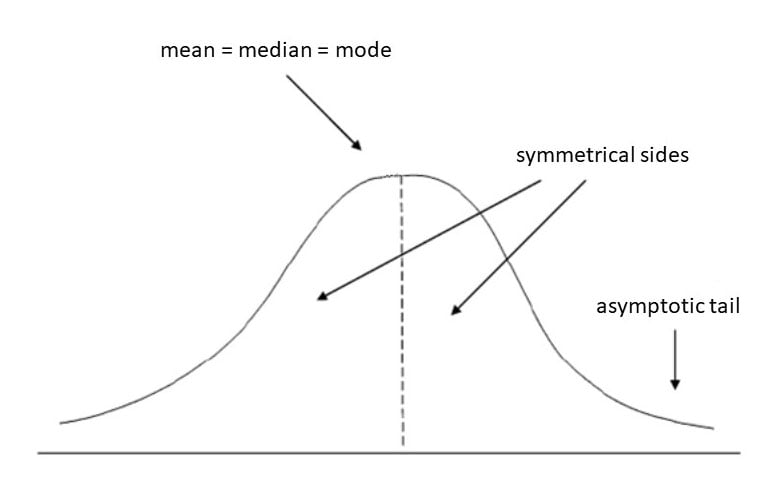
Why It Is Called the Normal or Gaussian Distribution
The normal distribution is often called the bell curve because the graph of its probability density looks like a bell.
The curve began as a shortcut for calculating probabilities, not as a theory of human traits.
De Moivre showed in 1733 that the area under it approximates long sums of binomial probabilities. Laplace published the central limit theorem in 1810 (Stahl, 2006).
The German mathematician Carl Gauss derived the same curve as an error law, after the planet Ceres was lost and recovered in 1801.
It justified averaging repeated astronomical observations. This is why it is also called the Gaussian distribution.
Until then, the curve described errors in measuring one fixed quantity. Quetelet and Galton later applied it to people. Galton argued that a trait shaped by many independent influences should follow it (Stahl, 2006).
The word “normal” came later. Karl Pearson, through whom the term spread, said in 1920 that it can mislead people into thinking other distributions are somehow abnormal (Stahl, 2006).
Why is the normal distribution important?
How Common Is the Bell Curve in Nature and Psychology?
The normal distribution is the most important probability distribution in statistics. Many measures in nature and psychology look roughly bell-shaped when graphed, although few match the curve exactly.
A quantity shaped by many small, independent influences, some pushing it up and some down, tends to be normally distributed (Stahl, 2006). This explains why the bell shape appears so often. It is a reason to expect approximate normality, not a guarantee of it (Lyon, 2014).
Real data rarely follow the curve perfectly. Micceri (1989) found that all 440 large-sample achievement and psychometric distributions he tested were significantly non-normal.
The familiar examples show how varied the picture is:
- IQ: Scores are bell-shaped largely because test developers construct the scale to be normal, which says nothing about the nature of intelligence.
- Height: Adult height is roughly normal, but men and women have different averages, so the pooled distribution is not exactly normal.
- Weight and blood pressure: Both often show a longer upper tail than lower tail.

Role in the Central Limit Theorem
The normal distribution is exceptionally powerful due to its connection to the Central Limit Theorem.
The theorem says that if you draw large random samples from any population and calculate each sample’s mean, those means form a roughly normal distribution. This holds whatever the shape of the population, provided its variance is finite.
A sample of 30 is a common rule of thumb. It is only an approximation. In simulations, 95% confidence intervals built from samples of 30 captured the true mean of a skewed population about 93% of the time.
Extreme skew or heavy outliers can require thousands of observations.
How do mean and standard deviation change a bell curve’s shape?
Because there are an infinite number of possible normal distributions, these two mathematical measures are required to uniquely define any specific curve.
Here is how each parameter alters the bell curve:
Mean (μ): Shifts the Curve’s Location
The mean establishes the center point of the distribution. The bell curve is perfectly symmetrical around a vertical line drawn straight down through this mean.
If the standard deviation is kept constant but the mean is changed, the physical shape (the height and width) of the bell curve does not change at all.
Instead, the entire graph simply shifts its location to the left or the right along the horizontal x-axis.
Standard Deviation (σ): Alters the Curve’s Shape
The mean tells you exactly where the center of the bell curve sits on a graph, while the standard deviation tells you how tall and wide the bell will be.
The standard deviation measures the variability or spread of the data, indicating how far data values fall from the mean.
Because the total area under any continuous probability distribution curve must always equal exactly one (or 100%), changing the standard deviation directly dictates how “fat” or “skinny” the curve appears.
- Small Standard Deviation: When the standard deviation is small relative to the mean, it indicates that most data points are tightly concentrated and packed close to the center. To accommodate this lack of spread while keeping the total area at 1, the bell curve becomes taller, narrower, and more “pointy”.
- Large Standard Deviation: When the standard deviation is large relative to the mean, it indicates that the data values are widely dispersed and spread out away from the center. To account for this wide spread across the x-axis, the bell curve stretches out and becomes flatter, wider, and “fatter”.
Because the area must stay at 1, narrowing the curve makes it taller. The peak height is about 0.399 divided by the standard deviation.
The table compares four normal curves. The first and fourth differ only in location, so they share the same height and width. The first three differ only in scale.
| Curve | Peak height | Inflection points | Middle 95% of values |
|---|---|---|---|
| Mean 100, SD 15 | .0266 | 85 and 115 | 70.6 to 129.4 |
| Mean 100, SD 10 | .0399 | 90 and 110 | 80.4 to 119.6 |
| Mean 100, SD 20 | .0200 | 80 and 120 | 60.8 to 139.2 |
| Mean 110, SD 15 | .0266 | 95 and 125 | 80.6 to 139.4 |
Parametric Tests and the Normality Assumption
Parametric tests, the most powerful tests psychologists use, assume that the random part of each score (its error) is normally distributed. Saying the data must be normal overstates the requirement. What has to be normal depends on the analysis:
- Small samples: Exact p-values need normally distributed errors, yet small samples reveal little about shape.
- Larger samples: Tests on means rely on the sampling distribution of the mean, which approaches normality as samples grow.
- Individual predictions: Prediction intervals and percentiles read from a normal table depend on the shape of the scores themselves.
- Extreme outliers: A single extreme value can dominate a mean or regression slope, even in a large sample.
If the data clearly depart from a bell curve, researchers may use a non-parametric test. It makes fewer assumptions but tests a different hypothesis.
The classic argument that raw-score normality matters less than people think is Lumley and colleagues’ (2002) review.
- Aim: To address the belief that the t-test and linear regression are valid only for normally distributed outcomes.
- Method: A review article that demonstrates by simulation how these methods behave in extremely non-normal data.
- Results: The methods are valid in very small samples if the outcome is normal, but in large samples they are valid for any distribution. The major limitation is whether a difference in means answers the scientific question.
- Conclusion: The t-test and linear regression are often a convenient, practical alternative to rank-based and other methods.
The argument is persuasive for tests of means. It does not rescue percentile readings or prediction intervals for individuals.
Converting Raw Scores to Z-Scores
There is an infinite number of possible normal distributions, depending on the mean and standard deviation of the dataset. To compare them, statisticians convert data into a standardized format called the Standard Normal Distribution. This puts every dataset on one common scale.
Its mean is always 0, and its standard deviation is always 1, whatever the original units.
We can standardize a normal distribution’s values (raw scores) by converting them into z-scores.
A z-score precisely measures the distance of a data point from the mean, expressed purely in units of standard deviation.
- A z-score of exactly 0 indicates that the raw score is perfectly equal to the mean.
- A positive z-score indicates that the raw score falls above (to the right of) the mean.
- A negative z-score indicates that the raw score falls below (to the left of) the mean.
- The absolute value of the z-score reveals exactly how far the score deviates from the center, regardless of the direction.
By converting raw scores into z-scores, statisticians can meaningfully compare observations from completely different distributions that rely on entirely different scales.
For example, standardizing lets researchers compare a student’s SAT score (the SAT has a mean around 500) with another student’s ACT score (mean around 21). Each score becomes a distance from its own test’s mean, so you can see who did better relative to their testing population.
What is the empirical rule formula?
A highly useful property of a normal distribution is how predictably the data is dispersed around the mean.
Known as the Empirical Rule, or the 68-95-99.7 rule, it states that in a normal distribution:
- Approximately 68% of the data values lie within one standard deviation of the mean (μ±1σ).
- Approximately 95% of the data values lie within two standard deviations of the mean (μ±2σ).
- Approximately 99.7% (almost all) of the data values lie within three standard deviations of the mean (μ±3σ)

To use the rule, express each score as a z-score, its distance from the mean in standard-deviation units (σ).
The rule is exact only for a normal distribution. Symmetry and a bell shape are not enough. A t distribution with 5 degrees of freedom is bell-shaped too, but with heavier tails. About 1.2% of its values lie beyond three standard deviations, against 0.27% for a normal curve.
The percentages are also rounded. Exactly, 68.27%, 95.45% and 99.73% of values fall within one, two and three standard deviations. The distance enclosing exactly 95% is 1.96 standard deviations.
The empirical rule allows researchers to calculate the probability of randomly obtaining a score from a normal distribution.
About 68% of data falls within one standard deviation of the mean. A randomly selected score therefore has a 68% probability of lying between -1 and +1 standard deviations.

About 95% of values fall within two standard deviations. A random score has a 95% chance of lying between -2 and +2.

Almost all values, about 99.7%, fall within three standard deviations of the mean. A randomly selected score therefore has a 99.7% probability of lying between -3 and +3 standard deviations.

Normal Distribution Examples
The empirical rule answers practical questions once you know the mean and standard deviation. Many intelligence tests report scores with a mean of 100 and a standard deviation of 15, on a scale constructed to be normal. For that scale, the rule gives these answers:
- Between 85 and 115: These limits are one standard deviation either side of the mean, so about 68% of people score here.
- Between 70 and 130: These are two standard deviations out, so about 95% of people score here.
- 130 or higher: The 4.55% outside the 70 to 130 range splits evenly between the tails, so about 2.3% score 130 or above.
- 145 or higher: This is three standard deviations above the mean, so roughly 1 person in 741 scores this high.
These answers hold because the scale is normal by construction.
Now suppose a lecturer reports exam marks with a mean of 62 and a standard deviation of 12. These numbers are invented for illustration. If the marks are roughly normal:
- Above 80: A mark of 80 is 1.5 standard deviations above the mean, so about 6.7% of students score higher.
- Below 50: A mark of 50 is one standard deviation below the mean, so about 15.9% of students score lower.
- 50 to 74: These marks lie within one standard deviation of the mean, so about 68% of students fall here.
- Top 5%: These students score above 81.7, which is 1.645 standard deviations above the mean.
These percentages follow from the shape assumption, not from the mean and standard deviation alone. If the exam has a ceiling, if marks bunch at the top, or if the class is really two groups, every one of them can be wrong. Look at the distribution first.
How to Check If Data Are Normally Distributed
Statistical software such as SPSS can help you check whether a dataset is normally distributed. Start by calculating the three measures of central tendency.
If the mean, median and mode are very similar, there is a good chance the data follow a bell-shaped distribution. This is only a first clue, because a mixture of two groups can also have a mean close to its median.
Plot the data too. A frequency graph shows the visual shape of your data. If your chart is a histogram, SPSS can add a distribution curve: from the menus, choose Elements > Show Distribution Curve.

A larger sample gives a clearer picture of the shape. A small sample can look irregular even when it comes from a normal population.
A Q-Q plot (quantile-quantile plot) offers a second view. It plots each ordered data value against the value a normal distribution would give at that position. If the data are normal, the points follow a straight line. Systematic departures look different:
- Upward curve: A long right tail, meaning right skew. A downward curve indicates left skew.
- S-shape: Points below the line at the left end and above it at the right indicate heavy tails. The reverse S-shape indicates light tails.
- Flat step: A flat step at the upper end indicates a ceiling.
- Kink or two slopes: Two segments with different slopes indicate a mixture of groups.
You can also calculate skewness, which measures asymmetry, and kurtosis, which measures how heavy the tails are relative to the peak. A normal distribution has a skewness of zero and an excess kurtosis of zero. Raw kurtosis, which some software reports instead, is three.
Formal tests of normality, such as the Kolmogorov-Smirnov and Shapiro-Wilk tests, can be calculated using SPSS. The Shapiro-Wilk test is powerful against many departures, especially in small and moderate samples.
- Aim: To introduce a test of whether a sample comes from a normal distribution when the mean and variance are unknown.
- Method: The statistic W compares the squared slope of the line on a normal probability plot with the usual sample variance. Percentage points were tabulated for samples of 3 to 50.
- Results: W was sensitive to a wide range of departures even at n = 20, especially asymmetry and long tails. For a chi-square population with 1 degree of freedom, its power was .98.
- Conclusion: W is a convenient omnibus test for small and moderate samples, offered as a supplement to normal probability plotting, not a substitute.
These tests compare your data to a normal distribution and give a p-value. A significant result (p < .05) suggests your data differ from a normal distribution, so researchers hope for a non-significant one.
A non-significant result does not prove normality. It means only that the test found no evidence of a departure, and small samples give tests little power to find one.
Large samples cause the opposite problem. In simulations with 4,000 samples per size, the Shapiro-Wilk test flagged a mild skew of 0.45 in 62% of samples of 200. It flagged the same skew in every sample of 1,000.
A strong skew of 1.75, which could matter, went unnoticed in 75% of samples of 10. So a significant result should prompt a look at how large the departure is, not an automatic change of test.

Limitations of the Normal Distribution
The normal distribution is a theoretical model, not a description that any real data set matches exactly. It approximates many measures well, but few real distributions are truly normal.
Why Many Measures Are Not Normal
Several features of psychological data make normality unlikely, and each leaves a recognizable fingerprint.
- Bounds, floors and ceilings: A reaction time cannot be negative, and a 20-item test cannot score above 20. Scores bunch against the limit, which skews the distribution.
- Mixtures of subgroups: Pooling groups with different means produces a mixture, and a mixture of normal distributions is not normal.
- Heavy tails and outliers: A few extreme observations, genuine or mistaken, make the tails heavier than the normal curve allows.
- Discreteness: Scores from a few response options take only certain values, so the histogram is stepped rather than smooth.
The classic demonstration of how common this is comes from Micceri (1989).
- Aim: To examine the distributional shapes of large-sample achievement and psychometric measures.
- Method: Micceri examined 440 large-sample distributions and tested each for departure from normality at the .01 level.
- Results: All 440 distributions were significantly non-normal, with contaminated tails, strong asymmetry, digit preferences and multiple peaks.
- Conclusion: The assumptions behind normality-based statistics do not hold up for this type of data, so earlier robustness research needed re-evaluating with more realistic shapes.
With very large samples any test detects small departures, so which shapes occur matters more than the count of rejections.
When influences multiply rather than add, the result is skewed. A variable whose logarithm is normal is called lognormal. It has a long right tail and cannot be negative.
Limpert et al. (2001) surveyed lognormal distributions across the sciences. Reaction times, durations and many symptom counts behave this way, so a logarithmic transformation is a common first remedy.
What to Do When Data Are Not Normal
The right response depends on what kind of non-normality you have and what the analysis is for. Diagnose the cause, then ask whether it matters.
- Diagnose first: Check whether the cause is a floor, ceiling, mixture, outliers or discreteness. Fix recording errors, and model subgroups separately instead of pooling them.
- Transform: A logarithm suits right-skewed positive data such as reaction times. Results then apply to the transformed scale, and transformation can bias estimates (Schmidt & Finan, 2018).
- Change the test: Welch’s t-test drops the equal-variance assumption, and trimmed means down-weight extreme values (Wilcox & Keselman, 2003).
- Use ranks: The Mann-Whitney U test needs no normality and resists outliers. It tests a different hypothesis, so the question changes.
- Resample: The bootstrap builds a confidence interval from the data without assuming a shape, at the cost of computation.
Choose the method from the design, the sample size and the plots, not from a normality pretest alone. Switching tests after a pretest can change the error rates of the main analysis (Rochon et al., 2012).
What “Normal” Does Not Mean
In statistics, “normal” is only a mathematical label. It is not a judgment about what is healthy or desirable. That distinction matters.
Quetelet treated deviations from the “average man” as errors (Stahl, 2006). That idea resurfaces whenever a statistical norm is used to label people. Three cases show how.
- Fixed cut-offs: Labeling people abnormal beyond two standard deviations turns a continuous difference into a category. That is fair only if the tails are as thin as the curve says.
- Reference groups: Behavioral science samples draw heavily on Western, educated, industrialized, rich and democratic societies, which prove unusual across many measured domains (Henrich et al., 2010).
- Grading on a curve: It imposes a bell-shaped distribution on marks. That is a decision about allocating grades, not evidence that ability is normally distributed.
Someone assessed against a curve fitted to a narrow reference group is measured on the wrong ruler.
Contemporary Research
Recent meta-research confirms that non-normality is common.
Authors of articles in two leading journals supplied 1,567 distributions, and 74% deviated from normality (Cain et al., 2017). A systematic review of 262 abstracts ranked the non-normal shapes reported most often (Bono et al., 2017).
These studies show how often data depart from normality, not how often that changes a conclusion.
Simulation studies address that second question. They sit lower on the evidence hierarchy than systematic reviews, but they suit a question about error rates under known conditions.
Two large simulations anchor the findings. Their consistent message is that the shape of the errors is usually a smaller threat to a test of means than outliers, unequal variances with unbalanced groups and non-independence.
Methodological guidance has moved the same way, away from pretests and towards residual plots. Kozak and Piepho (2018) argued that plots of residuals are more telling than significance tests when checking ANOVA assumptions.
Is the F-Test Still Valid for Non-Normal Data?
- Aim: To test whether the one-way ANOVA F-test keeps its Type I error rate (false-positive rate) when data are not normal.
- Method: A Monte Carlo simulation of a three-group design with no true effect. It covered 22 distribution shapes, 1,308 conditions and 10,000 runs per condition.
- Results: Every Type I error rate fell between .025 and .075, so the F-test counted as robust in all 1,308 conditions.
- Conclusion: Under non-normality the F-test remained valid for Type I error, and a transformation or rank-based alternative offered no added benefit.
Blanca et al. (2017) designed this study well. However, it examined Type I error only, assumed equal variances and tolerated an error rate 50% above the nominal one.
Is Violating Normality the Lesser Evil?
- Aim: To assess the risks and benefits of fitting Gaussian linear models to non-normal data, compared with non-Gaussian alternatives.
- Method: A Monte Carlo simulation of ten outcome and predictor distributions, five continuous and five discrete, at sample sizes from 10 to 1,000.
- Results: At 100 and 1,000 observations, Type I error stayed between .037 and .058. With only 10, four extreme combinations reached .086 to .11.
- Conclusion: Violating normality carried limited, manageable risks, while the alternatives carried less well-known ones. Non-independence is more dangerous, and prediction intervals for individuals still need normality.
Knief and Forstmeier (2021) are advocates for their position. Weigh their work alongside the independent simulations above.
Together, the studies suggest that tests of means and regression slopes tolerate substantial non-normality. The tolerance has edges, though.
Outliers with high leverage, very small samples, strict significance levels and non-independence can all break it. This matches the older argument that the main limitation of the t-test is whether a difference in means answers the question (Lumley et al., 2002).
Further Information
Is a normal distribution kurtosis 0 or 3?
A normal distribution has a kurtosis of 3. However, sometimes people use “excess kurtosis,” which subtracts 3 from the kurtosis of the distribution to compare it to a normal distribution.
In that case, the excess kurtosis of a normal distribution is 3 − 3, or zero.
So its kurtosis is 3, but its excess kurtosis is zero.
References
Blanca, M. J., Alarcón, R., Arnau, J., Bono, R., & Bendayan, R. (2017). Non-normal data: Is ANOVA still a valid option? Psicothema, 29(4), 552–557. https://doi.org/10.7334/psicothema2016.383
Bono, R., Blanca, M. J., Arnau, J., & Gómez-Benito, J. (2017). Non-normal distributions commonly used in health, education, and social sciences: A systematic review. Frontiers in Psychology, 8, Article 1602. https://doi.org/10.3389/fpsyg.2017.01602
Cain, M. K., Zhang, Z., & Yuan, K.-H. (2017). Univariate and multivariate skewness and kurtosis for measuring nonnormality: Prevalence, influence and estimation. Behavior Research Methods, 49(5), 1716–1735. https://doi.org/10.3758/s13428-016-0814-1
Henrich, J., Heine, S. J., & Norenzayan, A. (2010). The weirdest people in the world? Behavioral and Brain Sciences, 33(2–3), 61–83. https://doi.org/10.1017/S0140525X0999152X
Knief, U., & Forstmeier, W. (2021). Violating the normality assumption may be the lesser of two evils. Behavior Research Methods, 53(6), 2576–2590. https://doi.org/10.3758/s13428-021-01587-5
Kozak, M., & Piepho, H.-P. (2018). What’s normal anyway? Residual plots are more telling than significance tests when checking ANOVA assumptions. Journal of Agronomy and Crop Science, 204(1), 86–98. https://doi.org/10.1111/jac.12220
Limpert, E., Stahel, W. A., & Abbt, M. (2001). Log-normal distributions across the sciences: Keys and clues. BioScience, 51(5), 341–352. https://doi.org/10.1641/0006-3568(2001)051[0341:LNDATS]2.0.CO;2
Lumley, T., Diehr, P., Emerson, S., & Chen, L. (2002). The importance of the normality assumption in large public health data sets. Annual Review of Public Health, 23, 151–169. https://doi.org/10.1146/annurev.publhealth.23.100901.140546
Lyon, A. (2014). Why are normal distributions normal? The British Journal for the Philosophy of Science, 65(3), 621–649. https://doi.org/10.1093/bjps/axs046
Micceri, T. (1989). The unicorn, the normal curve, and other improbable creatures. Psychological Bulletin, 105(1), 156–166. https://doi.org/10.1037/0033-2909.105.1.156
Rochon, J., Gondan, M., & Kieser, M. (2012). To test or not to test: Preliminary assessment of normality when comparing two independent samples. BMC Medical Research Methodology, 12, Article 81. https://doi.org/10.1186/1471-2288-12-81
Schmidt, A. F., & Finan, C. (2018). Linear regression and the normality assumption. Journal of Clinical Epidemiology, 98, 146–151. https://doi.org/10.1016/j.jclinepi.2017.12.006
Shapiro, S. S., & Wilk, M. B. (1965). An analysis of variance test for normality (complete samples). Biometrika, 52(3–4), 591–611. https://doi.org/10.1093/biomet/52.3-4.591
Stahl, S. (2006). The evolution of the normal distribution. Mathematics Magazine, 79(2), 96–113. https://doi.org/10.1080/0025570X.2006.11953386
Wilcox, R. R., & Keselman, H. J. (2003). Modern robust data analysis methods: Measures of central tendency. Psychological Methods, 8(3), 254–274. https://doi.org/10.1037/1082-989X.8.3.254