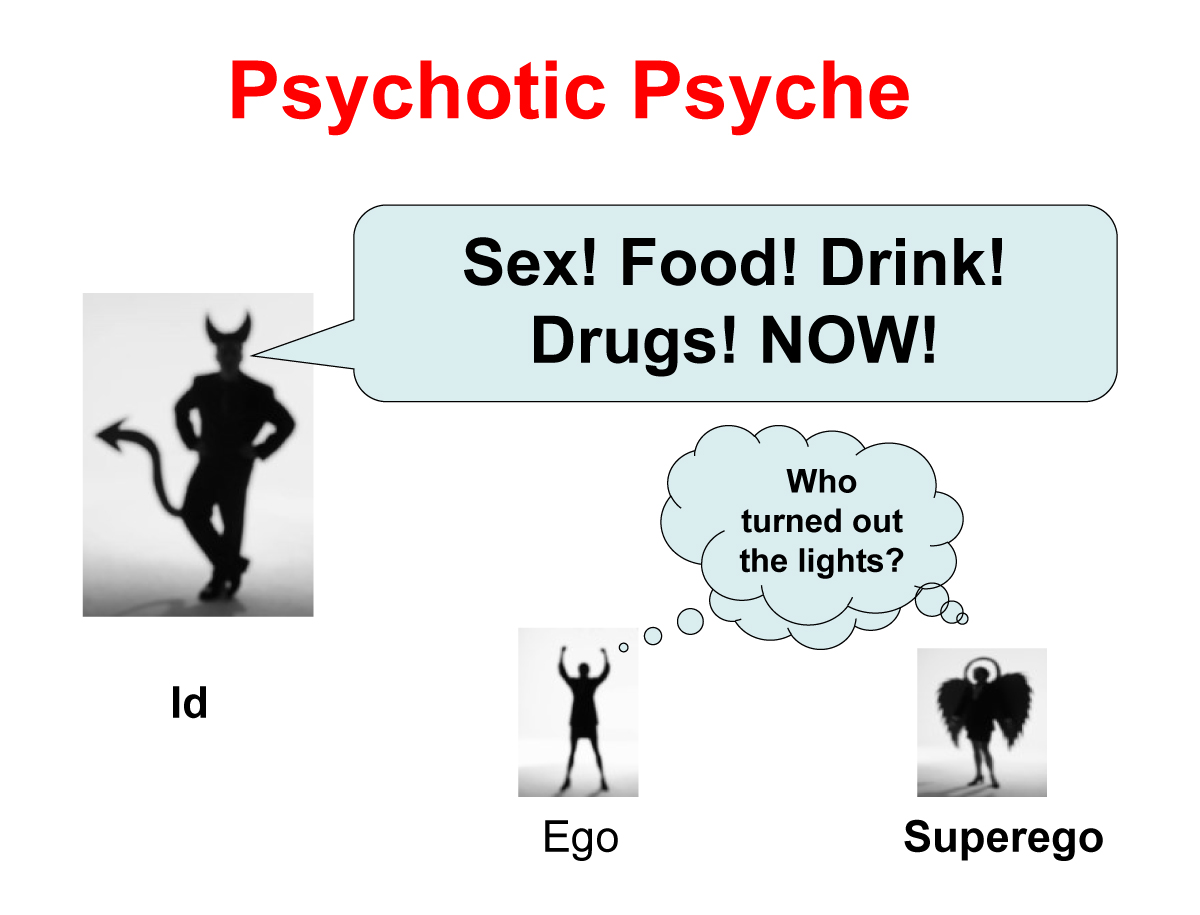
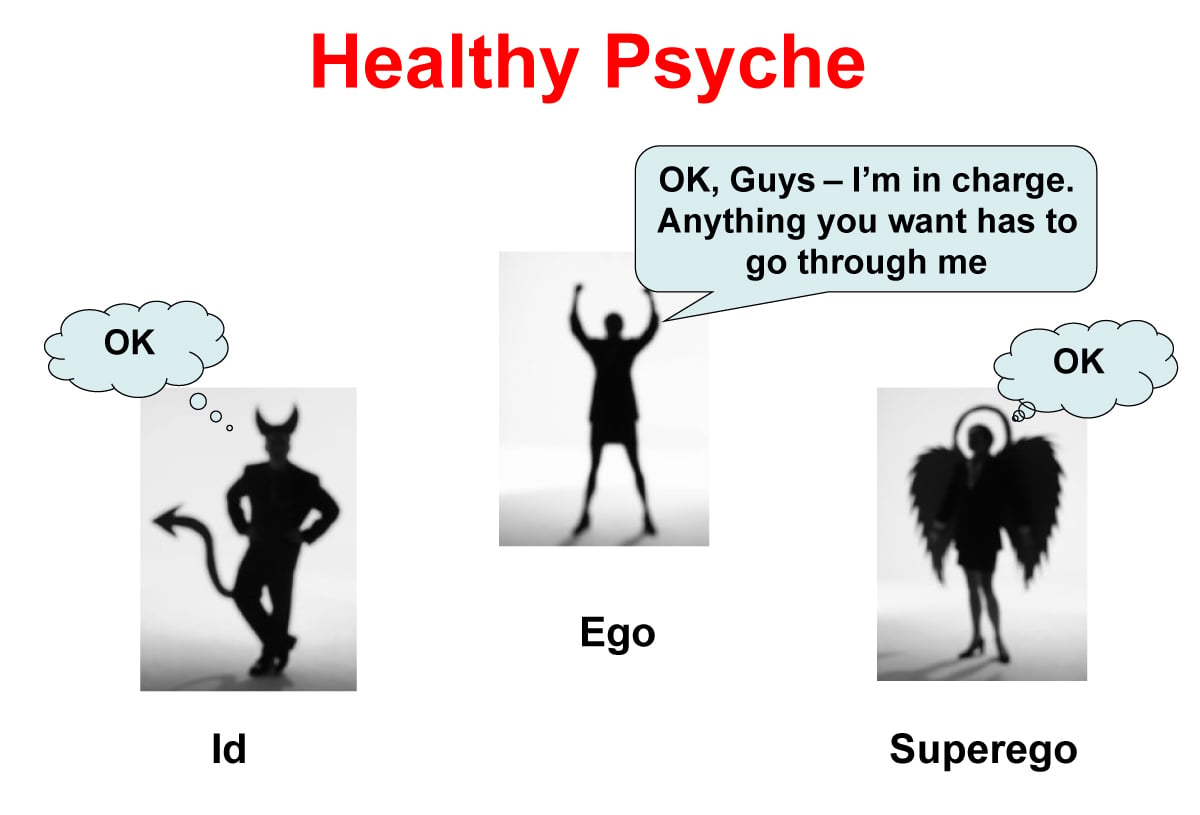
The Id, Ego, and Superego are components of Freud’s psychoanalytic theory.
Sigmund Freud’s structural model divides the personality into three interacting components: the id, ego, and superego. Together, they form the psyche. That is the mind as a whole, conscious and unconscious.
The Id represents our basic instincts and desires. It seeks immediate gratification.
The Ego, guided by reality, balances the Id’s impulses with social norms.
The Superego is our moral conscience, pushing us to follow ethical standards. Together, they shape our behavior and personality.
Freud introduced this tripartite model in The Ego and the Id (1923) as an amendment to his earlier topographical model of the conscious and unconscious mind.
These are systems, not parts of the brain, or in any way physical, but rather hypothetical conceptualizations of important mental functions.
Freud saw the psyche structured into three parts (i.e., tripartite), the id, ego, and superego, all developing at different stages in our lives.
The super-ego: moral conscience and guiding force.
Although each part of the personality comprises unique features, they interact to form a whole, and each part makes a relative contribution to an individual’s behavior.
The basic dilemma of all human existence is that each element of the psychic apparatus makes demands upon us incompatible with the other two.
Inner conflict is inevitable. For example, the superego can make a person feel guilty if rules are not followed.
When there is a conflict between the goals of the id and superego, the ego must act as a referee and mediate this conflict.
The ego can deploy various defense mechanisms (Freud, 1894, 1896) to prevent it from becoming overwhelmed by anxiety.
The id is the primitive and instinctive component of personality. Freud described the id as a “cauldron of seething excitations” filled with energy striving for immediate release.
The id is the impulsive (and unconscious) part of our psyche that responds directly and immediately to basic urges, needs, and desires.
The personality of a newborn is all id. The ego and superego develop later.
When the id achieves its demands, we experience pleasure, and when it is denied, we experience ‘unpleasure’ or tension.
Core Mechanics
The Pleasure Principle: The Id operates entirely on the pleasure principle. Its sole goal is the immediate reduction of tension and the maximization of satisfaction. Every unconscious wishful impulse should be satisfied immediately, with zero regard for logic, safety, or social consequences.
Primary Process Thinking: The Id’s logic is primitive, irrational, and fantasy-oriented. It does not understand the word “no,” nor does it recognize the passage of time. A repressed wish from decades ago remains immortal within the Id, feeling as fresh and urgent as if it occurred today.
Amorality: The Id is completely amoral. It has no concept of right or wrong, good or evil; it is concerned only with the fulfillment of instinctive needs.
Life and Death Instincts
The id is a part of the unconscious that contains all the urges and impulses, including what is called the libido, a kind of generalized sexual energy that is used for everything from survival instincts to appreciation of art.
The id comprises two kinds of biological instincts (or drives), including the sex (life) instinct called Eros (which contains the libido) and the aggressive (death) instinct called Thanatos (Freud, 1920).
Eros (The Life Instinct): This drive ensures survival. It covers life-sustaining activities like breathing, eating, and sex. The energy generated by Eros is known as libido.
Thanatos (The Death Instinct): This represents a set of destructive forces present in all humans. When directed outward, it manifests as aggression, violence, and cruelty.
Freud believed that Eros was stronger than Thanatos, thus enabling people to survive rather than self-destruct.
The Id in Action: The Horse and the Rider
Because the Id is entirely cut off from the external world, it cannot navigate reality on its own.
It requires the Ego to act as its intermediary.
Freud used a famous metaphor for this relationship. The id is like a horse, providing the massive energy and power to move. The ego is the rider, trying to steer that power.
However, the rider often has to guide the horse where it already wants to go, just to stay in the saddle.
The image is vivid, and Freud did not stop there.
He returned to it in The Ego and the Id (1923).
The rider tries to control the horse “with his own strength,” but the ego works with “borrowed forces” instead.
The energy the ego uses is the id’s energy. Its rationality is a borrowed instrument, not an independent power.
Freud’s own summary of the ego’s position is blunter still.
He called it a “poor creature owing service to three masters”: the id, the superego, and external reality, each pulling it in a different direction.
What is the Ego?
Freud’s ego is the rational part of the psyche.
It mediates between the instinctual desires of the id and the moral constraints of the superego, operating primarily at the conscious level.
The ego is “that part of the id which has been modified by the direct influence of the external world.”
(Freud, 1923, p. 25)
The ego (Latin for “I”) is the part of the personality most open to awareness, though it also works unconsciously. It’s what the person is aware of when they think about themselves and what they usually try to project toward others.
The ego develops to mediate between the unrealistic id and the real external world. It is the decision-making component of personality.
Ideally, the ego works by reason, whereas the id is chaotic and unreasonable.
The Reality Principle and the Role of the Ego
The ego develops from the id during infancy.
The ego’s goal is to satisfy the id’s demands in a safe and socially acceptable way.
It does this through the reality principle: the ego’s rule that a wish can wait.
The ego works out realistic ways to satisfy the id’s demands, often postponing satisfaction to avoid negative consequences. This principle operates in both the conscious and unconscious mind.
The ego also weighs social realities, norms, etiquette, and rules before it acts.
Like the id, the ego seeks pleasure and avoids pain. Unlike the id, though, it pursues that pleasure through a realistic strategy rather than blind impulse.
The ego has no concept of right or wrong. Something is good simply if it satisfies without causing harm to itself or the id.
Freud’s theory implies that a healthy personality is one in which an effective ego balances the demands of the id, the mandates of the superego, and the constraints of external reality.
Ego Strength, Defense Mechanisms, and Reality Testing
Often the ego is weaker than the headstrong id. The best it can do is stay in the saddle, pointing the id in the right direction. It can only claim some credit at the end, as if the action were its own.
Freud made the analogy of the id being a horse while the ego is the rider. The ego is “like a man on horseback, who has to hold in check the superior strength of the horse.”
(Freud, 1923, p. 15)
If the ego fails to use the reality principle, anxiety follows.
Unconscious defense mechanisms are then employed to ward off the unpleasant feeling, or to make already-good things feel even better.
The relief is real, but temporary.
The ego engages in secondary process thinking: rational, realistic, and oriented toward problem-solving.
If a plan does not work, it is thought through again until a solution is found.
This is reality testing.
Mastering it lets a person control their impulses and demonstrate self-control.
That mastery matters clinically.
Enhancing ego functioning is a stated aim of clinical and social work: helping a client think through their options.
Not every upbringing supports it.
According to Freudians, some abnormal upbringing, particularly a cold, rejecting ‘schizogenic’ mother, can leave the ego weak and fragile.
Its ability to contain the id’s desires becomes limited.
The ego can then be ‘broken apart’ by its own attempt to contain the id, leaving the id in overall control of the psyche.
Conflict and Anxiety: Three Sources of Danger
Freud saw conflict as unavoidable. The ego answers to the id, the superego and the outside world at once.
Each pressure produces its own kind of conflict and its own kind of anxiety.
Conflict
Between
Anxiety
External
Ego (reality principle) and external reality
Realistic anxiety
Neurotic
Ego and id (pleasure principle)
Neurotic anxiety
Moral
Ego and superego
Moral anxiety
Anxiety is the ego’s alarm. Freud argued that “three kinds of anxiety correspond to these three dangers, since anxiety is the expression of a retreat from danger” (Freud, 1923).
In his mature theory, Freud treated anxiety as a danger signal generated by the ego, not as transformed libido (Freud, 1926).
If the ego cannot manage the danger realistically, it deploys unconscious defense mechanisms to ward off the anxiety (Freud, 1894). These include repression, denial, projection, displacement and rationalization.
The ego settles its tensions through three characteristic compromises: dreams, neurotic symptoms and defense mechanisms.
What is the Superego?
Freud’s superego is the moral component of the psyche, representing internalized societal values and standards. It contrasts with the id’s desires, guiding behavior towards moral righteousness and inducing guilt when standards aren’t met.
The superego (Latin for “over-I” or “above the ego”) incorporates the values and morals of society, which are learned from one’s parents and others.
The superego’s function is to control the id’s impulses, especially those which society forbids, such as sex and aggression.
In everyday terms, the superego is like one’s inner critic or inner angel, providing a sense of right and wrong.
Formation and Development
The superego is the last component of the personality to develop, typically emerging between the ages of 3 and 6 during the phallic stage of psychosexual development.
Introjection: Children internalize the “Thou shalt” and “Thou shalt not” rules of their parents and authority figures.
Oedipal Resolution: Freud posited that the superego forms as the child resolves the Oedipus complex. By identifying with the same-sex parent, the child absorbs that parent’s authority and moral standards.
Generational Echoes: Interestingly, the child often internalizes the parent’s superego rather than the parent’s actual behavior, allowing cultural traditions and social norms to persist across generations.
Two Systems of the Superego
The superego operates on the Morality Principle. Freud described this agency as one that “observes the ego, gives it orders, judges it and threatens it with punishments” (Freud, 1940). It acts “exactly like the parents whose place it has taken.”
Its severity can outrun anything real parents showed. As Freud put it, “the super-ego often displays a severity for which no model has been provided by the real parents” (Freud, 1940).
The superego works through two sub-systems: the conscience and the ego-ideal.
1. The Conscience (The “Inner Critic”)
The moral conscience is our “inner voice” that tells us when we have done something wrong.
The conscience is the “don’t” system. It monitors the ego and issues punishments when the individual falls short of moral standards or harbors forbidden thoughts.
Punishment: Intense feelings of guilt, shame, and self-reproach.
Unconscious Reach: Because the conscience reaches deep into the unconscious, it can punish a person for forbidden wishes just as severely as for actual misdeeds.
2. The Ego-Ideal (The “Ideal Self”)
The superego portrays what it wants the person to do in grandiose, glowing terms. Freud called this picture the ego-ideal.
The ego-ideal arises out of the person’s first great love attachment, usually a parent.
The ego-ideal is the “do” system. It is an imaginary picture of how one ought to be, representing career aspirations, social etiquette, and moral excellence.
Reward: When behavior aligns with the ego-ideal, the superego rewards the individual with feelings of pride, high self-esteem, and satisfaction.
According to Freud, an overdominant superego causes neuroses. The ego then over-uses defense mechanisms in an attempt to regain control. Too much psychic energy is spent on them, allowing maladaptive behavior to emerge.
The Balance of the Superego
The balance of the superego’s strength is important.
Freud noted that an overly harsh or punitive superego can be problematic.
It may flood a person with excessive guilt or feelings of inferiority, even for minor transgressions or mere thoughts.
This can contribute to anxiety or depressive tendencies.
Freud’s study of melancholia suggested that in depression, the superego mercilessly attacks the ego with self-criticism.
Freud traced this cruelty to redirected aggression. “The more a man controls his aggressiveness,” he wrote, “the more intense becomes his ideal’s inclination to aggressiveness against his ego” (Freud, 1923).
That drive does not vanish. Denied an outlet, it turns on the self as conscience.
Freud used a vivid image for this in Civilization and Its Discontents. Society, he argued, sets up an agency within the individual to watch over aggression, “like a garrison in a conquered city” (Freud, 1930).
There are various ways an individual handles guilt, which are called defense mechanisms.
Balance runs both ways.
Conversely, a weak or underdeveloped superego might result in a person with poor morals or antisocial behavior, since the internal “brakes” on the id are insufficient.
Indeed, traditional psychoanalytic theory sometimes viewed criminal or antisocial personalities as having a deficient superego, with no strong conscience to restrain impulses.
Examples of the Id, Ego, and Superego
Picture a person on a strict diet who is tempted by a box of donuts at work.
The id impulsively wants immediate gratification: eat the donuts now.
At the same time, the superego reminds the person of their commitment to a healthy lifestyle, instilling guilt at the very thought of breaking the diet.
The ego mediates between the two.
It may allow the person to eat just one donut as a compromise, balancing the id’s craving against the superego’s standards.
Skipping a workout:
Id: I want to skip my workout because I feel lazy and just want to relax.
Superego: I shouldn’t skip the workout because it’s essential for my health and discipline.
Ego: I can do a shorter workout today and make up for it with a longer session tomorrow.
Buying an expensive item:
Id: I want this luxury bag now because it’s stylish and will make me feel good.
Superego: I shouldn’t spend so much on a bag when I could save or use that money for more essential things.
Ego: I’ll save a portion of my salary for a few months, and if I still want it, I’ll buy the bag as a reward.
Reacting to criticism:
Id: I’m upset and want to snap back immediately because they hurt my feelings.
Superego: I should remain calm and composed, taking criticism professionally and not personally.
Ego: I’ll consider the feedback, see if there’s any truth to it, and respond diplomatically, asking for clarification if needed.
Topographical Model: Levels of the Mind
The structural model is only half of Freud’s map of the psyche. The word comes from the Greek psychē, meaning breath, life or soul. Psychology is literally the study of it.
Freud’s earlier topographical model (Freud, 1900, 1915) answers a different question. Its levels describe where a mental event stands in relation to awareness. The id, ego and superego describe which agency is doing the work.
The Three Levels of the Mind
Level
What it holds
Conscious
What you are aware of at this moment, a small and constantly changing selection.
Preconscious
Thoughts and memories not in awareness now, but retrievable through ordinary recall.
Unconscious
Material closed to ordinary introspection, including repressed memories and the instinctual drives.
Freud treated the unconscious as the foundation of the mind, not an exception. He called it “the true psychical reality” (Freud, 1900).
Freud defended the unconscious as “necessary and legitimate” (Freud, 1915). Conscious experience has large gaps. Dreams, slips of the tongue and neurotic symptoms fill them.
Much of the unconscious was put there by repression, the active barring of anxiety-provoking material from awareness. It can be reached only through special techniques, such as free association, dream interpretation and transference.
From Levels to Agencies: Where the Iceberg Fits
The topographical model hit a problem Freud himself identified. The force that represses material is itself unconscious, so “unconscious” could no longer name one coherent region (Freud, 1923).
Consciousness, it turned out, is a quality, not a place. It cuts across the mind’s agencies. In Freud’s words, the qualities of consciousness and the provinces of the mental apparatus “do not fall together into three peaceable couples” (Freud, 1933).
His answer, in The Ego and the Id (1923), was the structural model. It amended the topographical model rather than replacing it.
The usual way to combine the two models is the iceberg diagram, with a conscious tip above the waterline and a vast unconscious below. It is not a figure Freud published. It is a later teaching convention.
The line that the mind “floats with one-seventh of its bulk above water” is attributed to Freud in conversation. It appears nowhere in his written works.
The only diagram Freud published of the psychical apparatus was an egg-shaped schematic. He warned that “the space occupied by the unconscious id ought to have been incomparably greater than that of the ego or the preconscious” (Freud, 1933).
Used carefully, the iceberg still helps. The id lies wholly below the waterline. The ego and superego straddle all three levels.
Supporting Evidence
Within the psychoanalytic tradition, Freud’s model is foundational. Many theorists have built upon it rather than rejecting it.
Ego psychology
Pioneered by Anna Freud, Heinz Hartmann, and others, this school focused on the ego’s adaptive capacities (Freud, A., 1936).
It suggests that the ego isn’t just a mediator for the id, but an autonomous system responsible for adaptation, judgment, and frustration tolerance.
Therapists in this tradition might work directly on enhancing ego functions like insight, judgment, and frustration tolerance, considering these skills as crucial for mental health.
They extended Freud’s ideas. The ego, they argued, can function autonomously of the id. Hartmann believed it has conflict-free spheres that handle adaptation to reality.
Object relations and self psychology
These later psychoanalytic models shifted focus to interpersonal relationships and self-cohesion, but they still utilize the language of ego and superego to some extent.
Object relations theory views the superego not just as abstract “rules,” but as internalized representations of significant people (Boag, 2014).
An object relations therapist might interpret a client’s self-sabotaging behavior as stemming from an internalized punitive parent, a harsh superego representation.
The client unconsciously recreates that parent in their life.
Transactional Analysis (TA)
Eric Berne’s Transactional Analysis simplified Freudian structural theory into three “ego states”: Parent, Adult, and Child (Berne, 1961).
TA is Freud’s model in plain English.
The states roughly correspond to superego (Parent, internalized authority and teachings), ego (Adult, rational problem-solving), and id (Child, feelings and impulses).
TA therapy involves identifying which ego state is dominating a person’s interactions and encouraging healthier Adult functioning.
This is a direct application of Freud’s concepts in a more approachable format.
There is also a strand of modern research called neuropsychoanalysis that seeks to find neural correlates of Freud’s constructs.
A research programme called neuropsychoanalysis, associated with the neuroscientist Mark Solms, argues that Freud’s functional divisions map loosely onto dissociable brain systems.
The id’s primal drives align with the limbic system (specifically the amygdala and hypothalamus), which manages basic emotions and instincts.
The ego’s executive functions and the superego’s moral constraints parallel the frontal lobes, which govern planning, impulse control, and social reasoning.
The fit is not exact.
Solms is careful to call these functional analogies, not literal locations (Solms, 2006, 2018).
Carhart-Harris and Friston (2010) offered a more formal version of the same idea.
They proposed that the brain’s default-mode network behaves like Freud’s ego, suppressing spontaneous subcortical activity much as secondary process thinking reins in the id.
The idea is elegant.
This recasts the id-ego relationship in the mathematics of a modern theory of brain function, the free-energy principle.
These are theoretical mappings, not proof, but they show a serious attempt to integrate Freud’s model with contemporary neuroscience.
Some studies of decision-making and impulse control echo Freud’s concepts.
Modern dual-process models distinguish a fast, automatic, impulsive system from a slower, deliberative, self-controlled one, roughly analogous to id and ego or superego functions.
Psychologists call this the System 1 versus System 2 distinction (Kahneman, 2011), and it strikingly echoes Freud’s thinking on the dual nature of mental processes.
System 1 is fast, impulsive, and automatic. System 2 is slow, deliberative, and rational.
Together they reflect the tension Freud described between id-driven impulse and ego-driven control.
None of this proves Freud was right.
But it suggests he intuited an enduring truth: much of our thought is unconscious and driven by emotional impulses.
Defenders also point to its interpretive power.
The model gave psychology its first worked-out account of inner conflict, anxiety as a signal and compromise formation (Freud, 1923, 1926). As Stevens (1995) argues, Freud’s theory offers “concepts and techniques that help us to interpret underlying meanings.”
Freud wanted a nomothetic science, one that uncovers general laws. He finished with a powerful set of interpretive tools instead.
Empirical Test of Ego Defenses: Cramer (2015)
Few parts of the structural model can be tested directly. The ego’s defense mechanisms are an exception, because researchers can score the stories people tell about ambiguous pictures (the Thematic Apperception Test, or TAT) for signs of defenses.
Aim: To test whether ego defenses are measurable processes that develop in a predictable order, rather than untestable clinical metaphors.
Method: A review of cross-sectional, longitudinal and experimental studies that coded TAT stories. The Defense Mechanism Manual rated denial, projection and identification.
Results: Denial predominated in early childhood and then declined sharply. Projection rose through middle childhood, and identification became the main defense by late adolescence.
Conclusion: Defenses are measurable, developmentally ordered and protective against anxiety, not merely clinical metaphor.
The pattern replicated across independent samples. It also held longitudinally in children followed from age 6 to 9½. Experimentally induced failure raised defense use in both children and college students.
Defenses that did not fit a child’s age tracked psychopathology. Heavy denial in older children is one example.
This is strong evidence for one specific claim: the ego uses graded, age-linked strategies to manage anxiety. The validated coding system, the mix of designs and the independent replications all strengthen it.
Its reach is limited. It tests only the ego-defense component, using story coding as a proxy for an unconscious process. It says nothing about the id, the superego or Freud’s hydraulic “psychic energy.”
Critiques and challenges
From the standpoint of scientific psychology, Freud’s structural model has been heavily criticized on several grounds.
Lack of empirical evidence and falsifiability:
A primary scientific critique, famously championed by Karl Popper, is that Freud’s theory is unfalsifiable.
Because the id, ego, and superego are abstract metaphors rather than physical structures, they cannot be measured or disproven.
Popper (1963) cited psychoanalysis as a paradigm pseudo-science: its claims are flexible enough to accommodate any outcome.
For example:
If a person acts on an aggressive impulse, it’s the id.
If they act with extreme kindness instead, a Freudian might call it a reaction formation (a defense to hide the id).
This “heads I win, tails you lose” logic makes the theory impossible to test experimentally.
Freud overemphasized sexual and aggressive drives at the expense of social and cognitive motives:
Freud focused almost exclusively on sexual and aggressive urges.
Empirical research on personality and motivation has unveiled many drivers of behavior (need for attachment, for achievement, and social belonging) that Freud’s id concept doesn’t cover well.
Humanistic psychologists like Abraham Maslow argued that the structural model is entirely deterministic.
It views humans as helpless victims of unconscious conflict, ignoring free will, personal agency, and the drive for self-actualization.
Cultural and Gender Bias:
Freud’s theories are often criticized for reflecting the cultural and social norms of his time, particularly Victorian-era views on sexuality and gender.
From the 1960s onward, feminist scholars and social theorists began criticizing Freud’s focus on male-centered family structures and Victorian sexual morality.
Furthermore, anthropologists and cross-cultural psychologists pointed out that Freud’s universal claims about psychosexual development were deeply rooted in Western, Judeo-Christian contexts.
Some criticize that the superego concept, for example, is too tied to outdated notions of authority and guilt.
Carl Jung leveled a related charge at the superego itself.
He called it a “furtive attempt” to dress up the image of a punishing God in psychological clothing, arguing that Freud reduced spiritual instincts to mere parental discipline.
Reification: treating metaphors as things:
The id, ego and superego are metaphors, not brain regions. Treating them as separate things mistakes a figure of speech for an anatomy, and neuroscience finds no literal id or superego.
Mistranslation of Freud’s German terms:
Freud wrote of das Es (“the it”), das Ich (“the I”) and das Über-Ich (“the over-I”). His translator chose Latin words to give them scientific credibility.
Bettelheim (1985) argues that the Latin terms depersonalize Freud’s ideas. They give the false impression of three separate “selves.”
An outdated energy model of the mind:
Freud pictured instinctual energy building pressure, seeking discharge, and being dammed or displaced. That hydraulic picture belongs to nineteenth-century physics.
Modern cognitive science models the mind as information processing. The cognitive unconscious it documents is routine automatic processing, not repressed wishes (Kihlstrom, 1987).
Academic psychologists like John Kihlstrom have noted that Freud’s ideas remain influential in culture (how we think about ourselves), but in scientific psychology they are largely seen as obsolete or superseded (Kihlstrom, 1987):
In academic and clinical psychology, Freud’s model has largely been replaced by frameworks that allow for objective measurement.
Behaviorism: Views psychological issues (like phobias) as conditioned responses that can be unlearned through exposure, rather than hidden internal battles.
Cognitive Science: Focuses on maladaptive thought patterns and information processing.
Neuroscience: Seeks to understand behavior through brain chemistry and neural pathways, finding no evidence of a literal “id” or “superego.”
Therapeutic Implications
Freud’s structural model suggests that mental health depends on the balance between three competing internal forces: the id (primitive drives), the superego (moral conscience), and the ego (the rational mediator).
When the ego is overwhelmed by these forces, psychological distress occurs.
Neurosis: Occurs when a harsh superego or a demanding id overwhelms the ego, leading to anxiety and repetitive behaviors.
Psychosis: Occurs when the conflict is between the ego and the external world, causing the ego to detach from reality entirely. Because a therapeutic pact requires an ego that is grounded in reality, Freud believed traditional analysis was less effective for psychosis than for neurosis.
Interpreting defenses
When the system is out of balance, the ego uses defense mechanisms to manage the pressure.
While these protect us from immediate anxiety, they consume massive amounts of psychic energy and can lead to maladaptive behaviors.
Rationalization: A patient may make excuses for failures to appease a judgmental superego.
Projection: A patient might externalize their own id-driven anger by asking, “Why is everyone so hostile toward me?”
According to the psychodynamic approach, the therapist would resolve these problems by assisting the client in delving back into their childhood and identifying when the problem arose.
By analyzing defenses, therapy gradually reduces their need.
The client can face underlying feelings more directly once the ego is supported by the therapeutic relationship.
Strengthening the ego
The central goal of psychoanalysis is summarized by Freud’s famous phrase: “Where id was, there ego shall be.“
Therapy aims to strengthen the ego. Freud wanted to make it more independent of the superego. He also wanted to widen its field of perception, so that it could “appropriate fresh portions of the id” (Freud, 1933).
Freud compared therapy to “the draining of the Zuider Zee.”
This involves a therapeutic pact: an alliance where the therapist and the patient’s conscious ego join forces against the unruly id and the punishing superego.
In practical terms, this might mean helping the client develop greater impulse control, or easing an overly punitive conscience.
The therapist’s neutral and accepting stance can provide a model of understanding that tempers the harsh self-criticism clients often direct at themselves (their internalized superego voice).
Superego modification
As the psychoanalyst Karen Horney explains, a punitive superego does not just enforce morality. It can crush a person with impossible self-demands.
She called this the “tyranny of the should“: perfectionistic, self-imposed demands that obstruct genuine growth rather than expressing an inevitable stage of development (Horney, 1950).
Modern relational psychodynamic therapies work in the same register.
Through the therapist’s empathic, non-judgmental stance, patients learn to internalize a kinder, more realistic inner voice in place of the punitive one.
Challenges of the Analytical Method
Psychoanalysis faces practical hurdles:
Time and Cost: Traditional analysis is a long-term commitment that may take years.
Subjective Success: No objective measurement can be taken to demonstrate that a cure has been effected; it is reliant on the client’s subjective report of their improvement. There is concern that clients may claim they are better, not because they are, but because of the time and expense involved.
Resistance: Progress is rarely linear. Some patients have a superego so sadistic that they have a need to suffer. Patients often experience a negative therapeutic reaction, where they paradoxically get worse before they get better because their unconscious guilt makes them feel they “deserve” to remain ill.
Clinical Significance
The Id is not just a relic of birth; it remains infantile throughout a person’s life.
It is also the “reservoir of the repressed.” When the Ego finds a thought too painful or shameful, it shoves it down into the unconscious, where it merges with the Id.
There, these “hidden” impulses continue to press for satisfaction, often manifesting as intrusive thoughts or neurotic symptoms.
Rat Man Case Study
The case of the Rat Man is one of Sigmund Freud’s most famous clinical histories.
It illustrates a paralyzing conflict. The id, the ego, and the superego pull against each other in it.
The patient was a young military officer suffering from a severe obsessional neurosis.
The crisis began when the officer heard a story about a gruesome torture involving rats boring into a victim.
Key Study: Freud’s Rat Man Case (1909)
Aim: To show that an obsessional symptom is a compromise between the id, ego and superego, as a clinical proof of concept for the structural model (Freud, 1909).
Method: Freud analyzed a young army officer over roughly eleven months. He used free association to trace the symptoms back to the story of the rat torture.
Results: The symptoms traced to a sadistic id impulse, a punishing superego and an ego caught between them, producing rituals of doing and undoing.
Conclusion: Obsessional symptoms become legible as structural compromises once the analyst reconstructs the unconscious conflict beneath them.
The Id: A Suppressed Sadistic Impulse
When the Rat Man heard this, his id reacted with powerful, suppressed sadistic impulses.
He imagined, to his conscious horror, this exact punishment happening to the two people he loved most: his deceased father and the lady he admired.
Freud noted that as the patient recounted this, his face showed a strange, composite expression of horror mixed with a subtle, “unaware pleasure.”
The mixture was telling. Freud read it as a direct manifestation of the id’s repressed sadistic gratification.
The Superego: A Crushing, Inexplicable Guilt
Because the superego found these aggressive impulses utterly reprehensible, the ego was forced to immediately deploy defensive measures.
The superego behaved as if it knew exactly what the id was trying to do, even though the ego had repressed the actual wording and emotion of the impulse.
It treated the innocent ego with immense severity, burdening the patient with a crushing, inexplicable sense of guilt.
The Ego: Rituals of Doing and Undoing
Caught between a murderous impulse and a punishing conscience, the man’s Ego began performing acts that satisfied both “masters” by doing and then immediately undoing an action.
The Stone in the Road: He moved a stone to protect his lady’s carriage (the loving act). He then felt forced to put it back so she might crash (the hostile act).
The Corrupted Prayer: He would pray “May God protect her,” but his Id would slip the word “not” into the sentence. He eventually had to invent “speed-praying” acronyms to finish a thought before his dark side could sabotage it.
Helpless in both directions, the Rat Man’s ego was paralyzed.
It could only defend itself vainly against both the instigations of the murderous id and the reproaches of the punishing superego.
How Strong Is the Rat Man Evidence?
The case has real interpretive power. The doing-and-undoing rituals map unusually cleanly onto a three-way conflict, which is why it became the main clinical exhibit for the structural model’s account of neurotic conflict.
But it is a single case with no comparison group and no independent rater. Nobody could verify the unconscious processes Freud inferred.
His own theoretical commitments may also have shaped which details of the patient’s material he selected and emphasized. That echoes the unfalsifiability critique above.
Key Takeaways
Id: The instinct-driven part of the mind, present from birth and ruled by the pleasure principle. It demands immediate gratification.
Ego: The rational mediator, ruled by the reality principle. It balances the id’s impulses against real-world constraints.
Superego: The moral conscience, formed around ages 3 to 6. It punishes with guilt and rewards with pride.
Conflict: The ego answers to the id, the superego and reality at once. It uses defense mechanisms to reduce the resulting anxiety.
Topographical Model: Freud’s earlier map of conscious, preconscious and unconscious levels. The structural model amends it rather than replacing it.
Evidence: Critics call the model unfalsifiable and its energy picture outdated. Research on defense mechanisms and neuropsychoanalysis offers partial support.
Berne, E. (1961). Transactional Analysis in Psychotherapy. New York: Grove Press.
Bettelheim, B. (1985). Freud and man’s soul. Flamingo.
Boag, S. (2014). Ego, Drives, and the Dynamics of Internal Objects. Frontiers in Psychology, 5, 666.
Carhart-Harris, R. L., & Friston, K. J. (2010). The default-mode, ego-functions and free-energy: A neurobiological account of Freudian ideas. Brain, 133(4), 1265-1283.
Cramer, P. (2015). Defense mechanisms: 40 years of empirical research. Journal of Personality Assessment, 97(2), 114–122. https://doi.org/10.1080/00223891.2014.947997
Freud, A. (1936). The Ego and the Mechanisms of Defense. International Universities Press, Inc.
Freud, S. (1894). The neuro-psychoses of defence. SE, 3: 41–61.
Freud, S. (1900). The interpretation of dreams. SE, 4–5.
Freud, S. (1909). Notes upon a case of obsessional neurosis. SE, 10.
Freud, S. (1915). The unconscious. SE, 14: 159–215.
Freud, S. (1920). Beyond the pleasure principle. SE, 18: 1-64.
Freud, S. (1923). The ego and the id. SE, 19: 1-66.
Freud, S. (1926). Inhibitions, symptoms and anxiety. SE, 20.
Freud, S. (1930). Civilization and its discontents. SE, 21: 57–145.
Freud, S. (1933). New introductory lectures on psycho-analysis. SE, 22: 1–182.
Freud, S. (1940). An outline of psycho-analysis. SE, 23.
Horney, K. (1950). Neurosis and Human Growth: The Struggle Toward Self-Realization. W. W. Norton.
Kahneman, D. (2011). Thinking, Fast and Slow. Farrar, Straus and Giroux.
Kihlstrom, J. F. (1987). The cognitive unconscious. Science, 237(4821), 1445–1452. https://doi.org/10.1126/science.3629249
Popper, K. (1963). Conjectures and refutations: The growth of scientific knowledge. Routledge & Kegan Paul.
Solms, M. (2006). Putting the psyche into neuropsychology. The Psychologist, 19(9), 538-539.
Solms, M. (2018). The neurobiological underpinnings of psychoanalytic theory and therapy. Frontiers in Behavioral Neuroscience, 12, 294.
Stevens, R. (1995). Freudian theories of personality. In S. E. Hampson & A. M. Colman (Eds.), Individual differences and personality. Longman.
The Iceberg Model of the Mind: a teaching convention, not a figure Freud published. The id lies wholly below the waterline, while the ego and superego straddle the conscious, preconscious and unconscious.
BSc (Hons) Psychology, MSc Psychology of Education
Associate Editor for Simply Psychology
Olivia Guy-Evans is a writer and associate editor for Simply Psychology, where she contributes accessible content on psychological topics. She is also an autistic PhD student at the University of Birmingham, researching autistic camouflaging in higher education.
BSc (Hons) Psychology, MRes, PhD, University of Manchester
Saul McLeod, PhD, is a qualified psychology teacher with over 18 years of experience in further and higher education. He has been published in peer-reviewed journals, including the Journal of Clinical Psychology.