Beige flags are a partner’s mildly quirky, neutral habits: behaviors that are neither clearly good nor clearly bad, but that make you pause and think, What are they doing? The label began as social media slang, and its meaning has already flipped once.
Key Takeaways
- Beige flags: a partner’s mildly quirky, neutral habits, neither clearly good nor clearly bad.
- 2022 vs 2023: the term started out meaning “boring” dating-profile traits, then flipped to mean “quirky” by 2023.
- Own category: beige flags are distinct from red flags (unsafe or unhealthy signs) and green flags (healthy signs).
- Context matters: a beige flag can tip into a red flag, or soften into a green flag, depending on the wider pattern in the relationship.
- Not validated: “beige flag” is internet dating vocabulary, not a validated psychological construct.
What Does a Beige Flag Mean?
The term was originally coined by a TikTok creator, @itscaito, in 2022. It described traits on a dating profile that came across as boring or neutral.
Nothing dramatic. For example, a dating profile might list hobbies like taking walks, petting dogs, and drinking coffee. These read as things almost anyone does every day, not as distinctive interests.
These activities may not even count as hobbies at all. Listing them as your hobbies is a beige flag: it’s neutral, hence the color beige, a famously neutral shade.
However, the definition of beige flags shifted in 2023. It now means almost the opposite of its original sense.

The newer definition of beige flags is a trait or characteristic that someone has that can be described as quirky or different about them.
This trait is neither a good nor bad trait, but it can make the other person in the relationship pause and think, ‘What are they doing?’.
Beige flags are not something that you necessarily like or love about your partner, but they’re also not serious enough to consider leaving them. A key theme is that beige flags are subjective to each person.
A TikTok trend has been circulating where creators share personal, often humorous, accounts of beige flags that their partner has. Each video offers a window into how partners operate.
For instance, one creator describes how their partner’s beige flag is how they always ask the waitress at the restaurant for their recommendation of what meal they should have, just to not choose any of them.
This is not considered a positive or negative action, but it can be considered odd to the other person they are having dinner with.

Beige flags should not be confused with toxic traits, but they can be mildly annoying for the other person in the relationship.
They are different from red flags, which are signs that a person may make the relationship unsafe or unhealthy, e.g., criticizing or belittling your hobbies.
They are also different from green flags, which are signs that the relationship is healthy and going in a positive direction, e.g., treating your parents with respect.
Beige Flag Examples
If you use the hashtag #beigeflag or search for ‘beige flag’ on TikTok, you will find countless videos of people sharing their partners’, friends, or even their own beige flags.
Below are some examples of people sharing their partner’s beige flags:
“My boyfriend’s beige flag is that he sets timers instead of alarms. It’s midnight and he needs to wake up at 6? He’ll set a six hour timer.”
“My fiancé’s beige flag is that he’s always so unbothered he never cares to ask for details. His best friend is splitting from his partner. Why? He didn’t ask. His sister got a new job. Where? He doesn’t know.”
“My boyfriend’s beige flag is honking and waving at strangers as if he knows them.”
“My girlfriend’s beige flag is that she is never at 100% health. It’s always “I’ve got a headache” or “my stomach hurts” or “my left pinky toe is aching.” Never is there not a health issue of some sort.”
“My boyfriend’s beige flag is if I text him multiple questions on text, when he reads my texts he will choose one question, and only one question to reply to and ignore the rest of them like they were never asked.”
Other examples of possible beige flags that a partner can display include:
- Talking in their sleep
- Refusing to sit on any other seat in the house aside from ‘their seat’
- Using a straw for every drink, even hot tea
- Holding a pen in an unconventional way while writing
- Needing to sleep with a fan on, even in the middle of winter
- Clapping at the end of a flight when the plane lands
Are beige flags something to worry about?
For the most part, the trend of sharing beige flags is harmless fun, primarily shared for humor. Beige flags are, in their nature, not a cause for ending a relationship.
If a beige flag is causing you concern, discomfort, or a negative impact on your life, pause and reconsider it. Ask whether it is really a beige flag at all, or a more substantive problem that needs addressing.
Can beige flags turn into red flags?
Of course, it can be hard to imagine how a partner who sets a 6-hour timer on their phone instead of an alarm can become a problem.
Many of the beige flags may feel mildly frustrating at worst but are not deal-breakers or cause for concern.
However, according to psychologist Carly Dober, in some cases, beige flags could potentially turn into red flags.
If someone’s beige flag is that they must buy a cup of coffee every single day, this is not necessarily harming anyone. However, Dober states,
“That could become a red flag if they’re not financially literate, get themselves into debt for coffee, can’t pay their rent or bills because they like coffee so much.”
Psychologist Mark Travers takes a similar view. Writing for Psychology Today, he explains that beige flags are best treated as “gentle taps on the shoulder.” They urge you to pay attention, not signal immediate concern.
He points to small, repeated patterns worth quietly tracking rather than dismissing, such as a partner who says they will call right back but consistently doesn’t (Travers, 2023).
The same logic applies to the boyfriend who answers only one of several text questions. It might be funny in isolation. But the reason behind it matters: he could simply have a habit, or he could be dismissive of his partner.
A single instance rarely means much. If similar patterns of feeling ignored or dismissed keep showing up elsewhere in the relationship, though, that recurring pattern is what turns a beige flag into a red flag.
Can beige flags turn into green flags?
In some ways, your partner’s beige flags may turn into green flags. If you have a healthy relationship, your partner’s little quirks can become appreciated or endearing. After all, their differences are what makes them them.
Beige flags often stand out early on. Over time, though, many become such a normal part of shared life that they stop being noticed at all.
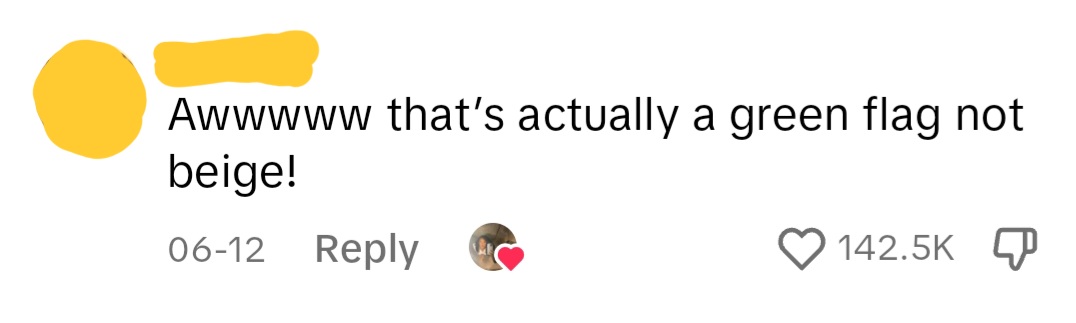
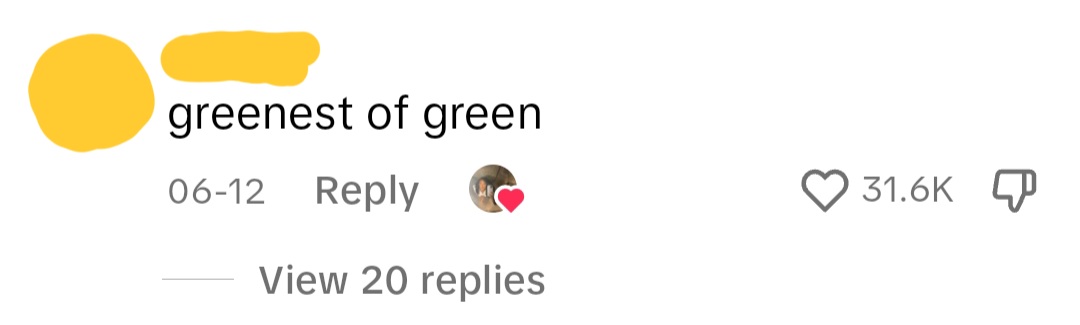
According to the comments sections on TikTok videos for this trend, the public has decided that some of the so-called beige flags are what they would determine as green flags.
One video creator shared this example:
“My fiancé’s beige flag is that he doesn’t like to eat dinner in silence. He will google ‘couples questions’ or ‘relationship quiz’ and ask me the most random yet intimate questions in a room full of people as if we’re in our own world.”
This might be a quirk, but it also shows he wants deep conversation and genuine connection. Several commentators picked up on this, reframing it as a positive rather than a neutral trait.
There is a reason for this. Research on partner idealization finds that people in satisfying relationships consistently see their partner more positively than the partner sees themselves. This generous bias is linked to greater relationship satisfaction, not less (Murray et al., 1996).
Not accuracy, but generosity. A trait first noticed as merely odd can be folded into that generous picture over time. It gets recast as endearing, rather than judged the way a stranger would judge it.
How to deal with beige flags
So, is there anything that can be done about beige flags?
The first step would be to consider whether the trait or behavior is actually a beige flag or a red one.
If it is something that is not negatively affecting the relationship or is turning you off your partner, then there is probably no need to do anything about it!
Identifying beige flags is a fun way to identify your partner’s mildly unusual behaviors and shouldn’t be taken too seriously.
It is important to remember that no one is perfect, and you should have realistic expectations when it comes to relationships. If you are looking for perfection, then you may have to shift your focus.
We should remain wary that we are not losing sight of why we are in a relationship with our partner and be accepting of the differences we have.
However, it is good to remain mindful about your relationships. According to psychologist Carly Dober,
“Signposting what could become future issues early is great in relationships because that way you have options: Do I choose to talk about this with my partner or my friends… or do I just watch and wait?… I can be mindful about where this might lead.”
She goes on to say,
“You really have to decide what is worthwhile to you. What kind of relationship you want. What you can overlook and what you are happy just to accept. Not like. Not love. But accept.”
Talking to my partner about beige flags
Dober suggests that you could talk about beige flags with your partner in a lighthearted way.
You could say that you have seen a lot about beige flags on social media, and it got you reflecting on your own beige flags. You could ask your partner what they think your beige flags are, and you can share what you think theirs are.
As long as feelings are not getting hurt and it does not lead to picking each other apart, this can be a healthy way of reflecting on your relationship. Your partner might even find it sweet that you pick up on some of their quirks.
You could finish the discussion by identifying each other’s green flags to end on a positive note.
When it comes to beige flags, acceptance and open communication about our differences contribute to a healthy and fulfilling relationship.
The Psychology and Limits of Beige Flags
“Beige flag” has no research literature of its own. No study has asked what people spontaneously call a beige flag, the way researchers have studied red flags.
But the underlying pattern connects to psychology that is well studied. Two ideas explain why a partner’s quirk gets read the way it does.
Idiosyncrasy Credit
Psychologist Edwin Hollander (1958) proposed that a person builds “credit” with a group by reliably meeting its expectations. That credit can later be spent on breaking those expectations without being penalized.
Trust is the currency here. In a relationship, a partner who has proven caring and trustworthy has banked that credit. An odd habit, like a six-hour timer, reads as a quirk rather than a concern.
A newer or less-trusted partner doing the same thing has no such credit. The identical behavior is more likely to be read warily.
This helps explain why identical quirks land differently. Trust matters. A partner who repeatedly follows through on promises has more room for an odd habit. Something like honking and waving at strangers gets read as charming rather than concerning.
Sentiment Override
This second idea works differently.
Psychologist Robert Weiss (1980) described how a neutral partner behavior gets read through the lens of a relationship’s overall mood, not judged on its own terms. The idea is old. Hawkins, Carrère, and Gottman (2002) confirmed it in real observational data on married couples.
In a positive relationship, an ambiguous behavior tends to get the benefit of the doubt. In a negative one, it reads as more evidence something is wrong. Context decides the reading.
Whether ignoring part of a text gets waved off as a quirk, or read as dismissive, may depend less on the act itself than on the relationship’s overall sentiment.
Hawkins and colleagues studied real married couples over time, rather than relying on lab vignettes. That is part of why sentiment override is considered one of the better-evidenced ideas in relationship psychology.
Not a Scientifically Validated Category
Unlike “red flag,” which has been the subject of a purpose-built empirical study, “beige flag” has no comparable research behind it. The gap is real.
Csajbók, White, and Jonason (2023) asked what specific qualities people associate with a “red flag” partner. Using factor analysis, they identified six replicable dimensions: being gross, addicted, clingy, promiscuous, apathetic, and unmotivated.
The gap is well documented.
No equivalent study exists for “beige flag.” It remains genuinely unknown whether the label has any comparable structure, or whether it is simply whatever is left over once red and green have been assigned.
This matters practically too. No large study has asked people what they mean by “beige flag.” Every example here, including the TikTok quotes above, reflects informal social-media consensus, not anything psychologists have measured.
Who Gets Labeled a Beige Flag?
Most viral beige flag, red flag, and green flag content is produced by, and about, heterosexual women narrating men’s traits.
A woman filming her boyfriend’s “beige flag” for an audience is a different social act than the reverse would be, with a different power dynamic. The imbalance is worth noticing.
This pattern says as much about who narrates whom in modern dating culture as it does about partner psychology, and it is worth naming rather than absorbing uncritically.
This mirrors a pattern already documented for “red flags.” The popular genre there skews heavily toward women publicly cataloguing men’s flaws. That does not make the traits described inaccurate. It does mean the trend’s framing is not gender-neutral, and worth noticing as such.
Where the Trend Comes From
This vocabulary spreads mainly through short-form social video, not clinical sources. That matters. It is worth checking that medium’s accuracy directly.
A large study of psychiatric- and mental-health-themed TikTok content found substantial rates of disinformation in exactly this kind of relationship-diagnosis content, disproportionately from non-professional creators (Hudon et al., 2025).
That is not proof beige flag itself is untrue. It is too informal a label for that. But a claim resting only on unverified social media content is weaker evidence than a properly designed study.
This is a media-literacy point, not a claim that beige flags are untrue. It simply means checking a creator’s credentials before treating a TikTok relationship diagnosis as expert advice, especially on anything more serious than a lighthearted quirk.
References
Csajbók, Z., White, K. P., & Jonason, P. K. (2023). Six “red flags” in relationships: From being dangerous to gross and being apathetic to unmotivated. Personality and Individual Differences, 204, Article 112048. https://doi.org/10.1016/j.paid.2022.112048
Dober, C. (2023, July 26). Everything to know about relationship beige flags. [Audio podcast episode]. In Extra Healthy-ish.
Hawkins, M. W., Carrère, S., & Gottman, J. M. (2002). Marital sentiment override: Does it influence couples’ perceptions? Journal of Marriage and Family, 64(1), 193-201. https://doi.org/10.1111/j.1741-3737.2002.00193.x
Hollander, E. P. (1958). Conformity, status, and idiosyncrasy credit. Psychological Review, 65(2), 117-127.
Hudon, A., Perry, K., Plate, A.-S., Doucet, A., Ducharme, L., Djona, O., Testart Aguirre, C., & Evoy, G. (2025). Navigating the maze of social media disinformation on psychiatric illness and charting paths to reliable information for mental health professionals: Observational study of TikTok videos. Journal of Medical Internet Research, 27, Article e64225. https://doi.org/10.2196/64225
Murray, S. L., Holmes, J. G., & Griffin, D. W. (1996). The benefits of positive illusions: Idealization and the construction of satisfaction in close relationships. Journal of Personality and Social Psychology, 70(1), 79-98. https://doi.org/10.1037/0022-3514.70.1.79
Travers, M. (2023). 2 relationship “beige flags” to watch for. Psychology Today, “Social Instincts” blog. https://www.psychologytoday.com/us/blog/social-instincts/202310/2-relationship-beige-flags-to-watch-for
Weiss, R. L. (1980). Strategic behavioral marital therapy: Toward a model for assessment and intervention. In J. P. Vincent (Ed.), Advances in family intervention, assessment and theory (Vol. 1, pp. 229-271). JAI Press.