Heteronormativity is the belief that being heterosexual or being attracted to the opposite sex, is the natural and accepted sexual orientation (it is predicated on the gender binary).
Heteronormativity is the overall assumption that everyone is straight, built on the idea that there are only two genders. It assumes that romantic and sexual relationships are always between one man and one woman. That assumption does not reflect reality, because gender exists on a spectrum.
Heteronormativity treats heterosexuality as the “default” sexual orientation. This erases other sexual identities and can lead people to misgender someone, such as using the wrong pronouns.
The harm to LGBTQ+ people includes reduced human rights protections and less funding for the communities and services that support them.
Heteronormativity fortifies transphobia and homophobia by assuming everyone should be straight and cisgender. Transphobia means prejudice against transgender people. Homophobia means intolerance of people attracted to the same gender.
Psychologically, heteronormativity works less like a single belief and more like an ideology: a largely invisible system of assumptions about what a culture treats as normal. It operates at three levels at once.
- Interpersonal: one person assuming a new colleague has a husband, not a wife.
- Institutional: a hospital form offering only two sex options and a “husband/wife” field.
- Cultural: romantic comedies, school sex education, and marriage law that quietly script heterosexuality as the default.
This three-level structure is why researchers distinguish heteronormativity from simple, individual homophobia. A person can hold no conscious anti-gay attitude at all. They can still take part in heteronormativity, simply by assuming a teenage boy has a girlfriend.
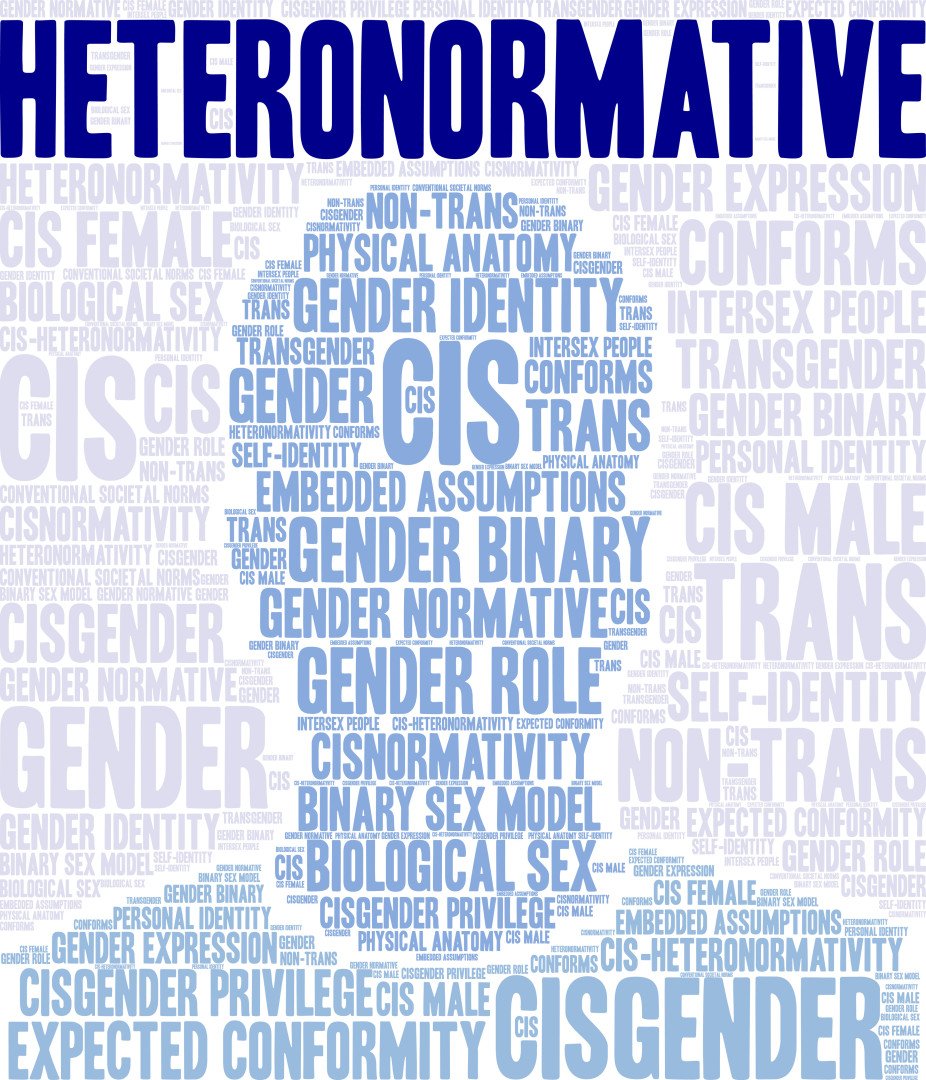
Key Definitions:
Sex is the biological and physical characteristics typically associated with men and women. Sex has a natural component, but its implications and attributes are also socially constructed. People whose anatomy is not typical for males or females are intersex.
Gender refers to the social norms tied to each sex. It is society’s rulebook for acting “like a man” or “like a woman.”
Gender binary is the heteronormative way of defining people as either men or women. It carries a full set of male and female expectations.
Gender expression is the way people show their experience of gender to the world. Heteronormative expectations around gender expression are common. Women are generally expected to wear makeup, and men are not expected to wear skirts.
Sexual orientation is a person’s sexual and romantic preference for a particular gender or genders. People can be straight, gay, lesbian, or bisexual, but heteronormativity treats heterosexuality as the only proper orientation.
Key Takeaways
- Default Assumption: Heteronormativity treats being straight and cisgender as the natural, unquestioned default, built on the idea that there are only two genders.
- Institutional Reach: It shows up in institutions and culture, not just personal prejudice, for example a hospital form with only two sex options.
- Origins: The term was popularized by Michael Warner in 1991, building on Adrienne Rich’s 1980 concept of “compulsory heterosexuality.”
- Real Harms: It is linked to discrimination, bullying, and worse mental health outcomes for LGBTQ+ people, including higher rates of depression and anxiety.
- Contested Mechanism: A 2026 twin-study meta-analysis questions how much of this mental health gap is caused by stigma versus shared family background.
- Everyday Fix: Asking someone for their pronouns, rather than assuming them, is a simple way to avoid heteronormative assumptions.
Origins and History
To understand the origins of heteronormativity, one must first understand the history of sexuality. It is tempting and widespread for people to believe that heterosexuality has always been the standard as it is now understood.
On the contrary, there has been a mixture of constructions of normative sexuality throughout history and in different cultures.
For instance, in medieval Europe and modern Catholicism, the singular acceptable expression of sexuality is between a married man and woman with the distinct purpose of conceiving a child. Any other form of sexual articulation was considered equally deviant and inappropriate, even if it was heterosexual.
The word “heterosexual” itself did not develop its current definition until 1934. Before this, it was defined as a dreadful sexual desire for one of the opposite sex rather than normative sexuality.
Heteronormativity existed long before these terms were defined. It conquered the storytelling and imagery of the man-and-woman relationship and the nuclear family.
Specific expectations and norms around sexuality have always existed. But those norms shift over time. The term “heteronormativity” itself became prevalent in the 1990s, used to critique society’s rigid sexual and gendered expectations.
Michael Warner popularized the term in 1991. He was a queer literary and social theorist. His work drew on Adrienne Rich’s 1980 essay, “Compulsory Heterosexuality and Lesbian Existence.” LGBTQ+ activists and theorists were the first to name heteronormativity as a distinct, describable force.
Rich’s “Compulsory Heterosexuality”
Rich’s essay is the direct conceptual ancestor of “heteronormativity.” It remains one of the most cited pieces of feminist theory of the twentieth century.
Her core argument was that heterosexuality is not simply a private preference most women happen to have. It is a political institution, she argued, enforced through specific, nameable mechanisms.
Rich catalogued these mechanisms across history and culture:
- the economic dependence of women on men
- the idealization of romantic heterosexual love in literature and film
- restrictions on women’s ability to earn a living or own property independently
- the pathologizing of lesbianism as a psychiatric abnormality
- outright violence against women who did not comply
These forces operate from childhood onward. Rich argued they turn heterosexuality into a “compulsory” arrangement rather than a free choice. Most people never consciously examine it, because every institution around them treats it as simply how things are.
Rich’s essay predates the word “heteronormativity” itself. It supplies the theory’s central move regardless: treating heterosexuality’s “natural” status as something manufactured and maintained, not a neutral biological fact.
Theoretical Foundations
Much of the psychological weight behind heteronormativity theory comes from philosopher Judith Butler’s account of gender as performative. Butler set this out in two books: Gender Trouble (1990) and Bodies That Matter (1993).
On this view, being a man, a woman, or being straight is not simply an inner fact a person expresses outwardly. It is something continually done.
Small, repeated acts build this up: how someone dresses, moves, or speaks. Together they produce the appearance of a stable, natural identity.
Butler argued these performances only make sense to other people for one reason. They draw on a shared background: a “matrix of intelligibility.” This is the set of norms about which combinations of body, gender, and desire count as coherent, and which do not.
A person assigned male at birth who grows up to desire men and identify as a woman is not “failing” to be normal. They are simply falling outside the matrix. A heteronormative culture built that matrix for recognizing people at all.
This is why gender-nonconforming and same-sex-attracted people so often report something more basic than disapproval. They report feeling invisible.
This theoretical move changes how heteronormativity is studied. Rather than asking only why some individuals hold anti-gay attitudes, queer theory asks a different question.
What background assumptions make heterosexuality the thing that never needs explaining? Every other configuration does need explaining, in this view.
Both questions are studied within psychology, but they call for different evidence. Attitude surveys suit the first. Discourse analysis, institutional ethnography, and interview studies suit the second.
One finding here stands out. Heteronormative assumptions get reproduced even by people actively trying to be inclusive.
The reason is structural. The assumption sits inside the categories themselves, such as a form with a “mother” field and a “father” field, not in any one person’s conscious belief. This is why heteronormativity is described as structural, not purely attitudinal.
Butler’s account matters for the rest of this article too. The specific assumptions heteronormativity makes, covered next, are the concrete, everyday version of the “matrix of intelligibility” that Butler describes at a theoretical level.
Each one is a small piece of the same larger pattern.
Assumptions behind Heteronormativity
Heteronormativity is not one belief. It is a bundle of specific assumptions.
- Only One Way to Have Sex: treating penis-in-vagina intercourse as the only “real” sex.
- Everyone Is Straight: assuming a person’s default orientation is heterosexual unless stated otherwise.
- Someone’s Gender: assuming the gender assigned at birth always matches gender identity.
- Monogamy: treating one exclusive relationship as the only legitimate, superior arrangement.
Assuming There Is Only One Way to Have Sex
For people who adhere to heteronormativity, penis-in-vagina intercourse, also coined PIV, is believed to be the only way to have sexual intercourse.
Obviously, this is false. Individuals can have sex without a penis or a vagina. Sex could involve one or more people who both have penises or one or more people who both have vaginas – it does not have to involve any penetration.
Having what is defined as normal sex is seen as PIV sex, while all other forms of sex are considered “different” or “abnormal” in a heteronormative society.
Assuming Everyone Is Straight
Assuming that someone is straight erases their actual sexual identity.
Telling someone, particularly someone who identifies as bisexual or pansexual, that they are “just going through a phase” is demeaning. It denies the identity outright. That denial feeds into a lack of human rights protections and funding for these communities.
One documented example of this kind of erasure is the U.S. federal government’s refusal to add questions about sexual and gender orientation to the 2020 Census. That survey determines the allocation of federal funding. Excluding people, and denying they exist, has real consequences.
Within heteronormativity, this “default straight” assumption reinforces both transphobia and homophobia. It assumes that being straight and cisgender is the only normal way to be.
Assuming Someone’s Gender
Heteronormativity assumes that the gender assigned to a person at birth is the gender they identify with. Society begins deciding a child’s gender before or immediately after birth, down to the color of their clothes, bedroom, and toys.
Not everyone identifies with the gender associated with their sex assigned at birth. Children are still expected to conform.
Which toys a child is encouraged to play with, for example, often depends on their allocated gender. Parents often reinforce this choice.
A child who diverges from these expectations can cause worry in heteronormative parents. A daughter who wants a short haircut, or a son who wants to wear dresses, are common examples.
This matters. A 2020 study of tens of thousands of LGBTQ young people in the United States found that transgender and nonbinary youth face elevated risk of depression and suicide. Nurturing a child matters regardless of how far their identity strays from heteronormative expectation.
Assuming One is Monogamous
Heteronormative belief treats monogamy, a romantic or sexual relationship with only one person, as the guaranteed, superior arrangement. The idea is that monogamous relationships carry more trust and communication.
By extension, non-monogamous relationships get treated as existing outside the heteronormative ideal. Monogamy itself is not the problem. Treating it as inherently superior to non-monogamous relationships is.
Non-monogamy covers relationship structures beyond the traditional monogamy framework. This includes polyamory, having multiple romantic partners, and open relationships, where partners are also sexually involved with others.
Heteronormativity also tends to treat reproduction as essential. The expectation is that marriage or a long-term relationship should end in children, in a nuclear household with a cisgender, heterosexual mother and father. People who are unmarried, childless, or non-monogamous are frequently viewed as “weird” by those who hold this frame.
The script rarely explains itself. This is the assumption where the “compulsory” framing of heterosexuality is easiest to see directly.
The expectation is not merely that most couples happen to be monogamous, married, and reproductive. Any relationship that fails to follow that script must explain itself, while the script itself never does.
Examples
Many heteronormativity examples impact people daily. Typically, those who are hurt the most by heteronormativity are people who do not conform to the heterosexual ideal, including those who identify as lesbian, gay, bisexual, and transgender.
However, heteronormativity also creates strict rules that can be stifling for heterosexual people and can limit people’s capability to express themselves comfortably. Here are some examples of heteronormativity.
Media Representation
In the past years, there has been a significant push for TV shows, movies, and advertisements to better illustrate how diverse the human population is.
Heteronormativity is apparent in media as default and standard couples are consistently portrayed as straight. The influence and battle that people in the LGBTQ+ community have to be displayed as examples of couples to clarify how predominant heteronormativity is in society.
Queerness As Confusion
When people who identify as part of the LGBTQ+ community come out, they are frequently told that they are simply going through a phase.
People may assume they are not sure of themselves or their sexuality. The idea that it is a phase of having a sexual preference that is not heterosexual is heteronormative because it believes that all people are straight. Anyone who is not is simply confused.
Biological Pronouns
If someone insists on referring to another person based on their biological sex, regardless of how many times one tries to correct them, they display heteronormative beliefs. If you find yourself in this situation and sense this could be a mistake, take some time to fix them.
If you see another person in this situation who is obviously uncomfortable because someone is referring to them in the wrong pronouns, take the time to speak up.
Healthcare Discrimination
Heteronormative culture is displayed when LGBTQ+ individuals face struggles trying to obtain proper healthcare. Gaps in insurance coverage and a shortage of providers equipped to understand their needs are both part of the problem.
A study interviewing LGBTQ+ health professionals themselves found that heteronormative assumptions are woven into the everyday routines of clinical workplaces.
Casual talk assumes a patient or colleague has a husband. Curricula built around a “mom and dad” family model shape how LGBTQ+ patients are treated too (Bizzeth & Beagan, 2023).
One professional put it simply.
“It’s always been just the same question: do you have a boyfriend; do you have a husband; do you have kids?”
Parental Disapproval
Many heteronormative parents who practice transphobia and homophobia would not respond kindly to their kids coming out. They will deny their kids the chance to come out as part of the LGBTQ+ community.
Therefore, their kids will never reveal their true identities to their parents. Related to this, intersex is when a child is born with sexual anatomy that does not fit a female or male. Parents who practice heteronormativity by performing excessive surgery to ensure the newborn is entirely male or female.
Societal Effects
The presumption that heterosexuality is the only natural, standard orientation causes harm along several distinct pathways.
Much of the research explaining why this presumption translates into measurable harm draws on Meyer’s (2003) minority stress theory. It proposes that the mental health gap between LGBTQ+ and heterosexual people is driven by chronic exposure to a hostile social environment.
Discrimination, expectation of rejection, and internalized stigma layer on top of ordinary life stress everyone experiences.
- Lack of Acceptance: family rejection and its downstream effects on housing and mental health.
- Employment Discrimination: unequal pay, firing, and workplace mistreatment.
- Homophobia and Transphobia: media framing that feeds hostile attitudes.
- Bullying and Violence: harassment that can escalate to hate crimes.
Lack of Acceptance
Studies show that about 40 percent of all homeless youth are part of the LGBTQ+ community. Most of them find themselves living on the streets because of nonacceptance from their family members.
The presumption that heterosexuality is the only sexual orientation affects LGBTQ+ kids, causing them to deny who they are and encounter trauma that affects their lives. LGBTQ+ people also lack proper healthcare as the providers discriminate against them based on their sexuality.
Employment Discrimination
Individuals who do not identify as heterosexual are more likely to be fired due to their sexual identity. Regardless of their ability and success, a person who identifies as LGBTQ+ could lose their job if their manager clashes with their sexual identity.
LGBTQ+ people are also not treated equally to heterosexual people. They often get lower salaries, are overworked, and are forced to work night shifts. This discrimination can lead to mental health conditions like anxiety and depression, and substance abuse.
Homophobia and Transphobia
When the media only portrays examples of straight couples, it creates the idea that those who are not heterosexual are abnormal.
Obviously, this is false because LGBTQ+ relationships exist worldwide and are entirely natural. Portraying straight couples only passes the message that it is weird to be attracted to someone other than the opposite sex.
This then plants the seed for homophobic statements and ideas, which can emotionally harm LGBTQ+ people. Homophobia can also lead to scary physical violence or assault cases against people who are not heterosexual.
Bullying and Violence
When LGBTQ+ children are bullied, this can cause severe emotional distress. Children have long been taught that being straight is customary. They then pick on peers who display LGBTQ+ behavior, wrongly seen as abnormal, and those peers become targets for bullying. The pattern repeats often.
This can often extend to hate crimes and physical violence against LGBTQ+ individuals. One study showed that about one in five hate crimes committed in the US was due to sexual orientation and identity.
Extreme bullying and violence can lead to several issues (like mental health conditions) and cause significant damage to queer individuals.
Critical Evaluation
Heteronormativity theory is well supported, but the evidence base has real limits worth naming honestly.
- Small, Qualitative Evidence: much of what is known about how heteronormativity feels day to day comes from small, single-context interview studies, which may not generalize.
- Contested Mechanism: the claim that minority stress specifically explains the LGBTQ+ mental health gap is now genuinely disputed, not settled.
- Western-Centric Samples: the theory grew out of mostly American and European sources, and research remains disproportionately conducted in Western, educated, industrialized, rich, and democratic (WEIRD) samples.
- Theory-vs-Ideology Debate: because the theory grew from activist scholarship, some critics argue it is harder to falsify than a narrower claim like minority stress theory.
Contemporary Research
The most consequential recent development in this literature is not a confirmation of minority stress theory. It is a direct, well-powered challenge to one of its central claims.
- Aim: Meyer (2003) aimed to synthesize prevalence research on mental health disparities between lesbian, gay, and bisexual (LGB) and heterosexual people, and to propose a model explaining that gap.
- Method: The paper reviewed and meta-analyzed published prevalence studies of depression, anxiety, and other outcomes, distinguishing distal stressors (discrimination, violence) from proximal stressors (expectation of rejection, concealment, internalized stigma).
- Results: LGB populations showed consistently higher rates of depression, anxiety, and substance-use disorders than heterosexual comparison groups, a gap Meyer argued could not be explained by chance alone.
- Conclusion: Minority stress, a specific and in-principle modifiable set of social stress processes, better explained the gap than any account locating the cause within LGB identity itself.
A much larger, more recent study has directly tested how much of this gap survives once shared family background is statistically controlled.
- Aim: Ujma, Haltigan, and Bailey (2026) tested how much of the mental health disparity between heterosexual and non-heterosexual people could instead be explained by shared genetic and family factors.
- Method: The researchers identified 17 twin and sibling studies reporting sexual orientation and mental health, comparing population-level differences against differences within family members, including discordant identical twins.
- Results: The population-level disparity shrank by roughly 48% once compared within family members generally, and by close to two-thirds when restricted to identical twin pairs.
- Conclusion: Shared familial factors, not exposure to minority stress, account for most of the disparity, directly challenging minority stress theory’s central causal claim.
This is a newly published, closely contested finding, not settled consensus. It has its own limits, including a relatively small pool of 17 available studies and reliance on self-reported orientation and mental health.
It does not disprove that heteronormativity causes harm. It challenges how much of one specific gap minority stress alone explains.
Real-World Applications
Education and School Climate
Heteronormative assumptions are woven into school life well before adolescence. Curricula default to depicting heterosexual families, sex education assumes a heterosexual audience, and peer culture polices gender presentation that falls outside expectations.
GLSEN, the Gay, Lesbian & Straight Education Network, has run large-scale school-climate surveys for years. They repeatedly find that LGBTQ+ students at schools with inclusive curricula, supportive staff, and enforced anti-bullying policies report lower rates of victimization (Kosciw et al., 2020). They also report better attendance and psychological wellbeing.
This is a direct, applied test of a broader claim: changing an institution’s default changes outcomes, not just disciplining individual bullies.
Practically, this finding has informed school-based interventions such as staff training on inclusive language, gender-neutral facilities, and Gay-Straight Alliance clubs.
Clinical Psychology and Family Therapy
Family and couples therapy has historically been built around a heterosexual, nuclear-family template, in its theoretical models, its standard intake forms, and its language of “husband and wife.”
Harvey, Fish, and Levatino (2020) argue this has real consequences. It can lead therapists to unconsciously pathologize non-heterosexual relationship structures.
It can also mean missing family dynamics specific to LGBTQ+ clients, such as chosen family, or the effect of a client’s own coming-out process on other relationships.
They outline an affirmative clinical approach instead. Family structure, gender, and sexuality are treated as open questions to explore with each client, not assumed in advance. Concrete practice changes follow, such as intake forms that do not presume a client’s family structure or a partner’s gender.
Workplace and Healthcare Inclusion
Workplace culture is a further site where heteronormativity operates through routine interactions rather than overt discrimination. Bizzeth and Beagan’s (2023) interview study of LGBTQ+ health professionals found that ordinary workplace chit-chat repeatedly forced participants to make a choice.
They could correct a colleague’s assumption, let it pass, or conceal their identity. Each option carried its own cost.
Organizational-inclusion practice now targets this directly. Gender-neutral language in official communications, visible allyship signals, and non-discrimination policies that explicitly name sexual orientation and gender identity are common responses.
Clinical training programs show the same shift. Providers increasingly learn to avoid assuming a patient’s sexual orientation, gender identity, or family structure when taking a history.
Asking open questions, such as “tell me about your partner,” replaces closed, heteronormative ones like “do you have a boyfriend?” It is the same underlying insight applied to healthcare: routine assumptions cause as much harm as deliberate hostility.
Combating Heteronormativity
Heteronormativity is a significant driving force in our culture. As we can see, though, it’s a highly problematic one that harms all people who are not straight.
Because heteronormativity functions on the assumption that everyone is straight, the most positive thing one can do not to harm others it is not to assume things about others.
It is a challenging job to help each heteronormative person to alter their beliefs. Along with spreading awareness about LGBTQ+ and the various gender and sexual preferences, one must know how to combat heteronormativity.
When one meets someone new, ask for their pronouns rather than using the pronouns one would assume they use.
A simple habit helps here. If one decides to ask about someone’s romantic life, one can ask whether they have a partner. This avoids assuming a girlfriend or boyfriend by default. One should also tell people how one identifies, rather than making them guess.
These simple gestures make people feel welcomed instead of harassed. Heteronormativity may be a firm ideology, but it is an old-fashioned one that causes damage. Little actions on everyone’s part help us achieve an equal society.
What Relationship Therapists See
Heteronormative scripts strain straight relationships too. As licensed marriage and family therapist Esther Perel explains, the common way of talking about male sexual difficulty is itself heteronormative.
She describes it as treating sex as a “performance” problem to be solved, following “this one predictable heteronormative way that we are all taught.”
According to Perel, naming a difficulty openly changes the dynamic. It works better than treating the difficulty as a performance failure to fix.
Perel has also observed that heteronormative assumptions about fixed gender roles shape how couples divide labor by default. She notes that a same-sex couple faces “a different negotiation” over these roles, because it cannot fall back on a traditional gendered default. The lesson generalizes beyond one couple.
Here is a summarized list of what you can do to stop heteronormativity:
-
Always ask about people’s preferred pronouns.
-
Do not rely on assumptions. When in doubt, ask politely.
-
Make sure one expresses one’s identity clearly.
-
Use gender-neutral terms.
References
Battle, J., & Ashley, C. (2008). Intersectionality, heteronormativity, and Black lesbian, gay, bisexual, and transgender (LGBT) families. Black Women, Gender & Families, 2 (1), 1-24.
Bizzeth, S. R., & Beagan, B. L. (2023). “Ah, it’s best not to mention that here”: Experiences of LGBTQ+ health professionals in (heteronormative) workplaces in Canada. Frontiers in Sociology, 8, 1138628. https://doi.org/10.3389/fsoc.2023.1138628
Butler, J. (1990). Gender trouble: Feminism and the subversion of identity. Routledge.
Butler, J. (1993). Bodies that matter: On the discursive limits of “sex.” Routledge.
Dent Jr, G. W. (2010). Straight is better: why law and society may justly prefer heterosexuality. Tex. Rev. L. & Pol., 15, 359.
Harvey, R., Fish, L. S., & Levatino, P. (2020). Sexual identity development and heteronormativity. In K. S. Wampler & L. M. Blow (Eds.), The handbook of systemic family therapy (Vol. 3). Wiley. https://doi.org/10.1002/9781119438519.ch55
Herek, G. M. (2000). The psychology of sexual prejudice. Current Directions in Psychological Science, 9(1), 19-22. https://doi.org/10.1111/1467-8721.00051
Herek, G. M. (2007). Confronting sexual stigma and prejudice: Theory and practice. Journal of Social Issues, 63(4), 905-925. https://doi.org/10.1111/j.1540-4560.2007.00544.x
Hubbard, P. (2008). Here, there, everywhere: The ubiquitous geographies of heteronormativity. Geography Compass, 2 (3), 640-658.
Kosciw, J. G., Clark, C. M., Truong, N. L., & Zongrone, A. D. (2020). The 2019 national school climate survey: The experiences of LGBTQ youth in our nation’s schools. GLSEN.
Meyer, I. H. (2003). Prejudice, social stress, and mental health in lesbian, gay, and bisexual populations: Conceptual issues and research evidence. Psychological Bulletin, 129(5), 674-697. https://doi.org/10.1037/0033-2909.129.5.674
Nielsen, J. M., Walden, G., & Kunkel, C. A. (2000). Gendered heteronormativity: Emprical illustrations in everyday life. Sociological quarterly, 41 (2), 283-296.
Rich, A. (1980). Compulsory heterosexuality and lesbian existence. Signs: Journal of Women in Culture and Society, 5(4), 631-660. https://doi.org/10.1086/493756
Ujma, P. P., Haltigan, J. D., & Bailey, J. M. (2026). How much is sexual minority stress confounded with familial causes? A systematic multilevel meta-analysis. Psychological Medicine, 56, e105546. https://doi.org/10.1017/S0033291726105546
Ward, J., & Schneider, B. (2009). The reaches of heteronormativity: An introduction. Gender & Society, 23 (4), 433-439.
Warner, M. (1991). Introduction: Fear of a queer planet. Social text, 3-17.
Warner, M. (Ed.). (1993). Fear of a queer planet: Queer politics and social theory (Vol. 6). U of Minnesota Press.


