At the very heart of cognitive psychology is the idea of information processing.
Information processing theory is a framework that views the human mind as a complex system through which information flows, much like a digital computer.
Computer-Mind Analogy
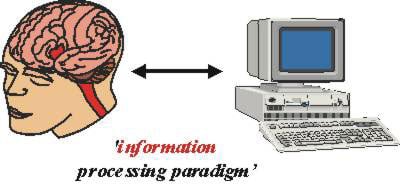
The development of the computer in the 1950s and 1960s had a profound influence on psychology.
It provided cognitive psychologists with a compelling metaphor for human mental processing and was instrumental in establishing the cognitive approach as the dominant paradigm in modern psychology.
The analogy works as follows: a computer receives input, encodes that input into a usable format, stores and manipulates the resulting information, and produces an output.
Cognitive psychologists proposed that the human mind operates in structurally similar ways.
In this framework, the brain corresponds to the computer’s physical hardware, while the mind and its internal processes function as the software.
Cognitive psychologists working within this tradition treat humans as active processors who take in symbolic input, recode it, make decisions, store the results, and translate these internal states into behavioural outputs.
The model is built on several interlocking theoretical principles:
- Coding: Sensory input from the environment is translated into a usable mental format, much as a telecommunications system converts a voice signal into an electromagnetic code. The eye, for instance, receives visual information and converts it into electrical neural activity, which is then transmitted to the brain for further processing.
- Channel capacity: The human information-processing system has finite limits. At any given moment, only so much information can be held and processed, a constraint that bears directly on attention and short-term memory.
- Serial and parallel processing: Information can be processed sequentially, one operation at a time, or simultaneously across multiple cognitive processes running in parallel.
- Storage and retrieval: Like a computer’s memory, the mind stores encoded information and can retrieve and transform it as needed, drawing on mental processes such as memory, perception, and attention to produce a behavioural output.
The influence of this approach has extended well beyond its origins.
Cognitive psychology has influenced and integrated with many other approaches and areas of study to produce, for example, social learning theory, cognitive neuropsychology, and artificial intelligence (AI).
Theoretical Models
Mental processes, though unobservable, can be modelled precisely using flowcharts and box-and-arrow diagrams, to infer and represent how information passes between different systems.
These models generate specific, testable predictions evaluated through controlled experiments, computational simulations, and neuroimaging.
The information processing model of memory consists of a series of stages, or boxes, representing stages of processing. Arrows indicate the flow of information from one stage to the next.
- Input processes are concerned with the analysis of the stimuli.
- Storage processes cover everything that happens to stimuli internally in the brain and can include coding and manipulation of the stimuli.
- Output processes are responsible for preparing an appropriate response to a stimulus.
A quintessential example of an information-processing model is the multi-store model of memory proposed by Atkinson and Shiffrin in 1968.

This model suggests information flows sequentially from sensory stores, into a limited-capacity short-term store via attention, and eventually into a practically unlimited long-term store via rehearsal.
Another prominent example is Donald Broadbent’s filter model of selective attention, which uses the concept of an information buffer to explain how the brain tunes out competing stimuli to prevent information overload, representing the mind as a limited-capacity channel.
Broadbent’s Filter Theory (1958), inspired by the demands placed on air traffic controllers, proposed that attention operates as a bottleneck. Incoming sensory information is briefly held in a buffer, after which a selective filter passes only one channel to the central processor, selected on the basis of physical characteristics such as pitch or location. All other information is discarded entirely.

Serial & Parallel Processing
- Serial processing is a cognitive operation in which each process must complete before the next can begin.
- Parallel processing describes a mechanism in which two or more cognitive processes occur simultaneously.
The distinction between these two modes is foundational to cognitive psychology, with implications for how we learn, how attention operates, and how the brain is physically organised.
Computer Analogy and Brain Architecture
The traditional information-processing approach initially assumed that human cognition was primarily serial, an assumption shaped by early computers, which were capable of performing only one operation at a time in a strict linear sequence.
Modern cognitive science has revised this picture considerably.
The human brain is composed of billions of interconnected neurons and operates as a massively parallel structure, distributing operations across multiple systems simultaneously.
Functional neuroimaging data now indicates that parallel processing in the brain is the rule rather than the exception.
Controlled and Automatic Processing
How much a task relies on serial or parallel processing depends largely on how practised the individual is at performing it.
- Serial processing is associated with controlled processes: slow, deliberate, capacity-limited operations that proceed one step at a time and demand conscious attention.
- Parallel processing is associated with automatic processes: fast, simultaneous operations that place little or no demand on attentional resources and run largely outside conscious awareness.
A learner driver illustrates this clearly.
Because steering, gear changes, and monitoring surrounding traffic each require deliberate attention, they cannot easily be performed at the same time, forcing a serial, step-by-step approach.
An experienced driver, by contrast, performs all of these tasks in parallel, managing them seamlessly without conscious effort.
System 1 and System 2 Thinking
This distinction maps onto dual-process models of reasoning and judgement.
System 1 is fast, intuitive, and automatic, operating in parallel without deliberate effort.
System 2 is slower, analytical, and rule-governed, proceeding serially and demanding conscious engagement.
Most everyday cognition involves an interaction between the two, with System 1 handling routine processing and System 2 recruited when tasks exceed automatic capacity.
Bottlenecks and Limitations
Despite the brain’s capacity for parallel processing, multitasking has clear limits.
Research on the psychological refractory period demonstrates that while early sensory and perceptual processing of two simultaneous tasks can overlap, a central bottleneck emerges at the stage of response selection.
When the brain must decide how to respond to incoming stimuli, processing becomes serial regardless of how much parallelism preceded it. Parallel processing, in other words, does not extend indefinitely through the cognitive system.
Applications in Perception and Speech
The interplay between serial and parallel processing has been studied extensively across specific cognitive domains.
In visual perception, the system relies heavily on parallel processing: depth is computed from two parallel streams of input from each eye, while separate neural channels simultaneously handle fine detail, contrast, and colour.
Critical Evaluation
1. The information processing models assume serial processing of stimulus inputs.
- Serial processing effectively means one process has to be completed before the next starts.
- Parallel processing assumes some or all processes involved in a cognitive task(s) occur at the same time.
There is evidence from dual-task experiments that parallel processing is possible.
It is difficult to determine whether a particular task is processed in a serial or parallel fashion as it probably depends (a) on the processes required to solve a task and (b) the amount of practice on a task.
Parallel processing is probably more frequent when someone is highly skilled; for example, a skilled typist thinks several letters ahead, while a novice focuses on just one letter at a time.
2. The analogy between human cognition and computer functioning adopted by the information processing approach is limited.
Computers can be regarded as information processing systems insofar as they:
- Combine information presented with the stored information to provide solutions to a variety of problems, and
- Most computers have a central processor of limited capacity, and it is usually assumed that capacity limitations affect the human attentional system.
However:
- The human brain has the capacity for extensive parallel processing, and computers often rely on serial processing.
- Humans are influenced in their cognitions by a number of conflicting emotional and motivational factors.
- Computers manipulate formal symbols based on algorithms and syntax but possess no inherent understanding or meaning of those symbols.
- Unlike computers, human brains are open, highly plastic biological systems that constantly physically adapt in response to their environment and social world, effectively re-creating memories and structures rather than simply pulling static files from a hard drive.
- The computer metaphor operates on the assumption of rationality in information processing. However, humans frequently make systematic, predictable mistakes due to cognitive biases and heuristics.
3. The evidence for the theories/models of attention that come under the information processing approach is largely based on experiments under controlled, scientific conditions.
Most laboratory studies are artificial and could be said to lack ecological validity.
In everyday life, cognitive processes are often linked to a goal (e.g., you pay attention in class because you want to pass the examination), whereas in the laboratory, the experiments are carried out in isolation from other cognitive and motivational factors.
Although these laboratory experiments are easy to interpret, the data may not apply to the real world outside the laboratory.
More recently, ecologically valid approaches to cognition have been proposed (e.g., the Perceptual Cycle, Neisser, 1976).
Attention has been studied largely in isolation from other cognitive processes, although clearly, it operates as an interdependent system with the related cognitive processes of perception and memory.
The more successful we become at examining part of the cognitive system in isolation, the less our data are likely to tell us about cognition in everyday life.
4. Oversimplification of processing dynamics
Early information-processing models were highly inflexible, assuming that human cognition was strictly a bottom-up, serial process where information flows step-by-step from one distinct stage to the next.
Modern cognitive science recognizes that this is a gross oversimplification.
Human cognition heavily relies on top-down processing, where an individual’s prior knowledge, expectations, and context continuously influence and alter perception and memory.

How did you read the text in the triangle above?
Expectation (top-down processing) often overrides information actually available in the stimulus (bottom-up), which we are, supposedly, attending to.
Additionally, the human brain contains billions of interconnected neurons that operate via massively parallel processing (carrying out multiple cognitive operations simultaneously), contradicting the rigid serial assumptions of early computer models.
References
Broadbent, D. (1958). Perception and Communication. London: Pergamon Press.
Deutsch, J. A., & Deutsch, D. (1963). Attention: Some Theoretical Considerations. Psychological Review, 70, 80–90.
Neisser, U. (1967). Cognitive Psychology. New York: Appleton-Century-Crofts.
Treisman, A. (1964). Selective attention in man. British Medical Bulletin, 20, 12–16.