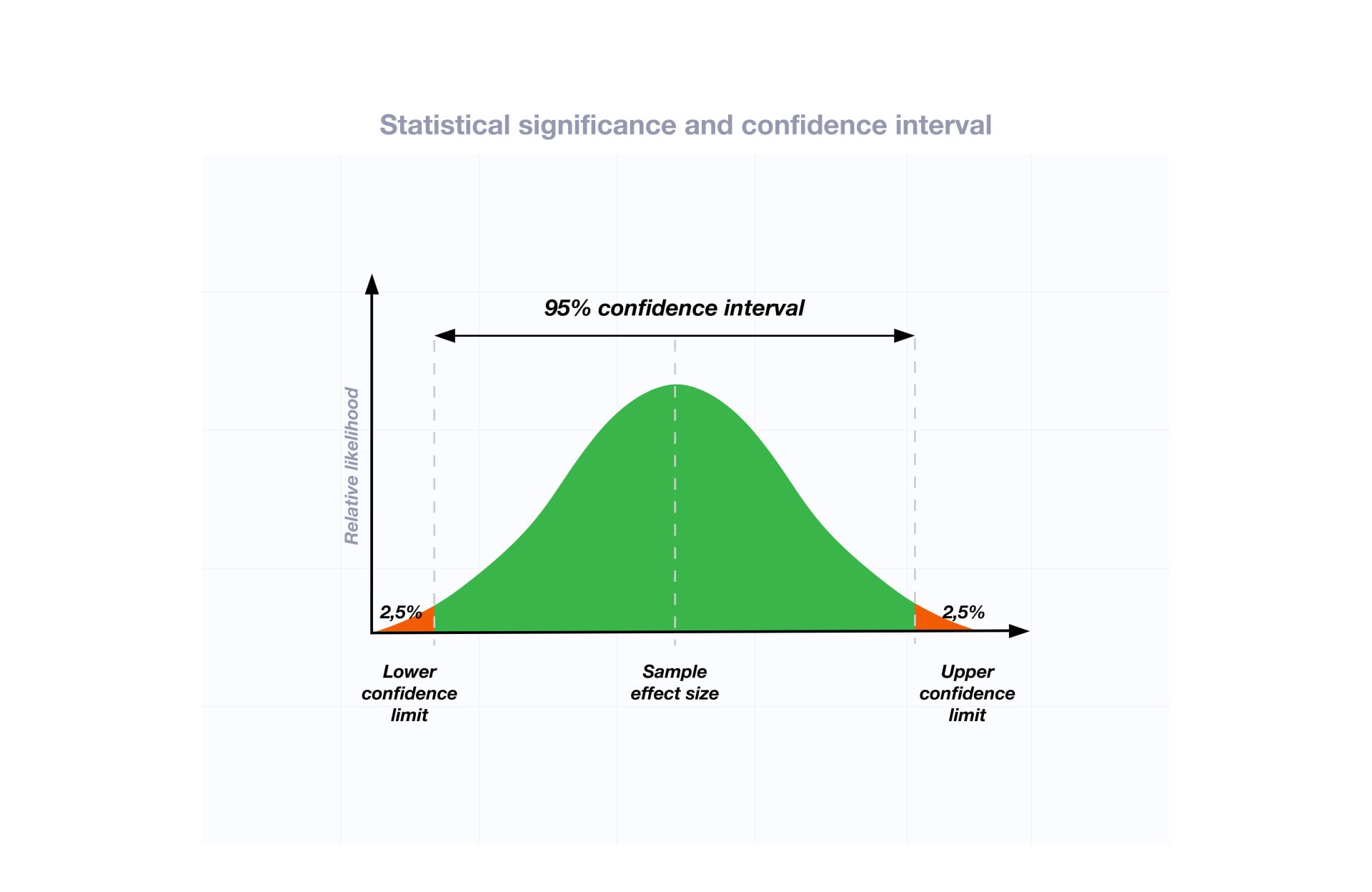
The confidence interval (CI) is a range of values that’s likely to include a population value with a certain degree of confidence. It is often expressed as a % whereby a population mean lies between an upper and lower interval.

Why use confidence intervals?
A confidence interval (CI) is a range of values that likely contains a true population mean.
A confidence interval is essentially a “safety net” built around a sample result to account for uncertainty.
Because researchers rarely test every single person in a population, they use samples (small representative groups).
The sample mean (the average score of your small group) is rarely exactly the same as the true population mean.
To address this, we create a range of values. This range gives us a more realistic picture of where the actual population average likely sits.
What is a 95% confidence interval?
A 95% confidence interval (CI) is a statement about the reliability of a statistical procedure rather than a probability for a specific calculated range.
In frequentist statistics, the true population parameter is fixed.
Therefore, it is technically incorrect to interpret a specific interval as having a 95% probability of containing the true value.
Instead, the “95%” refers to the long-term success rate of the method:
If you were to repeat an experiment infinitely and calculate an interval each time, approximately 95% of those various intervals would capture the true population parameter.
We can visualize this using a normal distribution (see the below graph).

Common mistakes to avoid
CIs describe a procedure, not a specific result.
- Not a Null Test: A CI is not a direct statement about the likelihood of a null hypothesis being true.
- No “95% Probability”: Once calculated, the true mean is either inside or it isn’t; it is incorrect to assign it a probability.
- Not a Data Spread: CIs estimate the population mean, not the range of individual sample scores.
- Not a Predictor: It does not mean 95% of future experiment results will fall into that specific interval.
Correct Definition: If we repeated the experiment over and over, 95% of the resulting intervals would contain the true mean.
How to Calculate
Confidence interval formula

Where:
- X (Sample Mean): The average value calculated from the collected data
- Z (Z-score): A standardized value reflecting the chosen confidence level, such as 1.96 for 95%.
- s (Standard Deviation): A measure of the amount of variation or dispersion in the data set
- n (Sample Size): The total number of individual observations or participants included in the sample
The plus and minus symbols indicate the calculation of both an upper and lower limit.
By subtracting the margin of error, the lower bound is established. Adding the margin of error creates the upper bound.
These two points define the span of the confidence interval.
Step 1: Gather Your Initial Information
Before starting your calculations, you need to identify four key pieces of information from your data:
- Sample Mean (x̄): The average value calculated from your sample.
- Sample Size (n): The total number of items or participants in your sample.
- Standard Deviation: Use the population standard deviation (σ) if it is known. If it is unknown, use the standard error (sample standard deviation).
- Confidence Level (CL): How sure you want to be that the interval contains the true mean (most commonly 95%).
Step 2: Find the Critical Value
Remember, you must calculate an upper and low score for the confidence interval using the z-score for the chosen confidence level (see table below).
The critical value depends on your chosen confidence level and whether you know the population standard deviation.
- If σ is known (use z-score): For a 95% confidence level, the critical z-score is 1.96.
- If σ is unknown (use t-score): You must use the Student’s t-distribution. You will need your Degrees of Freedom (df), which is n – 1. You can find the t-score in a t-table or using a calculator.
| Confidence Level | Z-Score |
|---|---|
| 0.90 | 1.645 |
| 0.95 | 1.96 |
| 0.99 | 2.58 |
Step 3: Calculate the Error Bound (Margin of Error)
The Error Bound for a Population Mean (EBM) tells you how far the true mean is likely to be from your sample mean.
- Formula when σ is known: EBM = z * (σ / sqrt(n))
- Formula when σ is unknown: EBM = t * (s / sqrt(n))
Step 4: Construct the Interval
To find your final range, subtract the EBM from the sample mean for the lower bound and add it for the upper bound.
- Lower Limit: x̄ – EBM
- Upper Limit: x̄ + EBM
Final Result Format: (Lower Limit, Upper Limit)
Example Calculation
Suppose a researcher wants to estimate the mean score on a statistics exam.
They take a random sample of 36 scores and find a sample mean of 68. It is known that the population standard deviation (σ) is 3 points.
Step 1: Identify Your Key Statistics
- Sample Mean (x̄) = 68
- Sample Size (n) = 36
- Population Standard Deviation (σ) = 3
- Confidence Level (CL) = 95% (0.95)
Step 2: Choose the Distribution
Because the population standard deviation (σ) is known, we use the Normal (z) Distribution.
Step 3: Determine the Critical Value
For a 95% confidence level, the area in the tails (α) is 0.05 (1 – 0.95). This area is split between two tails, leaving 0.025 in each.
- The critical z-score for 95% confidence is 1.96.
Step 4: Calculate the Margin of Error (EBM)
Using the formula: EBM = z * (σ / sqrt(n))
- Find the square root of n:
sqrt(36) = 6 - Divide σ by the result:
3 / 6 = 0.5 - Multiply by the z-score:
1.96 * 0.5 = 0.98
- Margin of Error (EBM) = 0.98
Step 5: Construct the Interval
- Lower Bound:
x̄ - EBM=68 - 0.98 = 67.02 - Upper Bound:
x̄ + EBM=68 + 0.98 = 68.98
Final Result Format: (67.02, 68.98)
Step 6: Interpretation
“We estimate with 95% confidence that the true population mean statistics exam score is between 67.02 and 68.98”.
Interpretation
We can be confident that the population mean is similar to the sample mean when the confidence interval is narrow.
The narrower the interval (upper and lower values), the more precise our estimate is.
As a general rule, as the sample size increases, the confidence interval should become more narrow.

A narrow interval, typically achieved through a large sample size and low data variability, indicates that the sample mean is likely very close to the true population mean.
| Factor | Change | Effect on CI Width | Impact on Precision |
| Sample Size (n) | Increase | Narrower | Higher |
| Data Variability (SD) | Increase | Wider | Lower |
| Confidence Level (%) | Increase | Wider | Lower (Relative to point estimate) |
What Dynamics Affect the Width of the Interval?
The width of a 95% confidence interval is determined by the margin of error, which is influenced by three primary factors:
1. Sample Size (n)
As the sample size increases, the width of the interval decreases.
Larger samples reduce uncertainty and provide more evidence, which “shrinks” the interval around the point estimate.
- Larger Samples: As n increases, the standard error of the mean decreases. This results in a narrower interval, which indicates a more precise estimate of the population mean.
- Smaller Samples: These have higher sampling variability, leading to wider intervals and less certainty that the sample mean is close to the true population mean.
2. Variation in the Data
The width of the interval is also directly related to the variability (standard deviation) of the measure being studied:
- High Variability: If data points are widely spread, the interval must be wider to capture the true mean with the same level of confidence.
- Low Variability: If the data is concentrated closely around the mean, the resulting confidence interval will be narrower.
3. Confidence Level
The margin of error also changes based on how much “confidence” you require.
- Increasing Confidence (e.g., 99%): To be more certain the interval captures the true parameter, you must include more of the sampling distribution, which makes the interval wider.
- Decreasing Confidence (e.g., 90%): This requires a smaller critical value, making the interval narrower but increasing the risk that it misses the true value.
How to Report
APA style requires you to use square brackets to enclose the confidence limits. You should also clearly state the confidence level (usually 95%).
Standard Template: M = 5.50, 95% CI [4.25, 6.75]
Key Formatting Rules:
- Abbreviation: You can use “CI” after you have defined it once in the text, or just use it directly if it’s inside parentheses.
- No “to” or dashes: Use a comma to separate the upper and lower limits.
- Consistency: Use the same number of decimal places for the limits as you did for the point estimate.
A Small “Heads Up”
While it’s common to see people write “95% CI = [4.25, 6.75]”, the APA manual actually prefers that you don’t use an equals sign before the brackets. Just a space and the brackets will do!
Specific Statistical Examples
- For Correlations: r = .35, 95% CI [.15, .52]
- For Regression: B = 1.20, 95% CI [0.95, 1.45]
- For Proportions: 60%, 95% CI [55%, 65%]
Reporting in Different Contexts
How you report the CI depends on where it sits in your sentence.
1. Inside Parentheses
If the entire statistic is already in parentheses, do not use nested parentheses. Use commas to separate the statistics.
- Example: The effect was significant (d = 0.45, 95% CI [0.12, 0.78]).
2. Within Narrative Text
If you are discussing the results in a sentence, you can be a bit more descriptive.
- Example: The mean score was 25.4, 95% CI [22.1, 28.7], suggesting a moderate increase.
3. In a Table
When reporting multiple CIs in a table, you can use a dedicated column labeled “95% CI” and put the limits in brackets.
| Group | M | SD | 95% CI |
| Control | 12.45 | 1.20 | [11.50, 13.40] |
| Treatment | 15.20 | 1.15 | [14.25, 16.15] |

Further Information
- Hypothesis testing and p-values (Khan Academy)
- Publication manual of the American Psychological Association
- Statistics for Psychology Book Download
Is The confidence interval the same as standard deviation?
No, they’re different. The standard deviation shows how much individual measurements in a group vary from the average. Think of it like how much students’ grades differ from the class average.
A confidence interval, on the other hand, is a range that we’re pretty sure (like 95% sure) contains the true average grade for all classes, based on our class. It’s about our certainty in estimating a true average, not about individual differences.
Does a boxplot show confidence intervals?
A standard box plot displays medians and interquartile ranges, not confidence intervals. However, some enhanced box plots can include confidence intervals around the median or mean, represented by notches or error bars.
While not a traditional feature, adding confidence intervals can give more insight into the data’s reliability of central tendency estimates.
Confidence Interval Practice Problems
- A researcher took a sample of 30 students’ test scores with an average score of 85 and a standard deviation of 5. What is the 95% confidence interval for the test scores?
- A study measures the heights of 50 people, finding an average height of 170 cm with a standard deviation of 10 cm. What is the 99% confidence interval for the population’s height?
- In a sample of 40 light bulbs, the mean lifetime is 5000 hours and the standard deviation is 400 hours. Compute a 90% confidence interval for the average lifetime of the bulbs.
Answers:
- For a 95% confidence interval and a sample size > 30, we typically use a z-score of 1.96. The formula for a confidence interval is (mean – (z* (std_dev/sqrt(n)), mean + (z* (std_dev/sqrt(n)). So, the confidence interval is (85 – (1.96*(5/sqrt(30))), 85 + (1.96*(5/sqrt(30))) = (83.21, 86.79).
- For a 99% confidence interval and a sample size > 30, we typically use a z-score of 2.58. So, the confidence interval is (170 – (2.58*(10/sqrt(50))), 170 + (2.58*(10/sqrt(50))) = (167.35, 172.65).
- For a 90% confidence interval and a sample size > 30, we typically use a z-score of 1.645. So, the confidence interval is (5000 – (1.645*(400/sqrt(40))), 5000 + (1.645*(400/sqrt(40))) = (4870.92, 5129.08).