For decades, autistic individuals have been left out of contributing to research that ultimately impacts them. If you are autistic or love someone who is, you may have felt a deep disconnect between what scientists study in a lab and what actually matters in your daily life.
You might ask yourself: How does knowing the biological cause of autism going to improve my quality of life?
According to leading experts like Dr. Monique Botha and Dr. Damian Milton, the exclusion of autistic people from autism research has caused real harm.
Today, a new wave of researchers (many of whom are autistic themselves) are working to fix these mistakes.
This guide explores the issues with old-fashioned (and oftentimes current!) research and reveals the expert-backed strategies making science more respectful, inclusive, and effective for everyone.
The Dark History: When Research Forgets the Human
Historically, the foundation of autism research viewed the condition through a “medical lens,” treating it like a disease to be cured.
As Dr. Monique Botha explains, this approach often relied on a flawed idea of “objectivity” that hid the personal biases of non-autistic researchers.
By ignoring autistic people as the true experts of their own lives, science created a narrative that was often cold and dehumanizing.
According to Dr. Botha’s work, this exclusion led to “research-based violence.”
In the past, academic papers even compared autistic individuals to machines, robots, or non-human animals. These studies often claimed that autistic people lacked “Theory of Mind” or empathy.
Dr. Botha argues that these narratives didn’t stay in the lab – they moved into the real world, negatively affecting the mental health, safety, and human rights of the autistic community.
Why Traditional Studies Often “Miss the Mark”
One of the biggest problems with a lot of autism research is that it simply isn’t built for the people it studies.
Dr. Christina Nicolaidis, Dr. Dora Raymaker, and the AASPIRE team have found that researchers often used surveys designed for non-autistic people or children.
When these same tools were used on autistic adults, the results were often inaccurate because of vague language or unfair assumptions.
Another major issue is the “Double Empathy Problem,” a concept developed by Dr. Damian Milton. He suggests that communication breakdowns aren’t just an autistic “deficit.”
Instead, they happen because neurotypical researchers and autistic participants have different ways of experiencing the world. Because traditional research ignored this “autistic expertise,” it led to a severe breakdown in trust.
When researchers only talk about autistic people instead of with them, the community naturally feels unheard and misrepresented.
Realigning Priorities: What the Community Actually Needs
There is a massive gap between where the money goes and what autistic people actually need.
Dr. Elizabeth Pellicano points out that most funding for autism research is poured into genetics or the search for causes and cures. However, when you ask autistic adults what they want, the answer is very different.
According to Dr. Pellicano’s research, the community consistently prioritizes:
- Mental health care (addressing high rates of anxiety and depression).
- Day-to-day quality of life.
- Support after a diagnosis.
- Social and workplace accommodations.
By excluding these voices, science has spent years solving problems that the community didn’t ask to have fixed, while ignoring the struggles that make life difficult today.
A New Framework: How to Do Research the Right Way
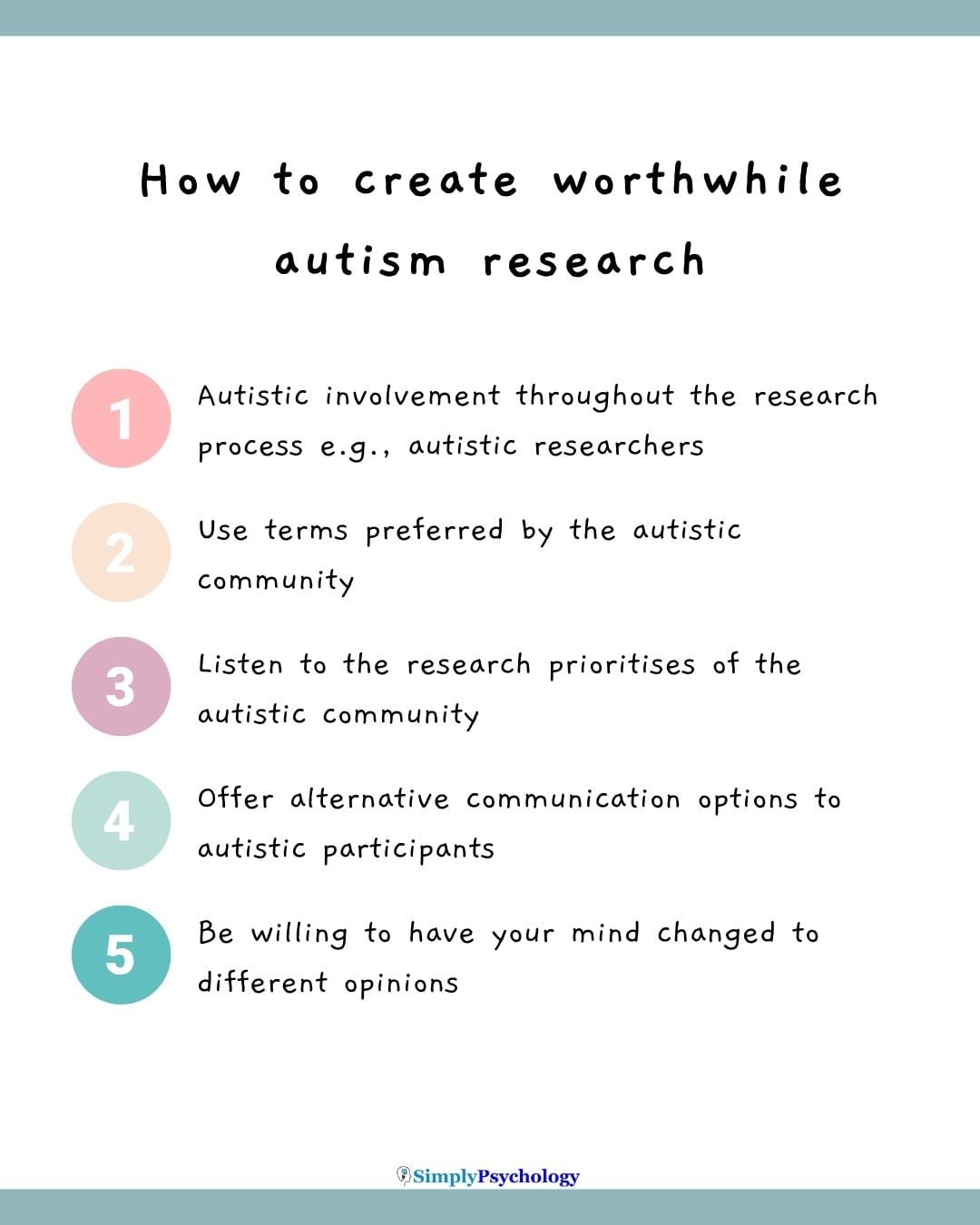
To fix these systemic issues, experts have developed clear frameworks for “neuro-inclusive” research.
Jessica Dark proposes Eight Principles of Neuro-Inclusion, which focus on making research accessible and representative.
She suggests recruiting a diverse range of people, including non-speaking individuals, women, transgender people, and people of color, to ensure no one is left behind.
Dr. Christina Nicolaidis and Dr. Dora Raymaker also recommend a “power-sharing” model called Community-Based Participatory Research (CBPR). This means:
- Sharing Decision-Making: Autistic people should be equal partners on the research team, not just helpers.
- Flexible Communication: Meetings should be offered in different formats, like text-based chats, to make communication easier for everyone.
- Fair Pay: Autistic partners must be paid fairly for their time and expertise, just like any other professional.
Why Language Matters in Science
The words researchers use can either build respect or create more stigma. Dr. Kristen Bottema-Beutel and Dr. Steven Kapp emphasize that researchers must audit their own language to remove “ableist” patterns—ideas that suggest autistic people are “broken” or “lesser.”
They recommend several specific changes:
- Ditch the Labels: Avoid terms like “high-functioning” or “low-functioning,” which are often inaccurate. Instead, describe a person’s specific support needs.
- Identity-First Language: Use “autistic person” rather than “person with autism,” as this is preferred by the majority of the community.
- Change the Focus: Replace patronizing terms like “special interests” with “focused interests.”
Reclaiming the Narrative Through Co-Interviewing
In qualitative research (where scientists interview people about their lives), having a non-autistic person ask all the questions can feel intimidating. Elizabeth Kaplan-Kahn and Reid Caplan recommend using autistic co-interviewers.
Having an autistic researcher in the room can create immediate psychological safety. This allows participants to be more honest and authentic.
Furthermore, autistic researchers may be better at spotting nuances that others might miss, such as “autistic burnout” or “autistic inertia.” This leads to much deeper, more accurate data that reflects the true autistic experience.
Your Next Steps for Neuro-Inclusive Advocacy
The shift toward inclusive research is a journey, and everyone has a part to play. Whether you are a researcher, a student, or a community advocate, you can help push for science that respects and empowers.
Action Checklist for a Better Future:
- Ask the “Human” Question: Does this research describe autistic people as equals, or as “subjects” to be fixed?
- Support Autistic-Led Projects: Look for research that includes autistic authors and uses participatory models.
- Challenge Functioning Labels: Whenever you see “high” or “low” functioning used, ask for more specific descriptions of support needs instead.
- Prioritize Real-World Impact: Advocate for funding that goes toward mental health and quality-of-life support.
- Listen to Lived Experience: Remember that an autistic person is the ultimate expert on their own life.
Research must never come at the cost of your safety or dignity. If you are participating in a study that feels harmful or dehumanizing, you have the absolute right to withdraw at any time.
References
Botha, M. (2021). Academic, activist, or advocate? Angry, entangled, and emerging: A critical reflection on autism knowledge production. Frontiers in psychology, 12, 727542. https://doi.org/10.3389/fpsyg.2021.727542
Bottema-Beutel, K., Kapp, S. K., Lester, J. N., Sasson, N. J., & Hand, B. N. (2021). Avoiding ableist language: Suggestions for autism researchers. Autism in adulthood, 3(1), 18-29. https://doi.org/10.1089/aut.2020.0014
Dark, J. (2024). Eight principles of neuro-inclusion; an autistic perspective on innovating inclusive research methods. Frontiers in psychology, 15, 1326536. https://doi.org/10.3389/fpsyg.2024.1326536
Kaplan-Kahn, E. A., & Caplan, R. (2023). Combating stigma in autism research through centering autistic voices: A co-interview guide for qualitative research. Frontiers in psychiatry, 14, 1248247. https://doi.org/10.3389/fpsyt.2023.1248247
Milton, D. E. (2014). Autistic expertise: A critical reflection on the production of knowledge in autism studies. Autism, 18(7), 794-802. https://doi.org/10.1177/1362361314525281
Nicolaidis, C., Raymaker, D., Kapp, S. K., Baggs, A., Ashkenazy, E., McDonald, K., … & Joyce, A. (2019). The AASPIRE practice-based guidelines for the inclusion of autistic adults in research as co-researchers and study participants. Autism, 23(8), 2007-2019. https://doi.org/10.1177/1362361319830523
Nicolaidis, C., Raymaker, D., Katz, M., Oschwald, M., Goe, R., Leotti, S., … & Powers, L. E. (2015). Community-based participatory research to adapt health measures for use by people with developmental disabilities. Progress in Community Health Partnerships: Research, Education, and Action, 9(2), 157-170.
Pellicano, E., Dinsmore, A., & Charman, T. (2014). What should autism research focus upon? Community views and priorities from the United Kingdom. Autism, 18(7), 756-770. https://doi.org/10.1177/1362361314529627