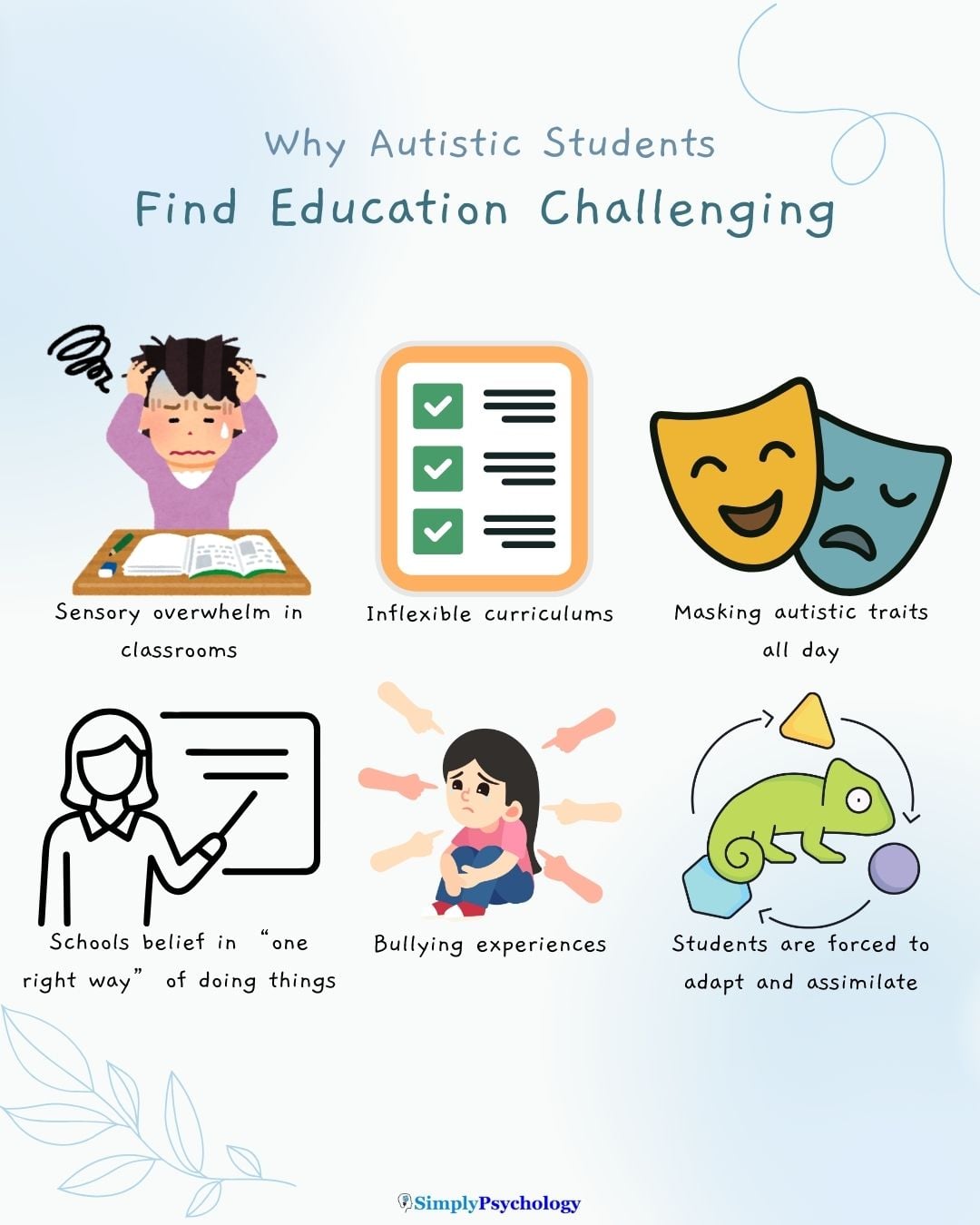
Autistic students often experience significant psychological and systemic barriers in mainstream education that often lead to long-term trauma.
These barriers result in disproportionately high rates of school exclusion, chronic absenteeism, and school refusal. Students frequently face victimization, bullying, and social isolation within the school environment.

Such negative experiences foster learned helplessness: a psychological state where an individual stops trying to avoid unpleasant stimuli because they believe they have no control.
Consequently, these students often suffer from lower academic achievement and profound psychological distress.
Environmental Mismatch and Sensory Processing
The primary driver of autistic struggle in schools is the person-environment fit: the degree of congruence between a person’s needs and their surroundings.
As Dr. Luke Beardon frequently states: Autism + Environment = Outcome.
Most mainstream classrooms are intentionally designed to be stimulating environments. They feature bright fluorescent lighting, high ambient noise levels, and crowded communal spaces.
These factors can trigger sensory overload: a state where the brain receives more information from the senses than it can process.
When students experience this overwhelm, they may undergo meltdowns or shutdowns. Educators often misinterpret these involuntary neurological responses as “defiance” or “non-compliance.”
Structural Ableism and Epistemic Injustice
Educational systems often operate under a framework of structural ableism: a systemic bias that favors neurotypical functioning as the superior norm.
This creates what Emmie Fisher describes as neuro-normative epistemic injustice: a phenomenon where the lived experiences and knowledge of autistic individuals are dismissed or undervalued by the dominant group.
Schools frequently prioritize integration over true inclusion. Integration refers to the physical placement of a student in a classroom without changing the environment.
Inclusion, conversely, involves adapting the curriculum and environment to meet the specific needs of the student.
Without these adaptations, the system demands assimilation, forcing students to suppress their natural traits.
The Psychological Cost of Masking
Many autistic students utilize camouflaging or masking to navigate social stigma and avoid punishment.
Masking is the conscious or subconscious suppression of autistic traits to mimic neurotypical behavior. While it may provide temporary social safety, it is cognitively and emotionally exhausting.
This chronic self-monitoring leads to autistic burnout: a state of physical and mental exhaustion, reduced tolerance to stimulus, and loss of functional skills.
Over time, the pressure to hide one’s true self contributes to severe identity crises and deteriorating mental health.
First-hand accounts
These below accounts from autistic individuals powerfully illustrate the isolation and frustration autistic students experience:
- “It feels like everyone else knows what is going on, but I just don’t know what the rules are.”
- “I was taught to repress my natural habits through ABA-like therapy, which made me feel wrong. Today, I’m learning to deconstruct this view.”
- “I am trying as hard as I can, but I still don’t fit what they want.”
- “Everyone, teachers hated me. It was like the number one complaint. Like, how do we get [name] to stay in his desk, right? And it’s like, well, how about you just meet [name] in the middle, you know?”
- “I didn’t find out I was a math savant until I was twenty-seven. In fact, your education system suppressed that in me, because it didn’t allow me to function how I needed to function to be focused on my work, my school work.”
- “I just [pause] I wish things—I just wish things were easier for me. Easier for people like me.”
Empirical Evidence
The Double Empathy Problem (Milton, 2012)
Aim: To investigate the bidirectional nature of communication breakdowns between autistic and non-autistic individuals.
Procedure: Theoretical analysis and qualitative review of social interaction data were conducted.
Findings: Researchers found that communication difficulties are not an inherent “deficit” in the autistic person. Instead, they result from a mutual lack of understanding between two different neurological groups.
How this relates to education: Social friction is a “two-way street” where neurotypical educators fail to empathize with autistic perspectives just as frequently as the reverse occurs.
Minority Stress in Autism (Botha & Frost, 2020)
Aim: To determine if the minority stress model explains mental health disparities in the autistic population.
Procedure: A large-scale survey was administered to autistic adults to measure exposure to stigma, victimization, and psychological distress.
Findings: Results indicated that chronic exposure to societal prejudice and the pressure to conceal identity directly predicted poor mental health outcomes.
How this relates to education: The psychological distress experienced by autistic students is largely a result of external social marginalization rather than internal pathology.
Strategic Educational Reforms
The Autistic SPACE Framework
True inclusion requires a shift from “integration” (merely placing a student in a room) to “neuro-affirming” practices that value autistic identity.
One effective framework is the Autistic SPACE model:
- Sensory: Modifying the physical environment to reduce triggers.
- Predictability: Using visual schedules to lower transitional anxiety.
- Acceptance: Creating a culture where “stimming” (self-stimulatory behavior) is normalized.
- Communication: Providing processing time and alternative communication methods.
- Empathy: Acknowledging the validity of the autistic experience.
Implementing the SPACE framework can transform school culture by addressing core autistic needs.
Universal Design and Monotropism
Universal Design for Learning (UDL) ensures that flexible teaching methods are built into the curriculum by default.
This approach reduces the need for students to constantly self-advocate for basic accommodations.
Furthermore, educators should leverage monotropism: a cognitive style characterized by an intense focus on a limited number of interests.
By embedding a student’s special interests into their assignments, teachers can facilitate a “flow state.” Flow is a psychological state of deep immersion and energized focus.
This strategy enhances academic engagement and builds self-confidence by focusing on student strengths rather than deficits.
Co-Produced Training and Peer Education
Professional development for school staff must be co-produced with autistic adults and autistic researchers. This ensures that training moves away from medicalized checklists and toward understanding lived experience.
The incorporation of more autistic teachers may also help in guiding future practice and reduce issues with double empathy.
Additionally, peer education programs like LEANS (Learning About Neurodiversity at School) help neurotypical students understand their peers.
These programs normalize neurological differences and reduce the prevalence of bullying. Shifting the focus from “fixing” the child to “fixing” the environment is the most effective way to improve long-term life trajectories.
References
Beardon, L. (2022). ‘Autopia’: A vision for autistic acceptance and belonging. In The Routledge International Handbook of Critical Autism Studies (pp. 159-164). Routledge.
Botha, M., & Frost, D. M. (2020). Extending the minority stress model to understand mental health problems experienced by the autistic population. Society and mental health, 10(1), 20-34.
Fisher, E., MacLennan, K., Mullally, S., & Rodgers, J. (2025). Neuro-normative epistemic injustice–Consequences for the UK education crisis and school anxiety. Neurodiversity, 3, 27546330251353565.
Milton, D. E. (2012). On the ontological status of autism: The ‘double empathy problem’. Disability & society, 27(6), 883-887.
Pearson, A., & Rose, K. (2021). A conceptual analysis of autistic masking: Understanding the narrative of stigma and the illusion of choice. Autism in Adulthood, 3(1), 52-60.

