There is no difference between AS and A-level for the Social Influence topic — the content is identical in both specifications.
Social Influence Exam
Test your knowledge of AQA A-level Psychology Paper 1: Social Influence. Covers conformity, obedience, resistance to social influence, minority influence, and social change.
Question 1 of 1
1. Which type of conformity involves both a change in public behaviour and private opinion? [1 mark]
Question 1 of 1
2. In Asch's line study, what was the conformity rate on critical trials? [1 mark]
Question 1 of 1
3. Which explanation for conformity suggests people conform because they want to be liked and accepted by the group? [1 mark]
Question 1 of 1
4. What was the obedience rate in Milgram's original baseline study? [1 mark]
Question 1 of 1
5. In Milgram's variation where the experiment was moved to a run-down office block, what happened to obedience levels? [1 mark]
Question 1 of 1
6. According to the agentic state theory, people obey because they: [1 mark]
Question 1 of 1
7. Which of the following is NOT a factor that Moscovici identified as important for minority influence? [1 mark]
Question 1 of 1
8. Rotter's concept of locus of control suggests that people with an internal locus of control are: [1 mark]
Question 1 of 1
9. In Asch's study, what happened to conformity when one confederate gave the correct answer? [1 mark]
Question 1 of 1
10. Which type of conformity involves changing behaviour to fit in with a group that you identify with, but only while in the group? [1 mark]
Question 1 of 1
11. Informational social influence is most likely to occur when: [1 mark]
Question 1 of 1
12. Which of the following best describes the process of social change through minority influence? [1 mark]
Question 1 of 1
13. Which two of the following are explanations of obedience identified by Milgram? [2 marks]
(Select all that apply)
Question 1 of 1
14. Which two of the following are factors that increase resistance to social influence? [2 marks]
(Select all that apply)
Question 1 of 1
15. Which two of the following best describe Zimbardo's Stanford Prison Experiment? [2 marks]
(Select all that apply)
Question 1 of 1
16. Which two of the following are situational variables that Milgram found affected obedience levels? [2 marks]
(Select all that apply)
Question 1 of 1
17. Outline and evaluate the authoritarian personality as an explanation of obedience to authority. [6 marks]
Model Answer
The authoritarian personality (Adorno et al., 1950) proposes that some people have personality traits that make them more obedient. These traits include being rigid, conformist, and submissive to those of higher status while being contemptuous of those perceived as inferior. According to Adorno, this personality type develops through strict, harsh parenting where conditional love creates hostility that cannot be expressed toward the parents and is instead displaced onto weaker targets (a process known as scapegoating). Adorno measured authoritarian traits using the F-scale (fascism scale) questionnaire.
One strength is that research support exists. Milgram and Elms (1966) found that participants who were fully obedient in Milgram’s study scored higher on the F-scale, supporting the link between authoritarian personality and obedience.
However, the F-scale has methodological problems. All items are worded in the same direction, so agreement always indicates authoritarianism. This creates acquiescence bias, meaning the scale may measure a tendency to agree rather than genuine authoritarian traits.
Additionally, Milgram argued that situational factors, such as proximity and location, provide a better explanation for obedience than dispositional factors like personality. His variations showed that obedience changed dramatically when the situation changed, yet the same participants with the same personalities behaved very differently.
Finally, the authoritarian personality cannot explain obedience at a societal level. In Nazi Germany, millions of people displayed obedient behaviour, and it is not credible to claim they all had the same personality type. Situational explanations are more parsimonious.
Mark Scheme
AO1 (3 marks): Description of the authoritarian personality concept, its characteristics (rigid, conformist, submissive to authority, contemptuous of inferiors), development through harsh parenting, and measurement via the F-scale.
AO3 (3 marks): Evaluation points such as supporting evidence (Milgram & Elms), methodological issues with the F-scale (acquiescence bias), the situational vs dispositional debate, or the inability to explain whole-society obedience.
Question 1 of 1
18. Explain how social influence processes have been used to bring about social change. Use an example in your answer. [4 marks]
Model Answer
Social change occurs when a whole society adopts new attitudes, values, or behaviours. Minority influence plays a key role in this process. A minority must first draw attention to an issue, then maintain a consistent message over time. This triggers deeper processing in the majority (the conversion effect), leading people to think more carefully about the minority’s arguments.
For example, the suffragette movement used consistency (campaigning for decades for women’s right to vote), commitment (enduring imprisonment and force-feeding), and flexibility (adjusting tactics from peaceful protest to more militant action when needed). The augmentation principle applied because the personal sacrifices of the suffragettes made their message more persuasive.
Over time, a snowball effect occurred as more people became convinced, and eventually women gained the right to vote in 1918 (partially) and 1928 (fully). This demonstrates how minority influence can gradually shift majority opinion until a tipping point is reached and social norms change permanently.
Mark Scheme
AO1 (2 marks): Outline of social influence processes (minority influence, consistency, commitment, flexibility, snowball effect).
AO2 (2 marks): Application to a real-world example (e.g., suffragettes, civil rights movement) showing how the processes operated in practice.
Question 1 of 1
19. Discuss Milgram's research into obedience. Refer to what Milgram did, what he found, and at least two evaluative points. [6 marks]
Model Answer
Milgram (1963) investigated obedience by recruiting 40 male participants who believed they were taking part in a study about learning. Each participant was assigned the role of ‘teacher’ (which was rigged) and had to administer electric shocks to a ‘learner’ (a confederate) each time they answered a question incorrectly. Shocks increased in 15V increments from 15V to 450V. The experimenter used standardised prods (e.g., ‘The experiment requires that you continue’) when the participant hesitated.
Milgram found that 65% of participants administered shocks up to the maximum 450V, despite the learner’s protests, screaming, and eventual silence. All participants went to at least 300V. Prior to the study, psychiatrists predicted that only about 1% would go to 450V.
One strength is that Milgram’s research has high external validity. Milgram’s findings have been replicated across cultures (e.g., Smith and Bond found similar obedience rates in many countries) and the findings parallel real-world atrocities where ordinary people commit harmful acts under authority.
However, the study raises serious ethical concerns. Participants experienced extreme stress (sweating, trembling, nervous laughter), and the right to withdraw was compromised by the experimenter’s prods, which pressured participants to continue. Baumrind (1964) argued this caused lasting psychological harm.
A further criticism is that Milgram’s study may lack internal validity. Orne and Holland (1968) suggested that participants may have guessed the shocks were not real (demand characteristics), meaning the study may not have truly measured obedience. However, Milgram’s post-study interviews indicated that 70% believed the shocks were genuine.
Mark Scheme
AO1 (2 marks): Description of Milgram’s procedure and findings (e.g., 65% obedience, electric shock paradigm).
AO3 (4 marks): At least two evaluation points. May include ethical issues, validity concerns, cross-cultural replication, real-world applications, or methodological strengths/weaknesses. Each point should be elaborated.
Question 1 of 1
20. Explain the difference between compliance and internalisation as types of conformity. Give an example of each. [4 marks]
Model Answer
Compliance is the shallowest level of conformity, where a person publicly goes along with the group but privately disagrees. It is temporary and only lasts as long as the group is present. For example, a student might laugh at a joke they do not find funny because everyone else is laughing, but privately they do not change their opinion about the joke.
Internalisation is the deepest level of conformity, where a person genuinely accepts the group’s beliefs and changes both their public behaviour and private opinion permanently. This is most likely when the individual is exposed to the views of experts or when the situation is ambiguous. For example, a person raised as a meat-eater might join a group of vegetarians, learn about the ethical arguments, and become genuinely convinced that vegetarianism is correct, maintaining this belief even outside the group.
Mark Scheme
AO1 (2 marks): Clear description distinguishing compliance (public change only, temporary) from internalisation (public and private change, permanent).
AO2 (2 marks): Appropriate examples that clearly illustrate the difference between the two types.
Scoring your answers…
Social influence is the process by which an individual’s attitudes, beliefs or behaviour are modified by the presence or action of others. Four areas of social influence are conformity, compliance and obedience, and minority influence.
How This Topic Is Assessed
Social influence is the first compulsory topic on the AQA AS and A-level Psychology specification (7181 AS / 7182 A-level). It is examined in Section A of Paper 1: Introductory Topics in Psychology.
Paper Structure and Marks
At full A-level, Paper 1 is a 2-hour exam worth 96 marks. It has four sections, each worth 24 marks.
These are Social influence, Memory, Attachment, and Clinical Psychology and Mental Health.
The AS-only qualification is shorter: 1 hour 30 minutes, 72 marks, and only the first three sections. Clinical Psychology sits on AS Paper 2 instead.
The content itself does not change between AS and A-level. Only the paper structure does.
Each section mixes multiple-choice, short-answer and extended-writing questions. A student cannot predict the exact question format from the topic alone.
Revising all three question types for every topic, not just extended writing, is worth the time it takes. Multiple-choice questions can be just as easy to lose easy marks on as a rushed essay.
The Assessment Objectives
Every question tests one of three assessment objectives, shared across every exam board’s psychology specification.
- AO1 (Knowledge): accurate knowledge of concepts, theories, studies and research methods.
- AO2 (Application): applying that knowledge to a novel scenario or context.
- AO3 (Evaluation): using evidence to judge a theory or study.
Across A-level Paper 1, AO1 carries roughly 11–14% of the total mark, AO2 roughly 6–9%, and AO3 roughly 12–14%.
Evaluation therefore matters as much as description. Many students lose marks by writing a long, accurate account and leaving too little time to discuss it.
Social influence questions frequently combine all three AOs in one extended-writing question. A strong answer weaves knowledge, application and evaluation together, rather than as separate paragraphs, and revisits the scenario throughout.
How Extended-Writing Questions Are Marked
Extended-writing questions are typically worth 16 marks at A-level, 12 at AS. They are marked on a 4-band levels-of-response scale, not a tick-list.
A top-band answer combines detailed knowledge with effective application and thorough discussion. It uses specialist terminology correctly throughout.
A Level 1 answer, by contrast, shows only basic, muddled knowledge with little attempt at application or discussion. This gap matters.
Most students sit somewhere between the two extremes, so sustaining Level 4 quality throughout a whole answer, not just the opening paragraph, is what separates the strongest scripts.
Consistency across the answer counts.
One examiner note applies across AQA’s published mark schemes for this topic. Methodological evaluation only earns credit when it is explicitly linked back to the point being discussed.
This rule is strict.
Simply writing “low ecological validity” caps the mark on its own. Saying what that limitation means for the explanation being discussed does not.
The Two-Sentence Technique for AO2
Scenario questions reward a simple pattern. State the relevant psychological knowledge in one sentence.
Then add a second sentence naming the specific detail from the scenario it explains.
For example: “Normative social influence is conforming to be liked or avoid rejection. This is shown by Freddie, who stops pushing once he sees the deputy head, a shift driven by wanting to avoid the disapproval of a visible authority figure.”
Quoting a short phrase directly from the scenario is rewarded. So is linking language such as “this suggests that…”.
Restating the scenario without naming the mechanism it illustrates earns no application credit. This same two-sentence pattern works for any AO2 question across the specification, so it is worth practising until it feels automatic.
Conformity (Majority Influence)
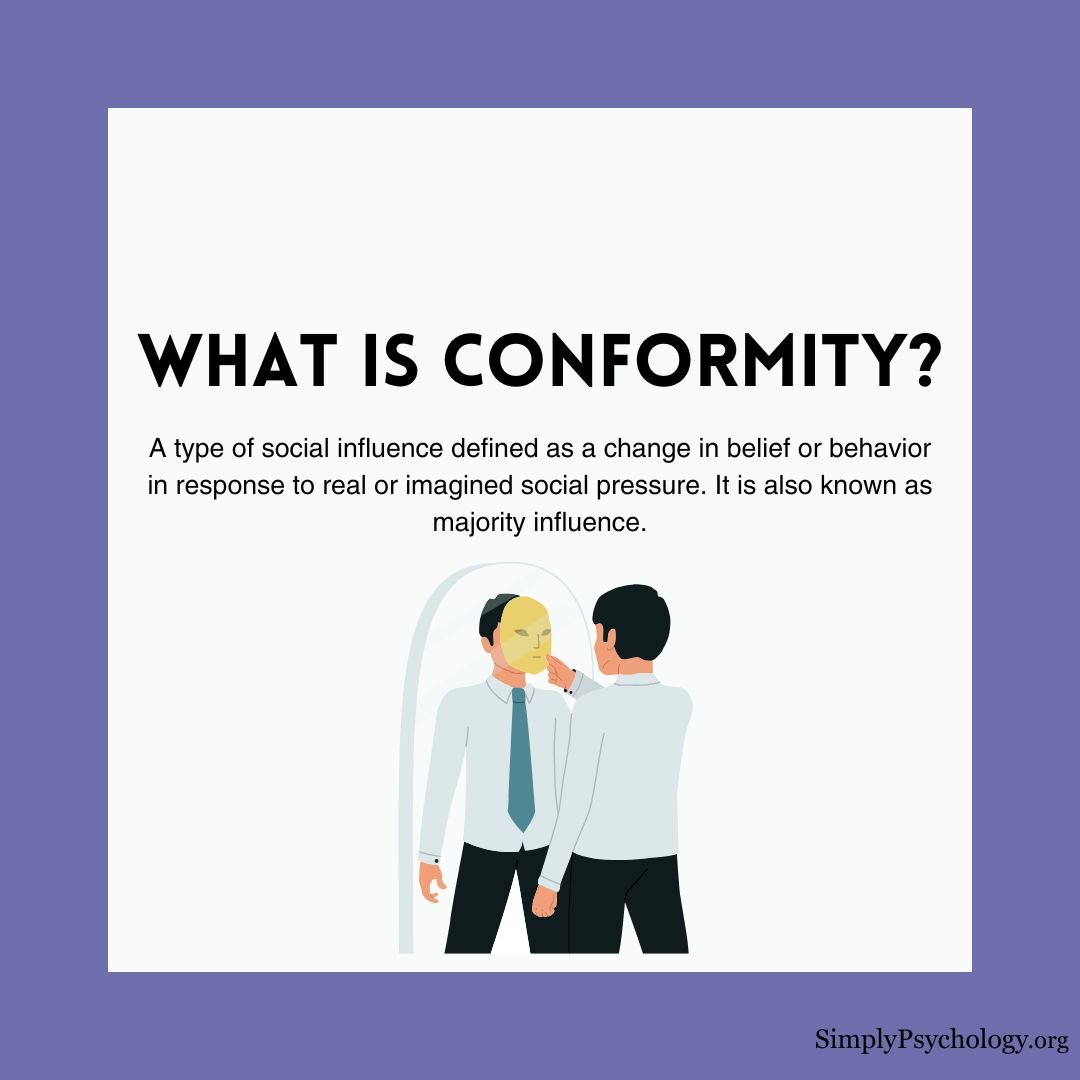
Conformity is defined as a type of social influence. It is yielding to group pressure: a change in a person’s behaviour or opinion due to real or imagined pressure from a person or group.
Real pressure involves consequences for conforming, while imagined pressure involves none for not conforming. Conformity is also known as majority influence.
Students will be expected to know:
- Types of conformity: internalisation, and compliance.
- Explanations for conformity: informational social influence and normative social influence.
- Variables affecting conformity including group size, unanimity and task difficulty as investigated by Asch.
Types of Conformity
According to Kelman (1958), there are three types of conformity: internalisation, identification, and compliance.
These are also sometimes seen as levels of conformity. Note – you no longer need to learn about identification for the 2027 exam.
One more spec-currency point worth flagging: an older specification also examined conformity to social roles (Zimbardo’s Stanford Prison Experiment) as part of this topic. That content has been removed too. Do not bring Zimbardo’s study into a conformity answer on the current specification.
Compliance AO1
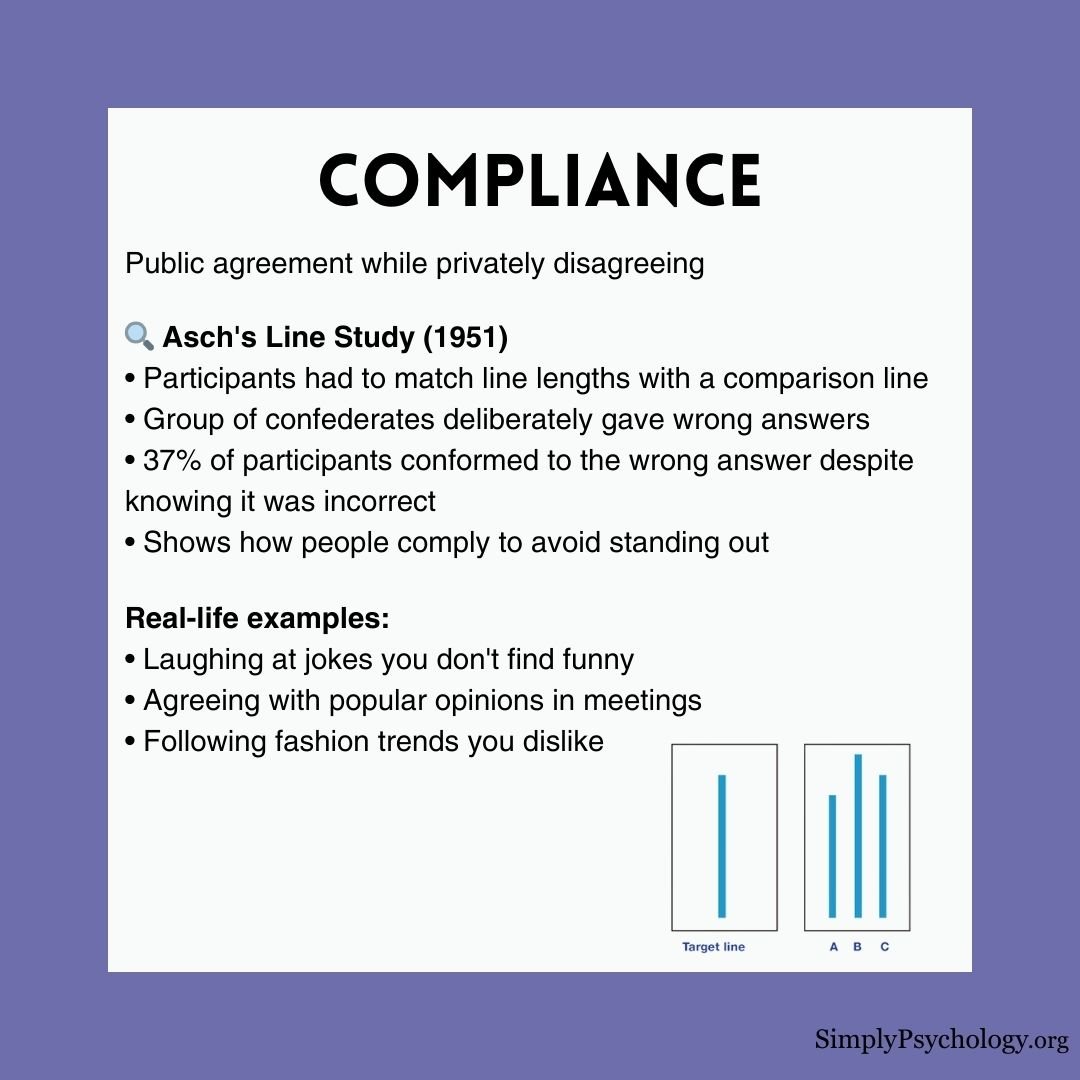
This refers to instances where a person may agree in public with a group, but privately disagrees with the group’s viewpoint or behaviour.
The change is temporary and superficial. It is driven by the desire to gain approval or avoid disapproval, often through normative pressure.
For example, a person may laugh at a joke because their friends find it funny, even though deep down they don’t find it funny themselves.
Drinking alcohol with friends despite not wanting to, then not drinking outside those social situations, is another example.
Compliance is the weakest form of conformity. It lasts only as long as group pressure is present.
For a study on compliance refer to Asch’s Line Study.
View this post on Instagram
Internalisation AO1
Publicly changing behaviour to fit in with the group while also agreeing with them privately.
An internal (private) and external (public) change of behaviour.
This is the deepest level of conformity, where the beliefs of the group become part of the individual’s own belief system.
This type of conformity usually lasts without the majority present. It links to Informational Social Influence.
An example of internalisation is someone who lived with a vegetarian at university and decided to also become one, because they agreed with their friend’s viewpoint. Converting to a different religion after living among people of that faith would be another good example.
For a study on internalisation refer to Jenness (see below).
View this post on Instagram
Normative Influence (AO1/AO3)

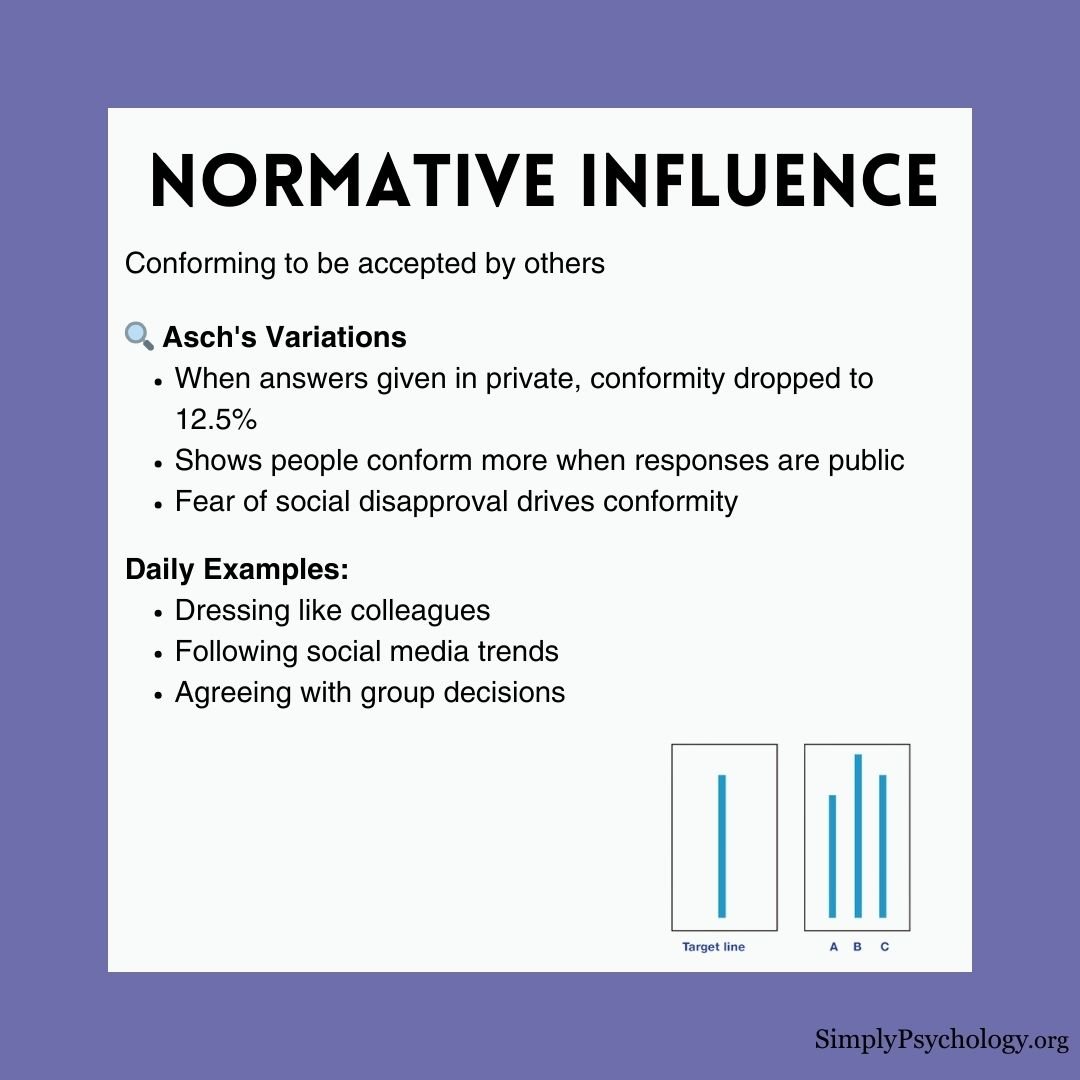
Normative social influence is where a person conforms because they want to be liked and be part of a group.
It is driven by a person’s need to be accepted or have approval from a group.
Normative social influence is usually associated with compliance, where a person changes their public behaviour but not their private beliefs.
This form of influence is shallow. People often use it to avoid the embarrassing situation of disagreeing with the majority, or through fear of rejection or being seen as an outcast.
For example, a person may feel pressurised to smoke because their friends do. Normative social influence tends to lead to compliance: the person smokes just for show, but deep down wishes not to smoke. Any change of behaviour is therefore temporary.
For a study on normative influence refer to Asch.
Not everyone is equally affected by normative pressure. People with a high need for affiliation (nAffiliators) are more likely to conform to be liked, whereas others less concerned with social approval may resist NSI.
Informational Influence (AO1/AO3)
Informational social influence is where a person conforms because they have a desire to be right.
They look to others who they believe have more information.
This usually happens when a person is uncertain or unsure of a situation or lacks knowledge.
It usually leads to internalisation. That is a permanent change in view or behaviour, not just a public one.
It occurs in ambiguous, difficult, or novel situations where we lack the knowledge or expertise to make our own decisions.
For example, a person may follow a crowd in an emergency, assuming others know the way.
Imagine going to a posh restaurant for the first time. Confronted with several forks and unsure which to use, a person might look to someone nearby to see which one they pick up first.
For a study on informational influence refer to Jenness (see below).
Jenness’ Bean Jar Experiment AO1
Jenness carried out a study into conformity – in his experiment participants were asked to estimate how many beans they thought were in a jar.
Each participant had to make an individual estimate, and then do the same as a group.
He found that when the task was carried out in a social group, participants reported estimates of roughly the same value.
This is despite differing individual estimates just before.
The study successfully showed majority influence: individuals’ behaviour and beliefs can be influenced by a group.
This is likely an example of informational social influence, since participants would be uncertain about the actual number of beans in the jar.
Variables Affecting Conformity
Asch’s Line Study AO1

Asch wanted to investigate whether people would conform to the majority in situations where an answer was obvious.
Procedure: Asch’s study had 5-7 participants per group.
Each group was presented with a standard line and three comparison lines.
Participants had to say aloud which comparison line matched the standard line in length.
One real participant sat among six confederates. The confederates were told to give the incorrect answer on 12 of 18 trials.
Results: Real participants conformed on 32% of the critical trials where confederates gave the wrong answers. Additionally, 75% of the sample conformed to the majority on at least one trial.
View this post on Instagram
Factors Affecting Conformity AO3
In further trials, Asch (1952, 1956) changed the procedure (i.e., independent variables) to investigate which situational factors influenced the level of conformity (dependent variable). His results and conclusions are given below:
1. Group Size
An individual is more likely to conform in a larger group.
Group size matters. Asch altered the number of confederates in his study to see how this affected conformity. The bigger the majority group, the more people conformed, but only up to a point.
With one confederate, conformity was 3%. With two, it rose to 13%. With three or more, it reached 32%.
Conformity does not increase much once the group reaches about four or five members. That is considered the optimal group size.

Brown and Byrne (1997) suggest that people might suspect collusion if the majority rises beyond three or four.
According to Hogg & Vaughan (1995), the most robust finding is that conformity reaches its full extent with 3-5 person majority, with additional members having little effect.
2. Group Unanimity
A person is more likely to conform when all members of the group agree and give the same answer.
When one other person in the group gave a different answer from the others, and the group answer was not unanimous, conformity dropped.
Asch (1951) found that even the presence of just one confederate that goes against the majority choice can reduce conformity as much as 80%.
3. Difficulty of Task
An individual is more likely to conform when the task is difficult.
When the (comparison) lines (e.g., A, B, C) were made more similar in length it was harder to judge the correct answer and conformity increased.
When we are uncertain, it seems we look to others for confirmation. The more difficult the task, the greater the conformity.
This suggests that informational social influence is a major mechanism for conformity when the situation is ambiguous.
4. Answer in Private
When participants were allowed to answer in private (so the rest of the group does not know their response) conformity decreases.
This decreases conformity because there are fewer group pressures and normative influence is not as powerful, as there is no fear of rejection.
Obedience
Obedience is a type of social influence where a person follows an order from another person who is usually an authority figure.
Students will be expected to know:
- Explanations for obedience: agentic state and legitimacy of authority.
- Situational variables affecting obedience including proximity and location, as investigated by Milgram, and uniform.
- Dispositional explanation for obedience: the Authoritarian Personality.
Explanations for Obedience
Milgram’s Shock Study AO1
Milgram wanted to know why Germans were willing to kill Jews during the Holocaust.
He thought it might be because Germans were simply evil.
But he thought Americans were different, and would not have followed such orders. To test this ‘Germans are different’ hypothesis, he carried out the study outlined below.

Procedure: Milgram wanted to see whether people would obey a legitimate authority figure when told to harm another person.
He ran a lab experiment. Two participants were assigned the role of teacher, always the real participant, or learner, a confederate called Mr. Wallace.
The teacher and learner were put into separate rooms.
The experimenter, who wore a lab coat, then asked the teacher to give electric shocks, which were actually harmless, to the learner each time he gave a wrong answer.
These shocks increased every time, from 15 to 450 volts.

The experimenter, Mr Williams, wore a grey lab coat. His role was to give a series of orders, or prods, when the participant refused to administer a shock.
There were four prods. If one was not obeyed, the experimenter read out the next.
- Prod 1: please continue.
- Prod 2: the experiment requires you to continue.
- Prod 3: It is absolutely essential that you continue.
- Prod 4: you have no other choice but to continue.
Results: all participants went to 300 volts, and 65% went all the way to 450 volts. Milgram ran 18 variations of the study in total.
Each variation altered the situation (the IV) to see how it affected obedience (the DV).
For example, when the experimenter instructed and prompted the teacher by telephone from another room, obedience fell to 20.5%.
The Agentic State
This is when a person believes that someone else will take responsibility for their actions.
Agency theory suggests people are more likely to obey when in the agentic state because they don’t believe they will suffer the consequences of those actions.
They believe they are acting on behalf of an agent.
The shift from an autonomous state (where a person takes responsibility for their own actions) to the agentic state is called an Agentic Shift.
Agency theory is supported by Milgram’s evidence. When participants were reminded they had responsibility, few obeyed; but many who had been refusing continued if the experimenter said he would take responsibility.
Another example of the agentic state involved a variation of Milgram’s study whereby participants could instruct an assistant (confederate) to press the switches.
In this condition 92.5% shocked to the maximum 450 volts. This shows when there is less personal responsibility obedience increases.
Being in the agentic state makes a person ‘unthinkingly’ carry out orders and involves diffusion of responsibility.
Limitations AO3
-
- Cannot explain Nazi behaviour – Mandel described how the German Police Reserve shot civilians in a small Polish town even though they were not directly ordered to and were told they could be assigned to other duties – Challenges agentic state as they were not powerless to obey.
-
- May be better explained by ‘plain cruelty’ – Zimbardo’s participants may have used the situation to express their sadistic tendencies, guards inflicted rapidly escalating cruelty to prisoners even though there was no authority figure telling them to – Obedience may be caused by certain aspects of human nature.
Situational Variables Affecting Obedience as Investigated by Milgram
The Milgram experiment was carried out many times whereby Milgram varied the basic procedure (changed the IV).
By doing this Milgram could identify which situational factors affected obedience (the DV).
Obedience was measured by how many participants shocked to the maximum 450 volts (65% in the original study).
1. Authority Figure Wearing a Uniform
Milgram’s experimenter (Mr. Williams) wore a grey laboratory coat (a symbol of scientific expertise) which gave him a high status.
However, when the experimenter dressed in everyday clothes, obedience was very low.
Uniform acts as a visible sign of authority, increasing legitimacy and status.
2. Status of Location
Milgram’s obedience experiment was conducted at Yale, a prestigious university in America.
The high status of the university gave the study credibility and respect in the eyes of the participants, thus making them more likely to obey.
When Milgram moved his experiment to a set of run down offices rather than the impressive Yale University obedience dropped to 47.5%. This suggests that status of location effects obedience.
3. Proximity of Authority Figure (and Learner)
This refers to the physical closeness between the teacher, the learner, and the experimenter.
People are more likely to obey an authority figure nearby.
In Milgram’s study the experimenter was in the same room as the participant (i.e. teacher).
Distance makes it easier to resist an order.
When the experimenter instructed the teacher by telephone from another room, obedience fell to 20.5%.
Decreased proximity to the authority figure meant participants returned to a more autonomous state.
Many participants cheated, missing out shocks or giving less voltage than ordered to by the experimenter.
Dispositional Explanation: Authoritarian Personality
Adorno felt that personality (dispositional) factors, rather than situational (environmental) ones, could explain obedience. This is the authoritarian personality.
It is a person who favours an authoritarian social system and admires obedience to authority figures. One characteristic of the authoritarian personality is that the individual is hostile to those of inferior status, but obedient toward people with high status.
They show a strict adherence to conventional norms, an intolerance of ambiguity, and a black-and-white worldview with no grey areas. Everyone should know their place.
There is no challenge to those above, and no mercy to those below. Adorno measured this using the F-scale, testing around 2,000 middle-class white Americans’ unconscious attitudes towards other racial groups.
Those with higher F-scale scores showed the traits of an authoritarian personality. They were more prejudiced. They also viewed society as needing strong leaders to eradicate evil, and were inflexible in their outlook.
Limitations AO3
- Adorno found many significant correlations (e.g. Authoritarianism correlated with prejudice against minority groups) but we cannot say that one variable causes another – Adorno cannot claim that a harsh parenting style caused a development of an Authoritarian personality, we must consider other explanations like legitimacy of authority.
- Millions of individuals in Germany displayed obedient behaviour but didn’t have the same personality, it is unlikely that the majority of Germany’s population possessed an authoritarian personality – An alternative explanation like social identity theory (people identify with groups they are apart with and discriminate against ones they are not) may be more realistic.
- May be better explanations – Prejudice and submissiveness could just as easily be caused by a poor standard of education as a child – Theory lacks internal validity as it assumes obedience is caused by dispositional explanations when it may be situational variables.
- Adorno used a biased sample – Only used 2000 middle class white Americans who are more likely to have an Authoritarian personality due to demographics and the time of the study – Research lacks population validity and historical validity, so conclusions cannot be generalised to people outside the sample.
Resistance to Social Influence
Resisting social influence means not yielding to pressures to conform or obey. Two key factors help people resist: the presence of social support, and an individual’s locus of control. Locus of control is how much control a person feels they have over events in their life.
Students will be expected to know:
- Explanations of resistance to social influence, including social support and locus of control.
Other possible explanations for resistance include reactance (the “boomerang effect”), status, morality, and being in an autonomous state.
- Previous experience and a high level of moral reasoning
- Situational factors: lack of uniform, increased distance, reduced group size, or lack of task ambiguity
- Prior commitment
Social Support
The presence of people helps others resist pressure to conform or obey.
Having an ally or seeing someone else resist can strengthen an individual’s ability to withstand group or authority pressure
1. Resisting Conformity:
Seeing others non-conform gives confidence to do so. Having an ally breaks the unanimity of the group.
As shown in Asch’s conformity experiments, a single confederate disagreeing with the majority sharply cut a participant’s conformity, to about a quarter of its previous level. This held even with a different wrong answer.
Just one dissenter broke the unanimity and provided a model of independent behaviour, making it easier for the participant to follow their own conscience.
The ally’s dissent confirms the participant’s own perceptions: “I’m not the only one who sees it differently.” It also reduces normative pressure. The majority is no longer unanimous in disapproval.
Essentially, the presence of a non-conforming person frees others to not conform. This effect isn’t long-lasting if the ally starts conforming again, but at least temporarily, it boosts confidence.
2. Resisting Obedience:
Disobedient models facilitate disobedience.
Seeing others disobey shows that defying the experimenter is possible. It can also sharpen a participant’s own sense of personal responsibility. This is powerful.
In Milgram’s obedience variations, participants worked in a team of three teachers, two of them confederates who refused to continue at certain points. The real participant’s obedience plummeted.
Only 10% continued to 450V once they saw their peers disobey the experimenter.
The disobedient confederates modelled rebellion. They showed the participant that one can stand up to authority, making it far easier to defy the experimenter’s orders.
Gamson et al. (1982) ran a related study. Participants in groups discussed a morally questionable situation, helping an oil company smear a manager’s reputation.
They found that 88% of groups rebelled against the orders, a much higher rate than Milgram found in individuals. Groups can reinforce each other’s resistance. This is the key difference from Milgram’s individually tested participants.
These findings show that social support undermines the legitimacy of authority or majority pressure, giving individuals courage to resist.
Why does it work? Social support works through two pathways: normative social influence (NSI) and informational social influence (ISI).
An ally reduces the fear of isolation, since you’re not the only deviant. That is NSI. They can also provide an alternative viewpoint that might be correct. That is ISI.
For example, in Asch’s study, a dissenter giving the correct answer broke unanimity and validated the participant’s own judgment. This reduces conformity through both normative and informational influence.
In essence, there is strength in numbers. Even a small break in consensus can tilt the balance towards independent behaviour.
Locus of Control
Locus of control (LOC) is a measurement of an individual’s sense of control over their lives.
It measures the extent to which people feel events in their lives are under their own personal control. This is internal LOC, versus under the control of external powers like fate, which is external LOC.
There is a continuum, with most people lying in between.
Internal LOC:
People with a more internal locus of control conform and obey less.
They take more responsibility for their actions and see themselves as having more control.
An internal LOC enables greater personal efficacy and self-confidence.
They are more likely to make decisions based on their own moral code.
People with a high internal LOC are more likely to be leaders, not followers.
External LOC:
People with an external locus of control believe the majority of their life events are beyond their control.
They are more likely to act on behalf of another (as an agent) and shift responsibility.
They are particularly susceptible to obedience.
Externals may be more prone to learned helplessness and tend to follow others because they don’t think they can control what happens anyway.
In social influence, externals are more likely to conform or obey, attributing outcomes to external pressure rather than their own agency.
Research Support (AO3)
Limitations (AO3)
Minority Influence
Students will be expected to know:
- Minority influence including reference to consistency, commitment and flexibility.
Minority influence occurs when a minority group influences the majority. Minority influence is the main cause of social change – a society’s large-scale shift in its attitudes, beliefs or behaviour. It often leads to internalisation: the majority actually change their private views after being influenced, though this tends to happen gradually.
Key processes that make minority influence effective are consistency, commitment, and flexibility.
Other processes involved in minority influence and social change include:
- Drawing attention to their beliefs, and deeper processing of the issue by the majority group
- The augmentation principle and the snowball effect: converted individuals bring others with them until a once-minority view becomes the majority one
- Social cryptomnesia: a society adopting a once-minority position while losing conscious memory of where the idea originally came from
Consistency
Consistency is one of three behaviours that enable a minority to influence a majority.
What Consistency Means
Minorities need to be consistent.
This has two parts: staying consistent over time (diachronic consistency) and staying consistent between members (synchronic consistency). Both parts matter.
Diachronic consistency means the minority sticks to its guns and does not modify its views.
Synchronic consistency means all members agree with each other and back each other up. Both matter equally.
For example, a minority group that repeats the same argument at every meeting, with every member saying the same thing, is highly consistent on both counts.
AQA’s specification names consistency explicitly as one of the three processes examiners expect students to describe and evaluate. Learn the two terms precisely, since exam questions sometimes ask for them by name.
Why Consistency Works
Consistency forces the majority to think deeply about the issue. The repetition and united front imply a strong, valid point.
A consistent minority causes the majority to at least reassess the issue: “They keep saying the same thing… they might have a point.”
Moscovici theorised that consistency makes majority members start to doubt themselves and take the minority view more seriously. That doubt is the point.
Confronted with a consistent opposition, the majority sits up and takes notice, because the minority has focused attention on itself.
A consistent minority also disrupts established norms, creating uncertainty and doubt that makes the majority question its own views.
However, too much consistency without flexibility can seem dogmatic.
In practice, consistency should be combined with rational argumentation – simply repeating an assertion isn’t enough, but holding firm to a clear stance is what matters (see Flexibility, below).
Key Study: Moscovici’s Blue-Green Slide Study
Aim: Moscovici aimed to determine the importance of consistency to a minority’s influence.
Method: Female participants were shown 36 blue slides of different intensity and asked to report the colour.
Each group had two confederates (the minority) and four real participants (the majority). This tested consistency directly.
A control group of participants only, with no confederates, was also used.
Two conditions followed. In the first, the two confederates answered “green” for all 36 slides: totally consistent.
In the second, they answered “green” 24 times and “blue” 12 times: inconsistent. The pattern was clear.
Results: When confederates were consistent, about 8% of participants also said the slides were green, compared with only about 1% when confederates were inconsistent.
Conclusion: A consistent minority influences the majority far more than an inconsistent one. Moscovici’s finding is often cited as the founding evidence for consistency as a key factor in minority influence.
Commitment
Minorities need to demonstrate commitment. They show resistance to social pressures and abuses against their viewpoint.
The Augmentation Principle
A minority that shows dedication to their cause, especially through personal sacrifice or suffering, is more likely to be influential.
This is explained by the augmentation principle: if the minority undergoes extreme activities or risks to further their cause, it amplifies their impact.
It shows they are not acting out of self-interest. They truly believe in their view.
For example, environmental activists who chain themselves to trees or go on hunger strikes make their commitment obvious.
This is why hunger strikes, public sacrifice, or highly visible risk-taking are such persuasive minority tactics: the cost to the individual signals the strength of their conviction.
A minority that risks nothing looks far less credible than one that visibly risks something real.
The Effect on Observers
Observers are more likely to pay attention. They ask themselves: “why would they do that unless they really have a strong point?”
High commitment can also create a sense of guilt in the majority: “perhaps our complacency is wrong if these people are willing to suffer for this.”
This works both ways.
Commitment can therefore convert more onlookers by demonstrating certainty and courage, making the minority’s message more compelling.
This is informational social influence at work.
Observers treat the minority’s willingness to suffer as evidence that their position deserves serious consideration. Over repeated exposure, this can shift bystanders from indifference to active reconsideration of their own views.
Commitment, in other words, quietly buys attention it would not otherwise get.
Flexibility
Minorities should be moderate, co-operative, and reasonable.
While consistency is vital, being inflexible and rigid can backfire.
If the minority refuses to compromise or consider alternate ideas, the majority may dismiss them as extremists or unrealistic.
Psychologist Nemeth (1986) argued that effective minorities strike a balance: they remain consistent in principle but demonstrate flexibility by adapting arguments, listening to others, and making small concessions.
A flexible minority can engage the majority in dialogue.
For instance, imagine a jury where one juror argues a defendant is not guilty, but also acknowledges valid points from others and stays open to discussion. The rest of the jury are more likely to take his view seriously than if he simply repeated himself.
AO3
In short, consistency without being inflexible is key – consistency shows commitment to the core issue, while flexibility shows an open mind.
This possibility was investigated by Nemeth. Their experiment used a mock jury: groups of three participants and one confederate decided on compensation for the victim of a ski-lift accident.
When the confederate argued for a very low amount and refused to move, he had no effect on the majority. He would not budge.
However, when he compromised and moved some way towards the majority position, the majority also compromised and changed their view.
This experiment questions the importance of consistency: the minority position changed, and it was this change that apparently resulted in minority influence, not the confederate holding firm.



Exam Practice: Worked Past-Paper Questions
The following are real AQA A-level Psychology (7182/1) past-paper questions with their official mark schemes, used here as worked exam-technique examples.
16-Mark Extended-Writing Example (June 2020)
It is the end of the school day and Freddie is pushing other students in the bus queue. “Stop it, will you?” protests one of Freddie’s classmates. “You can’t tell me what to do!” laughs Freddie. At that moment, Freddie turns to see the deputy head, wearing a high-visibility jacket, staring angrily at him. Without thinking, Freddie stops pushing the other boys and waits quietly in line.
Discuss the legitimacy of authority and agentic state explanations of obedience. Refer to Freddie’s behaviour in your answer. [16 marks]
Marks split AO1 = 6, AO2 = 4, AO3 = 6.
It is marked on a 4-band scale, from Level 4 (13–16 marks) down to Level 1 (1–4 marks).
AO1 content: recognising a social hierarchy and its symbols (legitimacy of authority); feeling no personal responsibility for one’s own actions (agentic state); the opposite autonomous state; binding factors. That is the AO1 half.
AO2 application: Freddie is autonomous when dismissing his classmate, an equal in the hierarchy. He shifts “without thinking” into the agentic state the moment he sees the deputy head. That shift is the AO2 point.
The deputy head is a legitimate authority, made visible by the high-visibility jacket.
AO3 discussion: use evidence to support or challenge the two explanations. Milgram’s variations, Bickman’s uniform study, and Hofling’s hospital study all fit here, alongside real-world examples. So do real-world parallels.
Note that neither explanation alone accounts for the disobedience seen in some studies. Consider the dispositional alternative too.
Examiner note: methodological evaluation only counts when tied back to the two named explanations. A free-standing “this study lacked ecological validity” point earns nothing on its own.
4-Mark Short-Answer Example (June 2019)
Outline two explanations of resistance to social influence. [4 marks]
Marked AO1 = 4: two marks per explanation.
Two marks reward a clear, coherent, elaborated explanation.
One mark rewards a limited or muddled one, and zero marks go to simply naming an explanation with no reference to how it affects resistance.
Suggested content for locus of control: an internal locus makes someone believe they control their own circumstances, so they resist conforming or obeying more than someone with an external locus.
That is the locus-of-control point.
Suggested content for social support: non-conformity or disobedience is more likely when others are seen to resist, because it gives an observer the confidence to do the same.
That is the social-support point.
The mark scheme also credits other valid explanations, such as being in an autonomous state, prior experience, or reactance.
It also credits the inverse of factors that normally increase conformity or obedience. These include lack of uniform, greater distance from an authority figure, a smaller group size, or a less ambiguous task.
Key Takeaways
- Definition: Social influence is a change in a person’s behaviour, attitudes or beliefs as a result of real or imagined pressure from others.
- Four Areas: The AQA spec covers conformity, obedience, resistance to social influence, and minority influence.
- Conformity: Compliance is public-only and temporary (normative influence); internalisation is public and private, and permanent (informational influence).
- Obedience: Milgram found 65% of participants obeyed to 450V; obedience fell with distance from the authority figure and a less prestigious setting.
- Resistance: Social support and an internal locus of control both make a person more likely to resist conforming or obeying.
- Minority Influence: A consistent, committed, yet flexible minority can shift majority opinion, typically via internalisation.
- Spec Currency: Identification (as a third type of conformity) and Zimbardo’s Stanford Prison Experiment are no longer examined under this topic.
References
- Avtgis, T. A. (1998). Locus of control and persuasion, social influence, and conformity: A meta-analytic review. Psychological Reports, 83(3), 899–903. https://doi.org/10.2466/pr0.1998.83.3.899
- Bond, R., & Smith, P. B. (1996). Culture and conformity: A meta-analysis of studies using Asch’s (1952b, 1956) line judgment task. Psychological Bulletin, 119(1), 111–137. https://doi.org/10.1037/0033-2909.119.1.111
- Perrin, S., & Spencer, C. (1980). The Asch effect: A child of its time? Bulletin of the British Psychological Society, 32, 405–406.

