Selective attention, also known as focused attention, is the process of directing our awareness to relevant stimuli while ignoring irrelevant stimuli in the environment.
There is a limit to how much information can be processed at a given time, and selective attention allows us to tune out insignificant details and focus on what is important.
This limited capacity for paying attention has been conceptualized as a bottleneck, which restricts the flow of information. The narrower the bottleneck, the lower the rate of flow.
Broadbent’s and Treisman’s Models of Attention are all bottleneck models because they predict we cannot consciously attend to all of our sensory input at the same time.

Cherry (1953)
The cocktail party problem refers to the ability to tune into a single conversation while successfully ignoring other conversations and background noises taking place simultaneously.
The British scientist Colin Cherry was the first to systematically investigate this phenomenon in 1953, laying the groundwork for the cognitive study of selective attention.
Cherry wanted to understand exactly how we manage to isolate one auditory message from a chaotic environment, and what happens to the information we choose to tune out.
Physical Cues
In his initial experiments, Cherry presented participants with two different spoken messages simultaneously through both ears (a process known as binaural listening).
He discovered that our ability to separate these messages relies heavily on physical differences between the auditory streams, such as the gender of the speaker, the intensity (volume) of their voice, and the spatial location the sound is coming from.
To prove this, Cherry presented two different messages recorded by the exact same voice to both ears at once.
By eliminating all physical differences between the messages, he found that listeners struggled to separate the two streams of information based on their meaning alone.
Empirical Validation: Cherry (1953)
-
Aim: To determine how listeners isolate one voice from many and what information is retained from the ignored source.
-
Procedure: Participants were asked to complete a shadowing task (the act of repeating a target message aloud as it is heard). They listened to different messages played through headphones. Some tasks used binaural presentation (both messages in both ears). Others used dichotic presentation (different messages in each ear).
-
Findings: Listeners could not separate binaural messages when the voices and volumes were identical. In dichotic tasks, participants noticed physical changes in the ignored ear, such as a shift from a male to a female voice. However, they failed to notice changes in language or reversed speech.
-
Conclusions: Human attention acts as a filter that prioritizes physical characteristics over semantic meaning for unattended stimuli.
Dichotic Listening
To study this filtering process in a more controlled laboratory setting, Cherry (and later Donald Broadbent in 1954) utilized a technique known as dichotic listening.
The dichotic listening tasks involves simultaneously sending one message (a 3-digit number) to a person’s right ear and a different message (a different 3-digit number) to their left ear.

Participants were asked to listen to both messages simultaneously and repeat what they heard. This is known as a “dichotic listening task.”
In a dichotic listening setup, a participant wears headphones and is presented with two completely different audio messages simultaneously, one playing in the left ear and a different one playing in the right ear.
To ensure that participants were dedicating their focal attention entirely to one specific message, Cherry employed a task called shadowing.
Participants were instructed to actively attend to the message in one designated ear and repeat it out loud, word-for-word, as they heard it, while entirely ignoring the competing message in the other ear.
Key Findings: What Happens to the Unattended Message?
Cherry’s dichotic listening experiments yielded striking results regarding the strict limits of human attention.
While listeners were easily able to shadow the attended message and extract its meaning, they retained practically nothing about the semantic content (the meaning) of the unattended message.
When asked about the message played in the non-shadowed ear, participants demonstrated the following:
- Failure to process meaning: Listeners rarely noticed what specific words were spoken in the unattended ear. Furthermore, they usually failed to notice if the unattended message suddenly changed from English to a foreign language.
- Failure to recognize reversed speech: When the unattended message was played backward, participants typically believed it was normal speech, with only a few noting that it sounded “something queer”.
- Successful detection of physical changes: Despite missing the meaning, participants almost always detected changes to the basic physical or acoustic properties of the unattended message. For example, they readily noticed if a pure tone was suddenly played (like a 400 cycles per second beep), or if the speaker’s voice changed from male to female.
Conclusion
Ultimately, Cherry concluded that unattended auditory information receives very little, if any, deep cognitive processing.
Because the non-shadowed message is only monitored for gross physical characteristics and not for meaning.
These findings provided the foundational evidence for early-selection models of attention, directly inspiring Donald Broadbent’s theory that a strict “bottleneck” or filter discards irrelevant information before it can be processed for semantic meaning.
Broadbent’s Filter Model
Selective attention acts as a cognitive bottleneck that filters environmental stimuli to prevent information overload.
Donald Broadbent (1958) proposed this model to explain how humans process sensory input through a limited-capacity system.
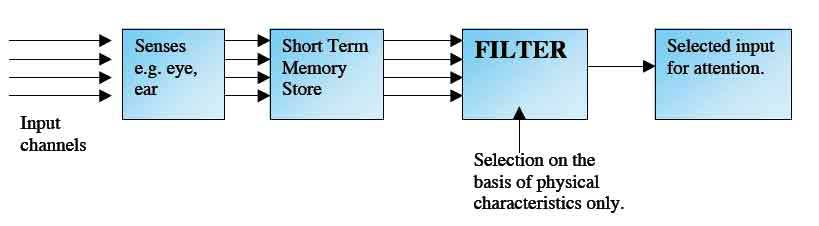
This framework relies on a serial processing structure: a system where information is handled one piece at a time in a specific sequence.
Broadbent argued that the brain functions like a single-channel computer with limited processing power.
Because we cannot process every sound or sight simultaneously, the mind must select specific data for higher-level analysis.
Mechanisms of the Information Pipeline
Information enters the cognitive system through the sensory register: a temporary storage area that briefly holds raw physical data from the environment.
This buffer preserves stimuli in their original form for a fraction of a second. Every sound, sight, or touch is represented here before any selection occurs.

Following the sensory register, a selective filter evaluates the physical properties of the incoming messages.
This mechanism identifies characteristics such as pitch, volume, or spatial location (e.g., which ear the sound enters).
Only one “channel” of information is permitted to pass through this filter.
Broadbent posited that all other stimuli are completely blocked and subsequently forgotten.
This is an early selection model: a theory suggesting that filtering occurs before any meaning is assigned to the data.
Once a message passes the filter, it moves into the limited-capacity channel.
This stage represents our conscious awareness where semantic analysis occurs: the process of identifying the meaning and significance of information.
Because the channel’s capacity is narrow, we only understand the messages that the filter prioritizes. Any information not selected at the filter stage never reaches this level of comprehension.
Broadbent wanted to see how people could focus their attention (selectively attend), and to do this; he deliberately overloaded them with stimuli.
One of the ways Broadbent achieved this was by simultaneously sending one message to a person’s right ear and a different message to their left ear.
This is called a split-span experiment (the dichotic listening task).
Empirical Validation: The Split-Span Task
Broadbent utilized the split-span experiment to prove that humans prefer filtering information based on physical location rather than chronological order.
-
Aim: To investigate whether the brain processes simultaneous auditory inputs by their physical channel or their temporal sequence.
-
Procedure: Participants were presented with three pairs of digits. One digit of each pair was played into the left ear while the other was played into the right ear. Participants were then asked to recall the digits in any order.
-
Findings: Participants were significantly more accurate when they recalled all digits from one ear first, followed by the digits from the other ear. They struggled to recall the digits in the pairs they were originally presented.
-
Conclusions: Switching between physical channels (the ears) requires cognitive effort and time. The results supported the existence of a filter that prefers to stay on one physical channel to maintain efficiency.
Evaluation of Broadbent’s Model
Broadbent’s Filter Theory posits that the human attentional system acts as a rigid bottleneck.
This bottleneck prevents irrelevant information from reaching semantic analysis: the process where the brain extracts the actual meaning of words.
Research consistently demonstrates that this “early selection” model is too restrictive.
Data show that unattended stimuli often undergo high-level processing before reaching conscious awareness.
Semantic Breakthrough: The Cocktail Party Phenomenon
Human cognition allows personally relevant stimuli to bypass physical filters.
This capability is colloquially known as the “Cocktail Party Phenomenon.”
It refers to the ability to focus on one conversation while still detecting significant words, like one’s name, from background noise.
This suggests that the brain monitors unattended channels for meaning, contradicting Broadbent’s claim that filters operate only on physical cues like pitch or location.
Study: Moray (1959)
-
Aim: To determine if highly significant verbal stimuli could bypass the selective filter.
-
Procedure: Participants performed a dichotic listening task where they shadowed (repeated aloud) a message in one ear. Their own name was inserted into the unattended message in the other ear.
-
Findings: The participant’s name was detected in the unattended ear in approximately 33% of trials.
-
Conclusions: Selective attention is not based solely on physical characteristics. The filter must allow for some level of semantic analysis to recognize personally relevant information.
Flexibly Shifting Attention: The “Dear Aunt Jane” Effect
Attentional selection often follows the logic of a sentence rather than the physical location of the sound.
This process is called semantic grouping: the cognitive act of organizing information based on meaning rather than physical source.
When messages are split across ears, listeners naturally “jump” between channels to make sense of the content.
Study: Gray and Wedderburn (1960)
-
Aim: To test if the filter selects information based on meaning or physical ear location.
-
Procedure: “Dear,” “7,” and “Jane” were played in the right ear. Simultaneously, “9,” “Aunt,” and “6” were played in the left ear.
-
Findings: Instead of reporting “Dear 7 Jane,” participants reported hearing “Dear Aunt Jane.”
-
Conclusions: The attentional system prioritizes meaningful sequences over physical channels. This indicates that the filter is more flexible than Broadbent originally proposed.
Subconscious Processing: Physiological Responses
Unattended information can trigger physical reactions even when a person cannot consciously recall the words.
This involves autonomic arousal: involuntary physiological changes, such as sweating, caused by the nervous system.
These responses prove that the brain analyzes the emotional or conditioned significance of words without the person’s awareness.
Study: Von Wright, Anderson, and Stenman (1975)
-
Aim: To investigate if unattended words are analyzed for meaning at a subconscious level.
-
Procedure: Participants were given a mild electric shock when hearing specific target words to create a conditioned response. These words were then played in the unattended ear during a shadowing task while measuring Galvanic Skin Response (GSR).
-
Findings: Participants showed increased GSR (sweating) when target words or synonyms were played in the unattended ear.
-
Conclusions: Semantic analysis occurs even without conscious perception. This suggests that the “bottleneck” is not absolute.
Methodological Criticisms of Early Selection
The rigid nature of Broadbent’s model may stem from the use of inexperienced participants.
Naive subjects—people who have never performed a specific psychological task—often struggle with the high cognitive load of shadowing.
Experience changes how the filter operates, allowing for more “leakage” or awareness of the unattended message.
Comparative Data: Participant Expertise
| Participant Type | Detection Rate of Unattended Digits |
| Naive Participants | 8% |
| Experienced Shadowers (e.g., Moray) | 67% |
Theoretical Evolutions: Attenuation and Late Selection
Shortcomings in the Filter Theory led to the development of the Attenuation Model.
This theory suggests that the filter does not “block” signals but instead attenuates them: it reduces the strength or “volume” of unattended information.
Alternatively, Late Selection models argue that all stimuli are fully processed for meaning, but only relevant information is stored in memory.
Broadbent later revised his views in 1971, acknowledging that filtering involves an interaction between physical cues and memory-based expectations.
Treisman’s Attenuation Model
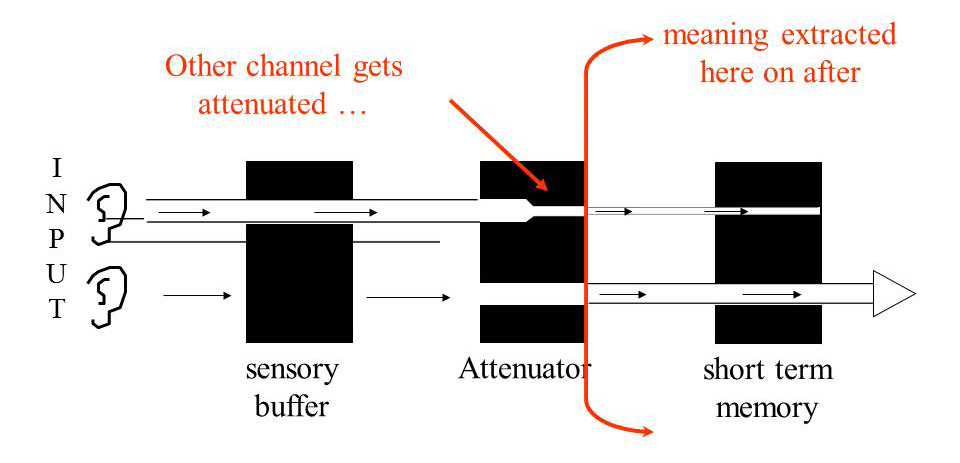
Treisman (1964) agrees with Broadbent’s theory of an early bottleneck filter. However, the difference is that Treisman’s filter attenuates rather than eliminates the unattended material.
Attenuation is like turning down the volume so that if you have four sources of sound in one room (TV, radio, people talking, baby crying), you can turn down or attenuate 3 to attend to the fourth.
This means people can still process the meaning of the attended message(s).
The Mechanism of Attenuation
The attenuation process functions as a flexible “leaky filter” that modifies the intensity of incoming sensory inputs.
Unlike earlier rigid models, this system does not operate on an all-or-nothing principle. It employs attenuation, which is the process of weakening the signal strength of unattended stimuli.
-
Selective Signal Processing: Attended messages pass through the filter at full strength for immediate cognitive evaluation.
-
Reduced Intensity: Unattended messages are weakened but not discarded entirely by the sensory system.
-
The Stimulus-Analysis System: Both signals move forward to the mental dictionary, a cognitive repository of stored word representations.
-
Threshold Activation: Each word in this dictionary has a specific threshold, which is the minimum signal strength required for recognition.
Hierarchy of Processing Stages
Information undergoes a systematic analysis through a hierarchy of increasing complexity.
If cognitive capacity is low, the system prioritizes the early stages over deeper semantic evaluation.
-
Physical Properties: The system first analyzes basic acoustic features like pitch, loudness, and location.
-
Pattern Recognition: Stimuli are then screened for phonetic patterns, specific syllables, or distinct words.
-
Semantic Evaluation: The final stage involves assessing the semantics, or the actual meaning and grammatical role of the word.
Thresholds and the Breakthrough Effect
The model explains why certain ignored stimuli, like your own name, suddenly grab your attention.
This occurs because different words have varying activation thresholds.
A threshold is the level of neural excitation needed to trigger conscious perception.
-
Permanent Low Thresholds: Biologically or socially significant words (e.g., “Fire” or your name) have permanently low thresholds. They require very little signal strength to be recognized.
-
Temporary Contextual Priming: The current conversation can temporarily lower the threshold for related words. This is known as priming, where a previous stimulus makes a related stimulus easier to process.
-
Probabilistic Filtering: Recognition depends on the mathematical probability that the weakened signal will meet the lowered threshold.
Empirical Validation: Treisman (1960)
Treisman conducted a pivotal study to test if meaning could influence attention during a shadowing task.
-
Aim: To determine if participants would follow the meaning of a sentence across different auditory channels.
-
Procedure: Participants were asked to shadow (repeat aloud) a message in one ear while ignoring the other. Mid-sentence, the meaningful content switched from the attended ear to the unattended ear.
-
Findings: Participants frequently spoke words from the unattended ear that completed the sentence logically.
-
Conclusions: The brain processes the semantics (meaning) of unattended information to maintain contextual flow. This finding directly refuted the idea that ignored information is blocked before meaning is extracted.
Empirical Validation: Treisman and Geffen (1967)
This experiment aimed to measure the exact degree of processing for unattended stimuli using a secondary task.
-
Aim: To compare detection rates of target words in shadowed versus non-shadowed ears.
-
Procedure: Participants shadowed one message and were instructed to tap whenever they heard a specific target word in either ear.
-
Findings: Detection reached 87% in the shadowed ear but dropped to only 8% in the unattended ear.
-
Conclusions: Information in the unattended channel is significantly attenuated (weakened) but remains present in the system. The low detection rate proves that while the signal exists, it rarely reaches the threshold for a motor response.
Comparison with Alternative Models
Treisman’s model serves as a middle ground between early-selection and late-selection theories. It addresses the flaws inherent in both rigid perspectives.
| Feature | Broadbent (Early) | Treisman (Attenuation) | Deutsch & Deutsch (Late) |
| Filter Location | Before semantic analysis. | Before semantic analysis. | After semantic analysis. |
| Ignored Info | Completely blocked. | Attenuated (weakened). | Fully processed for meaning. |
| Selection Basis | Physical traits only. | Physical and semantic traits. | Importance and relevance. |
Evaluation of Treisman’s Model
- Treisman’s Model overcomes some of the problems associated with Broadbent’s Filter Model, e.g., the Attenuation Model can account for the “Cocktail Party Syndrome.”
- Treisman’s model does not explain how exactly semantic analysis works.
- The nature of the attenuation process has never been precisely specified. Modern critics argue that identifying a word’s meaning requires more cognitive resources than an attenuated signal provides.
- A problem with all dichotic listening experiments is that you can never be sure that the participants have not actually switched attention to the so-called unattended channel.
Deutsch & Deutsch (1963)
The Late-Selection Filter Model posits that all sensory inputs undergo full semantic analysis before any selective filtering occurs.
Semantic analysis refers to the process where the brain automatically extracts the meaning and importance of a stimulus.
Unlike early-selection theories, this model suggests the cognitive bottleneck exists at the response stage.
A bottleneck is a point in a process where the flow of information is restricted due to limited capacity.
Core Mechanisms of Late Selection
Deutsch and Deutsch (1963) argued that the human brain processes every incoming signal to the level of meaning.
This means that unattended stimuli, such as background chatter, are fully understood by the subconscious mind. Awareness only occurs when a stimulus exceeds a specific threshold of pertinence.
Pertinence is defined as the momentary importance of an item based on the individual’s current goals or internal state.
Selection depends on the interaction between the signal strength and its assigned importance. Even a weak signal can enter consciousness if it is highly pertinent.
Your own name is a prime example of a permanently pertinent stimulus.
Because it is always relevant, it often “breaks through” from unattended channels into conscious awareness.
This mechanism explains why humans can shift focus to unexpected but critical environmental cues.
Empirical Validation: Key Studies
The debate between early and late selection was fueled by rigorous experimental testing. Researchers sought to determine if the brain truly processes the meaning of “ignored” information.
Treisman and Geffen (1967)
-
Aim: To test if target detection is equal in attended and unattended auditory channels.
-
Procedure: Participants were asked to shadow a message in one ear while tapping when they heard specific target words in either ear.
-
Findings: Targets in the shadowed ear were detected 87% of the time, whereas unattended targets were detected only 8% of the time.
-
Conclusions: The researchers concluded that unattended information is not processed as deeply as attended information, contradicting late selection.
Treisman and Riley (1969)
-
Aim: To eliminate task bias that might have hindered the detection of unattended stimuli in previous designs.
-
Procedure: Participants were instructed to stop shadowing immediately and tap upon hearing a target word in either ear.
-
Findings: Detection rates for the unattended ear rose to 33%, while the attended ear remained significantly higher at 76%.
-
Conclusions: While the attended ear still showed dominance, the increased detection in the unattended ear provided moderate support for late-selection processing.
Norman (1969)
-
Aim: To investigate if unattended words are briefly stored in a semantic format.
-
Procedure: Shadowing was interrupted at random intervals, and participants were asked to recall the most recent words from the unattended ear.
-
Findings: Participants could accurately recall the last few words from the unattended channel if they were prompted immediately.
-
Conclusions: This suggests that information from the ignored channel is processed and held briefly before being discarded from short-term memory.
References
Broadbent, D. (1958). Perception and Communication. London: Pergamon Press.
Broadbent, D. E. (1971). Decision and stress. Academic Press.
Cherry, E. C. (1953). Some experiments on the recognition of speech with one and with two ears. Journal of the Acoustical Society of America, 25, 975–979.
Deutsch, J. A., & Deutsch, D. (1963). Attention: Some theoretical considerations. Psychological Review, 70(1), 80–90.
Eysenck, M. W. & Keane, M. T. (1990). Cognitive psychology: a student’s handbook. Hove: Lawrence Erlbaum Associates Ltd.
Gray, J. A., & Wedderburn, A. A. (1960). Grouping strategies with simultaneous stimuli. Quarterly Journal of Experimental Psychology, 12(3), 180–184.
Moray, N. P. (1959). Attention in dichotic listening: Affective cues and the influence of instructions. Quarterly Journal of Experimental Psychology, 11, 56–60.
Treisman, A. M. (1960). Contextual cues in selective listening. Quarterly Journal of Experimental Psychology, 12(4), 242–248.
Treisman, A., 1964. Selective attention in man. British Medical Bulletin, 20, 12-16.
Treisman, A. M., & Geffen, G. (1967). Selective attention: Perception or response? Quarterly Journal of Experimental Psychology, 19(1), 1–17.
Von Wright, J. M., Anderson, K., & Stenman, U. (1975). Generalization of conditioned GSRs in dichotic listening. In P. M. A. Rabbitt & S. Dornic (Eds.), Attention and performance (Vol. V, pp. 194–204). London: Academic Press.
Von Wright, J. M., Anderson, K., & Stenman, U. (1975). Forced selection and the recall of unattended messages in a dichotic listening task. Attention and Performance V, 407–412.