Psychological problems is the study of mental health, what happens when it goes wrong, and how depression and addiction are described, explained and treated. In AQA GCSE Psychology (8182), it is Section D of Paper 2, worth 25 of the 100 marks. The topic covers unipolar and bipolar depression, antidepressants, CBT, Wiles’ study, dependence, Kaij’s twin study, aversion therapy and self-help groups.
Key Takeaways
Mental Health and Incidence
- Mental health is a person’s emotional and psychological wellbeing: how they feel about themselves, cope with everyday stress and take part in society.
- Incidence is how often a problem is recorded. It can change because more people notice problems, cultures differ, living is more isolating and stigma (unfair negative attitudes) lessens.
Effects of Mental Health Problems
- Individual effects fall on one person, such as damaged relationships. Social effects fall on society, such as more need for social care, more crime and costs to the economy.
Clinical Depression
- Unipolar depression is a continuous low mood. Bipolar depression swings between low, normal and manic (very high) moods. Sadness is a normal reaction that passes.
- Doctors use the ICD (International Classification of Diseases) to diagnose. It counts symptoms and their severity: low mood, low energy, changed sleep and appetite, and low self-confidence.
Depression Theories and Therapies
- Biology: an imbalance of neurotransmitters (brain chemicals), such as low serotonin, may cause depression.
- Psychology: negative schemas (lasting gloomy beliefs) and attributions (the reasons you give for events) may cause depression.
- Antidepressants raise the level of brain chemicals such as serotonin. CBT is a talking therapy that helps people spot and change unhelpful thinking.
- Reductionist means explaining a problem by one small part, such as brain chemicals. Holistic means looking at the whole person. Antidepressants are reductionist and CBT is less so.
- Wiles: people not improving on antidepressants stayed on them or also had CBT. At six months, 46 per cent with CBT improved by over half, against 22 per cent.
Characteristics of Addiction
- Addiction, or dependence, is a strong need for a substance, with withdrawal symptoms (unpleasant effects) when it is missing. Misuse means using a substance in a way it was not meant for.
- The ICD calls addiction dependence syndrome: a strong desire to use despite harm, difficulty controlling use, and putting the substance before other duties.
Addiction Theories and Therapies
- Genetic vulnerability is an inherited, higher chance of addiction, not a certainty.
- Kaij’s twin study: 54 per cent of identical twins (same genes) had the same level of drinking as their twin, against 28 per cent of fraternal twins (half the genes).
- Peer influence is friends and similar people leading you to copy them or fit in. Self-medication, using a substance to ease low mood, is a separate explanation.
- Aversion therapy links an unwanted behaviour to something unpleasant and is reductionist. Self-management programmes, such as Alcoholics Anonymous (a support group run by its members), are holistic.
Exam Skills
- Describe first, then evaluate with points about the named study. Match the command word, the word telling you what to do, and check what is asked, such as individual or social, nature or nurture.
Introduction to Mental Health and How the Incidence of Problems Changes Over Time
Everyone has mental health, just as everyone has physical health. This section covers what mental health is and why the number of recorded problems changes over time.
Incidence is how often a problem is recorded. A higher recorded rate does not always mean more people have a problem. People may now spot problems and ask for help.
In the exam you get marks for reasons why the number of people with significant problems has changed. Reasons include cultural beliefs, modern living and isolation, and more recognition. Less stigma and more people seeking help count too.
So does economic deprivation, which means having very little money. It can add stress.
Characteristics of Mental Health: Positive Engagement With Society and Effective Coping With Challenges
Mental health is a person’s emotional and psychological wellbeing. It covers how they feel about themselves.
It covers how they cope effectively with the stresses and challenges of daily life. It also covers how they take part in society.
A mental health problem is a difficulty with mental health. In the exam you get marks for these points when you explain what mental health means.
- Wellbeing: It is how well a person feels and thinks, emotionally and psychologically.
- Coping: It lets people cope and work well in everyday life and in society.
- Self and Life: It is how a person feels about themselves and how they deal with life.
- Other Credited Ideas: Good relationships, and not being overcome by difficult feelings.
Do not just repeat the words of the term, as in “someone’s mental wellbeing”. Do not call mental health “negative” or “a problem”. When a question gives a conversation or article, refer to it. Copying it out earns nothing.
Cultural Variations in Beliefs About Mental Health Problems
A culture is a group’s shared beliefs and rules. Cultures differ in what counts as a problem and in whether people seek help.
So the same behaviour may be recorded in one place and not in another. This changes the recorded rate without changing how many people struggle.
Increased Challenges of Modern Living, Such as Isolation
Modern living can cut people off from others. In the exam you get marks for “increased isolation” and “the challenges of modern living” as reasons rates have changed.
A review of studies that followed people over time found that lonely adults were more likely to develop new depression (Mann et al., 2022). This shows a link, not that modern living causes depression.
Increased Recognition of the Nature of Mental Health Problems and Lessening of Social Stigma
Increased Recognition
People now know more about mental health problems. Psychiatry, the branch of medicine for mental health, and ways of classifying problems began in the nineteenth century. Talking therapies and medication became widely available in the twentieth.
Campaigns such as Time to Change raise awareness. They show people the symptoms and where to get support. More people then spot a problem and are diagnosed, so the recorded rate rises.
Lessening of Social Stigma
Stigma is negative attitudes and unfair treatment towards people with a mental health problem, such as wrongly thinking they are to blame or dangerous. Most people with a mental health problem are not violent.
People can apply these ideas to themselves. This self-stigma can lower self-esteem and stop them asking for help (Corrigan et al., 2009).
When stigma lessens, more people ask for help and are diagnosed, so the recorded rate rises. Other reasons exist too, such as modern living.
Effects of Significant Mental Health Problems on Individuals and Society
A mental health problem can affect the person who has it and everyone around them. The exam asks you to keep these two apart.
Ask one question. Does the effect fall on one person, or on services, the economy or the community? Marks are only given for the side the question names.
Many students lost marks by writing individual effects when the question asked for social ones.
Individual Effects
Individual effects are the effects on the person with the problem. The specification gives three examples, and the exam credits more.
- Damage to Relationships: Relationships with family and friends can suffer.
- Difficulties Coping With Day to Day Life: Everyday tasks, such as going to school or work, can become hard.
- Negative Impact on Physical Wellbeing: Physical health can suffer too.
- Work and Money: Missing work, a risk of losing a job and financial difficulty are credited.
- Appointments: Attending appointments takes time and money.
- Fear of Crime: One question credited a person’s fear of being a victim of crime.
Social Effects
Social effects are the effects on society as a whole, such as costs to services, the economy and the community. The specification gives three examples, and the exam credits more.
- Need for More Social Care: Society needs more social care, which is help with daily life for people who cannot manage alone. Social housing and benefit payments are also credited.
- Increased Crime Rates: More crime means more policing and more demand on the justice system. This does not mean people with mental health problems are usually violent.
- Implications for the Economy: Society pays for health care and benefits. Productivity falls when people cannot work, and growth can slow.
- Health Care Staff: More health care professionals are needed, and demand on the NHS rises.
- Public Fear: Public fear of mental illness is also credited. It can leave people isolated.
If any of this sounds like you or someone you know, talk to a trusted adult or your doctor. Talking is a good first step.
Characteristics of Clinical Depression
Clinical depression is a long-lasting low mood, with other symptoms, that is serious enough to affect everyday life. It is more than feeling sad for a while.
This is a sensible reading, as the exam gives no definition.
Differences Between Unipolar Depression, Bipolar Depression and Sadness
Unipolar depression is a continuous low mood. Bipolar depression swings between low moods and manic moods, which are very high moods. Everyday sadness is a normal reaction that passes.
| Mood | Course | |
|---|---|---|
| Unipolar depression | A low mood that is continuous | Can recur or be lifelong, but many people get better |
| Bipolar depression | Low, normal and manic moods; the mood fluctuates | Lifelong, with no known cure, but it can be managed with treatment |
| Sadness | A normal reaction to something that has happened | Passes, and does not usually stop everyday life; not a diagnosis |
The exam gives no definition of sadness, so that row is a sensible reading. In the exam you get marks for one difference, with both sides described.
Examples are continuous against fluctuating mood, or low moods only against low, normal and manic moods.
The Use of the International Classification of Diseases (ICD) in Diagnosing Unipolar Depression
The International Classification of Diseases (ICD) is the World Health Organization’s list of illnesses and their symptoms. Doctors use it to diagnose.
For unipolar depression the ICD looks at the number and severity, or seriousness, of symptoms.
Duration also counts. The newest version, ICD-11, looks for symptoms most of the day, nearly every day, for at least two weeks. One exam question accepted “number” or “duration”.
The Symptoms in the Specification
- Low Mood: The person feels low.
- Reduced Energy Levels: The person has less energy and is less active.
- Changes in Sleep Patterns: The person sleeps more or less than usual.
- Changes in Appetite Levels: Appetite may go up or down.
- Decrease in Self-Confidence: The person has less belief in themselves.
Other Symptoms the Exam Credits
The exam also credits loss of interest or enjoyment, guilt or worthlessness, and poor concentration.
It credits hopelessness about the future and slowing down of thoughts and movements. Agitation, which is restlessness or anger, counts too.
One question asked which two items are not symptoms. The answers were hair loss and an increase in self-confidence.
When a question describes a person, name the symptoms and link each to something the person does.
Theories of Depression and Interventions or Therapies for Depression
A theory explains why people become depressed. A therapy is a treatment.
The specification gives one theory about nature, the influence of genes and biology. It gives another about nurture, the influence of upbringing and experience.
Biological Explanation (Influence of Nature): Imbalance of Neurotransmitters, Such as Serotonin in the Brain
Neurotransmitters are chemical messengers. They carry messages between neurons, or nerve cells. The messages cross the synapse, a tiny gap.
The biological explanation says depression may be caused by an imbalance of neurotransmitters. For example, a person may have too little serotonin, a neurotransmitter linked to mood.
It is a nature explanation because it is about the body’s chemistry.
Synaptic Transmission in Brief
A recent 9-mark question asked students to describe this first, then to discuss whether neurotransmitters help cause depression.
- Release: An electrical impulse reaches the synaptic knob, the end of the neuron. Vesicles, small sacs in the knob, open and spill neurotransmitters into the synapse.
- Binding: The neurotransmitters cross the gap and bind to receptors on the next neuron. Each receptor fits one particular chemical.
Evidence for the Neurotransmitter Explanation
- Brain Scans: Scans found lower levels of a serotonin receptor in depressed people than in people who were not depressed.
- Autopsies: In people who had many depressive episodes, fewer neurons released norepinephrine, which is also called noradrenaline.
- Link: Low serotonin may lower the level of norepinephrine.
- Drugs: Drugs that act on serotonin help many people.
Strengths of the Neurotransmitter Explanation
- Evidence: The scan and autopsy findings support it.
- Treatment: Drugs that raise serotonin relieve symptoms for many people, which may support the idea.
Limitations of the Neurotransmitter Explanation
- Cause or Effect: It is hard to know whether low levels cause depression or result from it.
- Measurement: Chemical levels in the brain are very hard to measure, and the brain is complex.
- Other Explanations: Psychological explanations also have evidence, so chemicals alone are unlikely to be the whole cause.
Many students answered the 9-mark question by evaluating antidepressants. Those are evidence for the idea, not the explanation itself.
Psychological Explanation (Influence of Nurture): Negative Schemas and Attributions
A schema is a mental package of knowledge built from experience. It shapes how we see the world. A negative schema is a lasting negative belief about yourself, the world or the future.
It makes people interpret events in a biased, pessimistic way and ignore positive views.
An attribution is the reason you give for why something happened. “It was all my fault” is an attribution.
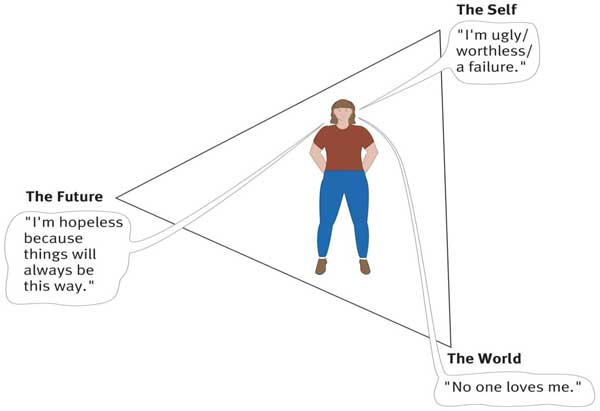
- Negative Triad: Beck (1967) proposed that depressed people hold gloomy views of themselves, the world and the future. Negative schemas and faulty thinking keep these views going.
- Learned Helplessness: Dogs given shocks they could not escape later failed to escape shocks they could easily avoid. Seligman and Maier (1967) said they had learned that nothing they did made a difference.
- Attributions: People who blame themselves for bad events and expect nothing to change may become depressed.
Imagine someone who gets a lower mark than a friend and thinks, “I’m useless at everything, and it will always be like this.” They blame themselves and expect nothing to change. This example is made up.
Evidence for the Psychological Explanation
Alloy et al. (2006) followed first-year students with no mental disorder for two and a half years. Those with a negative thinking style were more likely to develop depression.
Strengths of the Psychological Explanation
- Effective Treatment: Research into negative schemas and attributions led to CBT, which helps people spot and challenge negative thinking.
- Learned Helplessness: Research shows the harmful effect of certain thinking patterns.
- Measured Before Depression: Alloy et al. measured thinking before anyone was depressed, so it looks like a vulnerability.
Limitations of the Psychological Explanation
- Correlation: Much of the evidence is correlational, meaning it shows a link, not a cause. Negative thinking may be a symptom of depression, not its cause.
- Third Factors: Genes or early life could cause both the thinking and the depression.
- Sample Bias: The students may not represent older people or people with more severe depression.
- Nature Has Evidence Too: Chemical imbalances and genes are also part of why people become depressed. The best evaluation sets the two explanations side by side.
Many students lost marks on a question about this theory because they described nature instead.
Use of Antidepressant Medications
Antidepressants are drugs that increase the levels of certain neurotransmitters, such as serotonin and norepinephrine. A common type is the SSRI. It is a selective serotonin reuptake inhibitor.
Reuptake is when the sending neuron takes its neurotransmitter back in. An SSRI blocks this, so more serotonin stays in the synapse. The aim is to relieve the symptoms.
Strengths of Antidepressants
- Effectiveness: About half to two-thirds of people have some lessening of symptoms.
- Severity: They work better for moderate, severe and chronic depression, which is long-lasting, than for mild depression.
- Choice: Different drugs do not work in the same way for everyone, so a doctor can try another if the first does not suit.
Limitations of Antidepressants
- Placebo Effect: A placebo is a fake pill. About a quarter to a third of people also improve on a placebo, so some improvement may not come from the drug.
- Side Effects: Side effects, such as insomnia and dizziness, make some people stop. Anyone with side effects should talk to a doctor, not stop alone.
- Time Lag: Serotonin levels rise immediately, but the benefits take several weeks. Some people give up before the drugs work.
- Reductionist: This means explaining a problem by one small part. They concentrate on one aspect, brain chemicals, and deal with the symptoms, not the cause. Reductionist does not mean “reducing” the symptoms.
Cognitive Behaviour Therapy (CBT)
Cognitive behaviour therapy (CBT) is a talking therapy. It is based on the idea that thinking affects feelings, and feelings affect behaviour.
It helps people spot and change unhelpful thinking, such as negative schemas and cognitive distortions. Sessions can be one-to-one or in a group, and people are often given “homework” to practise between sessions.
CBT focuses on the here and now. Changing the thinking changes the feelings and the behaviour, which improves mental health.
Strengths of CBT
- Research Support: Wiles’ study, which you meet later in this section, found CBT plus antidepressants worked better than antidepressants alone.
- Less Reductionist: Reductionist means explaining something by one small part. CBT deals with more than the symptoms, because it looks at thoughts, feelings and behaviour.
Limitations of CBT
- Time and Money: Sessions may need to be attended for some time. People who cannot manage the time or cost may stop before any benefit.
- Here and Now: It focuses on the present, not on problems from the past.
- Biological Causes: It does not address biological causes, which limits how well it works for some people.
- Needs Willingness: It suits people who are happy to talk about their thoughts and feelings.
How These Improve Mental Health: Reductionist and Holistic Perspectives for Depression
A reductionist perspective says something is fully understood by simplifying it to its most basic parts, such as brain chemicals. A holistic perspective says all the parts are connected, so it is only understood by looking at the whole person and their life.
- Antidepressants: They are reductionist. They concentrate on one aspect, brain chemistry, and treat symptoms, not the cause.
- CBT: It is less reductionist, because it deals with more than the symptoms. It still stays with the here and now and does not address biological causes.
- CBT With Antidepressants: One exam scheme credited this as holistic. Another said not to give marks for combined therapies. So name one holistic therapy, such as counselling.
A theory can be called reductionist for its narrow focus. A study cannot, because studies are designed to look at certain aspects only. Reductionist does not mean “reducing” the behaviour.
Wiles’ Study of the Effectiveness of CBT
Wiles et al. (2013) tested whether CBT helps people whose depression has not improved on antidepressants.
A randomised controlled trial puts people into groups by chance and compares a treatment group with a control group, which does not get the treatment.
- Aim: To find out how effective CBT is for people with depression who had been prescribed antidepressants but were not improving.
- Participants: All had taken antidepressants for at least six weeks. People with bipolar disorder or substance addiction were not used. Nor were people already attending, or who had attended, CBT or counselling for depression.
- Method: Participants were randomly put into two groups. 234 were given CBT and stayed on their antidepressants. They had 12 individual one-hour sessions with a trained CBT practitioner.
- Control Group: 235 people carried on taking their antidepressants. Both groups could still use any other usual medical care for depression.
- Results, Six Months: 46 per cent of the CBT group showed more than 50 per cent improvement in symptoms, against 22 per cent of the control group.
- Results, Twelve Months: Those who had attended CBT kept showing greater improvement. They were also more likely to have had their symptoms reduced completely.
- Conclusion: CBT plus antidepressants was more effective in treating depression than antidepressants alone.
Strengths of Wiles’ Study
- Random Allocation: Choosing groups by chance reduces the effect of participant variables, which are differences between people, such as age. The groups are more alike.
- Control Group: It let the researchers see what CBT added to antidepressants.
- Longitudinal: A longitudinal study follows the same people over time. It showed how the benefit changed over twelve months.
- Ethics: Everyone kept using their usual medical care, so nobody was left without treatment.
- Real-World Use: It supports using CBT alongside antidepressants to treat depression.
- Support: Other research found similar results.
Limitations of Wiles’ Study
- Drop-Out: Not all participants completed the study. 32 per cent did not attend all 12 sessions, and only 84 per cent were followed up after a year.
- Self-Report: Symptoms were measured by self-report, which means people described their own symptoms. This is subjective, so it may not be entirely accurate. Participants may have moderated their answers to help the researcher.
- Real-Life Setting: Participants stayed in their normal lives. This makes it hard to control extraneous variables, which are other things that could change the results.
- Participant Controls: The researchers did leave out people with bipolar disorder or addiction, and people who already had CBT or counselling.
- Generalisability: This is a reasonable extra point. Everyone had depression that had not improved on antidepressants, so the results may not apply to other people.
Do not call this a laboratory study. Examiners list “it lacks ecological validity because it was in a lab” as a common error for this study.
Ecological validity means how well a study matches real life, and this trial ran in real life. Write about Wiles’ study, not CBT in general, and do not write about CBT for addiction.
Characteristics of Addiction
Addiction is a condition that doctors can diagnose and treat.
The Difference Between Addiction/Dependence and Substance Misuse/Abuse
Addiction, also called dependence, is a strong need to carry on using a substance. In the exam you need two ideas for full marks.
- Need: The brain or body only works normally when the substance is present.
- Withdrawal Symptoms: The person has unpleasant effects, called withdrawal symptoms, when it is missing.
Writing only that someone “depends” on a substance makes the answer less clear.
The exam gives no definition of the difference between dependence and misuse or abuse. The next lines are a sensible reading.
Substance misuse is using a substance, such as a drug, in a way or amount it was not meant for, such as taking more painkillers than prescribed.
Substance abuse is using a substance to excess, or in a way that harms the user or others.
Misuse and abuse describe how a substance is used. Dependence describes the person’s need for it.
In one question, using painkillers for something other than the prescribed use was not a sign of dependence syndrome.
The Use of the ICD in Diagnosing Addiction (Dependence Syndrome)
The ICD, the World Health Organization’s list of illnesses, calls addiction dependence syndrome. A syndrome is a group of signs that appear together. The specification names three signs.
- Strong Desire: A strong desire to use the substance, despite harmful consequences.
- Difficulty Controlling Use: The person finds it hard to control how much or when they use it.
- Higher Priority: The substance matters more to the person than other activities or obligations, such as school, work or family.
Dependence, tolerance and withdrawal are covered in more depth in A-level Addiction.
Theories of Addiction
Why do some people become addicted, and what helps? The specification gives one theory about nature and one about nurture. It then gives two therapies.
Biological Explanation (Influence of Nature): Hereditary Factors/Genetic Vulnerability
Hereditary means passed down from parents to children in their genes.
A genetic vulnerability is an inherited, increased chance of developing a problem, such as addiction. It is a chance, not a certainty.
In the exam you need both ideas. “Genetic” means to do with genes. “Vulnerability” means increased risk. Many students lost marks by not explaining “genetic”.
Strengths of the Genetic Explanation
- Twin Evidence: Kaij’s study, below, found identical twins were more alike in their drinking than fraternal twins.
- Later Research: A large study of people’s DNA linked many gene variants to problem alcohol use (Zhou et al., 2020).
Limitations of the Genetic Explanation
- Not Certain: Genes only raise the chance. In Kaij’s study, 46 per cent of identical twins did not match their twin.
- Nurture Too: Upbringing and friends also matter, as the next sections show.
Kaij’s Twin Study of Alcohol Abuse
A twin study compares twins to separate the effect of genes from the effect of upbringing. Identical twins share all their genes. Fraternal twins share about half. Kaij (1960) used this idea to study alcohol abuse.
- Aim: To investigate the effect of hereditary factors on addiction to alcohol, by comparing identical and fraternal twins.
- Participants: The twins were Swedish men, found using a register of known alcohol abusers kept by a temperance board. At least one twin in each pair was publicly known to abuse alcohol.
- Method: The twins and their families were interviewed, and used questionnaires, to find out about alcohol use. The twins were put into categories by level of alcohol use.
- What Was Compared: The concordance rate, the percentage of pairs in which both twins share the characteristic, for identical and fraternal twins.
- Results, Main Finding: 54 per cent of identical twins were in the same category of alcohol use as their twin, against 28 per cent of fraternal twins.
- Results, Registered: 61 per cent of identical twins were both on the board’s register, against 39 per cent of fraternal twins.
- Conclusion: Genetic factors are involved in alcohol addiction.
Do not write “54 per cent of identical twins abuse alcohol”. The figure is the concordance, the percentage who matched their twin. Examiners noted this error.
Strengths of Kaij’s Study
- Comparison: Both kinds of twin usually share a home, so comparing them helps to separate genes from upbringing. Identical twins may also be treated more alike, which is a limit below.
- Support: Later research supports the idea of genetic factors in alcohol use.
- Interviews: Structured interviews are easy to compare. Unstructured ones give detailed answers and feel like a conversation, so they are more like real life.
- Questionnaires: They collect a lot of information quickly with few materials. Participants know they are answering one, which helps make the study ethical.
Limitations of Kaij’s Study
- Self-Report: Alcohol use came from the twins and their relatives. This is subjective, and people may lie to give a socially desirable answer, which means one that looks good.
- Sample Bias: All the participants were male, twins and Swedish. So the findings may not apply to women, non-twins or other nationalities.
- Public Drinkers: At least one twin in each pair was publicly known to abuse alcohol, so the results may not represent people who drink heavily in private.
- Same Upbringing: Identical twins are often brought up the same way, so similar rates may come from nurture, not genes.
- Not Just Genes: The main finding was 54 per cent, so 46 per cent of identical twins did not match their twin. Other factors must matter.
- Interviews and Questionnaires: Structured interviews limit answers, and unstructured ones are hard to compare. Questionnaires give a limited range of answers, and nobody can check whether people lie.
Psychological Explanation (Influence of Nurture): Peer Influence
Peer influence means that a person’s behaviour and choices are affected by others who are similar to them, for example in age or social group. It can lead people to feel they must try a substance. Over time they may become addicted. It can also lead to positive behaviour.
The exam credits two ways peer influence can work.
- Social Learning Theory: We learn by watching others and often copy them, especially people we look up to, such as friends or role models.
- Social Identity Theory: We get self-esteem from the groups we belong to. Teenagers feel pressure to follow group norms to fit in.
Self-medication is another psychological explanation the exam credits. People start using a substance to feel better or ease pain. Over time they may become addicted. Environment, upbringing and trauma were also accepted.
In one question, two people started smoking because family and friends did. Credit went for peer influence, social learning, social identity and family habits. Genetic vulnerability, with Kaij as support, was also credited.
Many students lost marks. They repeated the information given, wrote about trying drugs instead of addiction, or gave their own opinion.
Strengths of Peer Influence
- Explains Starting: Teenagers feel close to their peers, so it explains why many start using a substance.
Limitations of Peer Influence
- Correlation: Evidence is mostly correlational. People choose their friends, so a link does not prove that friends cause the use.
- Not the Whole Story: Genetic, personality, social and stress factors all raise the chance of addiction, and none is enough alone.
Interventions or Therapies for Addiction
Aversion Therapy
Aversion therapy tries to stop a person using a substance.
It makes them feel something unpleasant when they use it. The behaviour and the bad feeling become linked. It is based on classical conditioning, which is learning by association.
- Emetic Example: A person with an alcohol problem takes an emetic, a medicine that causes vomiting, whenever they have an alcoholic drink.
- Electrical Example: A safe but painful electric shock is given during the unwanted behaviour, for example gambling.
- How It Improves Mental Health: The person learns to link the behaviour with something unpleasant, so they avoid it.
Strengths of Aversion Therapy
- Short-Term Success: Studies have shown short-term success in treating addictions.
- Established Learning: It uses classical conditioning, a well-established way of learning.
- Can Be Combined: It can be used with other treatment, such as CBT, which makes it more holistic.
Limitations of Aversion Therapy
- Short-Term Only: The benefits may last only a short time, so other support may be needed.
- Drop-Out: It is an unpleasant treatment, so many people drop out, and for them it does not work.
- Consent: Its unpleasant nature raises ethical concerns. The process should be fully explained and informed consent gained.
- Reductionist: It focuses only on the behaviour and does not address the underlying causes of addiction.
Examiners say the ethical point is not that the therapy is “harmful”. The harm from the addiction is generally far greater. Write about whether the person was told enough and whether their consent was voluntary or forced.
Self-Management Programmes: Self-Help Groups and 12 Step Recovery Programmes
A self-management programme is a group of people with the same problem who share experiences and support each other. Examiners stress that it does not mean managing your addiction alone.
Examples are self-help groups and 12 step recovery programmes, which work through twelve steps towards recovery. The best known is Alcoholics Anonymous. It is run by its members, not by professional therapists.
These programmes help people deal with the need to use a substance. They also help people think about why they became addicted, such as trauma or loss.
Strengths of Self-Management Programmes
- Holistic: They deal with the need to use the substance and with other factors, such as environment, social life, trauma or loss.
- Similar Success: Some research finds no clear difference in success from other treatments. A large review found 12 step programmes about as effective as CBT on most measures (Kelly et al., 2020).
- Support and Cost: Members support each other, and Alcoholics Anonymous groups have no fees.
Limitations of Self-Management Programmes
- Regular Attendance: They work best when attended regularly and for a long time.
- Drop-Out: About four in ten to six in ten people are reported to drop out.
- Sharing: People must be willing to share personal feelings, so it may not suit everyone.
- Motivation: They work best when the person is ready to change.
- No Control Groups: It is hard to compare with a group who get no treatment, as it would be unfair to leave people without help. This makes the evidence less reliable.
How These Improve Mental Health: Reductionist and Holistic Perspectives for Addiction
The exam can ask you to compare aversion therapy with self-management programmes.
Use the reductionist and holistic perspectives. Reductionist means explaining something by its most basic parts. Holistic means looking at the whole person and all the linked factors.
- Aversion Therapy: On its own it is reductionist. It only changes the link between the behaviour and its pleasure, by adding something unpleasant. With CBT it is more holistic.
- Self-Management Programmes: They are holistic. They deal with the urge to use and with other factors, such as environment, social life, trauma or loss. Talking therapies, counselling and psychotherapy are also credited as holistic.
- Comparison: So self-management programmes tend to be more holistic than aversion therapy, which is more reductionist.
Write a real comparison, not two separate descriptions. Describing or evaluating each therapy on its own is unlikely to earn credit.
If you or someone you know is struggling with alcohol or drugs, talk to a trusted adult or a doctor.
Research Methods in Psychological Problems Questions
Paper 2 tests research methods inside every topic, here with mental health and addiction as the setting. Questions have asked for an interview design, a way to protect anonymity, a percentage, and the median shown on a bar chart.
Opportunity sampling is biased when people are known to the researcher. Quick and efficient is a strength of a sampling method.
For random sampling, list the target population, pick names by a random method and stop at the number needed. Do not describe random allocation, which puts people into groups.
A strength of random sampling is no researcher bias. A weakness is that it takes time. For an ethical issue, give a way that matches it, such as numbers, not names, for confidentiality.
How the Exam Asks About Psychological Problems
Psychological problems is worth 25 marks. AO1 is knowledge, AO2 is applying it and AO3 is evaluation. The mix changes each year.
Command Words
- Identify, Give, State or Suggest: Give one answer, with no reason.
- What Is Meant By: Give a short, accurate meaning that covers every word of the term.
- Describe or Outline: For a study, give the aim, method, results and conclusion.
- Briefly Evaluate: Give strengths and limitations linked to the named study or therapy. Saying a study is weak because it did not look at something else earns nothing.
- Describe and Evaluate: Do both. Answers are marked in levels, and a long description with little evaluation cannot reach the top level.
- Discuss Whether or Not: Weigh both sides and reach a conclusion.
- Compare: Compare through both perspectives. Describing self-management, or evaluating each therapy alone, is unlikely to earn credit. The top level needs effective analysis from both perspectives.
- Refer to the Article or Conversation: Use the information given. Only repeating it earns nothing.
What Examiners Look For
- Define Every Word: In “mental health” and “genetic vulnerability” answers, many students defined only part of the term.
- Answer the Right Theory: In a nurture question, most students described nature. In a Wiles question, some described CBT in general or CBT for addiction.
- Keep Two Things Apart: Individual effects are not social effects. A rise in the recorded rate is not a fall in discrimination.
- Match the Way to the Issue: An ethical issue needs a way of dealing with it that fits. For aversion therapy, write about consent, not “harm”.
- Explanation, Not Treatment: In a 9-mark neurotransmitter question, many students wrote about antidepressants instead.
- Do Not Over-Write the Description: Students who wrote far more than asked about a theory, such as Dweck’s, had little room left for evaluation.
- The Linked 9-Marker: One 9-mark question joined this topic with brain and neuropsychology. Read both topic pages.
How the Studies and Theories Are Marked
- Mental Health: A 3-mark question: 2 marks for the meaning and 1 for using the conversation.
- Rates Over Time: A 6-mark discussion of awareness and stigma, with an article.
- Neurotransmitters: A 9-mark question: 4 marks for describing synaptic transmission and 5 for discussing the evidence.
- Antidepressants and CBT: A 3-mark brief evaluation, or a 9-mark describe and evaluate one therapy.
- Wiles: A 4-mark description and a 5-mark evaluation.
- Kaij: A 3-mark outline, a 3-mark or 4-mark evaluation, and a 9-mark question on the method used.
- Peer Influence: A 4-mark question: 2 marks for the explanation and 2 for applying it.
- Aversion Therapy and Self-Management: A 3-mark evaluation of aversion therapy, a 4-mark evaluation of self-management and a 3-mark application of it, and a 9-mark comparison.
Practice Question 1: Describe and Evaluate Wiles’ Study of CBT (9 Marks)
These model answers are examples. They are not the exam board’s own wording.
Model answer: Wiles tested how effective CBT is. The people had depression and were not improving on antidepressants.
Participants were randomly put into two groups. 234 had 12 one-hour CBT sessions and stayed on their antidepressants. A control group of 235 carried on taking only their antidepressants.
At six months, 46 per cent of the CBT group had improved by more than half. Only 22 per cent of the control group had. Wiles concluded that CBT plus antidepressants works better than antidepressants alone.
One strength is random allocation. It reduces the effect of participant variables, so the groups are more alike. Another is that everyone kept their usual medical care, so nobody went without treatment.
One limitation is drop-out. Only 84 per cent were followed up after a year, so results may be missing people. Another is self-report. Participants may have changed their answers to help the researcher. A third is that people stayed in real life, so extraneous variables were hard to control.
- Marking Note: In one exam, a 4-mark question asked for the description and a 5-mark question for the evaluation. Evaluation points must be about Wiles’ study.
Practice Question 2: Briefly Evaluate Kaij’s Twin Study (3 Marks)
Model answer: One limitation is that the information came from interviews and questionnaires. This is self-report, and people may lie about how much they drink to look good.
Another limitation is the sample. All the twins were Swedish men. At least one twin in each pair was known to abuse alcohol. So the findings may not apply to women or other groups.
A strength is that the study compared identical and fraternal twins. This helps to separate genes from upbringing. So genes may play a part.
- Marking Note: Each point must be about this study. A general point about any study earns less.
References
Alloy, L. B., Abramson, L. Y., Whitehouse, W. G., Hogan, M. E., Panzarella, C., & Rose, D. T. (2006). Prospective incidence of first onsets and recurrences of depression in individuals at high and low cognitive risk for depression. Journal of Abnormal Psychology, 115(1), 145–156. https://doi.org/10.1037/0021-843X.115.1.145
Beck, A. T. (1967). Depression: Clinical, experimental, and theoretical aspects. Hoeber.
Corrigan, P. W., Larson, J. E., & Rüsch, N. (2009). Self-stigma and the “why try” effect: Impact on life goals and evidence-based practices. World Psychiatry, 8(2), 75–81. https://doi.org/10.1002/j.2051-5545.2009.tb00218.x
Kaij, L. (1960). Alcoholism in twins: Studies on the etiology and sequels of abuse of alcohol. Almqvist & Wiksell.
Kelly, J. F., Humphreys, K., & Ferri, M. (2020). Alcoholics Anonymous and other 12-step programs for alcohol use disorder. Cochrane Database of Systematic Reviews, 2020(3), Article CD012880. https://doi.org/10.1002/14651858.CD012880.pub2
Mann, F., Wang, J., Pearce, E., Ma, R., Schlief, M., Lloyd-Evans, B., Ikhtabi, S., & Johnson, S. (2022). Loneliness and the onset of new mental health problems in the general population. Social Psychiatry and Psychiatric Epidemiology, 57(11), 2161–2178. https://doi.org/10.1007/s00127-022-02261-7
Seligman, M. E. P., & Maier, S. F. (1967). Failure to escape traumatic shock. Journal of Experimental Psychology, 74(1), 1–9. https://doi.org/10.1037/h0024514
Wiles, N., Thomas, L., Abel, A., Ridgway, N., Turner, N., Campbell, J., Garland, A., Hollinghurst, S., Jerrom, B., Kessler, D., Kuyken, W., Morrison, J., Turner, K., Williams, C., Peters, T., & Lewis, G. (2013). Cognitive behavioural therapy as an adjunct to pharmacotherapy for primary care based patients with treatment resistant depression: Results of the CoBalT randomised controlled trial. The Lancet, 381(9864), 375–384. https://doi.org/10.1016/S0140-6736(12)61552-9
Zhou, H., Sealock, J. M., Sanchez-Roige, S., Clarke, T.-K., Levey, D. F., Cheng, Z., Li, B., Polimanti, R., Kember, R. L., Vickers Smith, R., Thygesen, J. H., Morgan, M. Y., Atkinson, S. R., Thursz, M. R., Nyegaard, M., Mattheisen, M., Børglum, A. D., Johnson, E. C., Justice, A. C., Palmer, A. A., McQuillin, A., Davis, L. K., Edenberg, H. J., Agrawal, A., Kranzler, H. R., & Gelernter, J. (2020). Genome-wide meta-analysis of problematic alcohol use in 435,563 individuals yields insights into biology and relationships with other traits. Nature Neuroscience, 23(7), 809–818. https://doi.org/10.1038/s41593-020-0643-5