Friendships should lift you up, not wear you down. A toxic friendship is one where a friend’s behavior consistently leaves you feeling drained, disrespected, or belittled rather than supported.
Research links a healthy friendship environment to better psychological well-being, so identifying and addressing a toxic friendship is an act of self-care, not an overreaction.

Signs of Toxic Friends
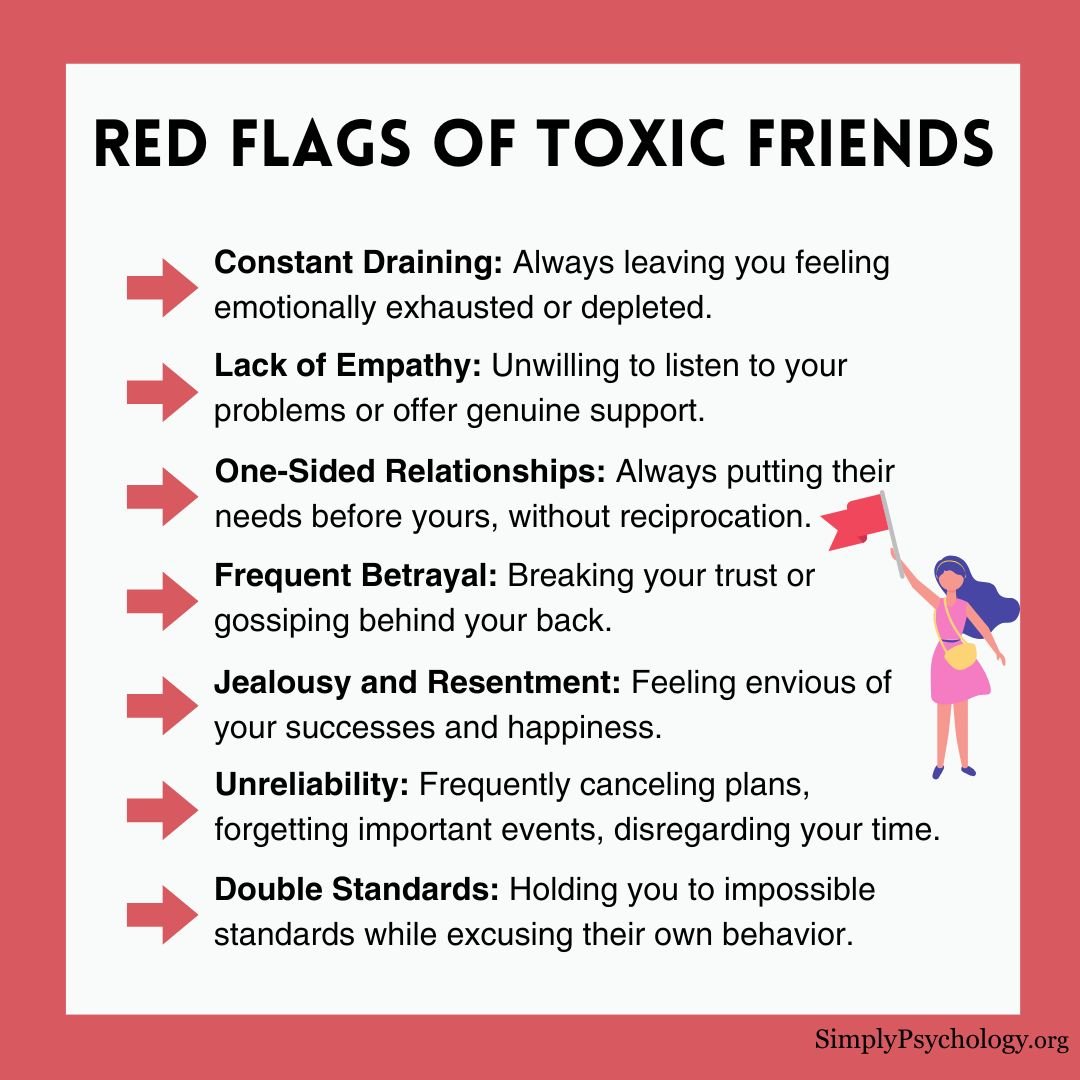
Even one or two of these red flags can indicate an unhealthy dynamic:
- Constant Negativity: Endless complaining, pessimism, or drama.
- Lack of Support: Reluctance to celebrate your wins or show up for you in hard times.
- Jealousy: Resentment or envy toward your achievements and happiness.
- Manipulation and Control: Guilt-tripping or pressuring you into things against your will.
- Unwarranted Criticism: Belittling your choices, appearance, or achievements.
- Double Standards: Holding you to rules they do not follow themselves.
- Unreliable and Flaky: Canceling plans and disregarding your time.
- Betrayal: Breaking trust or gossiping behind your back.
- One-Sided Relationships: Expecting support without reciprocating it.
Constant Negativity
- Endless complaining, pessimism, and/or drama.
Lack of Support
- Reluctance to celebrate your successes or provide encouragement during challenging times.
- Belittling your achievements or dismissing your goals (e.g., “Anyone could have got that promotion”).
Jealousy
- Displaying resentment or envy towards your achievements and happiness (e.g., making snide remarks about your accomplishments).
Manipulation and Control
- Pressuring or guilt-tripping you into doing things against your will (e.g., “If you cared about me, you would cancel your plans to be with me”).
- Attempting to control your decisions.
Unwarranted Criticism
- Belittling your choices, appearance, or achievements.
- Their “constructive criticism” often feels hurtful and lacks genuine support.
Double Standards
- Holding you to impossible expectations while readily violating their own.
- Making excuses for their bad behavior but judging yours harshly.
Unreliable and Flaky
- Canceling plans last minute.
- Forgetting important events.
- Showing disregard for your time and commitments.
Betrayal
- Breaking trust or gossiping behind your back (e.g., sharing personal information you told them in confidence).
One-Sided Relationships
- Expecting support without reciprocating or being emotionally unavailable (e.g., always venting but never listening to your concerns).
As relationship therapist Esther Perel explains, reciprocity is close to a defining condition of friendship. Unlike romantic love, she argues, “you cannot be a friend with someone who isn’t friends with you.”
A one-sided friendship has, in an important sense, already stopped working as a friendship.
Learn more about the signs of toxic people here.
Why Patterns Matter More Than Isolated Incidents
Patterns matter more than single incidents. Even one or two of the signs above are worth taking seriously if they keep recurring, and that is not just an arbitrary rule of thumb.
It has real research behind it.
Psychologists who study close relationships have long separated the positive, sustaining side of a bond from its negative, harmful side. One of the most influential early studies of the two found that they do not simply cancel each other out.
Psychologist Karen Rook tested this directly. In a 1984 study, she surveyed 120 widowed women aged 60 to 89, asking each to report the positive support she received from people close to her.
She also asked about the negative interactions she experienced, such as unwanted advice or being let down. Then she compared the two.
Negative interactions predicted well-being far more strongly and consistently than positive support did. A small amount of relational negativity outweighed a much larger amount of relational positivity in its effect on how people felt.
Researchers call this the negativity effect. A relationship’s harmful moments carry disproportionate psychological weight relative to its good ones.
That is why weighing a friendship by tallying its overall goodness can be misleading. A generally warm friendship does not automatically cancel out a recurring toxic pattern.
The pattern is what counts.
Rook’s sample was narrow, older widowed women, so how directly it applies to a young adult’s friendships is untested by the study itself. The design was also correlational, so it cannot rule out that people already struggling with well-being simply noticed more negativity in their relationships.
Even so, the pattern held. It has proven durable enough to organize decades of later research on friendship, described more fully in the Contemporary Research section below.
In practice, this means a friend who is wonderful nine days out of ten but reliably cruel on the tenth is not “mostly a good friend.”
The bad day matters more. It does more damage than the nine good ones repair. That is exactly why a recurring pattern, however occasional, is a genuine warning sign rather than something to weigh against the good times.
That standard is worth applying honestly when deciding whether a friendship is worth repairing or worth leaving.
Considering the Roots of Toxic Behavior
Toxic behaviors should not be tolerated long-term. But it can be useful to reflect on what may be driving your friend’s toxicity.
If this is new or uncharacteristic behavior, explore whether they are going through a difficult period. Context can matter.
Stressors like grief, job loss, or mental health struggles can temporarily impact relationships. Certain conditions, such as ADHD or trauma, can also affect emotional regulation and impulsivity in ways that spill into friendships.
That does not excuse harm, though. Your friend may still benefit from support and compassion during this time, and gentle encouragement toward counseling or other help where appropriate.
Examining root causes does not excuse harm but can provide context to better assess if positive change is possible. Momentary grace and empathy may aid that.
However, recurring toxicity without accountability or effort to improve goes beyond circumstance and requires firmer boundaries.
Deciding Whether to Stay or Leave
It is important to understand that you cannot fix your friend’s toxicity for them.
No amount of giving, caring, or listening will ever be able to fix the relationship that someone has with themselves. Only they can do that.
Truly examine the emotional toll of preserving this friendship and its harmful effects on your well-being. Contemplate making a change for your own peace of mind.
Two Paths Forward: Repair or Let Go
Communicate and enforce boundaries to minimize contact. Decide to confront your friend and resolve the problems causing this unhealthy dynamic. You may see that this is a bond better kept at a distance, interacting less frequently.
Let go of the friendship. If you conclude the friendship does more injury than good, you could completely dissolve it.
That may seem drastic, but releasing a poisonous tie creates space for more positive, empowering and meaningful connections, potentially lowering stress and bringing you joy.
To make your decision, you may have to evaluate your tolerance level, which you can get a better idea of by taking our quiz at the end of this article.
Communicate and enforce boundaries
If you choose to fix the friendship, learn how to communicate and enforce boundaries below:
How to effectively communicate with your toxic friend
Addressing a toxic friend directly can feel daunting, but effective communication can lead to positive change, possibly salvaging the relationship.
Setting a positive tone in your communication involves expressing your needs and expectations in a clear, direct, and constructive manner.
Start by calmly highlighting specific behaviors causing you distress. For instance, if constant negativity is an issue, communicate your desire for more positive and uplifting conversations.
Articulate your feelings and concerns using “I” statements to express your experiences. Avoid accusatory language, and instead, suggest solutions or boundaries. For example:
- “I need our friendship to be supportive, and this behavior makes it difficult.”
- Instead of a vague “you make me feel bad,” say, “when you make jokes about my appearance, it hurts my feelings. I need you to respect my boundaries around hurtful humor.”
Practice recognizing emotional manipulation, such as gaslighting (making you doubt your own memory or perception of events) or guilt trips. Do not engage in arguments or justifications. Simply reaffirm your boundaries. Remember, your feelings are valid.
How to set clear boundaries with your toxic friend
Define what you will and will not tolerate. Explicitly communicating your limits and expectations helps you create respectful friendships that ensure both people feel heard and valued.
This involves defining the qualities and behaviors you consider essential in a healthy friendship. For example, what does emotional support look like to you? Communicate these expectations with your friends.
As Esther Perel points out, setting a boundary does not have to mean losing the friendship. She frames maintaining a boundary as compatible with staying close to a friend, not opposed to it.
For instance, if your friend constantly criticizes you, express that you will not tolerate such behavior. Use “I” statements to assert your feelings without sounding accusatory.
Be specific–instead of a vague “please be nicer,” try, “I will not engage in conversations that belittle me, and I expect you to apologize when you cross that line.”
Be clear about the consequences for violating your boundaries. For example: “If you cancel plans again at the last minute, we will not be able to hang out for a while.”
Reinforce your boundaries by consistently enforcing consequences when they are crossed.
How to limit contact and take a break from your toxic friend
If a friend’s negativity or manipulation becomes overwhelming, consider physically or emotionally distancing yourself by limiting your contact and taking a break.
Create emotional space to reassess the relationship and its impact on your mental health. This matters just as much over text and social media, where a friend’s likes, comments, and visible closeness with other people become extra data points for comparison and hurt.
To carry this out effectively:
- gradually decrease communication (reduce or stop phone calls, texts, and in-person meetups);
- explain your need for space;
- use the time apart to gain clarity;
- do not feel pressured to justify it.
Remember, this is not abandonment; it is prioritizing and preserving your mental well-being, allowing you to rebuild strength and perspective.
“If you can slow down in your interactions with people whether it’s text message email in person over the phone you will have a lot more control over yourself and it will help you to better protect yourself and your energy and your anger when you are dealing with this person.”
Stephanie Lyn, Life & Relationship Coach
Let Go Of The Friendship
How to safely end the friendship
If setting boundaries has not worked and your well-being remains threatened, ending the friendship is the healthiest choice. Not all friendships can be salvaged.
Concluding the relationship involves assertive communication. Be honest and clear about your feelings, and express your decision respectfully but firmly.
You can say something like, “Our friendship is causing me more harm than good, so I need to step back.” You do not owe them a lengthy explanation.
Cut ties in a way that minimizes confrontation but prioritizes your well-being.
Practicing self-care after ending a toxic friendship
It is normal to feel a sense of grief after ending a toxic friendship, even if you know it was for the best. Use this time for yourself and meet your needs.
Prioritizing your mental, emotional, and physical well-being involves scheduling time for activities that make you feel good and making sure they get done.
Identify activities and practices that bring you comfort, joy, and relaxation, especially during difficult times. Incorporate them into your daily routine.
Create a personalized self-care plan to help replenish your energy. This could include:
- spending time with supportive people;
- engaging in hobbies you enjoy;
- mindful practices like journaling, meditation, or spending time in nature;
- developing self-compassion;
- seeking professional help if needed.
Prioritizing self-care is not selfish; it is necessary for maintaining overall health and remaining resilient and better equipped to cultivate positive relationships.
Creating a support network after ending a toxic friendship
Having a reliable support network boosts emotional resilience. A 2023 systematic review pooled 38 studies published between 2000 and 2019 and found that supportive, high-quality friendships consistently predict better wellbeing across the reviewed research.
A robust support network validates your feelings and reinforces your capacity to make decisions in the best interest of your well-being.
Identify allies who can offer:
- empathy, guidance, and encouragement;
- a safe space for venting;
- active listening without judgment;
- validation of your feelings.
Seek out those who have had similar experiences and can offer shared wisdom.
Trusted friends, understanding family members, a therapist, or even colleagues can provide valuable perspectives and a compassionate ear.
Furthermore, do not underestimate the power of online communities or support groups, where anonymity can provide extra comfort and connection.
Healing from the impact of a toxic friend
Explore resources like books, podcasts, or support groups tailored to recovering from unhealthy relationships. These can offer valuable insights and validation.
Recognize that certain patterns or vulnerabilities may have attracted this situation, but avoid self-blame.
Instead explore potential personal patterns that might attract toxic friendships, and use this knowledge to empower future choices.
Reflect on your experience and consider seeking professional help if needed.
Cultivating self-compassion helps you release any burdens of guilt and move toward personal growth and healing:
- Treat yourself with the same compassion you would show a loved one facing a similar challenge.
- Celebrate your courage in setting boundaries.
- Forgive yourself for any lapses in judgment, perceived shortcomings, or decisions that led to the toxic relationship.
Practice forgiveness towards the other person, not for them, but for your own peace.
Contemporary Research
What Behaviors Actually Make a Friendship Toxic?
Rook established that negative interactions matter more than positive ones. A newer body of work has tried to pin down exactly which behaviors do that damage.
The strongest evidence comes from a large 2022 meta-analysis pooling correlational data on 22,657 children and adolescents from studies published between 1995 and 2021.
It measured four specific behaviors: aggression, social withdrawal, assertion, and prosocial behavior. The results were not symmetrical.
Aggression was the behavior most strongly linked to a friendship turning negative. Prosocial behavior, by contrast, was the behavior most strongly linked to a friendship feeling positive.
A “good friend” and a “bad friend” are not simply opposite ends of one scale. Different behaviors drive each direction.
A separate 2022 survey of Islamic university students in Indonesia found the same basic pattern in an adult, non-Western sample. Exposure to toxic friendship dynamics significantly predicted poorer psychological well-being there too, extending the meta-analysis above beyond childhood and beyond Western samples.
Where the “Toxic Friend” Label Comes From
“Toxic friend” is not a clinical term. It is a popular-advice category, and a 2023 study examined where it actually comes from.
Researchers analyzed a large body of online popular advice about difficult and toxic friendships. The pattern repeats. It shows how the advice genre constructs “the toxic friend” as a category, and how it instructs readers to identify and respond to one.
They found that this advice consistently frames the problem as one the “healthy” party must diagnose and manage alone.
That is not quite fair. It is really a two-person dynamic, not one person’s job to fix.
That is a useful reminder for a guide like this one, built substantially from that same advice genre. The nine signs above are a genuinely useful starting vocabulary, not a validated diagnostic checklist.
Toxic Friendship Quiz
Ever feel drained, belittled, or manipulated after spending time with a friend? Wondering if your friend might be crossing lines?
Take this quiz to explore if your friendship might be harboring some toxicity. Be honest with yourself and answer based on your gut feeling.
For each question, choose the answer that best describes your experience with your friend.
How do you feel after spending time with your friend?
a. Energized and happy! We lift each other up.
b. Neutral, but not particularly excited or inspired.
c. Drained and emotionally exhausted.
d. Anxious, stressed, or negative, like I am walking on eggshells.
How often do you feel criticized or judged by your friend?
a. Rarely to never. We encourage and support each other.
b. Occasionally, but usually with good intentions.
c. Often, and it feels hurtful and discouraging.
d. Constantly, to the point where I doubt myself.
Does your friend respect your boundaries and commitments?
a. Absolutely! They understand and support my needs. My boundaries are respected, and we communicate openly about them.
b. Sometimes my boundaries are forgotten or ignored, but my friend apologizes later.
c. They often disregard my boundaries or pressure me to bend them.
d. My friend constantly disregards my boundaries without remorse, and I feel unheard.
How would you describe your communication?
a. We communicate openly and honestly, addressing issues directly and respectfully.
b. Sometimes communication gets rocky, but we resolve things eventually.
c. Important issues are often avoided or swept under the rug.
d. I feel uncomfortable expressing my feelings due to fear of judgment.
Does your friend make you feel guilty or obligated to do things you are uncomfortable with?
a. Never. They understand my limits and respect my choices.
b. Very rarely, and we always discuss it beforehand.
c. Sometimes, and I feel pressured to give in to avoid conflict.
d. Often, and I feel manipulated into doing things I don’t want to.
Do you trust your friend?
a. I trust my friend completely with my secrets and confidences.
b. There have been minor breaches of trust, but we have worked through them.
c. I am hesitant to share some things due to past betrayal.
d. I cannot fully trust my friend, and they regularly break promises.
Does your friend keep secrets or gossip about you or others?
a. No way! They are trustworthy and keep my secrets.
b. Maybe once or twice, but they apologized and learned from it.
c. Occasionally, and it makes me feel anxious about being talked about.
d. Frequently, and I cannot trust them with anything personal.
Does your friend display controlling behavior?
a. My friend respects my independence and avoids manipulation tactics.
b. They might occasionally try to influence me, but it is not malicious.
c. I sometimes feel pressured to do things for them I do not want to.
d. My friend constantly tries to control my decisions and uses guilt trips.
Is your friend supportive?
a. My friend is my biggest cheerleader, celebrating my successes and supporting my goals.
b. They are generally supportive but might express some doubts.
c. Their support feels conditional or focused on themselves.
d. I rarely feel genuine support from my friend.
Is your friendship reciprocal?
a. The friendship feels balanced and supportive, with mutual effort from both sides.
b. There might be some imbalance, but it is not a major concern.
c. I feel as if I give more than I receive in the friendship.
d. My friend takes advantage of me and rarely reciprocates support.
Does your friend truly celebrate your successes and achievements?
a. Absolutely! They are one of my biggest cheerleaders and celebrate my wins.
b. They are happy for me, but sometimes express doubt or negativity.
c. They might acknowledge my success, but often downplay it or shift the focus.
d. They seem jealous or dismissive of my accomplishments. They often belittle my achievements.
Does your friendship help you grow or have a positive effect on your life?
a. The friendship motivates me to grow and inspires me to be a better person.
b. It has some positive aspects, but also hinders my progress sometimes.
c. I feel stuck and discouraged due to the negativity in the friendship.
d. The friendship is overall harmful and hinders my personal growth.
Results:
Mostly As: Your friendship seems healthy and supportive! Keep nurturing it, and enjoy your positive connection!
Some Bs or Cs: Your friendship might have some minor issues, but communication and boundary setting can strengthen it.
Multiple Cs or Ds: Watch out for warning signs! This friendship exhibits some toxic behaviors. Evaluate its impact on your well-being, and consider talking to a trusted friend, family member, or therapist for guidance about this friendship.
Mostly Ds: Your friendship appears significantly toxic and is likely causing you emotional harm. Prioritize your well-being and consider taking steps to distance yourself, address the issues, or end the relationship.
Remember: This quiz is a starting point. If you are concerned about your friendship, it is always best to talk to someone you trust or seek professional help. You deserve to be in healthy and supportive relationships.
Key Takeaways
- Pattern, Not Incident: Even one or two recurring signs matter more than a single bad day — negative moments outweigh good ones in a relationship (the negativity effect).
- Nine Warning Signs: Constant negativity, lack of support, jealousy, manipulation, unwarranted criticism, double standards, unreliability, betrayal, and one-sidedness.
- Context Matters: Stress, grief, or conditions like ADHD can drive uncharacteristic behavior — but repeated toxicity without accountability still calls for firmer boundaries.
- Two Paths: Communicate and set boundaries to repair the friendship, or let it go if it does more harm than good.
- Reciprocity Counts: Genuine friendship works both ways — a one-sided bond has, in an important sense, already stopped functioning as one.
- Healing Takes Time: Grief after ending a toxic friendship is normal; self-care and a support network help rebuild afterward.
References
Arzt, N. (2023, December 29). Toxic Friends: 13 Signs of a toxic Friendship. Choosing Therapy. https://www.choosingtherapy.com/toxic-friends/
Dealing with a toxic friendship. (2023, September 20). ReachOut Australia. https://au.reachout.com/articles/dealing-with-a-toxic-friendship
DiveThru Team (2023, February 7). 8 Tips on How to Deal with a Toxic Friend. DiveThru. https://divethru.com/8-tips-on-how-to-deal-with-a-toxic-friend/
Dryburgh, N. S. J., Ponath, E., Bukowski, W. M., & Dirks, M. A. (2022). Associations between interpersonal behavior and friendship quality in childhood and adolescence: A meta-analysis. Child Development, 93(3), e332–e347. https://doi.org/10.1111/cdev.13728
Geller, L., & Blumberg, P. O. (2023, December 13). 15 signs you’re in a toxic friendship, according to experts. Women’s Health. https://www.womenshealthmag.com/relationships/a25939904/signs-of-toxic-friendships/
Lahad, K., & van Hooff, J. (2023). Is my best friend toxic? A textual analysis of online advice on difficult relationships. Families, Relationships and Societies, 12(4), 572-587. Retrieved Jan 19, 2024, from https://doi.org/10.1332/204674321X16613283926068
Lindberg, S. (2023, October 13). How to know if you’re in a toxic friendship (and how to get out of it). Headspace. https://www.headspace.com/articles/toxic-friendships
Pezirkianidis, C., Galanaki, E., Raftopoulou, G., Μoraitou, D., & Stalikas, A. (2023). Adult friendship and wellbeing: A systematic review with practical implications. Frontiers in Psychology, 14. https://doi.org/10.3389/fpsyg.2023.1059057
Rahimah, S., Abidin, M. Z., & Fadhila, M. (2022). The Effect of toxic Relationships in Friendship on the Psychological Well-Being of Islamic University Students. Jurnal Tazkiya, 10(2), 155–164. https://doi.org/10.15408/tazkiya.v10i2.27776
Rook, K. S. (1984). The negative side of social interaction: Impact on psychological well-being. Journal of Personality and Social Psychology, 46(5), 1097–1108. https://doi.org/10.1037/0022-3514.46.5.1097