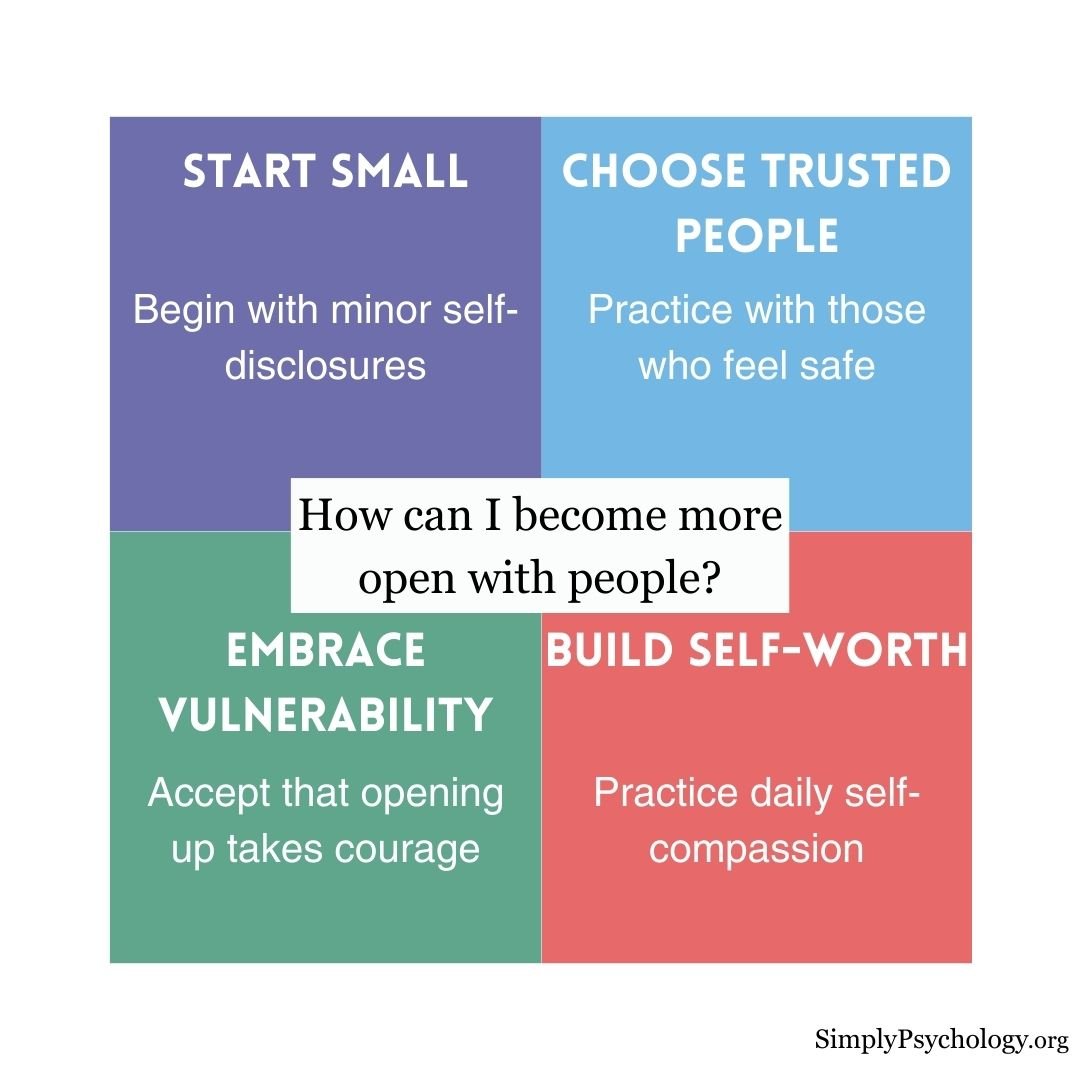
Opening up is hard, but you can build the skill. Share something small with someone you trust, notice how they respond, and build up as trust grows.
Being more open with people means letting them see your inner world: your fears, mistakes, and desires. Doing that means embracing vulnerability and letting go of fear and shame, the painful sense that you are bad rather than that you did something bad. That’s easier said than done.
Psychologists call this act of revealing your inner world to someone else self-disclosure. This article covers why it feels so scary, and five practical ways to get better at it.

Being closed off and avoiding vulnerability by opening up is often a deeply entrenched way of thinking and being.
That means it isn’t something you can switch on and off. It’s a journey: learning to trust, growing comfortable with vulnerability, and building your self-worth.
Approach opening up slowly. Small, gradual steps cause far less anxiety than diving in all at once. It helps to understand why opening up is worth it, because part of you may believe staying closed off is safer.
How to open up
- Gradual, Not Instant: Opening up isn’t a single decision. It’s a gradual practice built through learning to trust and tolerating discomfort.
- Main Barriers: Trauma, insecure attachment, fear of rejection or judgment, low self-worth, and introversion are the most common reasons people stay closed off.
- Response Matters: How someone responds to your disclosure, not just how much you share, is what actually builds closeness (Reis & Shaver, 1988).
- Content Matters Too: Disclosures that are specific and involve the other person feel riskiest to share, but often matter most for the relationship (Khalifian & Barry, 2020).
- Health Stakes: Weak social ties carry a health risk comparable to smoking up to 15 cigarettes a day (Holt-Lunstad et al., 2010).
- Start Small: Five practical habits below, focusing on the benefits, leaning into vulnerability, building self-worth, extending trust, and letting go of control, build the habit gradually.
1. Focus on The Benefits of Vulnerability
Connection is what gives life meaning and purpose. From working in the mental health sector for many years, I know that feeling connected and cared for is one of the best antidotes for suffering.
Learning to be vulnerable and open is therefore not just important for your social life, it’s imperative to your well-being.
Being closed off stops real connection. Even surrounded by friends and family, you can still feel like you are not truly connecting with any of them.
That gap leaves a deep sense that you don’t belong, that no one really cares. Left unaddressed, it curdles into loneliness.
Loneliness carries a real health cost. A meta-analysis pooled 148 studies and more than 300,000 participants. It found that weak social ties predict a health risk on par with smoking up to 15 cigarettes a day (Holt-Lunstad et al., 2010).
The hard part is letting go of the fear and shame that keep you closed off; doing that makes it easier to open up.
2. Lean Into Vulnerability
Vulnerability is uncomfortable for most people. It feels especially risky if your vulnerability has been abused before.
Staying strong and hiding any “weakness” can feel safer than opening up. Many people numb that vulnerability instead, turning to drugs, excessive drinking, extreme behavior, or workaholism.
As researcher Brené Brown explains, numbing shows up subtly too. It can look like blame, offloading your own negativity and shame onto someone else. Or perfectionism, hiding behind a façade of being flawless, or acting as though your choices don’t affect other people.
The catch: you can’t selectively numb negative emotions. Numbing your vulnerability also numbs joy, gratitude, and happiness.
Allowing yourself to be vulnerable invites connection back in. Brown’s research and writing describe vulnerability as the birthplace of shame and fear, but also of joy, creativity, belonging, love, and empathy.
Her original academic study, though, was a smaller, qualitative look at shame in women; her much wider popular writing has expanded on those themes since (Brown, 2006).
That’s why leaning into vulnerability matters.
Action Steps for Leaning Into Vulnerability
- Name the Cost: Write down, and revisit, why numbing isn’t neutral: it dulls joy and gratitude as well as pain.
- Spot Your Numbing: Notice habits like busyness, blame, perfectionism, or acting unaffected as they happen, not only afterwards.
3. Build Self-Worth
Part of you believes that letting others see your true and whole self will lead to judgment and rejection. Something within you says you’re not good enough, not worthy.
In a world of “perfect” Instagram lives and Snapchat filters, it’s hard to feel like you’re enough.
However, people with high self-worth believe that they are worthy of love and connection regardless of their achievements, flaws, and failures.
Action Steps for Building Self-Worth
- Track Your Wins: Write down and revisit your strengths and achievements daily.
- Personal Affirmations: Practice affirmations specific to your life, like “I am a good enough mother” or “I am good enough at my job,” rather than generic ones.
- Question the Flaw: Ask why a perceived flaw or shortcoming should mean you’re not worthy. No one is perfect.
- Address the Root: Where relational wounds or trauma sit underneath, consider therapy or other structured support.
4. Give People the Benefit of the Doubt
Opening up means being generous in your assumptions about people, rather than assuming the worst. Test that in real life.
You might expect ridicule, dismissal, or scolding if you say how you feel. But what if the other person listens, and offers empathy instead? That fear is common.
Choose someone you already trust, at least somewhat, and share something you wouldn’t normally say. Start small: something that carries real weight but won’t send your anxiety through the roof.
What happens next matters most.
Psychologists call it perceived partner responsiveness: whether you come away feeling understood, validated, and cared for. Disclosure alone doesn’t build closeness (Reis & Shaver, 1988).
In Reis and Shaver’s model, closeness builds in sequence: you disclose, your partner responds, and you interpret that response. A flat, distracted, or dismissive reply can do more harm than silence, because it shuts down the process that makes vulnerability worthwhile. So fear of a bad response is not irrational.
Newer evidence points the same way.
A seven-day diary study of 99 couples found that perceived partner responsiveness predicted couple satisfaction day to day and overall. Self-disclosure predicted satisfaction only for men (Candel & Turliuc, 2021).
Not all disclosures carry equal risk. A disclosure that’s specific and directly involves the other person feels riskiest to share. It’s also the hardest for a partner to receive well, even though it often matters most for the relationship (Khalifian & Barry, 2020).
Pick a good moment. Speak from the heart, and notice what actually happens.
You don’t need to open up to everyone. Having even one or two people you can be open with is enough.
As relationship therapist Jenna Nielsen puts it, “look at your own values and find a person who shares similar ones,” since shared values tend to make opening up easier.
Most people like being confided in and asked for help. A trusted friend or family member is more often receptive and empathetic than fear predicts.
A meta-analysis of roughly 94 studies found a two-way cycle between disclosure and liking. People who disclose more intimately are liked more. People disclose more to partners they already like. And people come to like a partner more after disclosing to them (Collins & Miller, 1994).
Brené Brown’s popular talks and writing argue that people who feel connected and loved live from a sense of worthiness. Her own words capture it: “that which makes me vulnerable also makes me beautiful.”
Why Starting Small Works
Starting small isn’t just a coping trick. Altman and Taylor’s (1973) social penetration theory shows why it works. It pictures a relationship as an onion. Outer layers, such as facts and neutral opinions, are easy to share. Inner layers, such as core fears and shame, are riskier to reveal.
Depth is earned.
Reaching the inner layers usually takes many smaller exchanges that went well first. Jump straight to your deepest secret with someone who hasn’t earned that trust, and it can feel intrusive rather than bonding.
Trust research agrees.
In eight focus groups with 39 Czech adolescents and adults, people described shrinking the risk in trusting someone, what the researchers call the “leap of faith.” Some built trust through small positive experiences over time. Others set low-stakes “trust tests” first (Fikrlová et al., 2025).
Opening up also isn’t the same as telling everyone everything. Securely attached people tend to match how much they share to the person and the moment (Mikulincer & Nachshon, 1991).
Action Steps for Extending Trust
- Pick Someone You Trust: Choose someone you trust and test opening up on a minor issue.
- Notice Their Response: Were they empathetic? Did sharing feel freeing, even a little?
- Accept Any Reaction: Remind yourself it’s okay if the response doesn’t match your expectations.
- Reframe the Reaction: Each person’s reaction reflects their own experiences and perspective, not a verdict on you.
- Build Gradually: Let each small experiment inform the next, sharing a little more based on how people respond.
5. Throw Yourself Into Heartbreak
We all want to avoid being hurt. But as the Buddhist teaching goes, “human life is one of suffering,” and you cannot avoid life’s ups and downs.
Throwing yourself into heartbreak means facing it as it comes. Rather than bracing against it forever, you open yourself to the beauty of life, connection, and relationships.
Vulnerability can feel unsafe. It means giving up the illusion of control, of being able to predict how someone will respond.
Let go of that need to control every interaction, little by little. Do things that scare you, including sharing more of your inner world with others.
Living in fear stunts your growth. It limits how fully you can enjoy life.
Living instead from compassion and empathy, toward yourself and others, lets you and your relationships grow.
Receiving care is its own, often harder, form of vulnerability.
As psychotherapist Esther Perel explains, relationships run on asking, giving, receiving, and refusing, and letting someone give to you is often the hardest of the four.
One caller on Perel’s podcast Where Should We Begin? described always being the dependable one. In his words: “I make sure to be in relationships where other people need me, so I never need to need them.”
Perel had advice for him. It was to “dare be vulnerable to others,” and not only in a crisis. Practice on ordinary days too.
As Perel explains, opening up is a skill built through trial and error. Pick people you already know to be trustworthy and start with something that matters but isn’t your biggest secret. Expect some fear at first. You simply haven’t had the practice.
Action Steps for Letting Go of Control
- Face Avoidance: Identify situations you avoid specifically because of fear of rejection, and take small steps toward them rather than avoiding them indefinitely.
- Let Go of Control: Practice releasing the need to control how an interaction or relationship will unfold.
- Push Through Discomfort: Share more of your real thoughts and feelings with trusted people, a little at a time.
Why Is Opening Up So Hard?
Pain usually built the wall. If you’re closed off, it’s most likely because you were hurt before after letting someone in, and the wall still protects you from being hurt again.
Whatever forced you to build it left behind fear and shame, and that’s what keeps you from being vulnerable now.
Underneath, there’s often a script that runs like this. “If I open up and let people know my fears, dreams, mistakes, or desires, then they will judge me as being weird or bad, and reject me.”
This shame comes from feeling unworthy, not good enough. So you hide behind the wall, making sure no one gets the chance to judge, ostracize, or reject you.
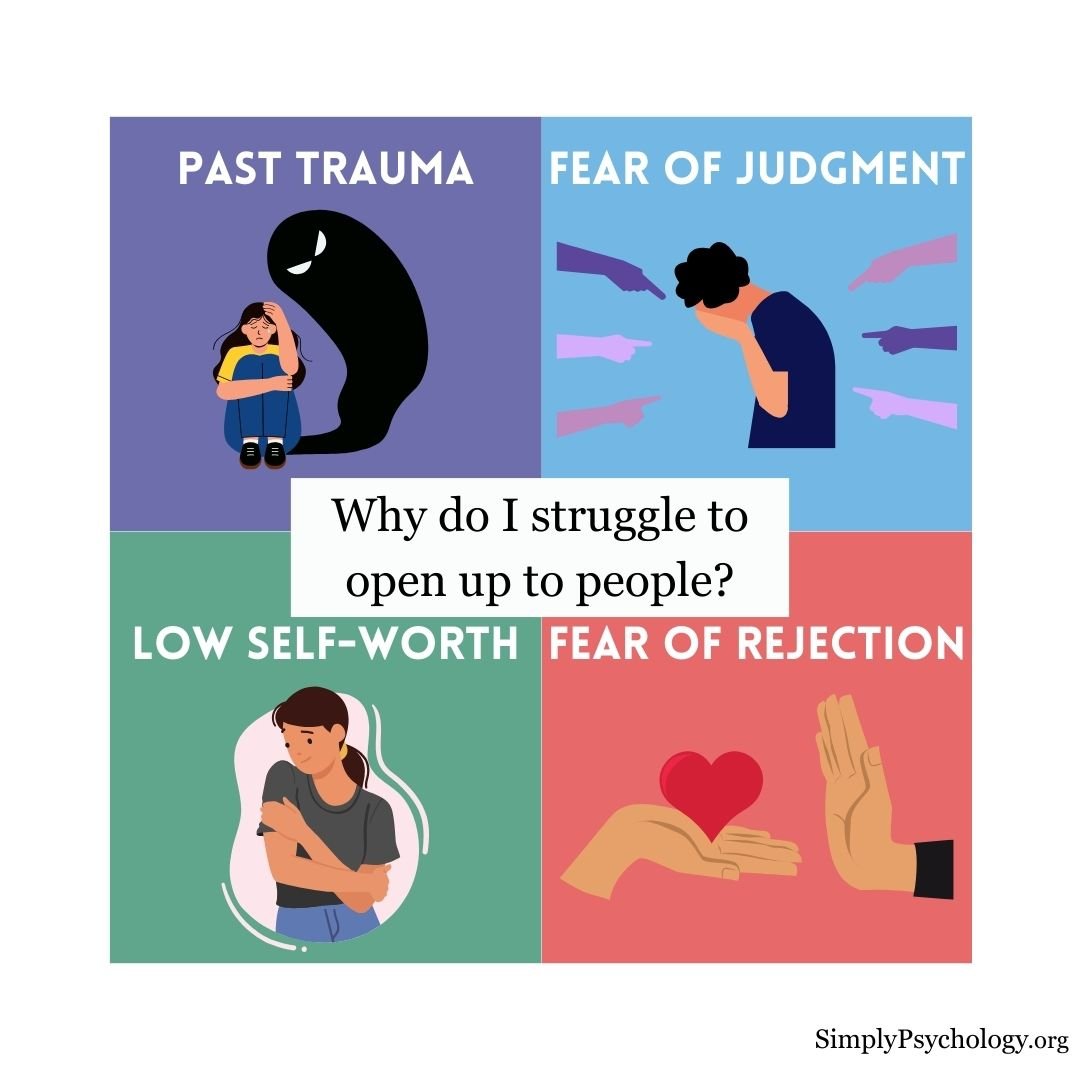
Here are some reasons why opening up can be difficult for people:
1. Trauma
Traumatic experiences, especially of the relational kind, often lead people to feel shame about who they are. They develop a strong fear of being seen as “flawed.” So they close off, avoiding people and keeping their thoughts, feelings, and inner world to themselves.
Being abused, neglected, stalked, mistreated, assaulted, or bullied (to name a few) can be significant traumas that can make you feel extremely vulnerable.
Naturally, you want to avoid feeling vulnerable again, so you build that wall and let no one in.
2. Avoidant or Disorganized Attachment Styles
Children whose feelings and needs weren’t consistently validated and met can develop an insecure attachment style. Two of the insecure styles, avoidant and disorganized, are linked to difficulty opening up, each for different reasons.
People with an avoidant attachment style value independence. They avoid intimacy and sharing because they don’t feel much need for it.
That’s fine by them. Being closed off isn’t uncomfortable for them, and they often stay contentedly on the shallow end of emotional expression.
People with a disorganized attachment style want closeness, but fear it, usually rooted in early trauma. They want to be understood and comforted, yet push people away the moment anyone gets close.
It’s a mental battle. A deep sense of insecurity and vulnerability, often masked by anger, indifference, and a fierce insistence on independence.
This isn’t just a clinical impression. Across three linked studies, 352 Israeli undergraduates were grouped by attachment style. Avoidantly attached people disclosed less, and less intimate, information than securely attached people (Mikulincer & Nachshon, 1991).
Anxiously attached people disclosed just as much overall, but struggled to match the depth of what they shared to the relationship.
Being met with care may help loosen these patterns. In a dyadic study of 139 heterosexual romantic partners, people who saw their partner as more responsive reported less avoidance in their attachment. Women also reported less attachment anxiety (Tosyali et al., 2026).
Because the study captured a single point in time, it shows a link rather than proof of cause.
3. Fear of Rejection
“If I open up, others will reject me”.
Trauma and insecure attachment can cause fear of rejection. Maybe you were rejected by caregivers, peers, or society, and this fear has followed you through life and made you close off.
You expect rejection, so you look for signs of it. Mid-conversation, you might feel the other person isn’t interested, or that a moment of vulnerability wasn’t met with enough empathy.
Your expectations of how someone should react can run very high. Anything that falls short gets read as a rejection, even when it wasn’t intended as one.
4. Fear of Judgment
“If I open up, others will judge me and think less of me.”
Fear of being judged, too, often traces back to trauma or insecure attachment. Maybe you were bullied or humiliated at home or school. There may have been real situations where being visibly yourself led to judgment; the fear isn’t random.
You might judge your own thoughts and feelings harshly. That harsh voice can echo your parents or childhood bullies telling you it’s never good enough.
Harsh self-judgment tends to generalize outward. If you judge yourself severely, you may assume others are judging you too, meaning the judgment you perceive is sometimes your own, projected.
The fear isn’t always a distortion, though. A 2025 systematic review of 42 studies on disclosing a mental illness found that concealing it consistently predicted worse depression, lower wellbeing, and poorer quality of life. Disclosing helped only inconsistently, depending heavily on how supportive the listener was (Gnainsky et al., 2025).
The best-supported strategy was selective disclosure. That means sharing with people likely to be supportive, such as a partner or close friend. With people less likely to be, such as an employer, stay private.
5. Low Self-Worth
Big or many little traumas can cause low self-worth: the sense of not being good enough, of being deeply flawed and unworthy of people’s affection and time.
Low self-worth causes shame of who you are and that can lead to fear of rejection and judgment.
So, low self-worth is usually what underpins having difficulties opening up, but it could also be your personality if you’re, for example, introverted.
6. Introversion
Introversion is a relatively stable personality trait. It describes someone who has less need for social interaction, enjoys and needs solitude, feels comfortable with silence, and doesn’t feel the need to share constantly.
Introversion itself isn’t a problem. Society, though, tends to make more room for extroverts.
If you’re less open than others but still feel secure and confident, that’s okay. But address it if you believe you’re a burden, doubt your own feelings are valid, or don’t trust the people around you.
7. Cultural Norms
Culture shapes what “open” looks like. In a questionnaire study of 200 American and 144 Chinese students, the Americans, from a more individualist culture, disclosed more than the Chinese students. They did so across conversation topics and to different people (Chen, 1995).
That doesn’t mean the Chinese students were closed off. In collectivist cultures, discretion and indirect emotional expression can carry positive social value rather than signal distance. If you grew up with those norms, being less open may simply be a different way of showing closeness.
Sources
Altman, I., & Taylor, D. A. (1973). Social penetration: The development of interpersonal relationships. Holt, Rinehart & Winston.
Brown, B. (2006). Shame resilience theory: A grounded theory study on women and shame. Families in Society, 87(1), 43–52. https://doi.org/10.1606/1044-3894.3483
Brown, B. (2010, June). The power of vulnerability [Video]. TED Conferences. https://www.ted.com/talks/brene_brown_the_power_of_vulnerability?language=en
Candel, O. S., & Turliuc, M. N. (2021). The role of relational entitlement, self-disclosure and perceived partner responsiveness in predicting couple satisfaction: A daily-diary study. Frontiers in Psychology, 12, Article 609232. https://doi.org/10.3389/fpsyg.2021.609232
Chen, G.-M. (1995). Differences in self-disclosure patterns among Americans versus Chinese: A comparative study. Journal of Cross-Cultural Psychology, 26(1), 84–91. https://doi.org/10.1177/0022022195261006
Collins, N. L., & Miller, L. C. (1994). Self-disclosure and liking: A meta-analytic review. Psychological Bulletin, 116(3), 457–475. https://doi.org/10.1037/0033-2909.116.3.457
Fikrlová, J., Albrecht, A., Šerek, J., & Macek, P. (2025). “That’s how the trust began”: Forming trusting friendships from adolescence to adulthood. Journal of Social and Personal Relationships, 42(1), 52–72. https://doi.org/10.1177/02654075241287909
Gnainsky, M., Roe, D., Negri-Schwartz, O., Cohen-Chazani, Y., Lavidor, M., & Hasson-Ohayon, I. (2025). To disclose or not to disclose: A systematic review of factors associated with disclosure and concealment of mental illnesses. Clinical Psychology Review, 122, Article 102660. https://doi.org/10.1016/j.cpr.2025.102660
Holt-Lunstad, J., Smith, T. B., & Layton, J. B. (2010). Social relationships and mortality risk: A meta-analytic review. PLoS Medicine, 7(7), e1000316. https://doi.org/10.1371/journal.pmed.1000316
Khalifian, C. E., & Barry, R. A. (2020). Expanding intimacy theory: Vulnerable disclosures and partner responding. Journal of Social and Personal Relationships, 37(1), 58–76. https://doi.org/10.1177/0265407519853047
Mikulincer, M., & Nachshon, O. (1991). Attachment styles and patterns of self-disclosure. Journal of Personality and Social Psychology, 61(2), 321–331. https://doi.org/10.1037/0022-3514.61.2.321
Reis, H. T., & Shaver, P. (1988). Intimacy as an interpersonal process. In S. Duck (Ed.), Handbook of personal relationships (pp. 367–389). Wiley.
Tosyali, F., Yaşın-Tekizoğlu, F., & Başaran, M. (2026). Perceived partner responsiveness and self-objectification: The mediating role of insecure attachment in a dyadic context. Journal of Social and Personal Relationships, 43(8), 2175–2196. https://doi.org/10.1177/02654075261428504