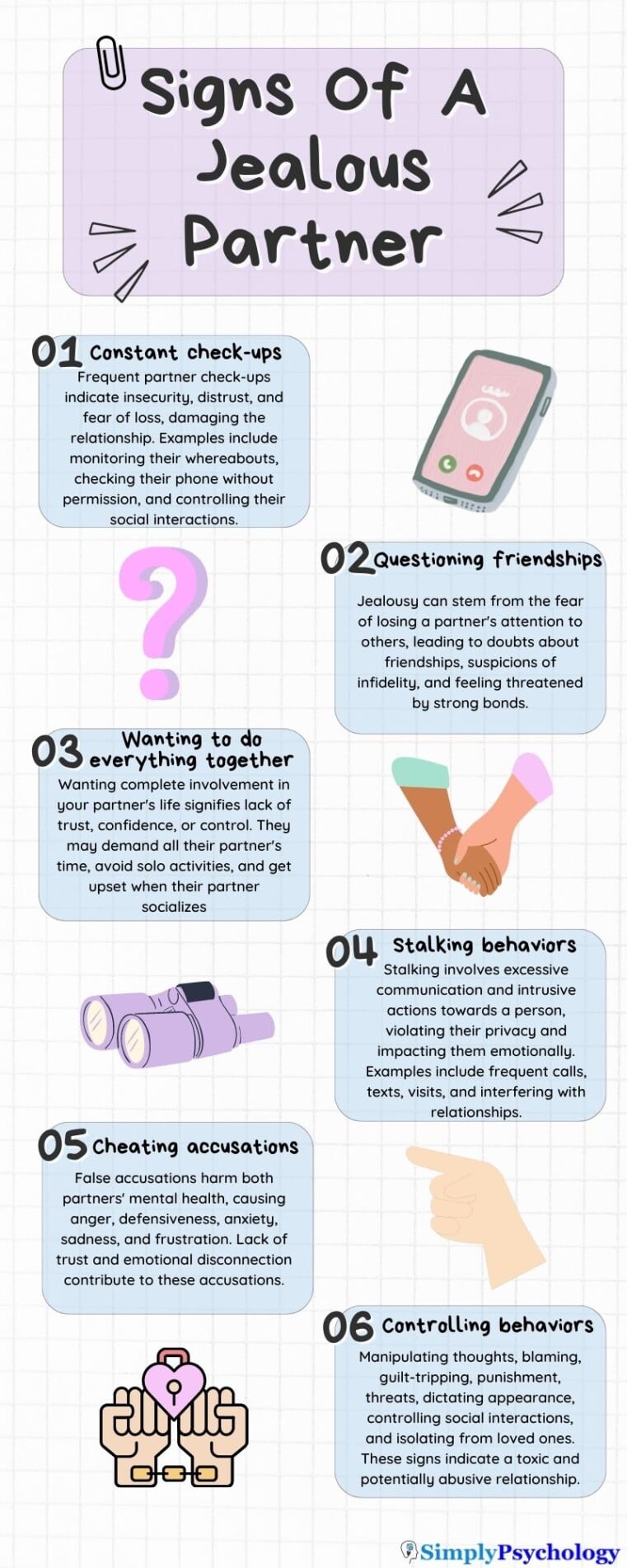
A jealous man may check your phone, question your friendships, grow possessive, or accuse you of cheating. These signs often grow from insecurity and a fear of losing a partner. Men and women both show them.
Jealousy is an emotional reaction that encompasses a range of feelings, including insecurity, anxiety, anger, and inadequacy. In a relationship, it can arise when one partner feels threatened by the possibility of losing their partner’s affection or attention to someone else.
Key Takeaways
- Normal Emotion: Mild, occasional jealousy is common and can show that a man values the relationship.
- Common Signs: Constant check-ups, isolating you from friends, possessiveness, stalking, cheating accusations, and emotional manipulation.
- Root Causes: Insecurity, low self-esteem, and past betrayal often drive jealousy more than anything a partner has done.
- Not Gender-Specific: Any partner can show these signs. Studies of sex differences ask what triggers jealousy, not who feels it.
- Warning Signs: Stalking, threats, isolation, and manipulation are about control. If you feel unsafe, put your safety first.
- Responding: Calm conversation, clear boundaries, and honest reassurance help. If jealousy stays controlling, consider couples therapy.
Healthy vs Unhealthy Jealousy
Is Some Jealousy Healthy?
Mild jealousy is a normal and even healthy emotion. Occasional jealousy can be a reminder for partners to appreciate and protect their relationship.
Jealousy can also reveal a man’s insecurities, unmet needs, and unspoken desires. Once he can name them, the couple can work out how to meet them.
What matters is degree, not the feeling itself. Intensity, frequency, and the way jealousy is expressed decide whether it protects a relationship or corrodes it.
Jealousy can also sit alongside trust. Four studies of 1,466 people found a pattern. Feeling jealous, or seeing a partner as jealous, went with ambivalence: caring and distrust at once (Đurić et al., 2025).
That does not excuse controlling behavior. The idea that jealousy is healthy applies to occasional, low-intensity jealousy that leaves a partner’s freedom alone.
How Excessive Jealousy Damages a Relationship
However, intense and irrational jealousy from a man in a relationship can be destructive if it is not managed.
Excessive jealousy can result in controlling behavior, ultimatums, and emotional manipulation, among other problematic behaviors.
The damage reaches both partners and the relationship itself.
For example, jealousy can lead to more frequent and intense arguments and conflicts within the relationship, which creates a toxic and emotionally charged atmosphere.
Jealousy also hinders communication. It becomes difficult to have open, honest, and productive conversations when one or both individuals are constantly on edge or defensive. Each partner’s defensiveness reinforces the other’s.
Over time, jealousy erodes trust within a relationship. When one partner constantly doubts the other’s intentions or fidelity, it becomes challenging to maintain a strong foundation of trust.
What Causes Jealousy?
Jealousy rarely has a single cause. It usually grows from a mix of insecurity, past experience, and the situation a couple is in.
- Insecurity: Feeling not good enough turns another person’s presence into a comparison. Worrying about appearance or comparing your relationship with happier-looking couples can feed it.
- Low self-esteem: A lasting belief that others are more desirable or successful breeds chronic suspicion that a partner will find someone better.
- Past betrayal: Being cheated on or abandoned before can leave a standing expectation that it will happen again, even when the current partner has given no reason.
- Poor communication: Gaps in understanding get filled with assumptions, so a friendly chat with a colleague can look like romantic interest.
- Social media: Curated posts invite unfair comparisons, and likes or comments from others can be misread as flirting.
Low self-esteem deserves a closer look. Andrea Darcy, a mental health writer, argues that constant jealousy has its roots in “how you feel about yourself” (Darcy, 2023). It can show up as harsh self-talk, sensitivity to criticism, and a need for constant outside validation.
Here are some common signs of jealousy in a partner:
Constant Check-Ups
Your partner may start monitoring your activities more closely, such as checking your phone and social media accounts or asking frequent questions about your whereabouts.
They might even attempt to control your actions, choices, and social interactions to minimize perceived threats to the relationship.
Constant surveillance and controlling behavior can be incredibly damaging to a relationship.
Constant monitoring and control create an unhealthy dynamic. It is marked by distrust, insecurity, and a lack of personal freedom.
Esther Perel explains why checking never settles the worry. In an episode of Where Should We Begin?, the couples therapist calls jealousy a statement of distrust. In her words: “I don’t trust, therefore I put surveillance in place to help me trust.”
Surveillance is really about control, she argues, because trust means tolerating what cannot be fully known. The more a person checks, the less they trust. So the urge to check grows, and the partner on the receiving end can feel suffocated rather than reassured.
Examples of behaviors that could be signs of jealousy include:
- He consistently asks you where you are, who you’re with, and what you’re doing
- He goes through your text messages, call logs, or emails without your consent
- He regularly checks your social media accounts and interactions with others
- He inquires about every conversation you have with friends, family, or colleagues
- He sends multiple texts or calls you frequently throughout the day to “check in”
- He requests pictures or proof of where you are and who you’re with
Isolation
A jealous man may try to isolate you. He may cut you off from friends and family, making it hard to keep your social connections outside the relationship.
Jealous individuals often fear losing their partner’s attention or affection to someone else. Isolation is a bid for exclusive control.
They may suspect romantic interest in friends or perceive their partner’s interactions with others as a threat to the relationship.
He may even envy the bond you share with your friends, seeing it as stronger or more significant than your relationship with him.
Here are some signs that your partner might be questioning your friendships:
- He repeatedly asks questions about your friends, their backgrounds, and your interactions with them
- He vocalizes discomfort or unease when you spend time with specific friends
- He makes comparisons between your friendships and your relationship and expresses concern that your friendships take precedence
- He asks for explanations as to why you spent time with a particular friend or why you made certain plans
- He subtly or overtly tries to limit your interactions with certain friends
- He monitors your interactions with friends, such as checking your phone or social media accounts
Excessive Possessiveness
Having a strong desire to be involved in every aspect of your partner’s life indicates a lack of trust and confidence in the relationship.
Couples naturally share their lives and experiences. It is also important to respect each other’s individuality and keep a healthy level of personal space and independence.
Possessiveness stemming from insecurity and jealousy can be detrimental to a relationship’s health and can lead to feelings of suffocation and unhappiness for both partners.
Here are some signs that a man may feel insecure or afraid of losing their partner:
- He demands a disproportionate amount of your attention and time, feeling anxious or neglected if you have other commitments or interests
- He exhibits an intense dependence on the relationship for his emotional well-being
- He uses emotional manipulation tactics, such as guilt-tripping or emotional blackmail, to ensure you prioritize his needs and desires
- He becomes visibly jealous and uncomfortable when you interact with others, especially with members of the opposite sex
- He tries to undermine your relationships with friends, criticizing or belittling them to make you less inclined to spend time with them
Stalking Behaviors
Stalking behaviors can be a severe and dangerous manifestation of jealousy in a partner.
While it’s not common for all jealous partners to engage in stalking, it can occur in cases where jealousy becomes extreme and unhealthy.
Stalking behaviors may include:
- Physically following or tracking the person’s movements in person or through GPS devices
- Monitoring the person’s online presence, activities, or interactions with others on social media
- Sending gifts, letters, or messages despite the person’s clear disinterest
- Sending repeated and unwanted text messages, emails, or messages
- Illegally entering the person’s home, work, or personal space
- Spreading false information or rumors about the person to damage their reputation
- Trying to control their behavior or who they spend time with
- Engaging in harassment, intimidation, or threats, either in person or online
Stalking is a criminal behavior and a violation of personal boundaries and privacy. It can have severe emotional and psychological effects on the victim, including fear, anxiety, and emotional distress.
Cheating Accusations
Making cheating accusations is a common sign of jealousy in a partner. Jealousy often leads individuals to become overly suspicious and to question their partner’s fidelity, even in the absence of concrete evidence of infidelity.
These accusations can range from subtle comments to direct confrontations. In either case, false accusations of infidelity can cause distress to a relationship.
They tend to take three forms:
- Baseless claims: Accusations of disloyalty, infidelity, or betrayal with no factual basis.
- Misread behavior: Friendly interactions with colleagues or acquaintances are treated as signs of cheating.
- Constant doubt: Repeated questioning that no amount of reassurance seems to settle.
Such accusations can feel like a violation of the trust that should exist in a healthy relationship. When wrongly accused, you may feel the need to defend your integrity and reassure your partner of your commitment (Psych Central, 2023). It is exhausting.
Constant accusations and mistrust take a significant emotional toll on both partners. The result is a cycle of conflict and distress. The accusations can also damage the very trust they are meant to protect.
Emotional Manipulation
A jealous, insecure partner may turn to manipulation. The aim is usually control: managing the other person’s behavior, protecting their own sense of security, or getting their emotional needs met.
In the book Controlling People: How to Recognize, Understand, and Deal with People Who Control You, Patricia Evans (2002) describes a couple called Jennifer and David. David would tell Jennifer what to wear, who she could talk to, and what she could do.

He would become angry if she disobeyed. This controlling behavior was probably a result of David feeling jealous and it eventually led to Jennifer ending the relationship.
Common Forms of Emotional Manipulation
- Guilt-tripping (e.g., “If you really loved me, you wouldn’t go out with your friends”)
- Gaslighting (making you doubt your own memory or judgment)
- Emotional blackmail (using fear, guilt, or obligation to make you comply)
- Giving the silent treatment
- Playing the victim
- Withholding affection
- Making false accusations of cheating or lying
Emotional manipulation is not a healthy or productive way to address jealousy or relationship issues. These signs should be taken seriously as they can lead to toxicity, emotional harm, and potential abuse.
Male Jealousy: What the Research Shows
Do men get jealous? Yes, and so do women.
Researchers have asked whether the sexes differ in what triggers jealousy, why it turns controlling, and whether it means a man cares.
Do Men and Women Differ?
Evolutionary psychologists argue that men and women faced different risks from infidelity.
A man could end up raising a rival’s child. A woman could lose a partner’s time, resources, and protection.
To test this, Buss et al. (1992) asked men and women which would upset them more: a partner’s sexual infidelity or emotional infidelity.
More men chose the sexual kind. Imagining it also produced stronger physical stress responses in men.
The finding is contested. Critics argue the forced choice itself creates the gap, and that rating each scenario separately often shrinks it (DeSteno & Salovey, 1996).
A later review of self-report, physiological, and violence evidence found the pattern far less consistent than the strongest claims suggest (Harris, 2003).
A newer study looked at teenagers. The sample was 1,266 Norwegian students aged 16 to 19, using the same forced-choice method.
Male students already found sexual infidelity more distressing than female students did, whatever their age or relationship experience (Larsen et al., 2021).
That suggests the pattern is in place by mid-adolescence. It does not answer the criticism of the method. Either way, this research concerns what hurts most, not who feels jealous. Both sexes do.
Why Jealousy Turns Controlling
How jealousy is expressed matters more than whether it is felt. In Gregory White’s (1981) model, the key step is appraisal.
People weigh their own worth, their alternatives, and how much control they have. That weighing shapes how intensely and destructively they act.
Attachment style adds another piece. Sharpsteen and Kirkpatrick (1997) asked adults to recall a real episode of jealousy. Secure and insecure adults felt it with similar intensity. They differed in what they did next.
Securely attached adults tended to talk openly, and reported that the episode brought the couple closer. Anxiously attached adults, who fear rejection or abandonment, more often responded with anger, blame, and attempts to control their partner (Sharpsteen & Kirkpatrick, 1997).
On this view, controlling behavior says less about how strongly a man feels. It says more about how he has learned to cope.
Does Jealousy Mean He Cares?
Many people ask whether a jealous man must have feelings for them. Often he does, but that is not the same as healthy love.
According to Esther Perel, envy is wanting something you have never had, while jealousy is the fear of losing something you already have. So jealousy does suggest the relationship matters to him. Research agrees that jealousy and care can coexist (Đurić et al., 2025).
What counts is what he does with the feeling. A man who talks about it is in a different place from one who checks, accuses, and restricts.
In a televised interview, Perel also suggested that a little jealousy can add desire. It reflects an honest recognition that a partner is a separate person who cannot be owned. She limits that claim to mild, occasional jealousy. It does not cover surveillance, possessiveness, or manipulation.
How Can I Deal With A Jealous Partner?
Dealing with a jealous partner can be challenging. With patience, clear communication, empathy, and healthy boundaries, you can work through the issues together.
Open Communication
First, encourage your partner to express their feelings and concerns about the relationship and jealousy. This can create a safe space where both of you can discuss your emotions without judgment.
Try to learn what sets the jealousy off. Being open about your plans, activities, and social contacts leaves fewer ambiguous situations to misread.
Then listen attentively and empathetically. Face your partner, make eye contact, and ask clarifying questions. Reflect back what you heard, and avoid interrupting or arguing. Active listening validates the feeling without agreeing that an accusation is fair.
Speak up too, using “I” statements. Say “I feel hurt when you accuse me of cheating” rather than “You always accuse me.” The first describes the effect on you. The second starts another argument.
Reassurance and Boundaries
You can reassure your partner about your commitment and love. Remind them of your feelings and make an effort to express your affection regularly.
Touch may help more than words. In one experiment, people made to feel jealous felt less so after affectionate touch from their partner (Kim et al., 2018).
The effect held only for those high in attachment anxiety, a fear of rejection or abandonment. A traditional non-touch reassurance condition had no such effect.
You should also agree on clear boundaries, such as how you communicate, who you see, and how you treat each other’s privacy. Following through matters more than the rules themselves.
Still include your partner in your social activities and introduce them to your friends and social circle. Reassurance is not the same as accommodation. Do not let jealousy dictate your friendships, your whole social life, or your freedom of movement.
When to Seek Help
Dealing with jealousy takes time. Your partner may need to work through their own issues, so be patient and understanding as they address their feelings and build their self-esteem.
If jealousy is causing significant distress in your relationship, consider seeking couples therapy or counseling. A trained therapist can provide guidance and strategies to address jealousy and improve the overall health of the relationship.
Individual therapy helps too. It can help the jealous partner tell normal jealousy from a harmful pattern. It can also build skills for managing intense feelings and reduce reliance on a partner for self-worth.
Patience has limits. If jealousy turns into gaslighting, isolation, or verbal abuse, it is no longer a problem to work through together.
It has become a problem of control, and your personal safety comes first. At that point, reconsidering the relationship is a fair question.
Julia Simkus edited this article.
References
Buss, D. M., Larsen, R. J., Westen, D., & Semmelroth, J. (1992). Sex differences in jealousy: Evolution, physiology, and psychology. Psychological Science, 3(4), 251–255. https://doi.org/10.1111/j.1467-9280.1992.tb00038.x
Darcy, A. (2023). Jealousy in relationships – Is it all in your head? Harley Therapy. https://www.harleytherapy.co.uk/counselling/jealousy-head.htm
DeSteno, D., & Salovey, P. (1996). Genes, jealousy, and the replication of misspecified models. Psychological Science, 7(6), 376–379. https://doi.org/10.1111/j.1467-9280.1996.tb00393.x
Đurić, M., Righetti, F., Zoppolat, G., Lohmer, C., & Schneider, I. K. (2025). Mixed signals: Romantic jealousy and ambivalence in relationships. Emotion, 25(4), 853–868. https://doi.org/10.1037/emo0001458
Evans, P. (2002). Controlling people: How to recognize, understand, and deal with people who control you. Adams Media.
Harris, C. R. (2003). A review of sex differences in sexual jealousy, including self-report data, psychophysiological responses, interpersonal violence, and morbid jealousy. Personality and Social Psychology Review, 7(2), 102–128. https://doi.org/10.1207/s15327957pspr0702_102-128
Kim, K. J., Feeney, B. C., & Jakubiak, B. K. (2018). Touch reduces romantic jealousy in the anxiously attached. Journal of Social and Personal Relationships, 35(7), 1019–1041. https://doi.org/10.1177/0265407517702012
Kingham, M., & Gordon, H. (2004). Aspects of morbid jealousy. Advances in Psychiatric Treatment, 10(3), 207–215. https://doi.org/10.1192/apt.10.3.207
Larsen, P. H. H., Bendixen, M., Grøntvedt, T. V., Kessler, A. M., & Kennair, L. E. O. (2021). Investigating the emergence of sex differences in jealousy responses in a large community sample from an evolutionary perspective. Scientific Reports, 11, Article 6485. https://doi.org/10.1038/s41598-021-85997-7
Psych Central. (2023). False accusations in a relationship: Is it emotional abuse? https://psychcentral.com/relationships/psychological-effects-of-false-accusations-in-relationships
Sharpsteen, D. J., & Kirkpatrick, L. A. (1997). Romantic jealousy and adult romantic attachment. Journal of Personality and Social Psychology, 72(3), 627–640. https://doi.org/10.1037/0022-3514.72.3.627
White, G. L. (1981). A model of romantic jealousy. Motivation and Emotion, 5(4), 295–310. https://doi.org/10.1007/BF00992549
Resources